Synonyms for crawling can completely transform your writing style today. Imagine watching a tiny insect move across a kitchen tile or seeing a baby explore the living room floor. Using the right word makes your storytelling vivid, precise, and highly engaging for your audience.
Synonyms for crawling help you avoid repetitive language in everyday writing. If you rely on the same basic terms, your prose loses energy quickly. Learning nuanced alternatives allows you to describe physical movement, digital speed, or slow progress with total clarity and confidence.
Synonyms for crawling enrich your vocabulary across various situations. Whether you write professional reports, academic essays, or personal blog posts, precise verbs matter. Native speakers constantly choose specific words to convey exact speed, effort, and physical posture in their sentences.
Using synonyms for crawling empowers students, bloggers, and content writers alike. Clear communication builds trust and keeps readers hooked on your message. Exploring diverse vocabulary choices expands your expressive capabilities and sharpens your overall English language skills effortlessly.
What Does “Crawling” Really Mean?
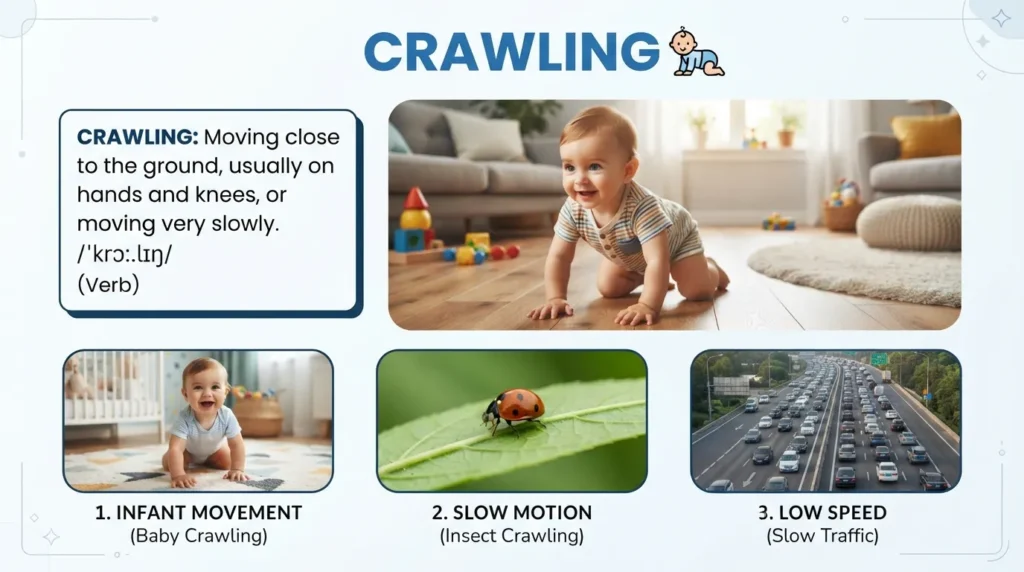
The word crawling primarily describes moving slowly along a surface, often on hands and knees or with the body close to the ground. In simple English, it means low-to-the-ground, slow movement. Beyond physical motion, native speakers use it metaphorically to describe sluggish progress, such as heavy traffic or a slow computer network.
The tone of the word is generally neutral, but context can make it sound desperate, cautious, or creepy. In physical contexts, it applies to infants, insects, reptiles, or injured individuals. In abstract contexts, it highlights frustratingly slow speeds.
- Part of Speech: Verb (Present Participle / Gerund), Adjective
- Definition: Moving on hands and knees, dragging the body along a surface, or progressing at an extremely slow pace.
Connotative Meaning
Connotation is the emotional or cultural association attached to a word beyond its literal definition.
- Positive tone: A baby happily exploring a room, demonstrating curiosity and milestone growth.
- Negative tone: A feeling of skin irritation, an insect infestation, or humiliating submission.
- Neutral tone: A slow-moving traffic queue or a reptile moving across a rock.
Etymology
The word originates from the Middle English craulen, which was borrowed from the Old Norse krafla (meaning “to claw” or “to scramble”).
- Old English (450–1100): Earlier Germanic forms focused on claw-like dragging movements.
- Middle English (1100–1500): Craulen emerged, specifically meaning to move with a dragging body.
- Modern English (1500–Present): Expanded to describe insects, slow machinery, network speeds, and servile human behavior.
Syllables & Structure
- Syllables: crawl-ing (2 syllables)
- Root: crawl
- Prefix: None
- Suffix: -ing
📖 Complete List of Synonyms for Crawling
Below is an extensive collection of 80 accurate synonyms for crawling. Each entry includes its part of speech, specific shade of meaning, tone, and two distinct real-life example sentences under a dedicated heading.
1. Creeping (Verb)
- Meaning: Moving slowly, quietly, or carefully to avoid detection or close to the ground.
- Tone/Register: Neutral, Informal
Examples:
- The cat is creeping through the tall grass toward the bird.
- Unsaved changes were creeping into the project without proper documentation.
2. Groveling (Verb)
- Meaning: Crawling on the ground in a humble, fearful, or servile manner.
- Tone/Register: Negative, Informal
Examples:
- He was groveling on the floor looking for his lost wedding ring.
- She refused to spend her life groveling for someone else’s approval.
3. Slithering (Verb)
- Meaning: Sliding smoothly along a surface with a twisting motion, like a snake.
- Tone/Register: Neutral, Descriptive
Examples:
- A small green snake was slithering across the garden path.
- The wet rope started slithering off the muddy deck.
4. Squirming (Verb)
- Meaning: Writhing or twisting the body from side to side, often in discomfort.
- Tone/Register: Informal, Expressive
Examples:
- The toddler was squirming in his high chair during dinner.
- Worms were squirming in the rich soil after the rain.
5. Writhing (Verb)
- Meaning: Making continual twisting, squirming movements of the body due to pain or struggle.
- Tone/Register: Dramatic, Formal
Examples:
- The injured athlete was writhing on the field, holding his knee.
- Heavy vines were writhing up the sides of the abandoned building.
6. Worming (Verb)
- Meaning: Moving by crawling or squeezing through a narrow space like a worm.
- Tone/Register: Informal, Descriptive
Examples:
- The mechanic was worming his way under the stalled vehicle.
- She wormed her way into the exclusive event.
7. Dragging (Verb)
- Meaning: Pulling oneself or an object along the ground slowly and with heavy effort.
- Tone/Register: Neutral, Casual
Examples:
- The tired hiker was dragging his feet after twenty miles.
- Exhausted workers were dragging heavy sacks across the warehouse.
8. Inches (Verb)
- Meaning: Moving forward very slowly and by tiny increments.
- Tone/Register: Neutral, Narrative
Examples:
- Traffic inches forward during the evening rush hour peak.
- The glacier inches down the mountainside each year.
9. Inchworming (Verb)
- Meaning: Moving in a distinct arching and straightening pattern like a caterpillar.
- Tone/Register: Playful, Informal
Examples:
- The athlete was inchworming across the mat as part of warm-ups.
- A small caterpillar was inchworming along the leaf stem.
10. Inching (Verb)
- Meaning: Advancing gradually and cautiously over a short distance.
- Tone/Register: Neutral, Standard
Examples:
- The car is inching closer to the intersection stop line.
- Prices have been inching up over the past few months.
11. Edging (Verb)
- Meaning: Moving slowly and carefully in a specific direction or along a boundary.
- Tone/Register: Neutral, Narrative
Examples:
- She was edging along the narrow cliff ledge with caution.
- The company is edging closer to profitability this quarter.
12. Sidling (Verb)
- Meaning: Walking or moving timidly, unobtrusively, or sideways.
- Tone/Register: Literary, Informal
Examples:
- The nervous student was sidling into the classroom late.
- A crab was sidling along the wet sandy shore.
13. Snaking (Verb)
- Meaning: Winding or curving along a narrow pathway or surface like a serpent.
- Tone/Register: Descriptive, Visual
Examples:
- The long line of visitors was snaking around the city block.
- Electrical cables were snaking across the studio floor.
14. Prowling (Verb)
- Meaning: Moving about stealthily in search of prey, food, or opportunity.
- Tone/Register: Suspicious, Dramatic
Examples:
- A stray dog was prowling near the restaurant bins.
- Security guards were prowling the perimeter all night.
15. Lurking (Verb)
- Meaning: Remaining hidden or moving stealthily while waiting to ambush or observe.
- Tone/Register: Negative, Mysterious
Examples:
- Shadowy figures were lurking in the poorly lit alley.
- Unknown bugs were lurking beneath the decaying tree bark.
16. Skulking (Verb)
- Meaning: Keeping out of sight or moving with a cowardly or sinister motive.
- Tone/Register: Negative, Formal
Examples:
- Someone was skulking near the back gate after hours.
- The defeated contestant was skulking away quietly.
17. Slinking (Verb)
- Meaning: Moving smoothly and quietly with a shameful, secretive, or sinuous motion.
- Tone/Register: Informal, Narrative
Examples:
- The guilty dog was slinking away from the chewed shoe.
- He tried slinking out of the office before the boss noticed.
18. Stealing (Verb)
- Meaning: Moving quietly, secretly, or imperceptibly without drawing attention.
- Tone/Register: Literary, Soft
Examples:
- Sunlight was stealing through the heavy bedroom curtains.
- She succeeded in stealing away from the loud party early.
19. Gliding (Verb)
- Meaning: Moving continuously, smoothly, and effortlessly over a flat surface.
- Tone/Register: Elegant, Neutral
Examples:
- The swan was gliding silently across the calm lake.
- Skaters were gliding smoothly over the fresh ice rink.
20. Sliding (Verb)
- Meaning: Moving smoothly along a surface while maintaining continuous contact.
- Tone/Register: Neutral, Everyday
Examples:
- Kids were sliding down the snowy hill on sleds.
- A heavy crate was sliding across the wet truck bed.
21. Crawling (Vermin Context) (Verb)
- Meaning: Being completely covered with or full of moving insects or small creatures.
- Tone/Register: Negative, Informal
Examples:
- The old wooden logs were crawling with termites.
- Her skin felt like it was crawling after reading the horror story.
22. Swarming (Verb)
- Meaning: Moving about in large, dense numbers or crowded masses.
- Tone/Register: Energetic, Neutral
Examples:
- Ants were swarming around the spilled sugar packet.
- Photographers were swarming the red carpet entrance.
23. Teeming (Verb)
- Meaning: Being full of or swarming with living things moving actively.
- Tone/Register: Descriptive, Formal
Examples:
- The pond water was teeming with tiny organisms.
- The busy market was teeming with local vendors.
24. Thronging (Verb)
- Meaning: Flocking or crowding together in a dense, slow-moving group.
- Tone/Register: Neutral, Standard
Examples:
- Tourists were thronging through the narrow historic streets.
- Shoppers were thronging the mall during holiday sales.
25. Crawling (Speed Context) (Verb)
- Meaning: Progressing at an unusually slow, frustrating, or inefficient rate.
- Tone/Register: Informal, Annoyed
Examples:
- Internet speeds were crawling during the stormy afternoon.
- The assembly line was crawling due to missing parts.
26. Dragging along (Verb)
- Meaning: Proceeding with tedious slowness or lack of momentum.
- Tone/Register: Informal, Critical
Examples:
- The long afternoon lecture was dragging along endlessly.
- Negotiations were dragging along without any clear progress.
27. Lagging (Verb)
- Meaning: Falling behind in movement, speed, or progress compared to others.
- Tone/Register: Technical, Everyday
Examples:
- My computer is lagging while running heavy applications.
- The younger runner was lagging behind the main group.
28. Straggling (Verb)
- Meaning: Moving slowly or wandering in an irregular, scattered fashion.
- Tone/Register: Neutral, Descriptive
Examples:
- A few stragglers were straggling behind the tour guide.
- Wild vines were straggling across the old fence.
29. Lollygagging (Verb)
- Meaning: Spending time foolishly or moving with excessive, aimless slowness.
- Tone/Register: Informal, Playful
Examples:
- Stop lollygagging in the hallway and head to class.
- The workers were lollygagging near the coffee machine.
30. Dawdling (Verb)
- Meaning: Moving slowly and taking more time than necessary for a task.
- Tone/Register: Informal, Lightly Critical
Examples:
- The children were dawdling on their walk to school.
- Please avoid dawdling when filling out these forms.
31. Loitering (Verb)
- Meaning: Standing or lingering around without an obvious reason or purpose.
- Tone/Register: Legal, Neutral
Examples:
- Signs prohibit teens from loitering outside the store.
- A stranger was loitering near the ATM entrance.
32. Tarrying (Verb)
- Meaning: Staying longer than intended or delaying action or movement.
- Tone/Register: Archaic, Literary
Examples:
- Do not tarry on your way home tonight.
- He was tarrying in the garden enjoying the evening air.
33. Shuffling (Verb)
- Meaning: Walking slowly while dragging one’s feet along the floor.
- Tone/Register: Neutral, Everyday
Examples:
- The sleepy patient was shuffling down the hospital corridor.
- He kept shuffling his feet while waiting in line.
34. Plodding (Verb)
- Meaning: Walking or progressing slowly and heavily with laborious steps.
- Tone/Register: Descriptive, Worklike
Examples:
- The donkey was plodding up the steep mountain track.
- Researchers are plodding through thousands of survey records.
35. Trudging (Verb)
- Meaning: Walking slowly with heavy steps due to exhaustion or harsh conditions.
- Tone/Register: Neutral, Narrative
Examples:
- Commuters were trudging through the deep winter snow.
- We spent hours trudging up the muddy trail.
36. Lumbering (Verb)
- Meaning: Moving in a slow, heavy, awkward, or uncoordinated way.
- Tone/Register: Descriptive, Heavy
Examples:
- A large bear was lumbering through the pine forest.
- The old garbage truck came lumbering down the lane.
37. Hobbling (Verb)
- Meaning: Walking awkwardly or with difficulty due to injury or pain.
- Tone/Register: Sympathetic, Standard
Examples:
- The soccer player was hobbling off the pitch.
- She was hobbling on crutches after spraining her ankle.
38. Limping (Verb)
- Meaning: Walking with difficulty, favoring one leg over the other.
- Tone/Register: Neutral, Everyday
Examples:
- The dog was limping after stepping on a thorn.
- He was limping noticeably after the long marathon.
39. Tottering (Verb)
- Meaning: Moving unsteadily or feebly, as if about to fall over.
- Tone/Register: Visual, Descriptive
Examples:
- The toddler was tottering across the rug toward her father.
- An older man was tottering down the cobblestone street.
40. Stumbling (Verb)
- Meaning: Moving unsteadily or tripping repeatedly while walking or crawling.
- Tone/Register: Neutral, Physical
Examples:
- He was stumbling through the dark hallway searching for a light.
- Exhausted climbers were stumbling into the base camp.
41. Scrambling (Verb)
- Meaning: Moving or climbing quickly but awkwardly using both hands and feet.
- Tone/Register: Energetic, Informal
Examples:
- Hikers were scrambling up the loose rock slope.
- Kids were scrambling over the playground equipment.
42. Clambering (Verb)
- Meaning: Climbing or moving clumsily or with difficulty using hands and feet.
- Tone/Register: Literary, Physical
Examples:
- Workers were clambering over the construction scaffolding.
- She was clambering out of the small boat onto the dock.
43. Wrangling (Verb)
- Meaning: Moving or managing awkward, squirming bodies with physical effort.
- Tone/Register: Informal, Colloquial
Examples:
- Parents were wrangling squirming toddlers into car seats.
- Ranchers were wrangling stray calves near the gate.
44. Wiggling (Verb)
- Meaning: Moving from side to side with small, quick movements while advancing.
- Tone/Register: Informal, Casual
Examples:
- The puppy was wiggling under the low fence.
- She managed to wiggle her toes out of the tight shoes.
45. Twisting (Verb)
- Meaning: Moving forward by turning and bending the body continuously.
- Tone/Register: Neutral, Descriptive
Examples:
- The gymnast was twisting through the narrow tube obstacle.
- Roots were twisting across the forest floor path.
46. Snake-crawling (Verb)
- Meaning: Moving with the full body flat against the ground like a soldier.
- Tone/Register: Military, Precise
Examples:
- Soldiers were snake-crawling through the muddy field during training.
- The intruder was snake-crawling beneath the laser barrier.
47. Low-crawling (Verb)
- Meaning: Advancing across terrain while keeping the torso as low as possible.
- Tone/Register: Tactical, Practical
Examples:
- Trainees practiced low-crawling under high barbed wire fences.
- Firefighters were low-crawling beneath dense smoke plumes.
48. Bear-crawling (Verb)
- Meaning: Moving on hands and feet with hips raised high in the air.
- Tone/Register: Fitness, Athletic
Examples:
- Athletes were bear-crawling across the turf during conditioning.
- The trainer suggested bear-crawling to build core stability.
49. Belly-flopping (Verb)
- Meaning: Dragging oneself along on the stomach in a rough, awkward fashion.
- Tone/Register: Informal, Humorous
Examples:
- Kids were belly-flopping along the slippery lawn surface.
- He ended up belly-flopping onto the safety mat.
50. Dragging-along (Verb)
- Meaning: Moving forward while trailing parts of the body heavily on the surface.
- Tone/Register: Neutral, Physical
Examples:
- The wounded animal was dragging along its back legs slowly.
- She was dragging along her heavy suitcase behind her.
51. Pacing (Verb)
- Meaning: Moving back and forth slowly, often due to anxiety or impatience.
- Tone/Register: Psychological, Everyday
Examples:
- He kept pacing across the waiting room floor.
- She was pacing near the phone expecting an urgent call.
52. Ambling (Verb)
- Meaning: Walking or moving at a slow, relaxed, and easygoing pace.
- Tone/Register: Relaxed, Casual
Examples:
- Couples were ambling through the park on Sunday.
- Cows were ambling back to the farm barn.
53. Strolling (Verb)
- Meaning: Walking in a leisurely manner for pleasure or exercise.
- Tone/Register: Casual, Positive
Examples:
- We were strolling along the beach during sunset.
- Tourists enjoy strolling through local craft markets.
54. Meandering (Verb)
- Meaning: Following a winding, indirect, and slow course while moving forward.
- Tone/Register: Descriptive, Literary
Examples:
- The river was meandering through the green valley.
- Visitors were meandering through the botanical garden paths.
55. Wandering (Verb)
- Meaning: Moving about slowly without a fixed destination or purpose.
- Tone/Register: Neutral, Everyday
Examples:
- Lost hikers were wandering through the thick woods.
- Her thoughts were wandering during the long meeting.
56. Roaming (Verb)
- Meaning: Moving over a wide area slowly and freely without restriction.
- Tone/Register: Open, Natural
Examples:
- Wild cattle were roaming freely across the plains.
- Children were roaming around the farm all afternoon.
57. Roving (Verb)
- Meaning: Traveling or moving constantly from place to place over terrain.
- Tone/Register: Formal, Literary
Examples:
- Roving bands of deer crossed the snowfields.
- Photographers were roving the festival grounds for shots.
58. Creeping along (Verb)
- Meaning: Advancing on a surface at a steady but almost unnoticeable pace.
- Tone/Register: Neutral, Descriptive
Examples:
- The shadow was creeping along the sunny patio floor.
- Construction work is creeping along despite bad weather.
59. Snake-like sliding (Verb)
- Meaning: Executing a flexible, continuous slide mimicking reptile motion.
- Tone/Register: Descriptive, Visual
Examples:
- The performer executed a snake-like sliding motion across the stage.
- Streams of water showed snake-like sliding down glass windows.
60. Dragging feet (Verb)
- Meaning: Moving forward reluctantly, slowly, or with obvious fatigue.
- Tone/Register: Idiomatic, Informal
Examples:
- Students were dragging their feet on their way to detention.
- Management is dragging its feet on approving the budget.
61. Sluggish movement (Noun/Verb phrase)
- Meaning: Exhibiting slow, heavy, and energy-lacking physical progress.
- Tone/Register: Formal, Analytical
Examples:
- Patient recovery showed sluggish movement during week one.
- The engine displayed sluggish movement under heavy load.
62. Slow-pacing (Verb)
- Meaning: Moving or executing steps intentionally slowly.
- Tone/Register: Descriptive, Neutral
Examples:
- The director was slow-pacing through the scene rehearsal.
- Guards were slow-pacing along the courtyard walls.
63. Friction-crawling (Verb)
- Meaning: Crawling by using body friction against a tight or rough surface.
- Tone/Register: Technical, Athletic
Examples:
- Cavers were friction-crawling through narrow rock passages.
- Climbers relied on friction-crawling to clear the crevice.
64. Squeezing through (Verb)
- Meaning: Forcing oneself through a tight space with slow, squirming effort.
- Tone/Register: Everyday, Physical
Examples:
- He was squeezing through the gap in the wooden fence.
- Rescue teams were squeezing through collapsed structure debris.
65. Navigating low (Verb)
- Meaning: Moving across an area while holding the posture close to the ground.
- Tone/Register: Professional, Tactical
Examples:
- Officers were navigating low through the dense smoke room.
- The guide recommended navigating low under hanging branches.
66. Inch-advancing (Verb)
- Meaning: Making tiny, highly deliberate forward movements.
- Tone/Register: Formal, Precise
Examples:
- The team was inch-advancing toward a breakthrough agreement.
- Heavy machinery was inch-advancing onto the shipping barge.
67. Ground-scrambling (Verb)
- Meaning: Moving rapidly while staying very close to dirt or floor levels.
- Tone/Register: Action, Informal
Examples:
- Lizards were ground-scrambling across hot desert sands.
- Competitors were ground-scrambling during the mud course.
68. Under-crawling (Verb)
- Meaning: Moving directly beneath low-hanging physical obstacles.
- Tone/Register: Practical, Descriptive
Examples:
- Technicians were under-crawling floor joists to lay wires.
- Kids enjoyed under-crawling blanket forts at home.
69. Carpet-crawling (Verb)
- Meaning: Crawling specifically across indoor carpeted surfaces, like infants.
- Tone/Register: Domestic, Informal
Examples:
- The baby spent hours carpet-crawling around the parlor.
- We were carpet-crawling, looking for a dropped contact lens.
70. Mud-crawling (Verb)
- Meaning: Dragging the body across wet, sticky earth or swampy ground.
- Tone/Register: Outdoor, Descriptive
Examples:
- Participants were mud-crawling during the obstacle race.
- Soldiers completed mud-crawling drills in heavy rain.
71. Tunneling (Verb)
- Meaning: Moving through a dark, enclosed, or underground passage slowly.
- Tone/Register: Technical, Neutral
Examples:
- Moles were tunneling under the fresh garden lawn.
- Workers were tunneling through solid rock for subway tracks.
72. Burrowing (Verb)
- Meaning: Pushing body parts or full torso into or under soft material.
- Tone/Register: Natural, Descriptive
Examples:
- The rabbit was burrowing under the wooden shed foundation.
- She was burrowing deep into heavy blankets for warmth.
73. Nosing forward (Verb)
- Meaning: Pushing slowly forward with extreme caution or tight clearances.
- Tone/Register: Informal, Drivers
Examples:
- The ferry was nosing forward into the fog-covered harbor.
- Cars were nosing forward into busy crosswalk traffic.
74. Dragging stomach (Verb)
- Meaning: Moving with the belly pressing flat against the floor or soil.
- Tone/Register: Descriptive, Physical
Examples:
- The injured fox was dragging its stomach across the yard.
- Reclining babies practice dragging stomach before full crawling.
75. Worm-sliding (Verb)
- Meaning: Executing a flexible, belly-down slide across slick ground.
- Tone/Register: Humorous, Informal
Examples:
- Children were worm-sliding on wet grass at the park.
- The mascot came worm-sliding across the gym floor.
76. Slump-walking (Verb)
- Meaning: Moving forward with stooped posture and dragging momentum.
- Tone/Register: Casual, Expressive
Examples:
- Exhausted commuters were slump-walking out of train doors.
- He was slump-walking home after an exhausting shift.
77. Shuffling along (Verb)
- Meaning: Progressing without lifting feet fully off the walking surface.
- Tone/Register: Everyday, Informal
Examples:
- Older residents were shuffling along the garden path.
- The line of buyers was shuffling along slowly inside.
78. Pushing forward (Verb)
- Meaning: Advancing against physical or mental resistance with effort.
- Tone/Register: Positive, General
Examples:
- Explorers were pushing forward through thick jungle brush.
- The company is pushing forward despite market setbacks.
79. Creep-crawling (Verb)
- Meaning: Combining stealthy slowness with low-to-ground physical movement.
- Tone/Register: Informal, Expressive
Examples:
- Bugs were creep-crawling across the damp cellar wall.
- The kids were creep-crawling to surprise their parents.
80. Edge-crawling (Verb)
- Meaning: Moving along the outermost border of a space cautiously.
- Tone/Register: Descriptive, Tactical
Examples:
- Drones were edge-crawling around building boundaries for maps.
- The cat was edge-crawling near the swimming pool deck.
🔍 Synonyms for “Crawling” by Tone
Choosing synonyms for crawling depends heavily on your intended tone. Word choice signals your attitude toward the subject and shapes how readers interpret speed, physical stance, or intent.
Positive Tone
- Ambling: Suggests leisure and peace.
- Strolling: Implies pleasant, stress-free activity.
- Gliding: Conveys effortless grace and smooth transition.
- Pushing forward: Shows determination and persistence.
Neutral Tone
- Inching: Focuses purely on small physical distances without emotion.
- Edging: Describes precise, careful positioning along borders.
- Sliding: Highlights continuous surface motion objectively.
- Moving: Indicates positional change without stylistic coloring.
Negative Tone
- Groveling: Expresses shame, cowardice, or humiliation.
- Skulking: Suggests sneaky, dishonest, or criminal motives.
- Lurking: Evokes hidden danger, threat, or discomfort.
- Sluggish: Implies frustrating inefficiency or laziness.
Playful / Informal Tone
- Lollygagging: A fun way to criticize someone for taking too long.
- Inchworming: Playfully describes arching, caterpillar-like movements.
- Wiggling: Conveys energetic, childlike motion.
- Belly-flopping: Adds humor to awkward physical landings or moves.
⚖️ Mini Comparison: “Crawling” vs. Close Alternatives
Understanding small distinctions prevents word misuse in essays, stories, and professional documents.
| Word | Key Focus | Primary Context | Tone |
| Crawling | Hands-and-knees motion or extreme slowness | Infants, insects, traffic | Neutral to Frustrating |
| Creeping | Stealth, silence, or low ground-contact | Predators, shadows, cats | Suspicious or Quiet |
| Inching | Precise, tiny physical measurements | Vehicles, stock prices, lines | Objective / Neutral |
- Crawling vs. Creeping: Use crawling when highlighting physical posture (hands and knees) or painful slowness. Use creeping when highlighting stealth, silence, or hiding from view.
- Crawling vs. Inching: Use crawling for general slow progress or physical movement. Use inching when progress happens in small, measurable increments over time.
🧠 Context-Based Usage
Daily Conversation
In casual talk, native speakers use these words to complain about delays or describe pets and kids.
- “Traffic was crawling on the highway.”
- “Look at the baby carpet-crawling toward her toy!”
Writing or Blogging
Bloggers use vivid action verbs to keep readers engaged and create strong visual mental images.
- “Instead of crawling through edits, streamline your process.”
- “Doubts began creeping into the team’s strategy.”
Professional or Academic Tone
In formal contexts, replace informal terms with precise, analytical vocabulary.
- “Project milestones are inching forward despite supply delays.”
- “The system demonstrated sluggish response times during testing.”
Creative Writing & Storytelling
Fiction authors select words that build suspense, atmosphere, or character emotion.
- “The shadow came slinking across the stone floor.”
- “He was clambering over sharp rocks toward safety.”
⚠️ Common Mistakes & Native Usage
Misuse Scenarios
- Confusing Creeping with Crawling: Saying a slow car is “creeping” suggests it is trying to hide. If it is just stuck in traffic, “crawling” or “inching” fits much better.
- Using Groveling Neutrally: Never use “groveling” to describe a baby or insect. Groveling implies human shame or begging.
Register & Style Notes
- Spoken vs. Written: Words like lollygagging or belly-flopping sound natural in conversation but out of place in formal business reports.
- Overuse Warning: Repeating “crawling” three or four times in one paragraph weakens your prose. Swap in verbs like inching, plodding, or trudging to maintain freshness.
For more tips on refining your language style, check out our guide on [building strong vocabulary habits].
🧩 Real-Life Mini Scenarios
- Workplace: Your internet connection slows down during a major video call. You tell your coworker, “My connection is crawling right now.”
- Social Situation: You are trying to leave a quiet movie theater late without disturbing others. You are creeping down the aisle toward the exit.
- Media & Entertainment: A commentator describes a defensive football play: “The linebacker is low-crawling through the offensive line.”
- Storytelling: Describing a tired traveler climbing a snowy hill: “She was trudging through deep drifts, her feet heavy as lead.”
📝 Interactive Practice Quiz
- Which synonym best describes a snake moving through grass?
A) Strolling
B) Slithering
C) Ambling
D) Sauntering
2. If traffic is moving extremely slowly, you can say it is:
A) Inching along
B) Soaring high
C) Sprinting forward
D) Flying past
3. What word describes a shy person moving sideways quietly?
A) Sidling
B) Running
C) Jumping
D) Galloping
4. Which term carries a strong negative tone of begging submissively?
A) Gliding
B) Groveling
C) Padding
D) Ambling
5. A cat moving softly toward a bird is:
A) Creeping
B) Plodding
C) Lumbering
D) Shuffling
6. Which word fits an old heavy truck moving slowly uphill?
A) Lumbering
B) Sliding
C) Gliding
D) Tiptoeing
7. When you waste time deliberately, you are:
A) Dawdling
B) Racing
C) Inching
D) Scaling
8. Moving on bare feet without making any noise is called:
A) Padding
B) Groveling
C) Clambering
D) Scrambling
9. A toddler twisting out of a sweater is:
A) Wriggling
B) Gliding
C) Strolling
D) Sauntering
10. A detective watching a house quietly is:
A) Prowling
B) Ambling
C) Slouching
D) Dawdling
Application Task
Write one short, original sentence describing a slow activity (like waiting in line or downloading a file) using one of the 80 synonyms above.
Answer Key:
1: B | 2: A | 3: C | 4: A | 5: B | 6: B | 7: A | 8: A | 9: A | 10: B
❓ FAQs
1. What is the most common synonym for crawling in everyday conversation?
The most common synonym is creeping. People use it interchangeably with crawling when describing slow, low-to-the-ground motion. However, creeping often carries an extra layer of meaning related to stealth, silence, or secrecy.
2. Can I use “crawling” to describe slow internet speeds?
Yes, native English speakers frequently use crawling metaphorically to describe slow technology, lagging computer networks, or heavy traffic. Words like sluggish, lagging, or inching also serve as great alternatives in technical contexts.
3. What is the difference between crawling and slithering?
Crawling typically involves using limbs (hands, knees, or legs) to move low to the ground. Slithering describes smooth, legless sliding motions across a surface, most commonly associated with snakes, worms, or wet objects.
4. Which synonym for crawling works best in formal business writing?
In formal or business contexts, use sluggish, lagging, or inching. These words convey slow progress or incremental change professionally without relying on dramatic or casual imagery like crawling or groveling.
5. Is groveling always a synonym for crawling?
Groveling is a specific, emotionally charged synonym. It means crawling on the ground in a fearful, begging, or servile manner. Use it only when describing humility, shame, or intense submission, never for neutral physical movement.
6. How do synonyms for crawling help improve SEO writing?
Using varied synonyms prevents keyword stuffing and improves semantic relevance. Search engines understand related vocabulary clusters, so using precise alternatives makes content more informative, natural, and helpful for human readers.
Conclusion
Expanding your command of synonyms for crawling gives your English writing greater precision, flavor, and visual power. Changing simple verbs based on tone, context, and intent transforms routine sentences into vivid descriptions. This habit instantly elevates your communication skills across essays, stories, and emails.
Practicing new vocabulary daily is the fastest way to build natural speaking and writing fluency. Try using words like inching, trudging, or creeping in your daily emails, personal journal, or social posts. Small, consistent updates to your word choices produce noticeable improvements over time.
We encourage you to bookmark this guide, test yourself with our practice quiz, and explore our full collection of [synonyms for crawling] to keep growing your expressive capabilities. Start integrating these rich linguistic alternatives into your writing today!

Sophia Carter is the founder and lead writer at SynonymVerse.com, a trusted online resource dedicated to English vocabulary and effective communication. She is passionate about helping students, writers, professionals, and lifelong learners find the most accurate words to express their ideas with clarity and confidence.
At SynonymVerse.com, every article is carefully researched and thoughtfully written to provide reliable guidance on synonyms, word meanings, and vocabulary. With a strong focus on accuracy, real-world usage, and easy-to-understand explanations, the website is committed to helping readers strengthen their language skills, enrich their vocabulary, and become more confident communicators.