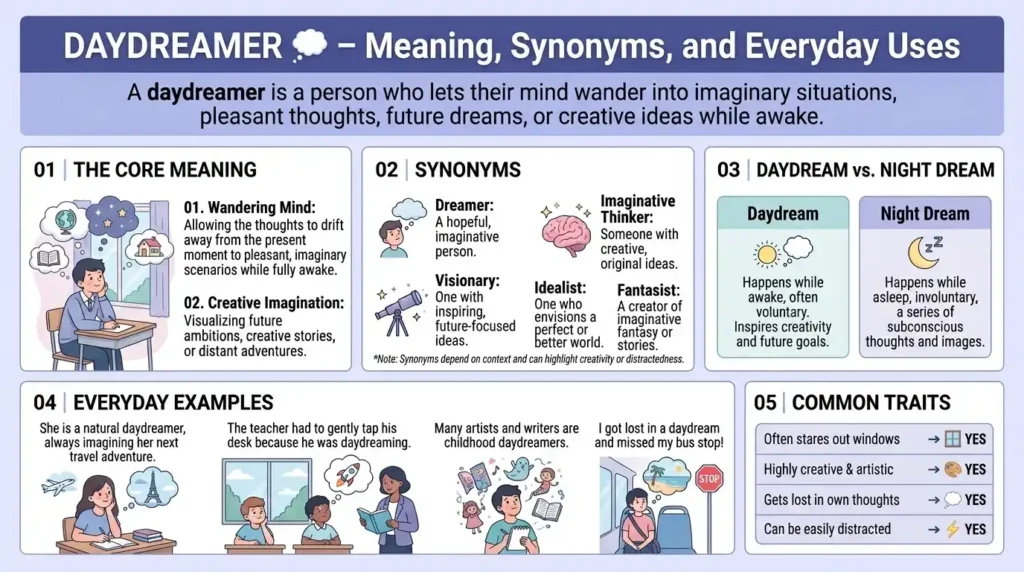
Synonyms for daydreamer include dreamer, fantasist, idealist, visionary, imaginative thinker, and absent-minded person. Each word describes someone who spends time imagining possibilities, but the best choice depends on whether you want to express creativity, hope, distraction, or unrealistic thinking.
Have you ever stared out a window and imagined your future instead of finishing a task? That familiar experience captures what it means to be a daydreamer.
Imagine a student picturing life as a famous author during a boring lecture. Calling that student a dreamer sounds hopeful, while calling them absent-minded highlights their distraction.
Learning synonyms for daydreamer helps you describe thoughts and personalities more precisely. Students can improve essays, bloggers can create engaging descriptions, and content writers can avoid repetitive language.
The word daydreamer appears in everyday conversations, books, blogs, and personality descriptions. Exploring its alternatives helps daily English users express imagination, ambition, and distraction with greater confidence.
What Does “Daydreamer” Really Mean?
A daydreamer is a person who often lets their mind wander into imagined situations, pleasant fantasies, plans, or unreal experiences while awake. These thoughts may involve personal goals, creative ideas, or imaginary worlds.
The word usually describes someone who becomes absorbed in their thoughts rather than focusing on the immediate surroundings. Depending on the situation, it can sound affectionate, encouraging, humorous, or mildly critical.
For example, a child imagining a journey through space might be called a creative daydreamer. An employee who repeatedly loses focus during meetings might receive the same label in a less flattering way.
Part of Speech
Daydreamer is a noun. It refers to a person who daydreams.
- Simple definition: Someone who spends time imagining things while awake.
- Plural form: Daydreamers.
- Related verb: Daydream.
- Related noun: Daydreaming.
- Related adjective: Dreamy.
How Native English Speakers Understand It
Native speakers commonly use daydreamer for people who have vivid imaginations or frequently become lost in thought. The word does not automatically suggest that someone is lazy or irresponsible.
The surrounding sentence determines the meaning. A novelist might describe a daydreamer as imaginative, while a teacher might use the term to explain why a student misses instructions.
Connotative Meaning
Connotation (the emotional association or feeling a word carries beyond its basic dictionary meaning) influences how readers interpret daydreamer.
Positive Tone
A positive use highlights creativity, hope, imagination, and ambition.
Example: “She is a daydreamer who imagines new ways to solve everyday problems.”
Negative Tone
A negative use suggests distraction, impractical thinking, or a lack of attention.
Example: “He is such a daydreamer that he forgets important deadlines.”
Neutral Tone
A neutral use simply describes someone who frequently imagines situations or lets their mind wander.
Example: “My brother has always been a daydreamer during long car journeys.”
Etymology: Where Does “Daydreamer” Come From?
The word daydreamer combines daydream with the agent suffix -er, which identifies a person who performs an action or has a particular habit.
The term daydream developed in English in the nineteenth century. It describes dreamlike thoughts that occur during waking hours rather than during sleep.
Historical Development
- Old English (450–1100): The modern compound daydreamer was not established in Old English. However, Old English had words for day, dreaming, and sleep-related experiences.
- Middle English (1100–1500): English vocabulary continued to develop through French and other linguistic influences. The modern word daydreamer was not yet in common use.
- Modern English (1500–present): Daydream emerged as a term for waking fantasies, especially in the nineteenth century. Daydreamer subsequently developed as a label for a person who often experiences them.
Pronunciation
- US: /ˈdeɪˌdriːmər/
- UK: /ˈdeɪˌdriːmə/
Syllables
Day-dream-er — three syllables.
Affixation Pattern of “Daydreamer”
- Root or base: Dream, combined with day to form daydream.
- Prefix: None.
- Suffix: -er, which identifies a person associated with an action.
- Word formation: Day + dream + er.
- Word type: Compound noun with a derivational suffix.
40 Synonyms for Daydreamer: Meanings and Examples
Not every alternative carries the same meaning. Some emphasize imagination and hope, while others describe distraction or unrealistic expectations. Choose a word that matches the person and the situation.
1. Dreamer (Noun)
Meaning: A person who spends time imagining possibilities, hopes, or experiences that may not exist yet.
Tone/Register: Positive or neutral; common in everyday speech.
Example:
She has always been a dreamer who hopes to travel the world.
People admire him because he never stops imagining a better future.
2. Idealist (Noun)
Meaning: Someone who believes in high standards or an improved world, even when achieving those goals is difficult.
Tone/Register: Positive or neutral; common in academic and professional discussions.
Example:
As an idealist, Maya believes every child deserves a good education.
His idealistic plans inspire the team to think beyond immediate problems.
3. Visionary (Noun)
Meaning: A person who imagines ambitious future possibilities and sees ways to make them happen.
Tone/Register: Positive; often used in business, leadership, and creative writing.
Example:
The young designer is a visionary with bold ideas for sustainable cities.
Her colleagues trust her because she turns imaginative plans into practical projects.
4. Fantasist (Noun)
Meaning: Someone who frequently invents imaginary situations or believes in elaborate fantasies.
Tone/Register: Often negative or literary, depending on context.
Example:
The novelist created a character who was a fantasist with an elaborate imaginary life.
His friends questioned his story because they thought he was a fantasist.
5. Imaginative Person (Noun Phrase)
Meaning: Someone who easily creates new ideas, mental pictures, or fictional situations.
Tone/Register: Positive and neutral; suitable for general writing.
Example:
An imaginative person can turn an ordinary afternoon into an exciting adventure.
Our teacher encouraged every imaginative person in the classroom to share ideas.
6. Creative Thinker (Noun Phrase)
Meaning: A person who generates original ideas and explores possibilities beyond familiar solutions.
Tone/Register: Positive; common in education and professional settings.
Example:
The company needs a creative thinker who can suggest fresh approaches.
As a creative thinker, Leo often imagines unusual ways to solve problems.
7. Free Spirit (Noun Phrase)
Meaning: Someone who follows personal interests and prefers freedom over strict expectations.
Tone/Register: Positive or playful; informal and conversational.
Example:
My cousin is a free spirit who loves spontaneous road trips.
Everyone remembers her as a free spirit who refuses to follow ordinary routines.
8. Absent-Minded Person (Noun Phrase)
Meaning: Someone who often forgets things or overlooks their surroundings because their attention wanders.
Tone/Register: Neutral or mildly negative; common in daily conversation.
Example:
The absent-minded professor left his notebook in the café again.
She can be an absent-minded person when she gets absorbed in a story.
9. Space Cadet (Noun Phrase)
Meaning: An informal label for someone who seems distracted, unaware, or lost in their own thoughts.
Tone/Register: Playful or negative; informal.
Example:
I was such a space cadet that I walked into the wrong classroom.
His friends called him a space cadet when he missed the obvious joke.
10. Head-in-the-Clouds Type (Noun Phrase)
Meaning: A person who often thinks about imaginary possibilities instead of practical matters.
Tone/Register: Informal; affectionate or critical.
Example:
She’s a head-in-the-clouds type who imagines living in a castle.
His head-in-the-clouds attitude makes it difficult to finish routine tasks.
11. Romantic (Noun)
Meaning: A person who views life through hopeful, emotional, or idealized expectations.
Tone/Register: Positive or neutral; common in personal descriptions.
Example:
As a romantic, he imagines a perfect future with the person he loves.
She is a romantic who believes small gestures can change someone’s day.
12. Optimist (Noun)
Meaning: Someone who expects positive outcomes and tends to focus on the hopeful side of life.
Tone/Register: Positive; common in everyday and professional English.
Example:
The optimist believes the project will succeed despite several setbacks.
Her optimistic outlook helps the group remain hopeful during difficult times.
13. Hopeful Thinker (Noun Phrase)
Meaning: Someone who imagines desirable outcomes and believes that improvement is possible.
Tone/Register: Positive; suitable for general writing.
Example:
As a hopeful thinker, Daniel believes his small business can grow.
She remains a hopeful thinker even when her plans take longer than expected.
14. Speculator (Noun)
Meaning: Someone who imagines or considers possible outcomes without having complete information.
Tone/Register: Neutral; often used in analytical, financial, or political contexts.
Example:
The speculator imagined several possible endings to the mysterious story.
Without reliable evidence, a speculator can only suggest what might happen.
15. Fantasizer (Noun)
Meaning: A person who regularly creates imagined situations or experiences in their mind.
Tone/Register: Neutral or mildly negative; less common than dreamer.
Example:
As a child, he was a fantasizer who invented entire kingdoms.
The story follows a fantasizer who escapes daily stress through imagination.
16. Escapist (Noun)
Meaning: Someone who turns to fantasy, entertainment, or imagined experiences to avoid unpleasant realities.
Tone/Register: Neutral to negative; common in psychology and literary discussion.
Example:
The character is an escapist who avoids difficult conversations by imagining another life.
Reading fantasy novels became an escapist habit during her stressful school year.
17. Visionary Thinker (Noun Phrase)
Meaning: Someone who imagines significant future changes and considers how to achieve them.
Tone/Register: Positive; formal and professional.
Example:
The visionary thinker proposed a new approach to renewable energy.
Our school invited a visionary thinker to discuss future learning methods.
18. Big Dreamer (Noun Phrase)
Meaning: Someone who imagines ambitious goals or hopes for major achievements.
Tone/Register: Positive and conversational.
Example:
He is a big dreamer who wants to build a library in every village.
Her family supports the big dreamer in her pursuit of a medical career.
19. Wishful Thinker (Noun Phrase)
Meaning: Someone who believes a desired outcome will happen without enough evidence.
Tone/Register: Negative; common in everyday and analytical writing.
Example:
Thinking the exam will be easy without studying is wishful thinking.
The wishful thinker ignored the risks and expected everything to work perfectly.
20. Fantast (Noun)
Meaning: A person who indulges in elaborate fantasies or impractical ideas.
Tone/Register: Literary and uncommon; often critical.
Example:
The novel portrays a fantast who prefers imaginary adventures to ordinary life.
Critics described the character as a fantasist whose plans rarely matched reality.
21. Storyteller (Noun)
Meaning: Someone who creates or tells stories, sometimes using a vivid imagination to invent events.
Tone/Register: Positive or neutral; widely used.
Example:
Grandpa was a gifted storyteller who turned family memories into adventures.
The young storyteller imagined a secret island beyond the mountains.
22. Dreamer of Dreams (Noun Phrase)
Meaning: An expressive description of someone who continually imagines hopes, ambitions, or possibilities.
Tone/Register: Poetic and literary.
Example:
The poem celebrates the dreamer of dreams who dares to imagine a kinder world.
She described her younger brother as a dreamer of dreams with endless ideas.
23. Imaginist (Noun)
Meaning: A person who relies strongly on imagination or creates imaginative concepts.
Tone/Register: Literary or specialized; uncommon in everyday speech.
Example:
The artist presented himself as an imaginist who explored unseen worlds.
Her imaginative paintings revealed the mind of a true imaginist.
24. Reverie-Prone Person (Noun Phrase)
Meaning: Someone who frequently drifts into a state of pleasant, absorbed thought.
Tone/Register: Formal or literary.
Example:
A reverie-prone person may lose track of time while watching the rain.
The writer was a reverie-prone person who found inspiration in quiet moments.
25. Absorbed Thinker (Noun Phrase)
Meaning: Someone who becomes deeply involved in private thoughts and pays less attention to their surroundings.
Tone/Register: Neutral; suitable for descriptive writing.
Example:
The absorbed thinker did not notice that the meeting had ended.
As an absorbed thinker, she often needed a gentle reminder to take a break.
26. Contemplative Person (Noun Phrase)
Meaning: Someone who spends time reflecting deeply on ideas, experiences, or questions.
Tone/Register: Neutral or positive; suitable for academic and reflective writing.
Example:
The contemplative person sat beside the lake and considered his future.
She is a contemplative person who thinks carefully before making decisions.
27. Reflective Thinker (Noun Phrase)
Meaning: Someone who regularly examines ideas, feelings, and experiences through thoughtful reflection.
Tone/Register: Positive; common in education and professional writing.
Example:
A reflective thinker learns from mistakes instead of ignoring them.
The reflective thinker considered several possible responses before replying.
28. Creative Soul (Noun Phrase)
Meaning: A person with a strong imagination and a natural interest in artistic or original expression.
Tone/Register: Warm, positive, and informal.
Example:
My sister is a creative soul who fills her notebooks with unusual ideas.
Every creative soul in the group contributed something unique to the performance.
29. Free Thinker (Noun Phrase)
Meaning: Someone who forms opinions independently instead of automatically accepting established beliefs.
Tone/Register: Positive or neutral; intellectual and conversational.
Example:
As a free thinker, he questioned the assumptions behind the proposal.
The teacher encouraged students to become free thinkers who examine evidence.
30. Innovator (Noun)
Meaning: Someone who develops new ideas, methods, or products, often turning imagination into practical change.
Tone/Register: Positive; common in business and technology.
Example:
The innovator imagined a simpler way to deliver clean water.
Her work shows how an innovator can transform a promising idea into a useful solution.
31. Abstractionist (Noun)
Meaning: An artist or thinker associated with abstract ideas or nonrepresentational art rather than literal depiction.
Tone/Register: Specialized and artistic.
Example:
The abstractionist used color to express ideas that words could not capture.
Visitors admired the abstractionist’s unusual interpretation of the landscape.
32. Philosophical Thinker (Noun Phrase)
Meaning: Someone who reflects deeply on life’s meaning, knowledge, values, or existence.
Tone/Register: Formal or neutral; academic and reflective.
Example:
The philosophical thinker often wondered what makes a life meaningful.
His questions revealed the curiosity of a philosophical thinker.
33. Absent-Minded Dreamer (Noun Phrase)
Meaning: Someone who frequently becomes lost in imagination and forgets immediate tasks or details.
Tone/Register: Neutral or gently humorous.
Example:
The absent-minded dreamer forgot where she had put her glasses.
His friends smiled at the absent-minded dreamer who missed the bus while imagining a new invention.
34. Impractical Idealist (Noun Phrase)
Meaning: Someone who holds ambitious ideals but struggles to account for real-world limitations.
Tone/Register: Critical; often used in discussions of plans or leadership.
Example:
The committee considered him an impractical idealist because his proposal lacked a budget plan.
An impractical idealist may need help turning good intentions into achievable steps.
35. Absent-Minded Professor (Noun Phrase)
Meaning: A familiar character type describing a highly intellectual person who forgets everyday details.
Tone/Register: Informal, humorous, and sometimes stereotypical.
Example:
The absent-minded professor arrived with two different shoes.
Everyone laughed when the absent-minded professor searched for the book already in his hand.
36. Dream-Chaser (Noun)
Meaning: Someone who actively pursues personal ambitions and works to achieve an imagined future.
Tone/Register: Positive and motivational; informal.
Example:
The dream-chaser practiced every evening to become a professional musician.
As a dream-chaser, she stayed focused on her goal despite repeated setbacks.
37. Aspiring Thinker (Noun Phrase)
Meaning: Someone who explores ideas and hopes to develop their intellectual or creative abilities.
Tone/Register: Positive; educational and descriptive.
Example:
The aspiring thinker filled a journal with questions about the world.
Our club welcomes every aspiring thinker who enjoys exploring new perspectives.
38. Visionary Dreamer (Noun Phrase)
Meaning: Someone who imagines ambitious possibilities and hopes to create meaningful change.
Tone/Register: Positive; inspirational and professional.
Example:
The visionary dreamer imagined a community powered entirely by clean energy.
Her colleagues saw a visionary dreamer who could inspire lasting improvements.
39. Daydreaming Type (Noun Phrase)
Meaning: An informal description of someone who often drifts into private thoughts or imagined situations.
Tone/Register: Neutral and conversational.
Example:
I’m the daydreaming type who imagines stories during long train rides.
He is a daydreaming type, especially when the weather turns rainy.
40. Head-in-the-Clouds Dreamer (Noun Phrase)
Meaning: A person who spends so much time imagining possibilities that practical details may receive little attention.
Tone/Register: Informal; affectionate or critical.
Example:
The head-in-the-clouds dreamer pictured a new career without considering the training involved.
Her friends love the head-in-the-clouds dreamer, even when her plans seem unrealistic.
Synonyms for Daydreamer by Tone
The emotional effect of a word matters as much as its dictionary meaning. The right choice helps you describe someone’s imagination without accidentally insulting them.
Positive Synonyms
Use these words to celebrate creativity, hope, or ambition.
- Dreamer: Emphasizes hopes and possibilities.
- Idealist: Highlights strong principles.
- Visionary: Suggests ambitious future thinking.
- Creative thinker: Focuses on original ideas.
- Free spirit: Highlights independence.
- Optimist: Emphasizes positive expectations.
- Big dreamer: Suggests ambitious goals.
- Creative soul: Expresses warmth and imagination.
- Innovator: Highlights practical originality.
- Dream-chaser: Emphasizes action toward a goal.
Neutral Synonyms
These alternatives describe thought patterns without automatically praising or criticizing them.
- Imaginative person: Someone who creates mental pictures or ideas.
- Contemplative person: Someone who reflects deeply.
- Reflective thinker: Someone who examines experiences.
- Storyteller: Someone who develops or shares stories.
- Speculator: Someone who considers possibilities.
- Absorbed thinker: Someone deeply involved in thought.
- Daydreaming type: Someone whose attention often wanders.
- Philosophical thinker: Someone who reflects on fundamental questions.
Negative Synonyms
Use these carefully when the context involves impractical thinking or distraction.
- Wishful thinker: Someone who expects a desired outcome without sufficient evidence.
- Escapist: Someone who avoids reality through fantasy.
- Fantasist: Someone who indulges in elaborate or unrealistic fantasies.
- Impractical idealist: Someone whose goals overlook real-world limits.
- Space cadet: An informal label for a distracted person.
- Head-in-the-clouds type: Someone who neglects practical details.
Playful or Informal Synonyms
These expressions work well in friendly conversations, lighthearted writing, and character descriptions.
- Free spirit: A person who values independence.
- Big dreamer: Someone with ambitious hopes.
- Absent-minded professor: A humorous intellectual character.
- Creative soul: Someone with an imaginative personality.
- Daydreaming type: A casual description of a frequent daydreamer.
- Head-in-the-clouds dreamer: A playful description of someone lost in imagination.
Daydreamer vs. Close Alternatives
Some alternatives overlap in meaning but carry different implications. These distinctions help you choose more accurate vocabulary.
Daydreamer vs. Dreamer
A daydreamer often imagines scenes or situations while awake. A dreamer may also have long-term hopes, ambitions, or ideals.
Use daydreamer when describing someone’s wandering attention. Choose dreamer when emphasizing hope or personal aspirations.
Daydreamer vs. Idealist
A daydreamer spends time imagining situations. An idealist believes in high principles or an improved version of reality.
Call someone an idealist when their beliefs or values drive their actions. Use daydreamer when their imagination is the main point.
Daydreamer vs. Visionary
A daydreamer may imagine possibilities without acting on them. A visionary sees a possible future and often develops ideas that can bring it closer.
Use visionary for an inventive leader, artist, or planner. Choose daydreamer for someone whose thoughts frequently drift into imagined experiences.
How to Use Daydreamer Synonyms in Different Contexts
Daily Conversation
In everyday speech, dreamer, big dreamer, and absent-minded person sound natural. The best option depends on whether you mean someone’s ambitions or their tendency to lose focus.
For example, “She’s a big dreamer” expresses admiration. “He’s a little absent-minded today” gently describes distraction.
Writing and Blogging
Writers can use imaginative thinker, creative soul, or visionary dreamer to add personality to descriptions. These phrases help avoid repeating daydreamer in every paragraph.
For SEO content, choose terms that genuinely fit the topic. Do not insert loosely related words just to increase keyword coverage.
Professional or Academic Writing
In professional contexts, visionary, reflective thinker, and creative thinker often communicate strengths more clearly than informal labels.
For example, “She is a visionary who develops long-term strategies” sounds more professional than “She has her head in the clouds.”
Creative and Informal Writing
Fiction writers can choose fantasist, escapist, or free spirit to reveal a character’s personality. Each expression suggests a different relationship with imagination.
A fantasist may invent elaborate stories, while an escapist may use fantasy to avoid uncomfortable circumstances.
Common Mistakes Learners Make
Confusing Imagination With Ambition
A daydreamer imagines situations. A dream-chaser actively works toward a goal. The two expressions are not interchangeable in every sentence.
Using “Visionary” as an Exact Replacement
A visionary often has useful ideas about the future. A daydreamer does not necessarily have practical plans or leadership qualities.
Treating “Wishful Thinker” as a Compliment
Wishful thinking usually suggests that someone expects success without enough evidence. Use optimist when you want to emphasize a positive outlook instead.
Using Uncommon Words in Everyday Conversation
Words such as fantast and imaginist may sound unnatural in casual speech. Prefer dreamer, creative thinker, or imaginative person for familiar situations.
Overusing Synonyms
Replacing every instance of daydreamer with a different expression can make writing confusing. Repeat the main term when clarity requires it, and use alternatives only when they add a meaningful distinction.
Register Notes: Formal vs. Informal English
Formal writing generally benefits from visionary, reflective thinker, or creative thinker. These phrases sound measured and suit reports, essays, and professional profiles.
Informal conversation allows expressions such as space cadet, big dreamer, and head-in-the-clouds type. Use them carefully because they can sound teasing or judgmental.
For related vocabulary practice, consider linking this article internally to a relevant guide about synonyms for imagination or creativity.
Real-Life Mini Scenarios
Workplace
A team member proposes an ambitious new approach to a difficult problem. Calling that person a visionary highlights the value of the idea. Calling them a daydreamer may suggest that the plan lacks practical details.
Social Situations
Your friend spends a long car journey imagining a future trip. Calling them a dreamer sounds affectionate, while daydreaming offers a casual description.
Media and Pop Culture
A fictional character invents imaginary worlds to escape everyday problems. The term escapist explains the character’s motivation more clearly than a general label such as dreamer.
Writing and Storytelling
A novelist creates a character who constantly imagines impossible adventures. The word fantasist may capture the character’s elaborate imagination, especially when those fantasies affect real decisions.
Interactive Practice Quiz: Choose the Best Synonym
Choose the best word or phrase for each situation. Think about meaning, tone, and context before checking the answer key.
Multiple-Choice Questions
1. Emma imagines becoming a famous author and hopes to publish a novel one day. Which word fits best?
A. Pessimist
B. Dreamer
C. Realist
D. Critic
2. A business leader predicts new possibilities and develops a plan to achieve them. Which word is most suitable?
A. Visionary
B. Space cadet
C. Escapist
D. Fantasist
3. Jack often forgets his keys because his mind wanders. Which expression describes him best?
A. Innovator
B. Idealist
C. Absent-minded person
D. Dream-chaser
4. A person believes that kindness and fairness can improve society. Which word fits best?
A. Idealist
B. Speculator
C. Fantasist
D. Escapist
5. Someone expects to pass an exam without studying or reviewing the material. What describes this attitude?
A. Creative thinking
B. Wishful thinking
C. Reflection
D. Innovation
6. A character avoids real problems by imagining a perfect life. Which term is most appropriate?
A. Optimist
B. Free thinker
C. Escapist
D. Storyteller
Part Two
7. Your friend invents original solutions during a group project. What is a suitable description?
A. Creative thinker
B. Absent-minded professor
C. Wishful thinker
D. Daydreaming type
8. Which term best describes someone who forms opinions independently?
A. Fantasist
B. Free thinker
C. Romantic
D. Reverie-prone person
9. A person reflects deeply on life’s meaning and moral questions. Which phrase fits best?
A. Space cadet
B. Big dreamer
C. Philosophical thinker
D. Dream-chaser
10. A friend has ambitious goals and works consistently to achieve them. Which expression is most suitable?
A. Dream-chaser
B. Escapist
C. Fantasist
D. Absent-minded person
Reflection Task
Write two sentences about an imaginative person you know or a fictional character.
Use one positive synonym for daydreamer in the first sentence and one neutral or negative alternative in the second. Explain how the word choice changes the description.
Answer Key
1-B, 2-A, 3-C, 4-A, 5-B, 6-C, 7-A, 8-B, 9-C, 10-A
FrAQs
1. What is the nicest word to describe a daydreamer?
Dreamer, creative soul, and visionary can sound positive, depending on the person and situation. Use dreamer for someone with hopes, creative soul for someone with a vivid imagination, and visionary for someone who imagines meaningful future possibilities. The kindest choice is the one that reflects the person’s actual qualities rather than making assumptions about their behavior.
2. What is a word for someone who daydreams too much?
An absent-minded person describes someone whose wandering thoughts affect attention or memory. Space cadet is a more informal, sometimes teasing expression. If the person uses fantasy to avoid difficult situations, escapist may fit better. The best term depends on whether the main concern is distraction, humor, or avoidance.
3. Is daydreamer a positive or negative word?
Daydreamer can be positive, negative, or neutral. It sounds positive when it highlights imagination and creativity. It may sound negative when someone ignores responsibilities or misses important information. In neutral contexts, it simply describes a person who often imagines situations while awake. The surrounding sentence and speaker’s attitude determine the intended meaning.
4. What is the difference between a daydreamer and an escapist?
A daydreamer frequently imagines situations while awake, which can happen for many reasons. An escapist uses fantasy, entertainment, or other distractions to avoid unpleasant reality. A person can be both, but the terms emphasize different things: daydreaming describes a thought pattern, while escapism emphasizes avoidance.
5. What do you call a person who dreams big but takes no action?
Wishful thinker may fit when the person expects success without evidence or effort. Impractical idealist suits someone whose ambitions overlook real-world limitations. Daydreamer is a gentler choice if you simply mean the person imagines possibilities without pursuing them. Choose the phrase that describes the behavior fairly.
6. Can I use daydreamer in academic or professional writing?
Yes. The word is suitable when discussing imagination, attention, learning, or a character’s personality. However, formal writing may benefit from a more precise phrase, such as reflective thinker, creative thinker, or visionary. Choose the term that matches your evidence and avoid using personality labels as unsupported judgments.
7. What is the difference between a dreamer and a visionary?
A dreamer imagines hopes, goals, or possible experiences. A visionary usually imagines a significant future change and may identify ways to achieve it. The word dreamer can sound personal and emotional, while visionary often suggests leadership, innovation, or strategic thinking. Neither term automatically guarantees that a person will succeed.
8. Where can I find reliable definitions and pronunciation for daydreamer synonyms?
Consult established dictionaries to compare definitions, pronunciation, example sentences, and usage labels. Merriam-Webster and the Cambridge Dictionary are useful starting points. Compare entries for daydreamer, dreamer, idealist, and visionary to see where their meanings overlap and where they differ.
Suggested external sources:
- Merriam-Webster Dictionary
- Cambridge Dictionary
Conclusion
Learning synonyms for daydreamer helps you describe imagination, ambition, and distraction with greater accuracy. The right word makes your meaning clearer and your writing more engaging.
Students can use these alternatives in essays, while bloggers and content writers can create richer descriptions. Everyday English speakers can also express ideas with more confidence.
Remember that a dreamer, an idealist, and a visionary are not always the same. Understanding their differences helps you choose words that reflect each person’s character and intentions.
Practice using these synonyms in emails, essays, and daily conversations. Choose one new word today, write an original sentence, and notice how it changes the meaning.

Sophia Carter is the founder and lead writer at SynonymVerse.com, a trusted online resource dedicated to English vocabulary and effective communication. She is passionate about helping students, writers, professionals, and lifelong learners find the most accurate words to express their ideas with clarity and confidence.
At SynonymVerse.com, every article is carefully researched and thoughtfully written to provide reliable guidance on synonyms, word meanings, and vocabulary. With a strong focus on accuracy, real-world usage, and easy-to-understand explanations, the website is committed to helping readers strengthen their language skills, enrich their vocabulary, and become more confident communicators.