Odd is one of those words that wears out fast. When you need a synonym for odd, Strange, Unusual, and Peculiar are the most reliable swaps — and each synonym for odd below comes with its meaning and example sentences so you land on the right word for your context.
Have you ever noticed something that seemed out of place? Perhaps a friend behaved differently, or a familiar room suddenly felt strange. The word odd helps describe that experience.
A synonym for odd can make your writing more precise. For example, peculiar sounds more descriptive, while bizarre suggests something much stranger than usual.
English speakers often use odd in everyday conversations because it is short, flexible, and easy to understand. Students, bloggers, and content writers can use alternatives to avoid repetition and express ideas clearly.
Learning a synonym for odd also helps you describe unusual events, surprising behavior, and unexpected situations. Practicing these words will strengthen your vocabulary and make daily communication more natural.
What Does “Odd” Really Mean?
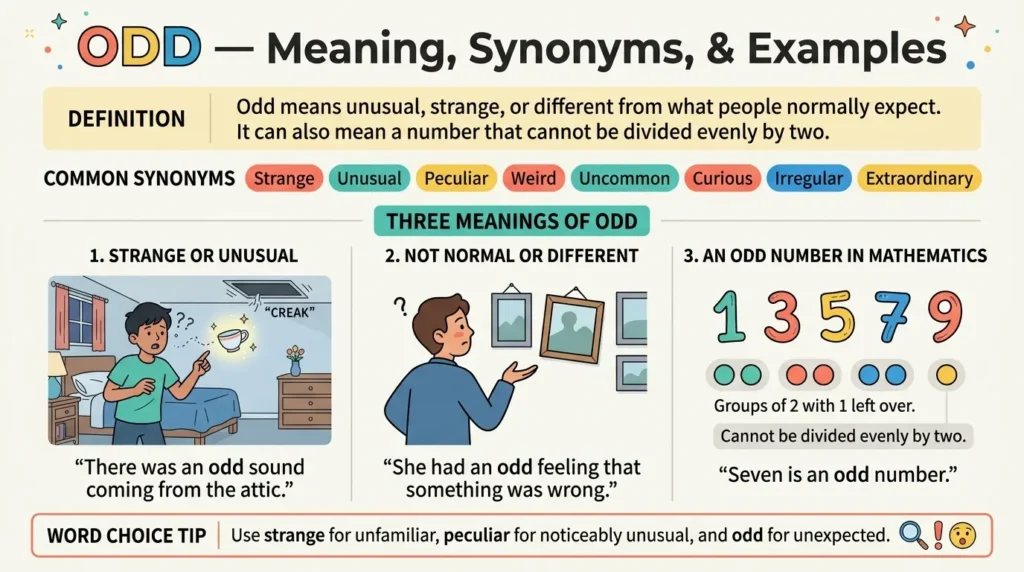
Odd means unusual, unexpected, or different from what people consider normal. It can describe a person’s behavior, an object, a situation, a sound, or an experience.
For example, if your neighbor waves at an empty street, you might say, “That seems odd.” You are expressing surprise because the behavior does not match what you expected.
The word does not always suggest something bad. An odd-looking painting might be interesting, while an odd remark might make someone uncomfortable. Context determines whether the word sounds neutral, amusing, or critical.
Part of Speech
Odd is an adjective. It describes a noun or pronoun.
- Simple definition: Different from what is usual, expected, or normal.
- Example: We heard an odd noise outside the window.
- Related word: Oddly is an adverb that describes an unusual manner or circumstance.
Connotative Meaning
Connotation (the feeling or association a word carries beyond its basic dictionary meaning) helps explain how odd can sound different in various situations.
- Positive tone: An odd design may be creative, original, or fascinating.
- Negative tone: An odd comment may seem suspicious, uncomfortable, or inappropriate.
- Neutral tone: An odd number is simply an integer that cannot be divided evenly by two.
Etymology and Word History
The word odd entered English through historical language changes and gradually developed its modern meanings.
Old English Period (450–1100)
The modern word has roots in Old Norse oddi, which referred to the point of a weapon or a triangular piece of land. Its history reflects the influence of Norse-speaking communities on English.
Middle English Period (1100–1500)
During the Middle English period, odd developed associations with things left over, unmatched, or not forming a complete pair. This helped establish the meaning of something unequal or additional.
Modern English Period (1500–Present)
Over time, odd gained its familiar meanings of unusual, peculiar, and unexpected. Today, it also appears in mathematics, everyday conversation, literature, and professional writing.
Pronunciation
- US: /ɑːd/ or /ɑd/, depending on the pronunciation system and accent.
- UK: /ɒd/
Syllables
Odd — one syllable.
Affixation Pattern of Odd
- Root: odd
- Prefix: None in the base word.
- Suffix: None in the base word.
- Related forms: oddly, oddness, oddity.
The word odd does not require an affix to express its central meaning. Adding a suffix creates related forms with different grammatical functions.
Synonyms List
The following alternatives describe different kinds of unusual things. Some suggest mild surprise, while others express confusion, humor, or strong disbelief. Choose the word that best matches your intended meaning.
1. Strange (Adjective) — US: /streɪndʒ/ | UK: /streɪndʒ/
Meaning: Different from what you normally expect or experience.
Tone/Register: Neutral; common in everyday English.
Examples:
I heard a strange noise coming from the kitchen.
Her strange reaction surprised everyone at the meeting.
2. Unusual (Adjective) — US: /ʌnˈjuːʒuəl/ | UK: /ʌnˈjuːʒuəl/
Meaning: Not commonly seen, experienced, or expected.
Tone/Register: Neutral; suitable for formal and informal writing.
Examples:
We had unusual weather for this time of year.
It is unusual for Daniel to arrive late.
3. Peculiar (Adjective) — US: /pɪˈkjuːliər/ | UK: /pɪˈkjuːliə/
Meaning: Unusual in a distinctive way that attracts attention.
Tone/Register: Neutral to mildly negative; descriptive.
Examples:
The old house had a peculiar smell.
She noticed a peculiar detail in the photograph.
4. Weird (Adjective) — US: /wɪrd/ | UK: /wɪəd/
Meaning: Very unusual in a way that may seem confusing, surprising, or unsettling.
Tone/Register: Informal; common in conversation.
Examples:
That was a weird dream about flying fish.
He told us a weird story during lunch.
5. Bizarre (Adjective) — US: /bɪˈzɑːr/ | UK: /bɪˈzɑː/
Meaning: Extremely strange or unexpected, often in a way that seems hard to believe.
Tone/Register: Neutral to dramatic; useful in storytelling and journalism.
Examples:
The documentary revealed a bizarre series of events.
We watched a bizarre performance at the festival.
6. Eccentric (Adjective) — US: /ɪkˈsɛntrɪk/ | UK: /ɪkˈsɛntrɪk/
Meaning: Different from conventional behavior, especially in a person’s habits or personality.
Tone/Register: Neutral to positive; often describes individuality.
Examples:
The eccentric artist painted portraits using unusual colors.
Our eccentric neighbor collects antique clocks.
7. Curious (Adjective) — US: /ˈkjʊriəs/ | UK: /ˈkjʊəriəs/
Meaning: Unusual or unexpected in a way that creates interest or puzzlement.
Tone/Register: Neutral; slightly literary in this meaning.
Examples:
A curious pattern appeared on the old wall.
There was a curious silence after his announcement.
8. Unconventional (Adjective) — US: /ˌʌnkənˈvɛnʃənəl/ | UK: /ˌʌnkənˈvɛnʃənəl/
Meaning: Different from traditional methods, accepted practices, or common expectations.
Tone/Register: Formal to neutral; common in professional writing.
Examples:
The teacher used an unconventional approach to explain grammar.
Her unconventional fashion choices attracted attention.
9. Abnormal (Adjective) — US: /æbˈnɔːrməl/ | UK: /æbˈnɔːməl/
Meaning: Different from what is considered typical or expected within a particular standard.
Tone/Register: Technical or formal; may sound negative.
Examples:
The test detected an abnormal reading.
The machine stopped after producing an abnormal sound.
10. Irregular (Adjective) — US: /ɪˈrɛɡjələr/ | UK: /ɪˈreɡjələ/
Meaning: Not following a regular pattern, schedule, or established rule.
Tone/Register: Neutral to formal; useful for technical descriptions.
Examples:
The tiles formed an irregular pattern across the floor.
Irregular attendance made it difficult to track her progress.
11. Unexpected (Adjective) — US: /ˌʌnɪkˈspɛktɪd/ | UK: /ˌʌnɪkˈspektɪd/
Meaning: Happening or appearing without being anticipated.
Tone/Register: Neutral; common in everyday and professional English.
Examples:
An unexpected visitor arrived just before dinner.
The sudden change produced an unexpected result.
12. Extraordinary (Adjective) — US: /ɪkˈstrɔːrdəneri/ | UK: /ɪkˈstrɔːdənəri/
Meaning: Far beyond what is ordinary, sometimes because something is remarkable or exceptional.
Tone/Register: Often positive; formal and expressive.
Examples:
The young musician showed extraordinary talent.
We witnessed an extraordinary sunset over the hills.
13. Outlandish (Adjective) — US: /aʊtˈlændɪʃ/ | UK: /aʊtˈlændɪʃ/
Meaning: So unusual or unconventional that it may appear ridiculous or unbelievable.
Tone/Register: Informal to literary; often critical or humorous.
Examples:
He arrived wearing an outlandish costume.
The newspaper published an outlandish claim about the celebrity.
14. Quirky (Adjective) — US: /ˈkwɜːrki/ | UK: /ˈkwɜːki/
Meaning: Unusual in an appealing, playful, or distinctive way.
Tone/Register: Informal; generally positive.
Examples:
The café is famous for its quirky decorations.
Her quirky sense of humor makes every gathering enjoyable.
15. Offbeat (Adjective) — US: /ˌɔːfˈbiːt/ | UK: /ˌɒfˈbiːt/
Meaning: Different from conventional ideas or styles, often in an entertaining or creative way.
Tone/Register: Informal to neutral; common in arts and entertainment.
Examples:
The director is known for offbeat comedy.
They chose an offbeat theme for the school event.
16. Uncanny (Adjective) — US: /ʌnˈkæni/ | UK: /ʌnˈkæni/
Meaning: Strange in a way that seems mysterious, eerie, or difficult to explain.
Tone/Register: Descriptive; often creates suspense or uneasiness.
Examples:
The abandoned building had an uncanny atmosphere.
She has an uncanny ability to remember faces.
17. Surreal (Adjective) — US: /səˈriːəl/ | UK: /səˈriːəl/
Meaning: So unusual or dreamlike that it seems disconnected from ordinary reality.
Tone/Register: Descriptive; common in art, travel writing, and storytelling.
Examples:
Walking through the empty city felt surreal.
The film combines surreal images with ordinary conversations.
18. Anomalous (Adjective) — US: /əˈnɑːmələs/ | UK: /əˈnɒmələs/
Meaning: Deviating from an established pattern, rule, or expected result.
Tone/Register: Formal or academic; common in research and data analysis.
Examples:
Researchers investigated an anomalous result in the experiment.
The system flagged an anomalous change in activity.
19. Atypical (Adjective) — US: /eɪˈtɪpɪkəl/ | UK: /eɪˈtɪpɪkəl/
Meaning: Not representative of the usual type or common pattern.
Tone/Register: Neutral to formal; useful in academic and professional contexts.
Examples:
The unusually warm winter was atypical for the region.
His response was atypical of his usual behavior.
20. Uncommon (Adjective) — US: /ʌnˈkɑːmən/ | UK: /ʌnˈkɒmən/
Meaning: Not frequently encountered or found.
Tone/Register: Neutral; often less intense than strange.
Examples:
This plant has an uncommon leaf shape.
It is uncommon to see snow in this area.
21. Unorthodox (Adjective) — US: /ʌnˈɔːrθədɑːks/ | UK: /ʌnˈɔːθədɒks/
Meaning: Not following established customs, beliefs, or accepted methods.
Tone/Register: Formal to neutral; often used in work and education.
Examples:
The coach introduced an unorthodox training routine.
Her unorthodox teaching style encouraged independent thinking.
22. Distinctive (Adjective) — US: /dɪˈstɪŋktɪv/ | UK: /dɪˈstɪŋktɪv/
Meaning: Clearly different from others because of a noticeable or recognizable feature.
Tone/Register: Usually positive or neutral; useful in descriptive writing.
Examples:
The building has a distinctive curved roof.
His distinctive voice made the narrator easy to recognize.
23. Inexplicable (Adjective) — US: /ˌɪnɪkˈsplɪkəbəl/ | UK: /ˌɪnɪkˈsplɪkəbəl/
Meaning: Impossible or difficult to explain using the available information.
Tone/Register: Formal to neutral; emphasizes uncertainty.
Examples:
An inexplicable error appeared during the final test.
She felt an inexplicable sense of sadness.
24. Mysterious (Adjective) — US: /mɪˈstɪriəs/ | UK: /mɪˈstɪəriəs/
Meaning: Difficult to understand or explain because important information is unknown.
Tone/Register: Neutral to dramatic; common in fiction and conversation.
Examples:
A mysterious letter arrived without a return address.
The village has a mysterious history that attracts visitors.
25. Suspicious (Adjective) — US: /səˈspɪʃəs/ | UK: /səˈspɪʃəs/
Meaning: Causing doubt because something appears dishonest, unsafe, or not quite right.
Tone/Register: Usually negative; common in everyday and professional English.
Examples:
The guard noticed suspicious activity near the entrance.
His suspicious explanation raised several questions.
26. Fishy (Adjective) — US: /ˈfɪʃi/ | UK: /ˈfɪʃi/
Meaning: Seeming dishonest, doubtful, or unlikely to be true.
Tone/Register: Informal; often used in conversation.
Examples:
Something feels fishy about that offer.
Her story sounded fishy, so we checked the facts.
27. Funny (Adjective) — US: /ˈfʌni/ | UK: /ˈfʌni/
Meaning: Slightly strange or suspicious in a particular context, rather than necessarily amusing.
Tone/Register: Informal; meaning depends heavily on context.
Examples:
There is something funny about this locked door.
I felt funny after hearing that unexpected remark.
28. Funny-Looking (Adjective) — US: /ˈfʌni ˌlʊkɪŋ/ | UK: /ˈfʌni ˌlʊkɪŋ/
Meaning: Having an unusual appearance that may seem amusing or unexpected.
Tone/Register: Informal; can sound unkind when used about people.
Examples:
The child drew a funny-looking monster.
We found a funny-looking shell on the beach.
29. Freakish (Adjective) — US: /ˈfriːkɪʃ/ | UK: /ˈfriːkɪʃ/
Meaning: Extremely unusual or unexpected, sometimes seeming unnatural or alarming.
Tone/Register: Strong and often negative; use carefully.
Examples:
The town experienced freakish weather in early spring.
A freakish coincidence brought the two old friends together.
30. Grotesque (Adjective) — US: /ɡroʊˈtɛsk/ | UK: /ɡrəʊˈtɛsk/
Meaning: So distorted, exaggerated, or disturbing that it appears shocking or unpleasant.
Tone/Register: Strongly negative or dramatic; common in art and literature.
Examples:
The sculpture featured grotesque shapes and twisted faces.
The novel describes a grotesque creature living underground.
31. Absurd (Adjective) — US: /əbˈsɜːrd/ | UK: /əbˈsɜːd/
Meaning: So unreasonable or illogical that it seems ridiculous.
Tone/Register: Critical or humorous; common in discussion and essays.
Examples:
It is absurd to blame one student for the entire problem.
The movie follows an absurd chain of misunderstandings.
32. Ludicrous (Adjective) — US: /ˈluːdɪkrəs/ | UK: /ˈluːdɪkrəs/
Meaning: So unreasonable or ridiculous that it deserves disbelief or amusement.
Tone/Register: Strongly critical; slightly more emphatic than absurd in many contexts.
Examples:
The proposal included a ludicrous deadline.
He made a ludicrous excuse for missing the meeting.
33. Erratic (Adjective) — US: /ɪˈrætɪk/ | UK: /ɪˈrætɪk/
Meaning: Not following a consistent or predictable pattern.
Tone/Register: Neutral to negative; common in technical and professional settings.
Examples:
The car’s erratic movement worried the driver behind it.
Her erratic sleep schedule left her feeling tired.
34. Aberrant (Adjective) — US: /əˈbɛrənt/ | UK: /əˈbɛrənt/
Meaning: Departing significantly from an established norm or expected pattern.
Tone/Register: Formal or technical; can imply a concerning deviation.
Examples:
The analyst examined an aberrant result in the dataset.
Scientists repeated the test to understand the aberrant behavior.
35. Singular (Adjective) — US: /ˈsɪŋɡjələr/ | UK: /ˈsɪŋɡjələ/
Meaning: Remarkably unusual or distinctive, often in a memorable way.
Tone/Register: Formal or literary; sometimes positive.
Examples:
The writer had a singular talent for describing ordinary life.
Her singular approach made the project memorable.
36. Remarkable (Adjective) — US: /rɪˈmɑːrkəbəl/ | UK: /rɪˈmɑːkəbəl/
Meaning: Unusual enough to attract attention because of its importance, quality, or unexpected nature.
Tone/Register: Usually positive; suitable for formal and informal writing.
Examples:
The small team achieved remarkable progress.
His recovery was remarkable given the difficult circumstances.
37. Startling (Adjective) — US: /ˈstɑːrtlɪŋ/ | UK: /ˈstɑːtlɪŋ/
Meaning: So unexpected that it causes surprise or a sudden emotional reaction.
Tone/Register: Neutral to dramatic; emphasizes the effect on the observer.
Examples:
The report revealed a startling difference between the results.
A startling noise interrupted our conversation.
38. Perplexing (Adjective) — US: /pərˈplɛksɪŋ/ | UK: /pəˈpleksɪŋ/
Meaning: Confusing or difficult to understand.
Tone/Register: Neutral to formal; useful when something creates uncertainty.
Examples:
The instructions contained a perplexing contradiction.
Researchers faced a perplexing question during the study.
39. Remarkably Different (Adjective Phrase) — US: /rɪˈmɑːrkəbli ˈdɪfrənt/ | UK: /rɪˈmɑːkəbli ˈdɪfrənt/
Meaning: Noticeably unlike what is typical or expected.
Tone/Register: Neutral to positive; useful in comparisons.
Examples:
The new design is remarkably different from the original.
Her writing style is remarkably different in this collection.
40. Peculiar-Looking (Adjective) — US: /pɪˈkjuːliər ˌlʊkɪŋ/ | UK: /pɪˈkjuːliə ˌlʊkɪŋ/
Meaning: Having an appearance that seems unusual or unfamiliar.
Tone/Register: Neutral to mildly negative; descriptive.
Examples:
A peculiar-looking cloud appeared above the hills.
The museum displayed a peculiar-looking instrument from the past.
Synonyms for Odd by Tone
Tone matters because a word can communicate more than the basic idea of being unusual. Your choice may express admiration, uncertainty, criticism, or humor.
Positive
- Quirky: Charming or playfully unusual.
- Extraordinary: Remarkable beyond ordinary expectations.
- Distinctive: Noticeably individual or recognizable.
- Remarkable: Worth attention or admiration.
- Offbeat: Creative and unconventional.
Neutral
- Unusual: Different from the common pattern.
- Uncommon: Not frequently encountered.
- Atypical: Not representative of the usual type.
- Irregular: Not following a regular pattern.
- Curious: Unusual enough to invite interest.
Negative
- Bizarre: Extremely strange.
- Suspicious: Suggesting possible dishonesty.
- Fishy: Seeming doubtful or untrustworthy.
- Grotesque: Disturbing or unpleasantly distorted.
- Ludicrous: Ridiculous or unreasonable.
Playful or Informal
- Weird: Very strange in casual conversation.
- Funny: Strange or suspicious in certain contexts.
- Quirky: Unusual in an entertaining way.
- Outlandish: Exaggerated or extravagantly unconventional.
- Funny-looking: Visually unusual, sometimes amusing.
“Odd” vs. Close Alternatives
Odd vs. Strange
Both words describe something outside normal expectations. Odd often suggests a small inconsistency, while strange can communicate a stronger sense of unfamiliarity.
- Use odd: “That’s an odd question.”
- Use strange: “A strange figure appeared in the distance.”
Odd vs. Weird
Weird is more informal and can sound more dramatic than odd. It is common in casual speech, social media, and conversations among friends.
- Use odd: “It seems odd that nobody replied.”
- Use weird: “That was a weird thing to say.”
Odd vs. Peculiar
Peculiar sounds more descriptive and sometimes more refined. It works well when you want to highlight a specific feature or characteristic.
- Use odd: “I noticed an odd mark.”
- Use peculiar: “The room had a peculiar smell.”
How “Odd” Changes by Context
Daily Conversation
In everyday speech, odd, strange, and weird are useful for expressing surprise. Choose odd for mild uncertainty and weird for a more casual or stronger reaction.
Writing and Blogging
Writers can use unusual, peculiar, bizarre, and unexpected to avoid repeating the same adjective. A travel blogger might describe an unusual tradition, while a mystery writer might introduce a bizarre clue.
Professional or Academic Writing
Words such as atypical, anomalous, irregular, and unconventional can offer greater precision. Select the word that accurately describes the evidence rather than using a dramatic alternative without justification.
Creative and Informal Use
Fiction, reviews, and personal stories often benefit from expressive words. Uncanny creates uneasiness, surreal suggests dreamlike experiences, and quirky gives an unusual character a playful quality.
Common Mistakes and Native Usage
Mistake 1: Treating Every Synonym as Identical
Odd, absurd, and suspicious express different ideas. Something may be unusual without being unreasonable or dishonest.
Mistake 2: Using Strong Words for Minor Differences
Calling a slightly unusual outfit grotesque may sound unnecessarily harsh. Choose quirky or unconventional if you want a gentler description.
Mistake 3: Confusing “Odd” With “Odd Number”
In mathematics, an odd number is an integer that is not divisible by two without a remainder. This meaning is different from describing a strange event.
Mistake 4: Overusing “Weird”
Although weird works well in casual speech, repeating it throughout an essay can make your writing feel limited. Try unusual, unexpected, or peculiar when they fit the context.
Register Notes
Formal alternatives include anomalous, atypical, and aberrant. Informal choices include weird, fishy, and funny. Words such as strange and unusual work in both spoken and written English.
For further vocabulary learning, consult Cambridge Dictionary or Merriam-Webster to check definitions, usage labels, and example sentences.
Real-Life Mini Scenarios Using “Odd”
Workplace
Your colleague sends an email with an unusual request that does not explain its purpose. You might say, “That request seems odd,” while asking for clarification before making assumptions.
Social Situations
A friend suddenly becomes quiet during a lively conversation. You could describe the behavior as unusual without immediately assuming something is wrong.
Media and Pop Culture
A film reviewer might call a storyline bizarre when its events are unexpected. The word helps readers understand that the plot departs significantly from ordinary storytelling.
Writing and Storytelling
A novelist may describe a house as uncanny to create suspense. That choice builds tension more effectively than repeatedly calling the setting strange.
Practice Quiz
Choose the best synonym for each situation. Consider the meaning, tone, and context before selecting your answer
1. Your friend wears colorful socks with completely different patterns. Which word describes this playful style best?
A. Aberrant
B. Quirky
C. Suspicious
D. Grotesque
2. A scientist discovers a result that does not match the expected data pattern. Which word fits best?
A. Remarkable
B. Funny
C. Anomalous
D. Outlandish
3. Someone gives you an explanation that seems dishonest. Which word would you use?
A. Fishy
B. Extraordinary
C. Distinctive
D. Surreal
4. A dream feels so realistic and unusual that it seems disconnected from reality. Which adjective is most suitable?
A. Irregular
B. Uncommon
C. Unorthodox
D. Surreal
5. Your teacher introduces a teaching method that differs from traditional classroom practices. What is the best description?
A. Grotesque
B. Unconventional
C. Fishy
D. Ludicrous
6. A plan is so unreasonable that everyone laughs at it. Which word fits best?
A. Curious
B. Atypical
C. Ludicrous
D. Uncanny
7. You hear a noise in an empty house that makes you feel uneasy. Which word communicates this atmosphere?
A. Uncanny
B. Remarkable
C. Distinctive
D. Extraordinary
8. A person’s schedule changes constantly and has no predictable pattern. Which adjective describes it?
A. Singular
B. Quirky
C. Outlandish
D. Erratic
9. You want a neutral word for something that rarely happens. Which option is most appropriate?
A. Freakish
B. Uncommon
C. Grotesque
D. Bizarre
10. A sculpture has distorted features that make viewers uncomfortable. Which word is most accurate?
A. Offbeat
B. Curious
C. Grotesque
D. Remarkable
Part Two
11. Your friend asks an unexpected question that makes you pause and think. Which expression fits naturally?
A. An odd question
B. An aberrant question
C. A grotesque question
D. A fishy question
12. A writer wants to describe an event that surprises readers because nobody predicted it. Which word works best?
A. Eccentric
B. Unorthodox
C. Peculiar
D. Unexpected
Reflection and Application Task
Write two short sentences describing something unusual in your daily life. Use a different synonym for odd in each sentence. Then explain why each word fits the situation.
Answer Key
1. B 2. C 3. A 4. D 5. B 6. C 7. A 8. D 9. B 10. C 11. A 12. D
FAQs
1. What is the best synonym for odd in an essay?
The best choice depends on the point you want to make. Use unusual for a neutral description, peculiar for a distinctive feature, or atypical for something that differs from an established pattern. In academic writing, choose the word that accurately represents your evidence instead of using an expressive term simply to make the sentence sound stronger.
2. What is a synonym for odd behavior?
Strange, unusual, peculiar, and erratic can describe odd behavior, but they have different meanings. Erratic suggests unpredictable actions, while peculiar highlights distinctive behavior. If the behavior appears dishonest, suspicious may fit better. Consider what makes the action unusual before selecting the most suitable expression.
3. What is a more sophisticated word for odd?
Anomalous, aberrant, and inexplicable can sound more sophisticated in appropriate contexts. Anomalous describes something that deviates from an expected pattern. Aberrant suggests a departure from an established norm. Inexplicable describes something that cannot readily be explained. These words are useful when their specific meanings match your intended message.
4. What is a positive synonym for odd?
Quirky, distinctive, extraordinary, and remarkable can express positive qualities associated with being different. For example, a quirky character may be entertaining, while a distinctive design may stand out from others. These words help you describe originality without suggesting that something is wrong or undesirable.
5. What is the difference between odd and even?
In mathematics, an odd integer cannot be divided by two without leaving a remainder. An even integer can be divided by two evenly. For example, 7 is odd, while 8 is even. This mathematical meaning is separate from the adjective odd when it describes something unusual or unexpected.
6. Can odd be used in formal writing?
Yes. Odd is acceptable in formal writing when it expresses the intended meaning clearly. However, more precise alternatives may suit particular subjects. A researcher might use anomalous for an unexpected data point, while a business writer might choose unusual for a situation outside normal practice.
7. How can I avoid repeating odd in an article?
Identify what makes each situation different, then choose a synonym that communicates that specific feature. Use unexpected for surprises, peculiar for distinctive characteristics, and bizarre for extremely strange events. Read your sentences aloud to check that each alternative sounds natural and does not change your intended meaning.
8. Where can English learners find reliable examples of odd synonyms?
English learners can consult established dictionaries and thesauruses to compare definitions, pronunciation, usage labels, and example sentences. The Oxford Learner’s Dictionaries is another useful educational resource. Compare examples in context and practice writing your own sentences to understand the subtle differences between alternatives.
Conclusion
Choosing the right synonym for odd helps you express unusual experiences with greater accuracy. Words such as strange, peculiar, and bizarre each add a different shade of meaning.
Expanding your vocabulary also improves essays, blog posts, professional emails, and everyday conversations. A carefully chosen adjective makes your message clearer and helps readers understand your intended tone.
You do not need to memorize all 40 alternatives at once. Start with a few familiar words, then explore more precise expressions as your confidence grows.
Practice using a new synonym for odd in an email, an essay, or a daily conversation today. Notice how each word changes your sentence, and keep building your English vocabulary one word at a time.

Sophia Carter is the founder and lead writer at SynonymVerse.com, a trusted online resource dedicated to English vocabulary and effective communication. She is passionate about helping students, writers, professionals, and lifelong learners find the most accurate words to express their ideas with clarity and confidence.
At SynonymVerse.com, every article is carefully researched and thoughtfully written to provide reliable guidance on synonyms, word meanings, and vocabulary. With a strong focus on accuracy, real-world usage, and easy-to-understand explanations, the website is committed to helping readers strengthen their language skills, enrich their vocabulary, and become more confident communicators.