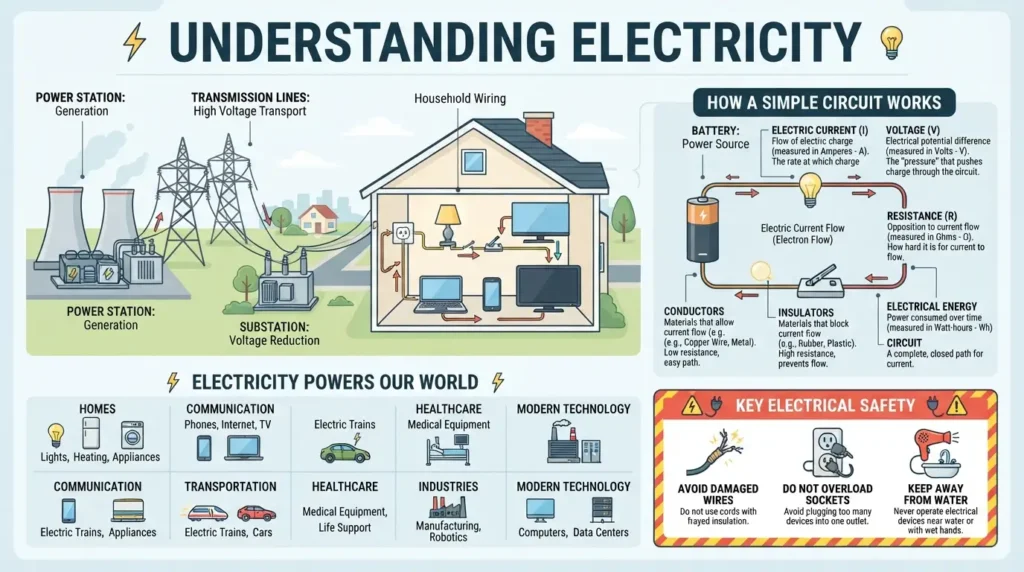
A close synonym for electricity is electric power, especially when discussing energy supplied to homes, buildings, or machines. Depending on context, related alternatives include electrical energy, electric current, power, charge, and mains electricity. However, these terms do not always mean the same thing.
synonym for electricity can make your writing more precise when you need to describe power, current, or electrical energy in a different way.
Imagine a student writing, “The electricity went off.” A natural alternative is, “The power went out,” which sounds more conversational.
The synonym for electricity you choose depends on context. “Power” works in daily speech, while “electric current” suits science writing.
Students, bloggers, and content writers can use alternatives to avoid repetition. Daily English users also benefit from knowing these useful expressions.
Learning a synonym for electricity helps you explain technical ideas clearly. It also makes ordinary conversations sound more natural and flexible.
What Does “Electricity” Really Mean?
Electricity is a noun that refers to a form of energy associated with electric charge and the movement or presence of charged particles.
In simple Terms, electricity is the energy or electrical phenomenon that lets lights, appliances, machines, computers, and many other devices operate.
For example:
The electricity is off.
This usually means the electrical supply to a home or building has stopped.
Another example is:
Electricity powers the refrigerator.
Here, the word refers to the electrical energy that enables the appliance to function.
Part of Speech
Electricity is primarily a noun.
It is an uncountable noun in most everyday uses.
We normally say:
We need electricity.
Not:
We need an electricity.
The adjective electric describes something related to electricity or powered by it.
The adjective electrical describes something connected to electricity, electrical systems, or electrical engineering.
How Native Speakers Understand “Electricity”
Native speakers commonly use electricity in everyday, scientific, educational, and professional contexts.
The word can describe the phenomenon itself, the energy used by a device, or the supply delivered to a home.
The exact meaning often becomes clear from context.
For instance, “electricity is flowing through the wire” has a scientific meaning, while “the electricity bill” refers to supplied electrical power.
Connotative Meaning of Electricity
Connotation (the feeling, association, or extra meaning a word can suggest beyond its basic definition) varies according to context.
Positive Tone
Electricity can suggest progress, innovation, comfort, productivity, and modern technology.
Reliable electricity makes modern life easier.
Negative Tone
The word can also appear in discussions about outages, dangerous wiring, shocks, accidents, or excessive consumption.
The storm caused an electricity outage.
Neutral Tone
In science and everyday factual writing, electricity is usually completely neutral.
Electricity can be generated from several energy sources.
Etymology of Electricity
The word electricity has a fascinating connection with amber.
The English noun electricity dates from the 1640s. It developed from electric plus the suffix -ity. The earlier word electric was connected with the attractive properties observed when amber was rubbed.
The deeper root comes from Greek ēlektron, meaning amber. The Latin form electrum also referred to amber. Amber became associated with electricity because rubbing it can create static electrical attraction.
Old English: 450–1100
The modern word electricity did not exist in Old English.
People in this period did not have the modern scientific vocabulary used to describe electricity. The relevant historical concept became important much later.
Middle English: 1100–1500
The word electricity still did not exist in Middle English.
However, amber was known in English during the later medieval period. Amber would eventually become central to the naming history of electricity.
Modern English: 1500–Present
The scientific vocabulary developed rapidly during the Early Modern period.
William Gilbert used the Latinized form electricus in connection with amber in his work De Magnete around 1600. The English adjective electric appeared in the 1640s, and electricity followed in the same decade.
The suffix -ity forms abstract nouns expressing a state, condition, or quality.
Pronunciation of Electricity
US Pronunciation
/ɪˌlekˈtrɪsəti/
UK Pronunciation
/ɪˌlekˈtrɪsəti/
The pronunciation is essentially the same in standard American and British English, although individual speakers may vary slightly.
Syllables
Syllable Breakdown
e-lec-tric-i-ty
Affixation Pattern of Electricity
Root
electr-
The root connects to the historical word for amber.
Prefix
None
Suffix
-ity
The suffix forms an abstract noun describing a state, condition, or quality.
Synonyms List
A linguistic note is important here: electricity does not have 40 perfect synonyms. Words such as power, current, and charge overlap with electricity in particular contexts but have more specific meanings.
The following 40 alternatives are therefore grouped as direct substitutes, close alternatives, technical expressions, and informal/contextual choices.
1. Electric Power (Noun) — US / UK: /ɪˈlɛktrɪk ˈpaʊər/ / /ɪˈlɛktrɪk ˈpaʊə/
Meaning: Electric power refers to electrical energy supplied or used to operate equipment.
Tone/Register: Neutral, technical, professional
Example:
The building depends on electric power for its heating system.
The electric power failed during the storm.
2. Electrical Energy (Noun) — US / UK: /ɪˈlɛktrɪkəl ˈɛnərdʒi/ / /ɪˈlɛktrɪkəl ˈenədʒi/
Meaning: Electrical energy is energy associated with electric charges and electrical systems.
Tone/Register: Academic, scientific
Example:
The battery stores electrical energy.
The motor converts electrical energy into motion.
3. Power (Noun) — US / UK: /ˈpaʊər/ / /ˈpaʊə/
Meaning: Power is a common everyday substitute for electricity when referring to supply.
Tone/Register: Neutral, conversational
Example:
The power went out last night.
We lost power during the heavy rain.
4. Electric Current (Noun) — US / UK: /ɪˈlɛktrɪk ˈkɜːrənt/ / /ɪˈlektrɪk ˈkʌrənt/
Meaning: Electric current is the movement of electric charge through a conductor.
Tone/Register: Scientific, academic
Example:
Electric current moves through the wire.
The circuit carries electric current to the motor.
5. Current (Noun) — US / UK: /ˈkɜːrənt/ / /ˈkʌrənt/
Meaning: Current can mean the flow of electric charge when the electrical context is clear.
Tone/Register: Technical, neutral
Example:
The current is too high for this component.
The device measures current continuously.
6. Electric Charge (Noun) — US / UK: /ɪˈlɛktrɪk tʃɑːrdʒ/ / /ɪˈlektrɪk tʃɑːdʒ/
Meaning: Electric charge is a physical property responsible for electrical interactions.
Tone/Register: Scientific
Example:
The particle carries an electric charge.
Opposite electric charges attract each other.
7. Charge (Noun) — US / UK: /tʃɑːrdʒ/ / /tʃɑːdʒ/
Meaning: Charge can refer to an amount or state of electrical charge in a technical context.
Tone/Register: Scientific
Example:
The object has a positive charge.
The experiment measures the charge on the particle.
8. Electrical Supply (Noun) — US / UK: /ɪˈlɛktrɪkəl səˈplaɪ/ / /ɪˈlektrɪkəl səˈplaɪ/
Meaning: Electrical supply refers to electricity delivered to a building or system.
Tone/Register: Formal, technical
Example:
The electrical supply was interrupted.
Engineers checked the electrical supply first.
9. Electricity Supply (Noun) — US / UK: /ɪˌlekˈtrɪsəti səˈplaɪ/ / /ɪˌlekˈtrɪsəti səˈplaɪ/
Meaning: This phrase describes the provision of electricity to users.
Tone/Register: Formal, professional
Example:
The electricity supply returned before noon.
The region needs a more reliable electricity supply.
10. Mains Electricity (Noun) — US / UK: /meɪnz ɪˌlekˈtrɪsəti/ / /meɪnz ɪˌlekˈtrɪsəti/
Meaning: Mains electricity means electricity supplied through the public electrical network.
Tone/Register: British, technical
Example:
The appliance runs on mains electricity.
The cabin has no mains electricity.
11. Mains Power (Noun) — US / UK: /meɪnz ˈpaʊər/ / /meɪnz ˈpaʊə/
Meaning: Mains power refers to electricity supplied from the main public network.
Tone/Register: British, technical
Example:
The machine needs mains power.
The system automatically switches to backup power.
12. Grid Power (Noun) — US / UK: /ɡrɪd ˈpaʊər/ / /ɡrɪd ˈpaʊə/
Meaning: Grid power is electricity supplied through an interconnected electrical grid.
Tone/Register: Technical, professional
Example:
The factory uses grid power during normal operations.
Solar panels can reduce dependence on grid power.
13. Electrical Power (Noun) — US / UK: /ɪˈlɛktrɪkəl ˈpaʊər/ / /ɪˈlektrɪkəl ˈpaʊə/
Meaning: Electrical power describes the rate at which electrical energy is transferred or used.
Tone/Register: Scientific, technical
Example:
The device requires very little electrical power.
Engineers calculated the electrical power required.
14. Electric Energy (Noun) — US / UK: /ɪˈlɛktrɪk ˈɛnərdʒi/ / /ɪˈlektrɪk ˈenədʒi/
Meaning: Electric energy refers to energy associated with electric systems.
Tone/Register: Scientific, educational
Example:
The battery releases electric energy.
Electric energy can be converted into heat.
15. Electrical Current (Noun) — US / UK: /ɪˈlɛktrɪkəl ˈkɜːrənt/ / /ɪˈlektrɪkəl ˈkʌrənt/
Meaning: Electrical current describes the flow of electric charge.
Tone/Register: Technical
Example:
The cable carries electrical current.
The sensor detects electrical current.
16. Energy (Noun) — US / UK: /ˈɛnərdʒi/ / /ˈenədʒi/
Meaning: Energy is a broad term that can replace electricity when the context clearly concerns electrical energy.
Tone/Register: Neutral, academic
Example:
The system stores energy for later use.
Clean energy can support modern infrastructure.
17. Electromagnetic Energy (Noun) — US / UK: /ɪˌlɛktroʊmæɡˈnɛtɪk ˈɛnərdʒi/ / /ɪˌlektrəʊmæɡˈnetɪk ˈenədʒi/
Meaning: Electromagnetic energy is energy carried by electromagnetic fields or radiation.
Tone/Register: Scientific
Example:
The experiment measures electromagnetic energy.
The antenna receives electromagnetic energy.
18. Electrical Force (Noun) — US / UK: /ɪˈlɛktrɪkəl fɔːrs/ / /ɪˈlektrɪkəl fɔːs/
Meaning: Electrical force describes the force acting between electrically charged objects.
Tone/Register: Scientific
Example:
The electrical force affects the charged particle.
The lesson explains electrical force with simple examples.
19. Electrostatic Charge (Noun) — US / UK: /ɪˌlɛktroʊˈstætɪk tʃɑːrdʒ/ / /ɪˌlektrəʊˈstætɪk tʃɑːdʒ/
Meaning: Electrostatic charge refers to a buildup of electric charge on a surface or object.
Tone/Register: Scientific
Example:
The fabric developed an electrostatic charge.
An electrostatic charge can attract lightweight objects.
20. Static Electricity (Noun) — US / UK: /ˈstætɪk ɪˌlekˈtrɪsəti/ / /ˈstætɪk ɪˌlekˈtrɪsəti/
Meaning: Static electricity is an accumulation of electric charge rather than a continuous current.
Tone/Register: Scientific, everyday
Example:
Static electricity made my hair stand up.
The dry air increased static electricity.
21. Static Charge (Noun) — US / UK: /ˈstætɪk tʃɑːrdʒ/ / /ˈstætɪk tʃɑːdʒ/
Meaning: Static charge is accumulated electric charge on an object.
Tone/Register: Technical
Example:
The plastic developed a static charge.
A static charge can produce a small spark.
22. Electrical Load (Noun) — US / UK: /ɪˈlɛktrɪkəl loʊd/ / /ɪˈlektrɪkəl ləʊd/
Meaning: Electrical load describes the amount of electrical demand placed on a system.
Tone/Register: Technical, professional
Example:
The building has a heavy electrical load.
The engineer measured the electrical load.
23. Power Supply (Noun) — US / UK: /ˈpaʊər səˈplaɪ/ / /ˈpaʊə səˈplaɪ/
Meaning: A power supply is a source or system that provides electrical power.
Tone/Register: Technical
Example:
The computer needs a stable power supply.
The backup power supply started automatically.
24. Electrical Service (Noun) — US / UK: /ɪˈlɛktrɪkəl ˈsɜːrvɪs/ / /ɪˈlektrɪkəl ˈsɜːvɪs/
Meaning: Electrical service refers to the provision of electricity to a property or customer.
Tone/Register: Professional, formal
Example:
The property has reliable electrical service.
The electrical service was temporarily interrupted.
25. Utility Power (Noun) — US / UK: /juːˈtɪləti ˈpaʊər/ / /juːˈtɪləti ˈpaʊə/
Meaning: Utility power means electricity supplied by a public or commercial utility network.
Tone/Register: Professional, technical
Example:
The facility operates mainly on utility power.
The generator works when utility power fails.
26. Distributed Power (Noun) — US / UK: /dɪˈstrɪbjətɪd ˈpaʊər/ / /dɪˈstrɪbjətɪd ˈpaʊə/
Meaning: Distributed power refers to electricity generated close to where it is consumed.
Tone/Register: Technical, academic
Example:
Distributed power can support local communities.
The project uses distributed power systems.
27. Generated Power (Noun) — US / UK: /ˈdʒɛnəreɪtɪd ˈpaʊər/ / /ˈdʒenəreɪtɪd ˈpaʊə/
Meaning: Generated power refers to electricity produced by a generating system.
Tone/Register: Technical
Example:
The plant sends generated power to the grid.
Engineers monitor the generated power continuously.
28. Electrical Output (Noun) — US / UK: /ɪˈlɛktrɪkəl ˈaʊtpʊt/ / /ɪˈlektrɪkəl ˈaʊtpʊt/
Meaning: Electrical output is the amount of electrical power produced by a device or system.
Tone/Register: Technical
Example:
The turbine has a high electrical output.
Researchers recorded the electrical output.
29. Power Flow (Noun) — US / UK: /ˈpaʊər floʊ/ / /ˈpaʊə fləʊ/
Meaning: Power flow describes the movement or transfer of electrical power through a system.
Tone/Register: Engineering, technical
Example:
The software tracks power flow across the network.
Engineers studied the power flow carefully.
30. Electrical Flow (Noun) — US / UK: /ɪˈlɛktrɪkəl floʊ/ / /ɪˈlektrɪkəl fləʊ/
Meaning: Electrical flow is an informal or explanatory phrase for the movement of electrical charge.
Tone/Register: Educational, technical
Example:
The switch controls electrical flow.
The diagram shows electrical flow through the circuit.
31. Juice (Noun) — US / UK: /dʒuːs/ / /dʒuːs/
Meaning: Juice is an informal expression for electrical power or energy.
Tone/Register: Very informal
Example:
This battery still has plenty of juice.
The phone needs more juice before the trip.
32. Spark (Noun) — US / UK: /spɑːrk/ / /spɑːk/
Meaning: Spark can refer to a brief visible discharge of electricity, not electricity in general.
Tone/Register: Everyday, informal
Example:
A spark jumped from the damaged wire.
The loose connection produced a small spark.
33. Charge (Noun, Everyday Use) — US / UK: /tʃɑːrdʒ/ / /tʃɑːdʒ/
Meaning: Charge can describe the electrical energy stored in a battery or similar device in everyday speech.
Tone/Register: Neutral, conversational
Example:
The phone has enough charge for the journey.
My laptop lost its charge quickly.
34. Volt (Noun, Technical) — US / UK: /voʊlt/ / /vəʊlt/
Meaning: A volt is a unit of electrical potential difference, so it is not a direct synonym for electricity.
Tone/Register: Scientific, technical
Example:
The adapter provides twelve volts.
Check the voltage before connecting the device.
35. Voltage (Noun, Technical) — US / UK: /ˈvoʊltɪdʒ/ / /ˈvəʊltɪdʒ/
Meaning: Voltage measures electrical potential difference rather than electricity itself.
Tone/Register: Technical
Example:
The voltage is too high for the device.
The technician checked the voltage first.
36. Electrical Potential (Noun) — US / UK: /ɪˈlɛktrɪkəl pəˈtɛnʃəl/ / /ɪˈlektrɪkəl pəˈtenʃəl/
Meaning: Electrical potential describes the potential energy per unit charge at a location.
Tone/Register: Academic, scientific
Example:
The electrical potential changes across the circuit.
Students calculated the electrical potential.
37. Electrification (Noun) — US / UK: /ɪˌlɛktrɪfɪˈkeɪʃən/ / /ɪˌlektrɪfɪˈkeɪʃən/
Meaning: Electrification means the process of supplying or converting something to electrical power.
Tone/Register: Formal, academic
Example:
Railway electrification reduced dependence on diesel.
The region is expanding rural electrification.
38. Electric Supply (Noun) — US / UK: /ɪˈlɛktrɪk səˈplaɪ/ / /ɪˈlektrɪk səˈplaɪ/
Meaning: Electric supply refers to electricity provided to a device, building, or network.
Tone/Register: Neutral, technical
Example:
The electric supply was interrupted.
The system needs a stable electric supply.
39. Electrical Resource (Noun) — US / UK: /ɪˈlɛktrɪkəl rɪˈsɔːrs/ / /ɪˈlektrɪkəl rɪˈsɔːs/
Meaning: Electrical resource is a broad formal expression for an available source or capacity of electrical energy.
Tone/Register: Formal, professional
Example:
The community needs dependable electrical resources.
The project manages local electrical resources efficiently.
40. Electrification Power (Noun Phrase) — US / UK: /ɪˌlɛktrɪfɪˈkeɪʃən ˈpaʊər/ / /ɪˌlektrɪfɪˈkeɪʃən ˈpaʊə/
Meaning: This phrase can describe power associated with an electrification project, although it is not a standard direct synonym for electricity.
Tone/Register: Technical, contextual
Example:
The project requires reliable power for electrification.
New infrastructure will support the electrification program.
Synonyms for Electricity by Tone
Positive
Electric power, electrical energy, clean energy, and reliable power can sound positive when discussing innovation, comfort, sustainability, or progress.
Reliable electric power improves daily life.
Neutral
Electricity, power, electric current, electrical supply, and electric energy work well in ordinary factual writing.
The building uses electricity throughout the day.
Negative
Words such as power failure, power outage, electrical interruption, and loss of power describe problems rather than electricity itself.
The storm caused a power outage.
These expressions should not be treated as exact synonyms because they describe the absence or interruption of electricity.
Playful or Informal
Juice is the clearest informal alternative.
My phone is almost out of juice.
It works in conversation but should generally be avoided in formal academic writing.
Why Tone Matters in Word Choice
Choosing the right alternative is not simply about finding another word.
The best choice depends on what you are describing.
A science essay may need electric current. A news report may use power supply. A casual conversation may simply say power.
Using the wrong alternative can change the meaning.
For example, voltage is not interchangeable with electricity. Voltage describes electrical potential difference.
Likewise, current specifically describes the flow of electric charge.
“Electricity” vs Close Alternatives
Electricity vs Power
The Electricity is the broader everyday term for the electrical phenomenon or supplied energy.
Power is often used as a practical substitute when discussing the supply that operates a home or device.
Use electricity for a general meaning.
Use power when discussing supply or availability.
The house uses electricity.
The house lost power.
Electricity vs Electric Current
It is broad.
Electric current specifically refers to the flow of electric charge.
Use electric current in physics and engineering contexts.
Electricity powers the device.
Electric current flows through the conductor.
Electricity vs Electrical Energy
Electrical energy is more scientific and focuses on energy associated with electrical systems.
Use it when discussing energy conversion, storage, generation, or physics.
The battery stores electrical energy.
How Electricity Changes by Context
Daily Conversation
In everyday speech, power is often more natural than electricity when discussing an outage.
We lost power last night.
You can also say:
The electricity went out.
Both are natural.
Writing and Blogging
- Bloggers should choose the term that matches the subject.
- Use electricity for general explanations.
- Use electric power for household or infrastructure topics.
- Use electrical energy when explaining science or energy conversion.
Professional and Academic Writing
Technical writing requires greater precision.
An engineer may use voltage, current, electrical load, or power flow instead of the broad word electricity.
The more specific term usually improves accuracy.
Creative and Informal Use
Informal English may use juice when talking about batteries or devices.
My phone has no juice left.
Creative writing can also use spark metaphorically.
Her idea gave the project a spark.
This does not mean that spark is a direct synonym for electricity.
Common Mistakes Learners Make
Using Power in Every Situation
Power is useful, but it cannot replace electricity in every scientific sentence.
Electricity is a physical phenomenon.
Changing this to:
Power is a physical phenomenon.
would alter the meaning.
Treating Current as a Perfect Synonym
Current means the flow of electric charge.
It is one part of the broader concept of electricity.
Confusing Voltage and Electricity
Voltage is not electricity itself.
It describes electrical potential difference.
This distinction matters in technical writing.
Using Juice in Formal Writing
“Juice” is natural in casual conversation.
It sounds inappropriate in most academic essays and professional reports.
Overusing Electricity
Even though electricity is the focus keyword, repeating it in every sentence can make an article sound mechanical.
Use precise alternatives when the meaning remains accurate.
Register Notes
Formal
Use expressions such as:
electrical energy
electric power
electrical supply
electric current
electrical output
Neutral
Common everyday choices include:
electricity
power
current
electric supply
Informal
Use:
juice
power
spark
These are more conversational and depend heavily on context.
Real-Life Mini Scenarios
Workplace
A technician may say:
The electrical supply to this office has been interrupted.
A coworker might simply say:
We lost power.
The second version sounds more natural in everyday workplace conversation.
Social Situation
Someone checking a phone might say:
I need to charge my phone. It has almost no juice.
This is casual and friendly.
Media and Pop Culture
A news report may say:
The storm left thousands of homes without power.
Here, power is more natural than repeatedly saying electricity.
Writing and Storytelling
A writer may describe a sudden spark from a damaged cable.
A bright spark flashed across the broken wire.
Here, spark creates a vivid image rather than functioning as a strict synonym.
Quick Word-Choice Guide
Use “Electricity” When:
You are discussing electricity in a broad sense.
Use “Power” When:
You mean the electrical supply available to a home, building, or machine.
Use “Current” When:
You mean the flow of electric charge.
Use “Electrical Energy” When:
You are explaining energy in a scientific context.
Use “Mains Electricity” When:
You mean electricity supplied through the public network, especially in British English.
Use “Juice” When:
You are speaking casually about battery power.
Use “Voltage” When:
You mean electrical potential difference.
Use “Charge” When:
You mean the electrical property or stored charge of a device.
External Learning Source
For deeper vocabulary and etymology research, readers can explore Etymonline’s entry for “electricity”, which traces the word to electric and ultimately to Greek ēlektron, “amber.”
Practice Quiz
1. Which word is most natural in “The whole neighborhood lost ___ after the storm”?
A. voltage
B. power
C. charge
D. current
2. Which term specifically describes the flow of electric charge?
A. current
B. energy
C. grid
D. juice
3. Which expression is best for a physics assignment?
A. juice
B. electrical energy
C. stuff
D. power thing
4. Which sentence uses “juice” naturally?
A. The research paper discusses juice.
B. The circuit contains juice.
C. My phone has very little juice left.
D. The engineer calculated the juice.
5. Which word describes electrical potential difference?
A. current
B. voltage
C. supply
D. electricity
6. Which expression is especially common in British English for public electrical supply?
A. mains electricity
B. electric juice
C. current energy
D. power charge
7. Which term describes accumulated electrical charge?
A. static charge
B. grid power
C. electrical output
D. utility power
8. Which sentence is most suitable for technical writing?
A. The machine needs more juice.
B. The machine needs electrical power.
C.Machine needs electric stuff.
D. Machine needs spark.
9. Which word is broader than “electric current”?
A. electricity
B. voltage
C. spark
D. volt
10. Which phrase refers to electricity supplied through an interconnected network?
A. static charge
B. grid power
C. electric force
D. electrical potential
Reflection Task
Write one sentence using power, electric current, electrical energy, mains electricity, or juice. Then explain why your chosen word fits the context.
Answer Key
1-B | 2-A | 3-B | 4-C | 5-B | 6-A | 7-A | 8-B | 9-A | 10-B
FAQs
1. What is another word for electricity in everyday English?
The most natural everyday alternative is power, especially when referring to the electrical supply in a home, office, or neighborhood. For example, “The electricity went out” and “The power went out” are both natural. In casual speech, juice can describe battery power, but it is informal and should not replace electricity in formal writing.
2. What is a synonym for electricity in an essay?
For an academic essay, electrical energy, electric power, or electric current may work depending on the intended meaning. These terms are more precise than simply repeating electricity. However, they are not perfect synonyms. Choose electrical energy when discussing energy, and electric current when discussing the movement of electric charge.
3. What is another way to say electricity went out?
Natural alternatives include the power went out, the power was cut off, there was a power outage, and the electrical supply was interrupted. “The power went out” is the most conversational option. “The electrical supply was interrupted” sounds more formal and works well in professional or technical writing.
4. Is power a synonym for electricity?
Power can function as a practical substitute for electricity in everyday contexts, especially when referring to electrical supply. However, the two words have different technical meanings. In physics, electrical power refers to the rate at which electrical energy is transferred or used. Therefore, power is a close contextual alternative, not a perfect synonym.
5. What is a scientific synonym for electricity?
There is no single scientific word that perfectly replaces electricity in every scientific context. Depending on the subject, scientists may use terms such as electric current, electric charge, electrical energy, electric field, or electrical potential. Each term describes a particular aspect of electrical phenomena, so precision is important.
6. What is an informal synonym for electricity?
Juice is an informal expression commonly used for electrical power, particularly battery power. For example, someone may say, “My phone is running out of juice.” It is natural in casual conversation but unsuitable for most academic essays, scientific explanations, formal reports, and professional documents.
7. What is the difference between electricity and electrical energy?
Electricity is a broad term covering electrical phenomena associated with electric charge. Electrical energy specifically refers to energy associated with an electrical system. In simple writing, the two may appear similar, but scientific contexts often require the more precise term. Use electrical energy when discussing storage, conversion, generation, or energy transfer.
8. What is the best synonym for electricity in British English?
Power is a natural everyday alternative in British English, while mains electricity specifically refers to electricity supplied through the public network. For example, “The house has no mains electricity” is more precise than simply saying “The house has no electricity” when the intended meaning concerns connection to the public supply.
Conclusion
Learning a synonym for electricity gives you more control over your English. You can choose broad, technical, formal, or casual expressions based on your audience.
Words such as power, electric current, and electrical energy make your writing more precise. Each one adds a slightly different meaning.
Better vocabulary helps students, bloggers, writers, and everyday speakers communicate ideas without unnecessary repetition. Context should always guide your choice.
Keep practicing these alternatives in emails, essays, conversations, and short writing exercises. The more you use them, the more naturally precise English becomes.

Sophia Carter is the founder and lead writer at SynonymVerse.com, a trusted online resource dedicated to English vocabulary and effective communication. She is passionate about helping students, writers, professionals, and lifelong learners find the most accurate words to express their ideas with clarity and confidence.
At SynonymVerse.com, every article is carefully researched and thoughtfully written to provide reliable guidance on synonyms, word meanings, and vocabulary. With a strong focus on accuracy, real-world usage, and easy-to-understand explanations, the website is committed to helping readers strengthen their language skills, enrich their vocabulary, and become more confident communicators.