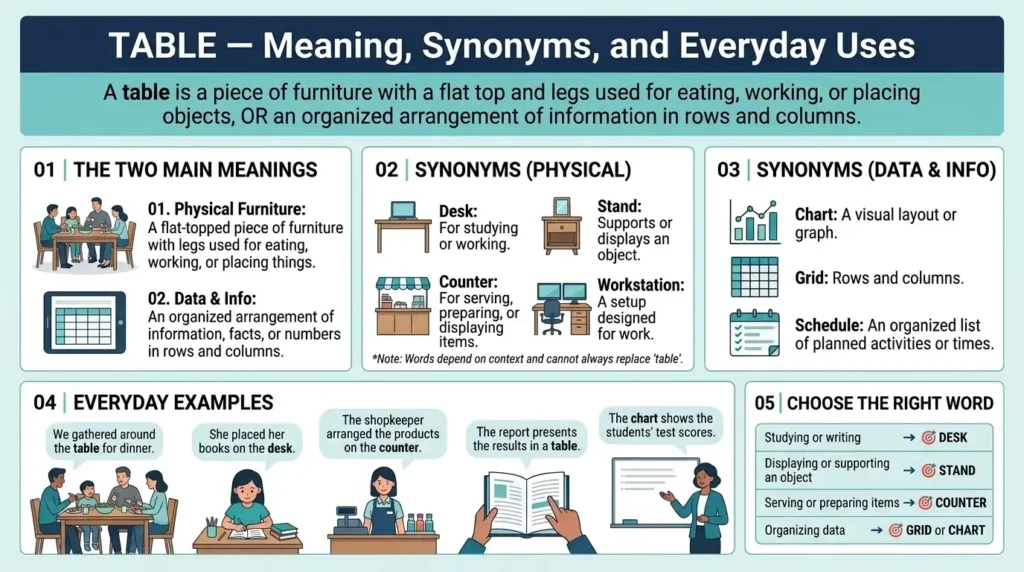
A synonym for table depends on the meaning you want to express. For furniture, alternatives include desk, workbench, and countertop. For organized information, use chart, grid, or spreadsheet. In meetings, words such as agenda and proposal relate to specific uses of the verb table.
Imagine describing your study room to a friend. You might call the furniture a desk rather than a table. The right word helps your listener picture the exact object.
The word table appears in everyday conversations, school assignments, business documents, and online articles. Learning related vocabulary helps you communicate without repeating the same word unnecessarily.
Understanding a synonym for table can improve your writing, especially when you create blog posts, essays, reports, or educational content. Students and everyday English users can also benefit from knowing which alternative fits each situation.
Not every alternative has the same meaning. A desk supports work, while a chart presents information visually. Learning these differences helps you choose precise words and express your ideas naturally.
What Does “Table” Really Mean?
A table is a piece of furniture with a flat top and one or more supports. People use it for eating, working, studying, displaying objects, and placing belongings.
The word also describes an organized display of information. In documents, a table usually presents facts or figures in rows and columns. As a verb, to table can mean to postpone a matter in American English or formally present it for discussion in some other varieties of English.
Part of speech: Noun and verb.
- Noun: We ate dinner at the kitchen table.
- Verb: The committee decided to table the proposal until next week.
Native speakers understand the meaning through context. A dining table refers to furniture, while a data table presents information. The verb can have different meanings depending on the variety of English.
Connotative Meaning
(Connotation means the feelings, associations, or attitudes a word suggests beyond its basic definition.)
Positive tone: A sturdy dining table may suggest family gatherings, comfort, and togetherness.
Negative tone: A conference table may remind someone of long meetings, bureaucracy, or difficult negotiations.
Neutral tone: In ordinary conversation, table usually describes furniture or an organized display of information without expressing a particular emotion.
The word itself is generally neutral. Its emotional effect depends on the context and the words surrounding it.
Etymology of Table
The English word table came through Old French table, which originated from Latin tabula. The Latin word referred to a board, plank, tablet, or flat surface.
Over time, the word developed several meanings. It came to describe furniture, written lists, organized information, and certain actions in meetings.
Historical Development
Old English (450–1100): English speakers commonly used native words such as bord for a board or table-like surface. The modern word table was not the standard Old English term.
Middle English (1100–1500): French influence helped introduce table into English. The word referred to flat surfaces and could also describe lists or arrangements of information.
Modern English (1500–present): The word gained wider use in education, mathematics, business, publishing, and public discussion. Today, it can refer to furniture, structured data, and actions involving formal discussions.
Syllables and Word Structure
Syllables: ta-ble (2 syllables)
Affixation pattern:
- Root: table
- Prefix: None in the basic word.
- Suffix: None in the basic word.
The word table functions as a base word. Related forms include tables, tabled, and tabling. These forms use grammatical endings to express number or verb tense.
45 Synonyms and Alternatives for Table
The best alternative depends on what you mean. Some words describe physical furniture, while others refer to information displays or meeting procedures. The following list explains each term with a definition, tone, and practical examples.
Furniture and Physical Surfaces
1. Desk (Noun)
Meaning: A desk is a flat-topped piece of furniture designed mainly for working, studying, or writing.
Tone/Register: Neutral, professional, everyday.
Examples:
I keep my laptop on the desk.
She bought a desk for her home office.
2. Workbench (Noun)
Meaning: A workbench is a sturdy surface used for practical tasks such as repairing, building, or assembling objects.
Tone/Register: Technical, practical.
Examples:
Dad repaired the chair on his workbench.
The mechanic placed the tools on the workbench.
3. Counter (Noun)
Meaning: A counter is a flat surface used for preparing food, serving customers, or handling transactions.
Tone/Register: Everyday, commercial.
Examples:
Leave the grocery bags on the counter.
The cashier stood behind the counter.
4. Countertop (Noun)
Meaning: A countertop is the horizontal working surface fitted to a kitchen or similar unit.
Tone/Register: Domestic, practical.
Examples:
We cleaned the countertop after breakfast.
The new countertop gives the kitchen a fresh look.
5. Dining Table (Noun)
Meaning: A dining table is a piece of furniture designed for eating meals.
Tone/Register: Neutral, domestic.
Examples:
The family gathered around the dining table.
We set the plates on the dining table.
6. Coffee Table (Noun)
Meaning: A coffee table is a low piece of furniture placed in a sitting area.
Tone/Register: Everyday, domestic.
Examples:
The remote is on the coffee table.
She placed a vase on the coffee table.
7. Side Table (Noun)
Meaning: A side table is a small table placed beside a bed, sofa, or chair.
Tone/Register: Neutral, domestic.
Examples:
My glasses are on the side table.
He put a lamp beside the armchair.
8. Bedside Table (Noun)
Meaning: A bedside table is a small surface placed next to a bed for keeping useful items nearby.
Tone/Register: Everyday, domestic.
Examples:
She keeps her alarm clock on the bedside table.
I left my book beside the bed.
9. End Table (Noun)
Meaning: An end table is a small table placed at the end of a sofa or beside a chair.
Tone/Register: Neutral, domestic.
Examples:
The cup sat on the end table.
We added an end table to the living room.
10. Console Table (Noun)
Meaning: A console table is a narrow table often placed against a wall or in an entryway.
Tone/Register: Interior design, descriptive.
Examples:
A mirror hangs above the console table.
She decorated the console table with flowers.
11. Worktable (Noun)
Meaning: A worktable is a broad surface used for tasks that require room to spread out materials.
Tone/Register: Practical, professional.
Examples:
The artist covered the worktable with paper.
We sorted the documents on the worktable.
12. Drafting Table (Noun)
Meaning: A drafting table is a specialized surface for technical drawing, design, or architectural plans.
Tone/Register: Technical, professional.
Examples:
The architect spread the plans across the drafting table.
He adjusted the angle of his drafting table.
13. Examination Table (Noun)
Meaning: An examination table is a medical surface on which a patient sits or lies during an examination.
Tone/Register: Medical, formal.
Examples:
The doctor asked me to sit on the examination table.
The nurse prepared the examination table for the next patient.
14. Conference Table (Noun)
Meaning: A conference table is a large table used for meetings and group discussions.
Tone/Register: Business, professional.
Examples:
Everyone gathered around the conference table.
The manager placed the reports on the conference table.
15. Picnic Table (Noun)
Meaning: A picnic table is outdoor furniture designed for eating or gathering outside.
Tone/Register: Casual, recreational.
Examples:
We ate lunch at a picnic table in the park.
The children played beside the picnic table.
16. Folding Table (Noun)
Meaning: A folding table is a table that can collapse for convenient storage or transport.
Tone/Register: Practical, everyday.
Examples:
We set up a folding table for the party.
The volunteers stored the folding table after the event.
17. Work Surface (Noun)
Meaning: A work surface is any flat area suitable for performing a task.
Tone/Register: Neutral, technical.
Examples:
Keep the work surface clean and dry.
The chef prepared vegetables on the work surface.
18. Platform (Noun)
Meaning: A platform is a raised or level surface that supports people or objects. It is not usually a direct synonym for ordinary furniture.
Tone/Register: Technical, general.
Examples:
The display stood on a wooden platform.
Workers placed the equipment on a stable platform.
19. Stand (Noun)
Meaning: A stand is a supporting structure for an object, such as a television, plant, or instrument.
Tone/Register: Neutral, practical.
Examples:
The television rests on a small stand.
She placed the speaker on its stand.
20. Serving Table (Noun)
Meaning: A serving table is a surface used to arrange food, drinks, or dishes for guests.
Tone/Register: Hospitality, domestic.
Examples:
The host arranged desserts on the serving table.
We placed extra plates beside the serving table.
Information and Data Terms
These alternatives apply when table means an organized display of information rather than furniture.
21. Chart (Noun)
Meaning: A chart presents information visually, often through bars, lines, symbols, or categories.
Tone/Register: Academic, professional.
Examples:
The chart shows monthly sales growth.
I used a chart to explain the results.
22. Grid (Noun)
Meaning: A grid arranges information or objects in intersecting rows and columns.
Tone/Register: Technical, neutral.
Examples:
Enter each answer in the correct grid cell.
The photos appear in a neat grid.
23. Spreadsheet (Noun)
Meaning: A spreadsheet is a digital or paper-based arrangement of data in rows and columns, commonly used for calculations and records.
Tone/Register: Business, technical.
Examples:
I tracked the expenses in a spreadsheet.
The spreadsheet contains the survey results.
24. Data Matrix (Noun)
Meaning: A data matrix arranges related values in a rectangular structure of rows and columns.
Tone/Register: Academic, technical.
Examples:
The researcher organized the measurements in a data matrix.
Each row represents one participant in the study.
25. Data Grid (Noun)
Meaning: A data grid displays records in a row-and-column layout, often in software or databases.
Tone/Register: Technical, business.
Examples:
The data grid displays customer records.
You can compare the entries across the data grid.
26. Schedule (Noun)
Meaning: A schedule lists planned activities, events, or times and may be presented as a table.
Tone/Register: Everyday, professional.
Examples:
The class schedule lists every lesson.
Check the schedule before choosing a meeting time.
27. Timetable (Noun)
Meaning: A timetable organizes events or activities by time, especially lessons and transport departures.
Tone/Register: Educational, formal, everyday.
Examples:
The train timetable shows the departure times.
Our teacher shared the examination timetable.
28. Roster (Noun)
Meaning: A roster is a list of people assigned to a team, duty, or work period.
Tone/Register: Administrative, professional.
Examples:
The manager updated the staff roster.
My name appears on tomorrow’s duty roster.
29. Ledger (Noun)
Meaning: A ledger is a record of financial transactions or accounts, sometimes organized in tabular form.
Tone/Register: Accounting, formal.
Examples:
The accountant checked every entry in the ledger.
We recorded the payments in the ledger.
30. Register (Noun)
Meaning: A register is an official list or record of names, events, or details.
Tone/Register: Administrative, formal.
Examples:
The teacher marked attendance in the register.
Her name appears in the official register.
31. Catalogue (Noun)
Meaning: A catalogue is an organized list of items or information that may include tabular details.
Tone/Register: Informational, formal.
Examples:
The library catalogue lists available books.
We checked the catalogue for publication dates.
32. List (Noun)
Meaning: A list is a series of names, facts, or items arranged in a particular order.
Tone/Register: Neutral, everyday.
Examples:
I made a list of the required documents.
The list includes each student’s name.
33. Record (Noun)
Meaning: A record preserves information about a person, event, transaction, or activity.
Tone/Register: Professional, administrative.
Examples:
The database contains a record for each student.
Please update the attendance record.
34. Summary (Noun)
Meaning: A summary presents the main points of information, sometimes in a compact table or chart.
Tone/Register: Academic, professional.
Examples:
The summary highlights the survey’s main findings.
I added a short summary below the results.
35. Breakdown (Noun)
Meaning: A breakdown divides information into smaller categories or components for easier understanding.
Tone/Register: Business, analytical.
Examples:
The report includes a breakdown of annual expenses.
This breakdown shows how the budget is distributed.
36. Matrix (Noun)
Meaning: A matrix is a structured arrangement of values or elements in rows and columns.
Tone/Register: Academic, mathematical, technical.
Examples:
The researcher compared the results in a matrix.
Each cell in the matrix contains a value.
37. Infographic (Noun)
Meaning: An infographic communicates information through visual elements such as text, icons, charts, and diagrams.
Tone/Register: Digital, educational, editorial.
Examples:
The infographic explains the survey findings.
I created an infographic to simplify the statistics.
38. Diagram (Noun)
Meaning: A diagram visually explains the structure, relationship, or operation of something.
Tone/Register: Educational, technical.
Examples:
The diagram shows how the system works.
Our teacher drew a diagram of the process.
39. Index (Noun)
Meaning: An index is an organized reference list that helps readers locate information quickly.
Tone/Register: Academic, reference.
Examples:
Look up the term in the book’s index.
The index lists important topics alphabetically.
40. Directory (Noun)
Meaning: A directory is an organized collection of names, contact details, or locations.
Tone/Register: Administrative, informational.
Examples:
The staff directory includes email addresses.
I found the department in the online directory.
Discussion and Presentation Terms
These alternatives relate to particular uses of table as a verb or to material prepared for discussion. They are not direct replacements for furniture.
41. Agenda (Noun)
Meaning: An agenda is a list of topics scheduled for discussion at a meeting.
Tone/Register: Business, formal.
Examples:
The agenda includes three major discussion points.
Please review the agenda before the meeting.
42. Proposal (Noun)
Meaning: A proposal is a suggested plan or idea submitted for consideration, which may be tabled during a meeting.
Tone/Register: Professional, formal.
Examples:
She presented a proposal for the new project.
The committee reviewed the proposal yesterday.
43. Motion (Noun)
Meaning: A motion is a formal suggestion put forward for discussion or a decision in a meeting.
Tone/Register: Parliamentary, formal.
Examples:
The chair accepted the motion for discussion.
Members voted on the motion after the debate.
44. Submission (Noun)
Meaning: A submission is a document or proposal formally presented to an authority or group for consideration.
Tone/Register: Formal, academic, professional.
Examples:
The board reviewed our written submission.
Please send your submission before the deadline.
45. Defer (Verb)
Meaning: To defer means to postpone something until a later time. It can describe one meaning of table in American English.
Tone/Register: Formal, professional.
Examples:
The committee decided to defer the discussion.
We will defer the decision until Friday.
Synonyms for Table by Tone
Word choice depends on your purpose. A furniture term, a data term, and a meeting term can all be appropriate in different settings.
Positive or Welcoming
- Dining table: Often suggests shared meals and family time.
- Picnic table: Creates a relaxed, outdoor feeling.
- Coffee table: Fits descriptions of comfortable living spaces.
- Serving table: Can suggest hospitality and entertaining guests.
Neutral
- Desk: Best for studying or office work.
- Counter: Suitable for kitchens and service areas.
- List: Useful for simple collections of information.
- Grid: Appropriate for structured layouts.
- Schedule: Ideal for planned activities.
- Record: Suitable for documented facts.
Professional or Academic
- Conference table: Fits workplace meetings.
- Spreadsheet: Best for organized numerical data.
- Matrix: Useful for technical comparisons.
- Ledger: Appropriate for accounting records.
- Agenda: Refers to planned meeting topics.
- Submission: Describes material formally presented for consideration.
Negative or Delaying
- Defer: Suggests postponing a decision or discussion.
- Postpone: Clearly indicates that something will happen later.
- Delay: Can imply that an action is happening later than expected.
Postpone and delay are alternatives for the postponement sense of table. They are not synonyms for a piece of furniture.
Playful or Informal
- Coffee table: Works naturally in casual home conversations.
- Stand: A simple term for furniture that supports an object.
- List: A straightforward choice for everyday organization.
Tone matters because the wrong word can confuse readers. Choose the term that communicates your intended meaning instead of replacing table automatically.
Table vs. Close Alternatives
Table vs. Desk
A table serves many purposes, including eating, displaying objects, and gathering. A desk usually supports focused work, writing, or studying.
Use a table for general-purpose furniture. Choose a desk when the setting involves office work or a study area.
Table vs. Counter
A table usually stands independently and supports a range of activities. A counter often forms part of a kitchen, shop, or service area.
For example, you eat at a dining table but prepare vegetables on a kitchen counter.
Table vs. Chart
A table typically organizes data into rows and columns. A chart often presents information visually to reveal patterns, comparisons, or trends.
Use a table when readers need exact values. Choose a chart when you want them to recognize a pattern quickly.
How Table Changes by Context
Daily Conversation
In everyday speech, table usually refers to furniture. People might ask you to set the table, clean the table, or move a table into another room.
Choose specific terms such as desk, counter, or coffee table when the furniture’s purpose matters.
Writing and Blogging
In an article, table often refers to a structured presentation of information. A synonym such as chart, grid, or spreadsheet may fit when the format or function is clear.
For SEO writing, do not replace the focus keyword in every sentence. Use tables naturally and introduce alternatives only when they improve clarity.
Professional and Academic Writing
Business reports often use tables to present figures, schedules, and comparisons. A matrix may organize relationships, while a ledger records financial transactions.
Choose terminology based on the document’s purpose. Precise wording helps readers understand your information without unnecessary explanation.
Creative and Informal Use
In stories, a table can become part of a scene. A wooden dining table may suggest a family gathering, while a workbench may establish a workshop setting.
Specific nouns help readers picture the scene. They also make descriptions more vivid without adding long explanations.
Common Mistakes Learners Make
1. Using Desk for Every Table
A desk usually supports work or study. It does not always suit a dining area, garden, or living room.
Better choice: Describe the furniture according to its actual purpose.
2. Treating Chart and Table as Identical
A chart often shows information visually. A table usually displays individual values in rows and columns.
Better choice: Use the term that matches the format you created.
3. Confusing Table as a Noun and Verb
The noun describes furniture or an information display. The verb can mean to present something for consideration or postpone it, depending on the variety of English.
Better choice: Check the sentence and the intended audience before interpreting the verb.
4. Overusing Synonyms for SEO
Replacing every occurrence of table with another word can make an article sound unnatural. Some alternatives are not interchangeable.
Better choice: Keep the main term where it fits. Add related vocabulary only when it offers useful information.
Register Notes: Formal vs. Informal English
In casual speech, people often say desk, counter, or list because these words communicate the intended object or format quickly.
Formal writing may require terms such as data matrix, ledger, schedule, or submission. These words have narrower meanings, so they can improve precision when used correctly.
Spoken English also relies on context. Written English may need extra detail to distinguish furniture from an information display or a postponed agenda item.
For further vocabulary practice, explore related words such as chart, grid, and spreadsheet to understand how information-display terms differ.
Real-Life Mini Scenarios Using Tables
Workplace
A manager asks an employee to prepare a table of monthly expenses. The employee organizes the figures in a spreadsheet and adds a chart to show spending trends.
Each term describes a different part of the task.
Social Situations
A family prepares a dining table for dinner. After the meal, someone places the dishes on the counter and clears the table.
The words help everyone understand which surface or task is involved.
Media and Pop Culture
A television program displays a chart showing audience ratings. A news website publishes a table comparing the results.
The chart highlights visual patterns, while the table helps readers check exact figures.
Writing and Storytelling
A writer describes a character sitting at a desk beside a window. Another scene features a workbench covered with tools.
Specific furniture terms help establish the setting and make the writing easier to visualize.
Interactive Practice Quiz
Choose the word that best fits each real-life situation. Each question has one intended best answer.
Multiple-Choice Questions
1. You need furniture for writing and studying in your bedroom. Which word fits best?
- A. Chart
- B. Desk
- C. Ledger
- D. Agenda
2. You want to arrange monthly sales figures in rows and columns. Which option is most suitable?
- A. Spreadsheet
- B. Workbench
- C. Picnic table
- D. Countertop
3. A family wants outdoor furniture for eating in a park. What should they use?
- A. Console table
- B. Drafting table
- C. Picnic table
- D. Examination table
4. You want to show a company’s growth using bars or lines. Which word fits best?
- A. Register
- B. Chart
- C. Ledger
- D. Desk
5. A mechanic needs a sturdy surface for repairing an engine part. Which alternative is appropriate?
- A. Workbench
- B. Coffee table
- C. Dining table
- D. Side table
6. A teacher wants to display lesson times for the week. Which term is most suitable?
- A. Matrix
- B. Timetable
- C. Counter
- D. Platform
7. A business meeting needs a list of topics to discuss. What should the organizer prepare?
- A. Agenda
- B. Countertop
- C. Stand
- D. Work surface
8. A company records its financial transactions in an accounting book. Which term fits best?
- A. Infographic
- B. Ledger
- C. Coffee table
- D. Diagram
Answer Key
- B | 2. A| 3. C | 4. B | 5. | 6. B | 7. A | 8. B
Reflection Task
Write two original sentences using different alternatives for table. Use one word for furniture and another for organized information. Explain why each word fits the context.
FAQs
1. What Is Another Word for Table in an Academic Essay?
In an academic essay, the best alternative depends on the information being discussed. Use chart for a visual representation, matrix for a structured arrangement of values, or schedule for planned activities. If the information appears in rows and columns, table may remain the most accurate term. Academic writing values precision more than variety.
2. What Is a Synonym for Table in Microsoft Excel?
Spreadsheet is the best general term for an Excel file containing organized data. Within a spreadsheet, a grid describes the arrangement of cells, while a data table describes a structured set of information. These terms are related but not identical. Choose the word that matches whether you mean the entire file, its layout, or a specific collection of records.
3. What Is the Difference Between a Table and a Database?
A table organizes related information into rows and columns. A database stores and manages collections of related information, often using multiple tables and relationships. For example, a school database may contain separate tables for students, teachers, and classes. A table can exist within a database, but the two terms do not mean the same thing.
4. What Is Another Word for a Table Used in a Restaurant?
A dining table is the clearest term for furniture where guests eat. Depending on the setting, you may also use booth for a restaurant seating area with built-in seats or counter for a raised service or eating surface. These alternatives describe different arrangements, so choose the term that matches the actual furniture.
5. What Does “Table a Proposal” Mean in British and American English?
The phrase can have different meanings across English varieties. In American English, table a proposal commonly means to postpone consideration. In British parliamentary usage, table a proposal traditionally means to formally present it for consideration. Because the meanings can differ, use postpone or present when you want to avoid ambiguity.
6. Can I Use Synonyms for Table to Improve SEO?
Yes, relevant alternatives can help explain related concepts and make content more useful. Terms such as spreadsheet, chart, desk, and workbench may support different sections of an article about tables. However, these words have different meanings. Use them only when they accurately describe the subject, and avoid inserting variations simply to increase keyword frequency.
7. What Is the Plural Form of Table, and How Do You Use It?
The plural of table is tables. Use it when referring to more than one piece of furniture or more than one organized display of information. For example, “The restaurant bought four new tables” refers to furniture. “The report contains three tables” refers to separate displays of data.
Suggested External Learning Resource
For additional information about the history and meaning of English words, visit Merriam-Webster Dictionary. Its dictionary entries can help you check definitions, word forms, and usage before choosing an alternative.
Conclusion
Choosing a suitable synonym for table helps you express ideas clearly. Words such as desk, counter, and spreadsheet describe different purposes and make your English more precise.
Learning these alternatives also improves blogging, academic writing, and everyday communication. The right word helps readers understand your message without confusion or unnecessary repetition.
Remember that synonyms are not always interchangeable. Consider the meaning, setting, and tone before choosing an alternative. This simple habit will strengthen your vocabulary and make your writing more natural.
Practice a few new words today by using them in emails, essays, or daily conversations. Keep exploring related vocabulary, and build confidence one clear sentence at a time.

Sophia Carter is the founder and lead writer at SynonymVerse.com, a trusted online resource dedicated to English vocabulary and effective communication. She is passionate about helping students, writers, professionals, and lifelong learners find the most accurate words to express their ideas with clarity and confidence.
At SynonymVerse.com, every article is carefully researched and thoughtfully written to provide reliable guidance on synonyms, word meanings, and vocabulary. With a strong focus on accuracy, real-world usage, and easy-to-understand explanations, the website is committed to helping readers strengthen their language skills, enrich their vocabulary, and become more confident communicators.