
A synonym for streamlining choices can instantly transform repetitive business reports into crisp, engaging content. Imagine trying to explain a faster workflow to your team.
Using a synonym for streamlining helps you explain modern efficiency clearly. It shows exact action and professional polish in every single sentence you draft.
Learning these alternatives expands your vocabulary for essays and professional blogs. Writers and students use a synonym for streamlining to avoid repetitive phrasing.
What Does “Streamlining” Really Mean?
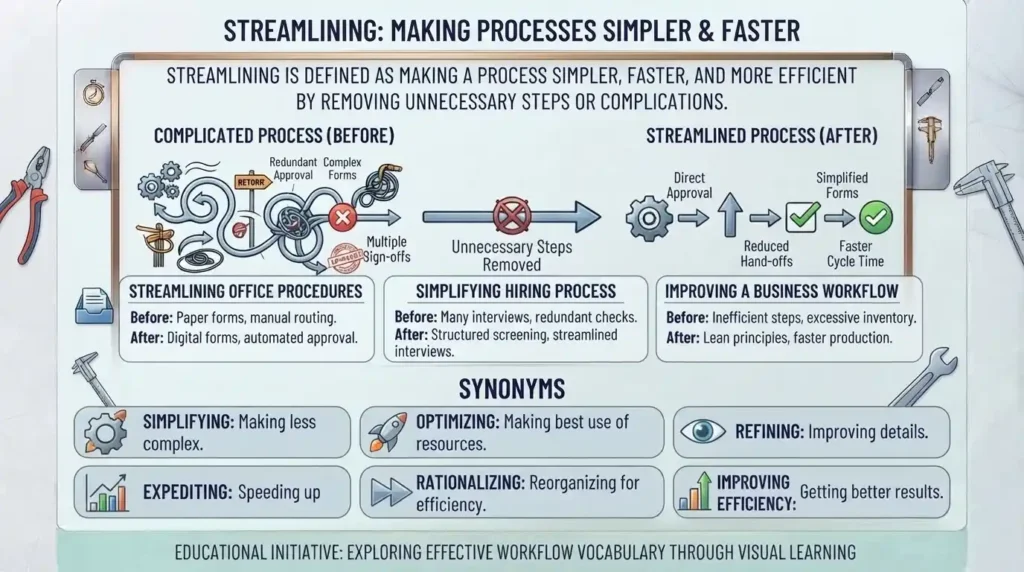
The term describes the act of making a system, process, or organization simpler, faster, and more efficient by removing unnecessary steps or obstacles. Originally borrowed from physics—where it meant shaping an object to reduce resistance in air or water—it now applies mostly to management, workflows, and daily tasks. It carries a distinctly positive and professional tone that implies smart progress and modern optimization. Native English speakers understand it as an active verb or noun referring to eliminating friction and saving time.
Part of Speech: Verb (Present Participle) / Noun (Gerund)
Simple Definition: The process of making a system or task simpler, faster, and more effective by removing unwanted steps.
Connotative Meaning
(Connotation is the emotional feeling or cultural association that a word carries beyond its literal dictionary definition.)
- Positive tone: “Streamlining customer support reduced waiting times significantly.” (Evokes efficiency, progress, and customer satisfaction)
- Negative tone: “Critics feared that streamlining the department meant sudden job cuts.” (Evokes corporate downsizing or clinical coldness)
- Neutral tone: “The team is streamlining the file-archiving process this week.” (Evokes routine organizational maintenance)
Etymology
The word roots trace back to Late Middle English streem, combined with the physical concept of a line.
- Old English (450–1100): Strēam referred to a flowing body of water or current.
- Middle English (1100–1500): Strem evolved to mean directional movement or fluid path.
- Modern English (1500–Present): In the 19th and 20th centuries, “streamline” entered engineering to describe aerodynamic designs that move smoothly through fluid. By the mid-20th century, business leaders adopted it figuratively to describe smoothing out business procedures.
Syllables & Structure
- Syllables: stream-lin-ing (3 syllables)
- Root: stream
- Prefix: None
- Suffix: -line (combining form), -ing (participle/gerund suffix)
Synonyms List for Streamlining
1. Simplifying (Verb/Gerund)
Meaning: Making a complex process easier to understand or do by removing difficulty.
Tone/Register: Neutral, Everyday, Professional
Examples:
- Simplifying our onboarding process helped new hires settle in faster.
- She excels at simplifying complex technical ideas for general audiences.
2. Optimizing (Verb/Gerund)
Meaning: Making something as effective, perfect, or useful as possible.
Tone/Register: Business, Technical, Academic
Examples:
- Optimizing supply chain routes reduced our delivery times dramatically.
- Engineers spent weeks optimizing the software code for mobile devices.
3. Expediting (Verb/Gerund)
Meaning: Accelerating the progress of an action or process to happen faster.
Tone/Register: Formal, Business, Legal
Examples:
- Expediting passport applications required extra processing fees and staff.
- The team worked overnight, expediting shipment orders before the holidays.
4. Refining (Verb/Gerund)
Meaning: Improving a system by making small, precise changes to remove flaws.
Tone/Register: Professional, Academic, Artistic
Examples:
- Refining the editorial workflow improved the overall quality of articles.
- Artisans spent years refining their glassblowing techniques to perfection.
5. Rationalizing (Verb/Gerund)
Meaning: Reorganizing a process or system logically to eliminate waste.
Tone/Register: Formal, Corporate, Academic
Examples:
- Rationalizing company expenditure helped prevent unnecessary budget losses.
- Executives focused on rationalizing administrative duties across branches.
6. Systematizing (Verb/Gerund)
Meaning: Arranging tasks or rules into an organized, repeatable system.
Tone/Register: Formal, Business
Examples:
- Systematizing daily inventory checks reduced manual counting errors.
- She built a great career by systematizing customer outreach methods.
7. Modernizing (Verb/Gerund)
Meaning: Updating an old system with current methods, ideas, or equipment.
Tone/Register: Neutral, Professional, Public Sector
Examples:
- Modernizing the city transit network attracted thousands of daily commuters.
- The school district began modernizing its library record systems.
8. Accelerating (Verb/Gerund)
Meaning: Causing a process or project to move or happen much quicker.
Tone/Register: Business, General
Examples:
- Accelerating production helped the factory fulfill winter demands on time.
- Digital tools are accelerating research in medical laboratories worldwide.
9. Trimming (Verb/Gerund)
Meaning: Cutting away unnecessary parts, steps, or expenses from a whole.
Tone/Register: Informal, Casual, Business
Examples:
- Trimming redundant approval steps shortened project delivery times.
- The manager suggested trimming unnecessary subscription costs immediately.
10. Centralizing (Verb/Gerund)
Meaning: Bringing diverse operations or control under a single management point.
Tone/Register: Corporate, Political, Administrative
Examples:
- Centralizing data storage improved security and accessibility for all teams.
- The university succeeded by centralizing student admissions across faculties.
11. Automating (Verb/Gerund)
Meaning: Converting a manual process to run automatically using technology.
Tone/Register: Technical, Business
Examples:
- Automating monthly billing cycles saved dozens of admin hours each week.
- The team is automating basic email responses to handle common queries.
12. Standardizing (Verb/Gerund)
Meaning: Bringing objects or operations into agreement with an established norm.
Tone/Register: Technical, Formal, Industrial
Examples:
- Standardizing safety checks across factories significantly lowered accidents.
- Teachers worked together on standardizing grading criteria for finals.
13. Pruning (Verb/Gerund)
Meaning: Removing unwanted or unproductive elements carefully from a system.
Tone/Register: Descriptive, Business, Creative
Examples:
- Pruning inactive subscriber email lists improved newsletter open rates.
- Management started pruning unnecessary budget items before next quarter.
14. Uncluttering (Verb/Gerund)
Meaning: Removing messy, extra, or confusing items to restore clarity.
Tone/Register: Casual, Everyday
Examples:
- Uncluttering your workspace can greatly boost your daily productivity.
- The designer focused on uncluttering the homepage layout for users.
15. Speeding Up (Verb/Gerund Phrase)
Meaning: Increasing the rate or velocity at which an activity occurs.
Tone/Register: Informal, Everyday
Examples:
- Speeding up invoice processing keeps our suppliers happy and loyal.
- The new update focuses on speeding up app loading times on phones.
16. Smoothing (Verb/Gerund)
Meaning: Removing roughness, interruptions, or friction from a process.
Tone/Register: Descriptive, General
Examples:
- Smoothing transition phases made the corporate merger run smoothly.
- Soft skill workshops help in smoothing communication between departments.
17. Reorganizing (Verb/Gerund)
Meaning: Changing the structure or arrangement of a system for better function.
Tone/Register: Professional, Corporate
Examples:
- Reorganizing the digital filing cabinet made documents easy to find.
- The firm spent the summer reorganizing its creative design division.
18. Consolidating (Verb/Gerund)
Meaning: Combining multiple operational units or ideas into one solid whole.
Tone/Register: Formal, Financial, Business
Examples:
- Consolidating branch offices reduced lease overhead costs by half.
- The author succeeded by consolidating three notes into one master guide.
19. Harmonizing (Verb/Gerund)
Meaning: Bringing different working parts or rules into pleasing agreement.
Tone/Register: Literary, Diplomatic, Formal
Examples:
- Harmonizing cross-border tax laws encouraged trade among nations.
- The conductor spent hours harmonizing orchestra section schedules.
20. Restructuring (Verb/Gerund)
Meaning: Altering the basic organization or financial structure of a system.
Tone/Register: Corporate, Financial
Examples:
- Restructuring debt payments allowed the small business to stay open.
- The director led team restructuring to adapt to remote work trends.
21. Coordinating (Verb/Gerund)
Meaning: Organizing different elements or people so they work together smoothly.
Tone/Register: Professional, General
Examples:
- Coordinating event logistics required clear communication and teamwork.
- The software excels at coordinating multi-calendar schedules easily.
22. Facilitating (Verb/Gerund)
Meaning: Making an action or process easy or easier to accomplish.
Tone/Register: Academic, Formal, Business
Examples:
- Facilitating open discussions helped resolve team conflicts quickly.
- New government policies are facilitating green energy investments.
23. Integrating (Verb/Gerund)
Meaning: Combining two or more things so that they work as a unified unit.
Tone/Register: Technical, Corporate
Examples:
- Integrating cloud storage into the app simplified user file backups.
- The company succeeded after integrating customer service with sales.
24. Paring Down (Verb/Gerund Phrase)
Meaning: Gradually reducing the size, quantity, or extent of something carefully.
Tone/Register: Descriptive, Casual
Examples:
- Paring down the meeting agenda kept discussions focused and brief.
- She started paring down her wardrobe before moving to a smaller flat.
25. Updating (Verb/Gerund)
Meaning: Making a system or object more modern by incorporating new information.
Tone/Register: General, Casual, Technical
Examples:
- Updating security policies protected the business against new cyber threats.
- The team spent yesterday updating old training manuals for recruits.
26. Improving (Verb/Gerund)
Meaning: Elevating the value, quality, or performance of a specific operation.
Tone/Register: General, Positive
Examples:
- Improving customer feedback loops raised product satisfaction scores.
- Daily practice is the most reliable method for improving language skills.
27. Re-engineering (Verb/Gerund)
Meaning: Redesigning a core business process from scratch to boost results.
Tone/Register: Business, Industrial, Academic
Examples:
- Re-engineering the engine assembly line doubled output within months.
- Consultants suggested re-engineering client intake procedures.
28. Organizing (Verb/Gerund)
Meaning: Arranging elements into a structured, orderly, and functional whole.
Tone/Register: General, Everyday
Examples:
- Organizing research notes makes drafting academic essays much faster.
- She loves organizing community events that bring neighbors together.
29. Fine-tuning (Verb/Gerund)
Meaning: Making tiny, precise adjustments to achieve maximum performance.
Tone/Register: Casual, Technical, Creative
Examples:
- Fine-tuning audio settings guaranteed crystal-clear concert sound.
- The chef spent weeks fine-tuning the recipe for the signature dish.
30. Polishing (Verb/Gerund)
Meaning: Refining or improving a process to make it elegant and faultless.
Tone/Register: Creative, General
Examples:
- Polishing your sales pitch helps you win client confidence quickly.
- The team put final touches on the project, polishing the user interface.
31. Upgrading (Verb/Gerund)
Meaning: Raising a system to a higher standard, version, or capability.
Tone/Register: Technical, Casual
Examples:
- Upgrading server hardware prevented website crashes during sales.
- The hotel chain started upgrading room facilities across all locations.
32. Regulating (Verb/Gerund)
Meaning: Controlling or maintaining the speed, quantity, or rate of a system.
Tone/Register: Legal, Technical, Academic
Examples:
- Regulating office temperatures reduced winter energy waste.
- The agency oversees the regulation of financial disclosures for public safety.
33. Aligning (Verb/Gerund)
Meaning: Adjusting parts so they line up correctly or work toward one goal.
Tone/Register: Corporate, Strategic
Examples:
- Aligning team goals with company vision increased overall focus.
- The mechanic spent an hour aligning the car wheels for safety.
34. Slashing (Verb/Gerund)
Meaning: Drastically and aggressively reducing amounts, steps, or costs.
Tone/Register: Informal, Dramatic, Journalistic
Examples:
- Slashing red tape encouraged local entrepreneurs to launch businesses.
- The store advertised huge savings after slashing prices on old stock.
35. Tailoring (Verb/Gerund)
Meaning: Customizing a system or task to fit specific requirements exactly.
Tone/Register: Professional, Business
Examples:
- Tailoring software features to user needs boosted active engagement.
- The tutor recommended tailoring study schedules around exam dates.
36. Cutting Back (Verb/Gerund Phrase)
Meaning: Reducing the total amount, size, or cost of an ongoing operation.
Tone/Register: Casual, Everyday
Examples:
- Cutting back on long status meetings gave developers time to code.
- Families are cutting back on dining out during tough economic times.
37. Shortening (Verb/Gerund)
Meaning: Decreasing the length of time, distance, or steps needed for a task.
Tone/Register: Neutral, General
Examples:
- Shortening approval chains allowed teams to launch features faster.
- Taking the highway helps shorten daily commute times greatly.
38. Straightening (Verb/Gerund)
Meaning: Making a confused or messy situation clear, neat, and organized.
Tone/Register: Casual, Descriptive
Examples:
- Straightening project accounts cleared up confusion among investors.
- She spent the afternoon straightening out supply order errors.
39. Synchronizing (Verb/Gerund)
Meaning: Causing multiple actions or systems to operate at the same time.
Tone/Register: Technical, Formal
Examples:
- Synchronizing cloud databases ensured real-time updates everywhere.
- The dancers spent weeks synchronizing movements for the show.
40. Condensing (Verb/Gerund)
Meaning: Expressing an idea or process in fewer words or shorter steps.
Tone/Register: Academic, Literary, Business
Examples:
- Condensing the quarterly report saved board members valuable time.
- The editor excelled at condensing long manuscripts into crisp books.
41. Mobilizing (Verb/Gerund)
Meaning: Organizing resources or people effectively for quick readiness.
Tone/Register: Strategic, Formal, Political
Examples:
- Mobilizing emergency crews quickly saved lives during the flood.
- The non-profit succeeded by mobilizing volunteers via mobile apps.
42. Digitizing (Verb/Gerund)
Meaning: Converting paper or physical processes into digital formats.
Tone/Register: Technical, Business
Examples:
- Digitizing medical records allowed doctors to access histories instantly.
- The library started digitizing rare historical documents for safety.
43. Simplifying (Verb/Gerund)
Meaning: Reducing clutter or unnecessary elements to make something clear.
Tone/Register: General, Casual
Examples:
- Simplifying user navigation improved website traffic and time.
- He focuses on simplifying daily routines to manage personal stress.
44. Marshalling (Verb/Gerund)
Meaning: Gathering and arranging facts, troops, or ideas in neat order.
Tone/Register: Formal, Literary, Legal
Examples:
- Marshalling evidence effectively helped the attorney win the trial.
- The manager showed skill in marshalling resources for new projects.
45. Standardizing (Verb/Gerund)
Meaning: Making sure all units conform to identical operational rules.
Tone/Register: Technical, Industrial
Examples:
- Standardizing service templates ensured high customer care quality.
- The franchise succeeded by standardizing kitchen preparation tasks.
46. Revamping (Verb/Gerund)
Meaning: Renovating, revising, or restructuring a system to give it a fresh look.
Tone/Register: Casual, Marketing, Creative
Examples:
- Revamping the brand identity attracted a much younger audience.
- The school began revamping its cafeteria menu to offer health options.
47. Overhauling (Verb/Gerund)
Meaning: Completely dismantling and rebuilding a system to restore function.
Tone/Register: Technical, Business
Examples:
- Overhauling the IT infrastructure eliminated frequent system outages.
- The government proposed overhauling tax regulations for small firms.
48. Minimizing (Verb/Gerund)
Meaning: Reducing something unwanted, such as waste or delay, to the smallest degree.
Tone/Register: Academic, Technical, General
Examples:
- Minimizing packaging waste lowered shipping expenses for the store.
- Good planning focuses on minimizing risks before project launch.
49. Clarifying (Verb/Gerund)
Meaning: Making a process or statement easier to understand by removing confusion.
Tone/Register: Professional, Academic
Examples:
- Clarifying team roles prevented overlapping tasks among developers.
- The policy guide helped in clarifying vacation request procedures.
50. Whittling Down (Verb/Gerund Phrase)
Meaning: Reducing a large quantity or complex system step-by-step.
Tone/Register: Casual, Idiomatic
Examples:
- Whittling down candidate applications took the committee three days.
- He worked diligently on whittling down his personal debt balance.
51. Streamlining (Verb/Gerund)
Meaning: Smoothing and simplifying a workflow to maximize throughput.
Tone/Register: Professional, Business
Examples:
- Streamlining factory assembly lines boosted daily output by twenty percent.
- Our team focuses on streamlining software updates for global users.
52. Filtering (Verb/Gerund)
Meaning: Removing unwanted elements or information from a flowing system.
Tone/Register: Technical, Casual
Examples:
- Filtering spam emails protected employees from potential phishing scams.
- The software excels at filtering search results by user preference.
53. Unloading (Verb/Gerund)
Meaning: Removing a burden, excess work, or non-essential tasks from someone.
Tone/Register: Informal, Casual
Examples:
- Unloading routine data entry duties freed up senior analysts for strategy.
- Delegation is about unloading minor tasks so you can focus on growth.
54. Directing (Verb/Gerund)
Meaning: Guiding operations or steps straight toward a clear target.
Tone/Register: Professional, General
Examples:
- Directing customer traffic to self-service portals cut phone wait times.
- She spent the morning directing setup crews for the outdoor conference.
55. Accelerating (Verb/Gerund)
Meaning: Speeding up the execution of a business or technical process.
Tone/Register: Business, Strategic
Examples:
- Accelerating innovation cycles helped the startup beat competitors.
- New machinery plays a key role in accelerating output in the workshop.
56. Narrowing (Verb/Gerund)
Meaning: Reducing the scope or options of a process to focus effort.
Tone/Register: General, Academic
Examples:
- Narrowing research questions helped the student draft a strong thesis.
- The committee succeeded after narrowing vendor choices down to two.
57. Compacting (Verb/Gerund)
Meaning: Pressing or packing parts together to take up less space or time.
Tone/Register: Technical, Formal
Examples:
- Compacting data files enabled faster transfers across slow networks.
- The team worked on compacting two training modules into one morning.
58. Short-circuiting (Verb/Gerund)
Meaning: Bypassing lengthy intermediate steps to get immediate results.
Tone/Register: Casual, Idiomatic
Examples:
- Direct manager approval allowed short-circuiting of standard waiting times.
- Innovation often means short-circuiting traditional design steps.
59. Sweeping Away (Verb/Gerund Phrase)
Meaning: Eliminating outdated rules, obstacles, or red tape.
Tone/Register: Dramatic, Descriptive
Examples:
- Sweeping away bureaucratic delays invigorated local business growth.
- The new manager started by sweeping away unnecessary reporting sheets.
60. Cleaving (Verb/Gerund)
Meaning: Cutting through or dividing away unwanted material cleanly.
Tone/Register: Formal, Literary
Examples:
- Cleaving away outdated corporate rules restored creative freedom.
- The sharp ship’s bow was cleaving through icy waters effortlessly.
61. Modernizing (Verb/Gerund)
Meaning: Bringing systems up to modern operational standards.
Tone/Register: Professional, Corporate
Examples:
- Modernizing payroll systems ensured error-free direct deposits.
- Urban planners are modernizing public park maintenance schedules.
62. Speed-tracking (Verb/Gerund)
Meaning: Placing a priority project on a fast route to quick completion.
Tone/Register: Casual, Business
Examples:
- Speed-tracking emergency permits helped rebuild the bridge in weeks.
- The board agreed on speed-tracking product safety tests this month.
63. De-cluttering (Verb/Gerund)
Meaning: Removing messy or useless items from a space or process.
Tone/Register: Casual, Everyday
Examples:
- De-cluttering your inbox every evening reduces morning workplace stress.
- The developer started de-cluttering old code lines from the script.
64. Fast-tracking (Verb/Gerund)
Meaning: Giving high priority to a project to skip normal delays.
Tone/Register: Business, Public Policy
Examples:
- Fast-tracking visa reviews boosted international tourism significantly.
- The hospital is fast-tracking critical care patient intake routines.
65. Re-structuring (Verb/Gerund)
Meaning: Systematically changing operations to increase overall efficiency.
Tone/Register: Corporate, Professional
Examples:
- Restructuring sales territories helped representatives cover more leads.
- The organization survived by restructuring management levels quickly.
Synonyms for “Streamlining” by Tone
Choosing the correct word tone ensures your writing feels natural and fits your intended audience.
Positive Tone
- Optimizing: Highlights maximum quality, intelligent design, and peak performance.
- Refining: Evokes elegance, precision, and high-level craftsmanship.
- Harmonizing: Suggests peaceful cooperation and smooth alignment.
- Modernizing: Creates impressions of progress, innovation, and forward motion.
Neutral Tone
- Simplifying: Direct, plain, and accessible word for making things easier.
- Standardizing: Objective term indicating systematic rule alignment.
- Centralizing: Structural term focused on organizational arrangement.
- Consolidating: Factual word describing the combination of distinct parts.
Negative Tone
- Slashing: Implies aggressive, extreme, or potentially harmful cuts.
- Trimming: Can carry cold corporate tones when associated with layoffs.
- Rationalizing: Often used as corporate jargon for job cuts or austerity.
- Paring Down: Suggests scarcity or harsh reduction under pressure.
“Streamlining” vs Close Alternatives
Streamlining vs Simplifying
- Meaning: “Streamlining” focuses specifically on efficiency, speed, and flow within a system. “Simplifying” means making something easier to do or understand, even if speed is not the primary goal.
- Tone: “Streamlining” is corporate, modern, and business-oriented. “Simplifying” is casual, general, and widely accessible.
- Usage: Use “streamlining” when discussing workflows or business operations. Use “simplifying” when explaining ideas, instructions, or user interfaces.
Optimizing vs Streamlining
- Meaning: “Streamlining” achieves results mainly by removing excess steps or friction. “Optimizing” involves adjusting all variables—adding, tweaking, or tuning—to reach peak performance.
- Tone: “Streamlining” emphasizes speed and reduction. “Optimizing” implies high-level technical or mathematical perfection.
- Usage: Use “streamlining” for administrative tasks or checkout processes. Use “optimizing” for engine performance, algorithms, or yield management.
How “Streamlining” Changes by Context
Daily Conversation
In casual speech, people use the term to talk about saving personal time or organizing household tasks. You might mention “streamlining my morning routine” so you can leave the house faster without stress.
Writing or Blogging
Bloggers and content marketers use this word to promise practical value to readers. Writing about “streamlining content creation” promises actionable tips that save readers time and energy.
Professional or Academic Tone
In corporate strategy or academic papers, writers use this term to signal operational efficiency. Executives report on “streamlining administrative overhead” to impress investors and stakeholders.
Creative or Informal Use
In creative storytelling, the word can describe sleek movement or rapid character action. A writer might describe a protagonist “streamlining her movements” to slip through a crowded subway station unnoticed.
Common Mistakes Learners Make
Confusing “Streamlining” with Simple “Cuttings”
Learners often assume the word simply means deleting things. True streamlining removes only unnecessary steps to improve overall flow; deleting vital steps damages the system.
Mixing Up Formal and Informal Registers
Using aggressive terms like “slashing” in academic research papers sounds overly dramatic. Stick to terms like “optimizing” or “rationalizing” for formal reports, and keep “slashing” for news headlines.
Overusing the Primary Keyword
Repeating the exact focus keyword in every paragraph makes your writing feel mechanical. Rotate naturally between terms like “optimizing,” “refining,” or “simplifying.” For more tips on diversifying your business vocabulary, check out our guide on professional writing techniques to master contextual word choice.
Real-Life Mini Scenarios
- Workplace: “The team began streamlining project approvals by replacing paper forms with digital signatures.”
- Social Situations: “She suggested streamlining group chat plans by creating a single shared event link.”
- Media / Pop Culture: “Tech journalists praised the new operating system for streamlining notification settings.”
- Writing or Storytelling: “The editor helped the author by streamlining the novel’s slow middle chapters.”
Conclusion
Mastering a synonym for streamlining can quickly expand your vocabulary. Learning new words can easily transform flat writing into vivid, sensory descriptions.
Using a synonym for streamlining helps bloggers, students, and writers connect better with readers. Clear word choices make your communication stand out.
Try replacing basic words with a synonym for streamlining in daily emails or essays. Small language shifts create stronger, more engaging visual scenes.
Start practicing these new descriptive terms in your daily writing today! Take a moment to test your favorite synonym in a sentence right now.
Interactive Practice Quiz
1. What does “streamlining” mean?
A) Making a process simpler and more efficient
B) Making something more complicated
C) Delaying a process
D) Removing all useful steps
2. Which word is closest in meaning to “streamlining”?
A) Simplifying
B) Confusing
C) Delaying
D) Expanding
3. Which synonym means making something work better?
A) Optimizing
B) Hiding
C) Weakening
D) Slowing
4. What does streamlining a process usually involve?
A) Removing unnecessary steps
B) Adding extra delays
C) Creating more paperwork
D) Making instructions harder
5. Which word can replace “streamlining” in a business context?
A) Rationalizing
B) Complicating
C) Interrupting
D) Postponing
6. Which word means reducing unnecessary complexity?
A) Simplifying
B) Enlarging
C) Scattering
D) Separating
7. “The company is streamlining its hiring process.” What does this mean?
A) The company is making hiring faster and more efficient.
B) The company is stopping all hiring.
C) The company is making hiring more difficult.
D) The company is increasing unnecessary steps.
8. Which synonym best fits “streamlining a workflow”?
A) Optimizing
B) Disrupting
C) Delaying
D) Complicating
9. Which word describes improving efficiency by removing unnecessary work?
A) Streamlining
B) Confusion
C) Expansion
D) Interruption
10. Which option is NOT a synonym for “streamlining”?
A) Simplifying
B) Optimizing
C) Expediting
D) Complicating
Part 2: Usage & Context
11. Choose the best synonym for “streamlining” in this sentence:
“The manager focused on streamlining the office procedures.”
A) Simplifying
B) Complicating
C) Delaying
D) Expanding
12. Which sentence uses “streamlining” correctly?
A) We are streamlining the process to save time.
B) We are streamlining the process by adding unnecessary steps.
C) She streamlined the problem by making it more confusing.
D) He streamlined the meeting by making everyone wait longer.
13. Which word best replaces “streamlining” here?
“The new software helps with streamlining daily tasks.”
A) Optimizing
B) Hiding
C) Stopping
D) Separating
14. A company streamlines its operations mainly to:
A) Increase efficiency
B) Create more delays
C) Increase unnecessary work
D) Make tasks harder
15. Which synonym means “making a process faster”?
A) Expediting
B) Slowing
C) Blocking
D) Extending
16. “The team streamlined the reporting system.” This means the team:
A) Made the reporting system more efficient
B) Removed the reporting system completely
C) Made the system more confusing
D) Stopped employees from reporting
17. Which word best completes the sentence?
“The hospital is ______ its administrative procedures to reduce delays.”
A) Streamlining
B) Complicating
C) Ignoring
D) Expanding
18. Which pair contains similar meanings?
A) Streamlining — Simplifying
B) Streamlining — Delaying
C) Streamlining — Complicating
D) Streamlining — Confusing
19. Which action represents streamlining?
A) Removing duplicate approval steps
B) Adding unnecessary forms
C) Increasing waiting time
D) Repeating the same task
20. What is the main goal of streamlining?
A) To make a process simpler and more efficient
B) To make a process longer
C) To increase confusion
D) To add unnecessary procedures
✅ Answer Key
- A
- A
- A
- A
- A
- A
- A
- A
- A
- D
- A
- A
- A
- A
- A
- A
- A
- A
- A
- A
FAQs
1. What is the most common synonym for streamlining in business?
The most common business synonyms are “optimizing,” “simplifying,” and “consolidating,” as they clearly convey increased efficiency and operational clarity without sounding aggressive.
2. Can “streamlining” be used when referring to reducing staff?
Yes, companies often use “streamlining” as a polite term for corporate downsizing, though words like “restructuring” or “reorganizing” appear just as frequently in formal press releases.
3. What is the difference between streamlining and automating?
Streamlining means removing unnecessary steps from a workflow, which can be done manually or digitally. Automating specifically means using technology or machines to perform steps without human intervention.
4. Is “streamlining” a formal or informal word?
It is a flexible word that fits professional, academic, and business registers, though it is clear and simple enough for everyday casual speech and blogging.
5. Which synonym for streamlining works best in resume writing?
Strong action verbs like “optimized,” “expedited,” “centralized,” or “restructured” work exceptionally well on resumes because they clearly quantify professional achievement and initiative.
6. How does streamlining improve SEO content quality?
Using semantic variations of streamlining prevents keyword stuffing, improves readability scores, and helps search engines understand the depth and authority of your informational article.

Sophia Carter is the founder and lead writer at SynonymVerse.com, a trusted online resource dedicated to English vocabulary and effective communication. She is passionate about helping students, writers, professionals, and lifelong learners find the most accurate words to express their ideas with clarity and confidence.
At SynonymVerse.com, every article is carefully researched and thoughtfully written to provide reliable guidance on synonyms, word meanings, and vocabulary. With a strong focus on accuracy, real-world usage, and easy-to-understand explanations, the website is committed to helping readers strengthen their language skills, enrich their vocabulary, and become more confident communicators.