Exploration covers everything from lab research to jungle treks, so the right synonym matters. If you’re after a synonym for exploration, Investigation, Discovery, and Research are the strongest options — each synonym for exploration below includes its meaning and real examples to help you use it with confidence.
Imagine visiting a new city without a map. You walk through unfamiliar streets, discover hidden cafés, and learn about local traditions. That experience is an exploration of a new place.
The word exploration appears in travel writing, science, education, business, and everyday conversation. It describes both physical journeys and the process of learning about unfamiliar ideas.
Choosing the right synonym for exploration can make your writing clearer and more engaging. Students can improve essays, while bloggers and content writers can avoid repeating the same word.
Learning these alternatives also helps daily English users express curiosity, research, and discovery more precisely. A small vocabulary change can make a sentence feel more natural and meaningful.
What Does “Exploration” Really Mean?
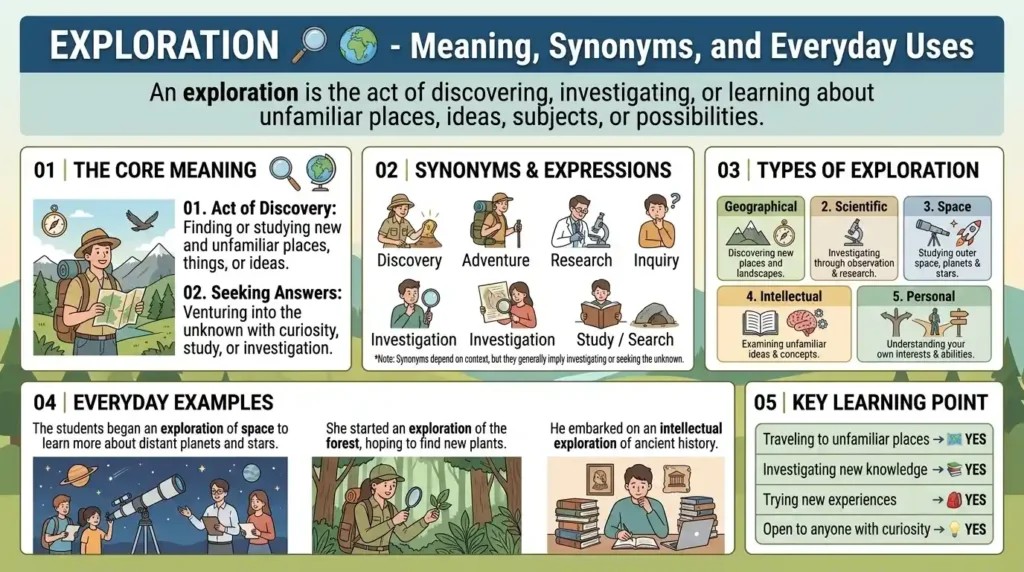
Exploration means the act of examining an unfamiliar place, subject, idea, or situation to discover information or gain understanding.
It can involve travelling to an unknown location, studying a scientific question, testing a new business idea, or examining your own thoughts and feelings.
The word usually carries a neutral or positive tone. It often suggests curiosity, learning, progress, and discovery. However, exploration can also involve danger, uncertainty, or intrusion when people enter places without permission.
Part of speech: Noun.
Simple definition: The process of discovering, investigating, or learning about something unfamiliar.
Examples in Everyday English
- The team began an exploration of new teaching methods.
- Our exploration of the old town revealed several historic buildings.
- The book encourages the exploration of personal identity.
- Scientists continue their exploration of distant planets.
Native English speakers use exploration when they want to describe a process rather than just a single result. The word can refer to a journey, an investigation, or an open-ended learning experience.
Connotative Meaning of Exploration
Connotation (the feelings or associations connected with a word beyond its basic dictionary meaning) helps explain why some alternatives sound more suitable than others.
Positive Tone
Exploration can suggest curiosity, opportunity, creativity, and personal growth.
Example: The exploration of new ideas helped the students develop innovative solutions.
Negative Tone
In some contexts, exploration may suggest intrusion, risk, or unwanted interference.
Example: The unauthorized exploration of the private property upset its owner.
Neutral Tone
The word can describe a process without expressing approval or disapproval.
Example: The report includes an exploration of three possible solutions.
Etymology and Word History
The English word exploration comes through French from Latin explorare, meaning to investigate, search out, or examine. The related Latin noun exploratio refers to the act of investigating.
Old English Period (450–1100)
The modern word exploration was not an established English term during this period. English speakers used other vocabulary to express searching, seeking, and discovering.
Middle English Period (1100–1500)
French and Latin influenced English vocabulary following the Norman Conquest. Words connected with investigation and discovery gradually became more common in formal and scholarly language.
Modern English Period (1500–Present)
Exploration became increasingly useful in scientific, geographical, and intellectual writing. Today, it describes everything from space missions and medical research to creative thinking and personal development.
Pronunciation, Syllables, and Word Structure
US pronunciation: /ˌɛk.spləˈreɪ.ʃən/
UK pronunciation: /ˌek.spləˈreɪ.ʃən/
Syllables: ex-plo-ra-tion
Root: Explore
Prefix: No productive prefix in the modern English word exploration.
Suffix: -ation, which forms nouns describing an action, process, or result.
Word family:
- Explore (verb)
- Explorer (noun)
- Exploration (noun)
- Exploratory (adjective)
- Explorative (adjective)
Synonyms List
The following alternatives cover discovery, research, investigation, travel, and intellectual curiosity. Some are close synonyms, while others work only in particular contexts. Choose the word that matches your intended meaning.
Investigation (Noun)
Meaning: A systematic effort to discover facts or understand a situation.
Tone/Register: Neutral, professional, academic.
Example: The school began an investigation into the missing equipment.
The investigation uncovered several useful facts.
Discovery (Noun)
Meaning: The act of finding something previously unknown or unnoticed.
Tone/Register: Positive, neutral, educational.
Example: Her discovery of the hidden garden made the trip memorable.
Scientific discovery often begins with curiosity.
Research (Noun)
Meaning: A careful study of a subject to collect information and develop knowledge.
Tone/Register: Academic, professional, formal.
Example: His research examines how children learn new languages.
We need more research before making a decision.
Examination (Noun)
Meaning: A close inspection or careful study of something.
Tone/Register: Neutral, formal, academic.
Example: The report includes an examination of local housing conditions.
A closer examination revealed a small error.
Inquiry (Noun)
Meaning: An attempt to obtain information by asking questions or investigating a matter.
Tone/Register: Formal, professional.
Example: The committee launched an inquiry into the complaint.
Her inquiry led to a useful conversation.
Survey (Noun)
Meaning: A broad review or collection of information about a subject, area, or group.
Tone/Register: Academic, business, neutral.
Example: The survey explored how students use digital libraries.
We completed a survey of the neighborhood.
Study (Noun)
Meaning: A focused effort to understand a particular topic or problem.
Tone/Register: Neutral, academic.
Example: The study explores the effects of daily reading.
Her study of ancient art took several months.
Inspection (Noun)
Meaning: A careful check of a place, object, or system.
Tone/Register: Professional, practical.
Example: The engineer carried out an inspection of the bridge.
The inspection revealed damage near the entrance.
Search (Noun)
Meaning: An effort to find something or someone.
Tone/Register: Neutral, conversational.
Example: Our search for a quiet study space took an hour.
The search uncovered an excellent little library.
Quest (Noun)
Meaning: A determined journey or effort to achieve an important goal or find something valuable.
Tone/Register: Literary, inspirational.
Example: Her quest for knowledge led her to study several languages.
The novel follows a hero on a quest for truth.
Adventure (Noun)
Meaning: An exciting experience involving unfamiliar places, activities, or challenges.
Tone/Register: Positive, informal, creative.
Example: Their adventure through the mountains lasted three days.
Moving abroad became an unexpected adventure.
Journey (Noun)
Meaning: Travel from one place to another or a process of personal development.
Tone/Register: Neutral, inspirational.
Example: The documentary follows a journey through remote villages.
Learning a new skill is a rewarding journey.
Expedition (Noun)
Meaning: An organized journey undertaken for research, discovery, or a specific purpose.
Tone/Register: Formal, adventurous, scientific.
Example: The team planned an expedition to the Arctic.
Their expedition collected valuable environmental data.
Reconnaissance (Noun)
Meaning: A preliminary examination of an area to gather information before taking action.
Tone/Register: Technical, military, professional.
Example: The rescue team performed reconnaissance before entering the valley.
Their initial reconnaissance identified a safer route.
Reconnaissance mission (Noun phrase)
Meaning: A planned operation to gather information about an unfamiliar location or situation.
Tone/Register: Technical, military, adventurous.
Example: The crew began a reconnaissance mission over the coastline.
The mission helped them identify suitable landing areas.
Probing (Noun)
Meaning: A thorough attempt to uncover hidden facts or understand a difficult subject.
Tone/Register: Investigative, analytical.
Example: The article offers a probing look at workplace culture.
Her probing questions encouraged everyone to think more deeply.
Scrutiny (Noun)
Meaning: Close and critical examination of information, actions, or evidence.
Tone/Register: Formal, analytical.
Example: The proposal faced scrutiny from the review panel.
Under scrutiny, several weaknesses became clear.
Analysis (Noun)
Meaning: A detailed examination of information to understand its parts, patterns, or significance.
Tone/Register: Academic, professional.
Example: The analysis explored why sales had declined.
Their analysis revealed a clear pattern.
Review (Noun)
Meaning: A careful reconsideration or assessment of a subject, document, or situation.
Tone/Register: Neutral, professional.
Example: The team conducted a review of its current procedures.
The review suggested several improvements.
Assessment (Noun)
Meaning: A process of evaluating a situation, condition, or set of possibilities.
Tone/Register: Academic, professional.
Example: The assessment explored students’ reading abilities.
A thorough assessment helped the teacher plan lessons.
Appraisal (Noun)
Meaning: A considered evaluation of the value, quality, or nature of something.
Tone/Register: Formal, professional.
Example: The report provides an appraisal of the proposed changes.
Her appraisal highlighted both strengths and weaknesses.
Inquiry-based learning (Noun phrase)
Meaning: An educational approach in which learners ask questions and investigate answers.
Tone/Register: Educational, academic.
Example: Inquiry-based learning encourages exploration through practical questions.
The teacher used inquiry-based learning during the science lesson.
Experimentation (Noun)
Meaning: The process of testing new methods or ideas to discover what works.
Tone/Register: Scientific, creative, professional.
Example: Experimentation helped the designer find a better layout.
The laboratory encourages careful experimentation.
Testing (Noun)
Meaning: The act of trying or checking something to understand its performance or effects.
Tone/Register: Practical, technical.
Example: Testing different materials helped the team select a stronger option.
The testing phase revealed an unexpected problem.
Observation (Noun)
Meaning: The careful watching of people, events, or conditions to gain information.
Tone/Register: Academic, scientific, neutral.
Example: Observation helped the researcher understand classroom behavior.
Her observation revealed how the group worked together.
Fieldwork (Noun)
Meaning: Research conducted in a real-world setting rather than only in a classroom or laboratory.
Tone/Register: Academic, scientific, professional.
Example: The students conducted fieldwork in a coastal village.
Fieldwork gave them a better understanding of local life.
Reconnoitering (Noun)
Meaning: The act of examining an area to learn about its features or conditions before proceeding.
Tone/Register: Technical, formal, military.
Example: Reconnoitering the route helped the hikers plan their journey.
The team spent the morning reconnoitering the area.
Mapping (Noun)
Meaning: The process of charting an area, system, or set of relationships to understand its structure.
Tone/Register: Technical, geographical, analytical.
Example: Mapping the cave helped researchers understand its layout.
The project involves mapping local walking trails.
Traversal (Noun)
Meaning: The act of moving across or through an area, often to study or reach it.
Tone/Register: Technical, geographical.
Example: The traversal of the mountain range took several days.
The report describes the team’s traversal of the terrain.
Navigation (Noun)
Meaning: The process of finding and following a route through a place or system.
Tone/Register: Practical, technical.
Example: Navigation through the forest required a reliable map.
The app makes navigation through the city easier.
Travel (Noun)
Meaning: The act of moving between places, sometimes to experience unfamiliar environments.
Tone/Register: Neutral, everyday.
Example: Her travel through Southeast Asia introduced her to new cultures.
Travel can broaden your understanding of the world.
Wandering (Noun)
Meaning: Moving around without a fixed route or strict destination.
Tone/Register: Informal, reflective.
Example: Our wandering through the old market led us to a quiet courtyard.
A little wandering can reveal places you might otherwise miss.
Roaming (Noun)
Meaning: Moving freely across an area while looking around or experiencing different places.
Tone/Register: Informal, adventurous.
Example: Their roaming through the countryside brought unexpected discoveries.
The children spent the afternoon roaming around the garden.
Delving (Noun)
Meaning: The act of examining a subject deeply to uncover information or meaning.
Tone/Register: Academic, literary, analytical.
Example: The podcast is delving into the history of forgotten inventions.
Delving into the topic gave her a fresh perspective.
Pursuit (Noun)
Meaning: The continued effort to achieve, understand, or find something.
Tone/Register: Formal, motivational.
Example: The pursuit of knowledge shaped his career.
Her pursuit of answers continued after the meeting.
Venture (Noun)
Meaning: An undertaking that involves uncertainty, risk, or an unfamiliar experience.
Tone/Register: Business, adventurous.
Example: Starting the community garden was a new venture for the residents.
The venture introduced the team to unfamiliar challenges.
Excursion (Noun)
Meaning: A short trip made for pleasure, learning, or a particular purpose.
Tone/Register: Neutral, educational, recreational.
Example: The class took an excursion to a local museum.
Our weekend excursion included a visit to the lighthouse.
Pilgrimage (Noun)
Meaning: A journey to a place with religious, cultural, or deep personal significance.
Tone/Register: Religious, literary, reflective.
Example: The writer made a pilgrimage to the village where her favorite poet lived.
For him, visiting the historic library felt like a pilgrimage.
Probing investigation (Noun phrase)
Meaning: A detailed investigation designed to uncover deeper explanations or hidden facts.
Tone/Register: Formal, investigative.
Example: The documentary presents a probing investigation of the incident.
The newspaper published a probing investigation into the claims.
Intellectual inquiry (Noun phrase)
Meaning: A thoughtful investigation into ideas, principles, or difficult questions.
Tone/Register: Academic, philosophical.
Example: The course encourages intellectual inquiry rather than memorization.
Her intellectual inquiry led to a new research question.
Deep dive (Noun phrase)
Meaning: A detailed examination of a subject, usually to gain a thorough understanding.
Tone/Register: Informal, business, digital media.
Example: The blog offers a deep dive into sustainable fashion.
Our team held a deep dive into customer feedback.
Fact-finding (Noun)
Meaning: The process of collecting facts to understand a situation or make a decision.
Tone/Register: Professional, administrative.
Example: The committee began fact-finding before preparing its report.
The fact-finding process clarified what had happened.
Learning (Noun)
Meaning: The process of gaining knowledge or understanding through study or experience.
Tone/Register: Neutral, educational.
Example: Her exploration of local history became a valuable learning experience.
Hands-on learning helped the class understand the subject.
Intellectual exploration (Noun phrase)
Meaning: The examination of ideas, concepts, or questions to expand understanding.
Tone/Register: Academic, reflective.
Example: The essay encourages intellectual exploration of human identity.
The discussion became an intellectual exploration of fairness.
Self-discovery (Noun)
Meaning: The process of learning about your own feelings, values, abilities, or identity.
Tone/Register: Personal, reflective, positive.
Example: Solo travel gave him time for self-discovery.
Writing in a journal became part of her self-discovery.
Brainstorming (Noun)
Meaning: A group or individual activity that generates possible ideas or solutions.
Tone/Register: Informal, professional, creative.
Example: Our brainstorming session explored several campaign ideas.
Brainstorming helped the writers overcome a creative block.
Experiment (Noun)
Meaning: A test designed to learn something or discover the effect of a change.
Tone/Register: Scientific, practical, creative.
Example: The class ran an experiment to explore how plants respond to light.
The first experiment produced surprising results.
Digging (Noun)
Meaning: An informal expression for searching deeply for information, often through records or evidence.
Tone/Register: Informal, investigative.
Example: A little digging uncovered the story behind the old photograph.
Her digging through the archives revealed a forgotten letter.
Peering (Noun)
Meaning: The act of looking closely or carefully at something difficult to see.
Tone/Register: Descriptive, informal.
Example: Peering into the dark cave, the hikers noticed unusual markings.
He spent a few minutes peering through the microscope.
Reconnoitring (Noun)
Meaning: A British spelling variant of reconnoitering, referring to a preliminary survey of an area.
Tone/Register: Formal, technical, British English.
Example: Reconnoitring the site helped the group prepare for the climb.
The team finished reconnoitring before sunset.
Discovery process (Noun phrase)
Meaning: A sequence of actions through which someone finds information, identifies possibilities, or develops new understanding.
Tone/Register: Neutral, educational, professional.
Example: The discovery process began with a simple question.
Each stage of the discovery process produced new insights.
Synonyms for Exploration by Tone
Tone affects how readers interpret your message. A word that suits a scientific report may sound too formal in a friendly conversation.
Positive Synonyms
- Discovery
- Adventure
- Quest
- Journey
- Self-discovery
- Learning
- Intellectual exploration
Use these words when you want to emphasize curiosity, opportunity, growth, or exciting experiences.
Neutral Synonyms
- Investigation
- Research
- Examination
- Study
- Survey
- Observation
- Review
- Analysis
- Search
These choices work well in informative writing, explanations, and everyday descriptions.
Negative or Critical Synonyms
- Scrutiny
- Probing
- Digging
These words can suggest intrusive questioning, unwanted attention, or an uncomfortable level of examination in certain contexts. They are not inherently negative, so consider the surrounding sentence.
Playful or Informal Synonyms
- Adventure
- Wandering
- Roaming
- Deep dive
- Brainstorming
- Digging
These alternatives work well in casual conversation, blog posts, social media, and creative storytelling.
“Exploration” vs. Close Alternatives
| Word | Main difference | Best use |
|---|---|---|
| Exploration | Broad process of discovering or learning | Travel, ideas, science, personal growth |
| Investigation | Systematic search for facts or explanations | Problems, incidents, evidence |
| Research | Organized study to build knowledge | Academic work, reports, scientific topics |
| Discovery | Finding something previously unknown | New findings, achievements, surprises |
| Adventure | An exciting experience involving uncertainty | Travel stories, personal experiences |
Quick comparison: Exploration can be open-ended. Investigation usually seeks answers to a particular question. Research often follows a planned method. Discovery emphasizes what is found rather than the process itself.
How Exploration Changes by Context
Daily Conversation
Use exploration, search, journey, or adventure when discussing a new place or activity.
Example: “Our exploration of the neighborhood led us to a lovely bakery.”
In casual speech, looking around may sound more natural than a formal noun.
Writing and Blogging
Writers can use discovery, deep dive, investigation, or journey to create variety.
Example: “This guide takes readers on a journey through the basics of indoor gardening.”
Choose an alternative that preserves the intended meaning instead of replacing words mechanically.
Professional and Academic Writing
Research, analysis, examination, and inquiry often suit formal documents.
Example: “The report presents an analysis of current teaching practices.”
For scientific work, use experiment, fieldwork, or investigation when those terms accurately describe the method.
Creative and Informal Writing
Quest, adventure, wandering, and self-discovery can add emotion or narrative movement.
Example: “Her summer became a quest to understand her family’s history.”
These words help readers picture a journey or connect with a character’s experience.
Common Mistakes Learners Make
Using Every Synonym Interchangeably
Not every alternative fits every sentence. An expedition is usually an organized journey, while research involves a focused study. Replacing one with the other can change the meaning.
Using Formal Words in Casual Situations
Saying “I conducted an examination of the shopping mall” sounds unnecessarily formal in everyday conversation. “I looked around the mall” is more natural.
Confusing the Process With the Result
Exploration refers to the process of investigating or discovering. Discovery often refers to the finding itself.
Example: “The exploration took weeks, but the discovery changed the project.”
Choosing Words Only for Variety
Avoid replacing exploration with an unfamiliar word just to prevent repetition. Clear communication matters more than using complicated vocabulary.
Overusing “Deep Dive”
Deep dive is common in modern business and online writing, but it can feel informal in scholarly work. Prefer detailed analysis or thorough examination when the setting requires a formal register.
Register Notes: Formal vs. Informal English
Formal alternatives include investigation, inquiry, analysis, examination, and intellectual exploration. These often work in reports, essays, research papers, and professional discussions.
Informal alternatives include looking around, digging, wandering, and deep dives. These suit conversation, personal blogs, and relaxed storytelling.
Spoken English often favors short expressions. Written English allows more specific terms when the subject and audience call for them.
For related vocabulary practice, you can also explore articles about synonyms for discovery, investigation, and research on your vocabulary website.
Real-Life Mini Scenarios
Workplace
A marketing team explores different ways to reach new readers. In a report, the same activity might be described as research or an analysis of audience preferences.
Social Situations
A visitor explores a new neighborhood and discovers a family-owned restaurant. In a casual conversation, the person may simply say they wandered around the area.
Media and Pop Culture
A documentary explores the mysteries of the ocean. A review might call it an investigation into marine life or a journey into an unfamiliar world.
Writing and Storytelling
A novel follows a character on a quest to understand a family secret. The character’s gradual self-discovery becomes an important part of the story.
Interactive Practice
Select the most suitable answer for each situation. Check the answer key after completing all questions.
1. A scientist carefully studies how plants grow under different lights. Which word fits best?
A. Adventure
B. Research
C. Wandering
D. Pilgrimage
2. A journalist tries to find out who caused a serious incident. Which word is most appropriate?
A. Investigation
B. Excursion
C. Roaming
D. Self-discovery
3. A family visits unfamiliar streets while enjoying a holiday. Which alternative sounds natural?
A. Scrutiny
B. Fact-finding
C. Adventure
D. Appraisal
4. A student discovers a new interest while learning about personal strengths. Which term fits best?
A. Inspection
B. Self-discovery
C. Reconnaissance
D. Traversal
5. A committee collects facts before deciding what happened. Which term should it use?
A. Brainstorming
B. Wandering
C. Fact-finding
D. Journey
6. A blogger writes a detailed article about how electric cars work. Which phrase is suitable for an informal headline?
A. Deep dive
B. Pilgrimage
C. Roaming
D. Excursion
7. An engineer checks a bridge for damage. Which word best describes the task?
A. Quest
B. Inspection
C. Adventure
D. Self-discovery
8. A group travels to a remote region to collect scientific information. Which word is most accurate?
A. Expedition
B. Brainstorming
C. Appraisal
D. Review
9. A teacher asks learners to develop ideas by suggesting many possible solutions. What is this activity called?
A. Scrutiny
B. Navigation
C. Brainstorming
D. Traversal
10. A researcher watches children in a classroom and records their behavior. Which word is the best fit?
A. Observation
B. Venture
C. Quest
D. Roaming
Part Two
11. A formal report evaluates the strengths and weaknesses of a proposal. Which word works best?
A. Wandering
B. Appraisal
C. Adventure
D. Digging
12. A hiker studies an unfamiliar area before choosing a safe route. Which term is most precise?
A. Reconnaissance
B. Self-discovery
C. Learning
D. Brainstorming
13. A student carefully examines evidence to identify patterns. Which word fits best?
A. Journey
B. Analysis
C. Excursion
D. Pilgrimage
14. A person walks through a town without a fixed destination and enjoys unexpected sights. Which word is most suitable?
A. Scrutiny
B. Testing
C. Wandering
D. Investigation
15. An essay considers difficult questions about human identity and meaning. Which phrase best describes this process?
A. Intellectual inquiry
B. Navigation
C. Inspection
D. Reconnoitering
Answer Key: 1-B, 2-A, 3-C, 4-B, 5-C, 6-A, 7-B, 8-A, 9-C, 10-A, 11-B, 12-A, 13-B, 14-C, 15-A.
Reflection Task
Write two original sentences about a subject you enjoy learning about. Use exploration in one sentence and a suitable synonym in the other. Explain why you chose that alternative.
FAQs
1. What is the best synonym for exploration in an essay?
The best synonym depends on the subject of your essay. Use research for a structured study, investigation for examining a question or problem, and discovery when emphasizing a new finding. For a discussion of ideas or personal growth, intellectual exploration may be more suitable. Always check whether the replacement preserves your original meaning.
2. What is another word for exploration of ideas?
Intellectual inquiry, investigation, examination, and study can describe the exploration of ideas. Intellectual inquiry emphasizes asking thoughtful questions, while examination suggests looking closely at a concept. If the goal is to generate new possibilities, brainstorming may fit better. Choose based on whether you are questioning, evaluating, or developing ideas.
3. What is a professional synonym for exploration?
Professional alternatives include investigation, research, analysis, assessment, and inquiry. In a business report, analysis works well when you examine information, while assessment emphasizes evaluating options or conditions. Use research for a planned effort to collect knowledge. The most professional choice is the one that accurately describes the activity.
4. What is the difference between exploration and discovery?
Exploration describes the process of looking into something unfamiliar. Discovery generally refers to finding something new or previously unknown. For example, scientists may spend months exploring a subject before making a discovery. The words are related, but they emphasize different stages: one focuses on the search, while the other highlights what the search reveals.
5. Which synonym for exploration is best for travel writing?
Adventure, journey, expedition, excursion, and wandering can work in travel writing. An expedition suggests an organized trip with a particular purpose, while an adventure highlights excitement or uncertainty. Wandering describes moving around without a strict plan. Pick the word that reflects the journey’s purpose, structure, and mood.
6. What is a simple synonym for exploration for English learners?
Search, study, discovery, and looking around are useful alternatives for English learners. Search often means trying to find something, while study means spending time learning about a subject. Looking around is especially natural in everyday conversation. Practicing each expression in a short sentence can help you understand when it sounds most appropriate.
7. Can exploration describe personal growth?
Yes. Exploration can describe learning about your emotions, interests, beliefs, and abilities. In this context, self-discovery is often a particularly suitable alternative. For example, someone might explore their interests by trying new hobbies or reflecting on personal goals. The term can describe a gradual process of understanding yourself rather than a physical journey.
8. What is the opposite of exploration?
There is no single opposite that fits every context. Depending on the sentence, avoidance, neglect, or disengagement may express a contrast with active investigation or learning. For physical travel, staying put can contrast with exploring new places. The right antonym depends on whether you mean avoiding a subject, refusing to investigate, or remaining in one location.
Conclusion
Choosing the right synonym for exploration helps you express curiosity, research, travel, and learning with greater precision. Each alternative brings a slightly different meaning to your sentence.
Students can strengthen essays, bloggers can create more engaging content, and professionals can explain complex ideas clearly. A thoughtful vocabulary choice makes communication more natural.
You do not need to memorize every alternative at once. Start with familiar words such as research, discovery, and investigation, then practice using more specific terms.
Make vocabulary practice part of your daily routine. Write a sentence in an email, add a new word to an essay, or use one in conversation to build confidence step by step.

Sophia Carter is the founder and lead writer at SynonymVerse.com, a trusted online resource dedicated to English vocabulary and effective communication. She is passionate about helping students, writers, professionals, and lifelong learners find the most accurate words to express their ideas with clarity and confidence.
At SynonymVerse.com, every article is carefully researched and thoughtfully written to provide reliable guidance on synonyms, word meanings, and vocabulary. With a strong focus on accuracy, real-world usage, and easy-to-understand explanations, the website is committed to helping readers strengthen their language skills, enrich their vocabulary, and become more confident communicators.