Synonym for evidenced can include demonstrated, shown, proved, supported, confirmed, substantiated, and documented. The best choice depends on whether you mean showing, proving, supporting, or making something clear.
Synonym for evidenced often appears when a writer wants stronger or more precise language. For example, “The results evidenced improvement” can become “The results demonstrated improvement.”
Students can use these alternatives in essays, while bloggers and content writers can avoid repetitive wording. Daily English users also gain more natural ways to explain facts.
Learning a synonym for evidenced helps you match your wording to the situation. Some choices sound academic, while others work better in conversation, reports, or storytelling.
When you understand these distinctions, your writing becomes clearer and more flexible. You can describe evidence without repeating the same verb in every sentence.
What Does “Evidenced” Really Mean?
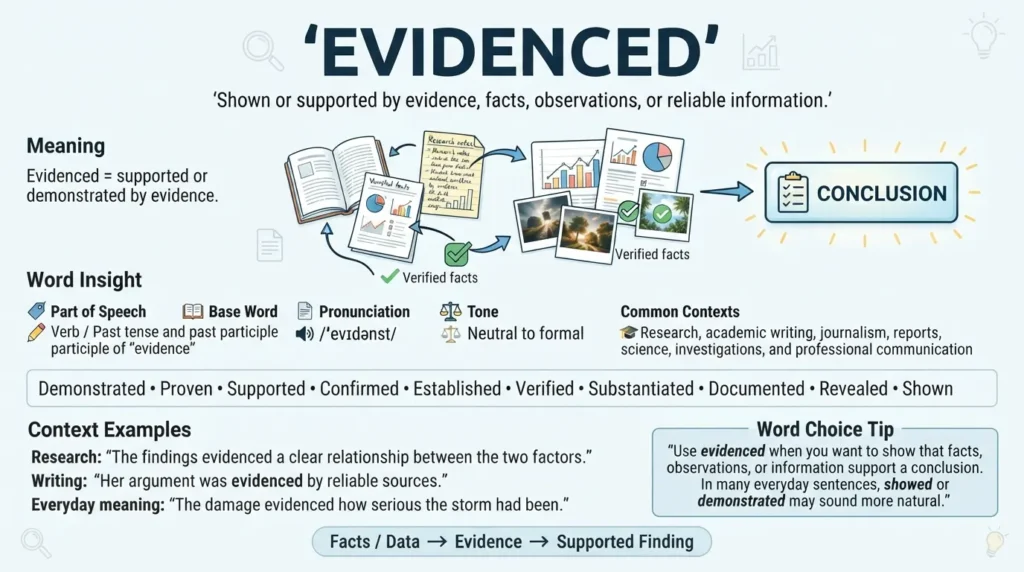
Evidenced is the past tense and past participle of the verb evidence.
In simple English, evidenced means “showed or demonstrated something clearly through signs, facts, actions, or information.”
For example:
The study evidenced a clear improvement in reading ability.
This means the study showed that reading ability had improved.
Another example is:
Her actions evidenced genuine concern.
Here, her actions demonstrated that she genuinely cared.
The word usually connects something observable with a conclusion. A report may evidence a trend. Behavior may evidence an attitude. Research may evidence a relationship.
Part of Speech
Evidenced is a verb.
It is the past tense and past participle form of evidence.
Native-Speaker Understanding
Native speakers generally understand evidenced as a formal way to say that something showed, demonstrated, indicated, or provided evidence of another fact.
It is more common in formal, academic, legal, technical, and professional writing than in casual conversation.
In everyday speech, people usually say:
The results showed improvement.
A formal writer might say:
The results evidenced significant improvement.
Connotative Meaning
Connotation (the feeling, attitude, or association a word carries beyond its basic dictionary meaning) can affect how a word sounds.
Positive Tone
The word can have a positive tone when it describes progress, skill, commitment, success, or improvement.
Her performance evidenced strong leadership skills.
Negative Tone
It can also appear in negative contexts involving problems, weaknesses, risks, or harmful behavior.
The report evidenced serious weaknesses in the system.
Neutral Tone
Most uses are neutral. The word simply connects evidence with a conclusion.
The survey evidenced a change in public opinion.
Etymology of “Evidenced”
The history of evidenced begins with evidence.
The noun evidence entered English around the early 14th century through Old French evidence, from Late Latin evidentia, meaning “proof.” The English verb evidence, meaning “show clearly, prove, or give evidence of,” developed around the early 17th century.
Old English: 450–1100
The modern word evidence was not an Old English word. Old English speakers used native terms for ideas such as proof, testimony, showing, and knowing.
The Latin family behind evidence, however, ultimately connects with videre, meaning “to see.”
Middle English: 1100–1500
During Middle English, evidence entered English through Old French. By around 1300, it referred to an appearance or fact from which someone could conclude.
Later, it developed the important meaning of a ground for belief. Legal uses also became established during this period.
Modern English: 1500–Present
The verb evidence appeared around 1600 with meanings such as “show clearly” and “prove.” The form evidenced developed as its past-tense and past-participle form.
The deeper Latin connection comes from evidens, meaning “clear, obvious, apparent,” related to videre, “to see.”
Pronunciation of “Evidenced”
US Pronunciation
/ˈɛvɪdənst/
UK Pronunciation
/ˈɛvɪdənst/
The final -ed is pronounced like /t/ because the base word ends in the voiceless consonant /s/.
Syllables
Evidenced
ev-i-denced
Affixation Pattern of “Evidenced”
Base: evidence
Past-tense formation: evidence + -d → evidenced
Root
The deeper Latin root is connected with vid- / vis-, associated with seeing.
Prefix
The Latin ancestor contains ex-, carrying the sense of “out” or “fully.”
Suffix
The modern English -ed marks the past tense and past participle.
The historical structure is more complex than simply dividing the modern English word into prefix, root, and suffix. Its Latin history connects evidens with ex and videre, “to see.”
50 Synonyms for “Evidenced”
Below are 50 useful alternatives. Some are closest in formal writing, while others work better when you specifically mean showing, proving, indicating, documenting, or supporting something.
1. Demonstrated (Verb) — US / UK: /ˈdɛmənˌstreɪtɪd/
Meaning: Clearly showed something through facts, actions, results, or examples.
Tone/Register: Formal, Academic, Professional
Example:
The experiment demonstrated the value of regular practice.
Her results demonstrated impressive progress.
2. Shown (Verb) — US / UK: /ʃoʊn/
Meaning: Made something visible, understandable, or apparent.
Tone/Register: Neutral, Everyday
Example:
The survey showed a rise in online learning.
His response showed genuine concern.
3. Proved (Verb) — US / UK: /pruːvd/
Meaning: Established that something was true through convincing evidence.
Tone/Register: Strong, Formal, Neutral
Example:
The test proved the device was reliable.
Her actions proved her commitment.
4. Supported (Verb) — US / UK: /səˈpɔːrtɪd/
Meaning: Provided evidence that helped strengthen a claim or conclusion.
Tone/Register: Academic, Professional
Example:
The findings supported the original theory.
New data supported his argument.
5. Confirmed (Verb) — US / UK: /kənˈfɝːmd/
Meaning: Provided evidence that established something as true or correct.
Tone/Register: Neutral, Professional
Example:
The second test confirmed the diagnosis.
The report confirmed earlier concerns.
6. Substantiated (Verb) — US / UK: /səbˈstænʃieɪtɪd/
Meaning: Strengthened a statement or claim with reliable evidence.
Tone/Register: Formal, Academic, Legal
Example:
The documents substantiated his account.
Researchers substantiated the original claim.
7. Established (Verb) — US / UK: /ɪˈstæblɪʃt/
Meaning: Made a fact or conclusion firmly accepted through evidence.
Tone/Register: Formal, Academic
Example:
The study established a clear connection.
The investigation established the timeline.
8. Indicated (Verb) — US / UK: /ˈɪndɪkeɪtɪd/
Meaning: Pointed toward a particular fact, condition, or conclusion.
Tone/Register: Neutral, Academic
Example:
The results indicated a behavior change.
The symptoms indicated a possible problem.
9. Revealed (Verb) — US / UK: /rɪˈviːld/
Meaning: Made something previously unknown or hidden known.
Tone/Register: Neutral, Journalistic
Example:
The interview revealed new details.
The survey revealed an unexpected trend.
10. Documented (Verb) — US / UK: /ˈdɑːkjəmentɪd/
Meaning: Recorded information in a way that provides evidence or a lasting record.
Tone/Register: Professional, Academic
Example:
Researchers documented the changes carefully.
The report documented several safety concerns.
11. Corroborated (Verb) — US / UK: /kəˈrɑːbəˌreɪtɪd/
Meaning: Provided additional evidence that supports information already given.
Tone/Register: Formal, Legal, Academic
Example:
The witness corroborated her statement.
The records corroborated the original account.
12. Verified (Verb) — US / UK: /ˈverɪfaɪd/
Meaning: Checked and established that information was accurate or genuine.
Tone/Register: Professional, Technical
Example:
The team verified the reported figures.
The source verified the author’s claim.
13. Validated (Verb) — US / UK: /ˈvæləˌdeɪtɪd/
Meaning: Provided evidence that showed something was sound, accurate, or legitimate.
Tone/Register: Academic, Business, Technical
Example:
The results validated the research method.
Later tests validated the earlier findings.
14. Attested (Verb) — US / UK: /əˈtestɪd/
Meaning: Provided evidence or testimony confirming that something exists or is true.
Tone/Register: Formal, Academic, Legal
Example:
Historical records attested to the practice.
Several sources attested to his influence.
15. Authenticated (Verb) — US / UK: /ɔːˈθentɪkeɪtɪd/
Meaning: Established that something is genuine or authentic.
Tone/Register: Formal, Technical
Example:
Experts authenticated the old manuscript.
The signature was authenticated by specialists.
16. Certified (Verb) — US / UK: /ˈsɝːtɪfaɪd/
Meaning: Officially confirmed something according to an accepted standard.
Tone/Register: Formal, Professional
Example:
The laboratory certified the test results.
The agency certified the product’s safety.
17. Recorded (Verb) — US / UK: /rɪˈkɔːrdɪd/
Meaning: Preserved information that can later serve as evidence.
Tone/Register: Neutral, Professional
Example:
The camera recorded the entire event.
The journal recorded her observations.
18. Cited (Verb) — US / UK: /ˈsaɪtɪd/
Meaning: Referred to a source, fact, or example as supporting evidence.
Tone/Register: Academic, Professional
Example:
The researcher cited several studies.
The article cited recent survey data.
19. Referenced (Verb) — US / UK: /ˈrefərəns(t)/
Meaning: Referred to information or a source that helps support an idea.
Tone/Register: Academic, Professional
Example:
The report referenced earlier research.
She referenced the original document.
20. Illustrated (Verb) — US / UK: /ˈɪləstreɪtɪd/
Meaning: Made an idea clear through an example, image, result, or situation.
Tone/Register: Neutral, Academic
Example:
The case illustrated the risks of poor planning.
Her story illustrated the importance of patience.
21. Exemplified (Verb) — US / UK: /ɪɡˈzemplɪfaɪd/
Meaning: Clearly represented a quality, idea, or principle through an example.
Tone/Register: Formal, Academic
Example:
Her work exemplified careful research.
The project exemplified creative problem-solving.
22. Signaled (Verb) — US / UK: /ˈsɪnəld/
Meaning: Gave a sign that suggested something was happening or likely.
Tone/Register: Neutral, Professional
Example:
The figures signaled a change in demand.
His silence signaled disagreement.
23. Suggested (Verb) — US / UK: /səˈdʒestɪd/
Meaning: Pointed toward an idea without establishing it with certainty.
Tone/Register: Neutral, Academic
Example:
The evidence suggested a possible connection.
The results suggested further research was needed.
24. Implied (Verb) — US / UK: /ɪmˈplaɪd/
Meaning: Communicated an idea indirectly rather than stating it openly.
Tone/Register: Neutral, Academic
Example:
Her response implied that she disagreed.
The data implied a deeper problem.
25. Pointed To (Verb Phrase) — US / UK: /ˈpɔɪntɪd tuː/
Meaning: Indicated that the available evidence led toward a particular conclusion.
Tone/Register: Neutral, Academic
Example:
The clues pointed to a technical error.
Several signs pointed to the same cause.
26. Reflected (Verb) — US / UK: /rɪˈflektɪd/
Meaning: Showed a quality, condition, attitude, or trend through observable features.
Tone/Register: Neutral, Academic
Example:
The results reflected growing public interest.
Her writing reflected years of experience.
27. Manifested (Verb) — US / UK: /ˈmænəˌfestɪd/
Meaning: Made a quality, condition, or feeling clearly visible.
Tone/Register: Formal, Academic
Example:
His frustration manifested in his tone.
The problem manifested during testing.
28. Displayed (Verb) — US / UK: /dɪˈspleɪd/
Meaning: Clearly showed a quality, emotion, behavior, or ability.
Tone/Register: Neutral
Example:
The student displayed strong analytical skills.
She displayed remarkable confidence.
29. Exhibited (Verb) — US / UK: /ɪɡˈzɪbɪtɪd/
Meaning: Showed a particular quality, behavior, or characteristic.
Tone/Register: Formal, Academic
Example:
The patient exhibited signs of improvement.
The material exhibited unusual strength.
30. Made Apparent (Verb Phrase) — US / UK: /meɪd əˈperənt/
Meaning: Caused something to become clearly noticeable or understood.
Tone/Register: Formal, Professional
Example:
The review made the problem apparent.
The discussion made her priorities apparent.
31. Made Clear (Verb Phrase) — US / UK: /meɪd klɪr/
Meaning: Helped people understand something uncertain or unclear.
Tone/Register: Neutral, Everyday
Example:
The results made the difference clear.
Her explanation made the issue clear.
32. Brought To Light (Verb Phrase) — US / UK: /brɔːt tə laɪt/
Meaning: Revealed information that had previously been hidden or unknown.
Tone/Register: Journalistic, Neutral
Example:
The investigation brought new facts to light.
The interview brought the problem to light.
33. Uncovered (Verb) — US / UK: /ʌnˈkʌvərd/
Meaning: Discovered information that had been hidden or unknown.
Tone/Register: Journalistic, Neutral
Example:
The investigation uncovered several errors.
Researchers uncovered an unexpected pattern.
34. Exposed (Verb) — US / UK: /ɪkˈspoʊzd/
Meaning: Revealed something hidden, especially a problem, weakness, or wrongdoing.
Tone/Register: Strong, Journalistic
Example:
The audit exposed serious financial gaps.
The article exposed weaknesses in the system.
35. Highlighted (Verb) — US / UK: /ˈhaɪˌlaɪtɪd/
Meaning: Drew attention to an important fact, issue, or result.
Tone/Register: Professional, Neutral
Example:
The report highlighted the need for change.
The survey highlighted several concerns.
36. Underscored (Verb) — US / UK: /ˌʌndərˈskɔːrd/
Meaning: Emphasized the importance or strength of a particular fact.
Tone/Register: Formal, Professional
Example:
The incident underscored the need for training.
The findings underscored the value of preparation.
37. Reinforced (Verb) — US / UK: /ˌriːɪnˈfɔːrst/
Meaning: Added strength to an existing idea, belief, or conclusion.
Tone/Register: Academic, Professional
Example:
The new evidence reinforced the original conclusion.
Her comments reinforced the team’s concerns.
38. Backed (Verb) — US / UK: /bækt/
Meaning: Supported a claim or position with evidence.
Tone/Register: Neutral, Informal
Example:
The numbers backed his argument.
The research backed the proposed approach.
39. Borne Out (Verb Phrase) — US / UK: /bɔːrn aʊt/
Meaning: Showed that an earlier belief, prediction, or statement was correct.
Tone/Register: Formal, Neutral
Example:
Later events bore out her prediction.
The results bore out the original theory.
40. Established Beyond Doubt (Verb Phrase) — US / UK: /ɪˈstæblɪʃt bɪˈjɑːnd daʊt/
Meaning: Provided evidence strong enough to remove reasonable uncertainty.
Tone/Register: Formal, Legal
Example:
The records established the timeline beyond doubt.
The evidence established his identity beyond doubt.
41. Proved Correct (Verb Phrase) — US / UK: /pruːvd kəˈrekt/
Meaning: Showed that a previous belief, prediction, or judgment was accurate.
Tone/Register: Neutral, Professional
Example:
The later results proved her prediction correct.
The investigation proved his concerns correct.
42. Confirmed Through Evidence (Verb Phrase) — US / UK: /kənˈfɝːmd θruː ˈevɪdəns/
Meaning: Established a conclusion after examining supporting information.
Tone/Register: Formal, Academic
Example:
The theory was confirmed through evidence from several studies.
The claim was confirmed through evidence from independent sources.
43. Supported By Findings (Verb Phrase) — US / UK: /səˈpɔːrtɪd baɪ ˈfaɪndɪŋz/
Meaning: Shown to have support from research results or discovered information.
Tone/Register: Academic, Professional
Example:
The conclusion was supported by findings from three studies.
Her argument was supported by findings from the survey.
44. Shown Through Data (Verb Phrase) — US / UK: /ʃoʊn θruː ˈdeɪtə/
Meaning: Made apparent through numerical or research-based information.
Tone/Register: Academic, Technical
Example:
The trend was shown through data collected over five years.
The difference was shown through data from multiple sources.
45. Demonstrated In Practice (Verb Phrase) — US / UK: /ˈdɛmənˌstreɪtɪd ɪn ˈpræktɪs/
Meaning: Shown to work or exist through real-world experience.
Tone/Register: Professional, Academic
Example:
The method demonstrated its value in practice.
Her leadership skills were demonstrated in practice.
46. Confirmed By Records (Verb Phrase) — US / UK: /kənˈfɝːmd baɪ ˈrekərdz/
Meaning: Shown to be accurate through official or preserved records.
Tone/Register: Formal, Professional
Example:
The date was confirmed by records from the archive.
His employment history was confirmed by records.
47. Supported With Evidence (Verb Phrase) — US / UK: /səˈpɔːrtɪd wɪð ˈevɪdəns/
Meaning: Strengthened a statement by providing information that supports it.
Tone/Register: Academic, Professional
Example:
The claim was supported with evidence from recent studies.
Her conclusion was supported with evidence from interviews.
48. Revealed Through Analysis (Verb Phrase) — US / UK: /rɪˈviːld θruː əˈnæləsɪs/
Meaning: Became known after information was carefully examined.
Tone/Register: Academic, Technical
Example:
The pattern was revealed through analysis of the data.
The cause was revealed through analysis of the records.
49. Made Evident (Verb Phrase) — US / UK: /meɪd ˈevɪdənt/
Meaning: Made a fact or condition clearly noticeable or understandable.
Tone/Register: Formal, Academic
Example:
The results made the need for reform evident.
Her actions made her commitment evident.
50. Gave Evidence Of (Verb Phrase) — US / UK: /ɡeɪv ˈevɪdəns əv/
Meaning: Provided signs or information that supported the existence of something.
Tone/Register: Formal, Neutral
Example:
The symptoms gave evidence of gradual recovery.
The results gave evidence of improved performance.
Synonyms for “Evidenced” by Tone
Tone matters because two words can express a similar idea while creating very different impressions.
Positive
Demonstrated, proved, confirmed, validated, established, exemplified, reinforced, highlighted
These choices work well when discussing achievements, progress, successful methods, or strong conclusions.
Neutral
Shown, indicated, suggested, reflected, displayed, recorded, documented, revealed, supported
These are useful when you want to communicate information without making the sentence sound overly dramatic.
Negative
Exposed, uncovered, revealed, highlighted, underscored, manifested
These choices are especially useful for discussing problems, weaknesses, failures, risks, or concerning behavior.
Academic and Professional
Substantiated, corroborated, attested, verified, validated, established, documented, cited, referenced
These alternatives are especially useful in essays, research papers, reports, and analytical writing.
Playful or Informal
Shown, backed, proved, pointed to
These choices generally sound more natural in casual writing and conversation.
Why Tone Matters in Word Choice
Imagine writing:
The evidence suggested that the plan might fail.
This sounds cautious.
Now compare:
The evidence proved that the plan failed.
This sounds much stronger.
The first sentence leaves room for uncertainty. The second presents the conclusion as established.
Choosing the right synonym therefore depends on how strong your evidence really is.
“Evidenced” vs Close Alternatives
Evidenced vs Demonstrated
” The Evidenced means something provided signs or evidence of a fact.
Demonstrated usually sounds more direct. It often suggests that something clearly showed a quality, ability, or result.
Use evidenced in formal analytical writing.
Use demonstrated when you want stronger, clearer wording.
Evidenced vs Indicated
Indicated is more cautious. It suggests that the evidence points toward a conclusion.
Evidenced can sound more direct because it presents something as providing evidence.
For uncertain research findings, indicated may be safer.
Evidenced vs Proved
Proved is considerably stronger.
It suggests that available evidence established something as true.
Do not replace evidenced with proved when the evidence only suggests a possibility.
How “Evidenced” Changes by Context
Daily Conversation
In everyday conversation, evidenced can sound formal.
Most people naturally say showed, proved, indicated, or made clear.
Instead of:
His reaction evidenced disappointment.
A conversational speaker might say:
His reaction showed that he was disappointed.
Writing and Blogging
Bloggers can use demonstrated, indicated, revealed, highlighted, and supported to create more varied writing.
For example:
The survey demonstrated a growing interest in remote work.
This sounds polished without being unnecessarily complicated.
Professional and Academic Writing
Evidenced can fit academic or professional writing when a result, document, behavior, or observation provides evidence for a conclusion.
For example:
The findings evidenced a meaningful change in user behavior.
Still, demonstrated, or indicated may sound more natural depending on the sentence.
Creative or Informal Writing
Creative writing usually benefits from stronger visual verbs.
Instead of:
His fear was evidenced by his expression.
You could write:
His expression revealed his fear.
The second version feels more immediate and vivid.
Common Mistakes Learners Make
Mistake 1: Using “Evidenced” Everywhere
Evidenced is formal. Repeating it throughout an article can make your writing feel stiff.
Use showed or demonstrated when they sound more natural.
Mistake 2: Treating “Evidenced” and “Proved” as Identical
They are not always interchangeable.
Proved usually communicates a stronger level of certainty.
Evidenced can simply mean that something provided signs or supporting information.
Mistake 3: Using “Indicated” When Certainty Is Absolute
Indicated often leaves room for interpretation.
If the evidence establishes a fact conclusively, confirmed, established, or proved may communicate the strength more accurately.
Mistake 4: Confusing Evidence With Opinion
An opinion does not automatically become evidence.
For example:
I think the plan will work.
That is an opinion.
A stronger statement would be:
Previous results support the plan.
Mistake 5: Choosing a Formal Synonym in Casual Speech
Words such as substantiated and corroborated are useful, but they may sound unnatural in relaxed conversation.
A simple showed is often better.
Register Notes
Formal Register
Use substantiated, corroborated, established, attested, validated, and documented in formal contexts.
Neutral Register
Use shown, supported, confirmed, indicated, revealed, and reflected for general communication.
Informal Register
Use showed, backed, proved, and pointed to when the context allows relaxed wording.
Written English
Evidenced appears more naturally in written language than ordinary conversation.
Spoken English
Native speakers generally prefer simpler forms such as showed, proved, or made clear.
Real-Life Mini Scenarios Using “Evidenced”
Workplace Scenario
A manager reviews a project and notices that the team met every deadline.
The successful launch demonstrated strong teamwork.
Here, demonstrated sounds more natural than evidenced.
Social Situation
Someone notices that a friend becomes quiet whenever a particular topic comes up.
Her reaction indicated that the subject made her uncomfortable.
Indicated works because the behavior gives a clue without proving the exact emotion.
Media and Pop Culture
A documentary presents interviews, recordings, and historical records.
The documentary revealed previously overlooked details.
Revealed creates a stronger storytelling effect.
Academic Scenario
A researcher analyzes thousands of responses.
The results supported the original hypothesis.
Supported is appropriate because the findings strengthen the hypothesis rather than necessarily proving it.
Legal Scenario
Several independent records support the same account.
The records corroborated the witness’s statement.
Corroborated is particularly useful when one source strengthens another.
Storytelling Scenario
A character keeps helping strangers despite personal difficulties.
His actions demonstrated his compassion.
Demonstrated makes the character’s quality clear through behavior.
Choosing the Best Synonym Quickly
Use “Shown” When
You want the simplest everyday alternative.
The results showed improvement.
Use “Demonstrated” When
You want a polished word that clearly communicates a result or quality.
The experiment demonstrated the effectiveness of the method.
Use “Indicated” When
The evidence points toward a conclusion but does not establish it completely.
The figures indicated a possible decline.
Use “Proved” When
The evidence establishes something with strong certainty.
The documents proved that the agreement existed.
Use “Supported” When
The evidence strengthens a claim without necessarily proving it.
The findings supported the proposed explanation.
Use “Confirmed” When
New information verifies something already suspected or reported.
The follow-up test confirmed the initial result.
Use “Documented” When
You want to emphasize a recorded source or permanent record.
Researchers documented the changes over several years.
Use “Revealed” When
You want to emphasize discovery.
The investigation revealed several hidden problems.
A Simple Word-Choice Formula
- When choosing an alternative to evidenced, ask yourself one question:
- What exactly does the evidence do?
- If it shows, choose shown.
- If it clearly establishes, choose demonstrated or established.
- If it strongly establishes truth, choose proved.
- If it supports a claim, choose supported.
- If it confirms an earlier belief, choose confirmed.
- If it points toward a possibility, choose indicated or suggested.
- If it uncovers hidden information, choose revealed or uncovered.
- This approach makes synonym selection much easier.
Practice Quiz
1. The research ______ that students performed better after regular practice.
A. suggested
B. demonstrated
C. uncovered
D. cited
2. The second test ______ the original result.
A. confirmed
B. reflected
C. illustrated
D. referenced
3. The investigation ______ several errors in the financial records.
A. exemplified
B. uncovered
C. displayed
D. indicated
4. The new findings ______ the researcher’s original argument.
A. supported
B. authenticated
C. exposed
D. uncovered
5. The figures ______ a possible decline in sales.
A. proved
B. indicated
C. certified
D. exemplified
6. The witness’s statement was ______ by independent records.
A. corroborated
B. manifested
C. highlighted
D. displayed
7. The student’s project ______ excellent research skills.
A. demonstrated
B. uncovered
C. cited
D. implied
8. The audit ______ serious weaknesses in the system.
A. exposed
B. exemplified
C. referenced
D. certified
9. The article ______ several recent academic studies.
A. cited
B. manifested
C. proved
D. uncovered
10. The historical documents ______ that the event had occurred.
A. documented
B. suggested
C. highlighted
D. illustrated
Part Two
11. The results ______ the need for better preparation.
A. underscored
B. authenticated
C. referenced
D. implied
12. Her expression ______ that she was worried.
A. indicated
B. certified
C. substantiated
D. documented
13. The old signature was ______ as genuine by experts.
A. validated
B. authenticated
C. suggested
D. reflected
14. The case ______ the importance of careful planning.
A. illustrated
B. uncovered
C. cited
D. verified
15. Later events ______ his original prediction.
A. bore out
B. exhibited
C. referenced
D. recorded
Reflection Task
Create Your Own Sentence
Write one sentence using demonstrated, indicated, supported, confirmed, revealed, or substantiated.
Then ask yourself whether your chosen word accurately expresses the strength and tone of the evidence.
Answer Key
1-B | 2-A | 3-B | 4-A | 5-B | 6-A | 7-A | 8-A | 9-A | 10-A | 11-A | 12-A | 13-B | 14-A | 15-A
FAQs
What is the best synonym for evidenced in academic writing?
Demonstrated is often an excellent academic alternative to evidenced because it clearly communicates that research, data, or results showed something. Depending on the level of certainty, indicated, supported, established, substantiated, or confirmed may be more precise. Choose the word that accurately reflects what the evidence actually shows.
Is “evidenced” grammatically correct in English?
Yes, evidenced is grammatically correct. It is the past tense and past participle of the verb evidence. However, it is relatively formal and appears more often in academic, professional, legal, and analytical writing. In everyday conversation, native speakers commonly choose showed, proved, or made clear instead.
What is a simple synonym for evidenced?
Shown is one of the simplest alternatives. Other easy choices include showed, indicated, proved, confirmed, and supported. The best option depends on the sentence. For example, “The results showed improvement” sounds natural and simple, while “The results substantiated the claim” creates a much more formal academic tone.
Is evidenced the same as proved?
Not always. Proved normally communicates a stronger level of certainty. Evidenced means that something showed or provided evidence for a conclusion. If research only points toward a possibility, indicated or suggested may be more accurate than proved. Good writing matches the verb with the actual strength of the evidence.
What is a professional alternative to evidenced?
Professional alternatives include demonstrated, confirmed, established, documented, validated, supported, and substantiated. The right choice depends on the situation. Documented emphasizes records, validated emphasizes reliability, and substantiated emphasizes strong supporting evidence. Demonstrated is a versatile choice for reports and professional communication.
What is the difference between evidenced and indicated?
Evidenced generally says that something provided evidence for a fact or conclusion. Indicated is often more cautious and suggests that the available information points toward a particular interpretation. For example, “The data indicated a possible trend” leaves room for uncertainty, while “The data demonstrated a clear trend” sounds more confident.
Can I use evidenced in everyday conversation?
You can, but it may sound formal or academic. Native speakers often use simpler expressions such as showed, proved, made clear, or pointed to in casual conversation. For example, “His expression showed that he was nervous” sounds more conversational than “His expression evidenced nervousness.”
What is the strongest synonym for evidenced?
There is no single strongest synonym for every situation. Proved can express a high level of certainty, while established can suggest that a conclusion has been firmly supported. Substantiated emphasizes reliable supporting evidence. The strongest choice should depend on the quality and certainty of the evidence.
Conclusion
Choosing the right synonym for evidenced makes your writing more precise. Words such as demonstrated, indicated, supported, and confirmed each communicate a different level of certainty.
Good vocabulary is not about using the most complicated word. It is about selecting the word that fits your meaning, audience, and purpose without sounding forced.
For students, bloggers, writers, and everyday English users, these alternatives make sentences smoother. They also help you explain evidence with greater confidence and accuracy.
Practice these words in essays, emails, articles, and daily conversations. Start with simple choices, then gradually use more precise alternatives when the context calls for them.

Sophia Carter is the founder and lead writer at SynonymVerse.com, a trusted online resource dedicated to English vocabulary and effective communication. She is passionate about helping students, writers, professionals, and lifelong learners find the most accurate words to express their ideas with clarity and confidence.
At SynonymVerse.com, every article is carefully researched and thoughtfully written to provide reliable guidance on synonyms, word meanings, and vocabulary. With a strong focus on accuracy, real-world usage, and easy-to-understand explanations, the website is committed to helping readers strengthen their language skills, enrich their vocabulary, and become more confident communicators.