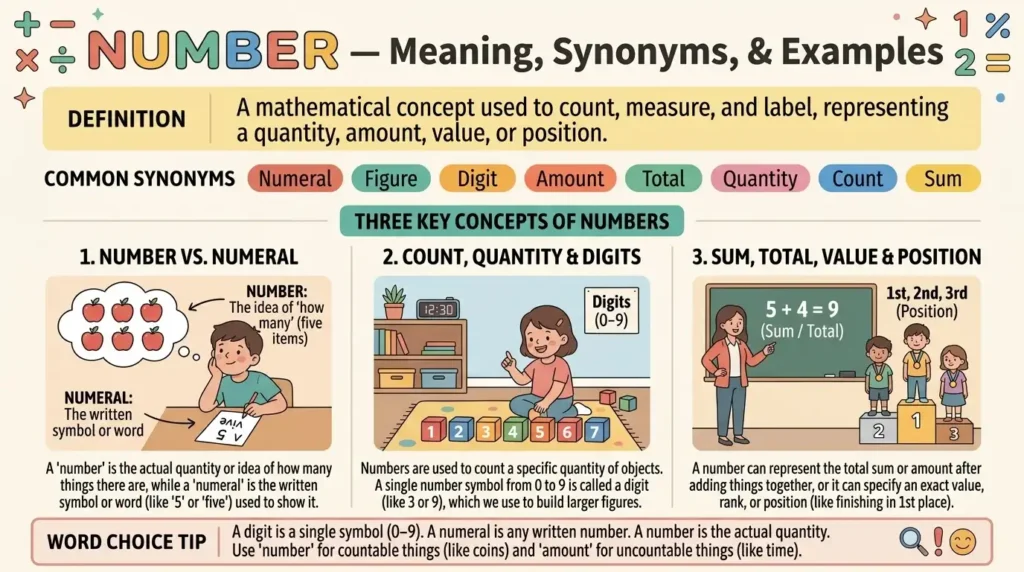
A synonym for Number is a word or expression that replaces number in a particular context. Common alternatives include figure, amount, total, quantity, numeral, digit, count, and tally. The best choice depends on whether you mean a mathematical symbol, a measurable quantity, a total, or an assigned identifier.
Imagine writing a blog post about survey results. You might use figure to discuss statistics, total to summarize responses, or count to describe how many people participated. Each alternative makes your meaning more precise.
The word number appears in everyday conversations, school assignments, business reports, and digital content. Learning a synonym for Number helps you explain quantities clearly without repeating the same word.
Students can improve essays, bloggers can write more naturally, and content writers can make their explanations more specific. Everyday English users can also communicate figures and quantities with greater confidence.
What Does “Number” Really Mean?
Number is a word that describes a mathematical value, indicates quantity, or identifies something within a sequence. It can also refer to a numeral, a count, or a particular item identified by a code.
For example, “The number of visitors increased” describes quantity. In “Write the number 8,” it refers to a mathematical value represented by a symbol.
Part of Speech
- Noun: A mathematical value, quantity, or identifier.
- Verb: To count, calculate, or include something within a group.
Examples:
- Noun: The number of students reached 120.
- Verb: The volunteers number more than fifty.
How Native English Speakers Understand It
Native speakers understand number according to the surrounding words. In mathematics, it refers to a value. In everyday life, it can refer to a phone number, room number, or identification code.
The word is neutral and highly versatile. Its meaning becomes clearer when it appears in a complete sentence.
Connotative Meaning
(Connotation means the emotional feeling or association that a word carries beyond its basic dictionary definition.)
- Positive tone: Record, total, or milestone can suggest achievement when the context involves growth or success.
- Negative tone: Excess, overload, or mass can suggest too much of something in the right context.
- Neutral tone: Number, figure, quantity, and count usually communicate information without strong emotion.
Remember that context determines the tone. For example, a high number of visitors may be encouraging, while a high number of complaints may be worrying.
Etymology of “Number”
The English word number came through Old French nombre and Latin numerus, meaning a number, amount, or numerical value.
Historical Development
- Old English (450–1100): English commonly used getæl for a number, count, or reckoning. The modern word number had not yet become the standard English form.
- Middle English (1100–1500): Following the Norman Conquest, forms derived from Old French nombre entered English and became increasingly common.
- Modern English (1500–present): Number developed into a broad everyday term for mathematical values, quantities, rankings, and identifying codes.
Pronunciation, Syllables, and Affixation
Pronunciation
- US: /ˈnʌm.bɚ/
- UK: /ˈnʌm.bə/
Syllables
num-ber — two syllables.
Affixation Pattern
- Root: number
- Prefix: None in the base word.
- Suffix: None in the base word.
- Related forms: numbered, numbering, numerical, and numericality.
The noun number can function as a verb without changing its spelling. Adding -ed creates numbered, while adding -ing creates numbering.
Synonyms List
Not every synonym for number works in every sentence. Some describe quantities, others represent mathematical values, and some identify objects. Use these alternatives according to the meaning you want to express.
1. Figure (Noun)
Meaning: A numerical value used to express an amount, measurement, or statistic.
Tone/Register: Neutral, formal, business.
Example: The latest sales figure exceeded our expectations.
The report includes figures from the previous five years.
2. Quantity (Noun)
Meaning: The amount of something that can be counted or measured.
Tone/Register: Neutral, academic.
Example: We ordered a large quantity of paper.
Please check the quantity before submitting your request.
3. Amount (Noun)
Meaning: A quantity of something, especially something measured rather than counted individually.
Tone/Register: Neutral, conversational.
Example: The amount of rainfall surprised everyone.
I spent a small amount on stationery.
4. Total (Noun)
Meaning: The complete amount obtained by adding individual values or items.
Tone/Register: Neutral, business.
Example: The total came to 250 dollars.
Please calculate the total before closing the register.
5. Count (Noun)
Meaning: The result of counting people, objects, or events.
Tone/Register: Neutral, everyday.
Example: The final count showed 35 participants.
Let’s check the count before we leave.
6. Tally (Noun)
Meaning: A recorded count or a total calculated from individual items.
Tone/Register: Neutral, informal, business.
Example: She updated the tally after every vote.
Our final tally reached eighty responses.
7. Digit (Noun)
Meaning: One of the ten basic symbols from 0 to 9 used in the decimal number system.
Tone/Register: Technical, educational.
Example: The password must contain at least one digit.
Replace the final digit with a zero.
8. Numeral (Noun)
Meaning: A symbol or group of symbols used to represent a number.
Tone/Register: Academic, mathematical.
Example: The numeral VII represents seven in Roman numerals.
Write each numeral clearly on the worksheet.
9. Integer (Noun)
Meaning: A whole number that may be positive, negative, or zero, without a fractional part.
Tone/Register: Mathematical, academic.
Example: The answer must be an integer.
Negative three is an integer.
10. Value (Noun)
Meaning: A numerical amount assigned to a quantity, variable, or measurement.
Tone/Register: Academic, technical, business.
Example: Enter the correct value in the final column.
The value of the variable changed during the experiment.
11. Statistic (Noun)
Meaning: A numerical fact derived from data or used to describe a group or situation.
Tone/Register: Academic, professional.
Example: One important statistic was the graduation rate.
The statistic highlights a change in student attendance.
12. Data Point (Noun)
Meaning: A single recorded observation or value within a dataset.
Tone/Register: Technical, academic.
Example: Each data point represents one survey response.
We removed an incorrect data point from the graph.
13. Sum (Noun)
Meaning: The result of adding two or more numbers together.
Tone/Register: Mathematical, educational.
Example: The sum of six and four is ten.
Write the sum beneath the equation.
14. Aggregate (Noun)
Meaning: A combined total formed from several amounts or individual items.
Tone/Register: Formal, academic, business.
Example: The aggregate reflects the results of all departments.
We reviewed the aggregate before comparing individual teams.
15. Grand Total (Noun)
Meaning: The final combined amount after all subtotals have been added.
Tone/Register: Business, accounting.
Example: The grand total includes delivery charges.
Check the grand total before sending the invoice.
16. Headcount (Noun)
Meaning: The number of people in a group, organization, or workforce.
Tone/Register: Business, conversational.
Example: Our department’s headcount increased this year.
The manager confirmed the event headcount yesterday.
17. Population (Noun)
Meaning: The entire group of people, animals, or items being considered or studied.
Tone/Register: Academic, demographic.
Example: The city’s population has grown rapidly.
Researchers studied a population of 500 birds.
18. Census (Noun)
Meaning: An official count of the people or members of a population, often with additional information.
Tone/Register: Formal, governmental, academic.
Example: The census recorded changes in household size.
Officials began preparing for the next census.
19. Frequency (Noun)
Meaning: The number of times an event occurs within a particular period or dataset.
Tone/Register: Academic, technical.
Example: The frequency of errors decreased after training.
We measured the frequency of each response.
20. Incidence (Noun)
Meaning: The rate or occurrence of a particular event, condition, or phenomenon within a group.
Tone/Register: Formal, academic.
Example: The study examined the incidence of workplace injuries.
Researchers tracked the incidence of equipment failure.
21. Rate (Noun)
Meaning: A numerical measure that relates one quantity to another, often over time.
Tone/Register: Neutral, technical, business.
Example: The error rate dropped after the update.
We calculated the rate of monthly growth.
22. Volume (Noun)
Meaning: The quantity of something, especially when discussing production, transactions, traffic, or material.
Tone/Register: Business, technical.
Example: The company handled a high volume of orders.
Website traffic volume increased during the campaign.
23. Magnitude (Noun)
Meaning: The size, extent, or relative importance of a quantity or phenomenon.
Tone/Register: Formal, scientific.
Example: The magnitude of the change surprised researchers.
Scientists measured the magnitude of the earthquake.
24. Measurement (Noun)
Meaning: A numerical result that expresses the size, length, weight, or other property of something.
Tone/Register: Technical, academic.
Example: Record each measurement in centimetres.
The measurement was slightly higher than expected.
25. Measure (Noun)
Meaning: A numerical or standard indication of the size, amount, or degree of something.
Tone/Register: Neutral, formal.
Example: Temperature is a measure of how hot or cold something is.
The score provides a useful measure of progress.
26. Score (Noun)
Meaning: A numerical result that indicates performance, points, or achievement.
Tone/Register: Educational, sporting, everyday.
Example: Her test score improved this term.
The team celebrated its highest score of the season.
27. Mark (Noun)
Meaning: A score awarded for performance in an examination or assessment.
Tone/Register: Educational, especially in British English.
Example: He received a high mark on the final test.
My English mark improved after regular practice.
28. Point (Noun)
Meaning: A unit used to count or measure a score, rating, or change.
Tone/Register: Neutral, academic, sporting.
Example: Our team won by one point.
The interest rate fell by half a percentage point.
29. Ranking (Noun)
Meaning: A position in an ordered list based on performance, quality, or another criterion.
Tone/Register: Business, academic, general.
Example: The university improved its national ranking.
Check your ranking after the results appear.
30. Position (Noun)
Meaning: The place that someone or something occupies in a sequence or ordered list.
Tone/Register: Neutral, formal.
Example: Our school finished in second position.
The number identifies the position of each entry.
31. Ordinal (Noun)
Meaning: A word or symbol that expresses an item’s position in a sequence, such as first, second, or third.
Tone/Register: Mathematical, linguistic.
Example: “Third” is an ordinal.
Use ordinal numbers to show the order of the winners.
32. Identifier (Noun)
Meaning: A number, label, or code used to distinguish one item from another.
Tone/Register: Technical, professional.
Example: Each student receives a unique identifier.
Enter the identifier to locate the correct record.
33. Identification Number (Noun)
Meaning: A number assigned to a person, account, document, or object for identification.
Tone/Register: Administrative, professional.
Example: Add your identification number to the form.
The identification number helps staff find the correct file.
34. Serial Number (Noun)
Meaning: A unique number assigned to an individual product or item.
Tone/Register: Technical, commercial.
Example: Write down the serial number of your laptop.
The technician checked the serial number before repairs.
35. Reference Number (Noun)
Meaning: A number assigned to a document, transaction, or request so it can be located later.
Tone/Register: Administrative, professional.
Example: Keep your reference number for future enquiries.
I used the reference number to track my application.
36. Code (Noun)
Meaning: A sequence of letters, digits, or symbols used to identify, classify, or access something.
Tone/Register: Technical, everyday.
Example: Enter the six-digit code to verify your account.
The product code identifies the correct item.
37. Index (Noun)
Meaning: A numerical indicator or an ordered system used to represent or locate information.
Tone/Register: Academic, financial, technical.
Example: The index rose slightly during the quarter.
Use the index to find the relevant topic.
38. Enumeration (Noun)
Meaning: The act or process of listing or counting items individually.
Tone/Register: Formal, academic, technical.
Example: The enumeration of entries revealed two omissions.
The researcher completed an enumeration of the collected samples.
39. Tally Mark (Noun)
Meaning: A simple mark used to record one item in a running count.
Tone/Register: Educational, everyday.
Example: Draw a tally mark for every correct answer.
Five tally marks usually appear as a group of four crossed by a fifth.
40. Subtotal (Noun)
Meaning: A partial sum calculated for one section before adding it to the final total.
Tone/Register: Business, accounting.
Example: The subtotal covers the items before tax.
Calculate each subtotal separately.
41. Census Figure (Noun)
Meaning: A numerical result published from an official population census.
Tone/Register: Formal, demographic.
Example: The latest census figure showed steady growth.
The report compares census figures across several decades.
42. Numerical Value (Noun)
Meaning: The number that represents a measurement, variable, or mathematical expression.
Tone/Register: Academic, technical.
Example: Enter the numerical value without any extra text.
The numerical value must fall within the permitted range.
43. Quantity Count (Noun Phrase)
Meaning: A recorded count of how many units or items are present.
Tone/Register: Operational, technical.
Example: The quantity count did not match the inventory sheet.
Please repeat the quantity count before shipping the order.
44. Attendance (Noun)
Meaning: The number of people who attend an event or session, or the act of being present.
Tone/Register: Educational, workplace.
Example: Attendance reached eighty people at the workshop.
The teacher records attendance every morning.
45. Turnout (Noun)
Meaning: The number of people who attend an event or participate in an election or activity.
Tone/Register: News, civic, conversational.
Example: Voter turnout was higher than expected.
The event attracted a strong turnout despite the rain.
46. Enrollment (Noun)
Meaning: The number of people registered for a course, school, or program, or the act of registering.
Tone/Register: Educational, administrative.
Example: Student enrollment increased this semester.
The college published its enrollment figures in June.
47. Membership (Noun)
Meaning: The number of people who belong to a group, club, or organization, or the state of belonging to it.
Tone/Register: Business, organizational.
Example: Club membership doubled in one year.
The organization reported its current membership at the meeting.
48. Majority (Noun)
Meaning: The greater part of a group or more than half of the relevant total.
Tone/Register: Neutral, formal, political.
Example: The majority of students preferred the earlier schedule.
A clear majority supported the proposal.
49. Minority (Noun)
Meaning: The smaller part of a group, especially a part that is less than half of the total.
Tone/Register: Neutral, formal, statistical.
Example: A minority of participants chose the final option.
Only a small minority disagreed with the decision.
50. Multitude (Noun)
Meaning: A very large number of people or things.
Tone/Register: Literary, expressive, formal.
Example: A multitude of stars filled the night sky.
The website offers a multitude of learning resources.
Synonyms for “Number” by Tone
The tone of a synonym affects how your sentence sounds. Choose a word that matches your audience, purpose, and subject.
Positive
These words can communicate achievement, completeness, or a favorable result when the context supports that meaning.
- Total: Emphasizes the complete amount.
- Score: Highlights achievement or performance.
- Milestone: Describes an important stage of progress rather than a direct synonym for a numerical value.
- Record: Can suggest an exceptional or highest recorded figure.
Example: The total number of learners reached a record high.
Neutral
These options communicate numerical information without adding strong emotion.
- Figure
- Quantity
- Amount
- Count
- Tally
- Value
- Digit
- Numeral
- Measurement
- Statistic
Example: The report lists the quantity of materials used.
Negative
These words can imply excess, difficulty, or an undesirable result. They are not universal synonyms for number.
- Excess: More than is needed or allowed.
- Overload: An excessive quantity or burden.
- Surplus: An amount remaining beyond requirements.
- Multitude: A large number; its tone depends on context.
Example: An excess of errors delayed the final report.
Playful or Informal
These expressions can make everyday communication sound more relaxed.
- A bunch: An informal way to describe a group or a large quantity.
- Loads: An informal expression meaning a lot.
- Tons: An informal exaggeration for a large amount.
- A handful: A small number, often suggesting that the quantity is manageable.
Example: We received loads of messages after publishing the article.
Why Tone Matters in Word Choice
A student writing a research paper may prefer quantity or statistic. A friend chatting about an event may say loads of people. Choosing the right expression makes your message more natural and appropriate.
“Number” vs. Close Alternatives
The following comparisons show why similar words are not always interchangeable.
Amount vs. Number
- Number: Usually refers to countable items or a mathematical value.
- Amount: Usually refers to an uncountable substance or a quantity considered as a whole.
- Best use: “The number of books increased.” “The amount of water decreased.”
Number vs. Figure
- Number: A broad term for a mathematical value, quantity, or identifier.
- Figure: Often refers to a specific numerical result, statistic, or measurement.
- Best use: “Write your phone number.” “The sales figure improved.”
Number vs. Quantity
- Number: Often emphasizes how many separate items exist.
- Quantity: Emphasizes how much of something is present.
- Best use: “The number of chairs is correct.” “The quantity of rice is sufficient.”
How “Number” Changes by Context
Daily Conversation
People often use number, count, amount, and total in ordinary conversations. The best choice depends on whether they are discussing separate items, a measured substance, or the final result.
Example: “The total came to twenty,” or “We need a count of the chairs.”
Writing and Blogging
Content writers can use figure, statistic, quantity, and total to explain research findings or present information clearly. These terms reduce unnecessary repetition while preserving the intended meaning.
Example: “The latest figure shows a rise in readership.”
Use a specific word only when it accurately describes the information. A synonym should improve clarity, not merely replace a repeated word.
Professional and Academic Writing
Business reports often use figure, aggregate, rate, and headcount. Mathematical explanations may require integer, digit, or numerical value.
Example: “The error rate fell during the final quarter.”
Precise vocabulary helps readers understand exactly what a result measures.
Creative and Informal Use
In stories, conversations, and social posts, expressions such as a multitude, loads, and a bunch can add variety. More expressive choices work best when they suit the audience and situation.
Example: “A multitude of lights shimmered across the city.”
Common Mistakes Learners Make
1. Using “Amount” for Every Quantity
Use number when counting separate items and amount when describing a quantity treated as a whole.
- Better: The number of visitors increased.
- Better: The amount of fuel decreased.
2. Confusing a Digit With a Number
A digit is one symbol from 0 to 9 in the decimal system. A number can contain one or several digits.
For example, 7 is a single digit, while 47 contains two digits.
3. Using “Statistic” for Any Number
A statistic conveys information derived from data or describes a measured characteristic. A random numerical value is not automatically a statistic.
4. Replacing Words Without Checking Their Meaning
Headcount concerns people, serial number identifies an item, and sum results from addition. Replacing number with any of these words can change the sentence’s meaning.
5. Overusing Formal Vocabulary
Words such as aggregate, enumeration, and magnitude are useful in specific contexts. In casual conversation, simpler choices like total, count, and amount often sound more natural.
Register Notes: Formal vs. Informal English
Formal English: Figure, quantity, statistic, aggregate, magnitude, and enumeration suit many reports and academic discussions.
Informal English: Count, total, loads, tons, and a bunch fit everyday speech, depending on context.
Spoken English: Simple expressions usually sound more natural and direct.
Written English: Select a term that communicates the exact measurement, quantity, or identifier. Avoid choosing complicated words solely to sound professional.
Real-Life Examples Using “Number”
Workplace
A manager reviews the headcount before arranging a training session. The finance team checks the grand total before approving the invoice.
Social Situations
An event organizer checks the turnout before ordering refreshments. Friends compare their scores after a quiz.
Media and Pop Culture
A news report discusses voter turnout. A music chart shows a song’s ranking, while a streaming report presents listening figures.
Writing and Storytelling
A blogger uses statistics to explain audience growth. A novelist describes a multitude of stars to create a vivid picture of the night sky.
Interactive Practice Quiz
1. Which word is a synonym for number?
A. Figure
B. Color
C. Chair
D. Window
2. What is the result of adding numbers called?
A. Score
B. Sum
C. Code
D. Mark
3. Which word means one symbol from 0 to 9?
A. Total
B. Amount
C. Digit
D. Count
4. Which word means the complete amount?
A. Total
B. Position
C. Code
D. Rate
5. Which word means counting people or objects?
A. Count
B. Value
C. Index
D. Rank
6. Which word can describe a numerical result in a report?
A. Figure
B. Story
C. Picture
D. Song
7. What identifies a particular product?
A. Sum
B. Serial number
C. Amount
D. Majority
8. Which word describes how many employees work in a company?
A. Headcount
B. Digit
C. Numeral
D. Score
9. Which word describes a result in a game?
A. Quantity
B. Score
C. Figure
D. Code
10. Which word means a large number of people or things?
A. Multitude
B. Digit
C. Integer
D. Subtotal
Answer Key
- A — Figure
- B — Sum
- C — Digit
- A — Total
- A — Count
- A — Figure
- B — Serial number
- A — Headcount
- B — Score
- A — Multitude
Reflection Task
Write two sentences about a school assignment, a work report, or a recent event. Use two different alternatives for number, such as figure, total, or count. Check that each word fits its context.
Suggested external resource:
Encyclopaedia Britannica — Number
Conclusion
Learning a synonym for Number helps you express quantities, values, and results with greater accuracy. The right word makes everyday English clearer and more natural.
Students can strengthen essays, bloggers can improve readability, and content writers can create more varied articles. Precise vocabulary helps every reader understand the message.
Regular practice makes it easier to choose between figure, quantity, total, and count. Use these words in emails, assignments, and everyday conversations.
Keep building your vocabulary one word at a time. Practice the examples, write your own sentences, and notice how native speakers use these alternatives in real situations.
FAQs
1. What is another word for number in an essay?
Figure, quantity, total, and statistic are useful alternatives in essays. Choose figure when discussing a numerical result, quantity when describing how much of something exists, and statistic when presenting data. For example, “The latest figure indicates growth” sounds appropriate in a research essay. Always choose a synonym that preserves your original meaning.
2. What is a synonym for number in mathematics?
In mathematics, suitable alternatives include integer, digit, numeral, value, and sum. Their meanings differ. A digit is a symbol from 0 to 9, an integer is a whole number that may be negative or positive, and a sum is the result of addition. Select the term that describes the exact mathematical concept.
3. What is the difference between number and numeral?
A number represents a mathematical value or quantity, while a numeral is a symbol or group of symbols used to express that value. For example, the number seven can be written as the numeral 7 or the Roman numeral VII. This distinction is especially useful when learning mathematics, number systems, and formal English vocabulary.
4. What is a formal synonym for number in a report?
Figure, quantity, aggregate, statistic, and numerical value can suit formal reports. The appropriate term depends on the information presented. Use aggregate for a combined total, statistic for a numerical finding based on data, and figure for a reported value. Clear terminology helps readers interpret business results and research findings accurately.
5. What is another word for a large number of people?
Multitude, crowd, host, and a large population can describe many people, depending on context. Multitude emphasizes a very large number, while crowd refers to people gathered together. Population describes the people living in an area or forming a group under study. For example, “A multitude of fans attended the concert.”
6. How can I avoid repeating the word number in writing?
First, identify what number means in your sentence. Replace it with count when discussing items, figure when reporting a numerical result, or total when emphasizing the complete amount. You can also restructure a sentence to remove unnecessary repetition. Read the revised passage aloud to ensure it sounds natural and retains its intended meaning.
7. Where can I learn more about numbers and their mathematical meaning?
A useful reference is Encyclopaedia Britannica’s overview of numbers, which explores mathematical concepts and their development. Read it alongside this synonym guide to understand the difference between mathematical terminology and everyday vocabulary.

Sophia Carter is the founder and lead writer at SynonymVerse.com, a trusted online resource dedicated to English vocabulary and effective communication. She is passionate about helping students, writers, professionals, and lifelong learners find the most accurate words to express their ideas with clarity and confidence.
At SynonymVerse.com, every article is carefully researched and thoughtfully written to provide reliable guidance on synonyms, word meanings, and vocabulary. With a strong focus on accuracy, real-world usage, and easy-to-understand explanations, the website is committed to helping readers strengthen their language skills, enrich their vocabulary, and become more confident communicators.