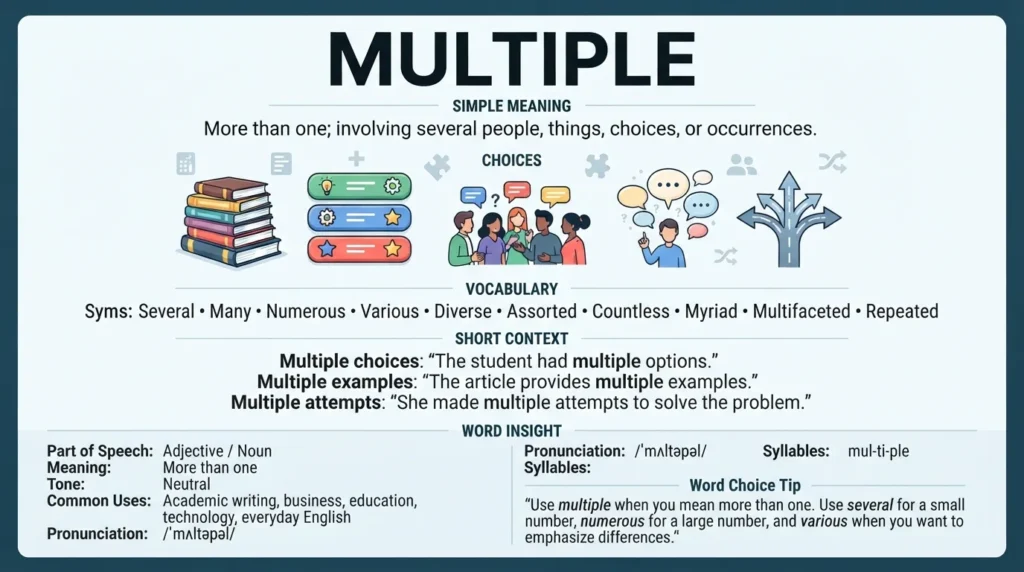
Synonym for multiple can include words such as several, numerous, many, various, manifold, and diverse. The best choice depends on whether you mean more than one, a large number, or different kinds of things.
A synonym for multiple becomes useful when one word appears too often in your writing. A precise alternative can make your sentence clearer and more natural.
Imagine a teacher giving students multiple ways to solve a problem. A blogger may write “several methods,” while a report may prefer “numerous methods.”
Learning synonyms for multiple helps students, bloggers, content writers, and daily English users avoid repetition. It also makes descriptions more precise and engaging.
What Does “Multiple” Really Mean?
Multiple means more than one or involving several people, things, parts, choices, or occurrences.
It commonly describes situations where something exists, happens, or appears in more than one instance.
For example:
- The company received multiple applications.
- She tried multiple approaches to solve the issue.
- The article contains multiple examples.
The word is especially common in academic writing, business communication, journalism, technology, mathematics, and everyday conversation.
Part of Speech
Multiple can function mainly as:
- Adjective: involving more than one
The project has multiple stages. - Noun: a number produced by multiplying another number
12 is a multiple of 3.
When used as an adjective, multiple usually emphasizes that something occurs or exists more than once.
Simple Definition
Multiple: more than one or consisting of several parts, people, items, or instances.
How Native Speakers Understand “Multiple”
Native speakers usually understand multiple as a neutral and flexible word.
It does not automatically suggest a very large number.
For example, “multiple reasons” could mean three reasons, ten reasons, or more. The exact number depends on context.
This makes multiple useful when the speaker knows there is more than one but does not want to give an exact number.
Connotative Meaning
Connotation (the feeling, association, or implied meaning connected with a word beyond its basic dictionary meaning) can influence which alternative sounds best.
Positive Tone
Multiple can suggest variety, opportunity, flexibility, or abundance.
Example:
The course offers multiple learning options.
Here, the word suggests useful choices.
Negative Tone
The word can sometimes suggest complexity, repetition, or difficulty.
Example:
The device experienced multiple failures.
The surrounding context creates the negative impression.
Neutral Tone
Most uses of multiple are neutral.
Example:
The survey included multiple questions about education.
The word simply states that there was more than one question.
Etymology of “Multiple”
The English word multiple comes through French from Latin multiplus, meaning “many-fold” or “manifold.”
The Latin form combines multus, meaning “many,” with a form related to plus, meaning “more.”
Old English: 450–1100
The modern word multiple was not part of ordinary Old English vocabulary.
Anglo-Saxon speakers used native expressions related to many, more, and manifold to express similar ideas.
Middle English: 1100–1500
After the Norman influence on English, many French and Latin-derived words entered the language.
Forms related to multiple developed through French and learned Latin vocabulary.
Modern English: 1500–Present
Multiple became established in English as a useful adjective and noun.
Today, it appears widely in mathematics, science, technology, business, education, journalism, and everyday communication.
Pronunciation
US: /ˈmʌltəpəl/
UK: /ˈmʌltɪpəl/
Syllables
mul-ti-ple
Affixation Pattern of “Multiple”
Root: Latin multus, meaning “many”
Prefix: None in modern English
Suffix: -ple, inherited as part of the historical word formation rather than functioning as a productive English suffix.
Synonyms List
The best synonym depends on the sentence. Some alternatives mean simply “more than one,” while others emphasize a large quantity, variety, or different types.
1. Several (Adjective/Determiner) — US / UK: /ˈsevərəl/
Meaning: More than two but not many.
Tone/Register: Neutral, everyday, academic
Example:
She visited several museums during her trip.
The report identifies several possible causes.
2. Many (Determiner/Pronoun) — US / UK: /ˈmeni/
Meaning: A large or noticeable number of people or things.
Tone/Register: Neutral, very common
Example:
Many students prefer digital notes.
The decision affected many families.
3. Numerous (Adjective) — US / UK: /ˈnuːmərəs/
Meaning: Existing in a large number.
Tone/Register: Formal, academic, professional
Example:
The study examined numerous cases.
The writer received numerous questions.
4. Various (Adjective/Determiner) — US / UK: /ˈveriəs/
Meaning: Several different people, things, or types.
Tone/Register: Neutral, academic, professional
Example:
We discussed various solutions.
The store carries various styles.
5. Manifold (Adjective) — US / UK: /ˈmænɪfoʊld/
Meaning: Existing in many different forms or having many aspects.
Tone/Register: Formal, literary
Example:
The decision has manifold consequences.
Her responsibilities are manifold.
6. Diverse (Adjective) — US / UK: /daɪˈvɜːrs/
Meaning: Including different types, qualities, or groups.
Tone/Register: Academic, professional, neutral
Example:
The city has a diverse population.
The team brings diverse perspectives.
7. Assorted (Adjective) — US / UK: /əˈsɔːrtɪd/
Meaning: Made up of different types or varieties.
Tone/Register: Neutral, informal
Example:
She bought an assorted collection of snacks.
The box contained assorted stationery.
8. Myriad (Noun/Adjective) — US / UK: /ˈmɪriəd/
Meaning: A very large or countless number.
Tone/Register: Formal, literary
Example:
The internet offers a myriad of resources.
A myriad of factors influenced the result.
9. Countless (Adjective) — US / UK: /ˈkaʊntləs/
Meaning: So many that they cannot easily be counted.
Tone/Register: Neutral, expressive
Example:
She has helped countless students.
Countless stories surround the historic building.
10. Innumerable (Adjective) — US / UK: /ɪˈnuːmərəbəl/
Meaning: Too many to be counted.
Tone/Register: Formal, literary
Example:
The artist inspired innumerable young creators.
The tradition has survived innumerable challenges.
11. Abundant (Adjective) — US / UK: /əˈbʌndənt/
Meaning: Existing in large quantities.
Tone/Register: Formal, academic
Example:
The region has abundant natural resources.
The website provides abundant information.
12. Plentiful (Adjective) — US / UK: /ˈplentɪfəl/
Meaning: Available in large amounts or numbers.
Tone/Register: Neutral
Example:
Fresh vegetables are plentiful in summer.
There are plentiful opportunities for practice.
13. Copious (Adjective) — US / UK: /ˈkoʊpiəs/
Meaning: Existing or produced in a very large amount.
Tone/Register: Formal, academic
Example:
The researcher collected copious notes.
The article contains copious evidence.
14. Manifolded (Adjective) — US / UK: /ˈmænɪfoʊldɪd/
Meaning: Existing in many forms or aspects.
Tone/Register: Very formal, uncommon
Example:
The topic has manifold interpretations.
The issue has manifolded effects across society.
15. Multifaceted (Adjective) — US / UK: /ˌmʌltɪˈfæsɪtɪd/
Meaning: Having many different aspects or sides.
Tone/Register: Academic, professional
Example:
Climate change is a multifaceted issue.
She has a multifaceted role at the organization.
16. Multiplicity (Noun) — US / UK: /ˌmʌltɪˈplɪsəti/
Meaning: A large number or variety of things.
Tone/Register: Formal, academic
Example:
The book explores a multiplicity of viewpoints.
The system allows a multiplicity of choices.
17. Multitudinous (Adjective) — US / UK: /ˌmʌltɪˈtuːdənəs/
Meaning: Existing in very large numbers.
Tone/Register: Formal, literary
Example:
Multitudinous voices joined the discussion.
The festival attracted multitudinous visitors.
18. Sundry (Adjective/Determiner) — US / UK: /ˈsʌndri/
Meaning: Various different people or things.
Tone/Register: Formal, old-fashioned
Example:
The folder contained sundry documents.
He mentioned sundry reasons for leaving.
19. Varied (Adjective) — US / UK: /ˈverid/
Meaning: Including many different kinds or forms.
Tone/Register: Neutral, professional
Example:
The course uses varied teaching methods.
Her interests are varied and creative.
20. Diverse (Adjective) — US / UK: /daɪˈvɜːrs/
Meaning: Made up of different kinds, qualities, or groups.
Tone/Register: Academic, professional
Example:
The audience had diverse interests.
The project needs diverse ideas.
21. Different (Adjective) — US / UK: /ˈdɪfrənt/
Meaning: Not the same; involving more than one distinct type or option.
Tone/Register: Neutral, everyday
Example:
We considered different approaches.
She tried different ways to explain the idea.
22. Assortment (Noun) — US / UK: /əˈsɔːrtmənt/
Meaning: A collection containing different kinds of things.
Tone/Register: Neutral
Example:
The shop sells an assortment of gifts.
He brought an assortment of snacks.
23. Variety (Noun) — US / UK: /vəˈraɪəti/
Meaning: A range of different types or choices.
Tone/Register: Neutral, common
Example:
The menu offers a variety of dishes.
Students need a variety of learning activities.
24. Range (Noun) — US / UK: /reɪndʒ/
Meaning: A selection or collection extending across different types or possibilities.
Tone/Register: Neutral, professional
Example:
The website covers a wide range of topics.
The program provides a range of activities.
25. Array (Noun) — US / UK: /əˈreɪ/
Meaning: An impressive or broad collection of things.
Tone/Register: Formal, professional
Example:
The library offers an array of resources.
She faced an array of choices.
26. Collection (Noun) — US / UK: /kəˈlekʃən/
Meaning: A group of items gathered together.
Tone/Register: Neutral
Example:
He owns a collection of rare books.
The museum displayed a collection of photographs.
27. Group (Noun) — US / UK: /ɡruːp/
Meaning: Several people or things considered together.
Tone/Register: Neutral, everyday
Example:
A group of students joined the workshop.
The article discusses a group of related ideas.
28. Host (Noun) — US / UK: /hoʊst/
Meaning: A large number or variety of people or things.
Tone/Register: Neutral, expressive
Example:
The platform provides a host of useful features.
She received a host of questions.
29. Multitude (Noun) — US / UK: /ˈmʌltɪtuːd/
Meaning: A large number of people or things.
Tone/Register: Formal, expressive
Example:
A multitude of factors shaped the outcome.
The city offers a multitude of activities.
30. Plethora (Noun) — US / UK: /ˈpleθərə/
Meaning: A very large amount, often more than necessary.
Tone/Register: Formal, sometimes critical
Example:
The website contains a plethora of information.
She faced a plethora of choices.
31. Scores (Noun/Determiner) — US / UK: /skɔːrz/
Meaning: A large number of people or things.
Tone/Register: Neutral, expressive
Example:
Scores of visitors attended the event.
Scores of applications arrived before Friday.
32. Hosts (Noun) — US / UK: /hoʊsts/
Meaning: Large numbers or collections.
Tone/Register: Neutral, expressive
Example:
The guide offers hosts of practical examples.
Hosts of readers shared similar experiences.
33. Multifarious (Adjective) — US / UK: /ˌmʌltɪˈferiəs/
Meaning: Having many different kinds or forms.
Tone/Register: Formal, literary
Example:
The report examines multifarious causes.
The city has multifarious cultural traditions.
34. Multifold (Adjective/Adverb) — US / UK: /ˈmʌltɪfoʊld/
Meaning: Many times greater or involving many aspects.
Tone/Register: Formal
Example:
The changes produced manifold benefits.
The company saw manifold improvements.
35. Multiple-fold (Adjective) — US / UK: /ˈmʌltɪpəl foʊld/
Meaning: Existing or increasing by several times.
Tone/Register: Technical, business
Example:
The campaign produced multiple-fold growth.
The update delivered multiple-fold improvements.
36. Manifoldly (Adverb) — US / UK: /ˈmænɪfoʊldli/
Meaning: In many ways or forms.
Tone/Register: Very formal, uncommon
Example:
The decision affected the community manifoldly.
The discovery changed the field manifoldly.
37. Plural (Adjective/Noun) — US / UK: /ˈplʊrəl/
Meaning: Relating to more than one person, thing, or form.
Tone/Register: Academic, grammatical
Example:
The noun has a plural form.
The discussion considered plural perspectives.
38. Repeated (Adjective) — US / UK: /rɪˈpiːtɪd/
Meaning: Happening or appearing more than once.
Tone/Register: Neutral
Example:
The device showed repeated errors.
Repeated attempts finally solved the problem.
39. Recurring (Adjective) — US / UK: /rɪˈkɜːrɪŋ/
Meaning: Happening again at intervals.
Tone/Register: Professional, academic
Example:
The report identified recurring problems.
Recurring meetings help the team stay organized.
40. Repeatedly Occurring (Phrase) — US / UK: /rɪˈpiːtɪdli əˈkɜːrɪŋ/
Meaning: Happening on more than one occasion.
Tone/Register: Neutral, descriptive
Example:
The same issue was repeatedly occurring.
The pattern was repeatedly occurring across the study.
41. More Than One (Phrase) — US / UK: /mɔːr ðæn wʌn/
Meaning: Referring to two or more people or things.
Tone/Register: Neutral, very clear
Example:
More than one answer may be correct.
More than one person noticed the mistake.
42. Two or More (Phrase) — US / UK: /tuː ɔːr mɔːr/
Meaning: Referring specifically to at least two items.
Tone/Register: Neutral, precise
Example:
The rule applies to two or more participants.
Choose two or more examples from the list.
43. A Number of (Phrase) — US / UK: /ə ˈnʌmbər əv/
Meaning: Several or a noticeable quantity of people or things.
Tone/Register: Neutral, formal
Example:
A number of students requested extra practice.
Several issues remain unresolved.
44. More Than One Instance (Phrase) — US / UK: /mɔːr ðæn wʌn ˈɪnstəns/
Meaning: Something occurring or existing on more than one occasion.
Tone/Register: Formal, analytical
Example:
The report records more than one instance of failure.
We found more than one instance of the same pattern.
45. Numerous Types (Phrase) — US / UK: /ˈnuːmərəs taɪps/
Meaning: Many different kinds within a particular category.
Tone/Register: Academic, descriptive
Example:
The database contains numerous types of records.
The market includes numerous types of products.
Synonyms for “Multiple” by Tone
Positive
When the context highlights opportunity, flexibility, or variety, these choices work well:
- Diverse
- Varied
- Multifaceted
- Variety
- Range
- Array
- Assortment
Example:
The course provides a diverse range of learning activities.
Neutral
For ordinary conversation and straightforward writing, choose:
- Several
- Many
- Various
- Different
- Group
- Collection
- More than one
- Two or more
These words communicate the idea without adding a strong emotional effect.
Negative
Some words can carry a negative implication when the quantity feels excessive or difficult to manage:
- Plethora
- Excessive variety
- Multitude
- Numerous
For example, plethora can suggest that there are more choices than necessary.
Playful or Informal
In relaxed writing, these expressions can sound more conversational:
- A bunch of
- A host of
- Scores of
- Plenty of
- A range of
Use informal expressions carefully in academic or professional writing.
Why Tone Matters
A synonym is not always a perfect replacement.
Several sounds ordinary, while numerous sounds more formal. Myriad can sound literary, while a bunch of sounds casual.
The right choice depends on your audience and purpose.
“Multiple” vs Close Alternatives
Multiple vs Several
The Multiple simply means more than one and does not specify a number.
Several usually suggests more than two but fewer than many.
Use multiple when the exact quantity is unimportant.
Use several when you want to suggest a small number.
Numerous vs Multiple
Multiple can refer to two or many items.
Numerous strongly suggests a large number.
Compare:
The article gives multiple examples.
The article gives numerous examples.
The second sentence suggests that the article contains a particularly large number of examples.
Multiple vs Various
Multiple focuses on quantity.
Various focuses more strongly on difference or variety.
Compare:
She considered multiple options.
She considered various options.
The first highlights that there was more than one option. The second emphasizes that the options were different.
How “Multiple” Changes by Context
Daily Conversation
In everyday speech, multiple is common when people want to describe more than one thing without giving an exact number.
I called multiple times, but nobody answered.
In casual conversation, several or a few may sound more natural in some situations.
Writing and Blogging
Bloggers can use multiple to introduce several examples, methods, reasons, or choices.
However, repeating it throughout an article can make the writing feel predictable.
Instead, alternate naturally with several, various, numerous, different, or a range of when the meaning allows it.
Professional and Academic Writing
Multiple works well in reports, research papers, presentations, and business documents.
For more precision, consider the exact meaning.
Use numerous for a large quantity, various for different types, and repeated for events that happen again.
Creative and Informal Writing
Creative writing may benefit from more expressive choices.
Words such as myriad, countless, and multitude can create stronger imagery.
Informal writing may use phrases such as a bunch of or a whole range of.
Related Synonyms for Social Norms in Different Contexts
Social norms can also be described through words related to cultural traditions, shared expectations, accepted behaviour, and community rules. The best alternative depends on what you want to communicate. Some expressions suit academic essays, while others work better when discussing culture, social behaviour, or everyday interactions.
1. Another Word for Social Norms in an Essay
When writing an essay, choose a term that matches your argument and maintains a formal tone. Suitable alternatives include:
- Social conventions: Commonly accepted ways of behaving in a society.
- Societal expectations: Behaviours that people are expected to follow.
- Cultural standards: Shared ideas about appropriate conduct within a culture.
- Social customs: Established practices followed by a community.
- Behavioural expectations: Standards that guide how people should act.
Example: Instead of writing, “Social norms influence people’s decisions,” you could write, “Societal expectations influence people’s decisions.”
For an academic essay, social conventions works well when discussing accepted practices. Use societal expectations when emphasizing pressure to behave in a particular way.
2. Synonyms for Societal Expectations
Societal expectations refer to the behaviours, responsibilities, or attitudes that a community expects from its members.
Depending on the context, you can use:
- Social expectations
- Community expectations
- Cultural expectations
- Behavioural standards
- Collective expectations
- Social obligations
- Shared expectations
Example: “Young people often face societal expectations about education and career choices.”
You could also write, “Young people often face cultural expectations about education and career choices.”
However, cultural expectations places greater emphasis on traditions and beliefs, while social expectations can include broader pressures from groups and communities.
3. Cultural Norms and Their Alternatives
Cultural norms are shared practices, beliefs, and behaviours associated with a particular culture. They may influence greetings, clothing, celebrations, family relationships, and communication.
Useful alternatives include:
- Cultural conventions
- Cultural practices
- Traditional customs
- Shared traditions
- Cultural standards
- Community traditions
- Established practices
Example: “Cultural norms influence how people greet their elders.”
An alternative is, “Traditional customs influence how people greet their elders.”
Use cultural practices when discussing actions that a community commonly performs. Choose traditional customs when the practices have developed over time and carry historical or cultural significance.
4. Social Rules, Social Codes, and Social Conventions
Social rules describe the expectations that guide behaviour in shared spaces. Some are formally established, while others develop through everyday interactions.
Consider these related expressions:
- Social rules: Informal or formal guidelines for behaviour.
- Societal rules: Rules that influence conduct across a society.
- Social codes: Shared guidelines about appropriate actions.
- Social conventions: Commonly accepted ways of behaving.
- Community guidelines: Expectations followed within a particular group.
- Rules of conduct: Principles that describe acceptable behaviour.
Example: “Waiting for your turn is one of the social rules people learn during childhood.”
You could also say, “Waiting for your turn is a common social convention.”
The distinction matters: social codes often refer to broader shared expectations, while rules of conduct can sound more formal or official.
5. Social Customs and Social Etiquette
Social customs and social etiquette are closely related to social norms, but they usually refer to more specific aspects of behaviour.
Social customs are practices that people commonly follow within a community. Examples include greeting guests, celebrating special occasions, or sharing meals in a particular way.
Social etiquette refers to accepted manners and polite behaviour. Examples include saying “please,” respecting personal space, and using appropriate table manners.
Related expressions include:
- Accepted manners
- Social conventions
- Traditional practices
- Rules of etiquette
- Community customs
- Polite behaviour
Example: “Social etiquette encourages people to respect others during conversations.”
This wording is more precise than using social norms when your sentence specifically concerns manners and politeness.
6. Norms and Values: What Is the Difference?
Norms and values are connected, but they do not mean exactly the same thing.
Norms are expectations or guidelines that influence how people behave. Values are beliefs about what a person or community considers important, desirable, or morally right.
For example, a community may value respect for older people. A related social norm might encourage younger members to speak politely to elders.
Useful expressions for norms and values include:
- Shared beliefs and expectations
- Cultural values and practices
- Community standards
- Collective principles
- Social expectations
- Shared principles of behaviour
Example: “Family traditions often reflect a community’s shared values and social expectations.”
Use shared values when discussing beliefs and priorities. Choose social expectations when focusing on how people are expected to act.
7. Synonyms for Social Values and Social Standards
Social values describe beliefs and principles that a group considers important. Social standards refer to the benchmarks or expectations people use to judge behaviour.
Depending on the sentence, related expressions include:
- Shared values
- Community principles
- Collective beliefs
- Social standards
- Cultural standards
- Accepted standards of behaviour
- Community expectations
Example: “Social standards can influence how people judge professional behaviour.”
Another option is, “Accepted standards of behaviour can influence how people judge professional conduct.”
Remember that values emphasize beliefs, whereas standards emphasize expectations or criteria.
8. Social Control and Social Reality
Some expressions associated with social norms describe broader social processes rather than direct synonyms.
Social control refers to the ways a society or group encourages people to follow expected rules and behaviours. It may operate through family guidance, education, community pressure, formal regulations, or social approval.
Related terms include:
- Behavioural regulation
- Social regulation
- Community oversight
- Mechanisms of social order
Example: “Social control can encourage people to follow community rules.”
In contrast, social reality refers to the shared conditions, meanings, relationships, and institutions that shape people’s experiences of society.
Related expressions include:
- Shared social experience
- Social conditions
- Collective experience
- Social environment
Example: “Social reality influences how people understand their roles within a community.”
These terms should not replace social norms automatically. Use them when the sentence focuses on regulation or the wider experience of living in society.
9. Social Needs and Social Behaviour
Social needs are the needs people have for connection, belonging, acceptance, and interaction with others. Social behaviour describes how people act when interacting with individuals or groups.
Related expressions for social needs include:
- Need for belonging
- Need for social connection
- Interpersonal needs
- Need for acceptance
- Need for companionship
Related expressions for social behaviour include:
- Interpersonal behaviour
- Group behaviour
- Social interaction
- Patterns of conduct
- Behaviour in social settings
Example: “The desire for acceptance can influence how people respond to social norms.”
Another example is, “Social interaction often reflects the expectations of a particular group.”
These expressions explain factors connected to social norms rather than serving as exact replacements in every sentence.
10. Socially Acceptable: Alternative Expressions
The phrase socially acceptable describes behaviour that a particular community generally considers appropriate or permissible.
Depending on the context, alternatives include:
- Socially appropriate
- Generally accepted
- Culturally acceptable
- Considered appropriate
- Within accepted standards
- Consistent with community expectations
Example: “The behaviour was considered socially acceptable in that community.”
You could also write, “The behaviour was considered appropriate within that community.”
The phrase socially appropriate emphasizes suitability, while generally accepted emphasizes what people commonly approve of. Acceptability can differ between cultures, generations, and social groups.
How to Choose the Best Alternative
Before replacing social norms, identify the exact meaning of your sentence.
- Use social conventions for commonly accepted practices.
- Use societal expectations for behaviours people feel expected to follow.
- Use cultural norms for practices and expectations connected to a culture.
- Use social rules for guidelines that influence conduct.
- Use social customs for established community practices.
- Use social etiquette for manners and polite behaviour.
- Use shared values for beliefs that a community considers important.
- Use social standards for accepted criteria or expectations.
- Use social control when discussing ways of encouraging compliance.
- Use socially appropriate when describing behaviour considered suitable.
Although these expressions overlap, they are not interchangeable in every situation. Selecting a term that matches your intended meaning will make your writing clearer, more accurate, and more natural.
Common Mistakes Learners Make
1: Treating Every Synonym as Identical
Not every alternative means the same thing.
For example, numerous suggests a large number, while multiple does not necessarily do so.
2: Using “Various” When You Mean Only “More Than One”
Various often highlights difference.
If two identical items exist, multiple may be more accurate than various.
3: Using “Myriad” for Every Situation
Myriad usually suggests a very large or seemingly endless number.
It may sound exaggerated when discussing only two or three items.
Mistake 4: Using Formal Words in Casual Speech
Words such as manifold, multitudinous, and multifarious can sound overly formal in ordinary conversation.
Choose many, several, or various when a simpler word works.
5: Assuming “Multiple” Always Means “Many”
This is one of the most important distinctions.
Multiple = more than one.
It does not necessarily mean a large number.
Native Usage Note
Native speakers often choose the simplest word that communicates the intended meaning.
Instead of automatically replacing multiple, first ask:
Do I mean more than one, several, many, or different kinds?
That question will usually lead you to the strongest synonym.
For related vocabulary practice, you can also connect this topic with other synonym-focused language lessons on your website.
Real-Life Mini Scenarios Using “Multiple” and Its Alternatives
Workplace
A manager may say:
We received multiple applications for the position.
If the number was especially high, the manager could say:
We received numerous applications.
Social Situations
A friend might say:
I have multiple plans for Saturday.
A more conversational version could be:
I have several plans for Saturday.
Media and Pop Culture
A reviewer may write:
The film has multiple storylines.
If the storylines are strongly different, various or multifaceted may provide more detail.
Writing and Storytelling
A novelist might describe:
Multiple characters influence the final decision.
A more expressive version could use:
A multitude of characters shapes the story.
The best option depends on the intended style.
Quick Word-Choice Guide
- Use multiple when you mean more than one.
- Use several when you mean a small number.
- Use many when the quantity is large.
- Use numerous when you want a formal sense of a large number.
- Use various when the items differ.
- Use diverse when the differences are important.
- Use myriad when the number feels extremely large.
- Use multifaceted when something has many distinct aspects.
- Use repeated when something happens more than once.
- Use range when discussing a spread of choices or possibilities.
Practice Quiz
Choose the best answer for each situation.
1. Which word best describes three possible solutions?
A. Countless
B. Several
C. Innumerable
D. Myriad
2. Which word emphasizes a large number?
A. Numerous
B. Plural
C. Different
D. Several
3. Which alternative emphasizes different types?
A. Repeated
B. Various
C. Multiple
D. Two or more
4. Which word fits formal academic writing best?
A. Bunch
B. Numerous
C. Stuff
D. Lots
5. Which word means “too many to count”?
A. Several
B. Countless
C. Various
D. Plural
6. Which word suggests many different aspects?
A. Multifaceted
B. Several
C. Group
D. Repeated
7. Which phrase clearly means at least two?
A. Two or more
B. Numerous
C. Myriad
D. Countless
8. Which word can imply more choices than necessary?
A. Plethora
B. Several
C. Plural
D. Repeated
9. Which word is best for events happening again?
A. Diverse
B. Assorted
C. Recurring
D. Numerous
10. Which option sounds most natural in everyday conversation?
A. Several
B. Multitudinous
C. Manifold
D. Multifarious
Reflection Task: Choose one synonym from this article and write your own sentence about school, work, family, or everyday life.
Answer Key: 1-B | 2-A | 3-B | 4-B | 5-B | 6-A | 7-A | 8-A | 9-C | 10-A
FAQs
1. What is a good synonym for multiple in academic writing?
Numerous, various, multifaceted, and several can work well in academic writing, depending on the meaning. Use numerous for a large number, various for different types, and several for a relatively small number. Multiple itself is also completely appropriate in formal academic contexts when you simply mean more than one.
2. What is another word for multiple choices?
Good alternatives include several choices, various options, multiple options, a range of options, and an array of choices. Choose several when there are only a few options. Choose various when the choices differ significantly. A range of options works particularly well in professional and informational writing.
3. What is the best synonym for multiple in an essay?
The best choice depends on the sentence. Several sounds natural and straightforward, while numerous suggests a larger quantity. Use various when you are discussing different kinds. Avoid replacing multiple automatically because the most accurate synonym depends on the exact relationship between the things being described.
4. Is “multiple” the same as “many”?
Not exactly. Multiple means more than one, while many generally suggests a large number. For example, “multiple attempts” could mean three attempts, whereas “many attempts” usually suggests a considerably larger number. Understanding this distinction helps writers choose a more precise word.
5. Can “various” replace “multiple” in every sentence?
No. Various usually emphasizes difference or variety, while multiple mainly emphasizes quantity greater than one. “The company offers multiple services” focuses on the number of services. “The company offers various services” can suggest that the services are different in type or nature.
6. What is the opposite of multiple?
The clearest opposite is single when multiple means more than one. Depending on the sentence, one, individual, sole, or singular may also work. For example, “multiple options” contrasts naturally with “a single option.” The correct antonym depends on the grammatical and contextual meaning.
7. Which synonym for multiple sounds most natural in everyday English?
Several, many, various, and different are among the most natural everyday alternatives. Several is especially useful when you mean a small number. For example, “I have several questions” sounds natural in ordinary conversation. Highly formal choices such as multitudinous or manifold are better suited to specialized writing.
8. How can I avoid repeating the word multiple in an article?
First, identify what you actually mean each time. Replace it with several for a small number, numerous for a large number, various for different types, or repeated for recurring events. Do not change the word simply for variety. Accuracy should come before avoiding repetition.
Conclusion
Learning a strong synonym for multiple gives you more control over tone, precision, and style. Small vocabulary choices can make everyday writing feel clearer.
Students can use these alternatives in essays, while bloggers and content writers can create smoother articles. Speakers can also choose words that sound natural.
Remember that several, numerous, various, and diverse do not carry the same meaning. Check the context before replacing multiple.
Practice these words in emails, essays, captions, and daily conversations. The more you use them, the easier precise English becomes.

Sophia Carter is the founder and lead writer at SynonymVerse.com, a trusted online resource dedicated to English vocabulary and effective communication. She is passionate about helping students, writers, professionals, and lifelong learners find the most accurate words to express their ideas with clarity and confidence.
At SynonymVerse.com, every article is carefully researched and thoughtfully written to provide reliable guidance on synonyms, word meanings, and vocabulary. With a strong focus on accuracy, real-world usage, and easy-to-understand explanations, the website is committed to helping readers strengthen their language skills, enrich their vocabulary, and become more confident communicators.