Synonyms for dangling include hanging, suspended, drooping, swinging, trailing, sagging, and hanging loose. The best choice depends on whether something hangs freely, moves slightly, falls downward, or remains unresolved.
Imagine a loose cable hanging from a desk while you work. You might describe it as dangling, but hanging or suspended could also fit.
In everyday English, dangling commonly describes something that hangs freely or loosely from a point. It also has a figurative use.
For students and writers, learning synonyms for dangling makes descriptions more precise. Bloggers and content writers can avoid repetitive wording.
The word is useful because it describes both physical objects and unfinished situations. Choosing the right alternative makes your English sound natural.
What Does “Dangling” Really Mean?
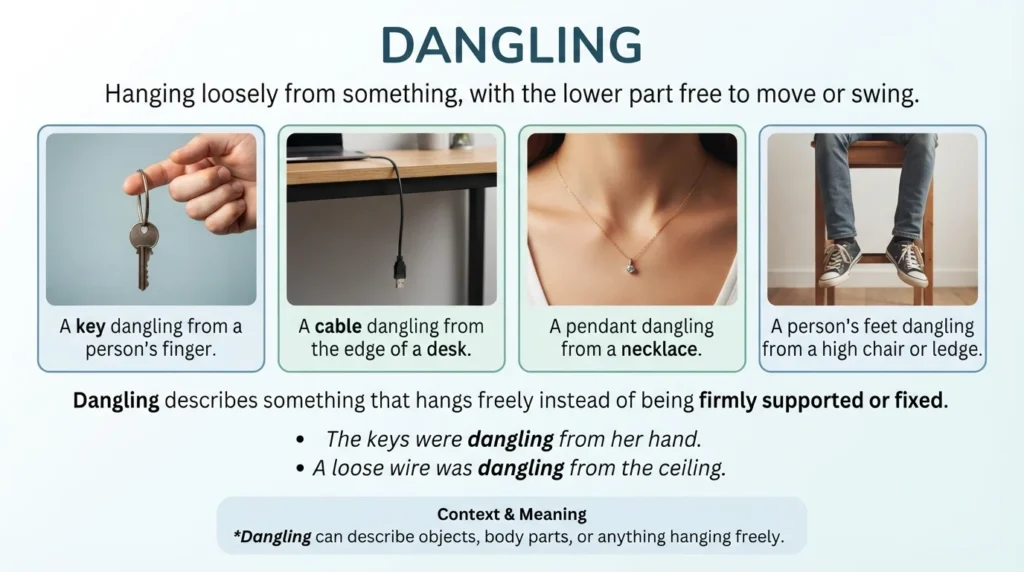
Dangling means hanging loosely from something, usually with the lower part free to move, swing, or fall.
For example, a key dangling from a hook hangs freely instead of resting on a surface.
The word can also describe something figuratively unfinished or unresolved. A writer may mention a dangling question when an issue remains unanswered.
Part of Speech
Dangling is usually the present participle or gerund form of the verb dangle.
It can also function as an adjective.
Simple definition: Hanging loosely or freely from something, often with the ability to move.
How Native Speakers Understand “Dangling”
Native speakers usually imagine something that is not firmly supported along its length.
A necklace may dangle from someone’s neck. A wire may dangle from a ceiling. A branch may dangle over a wall.
In figurative writing, the word can suggest something unfinished, uncertain, or left unresolved.
Connotative Meaning
Connotation (the feeling or association a word carries beyond its basic dictionary meaning) can change how dangling sounds.
Positive tone: It can suggest playful movement, such as earrings dangling attractively.
Negative tone: It may suggest disorder, weakness, inconvenience, or something left unfinished.
Neutral tone: It can simply describe the physical position of an object.
Etymology of “Dangling”
The word dangling comes from the verb dangle.
The exact early origin of dangle is uncertain. English dictionaries generally trace the verb to Middle English forms related to hanging or swinging loosely. It does not have a securely established direct Old English ancestor.
Old English: 450–1100
The modern verb dangle was not established in Old English in its present form. Earlier English used other words to express ideas such as hanging, suspending, or being fastened loosely.
Middle English: 1100–1500
Forms related to dangle appeared during the Middle English period. The word developed around the idea of hanging or moving loosely.
Modern English: 1500–Present
The verb became established in Modern English. Its physical meaning expanded naturally into figurative expressions involving uncertainty or unfinished matters.
Pronunciation
US: /ˈdæŋɡəl/
UK: /ˈdæŋɡəl/
Syllables
dan-gling
Affixation Pattern of “Dangling”
Root/base: dangle
Prefix: none
Suffix: -ing
The -ing ending forms the present participle or gerund.
Synonyms List
The following alternatives cover closely related meanings. Some describe physical suspension, while others work better when something hangs, moves, droops, trails, or remains unresolved.
1. Hanging (Verb/Adjective) — US /ˈhæŋɪŋ/ | UK /ˈhæŋɪŋ/
Meaning: Positioned above the ground or another surface without full support underneath.
Tone/Register: Neutral, everyday
Example:
A jacket was hanging behind the door.
The lamp was hanging from the ceiling.
2. Suspended (Adjective/Verb) — US /səˈspɛndɪd/ | UK /səˈspɛndɪd/
Meaning: Held above a surface or supported from a higher point.
Tone/Register: Formal, academic
Example:
A glass ornament was suspended from the ceiling.
The bridge appeared suspended above the valley.
3. Drooping (Adjective/Verb) — US /ˈdruːpɪŋ/ | UK /ˈdruːpɪŋ/
Meaning: Hanging downward because of weakness, weight, or lack of firmness.
Tone/Register: Neutral
Example:
The flowers were drooping after a hot afternoon.
His tired shoulders were drooping.
4. Trailing (Adjective/Verb) — US /ˈtreɪlɪŋ/ | UK /ˈtreɪlɪŋ/
Meaning: Extending behind or below something as it moves or hangs.
Tone/Register: Neutral, descriptive
Example:
Her scarf was trailing behind her.
A loose cable was trailing across the floor.
5. Swinging (Adjective/Verb) — US /ˈswɪŋɪŋ/ | UK /ˈswɪŋɪŋ/
Meaning: Moving repeatedly from side to side while hanging from a fixed point.
Tone/Register: Neutral
Example:
The sign was swinging in the wind.
A small lantern was swinging above the table.
6. Sagging (Adjective/Verb) — US /ˈsæɡɪŋ/ | UK /ˈsæɡɪŋ/
Meaning: Hanging lower than normal because of weight, age, or insufficient support.
Tone/Register: Neutral
Example:
The old rope was sagging between two posts.
The shelf looked sagging under the heavy books.
7. Drooping Down (Phrase) — US /ˈdruːpɪŋ daʊn/ | UK /ˈdruːpɪŋ daʊn/
Meaning: Extending downward in a loose or weak position.
Tone/Register: Descriptive
Example:
The curtain was drooping down near the window.
Several leaves were drooping down after the rain.
8. Overhanging (Adjective/Verb) — US /ˌoʊvərˈhæŋɪŋ/ | UK /ˌəʊvəˈhæŋɪŋ/
Meaning: Extending outward and downward beyond the edge of something.
Tone/Register: Neutral, descriptive
Example:
Branches were overhanging the garden wall.
An overhanging roof protected the doorway.
9. Lolling (Adjective/Verb) — US /ˈlɑːlɪŋ/ | UK /ˈlɒlɪŋ/
Meaning: Resting or hanging loosely in a relaxed or uncontrolled way.
Tone/Register: Informal, literary
Example:
His head was lolling against the window.
The puppy’s tongue was lolling from its mouth.
10. Pendulous (Adjective) — US /ˈpɛndʒələs/ | UK /ˈpɛndjʊləs/
Meaning: Hanging downward and capable of moving freely.
Tone/Register: Formal, descriptive
Example:
The plant had long, pendulous flowers.
Pendulous branches covered part of the pathway.
11. Loose (Adjective) — US /luːs/ | UK /luːs/
Meaning: Not firmly attached or secured, allowing movement.
Tone/Register: Neutral
Example:
A loose wire was dangling near the outlet.
The loose strap kept brushing against her arm.
12. Free-Hanging (Adjective) — US /ˌfriː ˈhæŋɪŋ/ | UK /ˌfriː ˈhæŋɪŋ/
Meaning: Hanging without being supported from below.
Tone/Register: Neutral, descriptive
Example:
The free-hanging lamp created a soft glow.
A free-hanging curtain moved with the breeze.
13. Drifting (Adjective/Verb) — US /ˈdrɪftɪŋ/ | UK /ˈdrɪftɪŋ/
Meaning: Moving slowly without a fixed direction, sometimes while suspended.
Tone/Register: Neutral, literary
Example:
A loose ribbon was drifting in the breeze.
The fabric kept drifting beside the open window.
14. Fluttering (Adjective/Verb) — US /ˈflʌtərɪŋ/ | UK /ˈflʌtərɪŋ/
Meaning: Moving lightly and repeatedly through the air.
Tone/Register: Descriptive, literary
Example:
A ribbon was fluttering from the package.
The loose paper kept fluttering beside the door.
15. Waving (Adjective/Verb) — US /ˈweɪvɪŋ/ | UK /ˈweɪvɪŋ/
Meaning: Moving from side to side, especially because of air or motion.
Tone/Register: Neutral
Example:
A loose flag was waving above the entrance.
The string was waving in the strong wind.
16. Bobbing (Adjective/Verb) — US /ˈbɑːbɪŋ/ | UK /ˈbɒbɪŋ/
Meaning: Moving repeatedly up and down.
Tone/Register: Informal, descriptive
Example:
The buoy was bobbing on the water.
A loose balloon kept bobbing above the crowd.
17. Swaying (Adjective/Verb) — US /ˈsweɪɪŋ/ | UK /ˈsweɪɪŋ/
Meaning: Moving gently from one side to another.
Tone/Register: Neutral, literary
Example:
The hanging lights were swaying in the breeze.
The branch was swaying above the path.
18. Dribbling (Verb) — US /ˈdrɪbəlɪŋ/ | UK /ˈdrɪbəlɪŋ/
Meaning: Falling or flowing gradually in small drops or thin streams.
Tone/Register: Neutral
Example:
Water was dribbling from the damaged pipe.
Paint was dribbling down the side of the can.
19. Streaming (Verb) — US /ˈstriːmɪŋ/ | UK /ˈstriːmɪŋ/
Meaning: Extending or flowing continuously in a long, loose form.
Tone/Register: Neutral, descriptive
Example:
Her hair was streaming behind her on the ride.
A long piece of fabric was streaming from the window.
20. Dangling Loose (Phrase) — US /ˈdæŋɡəlɪŋ luːs/ | UK /ˈdæŋɡəlɪŋ luːs/
Meaning: Hanging freely without firm attachment or support.
Tone/Register: Everyday
Example:
The shoelace was dangling loose.
A thread was dangling loose from his sleeve.
21. Hanging Free (Phrase) — US /ˈhæŋɪŋ friː/ | UK /ˈhæŋɪŋ friː/
Meaning: Hanging without being held tightly or restrained.
Tone/Register: Neutral
Example:
The cord was hanging free beneath the desk.
One end of the rope was hanging free.
22. Sagging Down (Phrase) — US /ˈsæɡɪŋ daʊn/ | UK /ˈsæɡɪŋ daʊn/
Meaning: Falling downward because something lacks strength or support.
Tone/Register: Neutral
Example:
The old net was sagging down in the middle.
The fabric was sagging down under its own weight.
23. Draping (Adjective/Verb) — US /ˈdreɪpɪŋ/ | UK /ˈdreɪpɪŋ/
Meaning: Hanging or lying loosely over something in folds.
Tone/Register: Neutral, fashion, descriptive
Example:
A scarf was draping over her shoulder.
The fabric was draping across the chair.
24. Draped (Adjective) — US /dræpt/ | UK /dræpt/
Meaning: Arranged so that fabric or another flexible material hangs loosely.
Tone/Register: Neutral, descriptive
Example:
A blanket was draped over the sofa.
A scarf was draped around his neck.
25. Extending Downward (Phrase) — US /ɪkˈstɛndɪŋ ˈdaʊnwərd/ | UK /ɪkˈstɛndɪŋ ˈdaʊnwəd/
Meaning: Reaching from a higher position toward a lower one.
Tone/Register: Formal, descriptive
Example:
The cable was extending downward from the ceiling.
Roots were extending downward into the soil.
26. Projecting (Adjective/Verb) — US /prəˈdʒɛktɪŋ/ | UK /prəˈdʒɛktɪŋ/
Meaning: Sticking outward from a surface or structure.
Tone/Register: Formal, technical
Example:
A branch was projecting over the walkway.
A metal pipe was projecting from the wall.
27. Protruding (Adjective/Verb) — US /proʊˈtruːdɪŋ/ | UK /prəˈtruːdɪŋ/
Meaning: Sticking outward beyond the normal surface or boundary.
Tone/Register: Formal, technical
Example:
A wire was protruding from the damaged panel.
A nail was protruding from the wooden board.
28. Bending Down (Phrase) — US /ˈbɛndɪŋ daʊn/ | UK /ˈbɛndɪŋ daʊn/
Meaning: Curving toward a lower position.
Tone/Register: Neutral
Example:
The flower was bending down toward the ground.
The branch was bending down under the snow.
29. Leaning (Adjective/Verb) — US /ˈliːnɪŋ/ | UK /ˈliːnɪŋ/
Meaning: Slanting away from an upright position.
Tone/Register: Neutral
Example:
The sign was leaning over the entrance.
The branch was leaning toward the road.
30. Drooping Loose (Phrase) — US /ˈdruːpɪŋ luːs/ | UK /ˈdruːpɪŋ luːs/
Meaning: Hanging downward without firmness or tension.
Tone/Register: Descriptive
Example:
The old cable was drooping loose beside the wall.
The fabric was drooping loose from the frame.
31. Unresolved (Adjective) — US /ˌʌnrɪˈzɑːlvd/ | UK /ˌʌnrɪˈzɒlvd/
Meaning: Not settled, answered, or completed.
Tone/Register: Formal, academic
Example:
The investigation left several questions unresolved.
The meeting ended with one major issue unresolved.
32. Outstanding (Adjective) — US /aʊtˈstændɪŋ/ | UK /aʊtˈstændɪŋ/
Meaning: Still needing attention, completion, or resolution.
Tone/Register: Business, formal
Example:
We still have two outstanding questions.
The manager reviewed the outstanding tasks.
33. Pending (Adjective) — US /ˈpɛndɪŋ/ | UK /ˈpɛndɪŋ/
Meaning: Waiting for a decision, action, or completion.
Tone/Register: Formal, business
Example:
The application remains pending.
The decision is pending further review.
34. Incomplete (Adjective) — US /ˌɪnkəmˈpliːt/ | UK /ˌɪnkəmˈpliːt/
Meaning: Not finished or lacking a necessary part.
Tone/Register: Neutral, academic
Example:
The report is incomplete.
Several sections remain incomplete.
35. Unsettled (Adjective) — US /ʌnˈsɛtld/ | UK /ʌnˈsɛtld/
Meaning: Not resolved, decided, or brought to a stable conclusion.
Tone/Register: Neutral, formal
Example:
The dispute remains unsettled.
Several details are still unsettled.
36. Lingering (Adjective) — US /ˈlɪŋɡərɪŋ/ | UK /ˈlɪŋɡərɪŋ/
Meaning: Continuing to exist or remain after it was expected to disappear.
Tone/Register: Neutral, literary
Example:
A lingering question remained after the discussion.
She had a lingering doubt about the decision.
37. Unanswered (Adjective) — US /ˌʌnˈænsərd/ | UK /ˌʌnˈænsərd/
Meaning: Not given an answer or explanation.
Tone/Register: Neutral
Example:
Several questions remained unanswered.
His final message left one concern unanswered.
38. Unfinished (Adjective) — US /ʌnˈfɪnɪʃt/ | UK /ʌnˈfɪnɪʃt/
Meaning: Not completed or brought to an end.
Tone/Register: Neutral
Example:
The story felt unfinished.
She returned to the unfinished project the next day.
39. In Limbo (Phrase) — US /ɪn ˈlɪmboʊ/ | UK /ɪn ˈlɪmbəʊ/
Meaning: Existing in an uncertain state while waiting for a decision or outcome.
Tone/Register: Informal, figurative
Example:
The project has been in limbo for weeks.
Their plans remain in limbo until the decision arrives.
40. Up in the Air (Phrase) — US /ʌp ɪn ði ɛr/ | UK /ʌp ɪn ði eə/
Meaning: Not yet decided, settled, or certain.
Tone/Register: Informal, conversational
Example:
Our travel plans are still up in the air.
The final schedule is up in the air.
Synonyms for Dangling by Tone
Positive
Some alternatives can create a pleasant or graceful image.
Swaying, fluttering, draping, waving, and hanging can work well when describing attractive movement or decoration.
For example, swaying curtains sounds softer than drooping curtains.
Neutral
For ordinary physical descriptions, use hanging, suspended, loose, trailing, swinging, or sagging.
These words describe position without adding a strong emotional judgment.
Negative
When something looks weak, neglected, or unfinished, sagging, drooping, unresolved, unanswered, incomplete, and unsettled may fit better.
The negative effect usually comes from the situation rather than the word alone.
Playful or Informal
Bobbing, lolling, in limbo, and up in the air can sound more conversational or expressive.
They are useful when formal wording would feel unnecessarily stiff.
Why Tone Matters
Two words can describe a similar situation but create different impressions.
Compare swaying branches with sagging branches. The first sounds gentle and natural. The second suggests weight or weakness.
“Dangling” vs Close Alternatives
Dangling vs Hanging
- Dangling suggests something hangs freely, often with the possibility of movement.
- Hanging is broader and simply describes a suspended position.
- Use dangling when the loose or free movement matters. Use hanging when you only need to describe location.
Suspended vs Dangling
Suspended sounds more formal and often emphasizes deliberate support from above.
Dangling sounds more natural in everyday conversation and can suggest loose movement.
Use suspended in technical or academic descriptions. Use dangling in ordinary descriptions.
Dangling vs Trailing
Dangling usually suggests something hangs downward from a point.
Trailing focuses on something extending behind or below another object.
A cable can be dangling from a ceiling, while a scarf may trail behind someone.
How “Dangling” Changes by Context
Daily Conversation
In casual speech, dangling is useful for objects that hang loosely.
You might talk about dangling headphones, loose wires, earrings, keys, or straps.
The word sounds natural and visual without being overly formal.
Writing or Blogging
Writers can use dangling to create a clear mental image.
Instead of saying that a cord is simply present, describing it as dangling tells the reader how it is positioned.
For descriptive content, alternatives such as swaying, trailing, or drooping can create different visual effects.
Professional or Academic Tone
Formal writing often favors words such as suspended, protruding, pending, unresolved, or outstanding, depending on the meaning.
For example, pending approval is more suitable for a business document than up in the air.
Creative or Informal Use
Creative writing allows more expressive choices.
Words such as fluttering, bobbing, swaying, lolling, and drifting can add movement and atmosphere.
Figurative expressions such as in limbo can also describe uncertainty.
Common Mistakes Learners Make
Using Every Synonym as an Exact Replacement
Not every alternative can replace dangling in every sentence.
For example, pending works for an unfinished decision, but it does not normally describe a necklace hanging from someone’s neck.
Confusing “Dangling” With “Sagging”
Dangling suggests free suspension.
Sagging suggests downward bending caused by weight, weakness, or poor support.
A heavy cable may be sagging between two poles. A loose cord hanging from a desk may be dangling.
Using “Suspended” in Very Casual Situations
Suspended is correct, but it can sound formal.
In ordinary conversation, native speakers may prefer hanging or dangling.
Overusing the Word
Repeatedly using dangling can make descriptive writing feel monotonous.
Try swaying, trailing, hanging, fluttering, or drooping when the meaning allows it.
Register Notes
Dangling is mainly neutral and works in both spoken and written English.
Suspended, protruding, pending, unresolved, and outstanding can sound more formal.
Bobbing, lolling, in limbo, and up in the air are more conversational or expressive.
For related vocabulary, an internal synonym guide can help you compare nearby words before choosing one.
Real-Life Mini Scenarios
Workplace
A loose cable hangs beneath a desk.
You could write:
“A cable was dangling beneath the desk.”
In a formal maintenance report, “A cable was suspended beneath the desk” may sound more technical, although suspended is not always the most natural replacement.
Social Situation
Someone wears long earrings that move as they walk.
“Her earrings were dangling as she walked.”
Here, swaying can emphasize the movement rather than the hanging position.
Media and Pop Culture
A movie poster may show a character hanging from a cliff.
A writer could use dangling to emphasize the character’s precarious position.
For example:
“The character was dangling from the edge of the cliff.”
Writing and Storytelling
A mystery story may leave an important question unanswered.
In this figurative context, unresolved, unanswered, or lingering may work better than the physical sense of dangling.
When Should You Use “Dangling”?
Choose dangling when something hangs freely from a point and appears loose or mobile.
It works especially well for:
- Wires
- Cords
- Earrings
- Keys
- Strings
- Straps
- Branches
- Decorations
- Loose clothing
- Small objects hanging from hooks
For abstract ideas, choose a context-specific alternative.
Use unresolved for an issue, pending for a decision, unanswered for a question, and unfinished for incomplete work.
Quick Word-Choice Guide
- Use hanging for the broadest everyday meaning.
- Use suspended when the object is deliberately held above something.
- Use dangling when it hangs freely and may move.
- Use swaying when side-to-side movement matters.
- Use drooping when something falls downward because it lacks firmness.
- Use trailing when something extends behind or below another object.
- Use sagging when weight or weakness causes a downward curve.
- Use unresolved when an issue has not been settled.
- Use pending when something is waiting for a decision or action.
- Use unanswered when someone has not received a response.
Interactive Practice Quiz
Choose the best answer for each situation.
1. Which word best describes earrings moving freely from someone’s ears?
A. Pending
B. Dangling
C. Unresolved
D. Incomplete
2. Which word best fits a business decision waiting for approval?
A. Fluttering
B. Bobbing
C. Pending
D. Trailing
3. A branch bends downward because it is carrying heavy snow. Which word fits best?
A. Sagging
B. Suspended
C. Waving
D. Unanswered
4. Which word best describes a question that nobody has answered?
A. Swinging
B. Unanswered
C. Draped
D. Protruding
5. Which alternative sounds most formal for something held above the ground?
A. Suspended
B. Bobbing
C. Lolling
D. Up in the air
6. Which word describes fabric hanging loosely in folds?
A. Pending
B. Draping
C. Outstanding
D. Unsettled
7. Which phrase means that plans have not yet been decided?
A. Hanging free
B. Up in the air
C. Drooping down
D. Free-hanging
8. Which word describes something moving gently from side to side?
A. Swaying
B. Incomplete
C. Unresolved
D. Pending
9. Which word best describes work that has not been completed?
A. Fluttering
B. Unfinished
C. Dangling
D. Waving
10. A loose scarf extends behind a runner. Which word fits best?
A. Trailing
B. Pending
C. Suspended
D. Outstanding
Reflection Task: Write one sentence using dangling, then rewrite it with another synonym that changes the tone or meaning slightly.
Answer Key: 1-B | 2-C | 3-A | 4-B | 5-A | 6-B | 7-B | 8-A | 9-B | 10-A
Frequently Asked Questions
1. What is the best synonym for dangling in everyday English?
Hanging is usually the closest everyday alternative because both words describe something supported from above. However, dangling gives a stronger sense of being loose or freely suspended. If movement is important, words such as swinging or swaying may be more precise.
2. What is another word for dangling in a sentence about wires?
For wires, hanging, suspended, trailing, or loose may work depending on the situation. Use dangling when the wire hangs freely from a point. Use trailing when it extends across or behind something, and suspended when the description needs a more formal tone.
3. What is the difference between dangling and hanging?
Hanging is a broad term for something positioned below a support. Dangling is more specific and often suggests that the object hangs loosely or can move freely. For example, a picture can be hanging on a wall, while a loose cable can be dangling from a ceiling.
4. Can dangling describe an unfinished situation?
Yes. Dangling can have a figurative meaning when something remains unresolved. A writer might describe a dangling question or dangling issue. In formal writing, alternatives such as unresolved, pending, outstanding, or unanswered may communicate the idea more precisely.
5. What is a formal synonym for dangling?
Suspended is a formal alternative when you mean physically held from above. For an unresolved matter, pending, unresolved, or outstanding may be better choices. The appropriate formal synonym depends on whether you are describing an object, movement, question, task, or decision.
6. What is a synonym for dangling that describes movement?
Words such as swinging, swaying, bobbing, and fluttering can describe movement associated with something hanging. Each creates a different image. Swinging suggests repeated side-to-side movement, while bobbing suggests repeated up-and-down motion.
7. Is dangling positive or negative?
Dangling is generally neutral. Its emotional effect depends on context. Dangling earrings may sound attractive, while a dangling electrical wire may suggest danger or disorder. In figurative expressions, a dangling question may suggest uncertainty or an incomplete situation.
8. How can learning synonyms for dangling improve English writing?
Learning related words helps writers describe position, movement, tone, and uncertainty more precisely. Instead of repeating dangling, you can choose swaying, trailing, drooping, or suspended when those words better match the intended meaning. This makes essays, articles, stories, and everyday communication more natural.
Conclusion
Learning synonyms for dangling helps you describe movement, position, and uncertainty with greater precision. The right word can make even a simple sentence clearer.
Students gain stronger vocabulary, while bloggers and writers gain more variety. Speakers can also choose words that sound natural in everyday conversations.
Practice these alternatives in emails, essays, stories, and daily conversations. Notice how each word changes the picture, tone, or meaning.
Keep exploring related vocabulary and create your own examples. Regular practice will make these words easier to remember, understand, and use confidently.

Sophia Carter is the founder and lead writer at SynonymVerse.com, a trusted online resource dedicated to English vocabulary and effective communication. She is passionate about helping students, writers, professionals, and lifelong learners find the most accurate words to express their ideas with clarity and confidence.
At SynonymVerse.com, every article is carefully researched and thoughtfully written to provide reliable guidance on synonyms, word meanings, and vocabulary. With a strong focus on accuracy, real-world usage, and easy-to-understand explanations, the website is committed to helping readers strengthen their language skills, enrich their vocabulary, and become more confident communicators.