
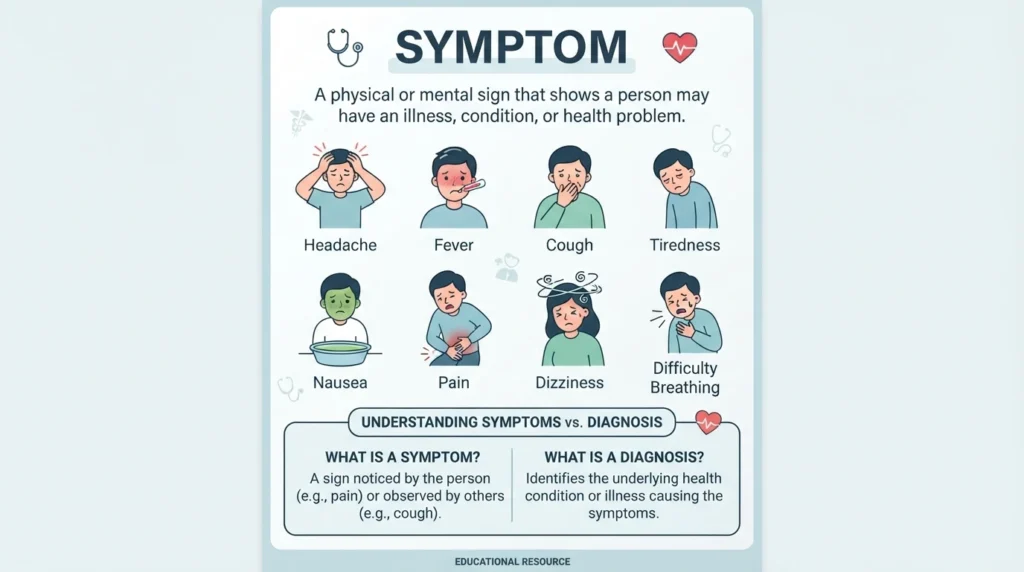
Synonym for symptom can include words such as sign, indication, manifestation, indicator, clue, and signal. The best alternative depends on whether you are describing a medical condition, warning, problem, or evidence of something else.
Synonym for symptom become useful when you want clearer, more varied English in essays, blogs, or conversations.
Imagine telling a doctor about a headache, tiredness, or dizziness. Each detail can describe a symptom in everyday communication.
Learning a synonym for symptom helps students, bloggers, writers, and daily English users express signs and problems more precisely.
The word symptom appears often in health writing and general discussions, so knowing its alternatives can make your vocabulary more flexible and natural.
What Does “Symptom” Really Mean?
A symptom is a physical or mental change that suggests a disease, illness, condition, or problem. It can also mean a sign that shows something is happening.
In medicine, a symptom is usually something a person experiences or reports. Examples include pain, nausea, fatigue, dizziness, or shortness of breath.
In general English, symptom can describe evidence of a larger problem.
For example:
“Low employee morale can be a symptom of poor communication.”
Here, symptom does not describe a medical condition. It describes an observable sign of an underlying issue.
Part of Speech
Symptom is primarily a noun.
Simple definition:
A symptom is a noticeable sign or experience that suggests an illness, condition, problem, or underlying cause.
How Native Speakers Understand “Symptom”
Native speakers usually understand symptom as something that points toward a deeper condition.
The word often suggests that the visible problem is not the entire problem.
For example, constant delays may be a symptom of poor planning. The delays are visible, but poor planning may be the underlying cause.
Common Contexts
The word appears frequently in:
- Medical conversations
- Healthcare articles
- Academic writing
- Psychology discussions
- Workplace communication
- News reports
- Social commentary
- Everyday conversations
- Problem-solving discussions
- Technical writing
Connotative Meaning
Connotation (the emotional or implied meaning a word carries beyond its basic dictionary definition) can affect how a symptom sounds.
Positive Tone
Symptom is rarely strongly positive because it usually points to a problem or abnormal condition.
However, a symptom can sometimes be viewed positively when it indicates improvement or recovery.
Negative Tone
The word often carries a negative tone when it refers to illness, dysfunction, weakness, or an underlying problem.
Example:
“Persistent fatigue can be a symptom of an underlying health problem.”
Neutral Tone
Symptom can sound neutral when used simply to describe evidence or an observable feature.
Example:
“The report identifies several symptoms of market instability.”
Etymology of “Symptom”
The English word symptom comes through Medieval Latin sinthoma from Late Latin symptoma. Its deeper origin is the Greek symptoma, meaning something that happens, an occurrence, or a condition.
The Greek word connects to sympiptein, meaning “to happen,” “to befall,” or literally relating to things “falling together.” The word eventually developed its medical sense in English.
Old English: 450–1100
There is no established Old English form of symptom matching the modern word. English speakers in this period used native vocabulary to describe signs, illness, sickness, and physical conditions.
Middle English: 1100–1500
Symptom entered English in the late 14th century in forms such as sinthoma. It was associated with signs or evidence of disease.
Modern English: 1500–Present
The spelling was later influenced by Latin and French forms. By the early 17th century, symptom also developed a broader meaning referring to a sign or indication of something beyond medicine.
Pronunciation of “Symptom”
US: /ˈsɪmp.təm/
UK: /ˈsɪmp.təm/
Syllables
symp-tom
Affixation Pattern of “Symptom”
Root: Greek symptōma / sympiptein
Prefix: No productive English prefix
Suffix: No productive English suffix in the modern English word
The apparent ending -tom should not be treated as a normal English suffix in this word.
50 Synonyms for Symptom
The alternatives below are arranged as useful vocabulary options. Some are direct substitutes in general contexts, while others work better in specific medical, academic, technical, or figurative contexts.
1. Sign (Noun) — US / UK: /saɪn/
Meaning: An observable feature that provides information about a condition or situation.
Tone/Register: Neutral
Example:
The doctor noticed a visible sign of infection.
The delay was a sign that something had gone wrong.
2. Indication (Noun) — US / UK: /ˌɪndɪˈkeɪʃən/
Meaning: Something that suggests or points toward a particular condition or fact.
Tone/Register: Formal, Academic
Example:
The results gave an indication of a larger problem.
Frequent errors may be an indication of poor planning.
3. Manifestation (Noun) — US / UK: /ˌmænɪfəˈsteɪʃən/
Meaning: A visible or noticeable expression of a condition, disease, or problem.
Tone/Register: Formal, Medical, Academic
Example:
Skin irritation can be a manifestation of an allergic reaction.
The argument became a manifestation of deeper tension.
4. Indicator (Noun) — US / UK: /ˈɪndɪkeɪtər/
Meaning: A measurable or observable feature that provides information about a condition.
Tone/Register: Academic, Business, Technical
Example:
High absenteeism is an important indicator of workplace stress.
The figure acts as an indicator of economic activity.
5. Signal (Noun) — US / UK: /ˈsɪɡnəl/
Meaning: Something that communicates or suggests that a condition or event exists.
Tone/Register: Neutral
Example:
The sudden pain was a signal that something was wrong.
Falling sales can signal a deeper business problem.
6. Clue (Noun) — US / UK: /kluː/
Meaning: A piece of information that helps reveal the cause of a problem.
Tone/Register: Informal, Neutral
Example:
The unusual rash gave the doctor a useful clue.
The sudden silence was a clue that something had changed.
7. Evidence (Noun) — US / UK: /ˈevɪdəns/
Meaning: Information or observable facts that support a conclusion.
Tone/Register: Formal, Academic
Example:
The test provided evidence of infection.
The repeated failures were evidence of a larger issue.
8. Warning Sign (Noun Phrase) — US / UK: /ˈwɔːrnɪŋ saɪn/
Meaning: An indication that a harmful or difficult situation may be developing.
Tone/Register: Neutral
Example:
Persistent headaches can be a warning sign.
Repeated complaints became a warning sign for the manager.
9. Telltale Sign (Noun Phrase) — US / UK: /ˈtelteɪl saɪn/
Meaning: A noticeable feature that strongly suggests something is present.
Tone/Register: Informal, Neutral
Example:
Dark circles were a telltale sign of exhaustion.
His hesitation was a telltale sign of uncertainty.
10. Mark (Noun) — US / UK: /mɑːrk/
Meaning: A visible feature that suggests a condition or event.
Tone/Register: Neutral
Example:
The scar remained as a mark of the injury.
The sudden change was a mark of growing tension.
11. Feature (Noun) — US / UK: /ˈfiːtʃər/
Meaning: A characteristic or noticeable aspect of a condition.
Tone/Register: Neutral, Academic
Example:
Fatigue is a common feature of the condition.
Poor communication became a feature of the troubled project.
12. Characteristic (Noun) — US / UK: /ˌkærəktəˈrɪstɪk/
Meaning: A typical quality associated with a condition or situation.
Tone/Register: Academic, Formal
Example:
Fever is a characteristic feature of some infections.
Frequent delays became a characteristic of the project.
13. Expression (Noun) — US / UK: /ɪkˈspreʃən/
Meaning: A way in which an underlying condition becomes visible or noticeable.
Tone/Register: Formal, Medical
Example:
The rash was an expression of the skin condition.
Anger became an expression of his frustration.
14. Signifier (Noun) — US / UK: /ˈsɪɡnɪfaɪər/
Meaning: Something that communicates or represents a particular meaning.
Tone/Register: Academic
Example:
The change became a signifier of social tension.
The symbol acts as a signifier of authority.
15. Token (Noun) — US / UK: /ˈtoʊkən/
Meaning: Something that serves as evidence or representation of another condition.
Tone/Register: Formal, Literary
Example:
The gesture was a token of growing concern.
The apology became a token of renewed cooperation.
16. Manifestation (Noun) — US / UK: /ˌmænɪfəˈsteɪʃən/
Meaning: A visible expression of an underlying condition.
Tone/Register: Medical, Academic
Example:
The behavior may be a manifestation of anxiety.
The dispute was a manifestation of deeper disagreement.
17. Indication (Noun) — US / UK: /ˌɪndɪˈkeɪʃən/
Meaning: A sign that points toward a particular explanation.
Tone/Register: Formal
Example:
The fever was an indication of infection.
The decline was an indication of changing demand.
18. Manifest Sign (Noun Phrase) — US / UK: /ˈmænɪfest saɪn/
Meaning: A clearly observable sign of a condition or problem.
Tone/Register: Formal, Medical
Example:
The swelling was a manifest sign of injury.
The disruption was a manifest sign of poor coordination.
19. Symptomatic Feature (Noun Phrase) — US / UK: /ˌsɪmptəˈmætɪk ˈfiːtʃər/
Meaning: A feature that reflects or points to an underlying condition.
Tone/Register: Medical, Academic
Example:
Fatigue can be a symptomatic feature of several conditions.
The behavior was a symptomatic feature of wider conflict.
20. Presentation (Noun) — US / UK: /ˌprezənˈteɪʃən/
Meaning: The way a disease or condition appears through observable features.
Tone/Register: Medical
Example:
The patient had an unusual clinical presentation.
The presentation included fever and severe fatigue.
21. Clinical Feature (Noun Phrase) — US / UK: /ˈklɪnɪkəl ˈfiːtʃər/
Meaning: An observable characteristic relevant to a medical condition.
Tone/Register: Medical, Professional
Example:
Pain is an important clinical feature.
The physician recorded each clinical feature carefully.
22. Clinical Sign (Noun Phrase) — US / UK: /ˈklɪnɪkəl saɪn/
Meaning: An observable finding that helps identify a medical condition.
Tone/Register: Medical
Example:
The doctor recorded the clinical sign during the examination.
Swelling can serve as a clinical sign of injury.
23. Finding (Noun) — US / UK: /ˈfaɪndɪŋ/
Meaning: An observation or result discovered during an examination or investigation.
Tone/Register: Medical, Academic
Example:
The examination produced an important finding.
The latest finding changed the doctor’s assessment.
24. Observation (Noun) — US / UK: /ˌɑːbzərˈveɪʃən/
Meaning: Something noticed during careful examination.
Tone/Register: Academic, Professional
Example:
The doctor recorded each observation.
Her observation helped explain the unusual result.
25. Abnormality (Noun) — US / UK: /ˌæbnɔːrˈmæləti/
Meaning: Something that differs from what is considered normal.
Tone/Register: Medical, Formal
Example:
The scan revealed a minor abnormality.
The laboratory detected an unusual abnormality.
26. Irregularity (Noun) — US / UK: /ɪˌreɡjəˈlærəti/
Meaning: A departure from an expected or normal pattern.
Tone/Register: Formal, Medical
Example:
The test detected a heart rhythm irregularity.
The audit revealed an irregularity in the records.
27. Disturbance (Noun) — US / UK: /dɪˈstɜːrbəns/
Meaning: A disruption in normal physical, emotional, or functional activity.
Tone/Register: Medical, Formal
Example:
The patient reported a sleep disturbance.
The outage caused a serious disturbance in service.
28. Disorder (Noun) — US / UK: /dɪsˈɔːrdər/
Meaning: A condition involving abnormal physical or mental functioning.
Tone/Register: Medical, Formal
Example:
The specialist diagnosed a digestive disorder.
The symptoms may relate to an underlying disorder.
29. Complaint (Noun) — US / UK: /kəmˈpleɪnt/
Meaning: A health problem or discomfort reported by a patient.
Tone/Register: Medical, Neutral
Example:
The patient’s main complaint was persistent back pain.
Headaches were her primary complaint.
30. Ailment (Noun) — US / UK: /ˈeɪlmənt/
Meaning: A physical illness or minor health problem.
Tone/Register: Neutral, Everyday
Example:
He visited the clinic for a minor ailment.
The medicine helped relieve her common ailment.
31. Affliction (Noun) — US / UK: /əˈflɪkʃən/
Meaning: A condition that causes suffering or distress.
Tone/Register: Formal, Literary
Example:
The illness became a serious affliction.
The community struggled with a long-standing affliction.
32. Effect (Noun) — US / UK: /ɪˈfekt/
Meaning: A result produced by a disease, event, or underlying cause.
Tone/Register: Neutral, Academic
Example:
Fatigue may be an effect of poor sleep.
The disruption was an effect of the technical failure.
33. Consequence (Noun) — US / UK: /ˈkɑːnsəkwens/
Meaning: A result that follows from an action, condition, or event.
Tone/Register: Formal, Academic
Example:
Stress can be a consequence of excessive workload.
The delay was a consequence of poor planning.
34. Result (Noun) — US / UK: /rɪˈzʌlt/
Meaning: Something that happens because of a particular cause or condition.
Tone/Register: Neutral
Example:
The headache was a result of dehydration.
The conflict was a result of repeated misunderstandings.
35. Outcome (Noun) — US / UK: /ˈaʊtkʌm/
Meaning: The final result of a process or situation.
Tone/Register: Neutral, Academic
Example:
The outcome depended on early treatment.
The poor outcome reflected several underlying problems.
36. Aftereffect (Noun) — US / UK: /ˈæftərɪfekt/
Meaning: An effect that continues after the original event or condition.
Tone/Register: Neutral, Medical
Example:
Fatigue remained as an aftereffect of the illness.
The stress left an emotional aftereffect.
37. Reaction (Noun) — US / UK: /riˈækʃən/
Meaning: A physical or emotional response to a substance, event, or condition.
Tone/Register: Neutral, Medical
Example:
The rash was a reaction to the medication.
Her anxiety was a reaction to the sudden change.
38. Response (Noun) — US / UK: /rɪˈspɑːns/
Meaning: A physical, emotional, or behavioral reaction to something.
Tone/Register: Neutral, Academic
Example:
The fever was a response to infection.
His silence was a response to the criticism.
39. Warning (Noun) — US / UK: /ˈwɔːrnɪŋ/
Meaning: Something that alerts people to possible danger or difficulty.
Tone/Register: Neutral
Example:
The unusual pain served as a warning.
The falling sales were a warning for the company.
40. Alarm (Noun) — US / UK: /əˈlɑːrm/
Meaning: A sign or event that causes concern about possible danger.
Tone/Register: Neutral
Example:
The sudden fever raised an alarm.
The financial losses caused alarm among investors.
41. Red Flag (Noun Phrase) — US / UK: /ˌred ˈflæɡ/
Meaning: A noticeable warning that something may be wrong or dangerous.
Tone/Register: Informal, Modern
Example:
Persistent pain can be a red flag.
Repeated missed deadlines were a red flag for the manager.
42. Marker (Noun) — US / UK: /ˈmɑːrkər/
Meaning: Something that identifies or indicates a particular condition.
Tone/Register: Medical, Academic
Example:
The test identified a biological marker.
The measurement can act as a marker of progress.
43. Biomarker (Noun) — US / UK: /ˈbaɪoʊˌmɑːrkər/
Meaning: A measurable biological feature that can provide information about a health condition.
Tone/Register: Scientific, Medical
Example:
Researchers studied the biomarker in blood samples.
The biomarker may help identify disease activity.
44. Diagnostic Clue (Noun Phrase) — US / UK: /ˌdaɪəɡˈnɑːstɪk ˈkluː/
Meaning: Information that helps a professional identify a disease or condition.
Tone/Register: Medical, Professional
Example:
The unusual rash provided a diagnostic clue.
The laboratory result became another diagnostic clue.
45. Manifestation of Disease (Noun Phrase) — US / UK: /ˌmænɪfəˈsteɪʃən əv dɪˈziːz/
Meaning: A visible or experienced expression of an illness.
Tone/Register: Medical, Formal
Example:
The swelling was a manifestation of disease.
The specialist examined each manifestation carefully.
46. Expression (Noun) — US / UK: /ɪkˈspreʃən/
Meaning: A visible or noticeable way in which an underlying condition appears.
Tone/Register: Academic, Formal
Example:
The behavior was an expression of emotional distress.
The rash was an expression of the underlying condition.
47. Indicia (Noun) — US / UK: /ɪnˈdɪʃiə/
Meaning: Signs or indications that provide evidence of something.
Tone/Register: Very Formal, Legal, Academic
Example:
The researchers examined several indicia of social change.
The findings provided indicia of a broader trend.
48. Harbinger (Noun) — US / UK: /ˈhɑːrbɪndʒər/
Meaning: Something that suggests an event or condition is likely to follow.
Tone/Register: Literary, Formal
Example:
The early decline was a harbinger of a larger crisis.
Dark clouds can be a harbinger of a storm.
49. Omen (Noun) — US / UK: /ˈoʊmən/
Meaning: A sign believed to suggest that something will happen.
Tone/Register: Literary, Informal
Example:
Some people viewed the event as an omen.
The unexpected silence felt like a bad omen.
50. Signal of an Underlying Problem (Noun Phrase) — US / UK: /ˈsɪɡnəl əv ən ˌʌndərˈlaɪɪŋ ˈprɑːbləm/
Meaning: An observable feature that points toward a deeper issue.
Tone/Register: Professional, Academic
Example:
Repeated errors can be a signal of an underlying problem.
Poor communication may be a signal of an underlying problem.
Synonyms for Symptom by Tone
Positive
Because symptom usually describes a problem, genuinely positive synonyms are uncommon.
Words such as indicator, marker, finding, and signal can become positive when they point toward improvement.
For example, increased energy can be an indicator of recovery.
Neutral
These are useful for everyday and general writing:
- Sign
- Indication
- Indicator
- Signal
- Clue
- Finding
- Observation
- Feature
- Mark
- Effect
- Response
- Result
Negative
These choices often emphasize a problem or warning:
- Warning sign
- Red flag
- Abnormality
- Irregularity
- Disturbance
- Disorder
- Affliction
- Alarm
- Consequence
Playful or Informal
A few alternatives work better in casual speech:
- Clue
- Red flag
- Telltale sign
- Warning sign
Tone matters because two words can communicate a similar basic idea while creating different impressions.
A doctor may write clinical finding, while a friend may say warning sign.
“Symptom” vs. Close Alternatives
Symptom vs. Sign
A symptom often refers to what a person experiences or reports.
A sign is usually something observable by another person or detected through examination.
For example, pain is commonly described as a symptom, while a measurable fever can be described as a clinical sign.
Indication vs. Symptom
An indication is broader and does not necessarily involve illness.
“The results are an indication of progress” sounds natural.
“Progress is a symptom” would suggest a different meaning and may sound inappropriate.
Symptom vs. Indicator
An indicator often refers to a measurable or observable feature used to assess a condition.
This makes it especially useful in business, research, economics, and academic writing.
How “Symptom” Changes by Context
Daily Conversation
In everyday speech, symptom usually relates to health.
Someone might say:
“I have a few cold symptoms.”
The word is simple and widely understood.
Writing or Blogging
Bloggers can use symptom in both medical and figurative contexts.
For example, an article about workplace culture might describe employee turnover as a symptom of deeper organizational problems.
Professional or Academic Tone
Academic writing often benefits from alternatives such as indicator, manifestation, finding, marker, and clinical feature.
These choices can make technical explanations more precise.
Creative or Informal Use
Creative writing may use expressions such as warning sign, telltale sign, clue, omen, or harbinger.
These alternatives can create stronger imagery.
Common Mistakes Learners Make
Using Every Alternative as a Perfect Substitute
Not every word in a synonym list can replace symptom in every sentence.
For example, biomarker is not a general substitute for symptom. It has a specific scientific meaning.
Confusing Symptoms and Signs
In medical contexts, symptoms and signs are related but not identical.
A symptom is generally experienced and reported by the patient. A sign is generally observed or measured by someone else.
Using “Omen” in Medical Writing
Omen has a predictive or sometimes superstitious flavor.
It is usually unsuitable for formal medical writing.
Overusing “Red Flag”
Red flag is common in online and conversational English.
However, professional writing may require more precise alternatives such as warning sign, indicator, or clinical finding.
Choosing Formal Words in Casual Conversation
Words such as indicia and manifestation may sound unnecessarily formal in a simple conversation.
Use vocabulary that matches your audience.
Register Notes
Formal: indication, manifestation, indicia, clinical finding, abnormality
Academic: indicator, marker, observation, characteristic, manifestation
Medical: symptom, clinical sign, finding, clinical feature, biomarker
Informal: clue, red flag, warning sign, telltale sign
Literary: harbinger, omen
One useful internal vocabulary strategy is to compare synonyms by meaning, tone, audience, and context before replacing the original word.
Real-Life Mini Scenarios
Workplace
A sudden increase in employee resignations may be a symptom of deeper workplace dissatisfaction.
A manager might call it an indicator or warning sign in a formal report.
Social Situation
A friend who becomes unusually quiet may show a sign of discomfort.
In casual conversation, you might call the behavior a clue.
Media and Pop Culture
A sudden change in public behavior can become a signal of a changing trend.
A journalist may describe it as an indication of a wider cultural shift.
Writing and Storytelling
A character’s nervous behavior can serve as a telltale sign of fear.
A dark change in the setting may act as an omen or harbinger of what comes next.
How to Choose the Right Synonym
- Ask yourself what you actually mean.
- If you mean a health experience, symptom or complaint may work well.
- If you mean something observable, consider sign or finding.
- If you mean measurable evidence, choose indicator or marker.
- If you mean a warning, use warning sign or red flag.
- If you mean a literary prediction, omen or harbinger may be more suitable.
- The best synonym is not always the most sophisticated word. It is the word that communicates your intended meaning most accurately.
External reference sources:
For dictionary-style verification and deeper word history, you can consult Merriam-Webster and Online Etymology Dictionary. The etymology above is consistent with the historical record reported by the Online Etymology Dictionary.
Interactive Practice Quiz
Choose the word that best fits each sentence.
1. The doctor asked about every new health ______.
A. omen
B. symptom
C. token
D. harbinger
2. Falling sales became an ______ of a larger business problem.
A. indicator
B. ailment
C. complaint
D. disorder
3. The rash gave the physician an important diagnostic ______.
A. clue
B. outcome
C. consequence
D. omen
4. Persistent delays were a clear ______ that the project needed attention.
A. warning sign
B. ailment
C. biomarker
D. complaint
5. The laboratory test identified a biological ______.
A. biomarker
B. symptom
C. clue
D. omen
6. The patient’s main ______ was severe back pain.
A. complaint
B. harbinger
C. token
D. feature
7. The behavior was a visible ______ of deeper emotional distress.
A. manifestation
B. outcome
C. consequence
D. result
8. Repeated missed deadlines became a major ______ for the manager.
A. red flag
B. ailment
C. biomarker
D. disorder
9. The examination produced an unexpected ______.
A. finding
B. omen
C. warning
D. token
10. In a formal research paper, “________” may sound more precise than “symptom” when discussing measurable trends.
A. indicator
B. ailment
C. complaint
D. red flag
Reflection Task
Write one sentence using indicator, manifestation, warning sign, clue, or finding. Then explain why your chosen word fits the context.
Answer Key: 1-B | 2-A | 3-A | 4-A | 5-A | 6-A | 7-A | 8-A | 9-A | 10-A
FAQs
What is the best synonym for symptom in medical English?
The best alternative depends on the context. Sign, clinical finding, clinical feature, manifestation, and complaint are useful medical alternatives, but they are not identical. A symptom usually refers to something experienced and reported by a patient, while a sign is generally something observed or measured by a healthcare professional.
What is another word for symptom of a problem?
Useful alternatives include sign, indication, indicator, warning sign, signal, clue, and manifestation. In a sentence such as “Low morale is a symptom of poor management,” you could say “Low morale is an indication of poor management” or “Low morale is a sign of poor management.”
What is a synonym for symptom in academic writing?
Academic writing often favors indicator, manifestation, indication, marker, finding, observation, or evidence, depending on the intended meaning. “Indicator” works particularly well when discussing measurable trends, while “manifestation” is useful when describing how an underlying condition becomes visible.
Is sign the same as symptom?
The words are closely related but can differ in medical usage. A symptom is usually a change or problem experienced by the patient, such as pain or nausea. A sign is generally something observable or measurable, such as a fever, swelling, or abnormal test result.
What is a formal word for symptom?
Depending on the context, manifestation, indication, clinical finding, clinical feature, indicator, or abnormality can provide a more formal alternative. However, symptom itself is not informal. It is standard and appropriate in professional and academic medical writing.
What is a synonym for symptom in a non-medical context?
For general or figurative writing, useful alternatives include sign, indication, indicator, signal, clue, warning sign, manifestation, and evidence. For example, “High turnover is a symptom of poor management” could become “High turnover is an indicator of poor management.”
Can “red flag” replace “symptom”?
Sometimes, but not always. Red flag specifically suggests a warning that something may be wrong or risky. Symptom is broader and can describe an ordinary feature of an illness or condition without emphasizing danger.
What is the difference between a symptom and an indicator?
A symptom is commonly associated with a health condition and may describe something a person experiences. An indicator is broader and often refers to a measurable or observable feature used to assess a condition, trend, or outcome. Therefore, “indicator” is especially useful in research, business, and analytical writing.
Conclusion
Learning a synonym for symptom gives you more control over meaning, tone, and clarity. The right alternative can make a sentence sound natural and precise.
Words such as sign, indication, indicator, and manifestation work across many contexts, while clinical finding and biomarker suit specialized writing.
Students and writers can use these alternatives to strengthen essays, blogs, reports, emails, and everyday conversations without repeating the same word.
Keep practicing by choosing one new synonym each day and using it in your own sentences. Small vocabulary choices can make your English clearer, richer, and more confident.

Sophia Carter is the founder and lead writer at SynonymVerse.com, a trusted online resource dedicated to English vocabulary and effective communication. She is passionate about helping students, writers, professionals, and lifelong learners find the most accurate words to express their ideas with clarity and confidence.
At SynonymVerse.com, every article is carefully researched and thoughtfully written to provide reliable guidance on synonyms, word meanings, and vocabulary. With a strong focus on accuracy, real-world usage, and easy-to-understand explanations, the website is committed to helping readers strengthen their language skills, enrich their vocabulary, and become more confident communicators.