Synonym for syllabus can include curriculum, course outline, course plan, study plan, and program of study. The best alternative depends on whether you mean subjects, course content, structure, or the complete academic program.
Imagine a student opening a course document before the first class. The topics, readings, assignments, and exam details are all clearly arranged for the term.
A synonym for syllabus helps you describe that document without repeating the same word. This makes writing smoother and more flexible.
Students, bloggers, teachers, and content writers often need alternatives when discussing education. Daily English users can also use them in natural academic conversations.
Learning a synonym for syllabus improves vocabulary and helps you choose words that match formal, academic, professional, or casual contexts.
What Does “Syllabus” Really Mean?
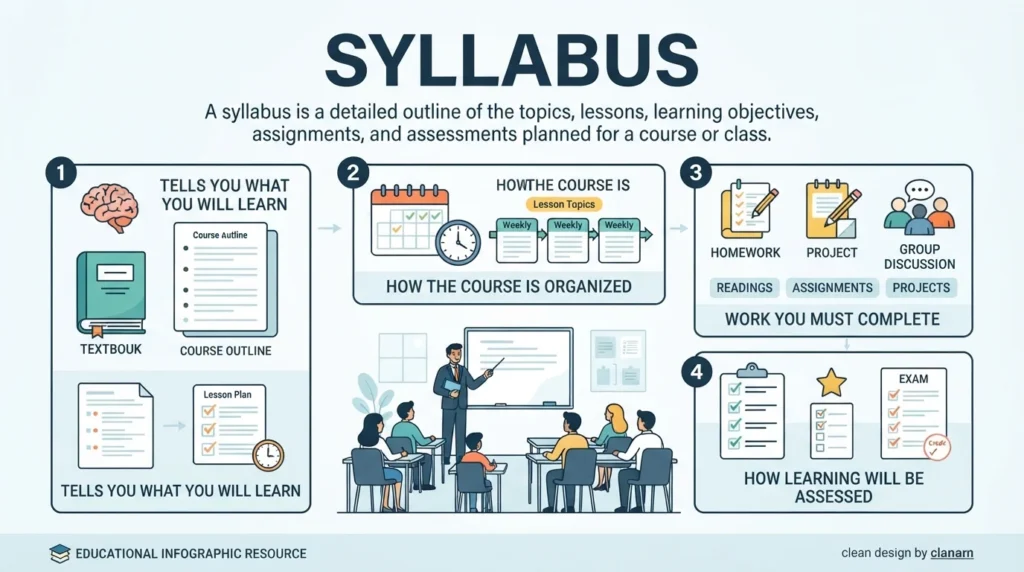
Syllabus is a noun that refers to a plan or outline showing the subjects, topics, readings, or other material covered in a particular course. Cambridge defines it as a plan showing the subjects or books studied in a course, especially one leading to an examination.
In simple English, a syllabus is a guide that tells students what they will study in a course.
For example:
The professor uploaded the syllabus before the semester began.
A syllabus can contain much more than a list of topics. It may include readings, assignments, grading information, learning objectives, deadlines, attendance rules, and examination details.
Part of Speech
Syllabus is a countable noun.
- Singular: syllabus
- Plural: syllabuses or syllabi
Both plural forms are recognized in English.
Emotional Tone
The word syllabus has no strong emotional meaning. It is mainly neutral and academic.
Native speakers commonly use it in schools, colleges, universities, training courses, examination preparation, and other structured learning environments.
Connotative Meaning of Syllabus
Connotation (the feeling or association a word creates beyond its basic dictionary meaning) can change depending on context.
Positive Tone
In a positive context, syllabus can suggest organization, preparation, clarity, and academic direction.
The detailed syllabus helped students prepare confidently.
Negative Tone
In a negative context, it may suggest rigid rules or an overloaded academic schedule.
The syllabus was so long that students felt overwhelmed.
Neutral Tone
Most uses are neutral and simply describe the content or structure of a course.
The syllabus lists six major units.
Etymology of Syllabus
The English word syllabus ultimately comes from the Latin syllabus. Its history is unusual because the Latin form is associated with a Greek word referring to a label, list, or written tablet.
The word entered English much later than the Old and Middle English periods.
Old English: 450–1100
Syllabus was not an established Old English word. Old English vocabulary developed before this term entered English.
Middle English: 1100–1500
Syllabus was also not a normal Middle English term. The modern academic sense developed later.
Modern English: 1500–Present
The word became established in English during the early Modern English period and developed its current educational meaning as formal courses and academic programs became increasingly structured.
This distinction matters because it would be inaccurate to invent an Old English or Middle English form of syllabus.
Pronunciation
US Pronunciation
/ˈsɪl.ə.bəs/
UK Pronunciation
/ˈsɪl.ə.bəs/
Cambridge gives the same basic pronunciation for both varieties.
Syllables
syl-la-bus
Affixation Pattern
Root: syllab-
Prefix: None in modern English
Suffix: No productive English suffix; -us belongs to the historical Latin form.
Synonyms List
Not every alternative below is a perfect dictionary synonym. Some are close contextual alternatives. This distinction is important because curriculum, course outline, and lesson plan, for example, describe different levels of educational planning.
1. Curriculum (Noun) — US /ˈkəˈrɪkjələm/ | UK /kəˈrɪkjələm/
Meaning: A broader organized framework of subjects and learning experiences offered by an educational institution.
Tone/Register: Academic, formal.
Example:
The school updated its science curriculum this year.
The new curriculum gives students more practical experience.
2. Course Outline (Noun) — US /kɔːrs ˈaʊtlaɪn/ | UK /kɔːs ˈaʊtlaɪn/
Meaning: A concise description of the topics, structure, and requirements of a particular course.
Tone/Register: Neutral, academic.
Example:
Read the course outline before choosing your classes.
The outline explains what we will cover each week.
3. Course Plan (Noun) — US /kɔːrs plæn/ | UK /kɔːs plæn/
Meaning: A planned structure showing how a course will progress.
Tone/Register: Neutral, professional.
Example:
The instructor shared the course plan on Monday.
Our course plan includes weekly discussions.
4. Study Plan (Noun) — US /ˈstʌdi plæn/ | UK /ˈstʌdi plæn/
Meaning: A structured plan showing what a learner intends to study and when.
Tone/Register: Neutral, educational.
Example:
I created a study plan for my final exams.
Her study plan covers every major topic.
5. Program of Study (Noun) — US /ˈproʊɡræm əv ˈstʌdi/ | UK /ˈprəʊɡræm əv ˈstʌdi/
Meaning: A structured set of courses or subjects that a student follows.
Tone/Register: Formal, academic.
Example:
His program of study focuses on environmental science.
The university offers several programs of study.
6. Course Program (Noun) — US /kɔːrs ˈproʊɡræm/ | UK /kɔːs ˈprəʊɡræm/
Meaning: A planned description of the content and organization of a course.
Tone/Register: Academic, neutral.
Example:
The course program covers modern literature.
Students received the course program during orientation.
7. Course Guide (Noun) — US /kɔːrs ɡaɪd/ | UK /kɔːs ɡaɪd/
Meaning: A document that helps students understand a course and its requirements.
Tone/Register: Neutral, student-friendly.
Example:
Check the course guide for assignment dates.
The guide explains how the course works.
8. Subject Outline (Noun) — US /ˈsʌbdʒɪkt ˈaʊtlaɪn/ | UK /ˈsʌbdʒɪkt ˈaʊtlaɪn/
Meaning: A summary of the subjects or topics covered in a course.
Tone/Register: Academic, formal.
Example:
The subject outline lists the required readings.
Students received the subject outline by email.
9. Course Description (Noun) — US /kɔːrs dɪˈskrɪpʃən/ | UK /kɔːs dɪˈskrɪpʃən/
Meaning: A short explanation of what a course teaches and what students can expect.
Tone/Register: Neutral, academic.
Example:
The course description helped me choose the class.
Read the description before registering.
10. Program of Courses (Noun) — US /ˈproʊɡræm əv ˈkɔːrsɪz/ | UK /ˈprəʊɡræm əv ˈkɔːsɪz/
Meaning: A structured collection or sequence of courses.
Tone/Register: Formal, academic.
Example:
The program of courses spans four semesters.
Students must complete the required courses.
11. Teaching Plan (Noun) — US /ˈtiːtʃɪŋ plæn/ | UK /ˈtiːtʃɪŋ plæn/
Meaning: A teacher’s organized plan for delivering course material.
Tone/Register: Professional, educational.
Example:
The teacher prepared a teaching plan for the semester.
Her plan includes group activities.
12. Instructional Plan (Noun) — US /ɪnˈstrʌkʃənəl plæn/ | UK /ɪnˈstrʌkʃənəl plæn/
Meaning: A structured plan for teaching content and achieving learning goals.
Tone/Register: Formal, educational.
Example:
The instructor revised the instructional plan.
The plan includes several practical exercises.
13. Learning Plan (Noun) — US /ˈlɜːrnɪŋ plæn/ | UK /ˈlɜːnɪŋ plæn/
Meaning: A plan that organizes learning goals, activities, and progress.
Tone/Register: Neutral, educational.
Example:
The student created a learning plan for the course.
Her plan focuses on improving academic writing.
14. Teaching Outline (Noun) — US /ˈtiːtʃɪŋ ˈaʊtlaɪn/ | UK /ˈtiːtʃɪŋ ˈaʊtlaɪn/
Meaning: A brief structure showing what a teacher intends to cover.
Tone/Register: Professional, academic.
Example:
The teaching outline covers twelve lessons.
The instructor changed the outline after the first week.
15. Course Structure (Noun) — US /kɔːrs ˈstrʌktʃər/ | UK /kɔːs ˈstrʌktʃə/
Meaning: The way a course is organized into topics, units, activities, or assessments.
Tone/Register: Neutral, academic.
Example:
The course structure is easy to follow.
Each unit builds on the previous one.
16. Academic Program (Noun) — US /ˌækəˈdemɪk ˈproʊɡræm/ | UK /ˌækəˈdemɪk ˈprəʊɡræm/
Meaning: An organized educational program containing related courses or study requirements.
Tone/Register: Formal, academic.
Example:
She joined an academic program in psychology.
The program includes research and practical work.
17. Course Schedule (Noun) — US /kɔːrs ˈskedʒuːl/ | UK /kɔːs ˈʃedjuːl/
Meaning: A timetable showing when course topics, classes, or assessments occur.
Tone/Register: Neutral, practical.
Example:
The course schedule shows the exam date.
Check the schedule before planning your week.
18. Study Schedule (Noun) — US /ˈstʌdi ˈskedʒuːl/ | UK /ˈstʌdi ˈʃedjuːl/
Meaning: A timetable for organizing individual study activities.
Tone/Register: Neutral, practical.
Example:
I made a study schedule for the semester.
My schedule gives extra time to difficult subjects.
19. Scheme of Work (Noun) — US /skiːm əv wɜːrk/ | UK /skiːm əv wɜːk/
Meaning: A detailed plan showing what teachers will teach over a particular period.
Tone/Register: British, formal, educational.
Example:
The teacher prepared a scheme of work for the term.
Each unit has clear learning objectives.
20. Course Framework (Noun) — US /kɔːrs ˈfreɪmwɜːrk/ | UK /kɔːs ˈfreɪmwɜːk/
Meaning: The underlying structure that organizes a course’s content and learning goals.
Tone/Register: Academic, professional.
Example:
The course framework supports practical learning.
The department revised the framework last year.
21. Learning Framework (Noun) — US /ˈlɜːrnɪŋ ˈfreɪmwɜːrk/ | UK /ˈlɜːnɪŋ ˈfreɪmwɜːk/
Meaning: An organized structure for guiding learning activities and outcomes.
Tone/Register: Academic, professional.
Example:
The learning framework encourages independent study.
Teachers use the framework to organize activities.
22. Course Content (Noun) — US /kɔːrs ˈkɑːntent/ | UK /kɔːs ˈkɒntent/
Meaning: The subjects, information, skills, and materials taught in a course.
Tone/Register: Neutral, academic.
Example:
The course content includes five major units.
Students reviewed the content before the exam.
23. Study Content (Noun) — US /ˈstʌdi ˈkɑːntent/ | UK /ˈstʌdi ˈkɒntent/
Meaning: The material that a learner needs to study.
Tone/Register: Neutral.
Example:
The study content appears in the online classroom.
We reviewed the required material together.
24. Academic Outline (Noun) — US /ˌækəˈdemɪk ˈaʊtlaɪn/ | UK /ˌækəˈdemɪk ˈaʊtlaɪn/
Meaning: A structured summary of academic topics or requirements.
Tone/Register: Formal, academic.
Example:
The academic outline explains the course goals.
Students received the outline at orientation.
25. Course Map (Noun) — US /kɔːrs mæp/ | UK /kɔːs mæp/
Meaning: A visual or organized representation of how course topics connect and progress.
Tone/Register: Modern, educational.
Example:
The course map shows how each unit connects.
Use the course map to understand the semester.
26. Learning Roadmap (Noun) — US /ˈlɜːrnɪŋ ˈroʊdmæp/ | UK /ˈlɜːnɪŋ ˈrəʊdmæp/
Meaning: A step-by-step guide showing how learning progresses toward a goal.
Tone/Register: Modern, professional.
Example:
The learning roadmap begins with basic concepts.
Students can track their progress through it.
27. Academic Roadmap (Noun) — US /ˌækəˈdemɪk ˈroʊdmæp/ | UK /ˌækəˈdemɪk ˈrəʊdmæp/
Meaning: A structured guide showing an academic path or sequence of study.
Tone/Register: Professional, academic.
Example:
The academic roadmap helps students plan their degrees.
It shows which courses come first.
28. Course Blueprint (Noun) — US /kɔːrs ˈbluːprɪnt/ | UK /kɔːs ˈbluːprɪnt/
Meaning: A detailed plan describing how a course is designed and organized.
Tone/Register: Professional, modern.
Example:
The instructor created a course blueprint.
The blueprint keeps every unit organized.
29. Instructional Outline (Noun) — US /ɪnˈstrʌkʃənəl ˈaʊtlaɪn/ | UK /ɪnˈstrʌkʃənəl ˈaʊtlaɪn/
Meaning: A structured summary of teaching content and activities.
Tone/Register: Formal, educational.
Example:
The instructional outline lists the weekly objectives.
Teachers use it to organize lessons.
30. Subject Guide (Noun) — US /ˈsʌbdʒɪkt ɡaɪd/ | UK /ˈsʌbdʒɪkt ɡaɪd/
Meaning: A guide explaining the main content and expectations of a subject.
Tone/Register: Neutral, academic.
Example:
The subject guide explains the assessment rules.
Students downloaded the guide before class.
31. Course Handbook (Noun) — US /kɔːrs ˈhændbʊk/ | UK /kɔːs ˈhændbʊk/
Meaning: A reference document containing course information and guidance.
Tone/Register: Formal, academic.
Example:
The course handbook contains important policies.
Read the handbook before starting the course.
32. Student Guide (Noun) — US /ˈstuːdənt ɡaɪd/ | UK /ˈstjuːdənt ɡaɪd/
Meaning: A document designed to help students understand their studies and responsibilities.
Tone/Register: Neutral, educational.
Example:
The student guide explains the first assignment.
New students received the guide during orientation.
33. Academic Guide (Noun) — US /ˌækəˈdemɪk ɡaɪd/ | UK /ˌækəˈdemɪk ɡaɪd/
Meaning: A resource that explains academic requirements, subjects, or study options.
Tone/Register: Formal, academic.
Example:
The academic guide explains degree requirements.
Students consulted it before selecting courses.
34. Lesson Plan (Noun) — US /ˈlesən plæn/ | UK /ˈlesən plæn/
Meaning: A detailed plan for one lesson or a small teaching sequence.
Tone/Register: Educational, professional.
Example:
The teacher prepared a lesson plan for Tuesday.
The plan includes a short writing activity.
Usage note: A lesson plan is narrower than a syllabus, so it is not always interchangeable.
35. Teaching Schedule (Noun) — US /ˈtiːtʃɪŋ ˈskedʒuːl/ | UK /ˈtiːtʃɪŋ ˈʃedjuːl/
Meaning: A timetable showing when teaching activities or topics will take place.
Tone/Register: Professional, academic.
Example:
The teaching schedule covers the entire semester.
The professor changed the schedule after the holiday.
36. Academic Schedule (Noun) — US /ˌækəˈdemɪk ˈskedʒuːl/ | UK /ˌækəˈdemɪk ˈʃedjuːl/
Meaning: A timetable organizing academic classes, events, or requirements.
Tone/Register: Formal, neutral.
Example:
The academic schedule lists examination dates.
Students checked it before making travel plans.
37. Course Specification (Noun) — US /kɔːrs ˌspesəfɪˈkeɪʃən/ | UK /kɔːs ˌspesɪfɪˈkeɪʃən/
Meaning: A formal document describing a course’s content, outcomes, structure, and requirements.
Tone/Register: Formal, institutional.
Example:
The course specification lists the expected outcomes.
Teachers reviewed the specification before the semester.
38. Course Requirements (Noun) — US /kɔːrs rɪˈkwaɪərmənts/ | UK /kɔːs rɪˈkwaɪəmənts/
Meaning: The tasks, materials, assessments, or conditions students must complete for a course.
Tone/Register: Academic, professional.
Example:
Check the course requirements before enrolling.
The requirements include two essays and an exam.
39. Academic Requirements (Noun) — US /ˌækəˈdemɪk rɪˈkwaɪərmənts/ | UK /ˌækəˈdemɪk rɪˈkwaɪəmənts/
Meaning: Educational conditions students must meet within a program or course.
Tone/Register: Formal, academic.
Example:
Students must meet all academic requirements.
The advisor explained the remaining requirements.
40. Study Guide (Noun) — US /ˈstʌdi ɡaɪd/ | UK /ˈstʌdi ɡaɪd/
Meaning: A resource that helps learners review important information and prepare for assessment.
Tone/Register: Neutral, educational.
Example:
I used the study guide before the exam.
The guide highlights the most important concepts.
41. Course Syllabus Outline (Noun) — US /kɔːrs ˈsɪləbəs ˈaʊtlaɪn/ | UK /kɔːs ˈsɪləbəs ˈaʊtlaɪn/
Meaning: A condensed structure showing the main parts of a course syllabus.
Tone/Register: Academic.
Example:
The course syllabus outline gives a quick overview.
Students reviewed it before reading the full document.
42. Subject Plan (Noun) — US /ˈsʌbdʒɪkt plæn/ | UK /ˈsʌbdʒɪkt plæn/
Meaning: A plan describing how a particular subject will be taught or studied.
Tone/Register: Educational, neutral.
Example:
The subject plan covers the entire academic year.
The teacher updated the plan before classes began.
43. Teaching Program (Noun) — US /ˈtiːtʃɪŋ ˈproʊɡræm/ | UK /ˈtiːtʃɪŋ ˈprəʊɡræm/
Meaning: An organized plan or program for delivering educational instruction.
Tone/Register: Professional, academic.
Example:
The teaching program includes practical workshops.
Teachers follow the program throughout the term.
44. Course Guidebook (Noun) — US /kɔːrs ˈɡaɪdbʊk/ | UK /kɔːs ˈɡaɪdbʊk/
Meaning: A guidebook containing useful information about a particular course.
Tone/Register: Neutral, educational.
Example:
The course guidebook explains the grading system.
Students received the guidebook on the first day.
45. Program Outline (Noun) — US /ˈproʊɡræm ˈaʊtlaɪn/ | UK /ˈprəʊɡræm ˈaʊtlaɪn/
Meaning: A summary showing the main components and organization of an educational program.
Tone/Register: Formal, academic.
Example:
The program outline shows the required subjects.
Students used it to plan their academic year.
Synonyms for Syllabus by Tone
Tone matters because two alternatives may communicate a similar idea but fit different situations.
Positive or Supportive
- Learning roadmap
- Academic roadmap
- Course guide
- Student guide
- Course map
- Learning framework
These choices can make education sound organized, supportive, and accessible.
Neutral
- Syllabus
- Course outline
- Course plan
- Subject outline
- Course structure
- Course content
- Study plan
- Course schedule
These are useful for everyday academic writing.
Formal or Academic
- Curriculum
- Program of study
- Academic program
- Instructional plan
- Course specification
- Academic outline
- Scheme of work
These work well in institutional, educational, and professional contexts.
Playful or Informal
English has fewer genuinely informal synonyms for syllabus. Modern expressions such as course map and learning roadmap can sound more approachable, but they are not universally interchangeable with syllabus.
Syllabus vs. Close Alternatives
Syllabus vs. Curriculum
A syllabus usually focuses on one course. A curriculum is broader and can cover an entire school, department, program, or educational system.
Use syllabus for one class or course.
Use curriculum for a broader educational framework.
Course Outline vs. Syllabus
A course outline is often a shorter summary of a course’s topics and structure.
A syllabus can include additional details such as policies, grading, assignments, readings, and deadlines.
Lesson Plan vs. Syllabus
A lesson plan normally focuses on a specific lesson.
A syllabus covers a much longer period, such as a semester or full course.
How Syllabus Changes by Context
Daily Conversation
In everyday academic conversation, syllabus is common and easy to understand.
Did the professor upload the syllabus?
You can use course outline when you want to emphasize the topics or general structure.
Writing and Blogging
Bloggers can use alternatives to avoid repetition.
Instead of:
The syllabus explains the course. The syllabus also lists the readings.
Try:
The course outline explains the main topics. The course guide also lists the required readings.
This creates smoother writing without changing the central idea.
Professional or Academic Writing
Formal contexts often favor expressions such as curriculum, program of study, course specification, and instructional plan.
Choose the term according to the exact scope.
A curriculum is broader than a single syllabus, while an instructional plan focuses more strongly on teaching.
Creative or Informal Use
Expressions such as course map or learning roadmap can make educational writing sound more accessible.
For example:
Think of the course map as your academic roadmap for the semester.
This style works particularly well in student-facing content.
Common Mistakes Learners Make
1. Mistake: Treating Curriculum and Syllabus as Identical
They overlap, but they do not always mean the same thing.
Curriculum usually has a wider scope.
Syllabus generally refers to a specific course.
2. Mistake: Using Lesson Plan for a Whole Course
A lesson plan normally describes one lesson or a short teaching sequence.
A syllabus usually covers the broader course.
3. Mistake: Assuming Every Alternative Is Interchangeable
Words such as study guide, course schedule, and course requirements describe parts of a syllabus rather than the entire document.
Use them only when that specific meaning fits.
4. Mistake: Overusing “Curriculum”
If you are discussing one university class, syllabus or course outline may be more precise.
5. Mistake: Confusing Course Content With Course Structure
- Course content tells you what students learn.
- Course structure tells you how the course is organized.
Native Usage and Register Notes
Syllabus is standard in both spoken and written English.
It is especially common in:
- Universities
- Schools
- Colleges
- Training courses
- Professional education
- Examination preparation
- Online learning
- For formal writing, syllabus, course outline, and program of study are usually safe choices.
- For student-friendly writing, course guide, course map, and learning roadmap may sound more approachable.
- For broader educational discussions, curriculum is often the better choice.
Real-Life Mini Scenarios
Workplace
A company trainer may provide a course outline before a professional development session.
The course outline explains the training objectives and activities.
Social Situation
A student might ask a friend:
Have you checked the syllabus for tomorrow’s class?
The word sounds completely natural in this context.
Media and Pop Culture
A documentary about education might discuss how a university changed its curriculum to include modern subjects.
Writing and Storytelling
A writer describing academic life might use course guide, study plan, or academic roadmap to create a more conversational tone.
Quick Word-Choice Guide
- Use syllabus when you mean the official plan for a particular course.
- Use curriculum when you mean a broader educational framework.
- Use course outline when you mean a concise summary of course topics.
- Use course plan when emphasizing organization and progression.
- Use study plan when focusing on the learner’s own preparation.
- Use lesson plan when discussing one lesson.
- Use scheme of work when writing in a British educational context.
- Use course guide when you want a student-friendly expression.
- Use course specification when you need a formal institutional term.
Interactive Practice Quiz
Choose the best answer for each situation. Do not look at the answer key until you finish.
Part 1: Meaning and Context
1. Which word usually describes the broader educational framework of a school or program?
A. Lesson plan
B. Curriculum
C. Study guide
D. Course schedule
2. A professor gives students a document containing readings, assignments, deadlines, and grading rules. What is it most likely called?
A. Syllabus
B. Lesson plan
C. Academic roadmap
D. Study schedule
3. Which alternative best describes a plan for one individual lesson?
A. Curriculum
B. Program of study
C. Lesson plan
D. Academic program
4. A student wants a personal timetable for preparing for final exams. Which term fits best?
A. Study plan
B. Curriculum
C. Course specification
D. Subject outline
5. Which expression is especially associated with British educational usage?
A. Scheme of work
B. Course map
C. Learning roadmap
D. Study content
6. Which term sounds especially formal and institutional?
A. Course specification
B. Course map
C. Study plan
D. Course guide
7. Which expression sounds more modern and student-friendly?
A. Course roadmap
B. Course map
C. Academic requirements
D. Course specification
8. Which word is best when discussing an entire educational system rather than one class?
A. Syllabus
B. Lesson plan
C. Curriculum
D. Course schedule
9. A document lists only the topics that students will study. Which alternative fits best?
A. Subject outline
B. Academic program
C. Lesson plan
D. Student guide
10. A timetable tells students when classes and examinations occur. Which term fits best?
A. Course schedule
B. Curriculum
C. Course content
D. Learning framework
Part Two
11. A teacher prepares a structured plan for delivering lessons and meeting learning objectives. Which term is most appropriate?
A. Instructional plan
B. Study guide
C. Course content
D. Program outline
12. A student wants a resource that helps review material before an exam. Which term fits best?
A. Study guide
B. Curriculum
C. Course structure
D. Teaching schedule
13. Which term emphasizes the actual information and subjects taught?
A. Course content
B. Course schedule
C. Academic roadmap
D. Teaching schedule
14. Which expression describes a sequence of courses that a student follows toward an academic goal?
A. Program of study
B. Lesson plan
C. Study guide
D. Course schedule
15. Which sentence uses “curriculum” most naturally?
A. I checked the curriculum for tomorrow’s lesson.
B. The university redesigned its curriculum.
C. I forgot to bring my curriculum to class.
D. The professor uploaded the curriculum for Monday’s homework.
Reflection Task: Write one sentence using course outline, curriculum, study plan, or learning roadmap. Make sure the synonym matches its intended context.
Answer Key: 1-B | 2-A | 3-C | 4-A | 5-A | 6-A | 7-B | 8-C | 9-A | 10-A | 11-A | 12-A | 13-A | 14-A | 15-B
Frequently Asked Questions
1. What is another word for syllabus in simple English?
A simple alternative is course outline. It describes the main subjects, topics, or structure of a course. Depending on context, course plan, course guide, and study plan can also work. However, these alternatives are not always exact replacements because each one can emphasize a different part of the educational plan.
2. Is curriculum the same as a syllabus?
Not exactly. A syllabus normally describes one particular course, while a curriculum has a broader scope. A curriculum can cover multiple subjects, courses, learning goals, or an entire educational program. The two words overlap, but curriculum should not automatically replace syllabus when you are discussing one class.
3. What is a formal synonym for syllabus?
Formal alternatives include program of study, course specification, instructional plan, academic outline, and scheme of work. The most appropriate choice depends on the document. Course specification sounds especially institutional, while program of study usually refers to a broader organized academic pathway.
4. What is a synonym for syllabus in British English?
Programme can function as a synonym in some British educational contexts, although the exact meaning depends on the situation. Scheme of work, course outline, and subject outline are also useful alternatives. British English commonly uses programme, whereas American English often uses program.
5. What is the difference between a syllabus and a course outline?
A syllabus can be a detailed course document containing topics, readings, assignments, deadlines, policies, and assessment information. A course outline is often more concise and focuses on the main topics and structure. In some institutions, the two terms may refer to nearly the same document.
6. What is a good synonym for syllabus in academic writing?
Course outline, program of study, academic outline, and course specification are useful choices. Select the term according to scope. Use course outline for a single class, while program of study can describe a broader sequence of academic courses.
7. What is the difference between a syllabus and a study plan?
A syllabus is normally created by an instructor or institution to explain a course. A study plan is often created by the learner to organize personal study. A syllabus tells you what the course includes, while a study plan can tell you how and when you will prepare.
Conclusion
Learning a synonym for syllabus gives you more precise ways to discuss education. Words such as curriculum, course outline, and course plan each add a useful shade of meaning.
Good vocabulary is not about replacing every word. It is about choosing the expression that fits your meaning, audience, tone, and situation.
Students can use these alternatives in essays and conversations, while bloggers and writers can use them to make educational content smoother and more natural.
Practice these words in emails, assignments, articles, and daily conversations. Start with a few alternatives and gradually build a stronger, more flexible vocabulary.

Sophia Carter is the founder and lead writer at SynonymVerse.com, a trusted online resource dedicated to English vocabulary and effective communication. She is passionate about helping students, writers, professionals, and lifelong learners find the most accurate words to express their ideas with clarity and confidence.
At SynonymVerse.com, every article is carefully researched and thoughtfully written to provide reliable guidance on synonyms, word meanings, and vocabulary. With a strong focus on accuracy, real-world usage, and easy-to-understand explanations, the website is committed to helping readers strengthen their language skills, enrich their vocabulary, and become more confident communicators.