The synonym for swing depends on the meaning you intend. Common alternatives include sway, sway back and forth, oscillate, rock, move, sway, fluctuate, shift, turn, pivot, hit, and strike. The best choice changes with context.
A synonym for swing can describe a child moving on a playground, a door moving freely, or a person changing direction quickly.
Imagine a child moving happily on a playground swing. In another sentence, a market can swing sharply in either direction.
Learning a synonym for swing helps students, bloggers, writers, and daily English users express movement, change, or action more precisely.
The word is common because it describes many everyday actions. Knowing its alternatives helps you avoid repetition and choose a word that matches your exact meaning.
What Does “Swing” Really Mean?
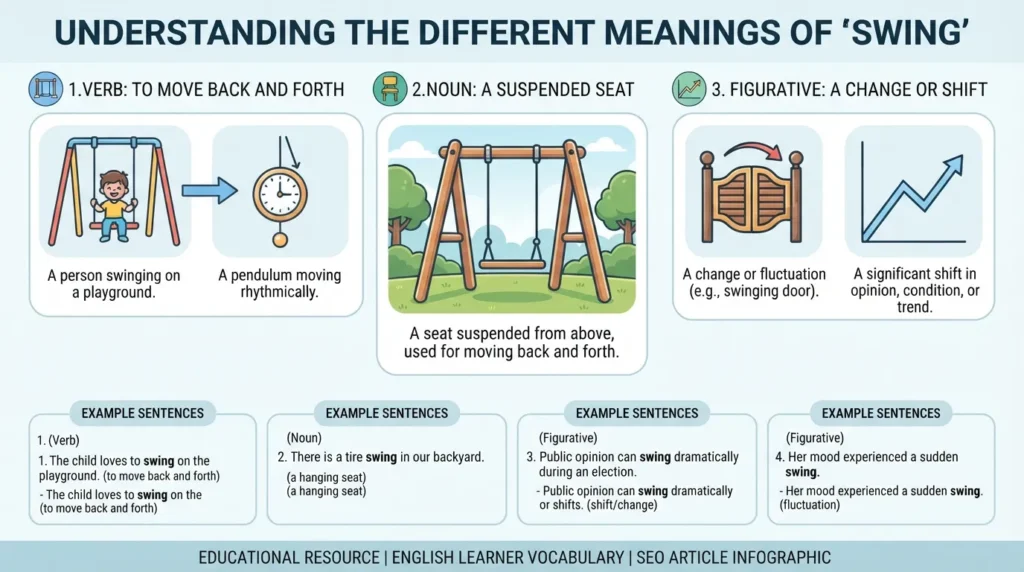
Swing is a versatile English word that can work as a verb or a noun.
As a verb, it usually means to move backward and forward, move from one side to another, change direction, or move something through the air.
Simple definition:
The Swing means to move back and forth, change direction, or move something with a curved or sweeping motion.
As a noun, swing can describe the movement itself or a suspended seat that moves backward and forward.
For example:
- The child swung high above the ground.
- The door swung open.
- The pendulum swings from side to side.
- He swung the bat toward the ball.
Native speakers understand swing through context. The word may describe physical movement, emotional or numerical change, sports action, musical rhythm, or even a change in opinion.
Part of Speech
Verb: to move, change direction, or cause something to move.
Noun: a back-and-forth movement, a playground seat, or a change in position or opinion.
Adjective: In some expressions, swing can appear in compound forms such as swing door or swing music.
Connotative Meaning
Connotation (the feeling, attitude, or association a word carries beyond its basic dictionary meaning) changes depending on context.
Positive Tone
Swing can sound energetic, playful, lively, or graceful.
The dancer swung her arms to the music.
Negative Tone
It can suggest instability or unpredictable change.
Public opinion swung dramatically after the announcement.
Neutral Tone
It can simply describe physical movement or a change.
The gate swung toward the wall.
The surrounding words usually determine whether swing feels positive, negative, or completely neutral.
Etymology of “Swing”
The word swing has Germanic roots. It is related to Old English swingan, meaning “to beat,” “strike,” or “move with a sweeping motion.”
Old English: 450–1100
The Old English form swingan referred mainly to striking, beating, or moving with force.
Middle English: 1100–1500
During Middle English, forms related to swingen continued to describe striking and moving. The sense of moving back and forth became increasingly established.
Modern English: 1500–Present
Modern English expanded swing into many areas. Today, it can describe physical movement, sports, music, moods, opinions, prices, political trends, and changes in direction.
Pronunciation
US: /swɪŋ/
UK: /swɪŋ/
Syllables
swing
It is a one-syllable word.
Affixation Pattern of “Swing”
Root: swing
Prefix: none
Suffix: none
The word is a simple base form rather than a prefixed or suffixed construction.
Synonyms List
The following alternatives cover the major meanings of swing. They are not all interchangeable. Always choose one that matches the context.
1. Sway (Verb) — US /sweɪ/ | UK /sweɪ/
Meaning: To move gently from side to side.
Tone/Register: Neutral, descriptive.
Example:
The trees swayed in the evening wind.
She swayed gently while listening to the song.
2. Oscillate (Verb) — US /ˈɑː.sə.leɪt/ | UK /ˈɒs.ɪ.leɪt/
Meaning: To move repeatedly between two positions or points.
Tone/Register: Formal, scientific, academic.
Example:
The fan oscillates from left to right.
The machine oscillated between two settings.
3. Rock (Verb) — US /rɑːk/ | UK /rɒk/
Meaning: To move gently backward and forward.
Tone/Register: Neutral, everyday.
Example:
She rocked the baby in her arms.
The boat rocked on the waves.
4. Roll (Verb) — US /roʊl/ | UK /rəʊl/
Meaning: To move by turning around or from one side to another.
Tone/Register: Neutral.
Example:
The ball rolled across the floor.
The waves rolled toward the shore.
5. Bob (Verb) — US /bɑːb/ | UK /bɒb/
Meaning: To move up and down or appear repeatedly above and below a surface.
Tone/Register: Neutral, descriptive.
Example:
The small boat bobbed on the water.
Her head bobbed above the crowd.
6. Toss (Verb) — US /tɔːs/ | UK /tɒs/
Meaning: To throw something lightly or casually.
Tone/Register: Informal, everyday.
Example:
He tossed the keys onto the table.
She tossed the ball to her brother.
7. Move (Verb) — US /muːv/ | UK /muːv/
Meaning: To change position or cause something to change position.
Tone/Register: Neutral, general.
Example:
The gate moved in the wind.
Please move the chair closer.
8. Shift (Verb) — US /ʃɪft/ | UK /ʃɪft/
Meaning: To move slightly or change position, direction, or focus.
Tone/Register: Neutral, professional.
Example:
The wind shifted during the afternoon.
Her attention shifted to the new speaker.
9. Rock Back and Forth (Phrase) — US /rɑːk bæk ən fɔːrθ/ | UK /rɒk bæk ən fɔːθ/
Meaning: To move repeatedly between forward and backward positions.
Tone/Register: Neutral.
Example:
The child rocked back and forth on the chair.
He rocked back and forth while thinking.
10. Pendulate (Verb) — US /ˈpen.dʒə.leɪt/ | UK /ˈpen.dʒə.leɪt/
Meaning: To move repeatedly like a pendulum.
Tone/Register: Technical, formal.
Example:
The object pendulated beneath the platform.
The weight pendulated slowly from side to side.
11. Fluctuate (Verb) — US /ˈflʌk.tʃu.eɪt/ | UK /ˈflʌk.tʃu.eɪt/
Meaning: To rise and fall or change repeatedly.
Tone/Register: Formal, academic, business.
Example:
Energy demand fluctuates throughout the day.
Her interest fluctuated over the semester.
12. Vary (Verb) — US /ˈver.i/ | UK /ˈveə.ri/
Meaning: To change in amount, level, quality, or degree.
Tone/Register: Neutral, academic.
Example:
Prices vary during the year.
The results varied from group to group.
13. Alternate (Verb) — US /ˈɔːl.tɚ.neɪt/ | UK /ˈɔːl.tə.neɪt/
Meaning: To switch repeatedly between two states or activities.
Tone/Register: Formal, neutral.
Example:
The lights alternate between red and green.
She alternated between work and study.
14. Vacillate (Verb) — US /ˈvæs.ə.leɪt/ | UK /ˈvæs.ɪ.leɪt/
Meaning: To move uncertainly between different choices or opinions.
Tone/Register: Formal.
Example:
He vacillated between the two offers.
She vacillated before making her decision.
15. Waver (Verb) — US /ˈweɪ.vɚ/ | UK /ˈweɪ.və/
Meaning: To move irregularly or become uncertain about a decision.
Tone/Register: Neutral, formal.
Example:
Her voice wavered during the speech.
His confidence began to waver.
16. Shift Direction (Phrase) — US /ʃɪft dəˈrek.ʃən/ | UK /ʃɪft dəˈrek.ʃən/
Meaning: To change the direction of movement.
Tone/Register: Neutral, professional.
Example:
The cyclist shifted direction quickly.
The storm shifted direction overnight.
17. Turn (Verb) — US /tɝːn/ | UK /tɜːn/
Meaning: To change direction or rotate around an axis.
Tone/Register: Neutral, everyday.
Example:
The car turned toward the main road.
She turned the handle slowly.
18. Pivot (Verb) — US /ˈpɪv.ət/ | UK /ˈpɪv.ət/
Meaning: To turn around a central point or change direction strategically.
Tone/Register: Business, professional, neutral.
Example:
The player pivoted toward the basket.
The company pivoted toward a new market.
19. Rotate (Verb) — US /ˈroʊ.teɪt/ | UK /rəʊˈteɪt/
Meaning: To move around a central point or axis.
Tone/Register: Technical, academic.
Example:
The wheel rotates smoothly.
Rotate the handle clockwise.
20. Spin (Verb) — US /spɪn/ | UK /spɪn/
Meaning: To turn rapidly around a central point.
Tone/Register: Neutral, informal.
Example:
The wheel spun rapidly.
The dancer spun across the stage.
21. Strike (Verb) — US /straɪk/ | UK /straɪk/
Meaning: To hit something with force.
Tone/Register: Neutral, formal, sports.
Example:
The player struck the ball cleanly.
He struck the drum with one hand.
22. Hit (Verb) — US /hɪt/ | UK /hɪt/
Meaning: To make forceful contact with something.
Tone/Register: Everyday, informal to neutral.
Example:
She hit the ball over the fence.
He hit the target on his first attempt.
23. Whack (Verb) — US /wæk/ | UK /wæk/
Meaning: To hit something with considerable force.
Tone/Register: Informal.
Example:
He whacked the ball with the bat.
She whacked the cushion against the sofa.
24. Bat (Verb) — US /bæt/ | UK /bæt/
Meaning: To hit a ball with a bat.
Tone/Register: Sports.
Example:
He batted the ball toward the boundary.
She batted first for her team.
25. Slap (Verb) — US /slæp/ | UK /slæp/
Meaning: To hit something with an open hand or flat surface.
Tone/Register: Everyday, informal.
Example:
She slapped the ball with her hand.
The waves slapped against the boat.
26. Knock (Verb) — US /nɑːk/ | UK /nɒk/
Meaning: To strike something with a short, firm movement.
Tone/Register: Neutral.
Example:
He knocked the ball off the table.
The branch knocked against the window.
27. Lunge (Verb) — US /lʌndʒ/ | UK /lʌndʒ/
Meaning: To move or strike forward suddenly and forcefully.
Tone/Register: Neutral, sports, descriptive.
Example:
The player lunged for the ball.
She lunged forward to catch it.
28. Lash (Verb) — US /læʃ/ | UK /læʃ/
Meaning: To strike or move forcefully and suddenly.
Tone/Register: Dramatic, literary.
Example:
The horse lashed its tail.
The strong wind lashed the branches.
29. Whip (Verb) — US /wɪp/ | UK /wɪp/
Meaning: To move or cause something to move suddenly and forcefully.
Tone/Register: Neutral, vivid.
Example:
The flag whipped in the strong wind.
He whipped his head around.
30. Sweep (Verb) — US /swiːp/ | UK /swiːp/
Meaning: To move across an area in a broad, smooth motion.
Tone/Register: Neutral, descriptive.
Example:
The spotlight swept across the audience.
She swept her arm toward the door.
31. Arc (Verb) — US /ɑːrk/ | UK /ɑːk/
Meaning: To move along a curved path.
Tone/Register: Technical, descriptive.
Example:
The ball arced over the defender.
The bird arced across the open sky.
32. Curve (Verb) — US /kɝːv/ | UK /kɜːv/
Meaning: To move or bend along a curved path.
Tone/Register: Neutral.
Example:
The road curves around the hill.
The ball curved toward the goal.
33. Veer (Verb) — US /vɪr/ | UK /vɪə/
Meaning: To suddenly change direction.
Tone/Register: Neutral, descriptive.
Example:
The car veered toward the shoulder.
The boat veered away from the rocks.
34. Swerve (Verb) — US /swɝːv/ | UK /swɜːv/
Meaning: To turn suddenly to avoid something.
Tone/Register: Neutral, everyday.
Example:
The driver swerved around the obstacle.
The cyclist swerved to avoid the dog.
35. Swing Around (Phrase) — US /swɪŋ əˈraʊnd/ | UK /swɪŋ əˈraʊnd/
Meaning: To turn or move around quickly.
Tone/Register: Conversational.
Example:
She swung around when she heard her name.
He swung around to face the door.
36. Change (Verb) — US /tʃeɪndʒ/ | UK /tʃeɪndʒ/
Meaning: To become different in position, level, direction, or condition.
Tone/Register: Neutral.
Example:
Public opinion changed after the debate.
The weather changed suddenly.
37. Turnaround (Noun) — US /ˈtɝːn.ə.raʊnd/ | UK /ˈtɜːn.ə.raʊnd/
Meaning: A major change from one situation or direction to another.
Tone/Register: Business, informal.
Example:
The team made an impressive turnaround.
The company achieved a rapid turnaround.
38. Rebound (Verb) — US /rɪˈbaʊnd/ | UK /rɪˈbaʊnd/
Meaning: To move back after hitting a surface or to recover after a decline.
Tone/Register: Sports, business, general.
Example:
The ball rebounded off the wall.
Sales rebounded after a difficult quarter.
39. Bounce (Verb) — US /baʊns/ | UK /baʊns/
Meaning: To move upward or away after hitting a surface.
Tone/Register: Neutral, informal.
Example:
The ball bounced across the court.
The child bounced happily on the mattress.
40. Flit (Verb) — US /flɪt/ | UK /flɪt/
Meaning: To move lightly, quickly, and often from one place to another.
Tone/Register: Literary, descriptive.
Example:
The butterfly flitted among the flowers.
Her attention flitted from one idea to another.
Synonyms for “Swing” by Tone
Tone matters because two words can describe similar movement while creating very different impressions.
Positive
Words such as sway, rock, glide, sweep, rebound, and bounce can create energetic, graceful, playful, or pleasant images depending on context.
Neutral
Move, shift, turn, rotate, roll, swing, vary, change, and oscillate can describe movement without adding a strong emotional judgment.
Negative
Waver, vacillate, veer, swerve, fluctuate, and lash can suggest instability, uncertainty, sudden movement, or lack of control in suitable contexts.
Professional or Academic
Oscillate, fluctuate, vary, alternate, pivot, rotate, and vacillate are useful when writing formally or explaining technical, financial, scientific, or analytical changes.
Playful or Informal
Toss, whack, hit, bounce, rock, and spin are common in relaxed conversation and everyday descriptions.
Choosing the right tone makes your writing sound more natural and precise.
“Swing” vs Close Alternatives
Swing vs Sway
The Swing often suggests a wider or more noticeable back-and-forth movement. Sway usually suggests a gentler side-to-side motion.
The child swung on the playground.
The trees swayed in the breeze.
Oscillate vs Swing
Swing is common in everyday English. Oscillate sounds more technical and often describes repeated movement between positions.
The door swung open.
The machine oscillated between two settings.
Swing vs Fluctuate
Swing can describe a change in level or direction, especially in everyday or journalistic language. Fluctuate is especially useful for changing numbers, rates, prices, or levels.
Temperatures swung sharply overnight.
Temperatures fluctuated throughout the week.
How “Swing” Changes by Context
Daily Conversation
In everyday English, swing often describes physical movement.
You might say:
Swing the door open.
The child is swinging outside.
It can also describe a sudden change.
Her mood swung from excitement to disappointment.
Writing and Blogging
Writers use swing to create vivid descriptions.
Instead of repeatedly using move, you can describe how something swings, sways, rocks, rolls, or sweeps.
This creates more precise imagery.
Professional or Academic English
Formal writing often favors more specific alternatives.
Use oscillate for repeated movement, fluctuate for changing values, pivot for strategic changes, and vacillate for uncertain decisions.
These choices make technical explanations more precise.
Creative and Informal English
Creative writing can use whip, sweep, arc, bounce, rock, flit, and lash to create movement and energy.
The best choice depends on speed, force, direction, and emotional effect.
Common Mistakes Learners Make
1. Mistake: Treating Every Synonym as Identical
Not every alternative works in every sentence.
For example, fluctuate works well for prices, but sway usually does not.
2. Mistakes: Using Formal Words in Casual Situations
- Oscillate is correct in technical writing, but it can sound unnatural when describing a child on a playground.
- The child swung on the swing.
- This sounds more natural than:
- The child oscillated on the playground.
3. Mistakes: Confusing Movement With Striking
- Swing can mean moving a body part or object through the air, but strike focuses more strongly on making contact.
- He swung the bat.
- He struck the ball.
- These sentences describe related actions, but they emphasize different moments.
4. Mistakes: Ignoring Context
When swing refers to changing numbers or opinions, physical-motion synonyms may not work.
For example:
Prices fluctuated throughout the month.
This is more precise than prices swayed throughout the month.
Native Usage Notes
Native speakers commonly use swing in phrases such as:
- swing open
- swing shut
- swing around
- swing back
- swing forward
- swing by
- swing into action
- swing the bat
- swing from side to side
The phrasal expression swing by has a different meaning. It usually means to visit somewhere briefly.
I’ll swing by your office after lunch.
This meaning should not be replaced with sway or oscillate.
For related vocabulary, an internal article about movement synonyms can help readers compare words such as sway, rock, bounce, and shift.
Real-Life Mini Scenarios
Workplace
A manager may pivot when a project needs a new strategy.
The team pivoted toward a simpler solution.
Social Situation
A person may sway while listening to music.
Everyone swayed to the rhythm.
Sports
A player may swing, strike, hit, or bat a ball.
She swung the racket and hit the ball.
Media and News
News reports may describe markets or public opinion as swinging or fluctuating.
The market fluctuated throughout the afternoon.
Storytelling
A novelist may use whip, sweep, arc, lash, or veer to make movement vivid.
The horse veered sharply toward the river.
How to Choose the Right Synonym for “Swing”
- Ask yourself what kind of movement or change you want to describe.
- Gentle side-to-side movement: use sway or rock.
- Repeated technical movement: use oscillate.
- Changing numbers or levels: use fluctuate or vary.
- Changing strategy: use pivot.
- Sudden directional change: use veer or swerve.
- Hitting something: use strike, hit, whack, or bat.
- Curved movement: use arc or curve.
- Fast, forceful movement: use whip or lash.
- Light, quick movement: use flit.
- This approach helps you select a synonym based on meaning instead of simply replacing one word with another.
Interactive Practice Quiz
Choose the word that best fits each situation.
Section 1: Movement and Direction
1. The trees gently ___ in the wind.
A. fluctuate
B. sway
C. strike
D. pivot
2. The machine repeatedly moved from one side to the other. Which word fits best?
A. oscillate
B. hit
C. bat
D. toss
3. The cyclist suddenly changed direction to avoid a dog.
A. rock
B. vary
C. swerve
D. alternate
4. The ball followed a curved path through the air.
A. arc
B. waver
C. knock
D. vacillate
5. The boat moved gently on the waves.
A. strike
B. rock
C. pivot
D. whack
6. The company changed its business strategy.
A. pivot
B. bob
C. slap
D. roll
Section 2: Change, Sports, and Usage
7. Prices repeatedly rose and fell during the year.
A. fluctuate
B. sweep
C. toss
D. flit
8. The baseball player used the bat to hit the ball.
A. sway
B. bat
C. waver
D. vary
9. He moved his head suddenly toward the sound.
A. whipped
B. oscillated
C. fluctuated
D. rebounded
10. The ball hit the wall and moved back.
A. rebounded
B. vacillated
C. swayed
D. pivoted
11. She could not decide between the two options.
A. rotated
B. vacillated
C. bounced
D. arced
12. The butterfly moved lightly from flower to flower.
A. flitted
B. struck
C. knocked
D. lashed
13. Which word sounds most technical?
A. rock
B. toss
C. oscillate
D. bounce
14. Which word best describes a sudden change to avoid an obstacle?
A. swerve
B. sway
C. vary
D. alternate
15. Which word is especially suitable for changing prices or rates?
A. fluctuate
B. slap
C. bat
D. flit
Reflection Task: Write one sentence using sway, oscillate, fluctuate, pivot, or swerve. Explain why your chosen word fits the situation.
Answer Key: 1-B | 2-A | 3-C | 4-A | 5-B | 6-A | 7-A | 8-B | 9-A | 10-A | 11-B | 12-A | 13-C | 14-A | 15-A
Frequently Asked Questions
1. What is a synonym for swing when describing gentle movement?
Sway is one of the closest choices when you mean gentle side-to-side movement. Rock also works when something moves backward and forward. For example, trees can sway in the wind, while a parent can rock a baby. The best choice depends on the direction, speed, and gentleness of the movement.
2. What is another word for swing in sports?
The best alternative depends on the sport and action. Hit and strike emphasize contact with a ball or object. Bat specifically describes hitting a ball with a bat. In some situations, whack can work informally when you want to emphasize a strong hit.
3. What is a formal synonym for swing?
Oscillate is a formal or technical alternative when something repeatedly moves between positions. Fluctuate works well when levels, prices, numbers, or conditions repeatedly rise and fall. Vacillate is appropriate when someone moves uncertainly between choices or opinions.
4. What is a synonym for swing when talking about prices?
Fluctuate is usually the most natural choice. It means that prices repeatedly rise and fall or change over time. Vary can also work when prices differ across places, products, or periods. The word swing is possible in news-style writing when the change is noticeable or dramatic.
5. What is the difference between swing and sway?
Both words can describe side-to-side movement, but their usual emphasis differs. Swing often suggests broader or repeated movement, while sway commonly suggests gentle movement from side to side. A child swings on playground equipment, while trees sway in the wind. Context determines which word sounds most natural.
6. Can swing mean change direction?
Yes. Swing can describe a change in direction, position, mood, opinion, or level. In such contexts, alternatives include turn, shift, pivot, veer, and swerve. These words are not identical. For example, pivot often suggests a deliberate change, while swerve usually suggests a sudden movement to avoid something.
7. What is the best synonym for swing in academic writing?
There is no single academic replacement. Oscillate works for repeated physical movement, fluctuate works for changing measurements, vary works for differences, and vacillate works for uncertain decisions. Academic writing benefits from choosing the exact word that describes the type of movement or change involved.
8. Is swing an informal or formal word?
Swing is a common neutral English word. It appears naturally in conversation, journalism, creative writing, sports, and professional communication. Its alternatives may carry different registers. Words such as oscillate and vacillate sound more formal, while whack and toss are more informal.
Conclusion
Learning a synonym for swing gives you more control over movement, direction, change, and action. Precise word choice makes everyday English clearer.
Words such as sway, oscillate, fluctuate, pivot, strike, and swerve each add a different shade of meaning to your writing.
Students, bloggers, and content writers can use these alternatives to reduce repetition and make sentences more vivid, natural, and accurate.
Keep practicing by using these words in emails, essays, stories, and daily conversations. A few new alternatives can make your English noticeably stronger.

Sophia Carter is the founder and lead writer at SynonymVerse.com, a trusted online resource dedicated to English vocabulary and effective communication. She is passionate about helping students, writers, professionals, and lifelong learners find the most accurate words to express their ideas with clarity and confidence.
At SynonymVerse.com, every article is carefully researched and thoughtfully written to provide reliable guidance on synonyms, word meanings, and vocabulary. With a strong focus on accuracy, real-world usage, and easy-to-understand explanations, the website is committed to helping readers strengthen their language skills, enrich their vocabulary, and become more confident communicators.