
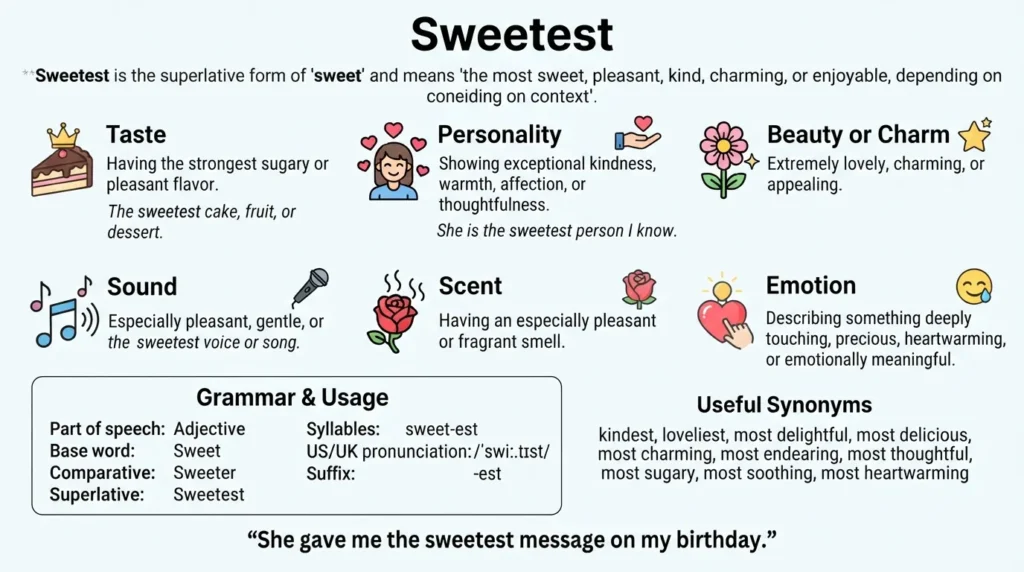
Synonym for sweetest can include words such as kindest, loveliest, most delightful, most charming, most delicious, and most sugary, depending on the context. Because sweetest can describe taste, personality, appearance, sound, scent, or an enjoyable experience, the best alternative depends on the exact meaning you want.
A synonym for sweetest becomes especially useful when you want to avoid repeating the same adjective in conversation or writing.
Imagine tasting two desserts and choosing the one with the richest sugary flavor. You might call it the sweetest dessert.
For students and bloggers, a synonym for sweetest can make descriptions clearer, warmer, and more expressive.
Content writers can choose precise alternatives, while daily English users can sound more natural when describing people, food, sounds, or memories.
What Does “Sweetest” Really Mean?
Sweetest is the superlative form of sweet. It usually means “the most sweet” when comparing three or more things.
The word has several meanings. It can describe food with a strong sugar-like taste, a person who behaves kindly, or something that feels charming. It can also describe a pleasant sound, smell, appearance, or experience.
Part of speech: Adjective
Simple definition: The most pleasant, sugary, kind, charming, or enjoyable, depending on the context.
For example:
- “This mango is the sweetest one.”
- “She is the sweetest person in our group.”
- “That was the sweetest message I received today.”
Native speakers understand the intended meaning from context. When sweetest describes cake, it usually concerns taste. When it describes a person, it often refers to kindness or affection.
Connotative Meaning
Connotation (the feeling or emotional association a word carries beyond its basic meaning) can change how sweetest feels in a sentence.
Positive tone: It can suggest kindness, affection, beauty, delight, or strong enjoyment.
Negative tone: In some contexts, words related to excessive sweetness can suggest something overly sentimental or artificial.
Neutral tone: When describing food, sweetest can simply identify the item with the strongest sugary taste.
The surrounding words usually tell readers which meaning the writer intends.
Etymology of “Sweetest”
Sweetest comes from the adjective sweet, with the superlative ending -est.
The word sweet traces back to Old English swete, with related Germanic forms. Its deeper reconstructed origin connects with the Proto-Indo-European root *swād-, meaning “sweet” or “pleasant.”
Old English: 450–1100
Old English used swete for something pleasing to the senses, mind, or feelings. It could also describe a person with a pleasant disposition.
Middle English: 1100–1500
Middle English forms such as sote and soote continued the idea of something pleasant or sweet to the senses. Chaucer famously used soote in expressions describing pleasant rain.
Modern English: 1500–Present
The word expanded into many figurative meanings. It can now describe taste, sound, smell, appearance, kindness, affection, and enjoyable experiences.
The modern superlative sweetest follows the regular English pattern:
sweet → sweeter → sweetest
Pronunciation of “Sweetest”
US: /ˈswiː.tɪst/
UK: /ˈswiː.tɪst/
The base word sweet is pronounced /swiːt/ in both US and UK English.
Syllables
sweet-est
Affixation Pattern of “Sweetest”
Root: sweet
Prefix: None
Suffix: -est
The suffix -est forms the superlative degree of many short adjectives.
Examples:
- sweet → sweetest
- kind → kindest
- warm → warmest
- bright → brightest
Synonyms List
The following alternatives cover different meanings of sweetest, including taste, personality, appearance, sound, scent, and emotional experiences. They are not interchangeable in every sentence.
1. Most sugary (Adjective) — US / UK: /ˈsʊɡəri/ / /ˈʃʊɡəri/
Meaning: Having the strongest sugar-like taste among the things being compared.
Tone/Register: Neutral; food-related.
Example:
This peach is the most sugary fruit on the plate.
The children chose the most sugary dessert.
2. Most saccharine (Adjective) — US / UK: /ˈsækərɪn/ / /ˈsækərɪn/
Meaning: Extremely sweet in taste or, figuratively, excessively sentimental.
Tone/Register: Formal; sometimes negative.
Example:
The frosting had the most saccharine flavor.
The film had the most saccharine ending in the series.
3. Most honeyed (Adjective) — US / UK: /ˈhʌnid/ / /ˈhʌnid/
Meaning: Having a particularly sweet taste, sound, or manner.
Tone/Register: Literary.
Example:
The tea had the most honeyed flavor.
Her most honeyed voice calmed the nervous child.
4. Most syrupy (Adjective) — US / UK: /ˈsɪrəpi/ / /ˈsɪrəpi/
Meaning: Extremely sweet, thick, or excessively sentimental.
Tone/Register: Neutral to negative.
Example:
The drink was the most syrupy option.
His speech sounded a little too syrupy.
5. Most sugary (Adjective) — US / UK: /ˈʃʊɡəri/ / /ˈʃʊɡəri/
Meaning: Containing or suggesting a very high level of sugar.
Tone/Register: Everyday.
Example:
That cereal was the most sugary one available.
She avoided the most sugary snacks.
6. Most luscious (Adjective) — US / UK: /ˈlʌʃəs/ / /ˈlʌʃəs/
Meaning: Exceptionally rich, delicious, or appealing to the senses.
Tone/Register: Descriptive; literary.
Example:
The strawberries were the most luscious part of dessert.
We enjoyed the most luscious chocolate cake.
7. Most delicious (Adjective) — US / UK: /dɪˈlɪʃəs/ / /dɪˈlɪʃəs/
Meaning: Extremely enjoyable in taste.
Tone/Register: Everyday; expressive.
Example:
That was the most delicious pie I’ve ever tasted.
The bakery made the most delicious cookies.
8. Most delectable (Adjective) — US / UK: /dɪˈlektəbəl/ / /dɪˈlektəbəl/
Meaning: Exceptionally pleasing to the taste.
Tone/Register: Formal; literary.
Example:
The chef served the most delectable dessert.
We sampled the most delectable pastries.
9. Most flavorful (Adjective) — US / UK: /ˈfleɪvərfəl/ / /ˈfleɪvərfəl/
Meaning: Having an especially rich or enjoyable taste.
Tone/Register: Neutral.
Example:
The ripe mango was the most flavorful fruit.
This variety produced the most flavorful juice.
10. Most candied (Adjective) — US / UK: /ˈkændid/ / /ˈkændid/
Meaning: Having a taste or texture associated with sugar-coated food.
Tone/Register: Food-related.
Example:
The most candied fruit tasted intensely sweet.
She preferred the most candied orange peel.
11. Kindest (Adjective) — US / UK: /kaɪndəst/ / /kaɪndəst/
Meaning: Showing the greatest amount of kindness and consideration.
Tone/Register: Everyday.
Example:
She is the kindest teacher I have ever had.
He gave me the kindest advice.
12. Gentlest (Adjective) — US / UK: /ˈdʒentləst/ / /ˈdʒentləst/
Meaning: Showing the most care, softness, or tenderness.
Tone/Register: Neutral.
Example:
She used the gentlest voice with the frightened child.
He gave the puppy the gentlest touch.
13. Nicest (Adjective) — US / UK: /ˈnaɪsəst/ / /ˈnaɪsəst/
Meaning: Most pleasant, friendly, or agreeable.
Tone/Register: Everyday.
Example:
Maria is the nicest person in our office.
That was the nicest thing anyone said today.
14. Loveliest (Adjective) — US / UK: /ˈlʌvliəst/ / /ˈlʌvliəst/
Meaning: Most beautiful, charming, or delightful.
Tone/Register: Warm; literary.
Example:
Spring is the loveliest season here.
She sent me the loveliest birthday card.
15. Most charming (Adjective) — US / UK: /ˈtʃɑːrmɪŋ/ / /ˈtʃɑːrmɪŋ/
Meaning: Having the greatest ability to please or attract people.
Tone/Register: Neutral; polished.
Example:
The village had the most charming streets.
He gave the most charming response.
16. Most adorable (Adjective) — US / UK: /əˈdɔːrəbəl/ / /əˈdɔːrəbəl/
Meaning: Extremely attractive or lovable in a cute way.
Tone/Register: Informal; affectionate.
Example:
That puppy is the most adorable one here.
Her baby made the most adorable sound.
17. Most endearing (Adjective) — US / UK: /ɪnˈdɪrɪŋ/ / /ɪnˈdɪrɪŋ/
Meaning: Especially likely to create affection or fondness.
Tone/Register: Neutral; warm.
Example:
His shy smile was the most endearing part of the story.
She has the most endearing laugh.
18. Most lovable (Adjective) — US / UK: /ˈlʌvəbəl/ / /ˈlʌvəbəl/
Meaning: Especially deserving of affection or love.
Tone/Register: Warm; informal.
Example:
The puppy was the most lovable animal at the shelter.
Her cheerful personality made her the most lovable character.
19. Most delightful (Adjective) — US / UK: /dɪˈlaɪtfəl/ / /dɪˈlaɪtfəl/
Meaning: Giving the greatest pleasure or enjoyment.
Tone/Register: Neutral; polished.
Example:
We had the most delightful afternoon.
The garden looked especially delightful in spring.
20. Most pleasant (Adjective) — US / UK: /ˈplezənt/ / /ˈplezənt/
Meaning: Producing the greatest sense of comfort or enjoyment.
Tone/Register: Neutral; professional.
Example:
The morning was the most pleasant part of the trip.
We chose the most pleasant room.
21. Most agreeable (Adjective) — US / UK: /əˈɡriːəbəl/ / /əˈɡriːəbəl/
Meaning: Especially enjoyable, comfortable, or easy to accept.
Tone/Register: Formal.
Example:
The countryside offered the most agreeable atmosphere.
Her manner was the most agreeable of the group.
22. Most appealing (Adjective) — US / UK: /əˈpiːlɪŋ/ / /əˈpiːlɪŋ/
Meaning: Creating the strongest feeling of attraction or interest.
Tone/Register: Neutral; professional.
Example:
The blue design was the most appealing choice.
His explanation was the most appealing to beginners.
23. Most attractive (Adjective) — US / UK: /əˈtræktɪv/ / /əˈtræktɪv/
Meaning: Having the greatest visual or general appeal.
Tone/Register: Neutral.
Example:
The garden was the most attractive part of the property.
She chose the most attractive layout.
24. Most beautiful (Adjective) — US / UK: /ˈbjuːtəfəl/ / /ˈbjuːtəfəl/
Meaning: Having the greatest beauty among the things compared.
Tone/Register: Neutral; expressive.
Example:
That was the most beautiful sunset of our trip.
She chose the most beautiful flowers.
25. Most graceful (Adjective) — US / UK: /ˈɡreɪsfəl/ / /ˈɡreɪsfəl/
Meaning: Showing the greatest elegance, smoothness, or refinement.
Tone/Register: Formal; descriptive.
Example:
She made the most graceful movement on stage.
The swan had the most graceful posture.
26. Most tender (Adjective) — US / UK: /ˈtendər/ / /ˈtendər/
Meaning: Showing especially strong care, affection, or gentleness.
Tone/Register: Emotional; literary.
Example:
He wrote the most tender message to his mother.
The film contains the most tender family scenes.
27. Most affectionate (Adjective) — US / UK: /əˈfekʃənət/ / /əˈfekʃənət/
Meaning: Showing the greatest amount of warmth or fondness.
Tone/Register: Neutral.
Example:
She gave her grandfather the most affectionate hug.
Their dog was the most affectionate pet.
28. Most caring (Adjective) — US / UK: /ˈkerɪŋ/ / /ˈkerɪŋ/
Meaning: Showing the greatest concern for another person’s well-being.
Tone/Register: Everyday.
Example:
My aunt is the most caring person I know.
She gave the most caring response.
29. Most compassionate (Adjective) — US / UK: /kəmˈpæʃənət/ / /kəmˈpæʃənət/
Meaning: Showing especially deep concern for someone experiencing difficulty.
Tone/Register: Formal; academic.
Example:
The nurse gave the most compassionate support.
Her response was the most compassionate in the discussion.
30. Most warm-hearted (Adjective) — US / UK: /ˌwɔːrm ˈhɑːrtɪd/ / /ˌwɔːrm ˈhɑːrtɪd/
Meaning: Showing especially strong kindness and emotional warmth.
Tone/Register: Warm; descriptive.
Example:
He was the most warm-hearted person at the gathering.
She gave the most warm-hearted welcome.
31. Most good-natured (Adjective) — US / UK: /ˌɡʊd ˈneɪtʃərd/ / /ˌɡʊd ˈneɪtʃərd/
Meaning: Having the most cheerful, friendly, and easygoing personality.
Tone/Register: Everyday.
Example:
Tom is the most good-natured member of our team.
Even under pressure, she remained good-natured.
32. Most gracious (Adjective) — US / UK: /ˈɡreɪʃəs/ / /ˈɡreɪʃəs/
Meaning: Showing especially polite, generous, and considerate behavior.
Tone/Register: Formal.
Example:
The host gave us the most gracious welcome.
She was the most gracious guest.
33. Most thoughtful (Adjective) — US / UK: /ˈθɔːtfəl/ / /ˈθɔːtfəl/
Meaning: Showing the greatest care and attention to another person’s needs or feelings.
Tone/Register: Neutral.
Example:
That was the most thoughtful gift.
He wrote the most thoughtful note.
34. Most considerate (Adjective) — US / UK: /kənˈsɪdərət/ / /kənˈsɪdərət/
Meaning: Showing exceptional awareness of other people’s needs or feelings.
Tone/Register: Neutral; professional.
Example:
She was the most considerate colleague on the team.
That was the most considerate way to handle it.
35. Most generous (Adjective) — US / UK: /ˈdʒenərəs/ / /ˈdʒenərəs/
Meaning: Giving more kindness, help, time, or resources than others.
Tone/Register: Neutral.
Example:
He made the most generous offer.
She was the most generous friend in our group.
36. Most soothing (Adjective) — US / UK: /ˈsuːðɪŋ/ / /ˈsuːðɪŋ/
Meaning: Providing the greatest sense of calm or comfort.
Tone/Register: Neutral.
Example:
Her voice was the most soothing sound in the room.
This music had the most soothing effect.
37. Most melodious (Adjective) — US / UK: /məˈloʊdiəs/ / /məˈləʊdiəs/
Meaning: Having the most pleasant and musical sound.
Tone/Register: Literary; formal.
Example:
The bird had the most melodious song.
Her voice sounded especially melodious.
38. Most harmonious (Adjective) — US / UK: /hɑːrˈmoʊniəs/ / /hɑːˈməʊniəs/
Meaning: Producing the most pleasing combination of sounds or elements.
Tone/Register: Formal.
Example:
The choir created the most harmonious sound.
The colors formed the most harmonious combination.
39. Most fragrant (Adjective) — US / UK: /ˈfreɪɡrənt/ / /ˈfreɪɡrənt/
Meaning: Having the most pleasant and noticeable smell.
Tone/Register: Neutral; descriptive.
Example:
The rose was the most fragrant flower in the garden.
We picked the most fragrant herbs.
40. Most aromatic (Adjective) — US / UK: /ˌærəˈmætɪk/ / /ˌærəˈmætɪk/
Meaning: Having the strongest or most pleasant distinctive smell.
Tone/Register: Formal; descriptive.
Example:
The tea produced the most aromatic scent.
We chose the most aromatic coffee beans.
41. Most inviting (Adjective) — US / UK: /ɪnˈvaɪtɪŋ/ / /ɪnˈvaɪtɪŋ/
Meaning: Creating the strongest feeling of welcome, comfort, or attraction.
Tone/Register: Neutral.
Example:
The little café looked the most inviting.
Her smile was the most inviting part of the portrait.
42. Most heartwarming (Adjective) — US / UK: /ˈhɑːrtˌwɔːrmɪŋ/ / /ˈhɑːrtˌwɔːrmɪŋ/
Meaning: Producing the strongest warm and happy emotional response.
Tone/Register: Informal; expressive.
Example:
That was the most heartwarming scene in the movie.
We heard the most heartwarming story.
43. Most delightful-smelling (Adjective phrase) — US / UK: varies by phrase
Meaning: Having the most enjoyable or pleasant scent.
Tone/Register: Descriptive; conversational.
Example:
The jasmine was the most delightful-smelling flower.
This candle has the most delightful-smelling fragrance.
44. Most precious (Adjective) — US / UK: /ˈpreʃəs/ / /ˈpreʃəs/
Meaning: Especially cherished, valuable, or emotionally important.
Tone/Register: Warm; emotional.
Example:
That photograph is my most precious memory.
Her grandmother gave her the most precious keepsake.
45. Most treasured (Adjective) — US / UK: /ˈtreʒərd/ / /ˈtreʒərd/
Meaning: Valued more deeply than other things because of emotional or personal importance.
Tone/Register: Warm; reflective.
Example:
That letter remains my most treasured possession.
The trip became one of my most treasured memories.
Synonyms for “Sweetest” by Tone
Positive
When sweetest expresses warmth, affection, beauty, or pleasure, these alternatives work naturally:
kindest, gentlest, loveliest, most charming, most adorable, most endearing, most lovable, most delightful, most affectionate, most caring, most compassionate, most thoughtful, most heartwarming
These choices work especially well when writing about people, relationships, memories, gifts, or emotional moments.
Neutral
For straightforward descriptions, consider:
nicest, most pleasant, most appealing, most attractive, most beautiful, most flavorful, most fragrant, most aromatic, most inviting
These words usually sound natural without adding an especially dramatic emotional effect.
Formal
For academic, professional, or polished writing:
most agreeable, most appealing, most gracious, most considerate, most compassionate, most harmonious, most delectable, most melodious
These choices can make writing more precise without sounding overly casual.
Playful or Informal
For friendly conversations and expressive descriptions:
most adorable, most lovable, most delicious, most heartwarming, most sugary
The right choice depends heavily on what you are describing.
Why Tone Matters in Word Choice
A synonym does more than replace a word. It can change the emotional effect of a sentence.
For example, kindest focuses on behavior, while adorable focuses more on charm or cuteness.
Similarly, most sugary describes taste, while most delightful emphasizes enjoyment.
Choosing the closest semantic match helps your writing sound natural instead of forced.
“Sweetest” vs. Close Alternatives
“Kindest” vs. “Sweetest”
- Sweetest can describe warmth, affection, or pleasant behavior. Kindest focuses specifically on generous and considerate behavior.
- Use sweetest for affectionate everyday language.
- Use kindest when you want to emphasize someone’s treatment of others.
“Sweetest” vs. “Most Delicious”
- Sweetest describes a strong sugary taste. Most delicious describes overall enjoyment of food.
- A dessert can be delicious without being especially sweet.
“Most Charming” vs. “Sweetest”
- Sweetest can suggest affection, kindness, or cuteness. Most charming emphasizes an attractive or pleasing quality that draws people in.
- Use most charming for personalities, places, designs, or social behavior.
How “Sweetest” Changes by Context
Daily Conversation
In everyday speech, sweetest often describes people, gestures, children, pets, or food.
For example:
“That was the sweetest thing you could do.”
Here, the word expresses affection rather than taste.
Writing or Blogging
Bloggers can replace repeated uses of sweetest with precise alternatives.
For food, choose most delicious, most sugary, or most luscious.
For people, kindest, most thoughtful, or most endearing may be better.
Professional or Academic Tone
Professional writing usually benefits from more specific vocabulary.
Instead of saying a response was the “sweetest,” you could write most considerate, most gracious, or most compassionate, depending on the intended meaning.
Creative or Informal Use
Creative writing gives you more freedom to use emotionally vivid choices.
Words such as loveliest, most tender, most heartwarming, and most precious can create a stronger emotional atmosphere.
Common Mistakes Learners Make
Using a Food Synonym for a Person
Do not replace sweetest with most sugary when describing someone’s personality.
Incorrect meaning:
“She is the most sugary person I know.”
Better:
“She is the kindest person I know.”
Using “Delicious” for Personality
Delicious normally describes food, flavors, or sometimes an experience in a figurative way.
It is not a normal replacement for sweetest when discussing someone’s kindness.
“Kindest” for Taste
A cake cannot normally be called the kindest cake.
For food, use terms such as most sugary, most delicious, or most luscious.
Overusing “Sweetest”
Repeating the same word can make descriptive writing feel flat.
Instead, identify the exact quality you want to emphasize.
Register Notes
- Sweetest is common in both spoken and written English.
- It can sound casual when used for people:
- “She is the sweetest.”
- It can also sound poetic in descriptions:
- “The sweetest melody filled the room.”
- Formal writing may favor more specific alternatives such as most pleasant, most considerate, or most harmonious.
- For related vocabulary, an internal article about synonyms for sweet can help readers explore the base adjective and its different meanings.
Real-Life Mini Scenarios Using “Sweetest”
Workplace
A colleague stays late to help you finish an important task.
You might say:
“That was the sweetest thing you could have done.”
In a professional email, most considerate may sound more appropriate.
Social Situations
A friend remembers your birthday and writes a personal message.
You could say:
“That was the sweetest message.”
You could also describe it as the most thoughtful message.
Media and Pop Culture
A romantic movie may contain an emotional reunion.
A reviewer might call it the most heartwarming scene rather than simply repeating sweetest.
Writing and Storytelling
A character remembers a childhood moment with a loved one.
Words such as tender, precious, or treasured can create a stronger emotional effect.
How to Choose the Right Synonym for “Sweetest”
- Ask yourself what sweetest means in your sentence.
- If you mean sugar or taste, use:
- most sugary, most saccharine, most honeyed, most syrupy, most delicious, most delectable
- If you mean kindness, consider:
- kindest, gentlest, most caring, most considerate, most compassionate
- If you mean beauty or charm, choose:
- loveliest, most charming, most adorable, most appealing, most beautiful
- If you mean pleasant sound or scent, consider:
- most melodious, most harmonious, most fragrant, most aromatic
- If you mean emotional value, choose:
- most heartwarming, most precious, most treasured, most tender
- This approach gives you a more accurate vocabulary choice than simply replacing one word with another.
Practice Quiz
Choose the Best Word
1. The ripe mango had the ______ flavor of all the fruit.
A. kindest
B. most sugary
C. most considerate
D. most gracious
2. Sarah brought soup when I was sick. She was the ______ friend.
A. most sugary
B. most aromatic
C. kindest
D. most flavorful
3. Which word best describes an especially pleasant singing voice?
A. most melodious
B. most sugary
C. most generous
D. most precious
4. The puppy looked extremely cute and lovable. Which option fits best?
A. most aromatic
B. most adorable
C. most syrupy
D. most harmonious
5. Which word best describes a very strong pleasant smell?
A. most fragrant
B. kindest
C. most thoughtful
D. most beautiful
6. You want to describe a friend who always thinks about other people’s feelings.
A. most candied
B. most thoughtful
C. most delicious
D. most syrupy
7. Which alternative emphasizes overall enjoyment of food?
A. most delicious
B. most considerate
C. most tender
D. most gracious
8. A peaceful voice helps someone relax. Which word fits best?
A. most soothing
B. most sugary
C. most attractive
D. most generous
9. A gift has strong emotional importance to someone. Which word fits best?
A. most flavorful
B. most precious
C. most saccharine
D. most aromatic
10. Which word best describes exceptional beauty?
A. most beautiful
B. most caring
C. most honeyed
D. most syrupy
Part Two
11. A person welcomes guests with warmth and excellent manners.
A. most gracious
B. most candied
C. most fragrant
D. most luscious
12. A dessert contains a very high amount of sugar.
A. most compassionate
B. most sugary
C. most graceful
D. most harmonious
13. A scene in a movie creates strong warm emotions.
A. most heartwarming
B. most flavorful
C. most aromatic
D. most syrupy
14. Which word best describes someone who gives exceptional care to others?
A. most caring
B. most candied
C. most honeyed
D. most delectable
15. Which alternative best describes something valued deeply because of personal memories?
A. most treasured
B. most sugary
C. most inviting
D. most flavorful
Reflection Task
Write one sentence using a synonym for sweetest. Then explain whether your word describes taste, personality, appearance, sound, scent, or emotion.
Answer Key: 1-B | 2-C | 3-A | 4-B | 5-A | 6-B | 7-A | 8-A | 9-B | 10-A | 11-A | 12-B | 13-A | 14-A | 15-A
FAQs
1. What is a good synonym for sweetest when describing a person?
Kindest, most caring, most thoughtful, and most endearing are useful choices when describing a person’s character. The best option depends on the quality you want to highlight. Kindest emphasizes helpful behavior, while most thoughtful focuses on consideration. Most endearing adds a sense of affection or charm.
2. What is another word for sweetest when talking about food?
For food, useful alternatives include most sugary, most delicious, most luscious, most delectable, and most saccharine. They do not mean exactly the same thing. Most sugary focuses on sugar content or taste, while most delicious describes overall enjoyment of the food.
3. Can “sweetest” describe a voice or sound?
Yes. Sweetest can describe a voice, melody, or sound that feels pleasant and enjoyable. Alternatives include most melodious, most harmonious, and most soothing. Choose melodious when you want to emphasize musical quality, harmonious for pleasing combinations, and soothing for a calming effect.
4. What is the difference between sweetest and kindest?
Sweetest has several meanings and can describe taste, charm, affection, or pleasant behavior. Kindest is narrower and focuses on considerate or helpful behavior. For example, “She is the sweetest person” sounds affectionate, while “She is the kindest person” specifically highlights how she treats others.
5. What is a formal synonym for sweetest?
There is no single formal replacement that works in every situation. Depending on context, most agreeable, most gracious, most considerate, most delightful, or most harmonious may work. Formal writing should identify the exact quality being described instead of replacing sweetest mechanically.
6. What is the best synonym for sweetest in creative writing?
Creative writing can use loveliest, most tender, most precious, most heartwarming, or most enchanting when the context supports them. These choices create different emotional effects. Select a word based on whether you want to emphasize beauty, affection, emotional importance, comfort, or charm.
7. Is “most sugary” always a synonym for sweetest?
No. Most sugary works mainly when sweetest refers to taste or sugar. It does not normally describe a kind person or a touching memory. For those meanings, words such as kindest, most thoughtful, most endearing, or most heartwarming are more suitable.
8. How can learning synonyms for sweetest improve English?
Learning these alternatives helps you describe specific qualities instead of relying on one general word. Students can improve vocabulary, bloggers can create more varied descriptions, and everyday speakers can communicate feelings more precisely. Practice each word in a sentence and note the context where it sounds most natural.
Conclusion
Learning a synonym for sweetest helps you choose words that match taste, kindness, beauty, sound, scent, or emotion with greater precision.
Instead of repeating one adjective, you can select kindest, loveliest, most delicious, most thoughtful, or another fitting alternative.
This wider vocabulary can strengthen essays, blog posts, emails, stories, and everyday conversations while making your English sound more natural.
Try using three new alternatives today. Write them in short sentences, then practice them in your next email, essay, or daily conversation.

Sophia Carter is the founder and lead writer at SynonymVerse.com, a trusted online resource dedicated to English vocabulary and effective communication. She is passionate about helping students, writers, professionals, and lifelong learners find the most accurate words to express their ideas with clarity and confidence.
At SynonymVerse.com, every article is carefully researched and thoughtfully written to provide reliable guidance on synonyms, word meanings, and vocabulary. With a strong focus on accuracy, real-world usage, and easy-to-understand explanations, the website is committed to helping readers strengthen their language skills, enrich their vocabulary, and become more confident communicators.