synonym for swallow can change your writing when you need a more precise word. Imagine quickly eating a bite of food before rushing to work.
A student may write, “She swallowed the medicine.” A stronger choice could be “She gulped the medicine,” depending on the context.
The word appears often in daily English, stories, health discussions, and ordinary conversation. Learning a synonym for swallow adds useful vocabulary.
Students, bloggers, writers, and English learners can use these alternatives to make sentences more natural. The right word also shows exactly how an action happens.
What Does “Swallow” Really Mean?
Swallow is a common English word with several meanings.
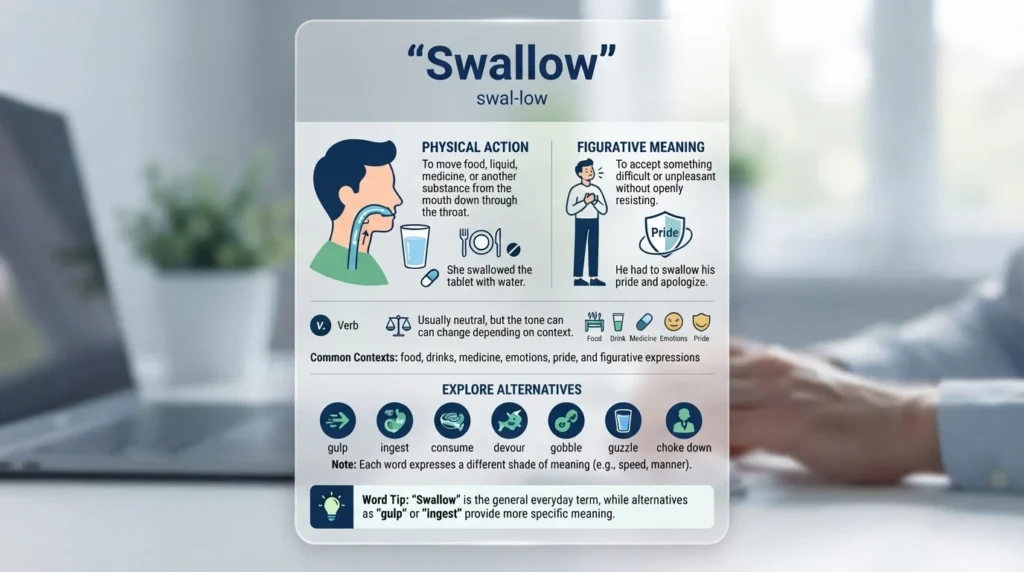
As a verb, it usually means to move food, liquid, medicine, or another substance from the mouth into the stomach.
Simple definition:
To make something pass from your mouth down into your throat and stomach.
For example:
- She swallowed the pill with water.
- The child swallowed the last bite of bread.
Native speakers also use swallow in figurative expressions. It can describe accepting something difficult, controlling a reaction, or hiding words or emotions.
For example:
- He had to swallow his pride.
- She swallowed her anger and stayed calm.
The word can also refer to a small migratory bird with pointed wings and a forked tail.
So, context matters. The best alternative depends on whether you mean eating, accepting something difficult, suppressing a reaction, or referring to the bird.
Connotative Meaning
Connotation refers to the feeling, attitude, or association a word suggests beyond its basic dictionary meaning.
Positive tone:
The word can sound neutral when someone calmly takes food or medicine.
Negative tone:
In expressions such as “swallow an insult,” it can suggest something unpleasant that a person accepts unwillingly.
Neutral tone:
In “swallow the tablet,” it simply describes a physical action without strong emotion.
Etymology of “Swallow”
The verb swallow comes from Old English swelgan, meaning to swallow, consume, or take something down.
The word belongs to an old Germanic family of words associated with taking something into the throat or consuming it.
Old English: 450–1100
Old English used forms related to swelgan. The word described the physical action of taking food or liquid down the throat.
Middle English: 1100–1500
During Middle English, the form developed through changes in spelling and pronunciation. Forms such as swolwen and related spellings appeared.
Modern English: 1500–Present
Modern English settled on swallow as the standard spelling. The word later developed several figurative uses, including accepting something unpleasant and suppressing emotions or words.
Pronunciation
- US: /ˈswɑːloʊ/
- UK: /ˈswɒləʊ/
Syllables
swal-low
Affixation Pattern of “Swallow”
Root: swallow
Prefix: None
Suffix: None
The word functions as a basic lexical root rather than a word formed through a common English prefix-and-suffix pattern.
40 Synonyms for Swallow
Because swallow has several meanings, no single alternative works in every sentence. The following words and phrases cover its main physical and figurative uses.
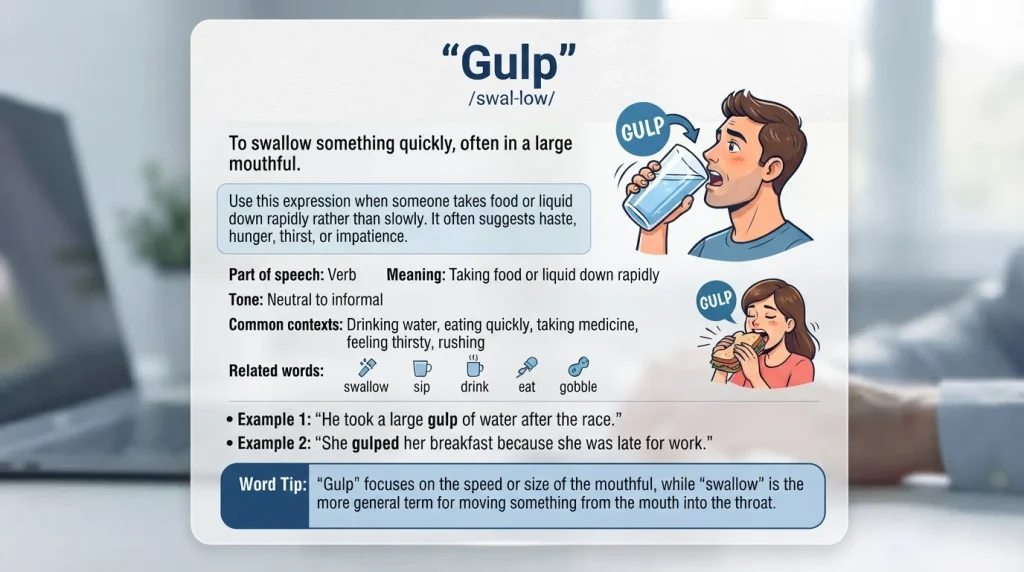
1. Gulp (Verb)
Meaning: To swallow something quickly, often in a large mouthful.
Tone/Register: Neutral, informal
Example 1: He gulped the cold water after the run.
Example 2: She gulped down her breakfast before class.
2. Ingest (Verb)
Meaning: To take food, drink, medicine, or another substance into the body.
Tone/Register: Formal, medical, academic
Example 1: The patient accidentally ingested the wrong liquid.
Example 2: The instructions explain how much medication to ingest.
3. Consume (Verb)
Meaning: To eat or drink something.
Tone/Register: Neutral, formal
Example 1: You should consume enough water during the day.
Example 2: The guests consumed the entire meal.
4. Eat (Verb)
Meaning: To take food into the body by chewing and swallowing it.
Tone/Register: Neutral, everyday
Example 1: Please eat your lunch before you leave.
Example 2: The child ate the sandwich quickly.
5. Drink (Verb)
Meaning: To take liquid into the body through the mouth.
Tone/Register: Neutral, everyday
Example 1: She drank the medicine with juice.
Example 2: He drank a glass of water after dinner.
6. Devour (Verb)
Meaning: To eat something eagerly and very quickly.
Tone/Register: Neutral, expressive
Example 1: The children devoured the pizza.
Example 2: She devoured the sandwich after the long hike.
7. Gobble (Verb)
Meaning: To eat something very quickly and greedily.
Tone/Register: Informal
Example 1: He gobbled his lunch before the meeting.
Example 2: The puppy gobbled the food in seconds.
8. Wolf Down (Verb Phrase)
Meaning: To eat something extremely quickly.
Tone/Register: Informal
Example 1: I had to wolf down my breakfast.
Example 2: She wolfed down the noodles before class.
9. Bolt (Verb)
Meaning: To swallow food quickly without taking much time to chew.
Tone/Register: Informal
Example 1: He bolted his dinner and left.
Example 2: Try not to bolt your food.
10. Scarf (Verb)
Meaning: To eat something rapidly and eagerly.
Tone/Register: Informal, playful
Example 1: We scarfed the sandwiches after the game.
Example 2: He scarfed down two slices of pizza.
11. Guzzle (Verb)
Meaning: To drink something quickly and in large amounts.
Tone/Register: Informal
Example 1: They guzzled cold water after hiking.
Example 2: He guzzled the entire bottle in minutes.
12. Down (Verb)
Meaning: To swallow or drink something quickly.
Tone/Register: Informal
Example 1: She downed the glass of water.
Example 2: He downed the medicine with a sip of juice.
13. Take In (Verb Phrase)
Meaning: To receive food, liquid, or another substance into the body.
Tone/Register: Neutral
Example 1: The body takes in nutrients from food.
Example 2: She took in a little water after exercising.
14. Get Down (Verb Phrase)
Meaning: To successfully swallow something, especially food or medicine.
Tone/Register: Informal
Example 1: I could barely get the tablet down.
Example 2: The child finally got the medicine down.
15. Choke Down (Verb Phrase)
Meaning: To force yourself to swallow something unpleasant.
Tone/Register: Neutral, expressive
Example 1: He choked down the bitter medicine.
Example 2: She choked down a dry piece of bread.
16. Force Down (Verb Phrase)
Meaning: To make yourself swallow something when you do not want to.
Tone/Register: Neutral
Example 1: She forced down a few bites of dinner.
Example 2: He forced down the medicine despite its taste.
17. Sup (Verb)
Meaning: To drink or take small amounts of liquid or food.
Tone/Register: Literary, old-fashioned
Example 1: The travelers supped beside the fire.
Example 2: He supped quietly before bedtime.
18. Imbibe (Verb)
Meaning: To drink something, especially a beverage.
Tone/Register: Formal, literary
Example 1: The guests imbibed tea during the reception.
Example 2: He rarely imbibes alcoholic drinks.
19. Assimilate (Verb)
Meaning: To absorb something mentally or physically into a larger system.
Tone/Register: Academic, formal
Example 1: Students need time to assimilate new information.
Example 2: The body assimilates nutrients from food.
20. Absorb (Verb)
Meaning: To take something in or accept it fully.
Tone/Register: Neutral, academic
Example 1: Young children absorb new vocabulary quickly.
Example 2: The material absorbs moisture from the air.
21. Engulf (Verb)
Meaning: To surround or cover something completely, often like swallowing it.
Tone/Register: Formal, descriptive
Example 1: Dark clouds engulfed the town.
Example 2: The flames engulfed the wooden structure.
22. Consume Completely (Verb Phrase)
Meaning: To use, eat, or take something in until little or nothing remains.
Tone/Register: Formal, neutral
Example 1: The fire consumed the dry leaves completely.
Example 2: The machine consumed the available fuel quickly.
23. Tolerate (Verb)

Meaning: To accept something unpleasant without reacting strongly.
Tone/Register: Neutral, formal
Example 1: She tolerated the criticism without arguing.
Example 2: He learned to tolerate minor setbacks.
24. Endure (Verb)
Meaning: To experience something difficult without giving up.
Tone/Register: Neutral, formal
Example 1: She endured the criticism with patience.
Example 2: He calmly endured a difficult conversation.
25. Bear (Verb)
Meaning: To accept or withstand something unpleasant or difficult.
Tone/Register: Neutral, formal
Example 1: I cannot bear another argument tonight.
Example 2: She bore the disappointment quietly.
26. Stomach (Verb)
Meaning: To accept or tolerate something unpleasant.
Tone/Register: Informal, figurative
Example 1: I cannot stomach that kind of dishonesty.
Example 2: He could not stomach the unfair treatment.
27. Accept (Verb)
Meaning: To agree to receive or recognize something, even when it may be difficult.
Tone/Register: Neutral
Example 1: She accepted the criticism professionally.
Example 2: He accepted the disappointing result.
28. Put Up With (Verb Phrase)
Meaning: To tolerate someone or something annoying or unpleasant.
Tone/Register: Informal
Example 1: I will not put up with rude behavior.
Example 2: She puts up with a lot at work.
29. Suppress (Verb)
Meaning: To deliberately prevent an emotion, reaction, or expression from appearing.
Tone/Register: Formal, academic
Example 1: He suppressed his anger during the meeting.
Example 2: She tried to suppress a laugh.
30. Stifle (Verb)
Meaning: To stop an emotion, sound, reaction, or expression from being shown.
Tone/Register: Neutral, formal
Example 1: She stifled a laugh during the ceremony.
Example 2: He stifled his frustration and continued working.
31. Repress (Verb)
Meaning: To hold back feelings, thoughts, or memories rather than express them.
Tone/Register: Formal, psychological
Example 1: He often represses his frustration.
Example 2: She struggled to express feelings she had repressed.
32. Hold Back (Verb Phrase)
Meaning: To stop yourself from showing or saying something.
Tone/Register: Neutral, conversational
Example 1: She held back her tears.
Example 2: He held back his anger during the discussion.
33. Bite Your Tongue (Idiom)
Meaning: To stop yourself from saying something you want to say.
Tone/Register: Informal, idiomatic
Example 1: I wanted to complain, but I bit my tongue.
Example 2: She bit her tongue instead of starting an argument.
34. Keep In (Verb Phrase)
Meaning: To prevent an emotion, reaction, or expression from coming out.
Tone/Register: Informal
Example 1: He kept in his laughter during the speech.
Example 2: She kept her frustration in all afternoon.
35. Contain (Verb)
Meaning: To control or prevent an emotion or reaction from becoming visible.
Tone/Register: Neutral, formal
Example 1: She contained her anger during the interview.
Example 2: He struggled to contain his excitement.
36. Restrain (Verb)
Meaning: To control an impulse, reaction, or emotion.
Tone/Register: Formal
Example 1: He restrained his anger during the debate.
Example 2: She restrained herself from interrupting.
37. Suppress a Reaction (Verb Phrase)
Meaning: To consciously stop yourself from displaying an immediate response.
Tone/Register: Neutral, formal
Example 1: She suppressed a reaction when she heard the news.
Example 2: He suppressed his surprise and continued speaking.
38. Overwhelm (Verb)
Meaning: To cover, surround, or affect something so strongly that it seems to consume it.
Tone/Register: Neutral, expressive
Example 1: A wave of sadness overwhelmed him.
Example 2: The crowd overwhelmed the small venue.
39. Swallow Up (Phrasal Verb)
Meaning: To completely cover, absorb, or consume something.
Tone/Register: Neutral, descriptive
Example 1: The fog swallowed up the road.
Example 2: The growing city swallowed up nearby villages.
40. Take Down (Verb Phrase)
Meaning: To successfully swallow something, especially food or medicine.
Tone/Register: Informal
Example 1: She could not take down another bite.
Example 2: He took down the tablet with some water.
Synonyms by Tone
Positive or Expressive
Some alternatives add energy or vividness to a sentence.
- Devour
- Gobble
- Scarf
- Guzzle
- Absorb
- Assimilate
These choices can make writing more lively, especially in storytelling.
Neutral
These words work well in ordinary conversation and general writing.
- Eat
- Drink
- Consume
- Ingest
- Accept
- Tolerate
- Endure
- Bear
- Take in
Formal or Academic
Use these when the context requires precise or professional vocabulary.
- Ingest
- Consume
- Assimilate
- Absorb
- Suppress
- Repress
- Restrain
- Tolerate
Playful or Informal
These words often sound conversational.
- Gulp
- Gobble
- Wolf down
- Scarf
- Bolt
- Guzzle
- Down
- Stomach
Tone matters because synonyms are rarely interchangeable in every situation. Ingest sounds clinical, while gobble sounds casual and vivid.
“Swallow” vs Close Alternatives
Gulp vs Swallow
Swallow focuses on moving something from the mouth down the throat.
Gulp emphasizes speed or a large mouthful.
Use swallow for a general action. Use gulp when you want to show quick or forceful eating or drinking.
Swallow vs Ingest
Swallow is common in everyday English.
Ingest sounds more technical and often appears in medical, scientific, or safety contexts.
For example, a doctor may write that a patient ingested a substance, while a friend may simply say that the person swallowed it.
Swallow vs Devour
Swallow describes the physical action.
Devour emphasizes enthusiasm, hunger, or speed.
“She swallowed the sandwich” gives a basic fact. “She devoured the sandwich” creates a stronger image of hunger.
How “Swallow” Changes by Context
Daily Conversation
In ordinary speech, swallow commonly refers to food, drinks, pills, or saliva.
“Swallow the tablet with water” sounds natural and direct.
Writing and Blogging
Writers can replace repetitive uses with words such as gulp, consume, devour, or ingest when the context supports them.
This creates more precise descriptions without making the writing unnecessarily complicated.
Professional or Academic English
Ingest, consume, and assimilate may work better in scientific or academic writing.
The choice depends on the subject. A medical report may prefer ingest, while a learning essay may use assimilate.
Creative or Informal English
Creative writing often benefits from vivid choices such as gobble, wolf down, scarf, or gulp.
These words help readers imagine the speed, emotion, or attitude behind an action.
Common Mistakes Learners Make
Using Every Synonym Interchangeably
Not every alternative works in every sentence.
You can say “swallow a pill,” but devour a pill sounds unnatural because devour usually suggests eager eating.
Using Formal Words in Casual Situations
“Ingest” is correct in many contexts, but it can sound overly technical in everyday conversation.
A friend would normally say, “Did you swallow the tablet?”
Confusing Physical and Figurative Meanings
“Swallow your pride” does not mean physically eating pride.
It means accepting an unpleasant situation and controlling your ego or reaction.
Overusing Dramatic Vocabulary
Words such as devour, engulf, and overwhelm are expressive.
Using them in every sentence can make ordinary writing sound exaggerated.
Register Notes
Swallow is highly versatile. It works in casual conversation, educational writing, professional communication, and storytelling.
Gulp, gobble, scarf, wolf down, and guzzle sound more conversational.
Ingest, assimilate, suppress, repress, and restrain fit more formal or specialized contexts.
For related vocabulary, an internal vocabulary article can help you compare additional alternatives and improve word choice.
Real-Life Mini Scenarios
Workplace
During a busy workday, an employee may say, “I had to gulp my coffee before the meeting.”
The informal verb adds a sense of speed.
Social Situation
Someone may need to swallow their pride after making a mistake.
Here, the expression means accepting the situation instead of arguing.
Media and Pop Culture
A fictional character might devour a meal after surviving a long adventure.
The stronger verb creates a vivid scene.
Writing and Storytelling

A novelist might write that darkness swallowed up the road.
This figurative use creates an atmospheric image rather than describing eating.
Quick Word-Choice Guide
For a basic physical action involving food, liquid, or medicine, swallow remains the natural everyday choice.
When someone takes a mouthful rapidly, gulp gives the sentence a stronger sense of haste.
In health, nutrition, or scientific writing, ingest provides a more precise technical expression.
Eating happens hurriedly and greedily; gobble creates that specific image.
For someone drinking rapidly or taking in a large amount of liquid, guzzle fits naturally.
A person manages to consume something unpleasant despite disliking it; choke down conveys that difficulty.
When fog, darkness, water, flames, or another force completely covers or absorbs something, swallow up creates the right image.
Interactive Practice Quiz
1. Which word best fits a medical report?
A. Gobble
B. Ingest
C. Scarf
D. Wolf down
2. Which option suggests eating very quickly?
A. Tolerate
B. Repress
C. Gulp
D. Endure
3. Which word means to eat eagerly and quickly?
A. Devour
B. Restrain
C. Accept
D. Contain
4. Which phrase means to tolerate something unpleasant?
A. Guzzle
B. Put up with
C. Bolt
D. Take down
5. Which word best describes drinking quickly?
A. Guzzle
B. Repress
C. Bear
D. Absorb
6. Which expression means to stop yourself from speaking?
A. Bite your tongue
B. Eat your words
C. Take in
D. Down it
7. Which word sounds most academic?
A. Scarf
B. Gobble
C. Ingest
D. Bolt
8. Which word best fits “She ___ the sandwich after the hike”?
A. Devoured
B. Resisted
C. Repressed
D. Tolerated
9. Which word means to control an emotional reaction?
A. Restrain
B. Guzzle
C. Gobble
D. Consume
10. Which phrase means something completely covers another thing?
A. Swallow up
B. Bite down
C. Eat out
D. Hold up
Reflection Task: Write one sentence using gulp, ingest, devour, suppress, or swallow up. Then explain why that word fits your sentence.
Answer Key: 1-B | 2-C | 3-A | 4-B | 5-A | 6-A | 7-C | 8-A | 9-A | 10-A
FAQs
1. What is the best synonym for swallow in everyday English?
The best alternative depends on the sentence. Gulp works when someone swallows quickly, while consume focuses on eating or drinking. Ingest is more technical. If the sentence describes accepting something unpleasant, words such as tolerate, endure, or stomach may fit better.
2. What is a formal synonym for swallow?
Ingest is one of the most useful formal alternatives when you mean taking food, liquid, medicine, or another substance into the body. It appears frequently in medical, scientific, and technical writing. Consume can also work in formal contexts, especially when discussing food, resources, energy, or materials.
3. What is a synonym for swallow food quickly?
Several words can express quick eating. Gulp, gobble, bolt, scarf, and wolf down all suggest speed. Their tones differ. Gulp is widely understood, while scarf and wolf down sound more informal. Devour adds the idea of strong hunger or enthusiasm.
4. What does swallow mean in “swallow your pride”?
In “swallow your pride,” the word has a figurative meaning. It means accepting an uncomfortable situation, admitting a mistake, or putting aside your ego. The expression often suggests that someone finds the action difficult but chooses not to argue or react emotionally.
5. What is the difference between swallow and gulp?
Swallow describes the general action of moving something from the mouth into the throat and stomach. Gulp adds the idea of taking something quickly or in a large mouthful. Therefore, every gulp can involve swallowing, but the two words do not always communicate the same speed or manner.
6. Is “ingest” the same as “swallow”?
They overlap, but they are not identical in tone. Swallow is an everyday word for taking something down the throat. Ingest is broader and more technical. It commonly appears in medical and scientific contexts when discussing substances entering the body, especially when the exact substance or method matters.
7. What synonym for swallow works best in creative writing?
Creative writing benefits from choosing a word based on the image you want to create. Gulp can show nervousness or speed, devour can show hunger, and choke down can suggest disgust. For figurative scenes, swallow up can describe darkness, fog, water, or another force covering something completely.
8. Can swallow mean hiding an emotion?
Yes. In figurative English, swallow can describe controlling an emotion, reaction, or response. Expressions such as “swallow your anger” and “swallow your tears” suggest that someone prevents an emotion from being openly expressed. Similar alternatives include suppress, stifle, hold back, and restrain.
Conclusion
Learning a synonym for swallow helps you choose words that match speed, emotion, formality, and context. Small changes can make English sound much more natural.
A strong vocabulary also makes essays, blogs, emails, and conversations more precise. Instead of repeating one common verb, you can select a word with the exact shade you need.
Practice these alternatives in short sentences first. Try gulp, devour, ingest, suppress, or endure in different situations to build confidence.
Keep expanding your vocabulary through regular practice, reading, and writing. Use these words in emails, essays, stories, and daily conversations, and your English will become clearer and more expressive.
For pronunciation and dictionary-level usage, you can also look up swallow on Merriam-Webster.

Sophia Carter is the founder and lead writer at SynonymVerse.com, a trusted online resource dedicated to English vocabulary and effective communication. She is passionate about helping students, writers, professionals, and lifelong learners find the most accurate words to express their ideas with clarity and confidence.
At SynonymVerse.com, every article is carefully researched and thoughtfully written to provide reliable guidance on synonyms, word meanings, and vocabulary. With a strong focus on accuracy, real-world usage, and easy-to-understand explanations, the website is committed to helping readers strengthen their language skills, enrich their vocabulary, and become more confident communicators.