A synonym for sully is essential when you want to describe tarnishing a reputation or ruining a spotless surface in your writing.
Imagine a dedicated teacher who worked twenty years to build a spotless career, only for one false rumor to damage their name completely.
That painful situation shows how a single bad incident can sully a person’s standing in a community.
Learning a synonym for sully helps you express exact feelings, improve your essays, and elevate your daily English communication.
This vivid word appears often in news stories, literary books, and professional legal cases to describe damage to honor or cleanliness.
Students, bloggers, content writers, and daily English speakers can use these precise alternatives to make their prose far more compelling.
What Does “Sully” Really Mean?
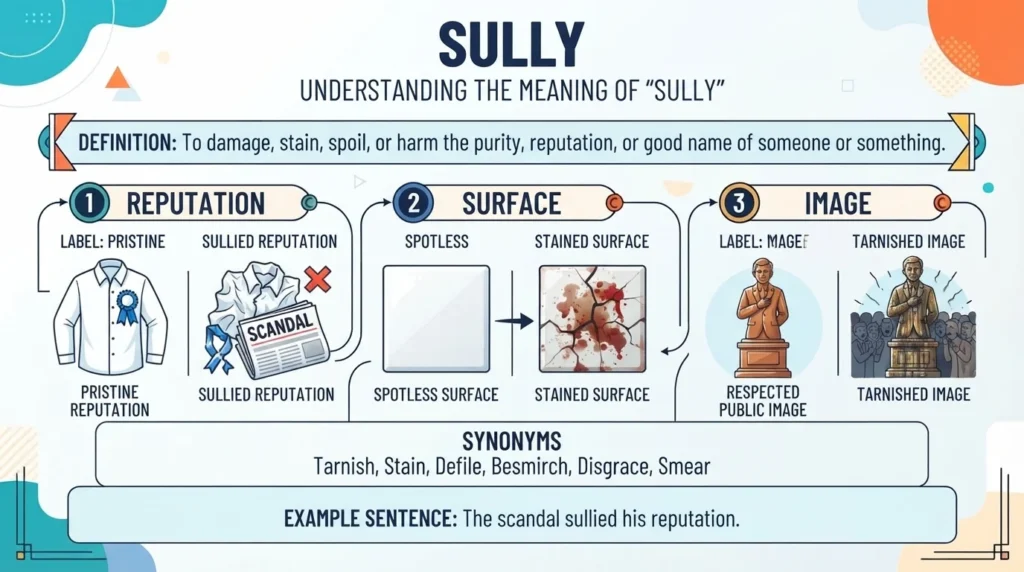
The word “sully” means to soil, stain, or tarnish something that was previously clean, pure, or honorable. Native English speakers use it both literally, like mud on a white dress, and figuratively, like a scandal hurting a good reputation.
It carries a serious emotional tone because it implies that something valuable has lost its purity or respect. You will often see it in news reports, corporate statements, formal essays, and dramatic literature.
As a verb, sully describes an action that brings dishonor or physical dirtiness to an object, name, or idea.
Connotative Meaning
Words often carry emotional weight beyond their basic dictionary definition. Connotation is the emotional or cultural association attached to a word beyond its literal definition.
- Positive Tone: Sully rarely carries a positive tone, though restoring something sullied can highlight resilience.
- Negative Tone: Strongly negative, as it implies damage, shame, pollution, or loss of integrity.
- Neutral Tone: Occasionally neutral when describing basic chemical or physical staining without moral judgment.
Etymology
The word “sully” comes from the Middle French word souiller, which means to soil or cover with mud.
- Old English (450–1100): Early Germanic roots used terms like sylian to describe making something muddy or dirty.
- Middle English (1100–1500): The French term souiller entered the language, gradually shifting toward sulyen.
- Modern English (1500–Present): By the late 16th century, Shakespeare and other writers used “sully” to describe tarnishing personal honor.
Pronunciation
- US: /ˈsʌl.i/
- UK: /ˈsʌl.i/
Syllables
sul-ly
Affixation Pattern of Sully
- Root: Sully
- Prefix: None
- Suffix: None (Can take suffixes like -ed for past tense sullied, or -ing for continuous sullying).
Synonyms List
Here are 70 accurate and commonly used synonyms for sully to expand your vocabulary.
1. Tarnish (Verb) — US: /ˈtɑːr.nɪʃ/ / UK: /ˈtɑː.nɪʃ/
Meaning: To dull the luster of a metal or damage a good reputation.
Tone/Register: Formal, Academic
Example 1: The scandal threatened to tarnish the politician’s spotless reputation.
Example 2: Moisture will tarnish silver if you do not store it properly.
2. Stain (Verb) — US: /steɪn/ / UK: /steɪn/
Meaning: To discolor something permanently or bring shame to a record.
Tone/Register: Neutral, Daily
Example 1: Red wine will stain the white carpet if you spill it.
Example 2: The unfair charge left a stain on his professional career.
3. Blemish (Verb) — US: /ˈblem.ɪʃ/ / UK: /ˈblem.ɪʃ/
Meaning: To spoil the perfection or appearance of something.
Tone/Register: Neutral, Business
Example 1: One bad review can blemish a new business record.
Example 2: A dark mark started to blemish the smooth wooden table.
4. Besmirch (Verb) — US: /bɪˈsmɝːtʃ/ / UK: /bɪˈsmɜːtʃ/
Meaning: To damage the reputation of someone by making false statements.
Tone/Register: Formal, Literary
Example 1: Critics tried to besmirch her character with false claims.
Example 2: He refused to besmirch his former friend during the debate.
5. Defile (Verb) — US: /dɪˈfaɪl/ / UK: /dɪˈfaɪl/
Meaning: To make dirty, impure, or profane.
Tone/Register: Formal, Academic
Example 1: Vandals tried to defile the ancient stone monument.
Example 2: Bad actions will defile a sacred family tradition.
6. Contaminate (Verb) — US: /kənˈtæm.ə.neɪt/ / UK: /kənˈtæm.ɪ.neɪt/
Meaning: To make something impure by adding a polluting substance.
Tone/Register: Formal, Technical
Example 1: Chemicals will contaminate the clean water supply quickly.
Example 2: Harsh rumors can contaminate the workplace atmosphere easily.
7. Pollute (Verb) — US: /pəˈluːt/ / UK: /pəˈluːt/
Meaning: To make land, water, or air dirty and dangerous.
Tone/Register: Neutral, Academic
Example 1: Factories pollute the nearby river with toxic waste.
Example 2: Negative thoughts can pollute your overall peace of mind.
8. Taint (Verb) — US: /teɪnt/ / UK: /teɪnt/
Meaning: To affect with a bad or undesirable quality.
Tone/Register: Formal, Legal
Example 1: Biased news reports can taint the views of the jury.
Example 2: Spoiled milk will taint the entire pitcher of cream.
9. Mar (Verb) — US: /mɑːr/ / UK: /mɑː/
Meaning: To impair the quality or appearance of something; spoil.
Tone/Register: Formal, Literary
Example 1: Rain threatened to mar the outdoor wedding celebration.
Example 2: Deep scratches mar the surface of the antique table.
10. Smudge (Verb) — US: /smʌdʒ/ / UK: /smʌdʒ/
Meaning: To cause a dirty mark or smear on a surface.
Tone/Register: Informal, Daily
Example 1: Wet ink will smudge if you brush your hand over it.
Example 2: She tried not to smudge her clean glass window.
11. Soil (Verb) — US: /sɔɪl/ / UK: /sɔɪl/
Meaning: To make dirty on the surface, especially with field dirt or waste.
Tone/Register: Neutral, Daily
Example 1: Mud will soil your clean shoes if you walk there.
Example 2: Dishonesty can soil a person’s family honor over time.
12. Blacken (Verb) — US: /ˈblæk.ən/ / UK: /ˈblæk.ən/
Meaning: To make black or dark, especially as a way to damage a name.
Tone/Register: Formal, Literary
Example 1: False stories were used to blacken her good name.
Example 2: Smoke began to blacken the kitchen walls during the fire.
13. Smear (Verb) — US: /smɪr/ / UK: /smɪə/
Meaning: To spread a greasy substance or damage someone’s reputation publicly.
Tone/Register: Informal, Media
Example 1: Opponents tried to smear his name during the election campaign.
Example 2: Butter will smear across the glass if you touch it.
14. Corrupt (Verb) — US: /kəˈrʌpt/ / UK: /kəˈrʌpt/
Meaning: To change from good to bad in morals, language, or state.
Tone/Register: Formal, Legal
Example 1: Bribes can corrupt even the most honest official.
Example 2: Bad software files will corrupt your computer storage quickly.
15. Debase (Verb) — US: /dɪˈbeɪs/ / UK: /dɪˈbeɪs/
Meaning: To reduce in quality, value, or moral character.
Tone/Register: Formal, Academic
Example 1: Adding cheap metals will debase the value of gold coins.
Example 2: Cruel behavior serves to debase human dignity in society.
16. Degrading (Verb/Adjective) — US: /dɪˈɡreɪ.dɪŋ/ / UK: /dɪˈɡreɪ.dɪŋ/
Meaning: To lower in rank, status, or moral character.
Tone/Register: Formal, Academic
Example 1: Poor conditions can degrade the quality of building materials.
Example 2: Harsh insults will degrade a worker’s self-confidence over time.
17. Disgrace (Verb) — US: /dɪsˈɡreɪs/ / UK: /dɪsˈɡreɪs/
Meaning: To bring shame or dishonor upon oneself or others.
Tone/Register: Formal, Social
Example 1: Cheating on the exam will disgrace your entire family name.
Example 2: His reckless actions brought public disgrace to the organization.
18. Dishonor (Verb) — US: /dɪsˈɑː.nɚ/ / UK: /dɪsˈɒn.ər/
Meaning: To fail to show respect or bring shame to someone.
Tone/Register: Formal, Ethical
Example 1: Breaking a solemn promise will dishonor your core values.
Example 2: He would never dishonor the memory of his late mentor.
19. Foul (Verb) — US: /faʊl/ / UK: /faʊl/
Meaning: To make dirty, offensive, or disgusting.
Tone/Register: Neutral, Daily
Example 1: Waste materials can foul clean running water sources easily.
Example 2: Improper storage will foul the taste of fresh food items.
20. Slur (Verb) — US: /slɝː/ / UK: /slɜː/
Meaning: To make damaging remarks about someone’s character.
Tone/Register: Formal, Legal
Example 1: The speech was an attempt to slur her professional record.
Example 2: He made a subtle slur against his business rival today.
21. Slander (Verb) — US: /ˈslæn.dɚ/ / UK: /ˈslɑːn.dər/
Meaning: To make false spoken statements that damage a reputation.
Tone/Register: Formal, Legal
Example 1: Spreading fake rumors will slander an innocent person’s name.
Example 2: She sued the newspaper for attempting to slander her company.
22. Libel (Verb) — US: /ˈlaɪ.bəl/ / UK: /ˈlaɪ.bəl/
Meaning: To publish false written statements that harm someone’s image.
Tone/Register: Formal, Legal
Example 1: Writing false articles can libel a public official severely.
Example 2: The magazine was sued for trying to libel the actor.
23. Vilify (Verb) — US: /ˈvɪl.ə.faɪ/ / UK: /ˈvɪl.ɪ.faɪ/
Meaning: To speak or write about someone in an abusively disparaging manner.
Tone/Register: Formal, Media
Example 1: Media outlets tried to vilify the activist during the protest.
Example 2: It is unfair to vilify an entire group over one mistake.
24. Denigrate (Verb) — US: /ˈden.ə.ɡreɪt/ / UK: /ˈden.ɪ.ɡreɪt/
Meaning: To criticize unfairly or disparage the value of something.
Tone/Register: Formal, Academic
Example 1: Do not denigrate the hard work of your team members.
Example 2: Columnists tend to denigrate new trends before understanding them.
25. Malign (Verb) — US: /məˈlaɪn/ / UK: /məˈlaɪn/
Meaning: To speak evil of or tell harmful untruths about someone.
Tone/Register: Formal, Literary
Example 1: Jealous colleagues tried to malign his success behind his back.
Example 2: She was unfairly maligned in the local gossip columns.
26. Discredit (Verb) — US: /dɪsˈkred.ɪt/ / UK: /dɪsˈkred.ɪt/
Meaning: To harm the good reputation of a person or idea.
Tone/Register: Formal, Business
Example 1: New evidence helped to discredit the false scientific theory.
Example 2: The scandal worked to discredit the leader in the public eye.
27. Drag Through the Mud (Idiom) — US: /dræɡ θruː ðə mʌd/ / UK: /dræɡ θruː ðə mʌd/
Meaning: To publicly damage someone’s reputation severely.
Tone/Register: Informal, Conversational
Example 1: The tabloids will drag your personal life through the mud.
Example 2: They dragged his good name through the mud for attention.
28. Cloud (Verb) — US: /klaʊd/ / UK: /klaʊd/
Meaning: To make uncertain, doubtful, or tarnished.
Tone/Register: Neutral, Literary
Example 1: Suspicion began to cloud his honest reputation after the audit.
Example 2: Personal feelings should not cloud your judgment during trials.
29. Depreciate (Verb) — US: /dɪˈpriː.ʃi.eɪt/ / UK: /dɪˈpriː.ʃi.eɪt/
Meaning: To diminish in value or lower the price/esteem.
Tone/Register: Formal, Business
Example 1: Neglect will depreciate the value of your house quickly.
Example 2: Cruel comments only serve to depreciate your own dignity.
30. Muddle (Verb) — US: /ˈmʌd.əl/ / UK: /ˈmʌd.əl/
Meaning: To make muddy or confuse something clear.
Tone/Register: Informal, Daily
Example 1: Adding poor facts will muddle an otherwise clean argument.
Example 2: Do not muddle the issue with irrelevant personal stories.
31. Impair (Verb) — US: /ɪmˈper/ / UK: /ɪmˈpeər/
Meaning: To weaken or damage something in quality or function.
Tone/Register: Formal, Technical
Example 1: Lack of sleep can impair your ability to focus properly.
Example 2: Constant harsh sunlight will impair the strength of fabric.
32. Ruin (Verb) — US: /ˈruː.ɪn/ / UK: /ˈruː.ɪn/
Meaning: To reduce to a state of decay or destroy value completely.
Tone/Register: Neutral, Daily
Example 1: One lie can ruin the trust built over several years.
Example 2: Heavy rain will ruin the paper decorations outside today.
33. Spoil (Verb) — US: /spɔɪl/ / UK: /spɔɪl/
Meaning: To diminish or destroy the value, quality, or pleasure of.
Tone/Register: Neutral, Daily
Example 1: An argument can spoil a pleasant family dinner quickly.
Example 2: Excess salt will spoil the subtle flavor of the soup.
34. Damage (Verb) — US: /ˈdæm.ɪdʒ/ / UK: /ˈdæm.ɪdʒ/
Meaning: To inflict physical or reputational harm on something.
Tone/Register: Neutral, Business
Example 1: A harsh rumor can damage a company’s sales significantly.
Example 2: Rough shipping will damage delicate electronics inside boxes.
35. Harm (Verb) — US: /hɑːrm/ / UK: /hɑːm/
Meaning: To cause hurt, injury, or damage to a person or idea.
Tone/Register: Neutral, Daily
Example 1: False news stories harm the credibility of journalism today.
Example 2: Too much direct sun can harm delicate skin tissue.
36. Poison (Verb) — US: /ˈpɔɪ.zən/ / UK: /ˈpɔɪ.zən/
Meaning: To introduce a destructive or harmful influence to something.
Tone/Register: Formal, Literary
Example 1: Jealousy can poison an otherwise healthy friendship over time.
Example 2: Toxic waste will poison the local soil for years.
37. Vitiate (Verb) — US: /ˈvɪʃ.i.eɪt/ / UK: /ˈvɪʃ.i.eɪt/
Meaning: To spoil or impair the quality or efficiency of something.
Tone/Register: Formal, Academic
Example 1: Fraud will vitiate a legal contract, making it completely void.
Example 2: Errors in logic vitiate the whole research paper quickly.
38. Adulterate (Verb) — US: /əˈdʌl.tə.reɪt/ / UK: /əˈdʌl.tə.reɪt/
Meaning: To render something poorer in quality by adding another substance.
Tone/Register: Formal, Technical
Example 1: Unscrupulous sellers adulterate pure honey with sugar syrup.
Example 2: Do not adulterate pure art with cheap commercial tricks.
39. Cheapen (Verb) — US: /ˈtʃiː.pən/ / UK: /ˈtʃiː.pən/
Meaning: To lower the price, dignity, or value of something.
Tone/Register: Neutral, Conversational
Example 1: Silly publicity stunts will cheapen the brand image overall.
Example 2: Rough jokes can cheapen an important formal ceremony easily.
40. Lower (Verb) — US: /ˈloʊ.ɚ/ / UK: /ˈləʊ.ər/
Meaning: To reduce in status, value, or moral standing.
Tone/Register: Neutral, Daily
Example 1: Rude behavior will lower your standing among your peers.
Example 2: Scandalous events will lower public confidence in leaders.
41. Compromise (Verb) — US: /ˈkɑːm.prə.maɪz/ / UK: /ˈkɒm.prə.maɪz/
Meaning: To bring into disrepute or danger by unwise conduct.
Tone/Register: Formal, Business
Example 1: Sharing passwords will compromise the security of data systems.
Example 2: He would never compromise his ethical principles for money.
42. Smear-Campaign (Noun/Verb) — US: /smɪr kæmˈpeɪn/ / UK: /smɪə kæmˈpeɪn/
Meaning: An effort to damage someone’s reputation by slanderous attacks.
Tone/Register: Formal, Political
Example 1: The candidate faced a vicious smear campaign during voting week.
Example 2: They launched an effort to smear his name across media outlets.
43. Slur-Over (Verb) — US: /slɝː oʊ.vɚ/ / UK: /slɜː r əʊ.vər/
Meaning: To pass over something lightly to conceal a flaw.
Tone/Register: Neutral, Literary
Example 1: Do not slur over key mistakes in your project report.
Example 2: The speaker tried to slur over his previous controversial claims.
44. Befoul (Verb) — US: /bɪˈfaʊl/ / UK: /bɪˈfaʊl/
Meaning: To make dirty with filth or soil thoroughly.
Tone/Register: Formal, Literary
Example 1: Industrial waste will befoul clean mountain streams downstream.
Example 2: Harsh language will befoul an otherwise peaceful discussion.
45. Muddy (Verb) — US: /ˈmʌd.i/ / UK: /ˈmʌd.i/
Meaning: To make murky, dirty, or hard to understand.
Tone/Register: Neutral, Daily
Example 1: Lies will only muddy the truth further during an investigation.
Example 2: Thick boots will muddy the clean hallway floor inside.
46. Splatter (Verb) — US: /ˈsplæt̬.ɚ/ / UK: /ˈsplæt.ər/
Meaning: To splash small drops of liquid or dirt onto something.
Tone/Register: Neutral, Daily
Example 1: Passing cars can splatter mud over your clean clothes.
Example 2: Paint drops will splatter the floor without protective sheets.
47. Grime (Verb) — US: /ɡraɪm/ / UK: /ɡraɪm/
Meaning: To cover deeply with ingrained dirt or soot.
Tone/Register: Neutral, Daily
Example 1: Grease will grime your hands if you fix engines without gloves.
Example 2: Dust began to grime the windows of the empty house.
48. Dirty (Verb) — US: /ˈdɝː.t̬i/ / UK: /ˈdɜː.ti/
Meaning: To make something clean turn messy, unclean, or stained.
Tone/Register: Neutral, Daily
Example 1: Playing in garden soil will dirty your clothes quickly.
Example 2: Bad deeds can dirty a clean family record in town.
49. Shadow (Verb) — US: /ˈʃæd.oʊ/ / UK: /ˈʃæd.əʊ/
Meaning: To cast a dark stain, doubt, or gloom over something.
Tone/Register: Formal, Literary
Example 1: Unsolved crimes can shadow a community’s peace for years.
Example 2: Financial doubts began to shadow the success of the venture.
50. Cloud-Over (Verb) — US: /klaʊd oʊ.vɚ/ / UK: /klaʊd əʊ.vər/
Meaning: To become gloomy, damaged, or obscure.
Tone/Register: Neutral, Literary
Example 1: A sad incident can cloud over an otherwise happy occasion.
Example 2: Suspicion will cloud over their professional partnership soon.
51. Dishonorate (Verb) — US: /dɪsˈɑː.nɚ.eɪt/ / UK: /dɪsˈɒn.ər.eɪt/
Meaning: To bring shame or disrepute upon someone or something.
Tone/Register: Formal, Historical
Example 1: Treasonous acts served to dishonor the fallen soldier’s legacy.
Example 2: The official was warned not to dishonour his uniform.
52. Deprave (Verb) — US: /dɪˈpreɪv/ / UK: /dɪˈpreɪv/
Meaning: To make someone morally bad, corrupt, or perverted.
Tone/Register: Formal, Academic
Example 1: Exposure to severe violence can deprave young minds over time.
Example 2: Greedy actions will deprave the ethics of an organization.
53. Pervert (Verb) — US: /pɚˈvɝːt/ / UK: /pəˈvɜːt/
Meaning: To alter something from its original, good, or proper state.
Tone/Register: Formal, Legal
Example 1: Lying under oath is an attempt to pervert the course of justice.
Example 2: Misleading facts can pervert the true meaning of history.
54. Contort (Verb) — US: /kənˈtɔːrt/ / UK: /kənˈtɔːt/
Meaning: To twist out of shape or twist truth into a damaging form.
Tone/Register: Formal, Academic
Example 1: Gossipers tend to contort simple statements into scandal.
Example 2: Heat will contort plastic materials if left in direct sun.
55. Distort (Verb) — US: /dɪˈstɔːrt/ / UK: /dɪˈstɔːt/
Meaning: To give a misleading, false, or tarnished impression.
Tone/Register: Neutral, Media
Example 1: Biased articles distort the facts about the company’s record.
Example 2: Broken glass will distort the view of the garden outside.
56. Slur-Name (Phrase) — US: /slɝː neɪm/ / UK: /slɜː neɪm/
Meaning: To insult or damage someone’s identity or character publicly.
Tone/Register: Informal, Social
Example 1: They tried to slur his name after he left the business.
Example 2: Do not let rival teams slur your name on social media.
57. Drag Down (Phrasal Verb) — US: /dræɡ daʊn/ / UK: /dræɡ daʊn/
Meaning: To lower someone’s position, mood, or good standing.
Tone/Register: Informal, Daily
Example 1: Bad company will drag down your grades and reputation.
Example 2: Negative news can drag down public morale during crises.
58. Cast Aspersions (Phrase) — US: /kæst əˈspɝː.ʒənz/ / UK: /kɑːst əˈspɜː.ʃənz/
Meaning: To make critical or damaging remarks about someone’s integrity.
Tone/Register: Formal, Legal
Example 1: It is unethical to cast aspersions on an opponent’s character.
Example 2: She refused to cast aspersions without hard evidence in hand.
59. Blackball (Verb) — US: /ˈblæk.bɑːl/ / UK: /ˈblæk.bɔːl/
Meaning: To reject or damage someone’s social standing or club access.
Tone/Register: Formal, Social
Example 1: The club decided to blackball the member after the incident.
Example 2: Unfair rumors can blackball a professional from getting work.
60. Cast Shadow On (Phrase) — US: /kæst ˈʃæd.oʊ ɑːn/ / UK: /kɑːst ˈʃæd.əʊ ɒn/
Meaning: To bring doubt or disgrace upon an achievement or name.
Tone/Register: Formal, Media
Example 1: Doping allegations cast a shadow on his Olympic victory.
Example 2: Scandals cast a dark shadow on the firm’s earnings report.
61. Disgraceful (Adjective Usage) — US: /dɪsˈɡreɪs.fəl/ / UK: /dɪsˈɡreɪs.fəl/
Meaning: Bringing or deserving dishonor and public damage.
Tone/Register: Formal, Ethical
Example 1: His disgraceful conduct sullied the school’s reputation.
Example 2: Such disgraceful behavior will destroy client trust quickly.
62. Foul-Mouth (Verb) — US: /faʊl maʊθ/ / UK: /faʊl maʊθ/
Meaning: To ruin or spoil conversation with crude or offensive talk.
Tone/Register: Informal, Daily
Example 1: Angry comments can foul-mouth a respectful discussion.
Example 2: He was told not to foul-mouth fellow players on court.
63. Dishonor-Name (Phrase) — US: /dɪsˈɑː.nɚ neɪm/ / UK: /dɪsˈɒn.ər neɪm/
Meaning: To act in a way that brings shame to family or self.
Tone/Register: Formal, Social
Example 1: A crime will dishonor the name built over generations.
Example 2: Always act with integrity so you never dishonor your name.
64. Soil-Honor (Phrase) — US: /sɔɪl ˈɑː.nɚ/ / UK: /sɔɪl ˈɒn.ər/
Meaning: To damage the moral standing or purity of personal honor.
Tone/Register: Literary, Academic
Example 1: Accepting bribes will soil honor that took years to earn.
Example 2: Do not soil your honor for temporary financial gains.
65. Smear-Honor (Phrase) — US: /smɪr ˈɑː.nɚ/ / UK: /smɪə ˈɒn.ər/
Meaning: To spread dirt or bad rumors about personal integrity.
Tone/Register: Literary, Media
Example 1: Rival factions tried to smear his honor before elections.
Example 2: Gossip sites love to smear the honor of top celebrities.
66. Blot (Verb) — US: /blɑːt/ / UK: /blɒt/
Meaning: To mark or stain with ink; bring a spot onto character.
Tone/Register: Formal, Literary
Example 1: That conviction remains a severe blot on his clean record.
Example 2: Ink will blot the paper if you press the pen too hard.
67. Blot Out (Phrasal Verb) — US: /blɑːt aʊt/ / UK: /blɒt aʊt/
Meaning: To obscure or ruin the appearance or memory of something.
Tone/Register: Neutral, Literary
Example 1: Dark clouds will blot out the sun during total eclipses.
Example 2: Bad news can blot out all joyful memories from the trip.
68. Put A Stain On (Phrase) — US: /pʊt ə steɪn ɑːn/ / UK: /pʊt ə steɪn ɒn/
Meaning: To permanently mark or hurt a standing or clean object.
Tone/Register: Neutral, Conversational
Example 1: The failure put a stain on the team’s winning record.
Example 2: Spilling oil will put a stain on the new wooden floor.
69. Make Dirty (Phrase) — US: /meɪk ˈdɝː.t̬i/ / UK: /meɪk ˈdɜː.ti/
Meaning: To ruin cleanliness, clarity, or moral purity simply.
Tone/Register: Informal, Basic
Example 1: Outdoor games can make your new white uniform dirty.
Example 2: False claims make an honest debate between candidates dirty.
70. Leave A Mark (Phrase) — US: /liːv ə mɑːrk/ / UK: /liːv ə mɑːk/
Meaning: To cause lasting negative or physical damage to something.
Tone/Register: Neutral, Daily
Example 1: Harsh words can leave a mark on a person’s self-esteem.
Example 2: The falling tool will leave a mark on the stone bench.
Synonyms for “Sully” by Tone
Selecting the right synonym for sully depends heavily on the emotional tone you want to set in your sentence.
- Positive Tone: (Restorative terms used in contrast) Clear, Cleanse, Purify, Vindicate, Restore, Honor.
- Neutral Tone: Soil, Stain, Smudge, Dirty, Mark, Muddle, Splatter, Cloud, Blemish, Alter.
- Negative Tone: Besmirch, Defile, Contaminate, Pollute, Taint, Corrupt, Slander, Libel, Vilify, Denigrate, Malign, Debase, Degrade, Disgrace, Dishonor, Vitiate, Poison, Pervert, Deprave, Befoul.
- Playful/Informal: Smear, Muddy, Drag through the mud, Drag down, Foul-mouth, Cheapen, Blot.
Tone matters in word choice because using a harsh formal term like defile in casual speech can sound unnatural, while using an informal phrase like drag through the mud in a legal document reduces professionalism.
“Sully” vs Close Alternatives
Understanding small differences between similar words improves your writing precision dramatically.
| Word | Specific Meaning | Tone / Register | Best Context to Use |
| Sully | To ruin the purity or reputation of something previously clean | Formal, Literary | Moral character, personal reputation, historical standing |
| Tarnish | To dull metal or slowly damage a good reputation | Formal, Business | Professional status, metallic surfaces, career accomplishments |
| Besmirch | To damage reputation intentionally using false statements | Formal, Academic | Legal disputes, media accusations, political debates |
How “Sully” Changes by Context
- Daily Conversation: Native speakers rarely use “sully” over coffee; they prefer simpler terms like dirty, mess up, or ruin.
- Writing or Blogging: Writers use “sully” to describe tarnished integrity, political scandals, or ruined beauty to add literary flair.
- Professional or Academic Tone: Scholars and lawyers select terms like taint, compromise, or vitiate to describe legal standing or damaged evidence accurately.
- Creative or Informal Use: Novelists use “sully” to dramatize a character’s tragic fall from grace or a pristine environment ruined by pollution.
Common Mistakes & Native Usage
Common Mistakes Learners Make
- Using “sully” for basic dirtying: Saying “I sullied my hands with soil in the garden” sounds overly dramatic. Use soiled or dirtied instead.
- Confusing active vs. passive forms: Saying “He was sully” is incorrect. Use “He was sullied” or “His name was sullied.”
- Overusing the word: Repeating “sully” in every sentence makes writing feel monotonous. Vary your vocabulary using terms like tarnish or besmirch.
Register Notes
“Sully” belongs primarily to formal written English, serious journalism, and literature. In spoken English, native speakers choose phrases like drag through the mud or ruin a name.
Improving your vocabulary with varied terms like a [synonym for sully] helps build professional communication skills over time.
Real-Life Mini Scenarios Using “Sully”
- Workplace: An accountant was falsely accused of theft, threatening to sully twenty years of honest service.
- Social Situations: Spreading rumors about a friend over a disagreement will only sully your own trustworthiness.
- Media / Pop Culture: Tabloids published unverified stories in a deliberate attempt to sully the actor’s public image.
- Writing or Storytelling: The brave knight refused to commit treason, preferring death over an act that would sully his family crest.
Interactive Practice Quiz
Test your understanding of synonyms for sully with these practical, scenario-based questions.
1. Which word is closest in meaning to “sully”?
A) Honor
B) Tarnish
C) Improve
D) Praise
2. What does “sully” mean?
A) To improve someone’s reputation
B) To damage or stain someone’s reputation
C) To celebrate someone
D) To protect something
3. Which is a synonym for “sully”?
A) Defile
B) Clean
C) Repair
D) Honor
4. Which word can replace “sully” in this sentence?
The scandal sullied his reputation.
A) Enhanced
B) Tarnished
C) Protected
D) Restored
5. Which phrase is closest in meaning to “sully”?
A) Damage a good name
B) Build a good name
C) Earn respect
D) Gain approval
Apply the Meaning
6. Which sentence uses “sully” correctly?
A) The false accusation sullied her reputation.
B) The award sullied his success.
C) The compliment sullied her confidence.
D) The cleaning product sullied the window.
7. Which word is NOT a synonym for “sully”?
A) Stain
B) Tarnish
C) Besmirch
D) Honor
8. If someone sullies another person’s reputation, they:
A) Improve it
B) Damage it
C) Celebrate it
D) Protect it
9. Choose the best synonym for “sully”:
The controversy sullied the company’s public image.
A) Damaged
B) Improved
C) Strengthened
D) Protected
10. Which sentence has the same meaning as “The rumor sullied his name”?
A) The rumor damaged his reputation.
B) The rumor praised his reputation.
C) The rumor improved his reputation.
D) The rumor protected his reputation.
Answer Key
- B
- B
- A
- B
- A
- A
- D
- B
- A
- A
FAQs
1. What is the most common synonym for sully in everyday English?
The most common everyday synonym for sully is stain or spoil. While sully sounds formal and literary, native English speakers use stain or spoil when talking about both physical objects and personal reputations in daily conversations.
2. Can the word sully be used for physical objects?
Yes, sully can describe making physical objects dirty, such as dirtying a clean white dress or ruining a pristine monument. However, modern speakers more frequently use it figuratively to describe damage to personal honor, dignity, or professional standing.
3. What is the main difference between sully and tarnish?
The main difference lies in their primary contexts. Tarnish literally refers to metals losing their shine due to oxidation and is used figuratively for long-term achievements. Sully focuses more on ruining the moral purity, cleanliness, or honor of a person or idea.
4. Is besmirch more formal than sully?
Both words are formal, but besmirch is slightly more literary and legal. Besmirch almost always implies an intentional verbal or written attack on someone’s character, whereas sully can happen through accidental mistakes or natural circumstances as well.
5. Is sully a negative word in all contexts?
Yes, sully carries a strongly negative connotation in almost every situation. It implies that something pure, clean, or honorable has been damaged, dirtied, or brought into disrepute. There are virtually no positive uses for this verb in standard English.
6. How do I use a synonym for sully in professional writing?
In professional or academic writing, select formal synonyms like compromise, taint, or impair. For example, write “Unverified data may compromise the study’s validity” instead of using casual phrases like “mess up” or “dirty.”
Conclusion
Learning a new synonym for sully, like tarnish, besmirch, or taint, expands your expressive power and transforms how you communicate.
Varying your word choices makes your articles, emails, and daily conversations much more engaging and precise for your readers.
Try incorporating two or three of these new alternatives into your daily writing practice or emails this week to master them completely.

Sophia Carter is the founder and lead writer at SynonymVerse.com, a trusted online resource dedicated to English vocabulary and effective communication. She is passionate about helping students, writers, professionals, and lifelong learners find the most accurate words to express their ideas with clarity and confidence.
At SynonymVerse.com, every article is carefully researched and thoughtfully written to provide reliable guidance on synonyms, word meanings, and vocabulary. With a strong focus on accuracy, real-world usage, and easy-to-understand explanations, the website is committed to helping readers strengthen their language skills, enrich their vocabulary, and become more confident communicators.