A synonym for suffice is a valuable search term when you want to replace a rigid word with natural alternatives in your daily writing. Imagine preparing a quick meal with simple ingredients that surprisingly fill everyone up. You might say those provisions will suffice, but using fresher vocabulary makes your message far more engaging.
Learning a synonym for suffice helps you avoid repetitive phrasing in essays, emails, and professional reports. When you vary your language, your sentences flow smoothly and sound far more natural to native speakers. Expanding your vocabulary builds confidence and improves your overall communication skills.
The word “suffice” appears frequently in formal contexts, academic papers, and workplace emails when expressing adequacy. Using a suitable synonym for suffice allows students, bloggers, content writers, and daily English speakers to match the exact tone of any situation effortlessly.
What Does “Suffice” Really Mean?
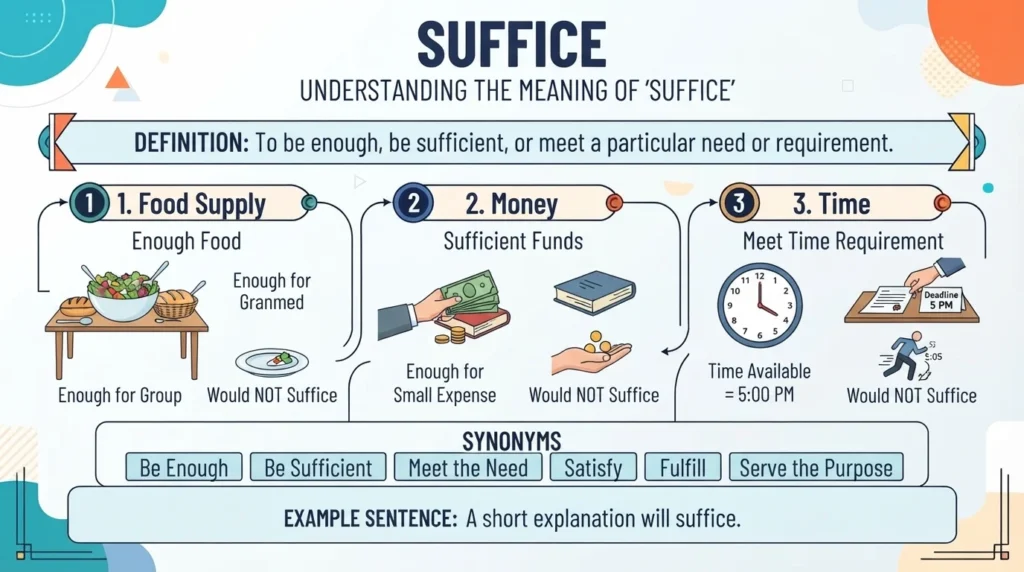
“Suffice” is a verb that means to be enough, adequate, or satisfactory for a specific purpose or need. It carries a neutral to slightly formal tone. Native speakers use it when something meets the minimum requirements without necessarily exceeding them.
You will often hear this word in phrases like “suffice it to say,” which means giving just enough information to make a point clear.
- Part of Speech: Verb
- Simple Definition: To be enough or to satisfy a requirement.
Connotative Meaning
Connotation refers to the emotional feeling or association that a word carries beyond its literal definition.
- Positive tone: Expresses complete contentment or satisfaction.
- Negative tone: Implies barely meeting a low standard or offering the bare minimum.
- Neutral tone: Simply states that a requirement has been met without emotion.
Etymology and History
“Suffice” comes from the Old French word suffire, which traces back to the Latin verb sufficere (meaning “to supply,” “to furnish,” or “to be adequate”).
- Old English (450–1100): The word did not exist in Old English; native Germanic terms like genohian (to satisfy) were used instead.
- Middle English (1100–1500): Introduced through Anglo-Norman French as suffisen, primarily used in legal and religious texts.
- Modern English (1500–Present): Shifted into standard literary and formal usage, retaining its core Latin meaning of meeting a basic threshold.
Pronunciation and Syllables
- US Pronunciation: /səˈfaɪs/
- UK Pronunciation: /səˈfaɪs/
- Syllables: suf-fice (2 syllables)
Affixation Pattern
- Root: fisc- / fect- (Latin facere, meaning “to make” or “to do”)
- Prefix: sub- / suf- (meaning “under” or “up to”)
- Suffix: -ice (verb-forming element via French)
40 Synonyms for Suffice
1. Serve (Verb) — US: /sɜːrv/ | UK: /sɜːv/
- Meaning: To be suitable or adequate for a particular purpose.
- Tone/Register: Neutral, Everyday
- Example 1: This simple wooden desk will serve as my workspace for now.
- Example 2: A summary will serve to explain the core concept.
2. Satisfy (Verb) — US: /ˈsæt.ɪs.faɪ/ | UK: /ˈsæt.ɪs.faɪ/
- Meaning: To meet a need, desire, or requirement fully.
- Tone/Register: Neutral, Professional
- Example 1: The proposed solution should satisfy all project guidelines.
- Example 2: A light snack was enough to satisfy her hunger.
3. Answer (Verb) — US: /ˈæn.sɚ/ | UK: /ˈɑːn.sə/
- Meaning: To fulfill or suit a specific purpose or requirement.
- Tone/Register: Neutral, Formal
- Example 1: This emergency budget will answer our immediate needs.
- Example 2: His quick explanation answered the board’s concerns.
4. Do (Verb) — US: /duː/ | UK: /duː/
- Meaning: To be acceptable, suitable, or sufficient in a given situation.
- Tone/Register: Informal, Conversational
- Example 1: You do not need a fancy coat because a simple jacket will do.
- Example 2: If we lack milk, water will do for this recipe.
5. Pass (Verb) — US: /pæs/ | UK: /pɑːs/
- Meaning: To be accepted as adequate or satisfactory under inspection.
- Tone/Register: Informal, Casual
- Example 1: Your initial draft will pass, but it needs further refinement.
- Example 2: That quick repair job will pass for the weekend.
6. Content (Verb) — US: /kənˈtent/ | UK: /kənˈtent/
- Meaning: To accept something as adequate despite it not being ideal.
- Tone/Register: Formal, Literary
- Example 1: He had to content himself with a secondary role.
- Example 2: We must content ourselves with the resources on hand.
7. Fill (Verb) — US: /fɪl/ | UK: /fɪl/
- Meaning: To meet or satisfy a specific operational requirement.
- Tone/Register: Neutral, Functional
- Example 1: This candidate will fill our immediate staffing need.
- Example 2: The temporary bridge will fill the gap for now.
8. Fit (Verb) — US: /fɪt/ | UK: /fɪt/
- Meaning: To be suitable, proper, or adequate for a particular role.
- Tone/Register: Neutral
- Example 1: These credentials fit the requirements of the job posting.
- Example 2: Her skills fit the team’s needs perfectly.
9. Suit (Verb) — US: /suːt/ | UK: /sjuːt/
- Meaning: To be convenient, acceptable, or satisfactory for someone.
- Tone/Register: Neutral, Daily Conversational
- Example 1: A morning meeting will suit my schedule best.
- Example 2: That simple arrangement suits everyone involved.
10. Qualify (Verb) — US: /ˈkwɑː.lə.faɪ/ | UK: /ˈkwɒl.ɪ.faɪ/
- Meaning: To reach the standard required for a specific purpose.
- Tone/Register: Formal, Academic
- Example 1: Your test score will qualify you for the advanced course.
- Example 2: Minimal edits will qualify this draft for submission.
11. Meet (Verb) — US: /miːt/ | UK: /miːt/
- Meaning: To fulfill or satisfy a standard, expectation, or need.
- Tone/Register: Professional, Business
- Example 1: The current supply will meet client demands this quarter.
- Example 2: We need to make sure our work meets safety standards.
12. Cover (Verb) — US: /ˈkʌv.ɚ/ | UK: /ˈkʌv.ə/
- Meaning: To provide enough funds or resources for a specific cost or need.
- Tone/Register: Neutral, Practical
- Example 1: Twenty dollars should cover the cost of lunch.
- Example 2: This insurance plan will cover your basic medical expenses.
13. Stretch (Verb) — US: /stretʃ/ | UK: /stretʃ/
- Meaning: To make a limited resource last far enough to satisfy a need.
- Tone/Register: Informal, Practical
- Example 1: We can stretch these supplies to last until Friday.
- Example 2: Her savings will stretch to cover three months of rent.
14. Work (Verb) — US: /wɝːk/ | UK: /wɜːk/
- Meaning: To function effectively or prove sufficient in a given context.
- Tone/Register: Informal, Everyday
- Example 1: A basic spreadsheet will work for tracking daily expenses.
- Example 2: Tuesday afternoon works well for our weekly check-in.
15. Measure up (Verb) — US: /ˈmeʒ.ɚ ʌp/ | UK: /ˈmeʒ.ə r ʌp/
- Meaning: To reach the required standard or expectation.
- Tone/Register: Idiomatic, Casual
- Example 1: The new product must measure up to consumer expectations.
- Example 2: His performance did not quite measure up to standards.
16. Make the grade (Verb) — US: /meɪk ðə ɡreɪd/ | UK: /meɪk ðə ɡreɪd/
- Meaning: To reach an acceptable level of performance or quality.
- Tone/Register: Idiomatic, Informal
- Example 1: Only three applicants made the grade this semester.
- Example 2: Her report made the grade after a quick revision.
17. Cut the mustard (Verb) — US: /kʌt ðə ˈmʌs.tɚd/ | UK: /kʌt ðə ˈmʌs.təd/
- Meaning: To meet expectations or reach a required standard.
- Tone/Register: Idiomatic, Informal
- Example 1: Old equipment simply will not cut the mustard anymore.
- Example 2: His enthusiasm was great, but his speed did not cut the mustard.
18. Match (Verb) — US: /mætʃ/ | UK: /mætʃ/
- Meaning: To equal or be adequate for a given set of needs.
- Tone/Register: Neutral
- Example 1: Our current budget matches our project expectations.
- Example 2: The outcome matched what we needed to move forward.
19. Fulfill (Verb) — US: /fʊlˈfɪl/ | UK: /fʊlˈfɪl/
- Meaning: To carry out, satisfy, or meet a requirement.
- Tone/Register: Formal, Business
- Example 1: This new strategy will fulfill all legal requirements.
- Example 2: The donation fulfilled our fundraising goal completely.
20. Clear (Verb) — US: /klɪr/ | UK: /klɪə/
- Meaning: To pass or surpass a minimum required threshold.
- Tone/Register: Professional, Technical
- Example 1: The candidate cleared the background check easily.
- Example 2: Our proposal cleared the initial review stage.
21. Discharge (Verb) — US: /dɪsˈtʃɑːrdʒ/ | UK: /dɪsˈtʃɑːdʒ/
- Meaning: To perform or complete a duty or obligation satisfactorily.
- Tone/Register: Formal, Legal
- Example 1: She discharged her responsibilities as manager effectively.
- Example 2: Payment will discharge all remaining debts.
22. Appease (Verb) — US: /əˈpiːz/ | UK: /əˈpiːz/
- Meaning: To satisfy a demand temporarily to bring peace.
- Tone/Register: Formal, Political
- Example 1: The statement was meant to appease concerned clients.
- Example 2: Minor changes helped appease the review committee.
23. Gratify (Verb) — US: /ˈɡræt.ə.faɪ/ | UK: /ˈɡræt.ɪ.faɪ/
- Meaning: To give pleasure or satisfaction by fulfilling a desire.
- Tone/Register: Literary, Formal
- Example 1: The high test results served to gratify her teacher.
- Example 2: It gratified him to see his work appreciated.
24. Sate (Verb) — US: /seɪt/ | UK: /seɪt/
- Meaning: To satisfy an appetite or desire fully.
- Tone/Register: Formal, Literary
- Example 1: A hearty meal served to sate their appetite.
- Example 2: Nothing could sate his curiosity about space.
25. Slake (Verb) — US: /sleɪk/ | UK: /sleɪk/
- Meaning: To satisfy a specific physical craving or thirst.
- Tone/Register: Literary, Formal
- Example 1: Cold spring water served to slake their thirst.
- Example 2: The rain helped slake the dry soil’s need for moisture.
26. Pacify (Verb) — US: /ˈpæs.ə.faɪ/ | UK: /ˈpæs.ɪ.faɪ/
- Meaning: To quell anger or agitation by providing enough reassurance.
- Tone/Register: Neutral, Diplomatic
- Example 1: A sincere apology served to pacify the upset customer.
- Example 2: The news helped pacify public concerns.
27. Reassure (Verb) — US: /ˌriː.əˈʃʊr/ | UK: /ˌriː.əˈʃɔː/
- Meaning: To restore confidence by offering adequate proof or words.
- Tone/Register: Neutral, Empathetic
- Example 1: A brief note was enough to reassure her parents.
- Example 2: Statistics served to reassure investors about safety.
28. Supply (Verb) — US: /səˈplaɪ/ | UK: /səˈplaɪ/
- Meaning: To provide what is needed to fulfill a demand.
- Tone/Register: Neutral, Business
- Example 1: Local farms supply enough produce to meet town needs.
- Example 2: The grant will supply funding for our research.
29. Yield (Verb) — US: /jiːld/ | UK: /jiːld/
- Meaning: To produce a sufficient or expected result or amount.
- Tone/Register: Formal, Academic
- Example 1: The experiment yielded enough data to conclude.
- Example 2: This investment strategy will yield adequate returns.
30. Provide (Verb) — US: /prəˈvaɪd/ | UK: /prəˈvaɪd/
- Meaning: To supply or make available what is necessary.
- Tone/Register: Neutral
- Example 1: The manual provides enough detail for basic setup.
- Example 2: They agreed to provide all necessary equipment.
31. Assuage (Verb) — US: /əˈsweɪdʒ/ | UK: /əˈsweɪdʒ/
- Meaning: To make an unpleasant feeling less intense by satisfying it.
- Tone/Register: Formal, Academic
- Example 1: The team offered data to assuage fear of project delays.
- Example 2: Extra security helped assuage resident concerns.
32. Cater to (Verb) — US: /ˈkeɪ.t̬ɚ tuː/ | UK: /ˈkeɪ.tə tuː/
- Meaning: To provide what is needed or desired by a specific group.
- Tone/Register: Business, Conversational
- Example 1: The new policy caters to flexible work schedules.
- Example 2: Simple options cater to beginners who need quick setups.
33. Accommodate (Verb) — US: /əˈkɑː.mə.deɪt/ | UK: /əˈkɒm.ə.deɪt/
- Meaning: To fit in or satisfy the needs of someone or something.
- Tone/Register: Formal, Business
- Example 1: The hall can accommodate up to two hundred guests.
- Example 2: We modified the schedule to accommodate your requests.
34. Sustenance (Verb context: Sustain) — US: /səˈsteɪn/ | UK: /səˈsteɪn/
- Meaning: To keep something going by providing adequate support.
- Tone/Register: Formal, Academic
- Example 1: Small donations helped sustain the local shelter.
- Example 2: Light snacks will sustain our energy through the afternoon.
35. Align with (Verb) — US: /əˈlaɪn wɪð/ | UK: /əˈlaɪn wɪð/
- Meaning: To match or meet expectations, rules, or standards cleanly.
- Tone/Register: Business, Corporate
- Example 1: Your proposed goals align with our company strategy.
- Example 2: The budget must align with strict state guidelines.
36. Suffice for (Verb) — US: /səˈfaɪs fɚ/ | UK: /səˈfaɪs fɔː/
- Meaning: To be completely adequate for a specific group or purpose.
- Tone/Register: Formal
- Example 1: One loaf of bread will suffice for our small group.
- Example 2: Simple equipment will suffice for basic home training.
37. Stand up (Verb) — US: /stænd ʌp/ | UK: /stænd ʌp/
- Meaning: To remain valid, adequate, or effective under scrutiny.
- Tone/Register: Informal, Idiomatic
- Example 1: Her arguments stand up well against critical review.
- Example 2: This old building will stand up to harsh weather.
38. Get by (Verb) — US: /ɡet baɪ/ | UK: /ɡet baɪ/
- Meaning: To manage or survive with the minimum necessary resources.
- Tone/Register: Informal, Casual
- Example 1: We can get by on a lower budget this month.
- Example 2: Basic English skills helped him get by during his trip.
39. Tide over (Verb) — US: /taɪd ˈoʊ.vɚ/ | UK: /taɪd ˈəʊ.və/
- Meaning: To be sufficient for someone until regular supplies arrive.
- Tone/Register: Conversational, Informal
- Example 1: A quick sandwich should tide you over until dinner.
- Example 2: This small loan will tide the family over for a week.
40. Fill the bill (Verb) — US: /fɪl ðə bɪl/ | UK: /fɪl ðə bɪl/
- Meaning: To be suitable or adequate for a particular purpose.
- Tone/Register: Idiomatic, Informal
- Example 1: If you need a reliable car, this sedan fills the bill.
- Example 2: His experience fills the bill for our open position.
Synonyms for Suffice by Tone
Understanding tone helps you choose the right word for any situation.
Positive Tone
- Words: Satisfy, Fulfill, Accommodate, Gratify.
- Usage: Use these options when something does more than just get the job done; it brings genuine satisfaction or completion.
Neutral Tone
- Words: Serve, Meet, Cover, Provide, Fit.
- Usage: Ideal for everyday conversations, workplace emails, and technical writing where you state facts clearly without extra emotion.
Negative / Minimal Tone
- Words: Get by, Pass, Stretch, Tide over.
- Usage: Best when pointing out that something is barely adequate or serves only as a temporary fix.
Playful / Informal Tone
- Words: Do, Cut the mustard, Make the grade, Fill the bill.
- Usage: Use these in casual discussions, friendly chats, or creative writing to keep sentences relaxed.
Mini Comparison: Suffice vs. Close Alternatives
| Feature | Suffice | Serve | Satisfy | Do |
| Formality | High / Formal | Neutral | Neutral / Professional | Informal / Casual |
| Connotation | Meets minimal criteria | Fits a specific function | Meets or exceeds needs | Barely or minimally adequate |
| Best Context | Academic & Legal | General & Technical | Business & Personal | Daily Conversation |
- Suffice vs. Satisfy: “Suffice” implies meeting a baseline requirement (“This amount will suffice”), whereas “satisfy” suggests fully meeting desires or expectations (“This meal will satisfy your hunger”).
- Suffice vs. Do: “Do” is much more casual (“That jacket will do”), while “suffice” fits polished or academic writing.
Context-Based Usage
Daily Conversation
In everyday speech, using “suffice” can sound overly stiff. Choose simpler alternatives like do, work, or get by to keep your language natural and friendly.
Professional and Business Writing
In emails, reports, or corporate presentations, words like meet, fulfill, or cover sound clear, direct, and professional without appearing pretentious.
Academic and Technical Writing
When writing essays or research papers, use suffice, qualify, or accommodate to maintain an authoritative and precise tone.
Common Mistakes and Native Usage
- Overusing “Suffice”: Using “suffice” in casual text messages can make your writing feel distant or arrogant.
- Confusing “Suffice” with “Satisfy”: Remember that “suffice” means being enough, while “satisfy” often involves making someone happy or contented.
- Redundant Phrasing: Avoid saying “enough to suffice.” Since “suffice” already means “to be enough,” adding “enough” creates unnecessary repetition.
Learning the right synonym for suffice can transform your vocabulary and elevate your everyday writing style.
Real-Life Scenarios
- Workplace: When a colleague asks if a short three-slide deck is acceptable for a quick status update, you can reply: “A quick overview will fill the bill for today’s meeting.”
- Social Situations: If you run low on snacks at a casual gathering, you might remark: “A couple of pizzas should tide us over until dinner.”
- Academic Writing: In a thesis introduction, write: “A summary will serve to highlight our core findings before we analyze the data.”
Interactive Practice Quiz
1. Which word is closest in meaning to “suffice”?
A) Fail
B) Satisfy
C) Reduce
D) Reject
2. What does “suffice” mean?
A) To be enough
B) To become larger
C) To cause problems
D) To remove something
3. Which phrase is a synonym for “suffice”?
A) Be sufficient
B) Be unnecessary
C) Be incomplete
D) Be excessive
4. Which word can replace “suffice” in this sentence?
One glass of water should suffice.
A) Delay
B) Be enough
C) Disappear
D) Overflow
5. Which option is closest in meaning to “suffice”?
A) Meet the need
B) Create a need
C) Avoid a need
D) Increase a need
Apply the Meaning
6. Choose the sentence that uses “suffice” correctly.
A) A short explanation will suffice.
B) A short explanation will disappear.
C) A short explanation will fail.
D) A short explanation will increase.
7. Which word is NOT a synonym for “suffice”?
A) Satisfy
B) Fulfill
C) Be enough
D) Lack
8. If a small amount of food suffices, it:
A) Is enough
B) Is spoiled
C) Is missing
D) Is excessive
9. Choose the best synonym for “suffice” in this sentence:
This amount should suffice for the trip.
A) Be adequate
B) Be useless
C) Be excessive
D) Be unsuitable
10. Which sentence has the same meaning as “This will suffice”?
A) This will be enough.
B) This will cause trouble.
C) This will become smaller.
D) This will be unnecessary.
Answer Key
- B
- A
- A
- B
- A
- A
- D
- A
- A
- A
FAQs
1. What is the most common synonym for suffice in casual speech?
The most common casual alternative is the verb “do.” For instance, saying “that will do” carries the exact same core meaning as “that will suffice,” but it sounds far more natural in everyday conversations.
2. Is “sufficient” the same thing as “suffice”?
No, they differ in their parts of speech. “Suffice” is a verb (e.g., “This meal will suffice”), whereas “sufficient” is an adjective used to describe a noun (e.g., “We have sufficient food”).
3. Can I use “satisfy” instead of “suffice” in business reports?
Yes, “satisfy” is an excellent professional replacement. It sounds natural in corporate contexts, especially when referring to fulfilling specific goals, legal requirements, or client expectations.
4. Why should I avoid saying “enough to suffice”?
“Suffice” already means “to be enough.” Adding the word “enough” right before or after it creates a redundant phrase. Simply say “that will suffice” to keep your sentences clean and concise.
5. What is an idiomatic expression that means the same as suffice?
Phrases like “fill the bill,” “make the grade,” or “cut the mustard” are popular idioms that mean meeting required standards or being completely adequate for a situation.
Conclusion
Expanding your vocabulary with a varied synonym for suffice makes your writing far more engaging, dynamic, and precise. Varying your word choices helps you communicate smoothly across casual chats, business reports, and academic essays.
Practicing new words in everyday emails and personal notes builds lasting language habits and strengthens overall communication skills. Regular practice ensures you always have the right word ready for any setting.
To build an impressive vocabulary, try incorporating these newly learned words into your daily conversation or writing tasks. You can learn more by exploring our detailed vocabulary guides to make your English sound natural, confident, and clear.

Sophia Carter is the founder and lead writer at SynonymVerse.com, a trusted online resource dedicated to English vocabulary and effective communication. She is passionate about helping students, writers, professionals, and lifelong learners find the most accurate words to express their ideas with clarity and confidence.
At SynonymVerse.com, every article is carefully researched and thoughtfully written to provide reliable guidance on synonyms, word meanings, and vocabulary. With a strong focus on accuracy, real-world usage, and easy-to-understand explanations, the website is committed to helping readers strengthen their language skills, enrich their vocabulary, and become more confident communicators.