A synonym for subpar can completely change how you express disappointment or criticism in your writing. Imagine receiving a cold, bland meal at a high-end restaurant after waiting for hours.
Calling that experience bad feels too simple, while calling it subpar captures the exact feeling of unmet expectations. Using a variety of terms helps you describe poor quality with precision and flair.
Learning a synonym for subpar helps students write better essays, bloggers craft sharper reviews, and professionals deliver constructive feedback. Expanding your word bank makes your communication far more engaging.
What Does “Subpar” Really Mean?
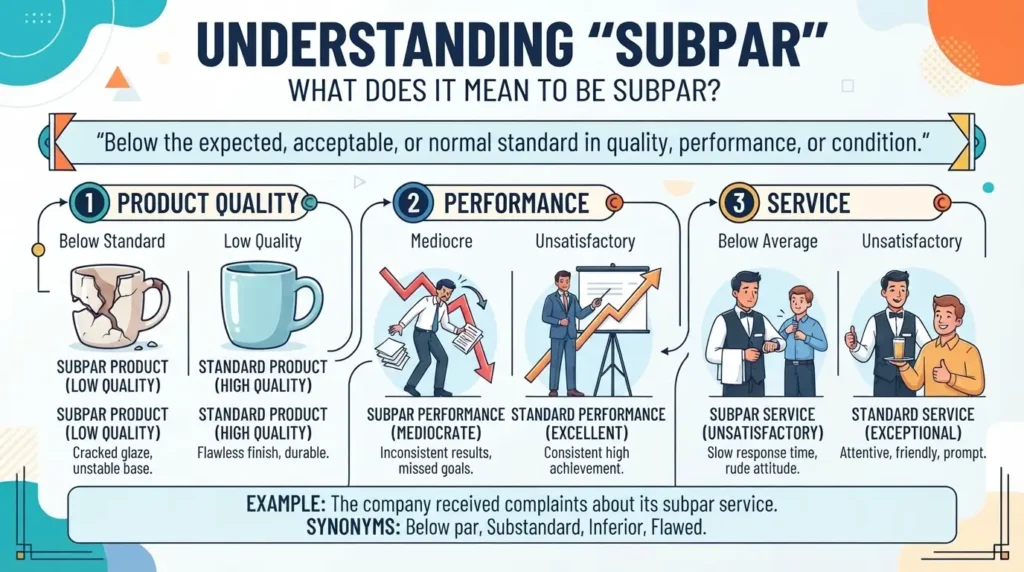
The word subpar means falling below an expected standard, average level, or established quality baseline. It is an adjective used across casual, academic, and professional settings.
Native speakers understand it as a clean way to criticize something without sounding overly aggressive or emotional. It focuses on performance or quality rather than personal dislike.
- Part of Speech: Adjective
- Simple Definition: Below the usual or expected standard.
Connotative Meaning
Connotation is the emotional feeling or cultural association attached to a word beyond its literal definition.
- Positive tone: Rarely used in a positive sense, though occasionally used in self-deprecating humor.
- Negative tone: Highlights failure, poor performance, defectiveness, or disappointment.
- Neutral tone: Used in statistical, technical, or objective evaluations to show a value below average.
Etymology
The term originates from golf culture, combining the Latin prefix sub- (meaning “under” or “below”) with the word par (meaning “equal” or “standard value”).
- Old English (450–1100): Neither component existed in Old English; Latin roots were separate.
- Middle English (1100–1500): The root word par entered English via Anglo-Norman French from Latin.
- Modern English (1500–Present): “Par” became established in golf in the late 19th century. “Subpar” emerged in the 20th century to describe performance below expected standards.
Pronunciation (US & UK – IPA)
- US: /ˈsʌb.pɑːr/
- UK: /ˈsʌb.pɑː/
Syllables & Affixation
- Syllables: sub-par
- Root: Par
- Prefix: Sub- (below/under)
- Suffix: None
60 Synonyms for Subpar
1. Inferior (Adjective) — US: /ɪnˈfɪr.i.ɚ/ | UK: /ɪnˈfɪə.ri.ər/
- Meaning: Lower in quality, rank, position, or value compared to others.
- Tone/Register: Formal / General
- Example 1: The cheap replica was made of inferior materials that tore instantly.
- Example 2: She refused to accept inferior work from her design contractor.
2. Inadequate (Adjective) — US: /ɪnˈæd.ə.kwət/ | UK: /ɪnˈæd.ɪ.kwət/
- Meaning: Lacking the quality or quantity required to meet a specific need.
- Tone/Register: Formal / Business
- Example 1: The old fire safety system was completely inadequate for the large facility.
- Example 2: He felt inadequate when attempting to solve the complex physics equation.
3. Deficient (Adjective) — US: /dɪˈfɪʃ.ənt/ | UK: /dɪˈfɪʃ.ənt/
- Meaning: Not having enough of a specified quality or ingredient.
- Tone/Register: Academic / Medical / Formal
- Example 1: The soil in this garden is deficient in essential organic nutrients.
- Example 2: Her report was deficient in primary research data.
4. Substandard (Adjective) — US: /ˌsʌbˈstæn.dɚd/ | UK: /ˌsʌbˈstæn.dəd/
- Meaning: Below the official or legal minimum standard of quality.
- Tone/Register: Professional / Legal
- Example 1: Inspectors shut down the construction site due to substandard wiring.
- Example 2: Living in substandard housing can cause long-term health problems.
5. Meddling (Adjective) — US: /ˈmed.əl.ɪŋ/ | UK: /ˈmed.əl.ɪŋ/
- Meaning: Intrusive in a way that yields disappointing results.
- Tone/Register: Informal
- Example 1: His meddling attempts to fix the clock only made it run slower.
- Example 2: She avoided meddling neighbors who offered low-quality advice.
6. Mediocre (Adjective) — US: /ˌmiː.diˈoʊ.kɚ/ | UK: /ˌmiː.diˈəʊ.kər/
- Meaning: Of moderate to low quality; ordinary and uninspiring.
- Tone/Register: General / Critical
- Example 1: The restaurant served mediocre food despite its expensive menu prices.
- Example 2: A mediocre effort will not win first place in this contest.
7. Second-rate (Adjective) — US: /ˌsek.əndˈreɪt/ | UK: /ˌsek.əndˈreɪt/
- Meaning: Of inferior quality or lower standard compared to the best.
- Tone/Register: Informal / Conversational
- Example 1: We stayed at a second-rate hotel on the edge of town.
- Example 2: I refuse to watch second-rate action movies with terrible scripts.
8. Lousy (Adjective) — US: /ˈlaʊ.zi/ | UK: /ˈlaʊ.zi/
- Meaning: Very poor in quality or skill; thoroughly bad.
- Tone/Register: Informal / Colloquial
- Example 1: He gave a lousy presentation because he did not prepare slides.
- Example 2: The weather was lousy throughout our entire beach vacation.
9. Poor (Adjective) — US: /pʊr/ | UK: /pɔːr/
- Meaning: Lacking high quality, skill, or excellence.
- Tone/Register: General / Universal
- Example 1: The car crashed due to poor visibility in the heavy fog.
- Example 2: Poor management led to the store closing down permanently.
10. Faulty (Adjective) — US: /ˈfɑːl.ti/ | UK: /ˈfɒl.ti/
- Meaning: Containing defects, errors, or operational flaws.
- Tone/Register: Technical / General
- Example 1: The technician replaced the faulty wire in the sound system.
- Example 2: Her logic was completely faulty during the political debate.
11. Defective (Adjective) — US: /dɪˈfek.tɪv/ | UK: /dɪˈfek.tɪv/
- Meaning: Imperfect or lacking a necessary component for proper function.
- Tone/Register: Technical / Business
- Example 1: The factory recalled thousands of defective smartphones this week.
- Example 2: Customers can return any defective item for a full refund.
12. Imperfect (Adjective) — US: /ɪmˈpɝː.fekt/ | UK: /ɪmˈpɜː.fekt/
- Meaning: Having flaws, mistakes, or omissions; not perfect.
- Tone/Register: General / Reflective
- Example 1: The handmade vase was imperfect but full of artistic charm.
- Example 2: We live in an imperfect world with continuous challenges.
13. Flawed (Adjective) — US: /flɑːd/ | UK: /flɔːd/
- Meaning: Marked by defects, weaknesses, or fundamental errors.
- Tone/Register: Academic / Analytical
- Example 1: Their scientific theory was built on flawed experimental premises.
- Example 2: The protagonist was a deep and wonderfully flawed character.
14. Unsatisfactory (Adjective) — US: /ˌʌn.sæt̬.əsˈfæk.tɚ.i/ | UK: /ˌʌn.sæt.ɪsˈfæk.tər.i/
- Meaning: Failing to meet expectations, rules, or requirements.
- Tone/Register: Formal / Professional
- Example 1: The student received an unsatisfactory grade on the final exam.
- Example 2: The company issued an apology for its unsatisfactory customer service.
15. Wanting (Adjective) — US: /ˈwɑːn.t̬ɪŋ/ | UK: /ˈwɒn.tɪŋ/
- Meaning: Lacking in requisite quality, amount, or completeness.
- Tone/Register: Literary / Formal
- Example 1: Her knowledge of world history was found wanting during the exam.
- Example 2: The new security policies were somewhat wanting in clarity.
16. Lacking (Adjective) — US: /ˈlæk.ɪŋ/ | UK: /ˈlæk.ɪŋ/
- Meaning: Deficient in an important aspect, quality, or feature.
- Tone/Register: General / Conversational
- Example 1: His explanation was entirely lacking in basic logic and facts.
- Example 2: The dish was flavorful but lacking in proper visual presentation.
17. Low-grade (Adjective) — US: /ˌloʊˈɡreɪd/ | UK: /ˌləʊˈɡreɪd/
- Meaning: Belonging to a low tier of quality, value, or purity.
- Tone/Register: Technical / Industrial
- Example 1: The engine ran poorly because it used low-grade gasoline.
- Example 2: They sold low-grade steel at a heavily discounted price.
18. Cheap (Adjective) — US: /tʃiːp/ | UK: /tʃiːp/
- Meaning: Made with poor workmanship; lacking quality or elegance.
- Tone/Register: Informal / General
- Example 1: The cheap plastic toy broke ten minutes after opening it.
- Example 2: I bought a cheap pair of sunglasses for my trip.
19. Shoddy (Adjective) — US: /ˈʃɑː.di/ | UK: /ˈʃɒd.i/
- Meaning: Badly made, carelessly constructed, or done without care.
- Tone/Register: Informal / Critical
- Example 1: The carpenter did shoddy work on the wooden kitchen cabinet.
- Example 2: We were disappointed by the shoddy craftsmanship of the table.
20. Trashy (Adjective) — US: /ˈtræʃ.i/ | UK: /ˈtræʃ.i/
- Meaning: Extremely poor quality; worthless, vulgar, or cheap.
- Tone/Register: Informal / Slang
- Example 1: She threw away the trashy magazines left on the coffee table.
- Example 2: The novel was filled with trashy dialogue and cliché plots.
21. Below-average (Adjective) — US: /bɪˈloʊ ˈæv.ɚ.ɪdʒ/ | UK: /bɪˈləʊ ˈæv.ər.ɪdʒ/
- Meaning: Falling underneath the standard central measurement or norm.
- Tone/Register: Analytical / Objective
- Example 1: The crop yield was below-average due to the summer drought.
- Example 2: He received a below-average score on his performance review.
22. Third-rate (Adjective) — US: /ˌθɝːdˈreɪt/ | UK: /ˌθɜːdˈreɪt/
- Meaning: Of extremely low quality; significantly inferior.
- Tone/Register: Informal / Critical
- Example 1: They were trapped in a third-rate movie theater with broken seats.
- Example 2: No one wants to hire a third-rate law firm for court cases.
23. Terribly-made (Adjective) — US: /ˈter.ə.bli meɪd/ | UK: /ˈter.ə.bli meɪd/
- Meaning: Constructed with severe errors or lacking basic craftsmanship.
- Tone/Register: Conversational
- Example 1: That coat is terribly-made; the buttons are falling off already.
- Example 2: I returned the terribly-made shoes to the retail store immediately.
24. Unsound (Adjective) — US: /ʌnˈsaʊnd/ | UK: /ʌnˈsaʊnd/
- Meaning: Not solid, reliable, healthy, or safe.
- Tone/Register: Professional / Formal
- Example 1: The old wooden bridge was declared structurally unsound by engineers.
- Example 2: Her financial advice was completely unsound and caused losses.
25. Weak (Adjective) — US: /wiːk/ | UK: /wiːk/
- Meaning: Lacking strength, intensity, power, or persuasive force.
- Tone/Register: General / Everyday
- Example 1: The writer gave a weak argument in favor of the new policy.
- Example 2: I prefer strong coffee over this weak morning brew.
26. Bad (Adjective) — US: /bæd/ | UK: /bæd/
- Meaning: Of poor quality, unacceptable, or below standard overall.
- Tone/Register: Everyday / Universal
- Example 1: The movie received bad reviews from major film critics worldwide.
- Example 2: Eating spoiled food is a very bad idea for your health.
27. Dreadful (Adjective) — US: /ˈdred.fəl/ | UK: /ˈdred.fəl/
- Meaning: Extremely bad, disagreeable, or of shockingly low quality.
- Tone/Register: Conversational / Dramatic
- Example 1: The actor gave a dreadful performance in the new play.
- Example 2: We had dreadful traffic on our drive to the airport.
28. Awful (Adjective) — US: /ˈɑː.fəl/ | UK: /ˈɔː.fəl/
- Meaning: Inspiring disgust, dissatisfaction, or disappointment.
- Tone/Register: Everyday / Informal
- Example 1: The restaurant served an awful meal that was completely cold.
- Example 2: She made an awful mistake by deleting the master file.
29. Terrible (Adjective) — US: /ˈter.ə.bəl/ | UK: /ˈter.ə.bəl/
- Meaning: Very serious, unsatisfactory, or poor in execution.
- Tone/Register: General / Conversational
- Example 1: He suffered from a terrible headache throughout the entire meeting.
- Example 2: The hotel had terrible service and dirty room carpets.
30. Horrible (Adjective) — US: /ˈhɔːr.ə.bəl/ | UK: /ˈhɒr.ə.bəl/
- Meaning: Extremely unpleasant or of unacceptable quality.
- Tone/Register: Informal / Emphatic
- Example 1: That shop had a horrible smell of burnt engine oil.
- Example 2: The weather forecast predicts horrible storms later this afternoon.
31. Abysmal (Adjective) — US: /əˈbɪz.məl/ | UK: /əˈbɪz.məl/
- Meaning: Extremely bad or appalling; figuratively bottomless in low quality.
- Tone/Register: Formal / Expressive
- Example 1: The team’s performance was abysmal during the championship match.
- Example 2: She expressed shock at the abysmal conditions of the shelter.
32. Atrocious (Adjective) — US: /əˈtroʊ.ʃəs/ | UK: /əˈtrəʊ.ʃəs/
- Meaning: Horrifyingly bad or of extremely poor taste and execution.
- Tone/Register: Formal / Emphatic
- Example 1: His grammar was atrocious in the first draft of his essay.
- Example 2: The singer made an atrocious noise during the live performance.
33. Poor-quality (Adjective) — US: /pʊr ˈkwɑː.lə.ti/ | UK: /pɔːr ˈkwɒl.ə.ti/
- Meaning: Lacking high features, durable materials, or proper construction.
- Tone/Register: Business / General
- Example 1: They sold poor-quality furniture that broke within two months.
- Example 2: Avoid buying poor-quality tools for heavy building work.
34. Low-quality (Adjective) — US: /loʊ ˈkwɑː.lə.ti/ | UK: /ləʊ ˈkwɒl.ə.ti/
- Meaning: Ranked near the bottom in terms of grade or manufacture.
- Tone/Register: Business / Technical
- Example 1: Low-quality audio recordings can ruin an entire video production.
- Example 2: The site was filled with low-quality articles and ads.
35. Crude (Adjective) — US: /kruːd/ | UK: /kruːd/
- Meaning: Constructed in a rough, unrefined, or rudimentary manner.
- Tone/Register: Academic / General
- Example 1: The survivalists built a crude shelter using fallen tree branches.
- Example 2: His drawing was a crude sketch of the original building plan.
36. Rough (Adjective) — US: /rʌf/ | UK: /rʌf/
- Meaning: Unfinished, unpolished, or lacking refined quality.
- Tone/Register: Conversational
- Example 1: The author submitted a rough draft of the introductory chapter.
- Example 2: He gave a rough estimate of the project expenses.
37. Unpolished (Adjective) — US: /ʌnˈpɑː.lɪʃt/ | UK: /ʌnˈpɒl.ɪʃt/
- Meaning: Lacking sophistication, elegance, or refined finishing touches.
- Tone/Register: Creative / Literary
- Example 1: The indie game had great ideas but remained unpolished.
- Example 2: Her speech was honest, though slightly unpolished in tone.
38. Early (Adjective) — US: /ˈprɪm.ə.t̬ɪv/ | UK: /ˈprɪm.ɪ.tɪv/
- Meaning: Extremely basic, undeveloped, or lacking modern sophistication.
- Tone/Register: Historical / Technical
- Example 1: They used early tools to carve stone blocks for houses.
- Example 2: The software features felt early compared to contemporary apps.
39. Elementary (Adjective) — US: /ˌel.əˈmen.t̬ɚ.i/ | UK: /ˌel.ɪˈmen.tər.i/
- Meaning: Unrefined or limited to basic, simple stages.
- Tone/Register: Educational / General
- Example 1: His coding skills were elementary and needed significant practice.
- Example 2: The security measures taken were surprisingly elementary for a bank.
40. Rudimentary (Adjective) — US: /ˌruː.dəˈmen.t̬ɚ.i/ | UK: /ˌruː.dɪˈmen.tər.i/
- Meaning: Limited to basic principles; undeveloped or imperfect.
- Tone/Register: Academic / Technical
- Example 1: She only had a rudimentary understanding of the local language.
- Example 2: The plane had only rudimentary navigation systems installed inside.
41. Off-target (Adjective) — US: /ɑːf ˈtɑːr.ɡɪt/ | UK: /ɒf ˈtɑː.ɡɪt/
- Meaning: Failing to achieve the intended goal or standard.
- Tone/Register: Business / Sports
- Example 1: The marketing campaign was off-target and missed key customers.
- Example 2: His answers during the interview were slightly off-target.
42. Fault-ridden (Adjective) — US: /fɑːlt ˈrɪd.ən/ | UK: /fɒlt ˈrɪd.ən/
- Meaning: Filled with numerous mistakes, defects, or flaws throughout.
- Tone/Register: Formal / Critical
- Example 1: The editor rejected the fault-ridden manuscript sent by the author.
- Example 2: They abandoned the fault-ridden software after several crashes.
43. Sub-standardized (Adjective) — US: /sʌb ˈstæn.dɚ.daɪzd/ | UK: /sʌb ˈstæn.də.daɪzd/
- Meaning: Manufactured or kept below accepted systemic standard codes.
- Tone/Register: Technical / Corporate
- Example 1: The auditor noted several sub-standardized safety procedures in the factory.
- Example 2: Sub-standardized goods should never be delivered to client companies.
44. Off-key (Adjective) — US: /ˌɑːfˈkiː/ | UK: /ˌɒfˈkiː/
- Meaning: Out of harmony or lacking appropriate quality and tone.
- Tone/Register: Arts / Conversational
- Example 1: The choir sounded off-key during their practice session today.
- Example 2: His humorous remarks felt off-key during the solemn ceremony.
45. Below-par (Adjective) — US: /bɪˈloʊ pɑːr/ | UK: /bɪˈləʊ pɑː/
- Meaning: Falling short of standard expectation or personal capability.
- Tone/Register: Sports / Business
- Example 1: The star player had a below-par performance during yesterday’s match.
- Example 2: I am feeling a bit below par today due to a cold.
46. Blemished (Adjective) — US: /ˈblem.ɪʃt/ | UK: /ˈblem.ɪʃt/
- Meaning: Damaged, spoiled, or marked by physical or abstract flaws.
- Tone/Register: General / Descriptive
- Example 1: The wood surface was blemished by several deep scratch marks.
- Example 2: He had a blemished record after missing multiple job deadlines.
47. Tarnished (Adjective) — US: /ˈtɑːr.nɪʃt/ | UK: /ˈtɑː.nɪʃt/
- Meaning: Reduced in quality, luster, status, or standard reputation.
- Tone/Register: Literary / Formal
- Example 1: The scandal left the politician with a tarnished public image.
- Example 2: She polished the tarnished silver spoons before serving dinner.
48. Damaged (Adjective) — US: /ˈdæm.ɪdʒd/ | UK: /ˈdæm.ɪdʒd/
- Meaning: Damaged, broken, or reduced in functional utility or quality.
- Tone/Register: General / Everyday
- Example 1: The delivery company replaced the damaged goods without extra charge.
- Example 2: His reputation was severely damaged by the false media reports.
49. Impaired (Adjective) — US: /ɪmˈperd/ | UK: /ɪmˈpeəd/
- Meaning: Weakened, diminished, or functioning at a reduced capacity.
- Tone/Register: Formal / Technical
- Example 1: Driving with impaired vision increases the risk of road accidents.
- Example 2: Cognitive function can become impaired due to severe lack of sleep.
50. Defective-grade (Adjective) — US: /dɪˈfek.tɪv ɡreɪd/ | UK: /dɪˈfek.tɪv ɡreɪd/
- Meaning: Classified as fundamentally unfit or failing quality control testing.
- Tone/Register: Industrial
- Example 1: The batch was sorted as defective-grade steel and sent back.
- Example 2: We cannot ship defective-grade products to our long-term clients.
51. Cheap-jack (Adjective) — US: /ˈtʃiːp.dʒæk/ | UK: /ˈtʃiːp.dʒæk/
- Meaning: Shoddy, flimsy, or made dishonestly with cheap materials.
- Tone/Register: Informal / Older Usage
- Example 1: Don’t waste your cash on cheap-jack souvenirs near tourist spots.
- Example 2: The house had cheap-jack doors that broke under light pressure.
52. Glitchy (Adjective) — US: /ˈɡlɪtʃ.i/ | UK: /ˈɡlɪtʃ.i/
- Meaning: Experiencing temporary technical failures or subpar performance.
- Tone/Register: Informal / Technical
- Example 1: The new video game felt glitchy right after its initial release.
- Example 2: I could not finish the meeting because of a glitchy internet connection.
53. Unsatisfying (Adjective) — US: /ˌʌn.sæt̬.əsˈfaɪ.ɪŋ/ | UK: /ˌʌn.sæt.ɪsˈfaɪ.ɪŋ/
- Meaning: Failing to provide complete fulfillment, quality, or emotional contentment.
- Tone/Register: General
- Example 1: The movie had an unsatisfying ending that left many questions.
- Example 2: Eating a small meal left him feeling hungry and unsatisfyingly full.
54. Half-baked (Adjective) — US: /ˌhæfˈbeɪkt/ | UK: /ˌhɑːfˈbeɪkt/
- Meaning: Insufficiently thought out, planned, or developed.
- Tone/Register: Informal / Idiomatic
- Example 1: He presented a half-baked business proposal to the investors.
- Example 2: We shouldn’t execute half-baked ideas without reviewing the budget.
55. Sloppy (Adjective) — US: /ˈslɑː.pi/ | UK: /ˈslɒp.i/
- Meaning: Careless, untidy, or done without precision or attention.
- Tone/Register: Informal / Critical
- Example 1: Her essay had sloppy handwriting and numerous grammatical errors throughout.
- Example 2: The team lost points because of sloppy defense during play.
56. Slipshod (Adjective) — US: /ˈslɪp.ʃɑːd/ | UK: /ˈslɪp.ʃɒd/
- Meaning: Characterized by a lack of care, thought, or organization.
- Tone/Register: Formal / Literary
- Example 1: The contractor was fired for doing slipshod repair work on the roof.
- Example 2: They criticized the committee for taking a slipshod approach to safety.
57. Variable (Adjective) — US: /ˈver.i.ə.bəl/ | UK: /ˈveə.ri.ə.bəl/
- Meaning: Inconsistent in quality; changing often between acceptable and poor.
- Tone/Register: Academic / Analytical
- Example 1: The restaurant has variable food quality depending on who is cooking.
- Example 2: His test scores were highly variable throughout the school term.
58. Disappointing (Adjective) — US: /ˌdɪs.əˈpɔɪn.t̬ɪŋ/ | UK: /ˌdɪs.əˈpɔɪn.tɪŋ/
- Meaning: Failing to fulfill expectations, hopes, or expected standards.
- Tone/Register: General / Conversational
- Example 1: The sales figures for this quarter were disappointing for investors.
- Example 2: We had a disappointing experience at the resort over the weekend.
59. Unacceptable (Adjective) — US: /ˌʌn.əkˈsep.tə.bəl/ | UK: /ˌʌn.əkˈsep.tə.bəl/
- Meaning: Completely below allowable limits or acceptable quality thresholds.
- Tone/Register: Professional / Serious
- Example 1: The teacher warned that late homework submissions were unacceptable.
- Example 2: The company faced backlash for unacceptable safety conditions.
60. Sub-grade (Adjective) — US: /sʌb ɡreɪd/ | UK: /sʌb ɡreɪd/
- Meaning: Below the minimum standard classification or physical quality mark.
- Tone/Register: Technical / Industrial
- Example 1: They recycled the sub-grade plastic items to create park benches.
- Example 2: Sub-grade timber should not be used for main structural support.
Synonyms for “Subpar” by Tone
Tone controls how your listener receives your criticism. Grouping synonyms by tone helps you pick the right word for your context.
- Positive (Soft/Gentle criticism): Unpolished, Variable, Imperfect, Off-target.
- Neutral (Objective/Technical): Substandard, Deficient, Below-average, Inadequate, Inferior, Sub-grade.
- Negative (Harsh/Direct): Abysmal, Atrocious, Dreadful, Lousy, Terrible, Shoddy.
- Playful/Informal: Half-baked, Glitchy, Sloppy, Trashy, Second-rate.
Tone matters because using a harsh word like abysmal in a delicate work review can destroy morale, while using unpolished softens the feedback while staying honest.
Mini Comparison: “Subpar” vs Close Alternatives
| Feature | Subpar | Substandard | Mediocre |
| Core Meaning | Below an expected baseline performance | Below official or required standards | Average, ordinary, or uninspiring |
| Tone | Objective to mildly critical | Formal and official | Mildly judgmental or critical |
| Best Use Case | Work performance, daily experiences | Safety codes, construction, products | Art, entertainment, average work |
How “Subpar” Changes by Context
- Daily Conversation: Native speakers often use it to describe temporary bad luck or mild disappointment. (e.g., “I played a subpar game of tennis today.”)
- Writing or Blogging: Used to evaluate products, books, or services neutrally. (e.g., “The camera delivers subpar photos in low light.”)
- Professional or Academic Tone: Appears in performance evaluations, reports, and analytical papers. (e.g., “Subpar results were attributed to supply chain delays.”)
- Creative or Informal Use: Used to highlight characters facing underwhelming circumstances or equipment. (e.g., “He stared at the subpar meal in his tiny cabin.”)
Common Mistakes & Native Usage
Learners often mistake subpar for mediocre. While subpar means below average, mediocre literally means average (though often with a negative undertone).
Another mistake is using subpar to describe people’s character instead of their work or performance. Native speakers apply it to actions, outputs, and conditions, rarely to a person’s moral character.
For formal contexts, consider reading about advanced business terms in our master vocabulary series to refine your professional communication.
Register Notes
- Subpar works well in both written reports and spoken conversations.
- Substandard is preferred in legal, regulatory, or technical writing.
Real-Life Mini Scenarios
- Workplace: A project manager reviews a rushed draft and says, “This proposal is subpar; please review the client brief and add missing figures.”
- Social Situations: Friends leave a cinema, and one remarks, “The visual effects were great, but the acting felt subpar.”
- Media / Pop Culture: A tech reviewer posts an update: “The phone boasts great specs, but battery life remains subpar.”
- Writing or Storytelling: An author describes a setting: “The detective stayed in a subpar motel on the edge of town.”
Practice Quiz
Test your understanding of these terms with the following questions:
Understanding the Meaning
1. Which word is closest in meaning to “subpar”?
A) Excellent
B) Inferior
C) Outstanding
D) Superior
2. “Subpar” means:
A) Above average
B) Extremely successful
C) Below the expected standard
D) Highly impressive
3. Which is a synonym for “subpar”?
A) Mediocre
B) Exceptional
C) Perfect
D) Remarkable
4. Which word can replace “subpar” in this sentence?
The restaurant received complaints about its subpar service.
A) Excellent
B) Superior
C) Unsatisfactory
D) Outstanding
5. Which phrase has the same meaning as “subpar”?
A) High quality
B) Below standard
C) First-rate
D) Top-class
Apply the Meaning
6. Which sentence uses “subpar” correctly?
A) The team delivered a subpar performance.
B) The team delivered an outstanding performance.
C) The team won every award.
D) The team achieved perfect results.
7. Which word is NOT a synonym for “subpar”?
A) Inferior
B) Inadequate
C) Mediocre
D) Excellent
8. If a product has subpar quality, it is:
A) Better than expected
B) Below the expected standard
C) Perfectly designed
D) Extremely durable
9. Which word best replaces “subpar” in this sentence?
The hotel provided subpar accommodation.
A) Unsatisfactory
B) Luxurious
C) Excellent
D) Exceptional
10. Which option describes something “subpar”?
A) A meal that exceeds expectations
B) A service that meets the highest standards
C) A product that falls below the expected quality
D) A performance that receives outstanding reviews
Answer Key
- B
- C
- A
- C
- B
- A
- D
- B
- A
- C
FAQs
1. What is the most common synonym for subpar in business writing?
In business writing, substandard and inadequate are the most common alternatives. They provide a clear, neutral tone that pinpoints issues without sounding overly emotional or informal.
2. Can subpar be used to describe a person?
It is best to avoid describing a person as subpar. Instead, apply the term to their performance, work, actions, or output to maintain a professional and respectful tone.
3. Is subpar a formal or informal word?
Subpar is versatile. It is suitable for formal business reports, academic essays, everyday conversations, and news publications.
4. What is the opposite of subpar?
The direct opposites of subpar include above-average, superficial, superior, excellent, outstanding, and exemplary.
5. Is subpar always a negative term?
Yes, subpar almost always carries a negative meaning because it indicates that something fails to reach an expected standard or baseline score.
Conclusion
Mastering various words to describe low quality allows you to express critical thoughts with exact precision. Swapping out simple words for rich vocabulary instantly strengthens your professional and academic communication.
Practicing these semantic variations helps bloggers write sharper reviews, enables students to construct compelling essays, and allows professionals to deliver effective feedback. Expanding your word choices builds long-term confidence in both speaking and writing.
Start using these alternatives in your daily conversations, emails, and essays to strengthen your command of the language. Discover more about synonym for subpar to continue refining your English writing skills today.

Sophia Carter is the founder and lead writer at SynonymVerse.com, a trusted online resource dedicated to English vocabulary and effective communication. She is passionate about helping students, writers, professionals, and lifelong learners find the most accurate words to express their ideas with clarity and confidence.
At SynonymVerse.com, every article is carefully researched and thoughtfully written to provide reliable guidance on synonyms, word meanings, and vocabulary. With a strong focus on accuracy, real-world usage, and easy-to-understand explanations, the website is committed to helping readers strengthen their language skills, enrich their vocabulary, and become more confident communicators.