Synonym for superficiality are what smart writers search for when they want to describe shallow behavior or a lack of depth in their essays and articles.
Imagine meeting a person who only talks about expensive clothes, designer shoes, and party trends while ignoring real feelings or deep ideas entirely.
That familiar situation shows how a lack of true substance in daily life highlights the core concept of superficiality among modern social groups.
Learning a synonym for superficiality helps you express exact thoughts, refine your academic writing, and elevate your daily English communication.
This versatile noun appears often in social media critiques, book reviews, and psychology reports to point out shallow thinking or surface-level details.
Students, bloggers, content creators, and daily English users can use these precise alternatives to make their spoken and written prose far more engaging.
What Does “Superficiality” Really Mean?
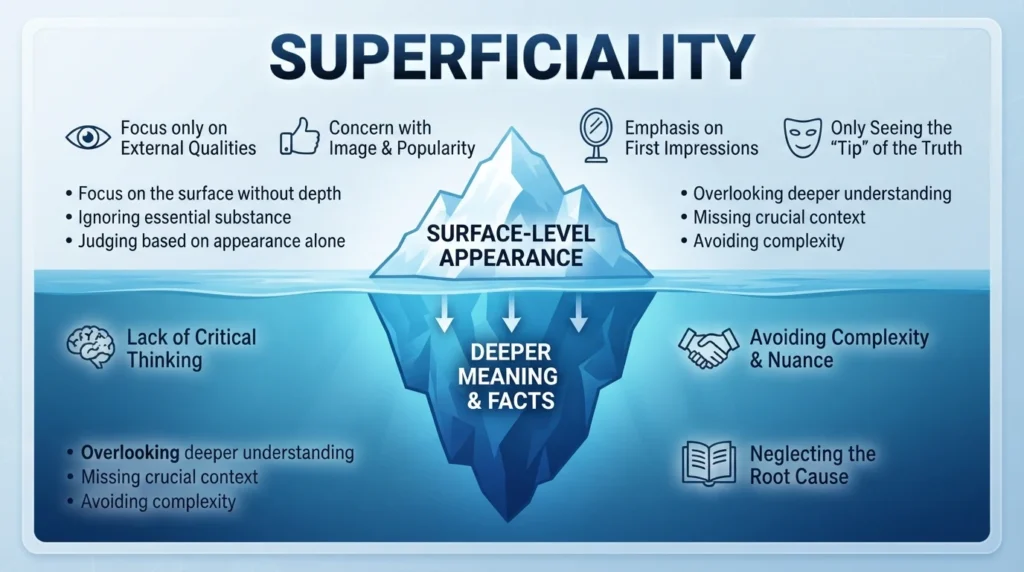
The word “superficiality” is a noun that describes the state or quality of being shallow, surface-level, or lacking genuine depth, substance, or serious thought. Native English speakers use it to describe physical surfaces, casual conversations, or people who care only about external appearances.
It carries a critical emotional tone because it highlights a gap between outward appearance and inner value. You will see it in cultural critiques, literature, character studies, and formal essays.
As an abstract noun, superficiality defines a trait rather than an action, pointing out shallow qualities in work, relationships, or ideas.
Connotative Meaning
Connotation is the emotional or cultural association attached to a word beyond its literal definition.
- Positive Tone: Rarely carries a positive tone, though occasionally used neutrally when describing harmless surface-level design or lighthearted banter.
- Negative Tone: Strongly negative, as it implies insincerity, vanity, lack of intellect, fake behavior, or carelessness.
- Neutral Tone: Used neutrally in technical or scientific contexts, such as describing a shallow wound or a surface-level scan.
Etymology
The word “superficiality” comes from the Late Latin word superficialis, built from superficies (super- meaning “above/over” and facies meaning “face/form”).
- Old English (450–1100): Early Anglo-Saxon English used native Germanic roots like smeoruwe or neowolness to describe surface features or depth.
- Middle English (1100–1500): The French term superficial entered the language, gradually referring to things existing on the surface.
- Modern English (1500–Present): By the late 17th century, English added the suffix “-ity” to form “superficiality,” describing shallow human character and thought.
Pronunciation
- US: /ˌsuː.pɚ.fɪʃˈæ.lə.t̬i/
- UK: /ˌsuː.pə.fɪʃˈæl.ə.ti/
Syllables
su-per-fi-ci-al-i-ty
Affixation Pattern of Superficiality
- Root: Face / Facies (Latin)
- Prefix: Super- (Meaning “above” or “on top of”)
- Suffix: -ial (Adjective forming) + -ity (Noun forming)
Synonyms List
Here are 50 accurate and commonly used synonyms for superficiality to expand your vocabulary.
1. Shallowness (Noun) — US: /ˈʃæl.oʊ.nəs/ / UK: /ˈʃæl.əʊ.nəs/
Meaning: A complete lack of depth in character, thought, or emotion.
Tone/Register: Neutral, Conversational
Example 1: The shallowness of his speech disappointed the eager audience.
Example 2: She disliked the shallowness of modern celebrity gossip magazines.
2. Triviality (Noun) — US: /trɪv.iˈæl.ə.t̬i/ / UK: /trɪv.iˈæl.ə.ti/
Meaning: The quality of being unimportant or lacking serious value.
Tone/Register: Formal, Academic
Example 1: We should focus on major goals instead of daily triviality.
Example 2: The meeting devolved into endless debates over pure triviality.
3. Frivolity (Noun) — US: /frɪˈvɑː.lə.t̬i/ / UK: /frɪˈvɒl.ə.ti/
Meaning: Silly or lighthearted behavior that lacks serious purpose.
Tone/Register: Formal, Literary
Example 1: High inflation left little room for financial frivolity this year.
Example 2: Her playful frivolity brought smiles during a tense afternoon.
4. Insubstantiality (Noun) — US: /ˌɪn.səb.stæn.ʃiˈæl.ə.t̬i/ / UK: /ˌɪn.səb.stæn.ʃiˈæl.ə.ti/
Meaning: The state of lacking solid mass, strength, or real content.
Tone/Register: Formal, Academic
Example 1: Critics pointed out the insubstantiality of his economic policy proposal.
Example 2: The ghost story relied on atmospheric mood and insubstantiality.
5. Vanity (Noun) — US: /ˈvæn.ə.t̬i/ / UK: /ˈvæn.ə.ti/
Meaning: Excessive pride in one’s appearance, qualities, or achievements.
Tone/Register: Neutral, Moral
Example 1: His constant mirror checks revealed a deep personal vanity.
Example 2: Wealth cannot protect anyone from the emptiness of pure vanity.
6. Artificiality (Noun) — US: /ˌɑːr.t̬ə.fɪʃ.iˈæl.ə.t̬i/ / UK: /ˌɑː.tɪ.fɪʃ.iˈæl.ə.ti/
Meaning: The quality of being fake, manufactured, or unnatural.
Tone/Register: Formal, Cultural
Example 1: The artificiality of her smile made everyone in the room uneasy.
Example 2: He hated the plastic artificiality of modern theme park displays.
7. Pretensiousness (Noun) — US: /prɪˈten.ʃəs.nəs/ / UK: /prɪˈten.ʃəs.nəs/
Meaning: An unpleasant claim to dignity, importance, or professional merit.
Tone/Register: Formal, Literary
Example 1: The art exhibit was ruined by excessive pretensiousness and jargon.
Example 2: She writes with simple clarity and avoids any false pretensiousness.
8. Fimsiness (Noun) — US: /ˈflɪm.zi.nəs/ / UK: /ˈflɪm.zi.nəs/
Meaning: Weakness or lack of solid backing in objects or arguments.
Tone/Register: Informal, Daily
Example 1: The flimsy nature of his defense exposed the weak argument.
Example 2: She noticed the cheap flimsiness of the plastic chair legs.
9. Vacuity (Noun) — US: /væˈkjuː.ə.t̬i/ / UK: /væˈkjuː.ə.ti/
Meaning: A total lack of thought, intelligence, or meaningful ideas.
Tone/Register: Formal, Academic
Example 1: The host stared at the screen with absolute mental vacuity.
Example 2: Her essay was criticized for its quiet spiritual vacuity.
10. Emptiness (Noun) — US: /ˈemp.ti.nəs/ / UK: /ˈemp.ti.nəs/
Meaning: The state of containing nothing, or lacking deep emotion or purpose.
Tone/Register: Neutral, Daily
Example 1: He felt a profound inner emptiness after chasing fast wealth.
Example 2: The silence of the abandoned mansion added to its emptiness.
11. Unreality (Noun) — US: /ˌʌn.riˈæl.ə.t̬i/ / UK: /ˌʌn.riˈæl.ə.ti/
Meaning: The quality of being imaginary, impractical, or disconnected from life.
Tone/Register: Formal, Philosophical
Example 1: The unreality of political campaign promises angered local voters.
Example 2: Movie sets often give actors a strange sense of unreality.
12. Facile Nature (Phrase) — US: /ˈfæs.əl ˈneɪ.tʃɚ/ / UK: /ˈfæs.aɪl ˈneɪ.tʃər/
Meaning: A tendency to offer overly simple solutions without real effort.
Tone/Register: Formal, Academic
Example 1: The report was rejected because of its facile nature and errors.
Example 2: Dealing with complex issues requires avoiding a facile approach.
13. Cursoriness (Noun) — US: /ˈkɝː.sɚ.i.nəs/ / UK: /ˈkɜː.sər.i.nəs/
Meaning: The quality of doing something quickly and without thorough attention.
Tone/Register: Formal, Business
Example 1: The cursoriness of the safety audit missed several danger signs.
Example 2: A quick scan showed the cursoriness of his editing process.
14. Insincerity (Noun) — US: /ˌɪn.sɪnˈser.ə.t̬i/ / UK: /ˌɪn.sɪnˈser.ə.ti/
Meaning: The quality of not expressing genuine feelings, thoughts, or beliefs.
Tone/Register: Neutral, Social
Example 1: Customers quickly detected the corporate insincerity in his apology.
Example 2: Her warm praise felt tinged with subtle personal insincerity.
15. Hollow Display (Phrase) — US: /ˈhɑː.loʊ dɪˈspleɪ/ / UK: /ˈhɒl.əʊ dɪˈspleɪ/
Meaning: An outward action or show that lacks real meaning or commitment.
Tone/Register: Neutral, Media
Example 1: The donation was seen as a hollow display for publicity.
Example 2: Empty promises represent a hollow display of political support.
16. Surface-Level Thinking (Phrase) — US: /ˈsɝː.fɪs ˈlev.əl ˈθɪŋ.kɪŋ/ / UK: /ˈsɜː.fɪs ˈlev.əl ˈθɪŋ.kɪŋ/
Meaning: Analyzing situations without looking at deep root causes.
Tone/Register: Informal, Educational
Example 1: Surface-level thinking will not solve deep structural business problems.
Example 2: Teachers encourage students to move past surface-level thinking daily.
17. Featherheadedness (Noun) — US: /ˈfeð.ɚ.hed.ɪd.nəs/ / UK: /ˈfeð.ə.hed.ɪd.nəs/
Meaning: Silly, flighty, or scatterbrained behavior lacking focus.
Tone/Register: Informal, Literary
Example 1: Her featherheadedness caused her to forget important house keys.
Example 2: Youthful featherheadedness often vanishes with real-life experience.
18. Lightweight Character (Phrase) — US: /ˈlaɪt.weɪt ˈker.ək.tɚ/ / UK: /ˈlaɪt.weɪt ˈkær.ək.tər/
Meaning: A person lacking mental weight, authority, or moral depth.
Tone/Register: Neutral, Conversational
Example 1: Critics dismissed the new director as a lightweight character.
Example 2: Hard work turns a lightweight character into a dependable leader.
19. Superficial Mindset (Phrase) — US: /ˌsuː.pɚ.fɪʃˈæl ˈmaɪnd.set/ / UK: /ˌsuː.pə.fɪʃˈæl ˈmaɪnd.set/
Meaning: A habitual focus on external looks or easy answers.
Tone/Register: Neutral, Psychological
Example 1: A superficial mindset limits personal growth and true friendships.
Example 2: Social media trends often promote a superficial mindset among teens.
20. Glibness (Noun) — US: /ˈɡlɪb.nəs/ / UK: /ˈɡlɪb.nəs/
Meaning: Speaking easily and fluently but without sincerity or careful thought.
Tone/Register: Formal, Political
Example 1: The salesperson’s glibness made the cautious buyers suspicious.
Example 2: True wisdom is defined by quiet reflection, not public glibness.
21. Meretriciousness (Noun) — US: /ˌmer.ə.trɪˈʃəs.nəs/ / UK: /ˌmer.ɪ.trɪˈʃəs.nəs/
Meaning: Attractive appearance on the surface but having no real value.
Tone/Register: Formal, Academic
Example 1: The novel was criticized for its cheap emotional meretriciousness.
Example 2: Bright neon packaging hides the product’s ultimate meretriciousness.
22. Speciousness (Noun) — US: /ˈspiː.ʃəs.nəs/ / UK: /ˈspiː.ʃəs.nəs/
Meaning: Seeming to be correct or true on the surface, but actually wrong.
Tone/Register: Formal, Academic
Example 1: The lawyer exposed the speciousness of the witness statement.
Example 2: Scientific tests disproved the speciousness of the home remedy.
23. Showiness (Noun) — US: /ˈʃoʊ.i.nəs/ / UK: /ˈʃəʊ.i.nəs/
Meaning: Bright, excessive, or pretentious display meant to attract attention.
Tone/Register: Informal, Daily
Example 1: The showiness of his sports car turned heads down the street.
Example 2: True elegance avoids excessive showiness in jewelry and clothes.
24. Ostentation (Noun) — US: /ˌɑː.stənˈteɪ.ʃən/ / UK: /ˌɒs.tenˈteɪ.ʃən/
Meaning: Pretentious and vulgar display intended to impress or show off wealth.
Tone/Register: Formal, Literary
Example 1: The mansion was filled with unnecessary golden ostentation.
Example 2: She preferred quiet comfort over loud public ostentation.
25. Affectation (Noun) — US: /ˌæf.ekˈteɪ.ʃən/ / UK: /ˌæf.ekˈteɪ.ʃən/
Meaning: Behavior, speech, or writing that is artificial and designed to impress.
Tone/Register: Formal, Literary
Example 1: His fake British accent was a ridiculous personal affectation.
Example 2: She adopted a posture of calm affectation during interviews.
26. Pretence (Noun) — US: /ˈpriː.tens/ / UK: /prɪˈtens/
Meaning: An attempt to make something that is not the case appear true.
Tone/Register: Formal, Social
Example 1: They dropped all pretence of agreement and began arguing loudly.
Example 2: Her friendly greeting was mere pretence to get cheap information.
27. Smatterings (Noun) — US: /ˈsmæt̬.ɚ.ɪŋz/ / UK: /ˈsmæt.ər.ɪŋz/
Meaning: Slight, superficial knowledge of a language, topic, or subject.
Tone/Register: Informal, Daily
Example 1: He possessed only small smatterings of French vocabulary.
Example 2: A few smatterings of science do not make you an expert doctor.
28. Facade (Noun) — US: /fəˈsɑːd/ / UK: /fəˈsɑːd/
Meaning: A deceptive outward appearance that hides an underlying truth.
Tone/Register: Neutral, Literary
Example 1: Behind his friendly facade lay a calculating business mind.
Example 2: The wooden building had a grand brick facade facing the street.
29. Cosmetic Touch (Phrase) — US: /kɑːzˈmet̬.ɪk tʌtʃ/ / UK: /kɒzˈmet.ɪk tʌtʃ/
Meaning: A minor surface fix that changes looks without fixing main issues.
Tone/Register: Neutral, Business
Example 1: Adding new paint was a cosmetic touch that missed structural cracks.
Example 2: The manager applied a quick cosmetic touch to the sales report.
30. Skin-Deep Nature (Phrase) — US: /skɪn diːp ˈneɪ.tʃɚ/ / UK: /skɪn diːp ˈneɪ.tʃər/
Meaning: Being limited strictly to the surface or external look.
Tone/Register: Informal, Conversational
Example 1: Her interest in art history had a purely skin-deep nature.
Example 2: Beauty with a skin-deep nature fades quickly over time.
31. Shallow Character (Phrase) — US: /ˈʃæl.oʊ ˈker.ək.tɚ/ / UK: /ˈʃæl.əʊ ˈkær.ək.tər/
Meaning: A personality type lacking moral fiber, intellect, or empathy.
Tone/Register: Informal, Social
Example 1: Movies often portray wealthy villains as having a shallow character.
Example 2: Avoid relying on a shallow character when facing tough challenges.
32. Flashiness (Noun) — US: /ˈflæʃ.i.nəs/ / UK: /ˈflæʃ.i.nəs/
Meaning: Cheap, bright, or tacky outward glamour meant to draw eyes.
Tone/Register: Informal, Daily
Example 1: The flashiness of neon lights defined the downtown casino strip.
Example 2: He traded flashiness for high quality and durability in tools.
33. Foaminess (Noun) — US: /ˈfoʊ.mi.nəs/ / UK: /ˈfəʊ.mi.nəs/
Meaning: The state of being light, airy, and lacking solid substance.
Tone/Register: Informal, Literary
Example 1: The pop song’s intellectual foaminess made it forgettable next week.
Example 2: She noticed the physical foaminess on top of her morning coffee.
34. Thinness (Noun) — US: /ˈθɪn.nəs/ / UK: /ˈθɪn.nəs/
Meaning: Lack of depth, density, coverage, or rich underlying facts.
Tone/Register: Neutral, Academic
Example 1: The professor criticized the thinness of historical facts in her paper.
Example 2: High altitude caused a noticeable thinness in mountain air.
35. Sleaziness (Noun) — US: /ˈsliː.zi.nəs/ / UK: /ˈsliː.zi.nəs/
Meaning: Cheap, low-quality, or morally corrupt surface appearance.
Tone/Register: Informal, Social
Example 1: The sleaziness of the cheap motel turned tourists away immediately.
Example 2: He backed out of the deal after sensing subtle sleaziness.
36. Exteriority (Noun) — US: /ekˌstɪr.iˈɔːr.ə.t̬i/ / UK: /ekˌstɪə.riˈɒr.ə.ti/
Meaning: The state of being external or situated on the outer side.
Tone/Register: Formal, Philosophical
Example 1: Philosophy often contrasts inner thought with pure exteriority.
Example 2: The exteriority of the building hid its modern inner rooms.
37. Surface Value (Phrase) — US: /ˈsɝː.fɪs ˈvæl.juː/ / UK: /ˈsɜː.fɪs ˈvæl.juː/
Meaning: Worth based solely on immediate outward look rather than real merit.
Tone/Register: Neutral, Business
Example 1: Never accept a contract based solely on its surface value.
Example 2: Antique collectors look past surface value to find rare items.
38. Cheapness (Noun) — US: /ˈtʃiːp.nəs/ / UK: /ˈtʃiːp.nəs/
Meaning: Lack of dignity, quality, high standards, or true value.
Tone/Register: Informal, Daily
Example 1: The cheapness of plastic toys leads to quick trash disposal.
Example 2: Rude insults show a cheapness of mind and lack of class.
39. Shallow Mind (Phrase) — US: /ˈʃæl.oʊ maɪnd/ / UK: /ˈʃæl.əʊ maɪnd/
Meaning: A mind incapable of deep reflection, study, or compassion.
Tone/Register: Informal, Moral
Example 1: A shallow mind easily falls for silly fake news online.
Example 2: Reading classic literature helps expand a shallow mind over time.
40. Illusoriness (Noun) — US: /ɪˈluː.sɚ.i.nəs/ / UK: /ɪˈluː.sər.i.nəs/
Meaning: Deceptive nature that creates a false perception of reality.
Tone/Register: Formal, Academic
Example 1: The illusoriness of quick fame tricks many young performers today.
Example 2: Oasis mirages in deserts demonstrate physical environmental illusoriness.
41. Trumpery (Noun) — US: /ˈtrʌm.pɚ.i/ / UK: /ˈtrʌm.pər.i/
Meaning: Showy, useless trash or worthless nonsense masquerading as good.
Tone/Register: Formal, Archaic
Example 1: The attic was crammed with dusty old trinkets and useless trumpery.
Example 2: Wise investors avoid spending savings on flashy market trumpery.
42. Sham (Noun) — US: /ʃæm/ / UK: /ʃæm/
Meaning: Something that is fake, bogus, or not what it purports to be.
Tone/Register: Neutral, Legal
Example 1: The election was declared an international fraud and total sham.
Example 2: He dropped his polite sham once the cameras stopped rolling.
43. Facile Quality (Phrase) — US: /ˈfæs.əl ˈkwɑː.lə.t̬i/ / UK: /ˈfæs.aɪl ˈkwɒl.ə.ti/
Meaning: Surface ease that lacks deep analysis, accuracy, or hard work.
Tone/Register: Formal, Academic
Example 1: The facile quality of the argument rendered it useless in court.
Example 2: She rejected simple slogans due to their facile quality.
44. Lightness (Noun) — US: /ˈlaɪt.nəs/ / UK: /ˈlaɪt.nəs/
Meaning: Lack of serious weight, depth, importance, or gravity.
Tone/Register: Neutral, Literary
Example 1: The unbearable lightness of his speech offended the grieving family.
Example 2: Her prose had a charming lightness that pleased summer readers.
45. Surface-Level Approach (Phrase) — US: /ˈsɝː.fɪs ˈlev.əl əˈproʊtʃ/ / UK: /ˈsɜː.fɪs ˈlev.əl əˈprəʊtʃ/
Meaning: A method that addresses outer symptoms without fixing main causes.
Tone/Register: Formal, Business
Example 1: Taking a surface-level approach will cause safety risks later.
Example 2: Engineers abandoned the surface-level approach for complete redesigns.
46. Gilded Appearance (Phrase) — US: /ˈɡɪl.dɪd əˈpɪr.əns/ / UK: /ˈɡɪl.dɪd əˈpɪər.əns/
Meaning: A golden or beautiful outer layer covering cheap material inside.
Tone/Register: Formal, Literary
Example 1: The gilded appearance of the palace hid widespread poverty outside.
Example 2: Do not let a gilded appearance trick you into buying bad cars.
47. Depthlessness (Noun) — US: /ˈdepθ.ləs.nəs/ / UK: /ˈdepθ.ləs.nəs/
Meaning: Complete absence of intellectual, moral, or emotional depth.
Tone/Register: Formal, Academic
Example 1: Modern culture is often accused of overwhelming visual depthlessness.
Example 2: The depthlessness of the villain made the movie plot predictable.
48. Surface Polish (Phrase) — US: /ˈsɝː.fɪs ˈpɑː.lɪʃ/ / UK: /ˈsɜː.fɪs ˈpɒl.ɪʃ/
Meaning: Outward neatness or charm that masks poor internal build.
Tone/Register: Neutral, Business
Example 1: The app had great surface polish but crashed every five minutes.
Example 2: Skilled editors add surface polish to rough student manuscripts.
49. Empty Show (Phrase) — US: /ˈemp.ti ʃoʊ/ / UK: /ˈemp.ti ʃəʊ/
Meaning: An elaborate display that contains no underlying truth or substance.
Tone/Register: Neutral, Literary
Example 1: Their grand speeches turned out to be an empty show.
Example 2: The parade was an empty show designed to distract citizens.
50. Lightweight Nature (Phrase) — US: /ˈlaɪt.weɪt ˈneɪ.tʃɚ/ / UK: /ˈlaɪt.weɪt ˈneɪ.tʃər/
Meaning: Being simple, unserious, or lacking heavy intellectual weight.
Tone/Register: Neutral, Daily
Example 1: The novel’s lightweight nature made it ideal for beach reading.
Example 2: Serious scholars overlooked the article due to its lightweight nature.
Synonyms for “Superficiality” by Tone
Selecting the right synonym for superficiality depends heavily on the emotional tone you want to set in your sentence.
- Positive Tone: (Lighthearted or harmless aspects) Lightness, Frivolity, Surface polish, Cosmetic touch.
- Neutral Tone: Shallowness, Exteriority, Surface value, Depthlessness, Thinness, Cursoriness.
- Negative Tone: Vacuity, Insincerity, Artificiality, Meretriciousness, Speciousness, Ostentation, Sleaziness, Pretensiousness.
- Playful/Informal: Flashiness, Showiness, Flimsiness, Featherheadedness, Smatterings, Cheapness.
Tone matters in word choice because using a harsh formal term like meretriciousness in casual speech can sound unnatural, while using an informal phrase like flashiness in an academic paper reduces professionalism.
“Superficiality” vs Close Alternatives
Understanding small differences between similar words improves your writing precision dramatically.
| Word | Specific Meaning | Tone / Register | Best Context to Use |
| Superficiality | Lack of depth, substance, or serious thought | Formal, Literary | Cultural critiques, human behavior, art reviews |
| Shallowness | Direct lack of deep thought, emotion, or intellect | Neutral, Daily | Personal character, simple conversations, relationship flaws |
| Triviality | Focus on small, unimportant details of no real value | Formal, Academic | Debates, management issues, daily annoyances |
How “Superficiality” Changes by Context
- Daily Conversation: Native speakers rarely use “superficiality” over coffee; they prefer simpler terms like shallowness, fake behavior, or being surface-level.
- Writing or Blogging: Writers use “superficiality” to critique social media trends, consumer culture, or shallow movie plots to add intellectual weight.
- Professional or Academic Tone: Scholars and analysts select terms like insubstantiality, vacuity, or cursoriness to describe weak arguments or flawed research.
- Creative or Informal Use: Novelists use “superficiality” to build character flaws, highlighting figures who care about money and looks while ignoring moral growth.
Common Mistakes & Native Usage
Common Mistakes Learners Make
- Using “superficiality” for basic physical cleanliness: Saying “The table has superficiality” is wrong. Use surface clean or smooth.
- Confusing adjective and noun forms: Saying “He is very superficiality” is incorrect. Use “He is superficial” (adjective) or “He displays superficiality” (noun).
- Overusing the word: Repeating “superficiality” in every paragraph makes writing feel repetitive. Vary your vocabulary using terms like shallowness or frivolity.
Register Notes
“Superficiality” belongs primarily to formal written English, academic prose, and cultural commentary. In spoken English, native speakers choose phrases like surface-level or skin-deep.
Improving your vocabulary with varied terms such as synonyms for superficiality helps build professional communication skills over time.
Real-Life Mini Scenarios Using “Superficiality”
- Workplace: The manager rejected the project proposal due to its superficiality and lack of budget details.
- Social Situations: Tired of party conversations filled with superficiality, she sought deeper friendships centered on shared values.
- Media / Pop Culture: Film critics called out the blockbuster for hiding its script’s superficiality behind expensive special effects.
- Writing or Storytelling: The author explored how social pressure creates a culture of superficiality among young aristocratic characters.
Interactive Practice Quiz
Test your understanding of synonyms for superficiality with these practical, scenario-based questions.
1. Which word is closest in meaning to “superficiality”?
A) Depth
B) Shallowness
C) Wisdom
D) Honesty
2. What does “superficiality” mean?
A) A lack of depth
B) Deep understanding
C) Strong commitment
D) Careful analysis
3. Which is a synonym for “superficiality”?
A) Substance
B) Depth
C) Shallowness
D) Insight
4. Which word can replace “superficiality” in this sentence?
The superficiality of the discussion disappointed the audience.
A) Depth
B) Shallowness
C) Accuracy
D) Complexity
5. Which phrase is closest in meaning to “superficiality”?
A) Lack of substance
B) Deep knowledge
C) Careful research
D) Serious thought
Apply the Meaning
6. Which sentence uses “superficiality” correctly?
A) The superficiality of his analysis ignored the main issue.
B) Her superficiality showed her deep understanding of the topic.
C) The teacher praised the superficiality of the detailed research.
D) His superficiality proved that he had studied the subject carefully.
7. Which word is NOT a synonym for “superficiality”?
A) Shallowness
B) Triviality
C) Hollowness
D) Depth
8. If someone focuses only on appearances, their behavior may show:
A) Superficiality
B) Wisdom
C) Insight
D) Thoroughness
9. Choose the best synonym for “superficiality”:
The article’s superficiality became clear when it failed to explore the issue deeply.
A) Shallowness
B) Accuracy
C) Expertise
D) Thoroughness
10. Which sentence has the same meaning as “The conversation showed superficiality”?
A) The conversation lacked depth.
B) The conversation showed deep insight.
C) The conversation provided detailed analysis.
D) The conversation explored every important detail.
Answer Key
- B
- A
- C
- B
- A
- A
- D
- A
- A
- A
FAQs
1. What is the most common synonym for superficiality in daily speech?
The most common everyday synonym for superficiality is shallowness. While superficiality sounds formal and academic, native speakers use shallowness when talking about shallow people, casual conversations, or surface-level ideas in daily chat.
2. Can superficiality be used to describe physical objects?
Yes, superficiality can describe physical items, like a surface scratch or a shallow pool, but it is much more frequently used in modern English to describe abstract concepts like personality, art, thoughts, or communication.
3. What is the difference between superficiality and frivolity?
Superficiality refers to a lack of depth, substance, or intellect, whereas frivolity refers specifically to silly, carefree, or lighthearted behavior that lacks serious intent or practical purpose.
4. Is the word artificiality the same as superficiality?
Not entirely. Artificiality focuses on something being fake, manufactured, or unnatural, while superficiality focuses on something being limited to the outer surface, regardless of whether it is natural or manufactured.
5. How can I use synonyms for superficiality in business essays?
In business essays, use formal alternatives like insubstantiality, cursoriness, or a surface-level approach. For instance, write “The team’s cursoriness during market analysis led to bad investments” for clear, professional impact.
6. Why is knowing synonyms for superficiality helpful for ESL learners?
Mastering these synonyms helps ESL learners avoid repetitive writing, express precise shades of meaning, and adapt their language style appropriately for casual chats, academic essays, and workplace reports.
Conclusion
Learning a new synonym for superficiality, like shallowness, vacuity, or frivolity, expands your expressive power and transforms how you communicate.
Varying your word choices makes your articles, emails, and daily conversations much more engaging and precise for your readers.
Try incorporating two or three of these new alternatives into your daily writing practice or emails this week to master them completely.

Sophia Carter is the founder and lead writer at SynonymVerse.com, a trusted online resource dedicated to English vocabulary and effective communication. She is passionate about helping students, writers, professionals, and lifelong learners find the most accurate words to express their ideas with clarity and confidence.
At SynonymVerse.com, every article is carefully researched and thoughtfully written to provide reliable guidance on synonyms, word meanings, and vocabulary. With a strong focus on accuracy, real-world usage, and easy-to-understand explanations, the website is committed to helping readers strengthen their language skills, enrich their vocabulary, and become more confident communicators.