
A synonym for syrup is a word or phrase that describes a similar thick, sweet liquid. Depending on the context, alternatives include sweetener, sugar syrup, molasses, treacle, nectar, and cordial. However, these terms differ in ingredients, thickness, flavor, and use.
Imagine pouring syrup over warm pancakes on a Sunday morning. You might call it a sweet topping, a sugar-based liquid, or a maple sweetener. The best alternative depends on the kind of syrup you mean.
The phrase synonym for syrup is useful when you want to describe food without repeating the same word. It also helps readers understand different ingredients and their specific uses.
Students, bloggers, recipe writers, and everyday English learners can benefit from knowing these alternatives. Each word adds a little more precision to descriptions, instructions, and conversations.
What Does “Syrup” Really Mean?
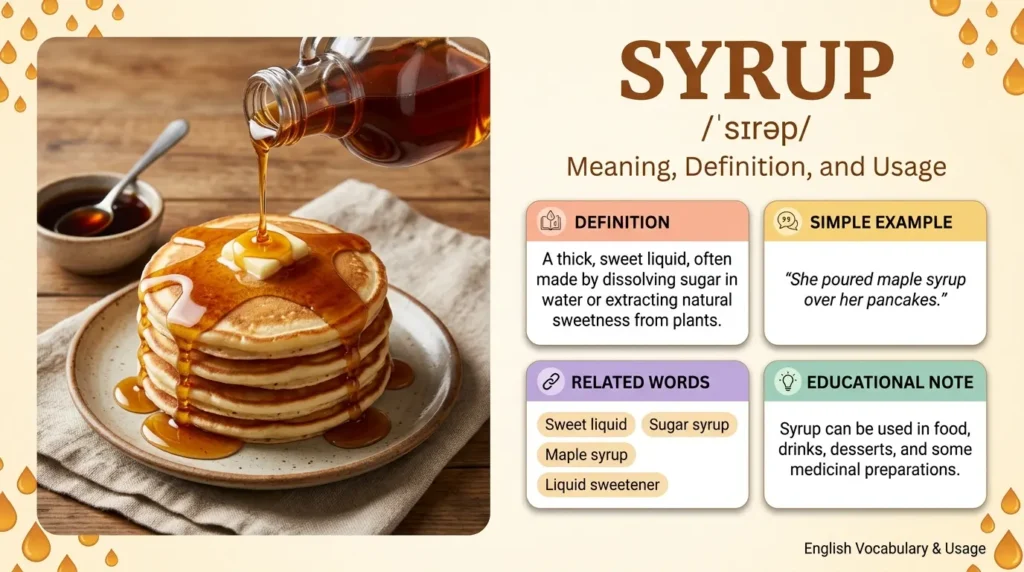
Syrup is a thick, sweet liquid made by dissolving sugar or another sweet substance in water or extracting sweetness from ingredients such as maple sap. Some syrups also contain fruit extracts, flavorings, or medicinal ingredients.
People commonly use syrup in cooking, baking, drinks, desserts, and medicine. Maple syrup adds sweetness to pancakes, chocolate syrup flavors milkshakes, and some medicinal syrups help deliver liquid medication.
Part of Speech
Syrup (noun): A thick liquid that usually contains sugar or another sweet substance and is used to flavor, sweeten, coat, or prepare foods and drinks.
The word generally has a neutral tone. Its meaning depends on the surrounding words. In a recipe, syrup usually refers to an ingredient. In a pharmacy, it may describe a liquid medicine.
Connotative Meaning
Connotation (the feeling or association a word creates beyond its literal meaning) helps explain how people interpret syrup in different situations.
- Positive tone: Syrup can suggest sweetness, comfort, indulgence, and delicious desserts.
- Negative tone: It may suggest excessive sweetness, stickiness, or an overly sentimental style, as in “a syrupy speech.”
- Neutral tone: In recipes and scientific descriptions, syrup simply identifies a type of liquid.
Etymology of Syrup
The English word syrup came through French from Medieval Latin syrupus, which developed from Arabic sharāb, meaning a drink or beverage. The Arabic word is related to drinking.
Historically, syrups often served as sweetened preparations for food and medicine. Over time, the word became common in cooking, confectionery, beverages, and pharmaceutical contexts.
Historical Development
- Old English (450–1100): The modern word syrup was not an established everyday English term during this period. Sweet liquids existed, but people used other words to describe them.
- Middle English (1100–1500): The word entered English through French and Latin-influenced medical and culinary vocabulary. Sweetened liquid preparations were especially relevant to traditional medicine.
- Modern English (1500–present): Syrup became a familiar term for sweet liquids used in food, drinks, desserts, and medicine.
Pronunciation (US and UK IPA)
- US: /ˈsɪr.əp/ or /ˈsɪr.ʌp/
- UK: /ˈsɪr.əp/
Syllables
Syrup: syr-up (2 syllables)
Affixation Pattern of Syrup
- Root: Syrup
- Prefix: None
- Suffix: None in the basic noun
- Word formation: A simple noun borrowed into English rather than formed by adding a modern English prefix or suffix.
Synonyms List
A useful distinction comes first: syrup has relatively few exact synonyms. Some alternatives describe particular kinds of syrup, while others name sweet liquids that serve similar purposes. The following 45 terms are useful in different culinary, descriptive, and linguistic contexts. They are not all interchangeable.
1. Sweetener (Noun) — US: /ˈswiːtənər/ | UK: /ˈswiːtənə/
Meaning: A substance added to food or drinks to make them taste sweeter.
Tone/Register: Neutral; everyday and culinary.
Example: Honey is my favorite natural sweetener for tea.
Some recipes use a liquid sweetener instead of ordinary sugar.
2. Sugar Syrup (Noun) — US: /ˈʃʊɡər ˈsɪrəp/ | UK: /ˈʃʊɡə ˈsɪrəp/
Meaning: A mixture of sugar and water that cooks or bartenders use to sweeten food and drinks.
Tone/Register: Neutral; culinary.
Example: Add sugar syrup to balance the sour lemon juice.
The baker brushed sugar syrup over the cake layers.
3. Simple Syrup (Noun) — US: /ˈsɪmpəl ˈsɪrəp/ | UK: /ˈsɪmpəl ˈsɪrəp/
Meaning: A liquid sweetener made by dissolving sugar in water.
Tone/Register: Neutral; cooking and beverage preparation.
Example: I added simple syrup to my iced coffee.
The recipe calls for simple syrup rather than dry sugar.
4. Maple Syrup (Noun) — US: /ˈmeɪpəl ˈsɪrəp/ | UK: /ˈmeɪpəl ˈsɪrəp/
Meaning: A sweet liquid made by concentrating the sap of maple trees.
Tone/Register: Neutral; culinary.
Example: We poured maple syrup over the waffles.
Maple syrup gives the dessert a distinctive woody sweetness.
5. Golden Syrup (Noun) — US: /ˈɡoʊldən ˈsɪrəp/ | UK: /ˈɡəʊldən ˈsɪrəp/
Meaning: A thick, golden-colored sugar syrup commonly used in baking.
Tone/Register: Neutral; especially common in British cooking.
Example: Golden syrup makes these biscuits softer.
The pudding recipe uses golden syrup for its rich sweetness.
6. Corn Syrup (Noun) — US: /ˈkɔːrn ˌsɪrəp/ | UK: /ˈkɔːn ˌsɪrəp/
Meaning: A sweet liquid produced from corn starch and used in many food products.
Tone/Register: Neutral; food science and cooking.
Example: The candy recipe uses corn syrup to control crystallization.
Corn syrup gives the filling a smooth texture.
7. Glucose Syrup (Noun) — US: /ˈɡluːkoʊs ˌsɪrəp/ | UK: /ˈɡluːkəʊs ˌsɪrəp/
Meaning: A concentrated glucose-containing syrup used in confectionery, baking, and food production.
Tone/Register: Technical; culinary and industrial.
Example: The confectioner added glucose syrup to the mixture.
Glucose syrup helps maintain the candy’s desired texture.
8. Molasses (Noun) — US: /məˈlæsɪz/ | UK: /məˈlæsɪz/
Meaning: A thick, dark, sweet liquid produced during sugar refining.
Tone/Register: Neutral; culinary.
Example: Molasses gives gingerbread its deep flavor.
I used molasses to add richness to the sauce.
9. Treacle (Noun) — US: /ˈtriːkəl/ | UK: /ˈtriːkəl/
Meaning: A thick sugar-processing syrup, especially one used in British cooking.
Tone/Register: Neutral; more common in British English.
Example: The recipe asks for black treacle.
She spread treacle over warm toast.
10. Honey (Noun) — US: /ˈhʌni/ | UK: /ˈhʌni/
Meaning: A naturally sweet substance produced by bees from flower nectar.
Tone/Register: Neutral; everyday and culinary.
Example: Honey adds sweetness to my morning tea.
We drizzled honey over the yogurt and fruit.
11. Agave Nectar (Noun) — US: /əˈɡɑːveɪ ˈnɛktər/ | UK: /əˈɡɑːveɪ ˈnɛktə/
Meaning: A sweetener made from agave plants, often sold in liquid form.
Tone/Register: Neutral; food and nutrition.
Example: Agave nectar dissolves easily in cold drinks.
She used agave nectar to sweeten the dressing.
12. Fruit Syrup (Noun) — US: /ˈfruːt ˌsɪrəp/ | UK: /ˈfruːt ˌsɪrəp/
Meaning: A sweet liquid made with fruit juice, fruit extracts, or fruit flavoring.
Tone/Register: Neutral; culinary.
Example: Raspberry syrup gave the pancakes a fruity taste.
The café serves fruit syrup with its desserts.
13. Berry Syrup (Noun) — US: /ˈbɛri ˌsɪrəp/ | UK: /ˈbɛri ˌsɪrəp/
Meaning: A sweet liquid prepared with berries or their juice.
Tone/Register: Neutral; food and beverages.
Example: Strawberry syrup transformed the plain milkshake.
We poured berry syrup over the cheesecake.
14. Chocolate Syrup (Noun) — US: /ˈtʃɑːklət ˌsɪrəp/ | UK: /ˈtʃɒklət ˌsɪrəp/
Meaning: A sweet chocolate-flavored liquid used in drinks and desserts.
Tone/Register: Informal and culinary.
Example: The children added chocolate syrup to their milk.
I drizzled chocolate syrup over the ice cream.
15. Pancake Syrup (Noun) — US: /ˈpænkeɪk ˌsɪrəp/ | UK: /ˈpænkeɪk ˌsɪrəp/
Meaning: A sweet topping designed for pancakes, waffles, and similar foods.
Tone/Register: Everyday; culinary.
Example: We ran out of pancake syrup before breakfast.
This pancake syrup has a mild vanilla flavor.
16. Dessert Sauce (Noun) — US: /dɪˈzɜːrt sɔːs/ | UK: /dɪˈzɜːt sɔːs/
Meaning: A sweet liquid or semi-liquid topping served with desserts.
Tone/Register: Neutral; culinary.
Example: The chef poured dessert sauce around the cake.
A warm dessert sauce made the pudding more appealing.
17. Sweet Sauce (Noun) — US: /ˈswiːt sɔːs/ | UK: /ˈswiːt sɔːs/
Meaning: A sauce with a sweet flavor that accompanies or coats food.
Tone/Register: Neutral; cooking.
Example: The sweet sauce complemented the grilled fruit.
I served the sweet sauce in a small bowl.
18. Fruit Reduction (Noun) — US: /ˈfruːt rɪˈdʌkʃən/ | UK: /ˈfruːt rɪˈdʌkʃən/
Meaning: A fruit liquid concentrated by simmering away some of its water.
Tone/Register: Culinary; professional cooking.
Example: The chef spooned a berry reduction onto the plate.
A fruit reduction added a tangy finish to the dessert.
19. Fruit Coulis (Noun) — US: /ˈfruːt kuːˈliː/ | UK: /ˈfruːt kuːˈliː/
Meaning: A smooth sauce made from puréed fruit, sometimes strained for a finer texture.
Tone/Register: Culinary; restaurant and formal menus.
Example: Raspberry coulis decorated the cheesecake plate.
The cook served strawberry coulis with the panna cotta.
20. Fruit Purée (Noun) — US: /ˈfruːt pjʊˈreɪ/ | UK: /ˈfruːt pjʊəˈreɪ/
Meaning: Fruit blended into a smooth or thick mixture.
Tone/Register: Neutral; culinary.
Example: The baby ate apple purée for lunch.
Fruit purée gave the smoothie a thicker consistency.
21. Nectar (Noun) — US: /ˈnɛktər/ | UK: /ˈnɛktə/
Meaning: A sweet liquid associated with flowers or, in food terminology, a fruit-based drink.
Tone/Register: Neutral; botanical or culinary.
Example: The label describes the drink as peach nectar.
Bees collect nectar from flowers.
Note: Nectar is not a general synonym for syrup. Its precise meaning depends on the context.
22. Cordial (Noun) — US: /ˈkɔːrdiəl/ | UK: /ˈkɔːdiəl/
Meaning: A sweet, concentrated fruit-flavored liquid that is often diluted with water.
Tone/Register: Neutral; beverage-related.
Example: She mixed blackcurrant cordial with cold water.
The cordial added a fruity note to the drink.
23. Squash (Noun) — US: /skwɑːʃ/ | UK: /skwɒʃ/
Meaning: In British English, a concentrated fruit-flavored drink that people dilute before drinking.
Tone/Register: Informal; everyday British usage.
Example: We made orange squash for the picnic.
The children asked for a glass of blackcurrant squash.
Note: Squash is a beverage concentrate, not a direct replacement for cooking syrup.
24. Sweetened Condensed Milk (Noun) — US: /ˈswiːtənd kənˈdɛnst mɪlk/ | UK: /ˈswiːtənd kənˈdɛnst mɪlk/
Meaning: Milk concentrated by removing water and sweetened with sugar.
Tone/Register: Neutral; culinary.
Example: Sweetened condensed milk made the fudge creamy.
She poured a little over the fruit salad.
25. Sugar Solution (Noun) — US: /ˈʃʊɡər səˈluːʃən/ | UK: /ˈʃʊɡə səˈluːʃən/
Meaning: A liquid in which sugar dissolves in water or another suitable liquid.
Tone/Register: Scientific; technical.
Example: The experiment required a measured sugar solution.
The cook prepared a sugar solution for the recipe.
26. Sweet Liquid (Noun Phrase) — US: /ˈswiːt ˈlɪkwɪd/ | UK: /ˈswiːt ˈlɪkwɪd/
Meaning: Any liquid with a noticeably sweet taste.
Tone/Register: Neutral; descriptive.
Example: The bottle contained a thick, sweet liquid.
Choose a sweet liquid that complements the fruit.
27. Liquid Sweetener (Noun) — US: /ˈlɪkwɪd ˈswiːtənər/ | UK: /ˈlɪkwɪd ˈswiːtənə/
Meaning: A sweetening ingredient that remains liquid at the point of use.
Tone/Register: Neutral; culinary and nutritional.
Example: Liquid sweetener mixed smoothly into the iced tea.
The recipe uses a liquid sweetener instead of granulated sugar.
28. Sugar Concentrate (Noun) — US: /ˈʃʊɡər ˈkɑːnsənˌtreɪt/ | UK: /ˈʃʊɡə ˈkɒnsənˌtreɪt/
Meaning: A concentrated preparation containing a substantial amount of sugar.
Tone/Register: Technical; food production.
Example: The manufacturer added sugar concentrate to the mixture.
The concentrated ingredient increased the product’s sweetness.
29. Invert Sugar Syrup (Noun) — US: /ˈɪnvɜːrt ˈʃʊɡər ˌsɪrəp/ | UK: /ˈɪnvɜːt ˈʃʊɡə ˌsɪrəp/
Meaning: A syrup made by breaking sucrose into glucose and fructose.
Tone/Register: Technical; confectionery and food science.
Example: Invert sugar syrup helped keep the filling soft.
The candy maker used invert syrup to control crystallization.
30. Malt Syrup (Noun) — US: /ˈmɔːlt ˌsɪrəp/ | UK: /ˈmɔːlt ˌsɪrəp/
Meaning: A thick, sweet liquid made from malted grains, usually barley.
Tone/Register: Neutral; baking and food production.
Example: Malt syrup gave the bread a deeper flavor.
The recipe lists malt syrup among its ingredients.
31. Rice Syrup (Noun) — US: /ˈraɪs ˌsɪrəp/ | UK: /ˈraɪs ˌsɪrəp/
Meaning: A sweet liquid produced by processing rice starch into sugars.
Tone/Register: Neutral; culinary.
Example: Rice syrup sweetened the homemade snack bars.
She stirred rice syrup into the mixture.
32. Date Syrup (Noun) — US: /ˈdeɪt ˌsɪrəp/ | UK: /ˈdeɪt ˌsɪrəp/
Meaning: A sweet, concentrated liquid made from dates.
Tone/Register: Neutral; culinary.
Example: Date syrup added a caramel-like flavor to the oats.
The cook drizzled date syrup over roasted vegetables.
33. Coconut Syrup (Noun) — US: /ˈkoʊkənʌt ˌsɪrəp/ | UK: /ˈkəʊkənʌt ˌsɪrəp/
Meaning: A sweet liquid made from coconut-derived ingredients, depending on the product.
Tone/Register: Neutral; culinary.
Example: Coconut syrup gave the dessert a tropical flavor.
She added a small amount to her iced coffee.
34. Palm Syrup (Noun) — US: /ˈpɑːm ˌsɪrəp/ | UK: /ˈpɑːm ˌsɪrəp/
Meaning: A sweet liquid made by concentrating sap from certain palm trees.
Tone/Register: Neutral; regional culinary usage.
Example: Palm syrup is used in several traditional desserts.
The cook stirred palm syrup into the warm mixture.
35. Sorghum Syrup (Noun) — US: /ˈsɔːrɡəm ˌsɪrəp/ | UK: /ˈsɔːɡəm ˌsɪrəp/
Meaning: A sweet, thick liquid produced by concentrating juice from sorghum stalks.
Tone/Register: Neutral; regional cooking.
Example: Sorghum syrup is popular in some Southern American food traditions.
We served it with warm biscuits.
36. Cane Syrup (Noun) — US: /ˈkeɪn ˌsɪrəp/ | UK: /ˈkeɪn ˌsɪrəp/
Meaning: A sweet liquid made by concentrating sugarcane juice.
Tone/Register: Neutral; culinary.
Example: Cane syrup gave the glaze a rich sweetness.
The recipe uses cane syrup instead of refined sugar.
37. Blackstrap Molasses (Noun) — US: /ˈblækˌstræp məˈlæsɪz/ | UK: /ˈblækˌstræp məˈlæsɪz/
Meaning: A dark, strongly flavored type of molasses produced during repeated sugar extraction.
Tone/Register: Neutral; culinary.
Example: Blackstrap molasses has a robust, slightly bitter taste.
A small spoonful deepened the flavor of the baked beans.
38. Treacle Syrup (Noun Phrase) — US: /ˈtriːkəl ˌsɪrəp/ | UK: /ˈtriːkəl ˌsɪrəp/
Meaning: A descriptive phrase for a thick treacle-based liquid, although treacle alone is usually more natural.
Tone/Register: Neutral; British culinary usage.
Example: The old recipe describes a treacle syrup filling.
The baker used treacle to sweeten the tart.
39. Flavored Syrup (Noun) — US: /ˈfleɪvərd ˌsɪrəp/ | UK: /ˈfleɪvəd ˌsɪrəp/
Meaning: A syrup containing flavorings such as vanilla, caramel, fruit, or herbs.
Tone/Register: Neutral; beverages and cooking.
Example: I added vanilla-flavored syrup to my latte.
The café offers several flavored syrups for iced drinks.
40. Vanilla Syrup (Noun) — US: /vəˈnɪlə ˌsɪrəp/ | UK: /vəˈnɪlə ˌsɪrəp/
Meaning: A sweet liquid flavored with vanilla.
Tone/Register: Neutral; culinary.
Example: Vanilla syrup made the coffee taste smoother.
She mixed vanilla syrup into the cold milk.
41. Caramel Syrup (Noun) — US: /ˈkærəməl ˌsɪrəp/ | UK: /ˈkærəməl ˌsɪrəp/
Meaning: A sweet liquid with a caramel flavor, made from caramelized sugar or flavoring ingredients.
Tone/Register: Neutral; culinary.
Example: Caramel syrup added a buttery flavor to the drink.
He drizzled caramel syrup over the sundae.
42. Butterscotch Syrup (Noun) — US: /ˈbʌtərˌskɑːtʃ ˌsɪrəp/ | UK: /ˈbʌtəˌskɒtʃ ˌsɪrəp/
Meaning: A sweet topping flavored with butterscotch, usually associated with brown sugar and butter.
Tone/Register: Neutral; dessert-related.
Example: Butterscotch syrup paired well with vanilla ice cream.
The pudding came with a drizzle of butterscotch syrup.
43. Chocolate Sauce (Noun) — US: /ˈtʃɑːklət sɔːs/ | UK: /ˈtʃɒklət sɔːs/
Meaning: A chocolate-based sauce used to coat or accompany desserts.
Tone/Register: Neutral; culinary.
Example: The chocolate sauce hardened slightly on the cold ice cream.
I served chocolate sauce with sliced strawberries.
44. Sweet Glaze (Noun) — US: /ˈswiːt ɡleɪz/ | UK: /ˈswiːt ɡleɪz/
Meaning: A sweet coating applied to food to add flavor, shine, or moisture.
Tone/Register: Neutral; baking and cooking.
Example: The baker brushed a sweet glaze over the buns.
A thin glaze gave the fruit tart a glossy finish.
45. Medicinal Syrup (Noun) — US: /məˈdɪsənəl ˌsɪrəp/ | UK: /məˈdɪsɪnəl ˌsɪrəp/
Meaning: A liquid medicine formulated as a syrup or sweetened liquid preparation.
Tone/Register: Medical; neutral and technical.
Example: The pharmacist explained how to measure the medicinal syrup.
The label listed the ingredients and recommended dosage.
Synonyms for Syrup by Tone
The right alternative depends on what you want to communicate. Some words describe a specific ingredient, while others emphasize sweetness, texture, or culinary purpose.
Positive Alternatives
- Honey: Suggests natural sweetness and a familiar flavor.
- Maple syrup: Evokes a distinctive, rich taste.
- Agave nectar: Offers a precise name for a plant-derived sweetener.
- Fruit syrup: Emphasizes fruity flavor.
- Date syrup: Highlights a sweet liquid made from dates.
Neutral Alternatives
- Sugar syrup: Identifies a sugar-and-water mixture.
- Simple syrup: Works well in drink recipes.
- Liquid sweetener: Describes a broader category of ingredients.
- Glucose syrup: Identifies a specific food ingredient.
- Sugar solution: Suits scientific explanations.
Negative or Critical Alternatives
These are not direct synonyms for syrup. They describe possible qualities or effects associated with it.
- Overly sweet liquid: Highlights excessive sweetness.
- Sticky liquid: Emphasizes texture.
- Syrupy mixture: Suggests a thick consistency.
- Cloying sweetness: Describes sweetness that becomes unpleasant.
- Heavy sweetness: Suggests a rich or overpowering taste.
Playful and Informal Alternatives
- Sweet topping: A casual description for syrup served over food.
- Pancake drizzle: A playful phrase for syrup poured over pancakes.
- Chocolate drizzle: A casual description of a thin chocolate topping.
- Sweet stuff: An informal phrase when the exact ingredient does not matter.
- Sugar splash: A creative expression for a small addition of sweetness.
Why Tone Matters
A recipe needs precise ingredient names. A food blog may benefit from sensory descriptions, while a casual conversation can use simpler expressions.
Choose the term that communicates the intended meaning. Avoid replacing syrup with a word that changes the ingredient or its function.
“Syrup” vs. Close Alternatives
Syrup vs. Sweetener
A syrup is a type of liquid ingredient, while a sweetener is any substance used to make food or drinks taste sweeter.
Use syrup when describing a thick liquid. Choose sweetener when discussing sugar, honey, artificial sweeteners, or other ingredients collectively.
Syrup vs. Molasses
Syrup is a broad category of thick liquids. Molasses is a particular dark, flavorful by-product of sugar production.
Use syrup when the exact variety is unknown or unimportant. Choose molasses when the recipe specifically calls for its distinctive flavor and consistency.
Syrup vs. Nectar
Syrup generally refers to a concentrated sweet liquid used in cooking, drinks, or medicine. Nectar can refer to flower liquid collected by pollinators or to certain fruit-based beverages.
Use nectar only when the context supports that meaning. It is not a universal substitute for syrup.
How “Syrup” Changes by Context
Daily Conversation
In everyday speech, people usually name the specific type of syrup they want. Someone might ask for maple syrup at breakfast or chocolate syrup in a milkshake.
When the exact ingredient is unimportant, phrases such as sweet topping or liquid sweetener can work.
Writing and Blogging
Food bloggers can use a mix of precise ingredient names and descriptive language. For example, maple syrup identifies the ingredient, while a rich, golden topping describes its appearance and purpose.
Do not insert unrelated alternatives simply to increase keyword variation. Accuracy and readability matter more than the number of related words.
Professional and Academic Writing
Technical writing benefits from exact terminology. Food scientists may distinguish glucose syrup from invert sugar syrup because their composition and properties differ.
In academic work, choose the specific term that matches the ingredient or process being discussed.
Creative and Informal Writing
Creative writers may describe syrup as a glossy drizzle, sticky sweetness, or a golden coating. Such expressions help readers imagine the scene.
These descriptions are stylistic alternatives, not exact dictionary synonyms. Use them to create imagery rather than to identify a precise ingredient.
Common Mistakes Learners Make
Treating Every Sweet Liquid as Syrup
Honey, nectar, cordial, and syrup may all taste sweet, but they have different origins and uses. Their meanings overlap only in certain contexts.
Confusing Syrup With Sauce
Some syrups work as dessert toppings, but not every sauce is a syrup. Sauces can contain fats, spices, dairy products, or savory ingredients.
Using Molasses and Syrup Interchangeably
Molasses is one particular ingredient. A recipe that requires maple syrup may taste very different if you replace it with dark molasses.
Assuming Every Alternative Has the Same Texture
A fruit purée can be thick without having the smooth, concentrated consistency of syrup. A cordial may also be thinner or intended for dilution.
Overusing Unnatural Phrases
Expressions such as sugar liquid may communicate the general idea, but they often sound less natural than sugar syrup or liquid sweetener.
Register Notes
- Formal: Use terms such as glucose syrup, sugar solution, and invert sugar syrup when appropriate.
- Informal: Choose phrases such as sweet topping or chocolate drizzle for casual descriptions.
- Spoken English: People generally prefer familiar terms such as honey, maple syrup, and sweet sauce.
- Written English: Recipes and technical articles should name ingredients precisely.
For related vocabulary practice, an article about synonyms for sweet can help you describe flavor without repeating the same adjective.
Real-Life Mini Scenarios Using Syrup Alternatives
Workplace Scenario
A baker is preparing a product description for a new cake. Instead of writing “The cake contains syrup,” the baker identifies the ingredient as golden syrup to give readers more useful information.
Social Scenario
A friend asks how to make an iced coffee taste sweeter. You recommend simple syrup because it mixes easily into a cold drink.
Media and Food Content Scenario
A food blogger describes pancakes topped with maple syrup and fresh berries. The precise ingredient name makes the recipe easier to understand.
Writing and Storytelling Scenario
A writer describes sunlight reflecting off a thick, golden liquid on a breakfast table. The phrase golden drizzle creates a visual image without claiming that the liquid is a different ingredient.
External Reference for Further Learning
For a reliable dictionary definition, pronunciation, and usage information, consult the Merriam-Webster entry for syrup. Compare its definition with examples from recipes to understand how the word works in everyday English.
Practice Quiz
Test your understanding with these practical questions. Select the word that best fits each situation.
1. Which word describes a sweet liquid made by bees?
A. Molasses
B. Honey
C. Cordial
D. Glucose syrup
2. Which ingredient is commonly poured over pancakes?
A. Maple syrup
B. Sugar solution
C. Fruit purée
D. Sweetened condensed milk
3. Which term describes a mixture of sugar dissolved in water for cocktails?
A. Molasses
B. Fruit coulis
C. Simple syrup
D. Sweet glaze
4. A recipe requires a dark, rich ingredient made during sugar refining. Which word fits best?
A. Nectar
B. Cordial
C. Vanilla syrup
D. Molasses
5. Which term describes a sweet liquid made from concentrated date fruit?
A. Date syrup
B. Corn syrup
C. Chocolate sauce
D. Sugar solution
6. Which word refers to a concentrated fruit drink that people often dilute with water in British English?
A. Treacle
B. Squash
C. Glucose syrup
D. Fruit purée
7. A food scientist needs a syrup containing glucose for confectionery. Which term is most precise?
A. Honey
B. Fruit coulis
C. Glucose syrup
D. Sweet topping
8. Which expression best describes a thin chocolate topping poured over ice cream?
A. Sugar solution
B. Liquid sweetener
C. Malt syrup
D. Chocolate drizzle
9. Which word describes a smooth sauce made from puréed fruit?
A. Fruit coulis
B. Corn syrup
C. Golden syrup
D. Treacle
10. Which term is most appropriate for a sweet ingredient that dissolves easily in cold tea?
A. Blackstrap molasses
B. Liquid sweetener
C. Sweet glaze
D. Fruit purée
Answer Key
1-B | 2-A | 3-C | 4-D | 5-A | 6-B | 7-C | 8-D | 9-A | 10-B
Reflection and Application Task
Write two original sentences using different alternatives for syrup. In the first, describe a food or drink. In the second, explain why a particular ingredient suits a recipe better than another option.
Conclusion
Learning a synonym for syrup helps you describe ingredients more precisely. Words such as honey, molasses, and simple syrup make your meaning clearer in different situations.
For students and bloggers, these alternatives improve vocabulary and reduce repetition. They also help readers understand recipes, food descriptions, and everyday conversations.
Remember that related words do not always mean the same thing. Choose an alternative that matches the ingredient, texture, flavor, and purpose you want to describe.
Practice using these words in emails, essays, recipes, and daily conversations. Try writing your own examples and build a stronger, more natural English vocabulary one word at a time.
FAQs
1. What is the closest synonym for syrup in everyday English?
The closest alternative depends on the liquid you mean. Sugar syrup is suitable for a sweet mixture of sugar and water, while liquid sweetener describes the broader category. Honey and maple syrup are familiar alternatives in food-related conversations, but they have distinct ingredients and flavors. Choose the term that accurately describes the product.
2. What is another word for syrup in a recipe?
A recipe may use terms such as simple syrup, golden syrup, maple syrup, or glucose syrup. Each refers to a different ingredient or preparation. If the recipe simply needs a sweet liquid, liquid sweetener may work as a general description. However, always check the ingredients and cooking purpose before substituting one type for another.
3. Is honey a synonym for syrup?
Honey is a related alternative, but it is not an exact synonym. Bees produce honey from flower nectar, whereas syrups can come from sugar, plants, fruit, or other ingredients. Both can sweeten food and drinks, so they sometimes serve similar purposes. Their flavors, textures, moisture content, and behavior during cooking may differ.
4. What is the difference between syrup and sweetener?
Syrup describes a type of liquid preparation, usually thick and sweet. Sweetener is a broader term for any ingredient used to make food or drinks taste sweeter. Honey, sugar, and certain low-calorie products are sweeteners, but they are not all syrups. Use the broader word when discussing sweetening ingredients as a group.
5. Which syrup alternatives are best for formal writing?
Formal writing benefits from specific terms such as glucose syrup, invert sugar syrup, and sugar solution when those descriptions match the subject. In scientific or culinary writing, precision matters more than variety. Avoid replacing a technical ingredient name with a vague expression simply to prevent repetition. Define specialized terms when your audience may not know them.
6. Can I use syrup alternatives without changing a recipe’s meaning?
You can change the wording of a recipe description without changing its meaning, but replacing the actual ingredient may affect the result. For example, calling maple syrup a sweet topping may be fine in a general description. Replacing maple syrup with molasses in the ingredient list is different because the flavor and cooking properties can change.
7. What words describe syrup’s thick texture?
Words such as viscous, thick, sticky, and concentrated can describe syrup’s texture or consistency. Viscous is more technical, while thick and sticky are common in everyday English. These words describe qualities rather than serving as direct synonyms. Select one according to whether you are writing a recipe, a scientific explanation, or a creative description.
8. How can English learners practice syrup-related vocabulary?
Start by identifying familiar ingredients in your kitchen and describing their flavor, texture, and purpose. Write sentences using words such as honey, simple syrup, molasses, and fruit coulis. Then compare the terms in recipe instructions or dictionary examples. This practice builds vocabulary while helping you recognize when two related words are not interchangeable.

Sophia Carter is the founder and lead writer at SynonymVerse.com, a trusted online resource dedicated to English vocabulary and effective communication. She is passionate about helping students, writers, professionals, and lifelong learners find the most accurate words to express their ideas with clarity and confidence.
At SynonymVerse.com, every article is carefully researched and thoughtfully written to provide reliable guidance on synonyms, word meanings, and vocabulary. With a strong focus on accuracy, real-world usage, and easy-to-understand explanations, the website is committed to helping readers strengthen their language skills, enrich their vocabulary, and become more confident communicators.