
A synonym for saving time can make your writing more natural and precise. Whether you’re writing for work, school, or everyday communication, the right word improves clarity.
A synonym for saving time can describe efficiency, speed, or productivity. Each alternative carries a slightly different meaning depending on the context.
This guide features 45 powerful alternatives with simple meanings and practical examples. You’ll learn when and how to use each word correctly.
If you’re searching for the best synonym for saving time, this list will help you expand your vocabulary and choose the perfect term for any situation.
What Does “Saving Time” Really Mean?
Saving time means reducing the amount of time required to complete a task, project, or journey. Native speakers understand this concept as finding a faster, smoother, or more intelligent path to a goal. You will see this idea used constantly in workplace productivity meetings, cooking blogs, and technological design reviews.
As a part of speech, saving time functions as a phrasal verb or a participle phrase acting as an adjective or noun. It modifies how an action is performed by highlighting its speed and total efficiency.
Connotative Meaning
Connotation is the emotional feeling or cultural coloring that a specific word carries alongside its literal dictionary definition.
- Positive tone: It suggests high intelligence, smooth productivity, excellent management, and modern innovation.
- Negative tone: It can sometimes imply cutting corners, rushing through important work, carelessness, or a lack of quality.
- Neutral tone: In mechanical or scientific operations, it simply measures a clear reduction in system duration.

Etymology
The phrase is built from two separate roots: saving comes from the Old French salver (to protect or keep secure), and time comes from the Proto-Germanic timon (an appointed duration or era).
- Old English (450–1100): People expressed this idea using separate early Germanic words for speed, haste, or early completion.
- Middle English (1100–1500): The words began joining together in administrative and agricultural records to keep hours secure.
- Modern English (1500–Present): The phrase settled into daily conversational use as a cornerstone concept for industrial and digital efficiency.
Pronunciation (US & UK – IPA)
- US: /ˈseɪvɪŋ taɪm/
- UK: /ˈseɪvɪŋ taɪm/
Syllables
sav-ing time
Affixation Pattern of Saving Time
- Root Words: Save and Time
- Prefix: None
- Suffix: -ing (added to form a present participle)
Synonyms List
Expediting (Adjective) — US: /ˈɛkspədaɪtɪŋ/ | UK: /ˈɛkspədaɪtɪŋ/
Meaning: Making an action or process happen much faster than its usual speed.
Examples:
- The team used an expediting method to complete the system update early.
- She found an expediting route through the city to avoid morning traffic.
Streamlining (Adjective) — US: /ˈstriːmlaɪnɪŋ/ | UK: /ˈstriːmlaɪnɪŋ/
Meaning: Making an organization or process simpler and more effective by removing waste.
Examples:
- Our company introduced a streamlining system for handling customer complaints.
- This streamlining software removes unnecessary steps from the writing process.
Accelerating (Adjective) — US: /ækˈsɛləreɪtɪŋ/ | UK: /əkˈsɛləreɪtɪŋ/
Meaning: Increasing the speed or rate of a specific activity or project.
Examples:
- They applied an accelerated technique to finish building the website.
- The business saw an accelerating trend in its daily delivery options.
Economizing (Adjective) — US: /ɪˈkɑːnəmaɪzɪŋ/ | UK: /ɪˈkɒnəmaɪzɪŋ/
Meaning: Using resources or hours carefully to avoid any unnecessary waste.
Examples:
- She adopted an economizing schedule to manage her heavy college homework.
- The manager suggested an economizing strategy for our weekly project updates.
Time-efficient (Adjective) — US: /ˈtaɪm ɪˈfɪʃənt/ | UK: /ˈtaɪm ɪˈfɪʃənt/
Meaning: Working well without wasting any precious minutes during an activity.
Examples:
- Cooking in large batches is a very time-efficient way to prepare meals.
- He chose a time-efficient study plan to prepare for his final exams.
Time-critical (Adjective) — US: /ˈtaɪm ˈkrɪtɪkl/ | UK: /ˈtaɪm ˈkrɪtɪkl/
Meaning: Requiring fast action because missing the deadline will cause failure.
Examples:
- The doctors handled a time-critical situation in the emergency room.
- Sending the digital contract became a time-critical task for the sales team.
High-speed (Adjective) — US: /ˈhaɪ ˈspiːd/ | UK: /ˈhaɪ ˈspiːd/
Meaning: Operating or moving at an incredibly fast velocity or high rate.
Examples:
- The office upgraded to a high-speed internet connection this morning.
- We need a high-speed solution to process these customer payments quickly.
Rapid (Adjective) — US: /ˈræpɪd/ | UK: /ˈræpɪd/
Meaning: Happening or moving with great speed within a short period.
Examples:
- The new worker made rapid progress during her first training week.
- The city experienced a rapid expansion of public bus routes last year.
Swift (Adjective) — US: /swɪft/ | UK: /swɪft/
Meaning: Happening quickly or responding to an issue without any delay.
Examples:
- The tech support agent provided a swift answer to my simple email question.
- We made a swift decision to cancel the outdoor picnic due to the dark rain clouds.
Fast-track (Adjective) — US: /ˈfæst træk/ | UK: /ˈfɑːst træk/
Meaning: Using a quicker method than usual to achieve a goal or position.
Examples:
- The bright student joined a fast-track program to graduate a year early.
- They used a fast-track process to approve the building design quickly.
Quick (Adjective) — US: /kwɪk/ | UK: /kwɪk/
Meaning: Done or finished in a very brief amount of time.
Examples:
- Let us have a quick meeting before we begin the main project today.
- She took a quick look at the map before driving to the new store.
Direct (Adjective) — US: /dəˈrɛkt/ | UK: /daɪˈrɛkt/
Meaning: Going straight to a point or destination without turning aside.
Examples:
- Taking a direct flight is a great way of avoiding long airport delays.
- He gave a direct answer that resolved the confusion instantly.
Express (Adjective) — US: /ɪkˈsprɛs/ | UK: /ɪkˈsprɛs/
Meaning: Designed for or offering a faster service than standard options.
Examples:
- She used the express lane at the supermarket to buy milk quickly.
- The courier delivered the express package within twenty-four hours.
Efficient (Adjective) — US: /ɪˈfɪʃənt/ | UK: /ɪˈfɪʃənt/
Meaning: Achieving maximum productivity with minimum wasted effort or expense.
Examples:
- An efficient heating system keeps the house warm without using too much power.
- The new secretary is highly efficient at sorting the daily office mail.
Optimizing (Adjective) — US: /ˈɑːptəmaɪzɪŋ/ | UK: /ˈɒptɪmaɪzɪŋ/
Meaning: Making the absolute best or most effective use of a situation or resource.
Examples:
- We created an optimization routine to handle our weekly inventory counts.
- His optimizing adjustments made the computer application run much faster.
Shortcut-driven (Adjective) — US: /ˈʃɔːrtkʌt ˈdrɪvən/ | UK: /ˈʃɔːtkʌt ˈdrɪvən/
Meaning: Relying heavily on alternative, quicker paths to complete tasks.
Examples:
- His shortcut-driven approach to coding saved the development team hours of labor.
- She shared a shortcut-driven guide for editing social media videos quickly.
Productive (Adjective) — US: /prəˈdʌktɪv/ | UK: /prəˈdʌktɪv/
Meaning: Doing a lot of useful work or generating excellent results quickly.
Examples:
- I had a very productive morning and finished three full reports.
- The team held a productive brainstorming session for the new product launch.
Prompt (Adjective) — US: /prɑːmpt/ | UK: /prɒmpt/
Meaning: Done or delivered immediately without any intentional delay.
Examples:
- We appreciate your prompt action in fixing the broken water pipe.
- The company is famous for providing prompt delivery to rural areas.
Instantaneous (Adjective) — US: /ˌɪnstənˈteɪniəs/ | UK: /ˌɪnstənˈteɪniəs/
Meaning: Occurring or done in a split second or instantly.
Examples:
- The mobile app provides an instantaneous translation of foreign words.
- We saw an instantaneous improvement in video quality after upgrading.
Hasty (Adjective) — US: /ˈheɪsti/ | UK: /ˈheɪsti/
Meaning: Done with excessive speed or urgency, sometimes without enough thought.
Examples:
- He made a hasty decision to sell his car before checking its real value.
- She wrote a hasty note on the kitchen counter before leaving the house.
Fleet (Adjective) — US: /fliːt/ | UK: /fliːt/
Meaning: Fast, nimble, and moving with a light, rapid grace.
Examples:
- The fleet runner easily won the short race across the grassy field.
- We need a fleet response to handle this minor social media issue.
Immediate (Adjective) — US: /ɪˈmiːdiət/ | UK: /ɪˈmiːdiət/
Meaning: Occurring at once or taking place without any intervening time.
Examples:
- The manager demanded an immediate stop to the unsafe factory work.
- This medicine provides immediate relief from painful muscle headaches.
Quick-time (Adjective) — US: /ˈkwɪk ˈtaɪm/ | UK: /ˈkwɪk ˈtaɪm/
Meaning: Performed with rapid speed or in an accelerated manner.
Examples:
- The developer did a quick-time repair on the crashed website server.
- They made a quick-time adjustment to the flight plan during the storm.
Brisk (Adjective) — US: /brɪsk/ | UK: /brɪsk/
Meaning: Active, fast, energetic, and completely free of sluggishness.
Examples:
- We went for a brisk walk around the park to get some fresh air.
- The store experienced a brisk trade in ice cream during the hot summer.
Consolidated (Adjective) — US: /kənˈsɑːlɪdeɪtɪŋ/ | UK: /kənˈsɒlɪdeɪtɪŋ/
Meaning: Combining multiple elements into a single, highly efficient unit.
Examples:
- He created a consolidated report that summarized four different business projects.
- Using a consolidated billing system reduces the hours spent on accounting.

Time-slashing (Adjective) — US: /ˈtaɪm ˈslæʃɪŋ/ | UK: /ˈtaɪm ˈslæʃɪŋ/
Meaning: Dramatically reducing the duration or cost of an activity.
Examples:
- The kitchen introduced a time-slashing tool for chopping fresh vegetables.
- This time-slashing strategy helped us hit our yearly sales targets early.
Smooth-running (Adjective) — US: /ˈsmuːð ˈrʌnɪŋ/ | UK: /ˈsmuːð ˈrʌnɪŋ/
Meaning: Operating perfectly without any unexpected friction, pauses, or issues.
Examples:
- A smooth-running registration process kept the conference guests very happy.
- The factory floor is an incredibly smooth-running operation these days.
Nimble (Adjective) — US: /ˈnɪmbl/ | UK: /ˈnɪmbl/
Meaning: Quick and light in movement or action, showing agile skill.
Examples:
- The nimble software team adapted to the sudden project changes easily.
- His nimble fingers quickly assembled the tiny mechanical watch parts.
Quick-acting (Adjective) — US: /ˈkwɪk ˈæktɪŋ/ | UK: /ˈkwɪk ˈæktɪŋ/
Meaning: Producing an effect or desired result almost immediately.
Examples:
- The clinic used a quick-acting spray to clean the minor skin injury.
- We need a quick-acting strategy to fix our falling web traffic.
Flying (Adjective) — US: /ˈflaɪɪŋ/ | UK: /ˈflaɪɪŋ/
Meaning: Moving very rapidly or performing an action with incredible haste.
Examples:
- The executive paid a flying visit to our branch office yesterday.
- The project got off to a flying start thanks to excellent preparation.
Time-saving (Adjective) — US: /ˈtaɪm ˌseɪvɪŋ/ | UK: /ˈtaɪm ˌseɪvɪŋ/
Meaning: Reducing the amount of time needed to do something.
Examples:
- Investing in a dishwasher is a great time-saving choice for big families.
- She discovered several time-saving tips for organizing her morning routine.
Labor-saving (Adjective) — US: /ˈleɪbər ˌseɪvɪŋ/ | UK: /ˈleɪbə ˌseɪvɪŋ/
Meaning: Reducing the amount of physical effort and time needed to complete a task.
Examples:
- The new washing machine has several labor-saving features.
- They bought labor-saving tools to finish the backyard construction work.
Hurried (Adjective) — US: /ˈhɜːrid/ | UK: /ˈhʌrid/
Meaning: Done in a great hurry or rush because of a lack of time.
Examples:
- He ate a hurried breakfast before running to the train station.
- They held a hurried discussion in the hallway before the final vote.
Breakneck (Adjective) — US: /ˈbreɪkneɪk/ | UK: /ˈbreɪkneɪk/
Meaning: Dangerously fast or occurring at a dizzying speed.
Examples:
- The tech company grew at a breakneck pace over the last two years.
- They worked at breakneck speed to deliver the software patch on time.
Whirlwind (Adjective) — US: /ˈwɜːrlwɪnd/ | UK: /ˈwɜːlwɪnd/
Meaning: Happening very fast and unexpectedly over a short duration.
Examples:
- The actors went on a whirlwind promotional tour across five countries.
- They had a whirlwind meeting that settled all outstanding contractual points.
Snappy (Adjective) — US: /ˈsnæpi/ | UK: /ˈsnæpi/
Meaning: Quick, brief, energetic, and completely effective.
Examples:
- The video editor created a snappy introduction to hook social media viewers.
- He gave a snappy presentation that kept the entire board interested.
Double-time (Adjective) — US: /ˈdʌbl ˈtaɪm/ | UK: /ˈdʌbəl ˈtaɪm/
Meaning: Performed at twice the normal speed or rate.
Examples:
- The kitchen staff worked in double-time mode to feed the large lunch crowd.
- We need a double-time effort to clean the main hall before the event.
Laser-focused (Adjective) — US: /ˈleɪzər ˈfoʊkəst/ | UK: /ˈleɪzə ˈfəʊkəst/
Meaning: Directing intense, uninterrupted concentration to finish tasks faster.
Examples:
- Her laser-focused approach helped her complete the thesis in one weekend.
- The team remained laser-focused on resolving the critical system bug.
Uninterrupted (Adjective) — US: /ˌʌnˌɪntəˈrʌptɪd/ | UK: /ˌʌnˌɪntəˈrʌptɪd/
Meaning: Continuing without any pauses or breaks, leading to faster completion.
Examples:
- He needs three hours of uninterrupted study time every single night.
- We enjoyed an uninterrupted workflow thanks to the new quiet office rules.
Systematic (Adjective) — US: /ˌsɪstəˈmætɪk/ | UK: /ˌsɪstɪˈmætɪk/
Meaning: Done according to a fixed plan or system to maximize output.
Examples:
- They used a systematic filing system to find old client contracts instantly.
- Her systematic approach to baking cut her kitchen preparation hours in half.
Lean (Adjective) — US: /liːn/ | UK: /liːn/
Meaning: Efficient and clean, with all wasteful actions completely removed.
Examples:
- The manufacturing plant adopted a lean process to reduce production hours.
- He runs a lean operation that handles hundreds of orders every day.
Agile (Adjective) — US: /ˈædʒl/ | UK: /ˈædʒaɪl/
Meaning: Able to move quickly and adapt easily to stay on schedule.
Examples:
- Our agile development strategy allows us to fix software issues rapidly.
- The business model is agile enough to handle unexpected market shifts.
Straightforward (Adjective) — US: /ˌstreɪtˈfɔːrwərd/ | UK: /ˌstreɪtˈfɔːwəd/
Meaning: Easy to do or understand, which naturally reduces wasted hours.
Examples:
- The online software has a straightforward setup wizard that saves effort.
- He gave a straightforward explanation that ended the long argument.
Resource-saving (Adjective) — US: /ˈriːsɔːrs ˌseɪvɪŋ/ | UK: /ˈrɪzɔːs ˌseɪvɪŋ/
Meaning: Preserving time, energy, or materials through smart management.
Examples:
- The modern office uses resource-saving settings on all printing machines.
- This resource-saving design cut our weekly operating timeline dramatically.
Synonyms for Saving Time by Tone
Selecting words correctly depends heavily on the specific tone you want to project to your audience.
- Positive: Streamlining, Optimizing, Time-efficient, Efficient, Productive, Laser-focused, Systematic, Lean, Agile, Resource-saving, Time-saving, Labor-saving. These positive words highlight advanced intelligence, creative mastery, helpful organization, and professional success.
- Neutral: Expediting, Accelerating, Direct, Consolidated, Rapid, Swift, Quick, Express, Prompt, Instantaneous, Immediate, Quick-time, Brisk, Smooth-running, Quick-acting, Straightforward. These terms accurately describe physical or structural speed improvements without adding heavy personal feelings.
- Negative: Hasty, Hurried, Breakneck. These words carry a clear warning because they imply rushing through details carelessly and making silly, unforced errors due to immense pressure.
- Playful/informal: Shortcut-driven, Flying, Fleet, Nimble, Whirlwind, Snappy, Double-time. These informal choices sound wonderfully natural when talking informally to close teammates or friends about clever daily work tricks.
Saving Time vs Close Alternatives
Compare these close dynamic options to understand their exact practical differences:
| Word | Meaning Nuance | Best Context |
| Saving Time | Reducing the overall clock hours needed for a specific task | General daily life, task management, casual conversations |
| Streamlining | Removing complex or wasteful steps to make a system simpler | Corporate processes, workflow design, business operations |
| Expediting | Pushing an existing process to move forward much faster than usual | Shipping logistics, legal paperwork, urgent requests |
Related Expressions for Saving Time
The phrase saving time can take different forms depending on what you want to communicate. Some expressions focus on speed, while others highlight better planning, lower costs, or making extra hours available.
Alternatives to Time-Efficient
Time-efficient refers to an approach that achieves a useful outcome without requiring unnecessary hours. Suitable alternatives include:
- Efficient
- Productive
- Time-saving
- Streamlined
- Expeditious
- Economical
- Well-planned
- Effective
For example:
This time-efficient approach helped the team finish the assignment sooner.
You could also write:
This streamlined approach helped the team complete the assignment sooner.
Other Terms for Time Saver
A time saver refers to a method, feature, tool, or habit that helps reduce unnecessary work or delays.
Possible alternatives include:
- Shortcut
- Convenience
- Productivity aid
- Efficiency aid
- Labor-saving solution
- Quick solution
- Streamlined method
- Workflow improvement
Example:
Meal preparation on weekends can be a useful time saver.
Another option is:
Weekend meal preparation can make the weekly routine more convenient.
Different Ways to Say Free Up Time
Free up time means creating additional availability by removing or reducing activities that consume your schedule.
You can express this idea with:
- Make more time available
- Create extra time
- Gain additional hours
- Clear some time
- Make room in the schedule
- Reduce time-consuming work
- Cut unnecessary tasks
- Open up your schedule
Example:
Automating routine reports can free up time for creative work.
Alternative:
Automating routine reports can open up your schedule for creative work.
Expressions for Saving Time and Money
When a method reduces both effort and expenses, the following terms can communicate the idea:
- Cost-effective
- Economical
- Resource-efficient
- Cost-saving
- Budget-friendly
- Labor-saving
- Efficient
- Economizing
Example:
Preparing meals at home can be a cost-effective way to reduce both expenses and preparation time.
Cost-effective places greater emphasis on financial value, while time-saving centers on reducing the hours required.
Other Terms for Time Efficiency
Time efficiency describes the effective use of available hours to accomplish a specific objective.
Depending on the context, you can use:
- Productivity
- Efficiency
- Effective time use
- Time management
- Workflow efficiency
- Operational efficiency
- Optimal use of time
- Productive scheduling
Example:
Better planning improved the team’s time efficiency.
A suitable alternative is:
Better planning improved the team’s workflow efficiency.
Ways to Express Using Time Wisely
When someone uses available hours carefully and purposefully, these expressions can work well:
- Use time effectively
- Manage time well
- Make good use of time
- Spend time productively
- Prioritize important tasks
- Plan the day efficiently
- Avoid unnecessary delays
- Get the most from available time
Example:
Students can improve their results by using study hours wisely.
You can also write:
Students can improve their results by spending their study hours productively.
Formal Alternatives to Save Time
For reports, workplace communication, and academic writing, more precise expressions can replace the conversational phrase save time.
Consider:
- Enhance efficiency
- Increase productivity
- Streamline operations
- Shorten processing time
- Optimize procedures
- Minimize delays
- Accelerate a process
- Reduce unnecessary steps
Example:
Simple:
The updated system saves time.
Formal:
The updated system reduces processing time and improves operational efficiency.
These choices are useful when you want your writing to sound precise and professional.
Other Ways to Say Saved Time
When you are talking about hours that someone has already gained or avoided spending, you can use:
- Time gained
- Hours recovered
- Time conserved
- Extra hours available
- Reduced time spent
- Avoided delays
- Recovered working hours
- Additional available time
Example:
The automated process saved the staff three hours each week.
Another version is:
The automated process gave the staff three additional hours each week.
Synonyms and Related Words for Productive
Productive describes an activity, person, or period that generates useful results.
Depending on your sentence, alternatives include:
- Effective
- Fruitful
- Constructive
- Efficient
- Result-oriented
- Successful
- Useful
- High-output
Example:
We had a productive discussion about the project.
You could replace it with:
We had a fruitful discussion about the project.
The meaning can shift slightly. Productive emphasizes useful results, whereas efficient focuses more on achieving an outcome without unnecessary waste.
“Zeit sparen” in English
The German phrase “Zeit sparen” means “save time” in English.
Other possible translations depend on the sentence:
- Save time
- Reduce the time required
- Avoid wasting time
- Cut down on time
- Use time efficiently
- Save valuable hours
Example:
Diese Methode spart Zeit.
This method saves time.
The most natural translation can vary according to the surrounding context.
Choosing the Right Expression
The best alternative depends on the specific idea you want to communicate:
- Save time — when something takes fewer hours than usual.
- Time-efficient — when an approach uses available hours effectively.
- Time saver — for something that prevents unnecessary work or delay.
- Free up time — when an activity makes additional hours available.
- Streamline — when unnecessary stages are removed from a procedure.
- Expedite — when an existing process needs to move faster.
- Cost-effective — when an option delivers value while controlling expenses.
- Time management — when discussing how to plan and organize available hours.
- Productive — when an activity produces worthwhile results.
Choosing the expression that matches the intended meaning makes your writing clearer and prevents different ideas from sounding interchangeable. How Saving Time Changes by Context
- Daily Conversation: In standard daily speech, native speakers prefer simple terms like quick, fast, snappy, or shortcut. For example, “Taking the highway is a great shortcut to the mall.”
- Writing or Blogging: Professional bloggers use terms like time-efficient or time-slashing to hook modern readers looking for lifestyle improvements or productivity advice.
- Professional or Academic Tone: Corporate leaders and academic researchers avoid informal slang. They describe operations using formal verbs like streamlining, consolidating, systematizing, or optimizing.
- Creative or Informal Use: Creative fiction storytellers use descriptive adjectives like nimble, brisk, whirlwind, or fleet to paint vivid pictures of fast actions and exciting events.
Common Mistakes & Native Usage
A common mistake language learners make is using accelerating when they simply mean efficient. Do not say a kitchen knife is “accelerating” your cooking unless the knife itself is gaining physical speed; call the tool time-efficient.
Another error is overusing the words hasty or hurried to describe good productivity, when they actually mean messy rushing. Keep your word choice aligned with reality to ensure your business communication stays clear and professional.
Real-Life Mini Scenarios
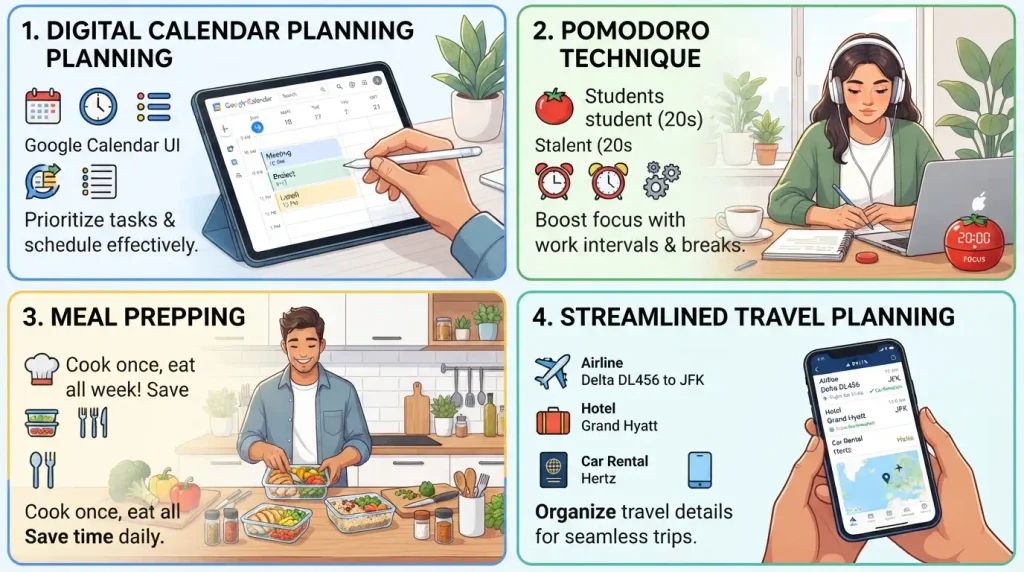
- Workplace: A tech manager introduces a streamlined digital system that helps employees submit expense reports in under two minutes.
- Social Situations: A host uses a time-efficient party planning strategy to prepare a beautiful dinner before guests arrive.
- Media / Pop Culture: A popular tech reviewer posts a video about an optimizing mobile app that cleans up phone storage instantly.
- Writing or Storytelling: An author describes how a nimble detective found a clever way to solve a difficult crime mystery ahead of schedule.
Practice Exercise
- Which word fits best when a tech company simplifies its software to remove annoying, useless steps?
A) Hasty
B) Streamlining
C) Separate
D) Delayed - If a project is done in extreme rush and ends up full of silly mistakes, how should we describe it?
A) Productive
B) Optimizing
C) Hasty
D) Efficient - Choose the perfect term for a direct flight that does not have any annoying layovers or stops.
A) Nimble
B) Direct
C) Fleet
D) Brisk - What is the emotional tone of the vocabulary word “Optimizing”?
A) Deeply negative
B) Purely positive
C) Careless
D) Slow - Identify the suffix used to build the word “Expediting”.
A) Ex-
B) -ing
C) -ped
D) -ite - Which word means combining multiple financial reports into one single, clean document?
A) Flying
B) Consolidated
C) Hasty
D) Fleet - When a walk is fast, energetic, healthy, and full of life, it is called what?
A) Sluggish
B) Brisk
C) Instantaneous
D) Hasty - What part of speech is the word “Efficient” in the phrase “an efficient strategy”?
A) Pronoun
B) Noun
C) Adjective
D) Preposition - Select the best option for an event that requires rapid action, as a delay will result in total failure.
A) Playful
B) Time-critical
C) Casual
D) Slow - Which word describes a quick, short visit made to a friend’s house during a busy workday?
A) Consolidated
B) Flying
C) Heavy
D) Analytical
Reflection Task
Write one original, conversational sentence using the synonym ” time-efficient “ based on a real-life situation you experienced this week.
Answer Key
1: B, 2: C, 3: B, 4: B, 5: B, 6: B, 7: B, 8: C, 9: B, 10: B
Conclusion
Mastering a variety of descriptive words allows you to express your thoughts with total clarity and professional impact. Stepping away from overused phrases helps your unique voice stand out clearly across all digital spaces.
Building this advanced vocabulary boosts your academic writing, creative blogging, public presentations, and daily workplace communication skills. It keeps your audience fully locked into the core value of your message.
Commit to trying these fresh terms in your personal emails, professional text messages, and school essays this week. Consistent execution transforms new terms into second nature

Sophia Carter is the founder and lead writer at SynonymVerse.com, a trusted online resource dedicated to English vocabulary and effective communication. She is passionate about helping students, writers, professionals, and lifelong learners find the most accurate words to express their ideas with clarity and confidence.
At SynonymVerse.com, every article is carefully researched and thoughtfully written to provide reliable guidance on synonyms, word meanings, and vocabulary. With a strong focus on accuracy, real-world usage, and easy-to-understand explanations, the website is committed to helping readers strengthen their language skills, enrich their vocabulary, and become more confident communicators.