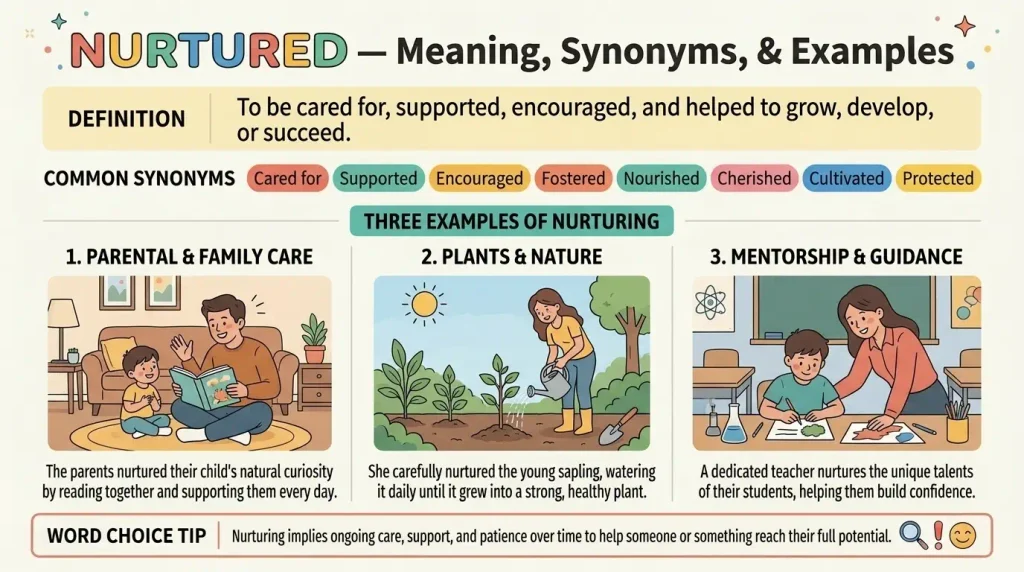
Synonym for nurtured include words such as cared for, supported, fostered, cultivated, encouraged, and nourished. The best alternative depends on the context. Some words describe caring for a person, while others refer to developing a skill, relationship, idea, or talent over time.
Imagine a teacher who helps a shy student gain confidence. She listens, offers encouragement, and celebrates small improvements. Over time, the student becomes more comfortable expressing ideas. You could say the teacher nurtured the student’s confidence.
Learning a synonym for nurtured helps you express care, growth, and support with greater precision. It also makes your writing more natural and reduces repetition in essays, blogs, stories, and everyday conversations.
The word appears in education, parenting, healthcare, business, and personal development. Students can use its alternatives in assignments, while bloggers and content writers can choose words that better match their message.
Whether you are describing a friendship, developing a creative idea, or supporting someone’s progress, the right alternative makes your meaning clearer. A stronger vocabulary helps you communicate these experiences with confidence.
What Does “Nurtured” Really Mean?
Nurtured means cared for, supported, or helped to grow and develop over time. It is the past tense and past participle of the verb nurture.
The word often describes the patient attention someone gives to a person, ability, relationship, or idea. It suggests more than a single helpful action. It usually involves continued care, encouragement, or guidance.
For example:
- The parents nurtured their child’s curiosity.
- The coach nurtured the team’s confidence.
- The organization nurtured a culture of creativity.
Native English speakers commonly use nurtured when describing development that happens through care, attention, and support. It can refer to physical growth, emotional well-being, personal skills, or abstract qualities.
Part of Speech
Part of speech: Verb form; past tense and past participle of nurture. It can also function as an adjective in certain contexts.
Simple definition: Helped someone or something grow by providing care, support, attention, or encouragement.
Connotative Meaning
Connotation (the feelings or associations a word suggests beyond its basic definition) helps explain the emotional effect of nurtured.
- Positive tone: Suggests kindness, encouragement, patience, and healthy development.
- Negative tone: Can suggest excessive protection or overdependence in a critical context, although the word itself is generally positive.
- Neutral tone: Describes the process of supporting growth without expressing a strong personal judgment.
Etymology of Nurtured
The word nurtured comes from nurture, which entered English through Anglo-French and Old French forms related to nourishment, upbringing, and care. Its deeper history connects to Latin nutrire, meaning “to nourish” or “to feed.”
Historical Development
Old English period (450–1100): The modern word nurture was not a standard Old English term in its present form. English used other words and expressions to describe feeding, raising, and caring for people.
Middle English period (1100–1500): Forms related to Old French nourriture entered English. The word developed associations with nourishment, upbringing, and education.
Modern English period (1500–present): Nurture expanded beyond physical care. Today, it can describe developing confidence, talent, relationships, creativity, and emotional well-being.
Pronunciation
- US: /ˈnɝːtʃɚd/
- UK: /ˈnɜːtʃəd/
Syllables
NUR-tured — 2 syllables.
Affixation Pattern of Nurtured
- Root/base: Nurture
- Prefix: None
- Suffix: -ed, marking the past tense or past participle
- Word formation: Nurture + ed = nurtured
The final e in nurture is dropped before adding -ed.
Synonyms List
Not every alternative fits every sentence. The following words cover different shades of care, development, guidance, and support. Choose the one that communicates your intended meaning most accurately.
1. Cared for (Verb phrase)
Meaning: Provided attention, protection, or help to someone or something.
Tone/Register: Warm, neutral, everyday.
Example:
Her grandparents cared for her during the summer.
The rescued kitten was carefully cared for until it recovered.
2. Supported (Verb)
Meaning: Gave someone the help, encouragement, or resources needed to grow.
Tone/Register: Neutral, professional, personal.
Example:
Her colleagues supported her as she learned a new skill.
The school supported students who struggled with reading.
3. Fostered (Verb)
Meaning: Encouraged the development of a quality, relationship, or ability.
Tone/Register: Formal, academic, professional.
Example:
The manager fostered trust across the department.
Group projects fostered cooperation among classmates.
4. Cultivated (Verb)
Meaning: Developed a skill, quality, or relationship through continued effort and attention.
Tone/Register: Formal, academic, literary.
Example:
She cultivated a habit of reading every evening.
The organization cultivated strong relationships with local communities.
5. Nourished (Verb)
Meaning: Provided the physical or emotional resources needed for healthy growth.
Tone/Register: Warm, descriptive, sometimes literary.
Example:
The family nourished his love of music.
Fresh meals nourished the children throughout the school day.
6. Encouraged (Verb)
Meaning: Gave someone confidence or motivation to continue or improve.
Tone/Register: Positive, conversational, professional.
Example:
My teacher encouraged me to share my ideas.
Her friends encouraged her to apply for the scholarship.
7. Raised (Verb)
Meaning: Brought up a child or young person and provided care during development.
Tone/Register: Neutral, everyday.
Example:
His aunt raised him in a supportive home.
They raised their children to treat others with kindness.
8. Guided (Verb)
Meaning: Helped someone develop by offering direction, advice, or instruction.
Tone/Register: Professional, educational, neutral.
Example:
The mentor guided her through the first stage of training.
Experienced teachers guided the students during the project.
9. Developed (Verb)
Meaning: Helped a skill, quality, idea, or ability become more advanced.
Tone/Register: Neutral, academic, professional.
Example:
The program developed students’ problem-solving skills.
He developed his artistic talent through regular practice.
10. Encouraged growth (Verb phrase)
Meaning: Created conditions that helped someone or something improve.
Tone/Register: Positive, educational, professional.
Example:
The new policy encouraged growth among junior employees.
Open discussions encouraged growth and mutual understanding.
11. Protected (Verb)
Meaning: Kept someone or something safe from harm or damaging influences.
Tone/Register: Neutral, caring, practical.
Example:
Her parents protected her from unnecessary pressure.
The team protected its young players during their recovery.
12. Cherished (Verb)
Meaning: Treated someone or something as deeply valuable and worthy of affection.
Tone/Register: Emotional, warm, literary.
Example:
Her family cherished her curiosity and imagination.
He cherished the friendship they had built over many years.
13. Treated with care (Verb phrase)
Meaning: Handled or looked after someone or something attentively and gently.
Tone/Register: Neutral, practical, compassionate.
Example:
The staff treated every patient with care.
She treated the delicate plants with care during the winter.
14. Attended to (Phrasal verb)
Meaning: Gave necessary attention to someone’s needs or a developing situation.
Tone/Register: Formal, practical, professional.
Example:
The nurse attended to the child’s immediate needs.
The gardener attended to the seedlings every morning.
15. Looked after (Phrasal verb)
Meaning: Took responsibility for someone’s care or well-being.
Tone/Register: Conversational, everyday.
Example:
Her neighbor looked after the children after school.
He looked after the injured bird until help arrived.
16. Strengthened (Verb)
Meaning: Made a quality, relationship, or ability stronger through support or practice.
Tone/Register: Neutral, professional, academic.
Example:
Regular feedback strengthened her confidence.
The workshop strengthened communication between team members.
17. Enriched (Verb)
Meaning: Improved the quality, depth, or value of an experience or ability.
Tone/Register: Positive, formal, descriptive.
Example:
Travel enriched his understanding of different cultures.
The reading program enriched the children’s learning experiences.
18. Promoted (Verb)
Meaning: Actively encouraged a quality, activity, or condition to develop.
Tone/Register: Professional, academic, business.
Example:
The school promoted creativity through hands-on activities.
The company promoted a culture of mutual respect.
19. Stimulated (Verb)
Meaning: Encouraged activity, interest, thought, or development.
Tone/Register: Academic, professional, educational.
Example:
The discussion stimulated her interest in science.
Interactive lessons stimulated curiosity among young learners.
20. Inspired (Verb)
Meaning: Filled someone with enthusiasm or motivation to pursue an idea or goal.
Tone/Register: Positive, emotional, motivational.
Example:
Her mentor inspired her to become a teacher.
The documentary inspired students to explore environmental issues.
21. Educated (Verb)
Meaning: Helped someone gain knowledge or understanding through learning.
Tone/Register: Neutral, academic, formal.
Example:
His parents educated him at home during the early years.
The program educated young people about online safety.
22. Trained (Verb)
Meaning: Helped someone build ability through instruction and repeated practice.
Tone/Register: Professional, practical, educational.
Example:
The coach trained the athletes throughout the season.
Her supervisor trained her to handle customer questions.
23. Mentored (Verb)
Meaning: Supported someone’s personal or professional development through advice and experience.
Tone/Register: Professional, educational, supportive.
Example:
A senior designer mentored her during the internship.
He mentored young writers who wanted to publish their work.
24. Guided along (Verb phrase)
Meaning: Helped someone progress through a process or period of development.
Tone/Register: Supportive, conversational.
Example:
Her parents guided her along the path to independence.
The instructor guided beginners along each step of the exercise.
25. Encouraged development (Verb phrase)
Meaning: Helped a person, skill, or idea progress through positive support.
Tone/Register: Academic, professional.
Example:
The curriculum encouraged development of critical-thinking skills.
The supervisor encouraged development through regular feedback.
26. Sustained (Verb)
Meaning: Maintained or continued support for something over time.
Tone/Register: Formal, professional.
Example:
Her friends sustained her confidence during a difficult period.
Consistent funding sustained the community’s education program.
27. Maintained (Verb)
Meaning: Kept something in good condition or preserved its continued existence.
Tone/Register: Neutral, practical, professional.
Example:
The team maintained a supportive learning environment.
They maintained their friendship through years of change.
28. Advanced (Verb)
Meaning: Helped an idea, cause, or skill move toward a more developed stage.
Tone/Register: Formal, academic, business.
Example:
The research group advanced new ideas about learning.
The initiative advanced young artists’ professional opportunities.
29. Brought up (Phrasal verb)
Meaning: Raised a child and helped shape their early development.
Tone/Register: Conversational, everyday.
Example:
She was brought up in a home that valued kindness.
His grandparents brought him up near the coast.
30. Built up (Phrasal verb)
Meaning: Gradually increased someone’s confidence, strength, or ability.
Tone/Register: Informal, everyday, motivational.
Example:
Daily practice built up her confidence before the performance.
The trainer built up the team’s endurance over several weeks.
31. Watered (Verb)
Meaning: Supplied plants with water so they could grow.
Tone/Register: Literal, practical.
Example:
She watered the seedlings every morning.
The gardener watered the young trees during the dry spell.
Usage note: This is appropriate for literal plant care, not usually for developing a person’s character or skills.
32. Fed (Verb)
Meaning: Gave someone or something food needed for nourishment.
Tone/Register: Neutral, everyday.
Example:
They fed the rescued puppies several times a day.
The farmer fed the young animals before sunrise.
Usage note: Like watered, this is a literal alternative when nurture refers to physical care.
33. Helped flourish (Verb phrase)
Meaning: Provided the support or conditions needed for someone or something to thrive.
Tone/Register: Positive, expressive.
Example:
The community helped local artists flourish.
Her patient teaching helped the children’s confidence flourish.
34. Promoted well-being (Verb phrase)
Meaning: Supported a person’s physical, emotional, or social health.
Tone/Register: Professional, health-related, educational.
Example:
The center promoted well-being through exercise and social activities.
A calm classroom promoted students’ emotional well-being.
35. Instilled (Verb)
Meaning: Gradually helped someone develop a belief, value, habit, or attitude.
Tone/Register: Formal, educational, parenting.
Example:
Her parents instilled a strong sense of responsibility in her.
The teacher instilled respect for different viewpoints.
36. Shaped (Verb)
Meaning: Influenced the development or character of a person, idea, or experience.
Tone/Register: Neutral, reflective, literary.
Example:
Her early experiences shaped her interest in helping others.
The coach shaped the team’s approach to difficult challenges.
37. Guided development (Verb phrase)
Meaning: Provided direction and support while something progressed.
Tone/Register: Professional, educational.
Example:
The supervisor guided the development of the new employee’s skills.
The program guided development through structured activities.
38. Looked out for (Phrasal verb)
Meaning: Watched over someone and tried to protect their interests.
Tone/Register: Informal, caring.
Example:
Her older sister always looked out for her.
The experienced players looked out for newcomers on the team.
39. Brought to maturity (Verb phrase)
Meaning: Helped someone or something reach a mature or fully developed state.
Tone/Register: Formal, literary.
Example:
Years of careful practice brought his talent to maturity.
The long research process brought the original idea to maturity.
40. Supported emotionally (Verb phrase)
Meaning: Offered understanding, reassurance, and empathy during emotional challenges.
Tone/Register: Compassionate, personal, professional.
Example:
Her friends supported her emotionally after the move.
The counselor supported students emotionally during exam season.
Synonyms for Nurtured by Tone
The emotional effect of a word can change how readers understand your message. Choose an alternative that matches your subject, audience, and purpose.
Positive Synonyms
Use these words when you want to emphasize growth, affection, encouragement, or achievement.
- Encouraged
- Cherished
- Nourished
- Inspired
- Enriched
- Helped flourish
- Strengthened
- Supported
Example: Her mentor encouraged her creativity and helped her flourish as a writer.
Neutral Synonyms
These alternatives describe care, development, or assistance without adding strong emotional meaning.
- Cared for
- Guided
- Developed
- Raised
- Maintained
- Attended to
- Looked after
- Protected
Example: The teacher guided the students through the learning process.
Professional and Academic Synonyms
Use these alternatives in reports, essays, research papers, workplace communication, and educational content.
- Fostered
- Cultivated
- Promoted
- Stimulated
- Mentored
- Sustained
- Instilled
- Advanced
Example: The training program fostered collaboration and cultivated leadership skills.
Playful and Informal Alternatives
These expressions work well in friendly conversations and casual storytelling.
- Looked after
- Looked out for
- Built up
- Brought up
- Helped flourish
Example: Her friends built up her confidence before the big performance.
Why Tone Matters in Word Choice
A word can be accurate but still sound unsuitable for your audience. Cherished communicates affection, while cultivated emphasizes deliberate development. Mentored suggests guidance, and looked after sounds more conversational.
Consider the purpose of your sentence before choosing an alternative. This approach makes your vocabulary more precise and your writing easier to understand.
Nurtured vs. Close Alternatives
Some synonyms have similar meanings but emphasize different aspects of care and growth.
Fostered vs. Nurtured
Nurtured emphasizes continued care, attention, and encouragement. It commonly describes people, relationships, confidence, and talents.
Fostered emphasizes creating conditions that allow something to develop. It frequently appears in discussions of teamwork, trust, creativity, and cooperation.
Compare the examples:
- She nurtured her daughter’s love of reading.
- The school fostered a culture of curiosity.
Use nurtured when care is central to the message. Choose fostered when you want to highlight the conditions that encourage development.
Nurtured vs. Cultivated
Nurtured often suggests personal care and emotional support. Cultivated emphasizes deliberate effort to develop a quality, ability, interest, or relationship.
Compare the examples:
- His parents nurtured his confidence.
- He cultivated his writing skills through daily practice.
Use nurtured to emphasize support from another person. Choose cultivated when effort, practice, or intentional development matters most.
Nurtured vs. Nourished
Nurtured can refer to emotional, intellectual, social, or physical development. Nourished most directly refers to providing food or the resources needed for growth. It can also describe emotional or intellectual enrichment.
Compare the examples:
- The teacher nurtured her curiosity.
- Reading nourished his imagination.
Choose nurtured for broad, ongoing support. Use nourished when you want to emphasize the resources or experiences that sustain growth.
How Nurtured Changes by Context
Daily Conversation
In everyday English, nurtured often describes how someone cared for a child, supported a friend, or developed a personal quality.
For example, you might say, “My family nurtured my interest in music.” In a more casual conversation, “My family encouraged my interest in music” may sound more natural.
Writing and Blogging
Writers can use nurtured to discuss personal development, education, parenting, creativity, or relationships. However, repeating it throughout an article can make the writing sound monotonous.
Choose alternatives according to meaning. Use cultivated for a skill, fostered for a supportive environment, and cherished for something deeply valued.
Professional and Academic Writing
In workplace reports and academic essays, words such as fostered, developed, cultivated, and promoted often communicate ideas more precisely.
For example, “The initiative fostered collaboration among departments” sounds suitable for a professional report. “The initiative helped departments work together” offers a simpler alternative.
Creative and Informal Writing
Stories and personal essays may benefit from expressive words such as cherished, nourished, and helped flourish. These choices can create a warmer emotional atmosphere.
In dialogue, everyday expressions such as looked after and built up may sound more natural than formal alternatives.
Common Mistakes Learners Make
1. Treating Every Synonym as Interchangeable
Not every alternative works in every sentence. You can nurture confidence, but water confidence would not normally express the same meaning.
Tip: Identify whether the sentence describes care, emotional support, education, or development before selecting a synonym.
2. Confusing Physical Care With Emotional Development
Fed and watered describe literal actions. They can replace nurtured when discussing the physical care of animals or plants, but they rarely work for abstract qualities.
Tip: Use nourished figuratively when you want to describe emotional or intellectual growth.
3. Using Formal Words in Casual Conversations
Words such as cultivated and instilled can sound overly formal in simple conversations.
Instead of saying, “My friends cultivated my confidence,” you could say, “My friends helped me become more confident.”
4. Overusing the Same Alternative
Replacing every instance of nurtured with supported does not necessarily improve your writing. Repeated synonyms can make an article sound predictable.
Tip: Vary your wording according to the actual meaning of each sentence. Sometimes rewriting the entire sentence works better than replacing one word.
5. Ignoring Verb Tense
Nurtured describes a past action or a completed action connected to the present. Its base form is nurture, and its present participle is nurturing.
- Present: She nurtures young talent.
- Past: She nurtured young talent.
- Present participle: She is nurturing young talent.
Keep the verb tense consistent with the time described in your sentence.
Register Notes: Formal vs. Informal English
Formal English: Prefer fostered, cultivated, developed, promoted, or instilled in academic and professional contexts.
Informal English: Choose looked after, cared for, built up, or encouraged for everyday conversation.
Spoken English: Simple alternatives usually sound more natural when talking with friends or family.
Written English: More specific vocabulary can improve clarity in essays, articles, reports, and creative writing.
For related vocabulary practice, you can explore other synonym articles on topics such as encouragement, development, and support.
Real-Life Examples Using Nurtured
Workplace
A team leader regularly gives constructive feedback and helps new employees gain confidence. You could say the leader nurtured their professional development or mentored the new employees.
Social Situations
A friend listens when someone feels uncertain and reminds them of their strengths. The friend nurtured their confidence or supported them emotionally.
Media and Pop Culture
A documentary describes a young musician whose family encouraged regular practice and creative exploration. The family nurtured the musician’s talent and cultivated a love of music.
Writing and Storytelling
A novelist creates a character who develops courage through years of patient guidance. The mentor nurtured the character’s courage and helped the character flourish.
These examples demonstrate why context matters. A well-chosen synonym communicates not only what happened but also how the development took place.
Interactive Practice Quiz: Choose the Best Synonym
Choose the alternative that best fits each situation. Consider the meaning, tone, and context.
Multiple-Choice Questions
1. A teacher helps a student become more confident by offering regular encouragement. Which word fits best?
A. Ignored
B. Encouraged
C. Interrupted
D. Restricted
2. A company creates an environment where employees trust one another. Which word is most suitable?
A. Fostered
B. Forgotten
C. Weakened
D. Delayed
3. Someone improves their writing through daily practice. Which word best describes this process?
A. Cherished
B. Cultivated
C. Protected
D. Raised
4. A family provides food, shelter, and loving care for a child. Which expression fits best?
A. Looked after
B. Stimulated
C. Advanced
D. Instilled
5. A senior employee gives career advice to a new colleague. Which word is most precise?
A. Watered
B. Mentored
C. Fed
D. Maintained
6. Parents gradually teach their child honesty and responsibility. Which word best fits?
A. Instilled
B. Sustained
C. Attended
D. Nourished
7. A school introduces activities that increase students’ curiosity. Which word is most appropriate?
A. Stimulated
B. Protected
C. Raised
D. Cherished
8. A friend provides emotional reassurance during a difficult time. Which phrase is most suitable?
A. Advanced professionally
B. Supported emotionally
C. Watered regularly
D. Brought to maturity
9. A person helps a community’s young artists gain confidence and opportunities. Which phrase best describes the result?
A. Helped flourish
B. Looked away
C. Held back
D. Broke down
10. A writer wants a formal alternative for developing cooperation in an organization. Which word works best?
A. Built up
B. Fostered
C. Fed
D. Brought up
Part Two
11. A gardener gives water to young plants every morning. Which word describes this literal action?
A. Mentored
B. Instilled
C. Watered
D. Inspired
12. A coach helps athletes improve through structured instruction and practice. Which word is the best choice?
A. Trained
B. Cherished
C. Maintained
D. Enriched
Reflection Task
Write two sentences about someone who helped you develop a skill or positive quality. Use nurtured in the first sentence and one suitable synonym in the second.
Answer key: 1-B, 2-A, 3-B, 4-A, 5-B, 6-A, 7-A, 8-B, 9-A, 10-B, 11-C, 12-A.
Suggested External Learning Resource
For reliable definitions, pronunciation, and examples, consult the Oxford Learner’s Dictionaries entry for nurture. Compare its definition with the examples in this article to deepen your understanding of the word’s usage.
FAQs
1. What is the best synonym for nurtured in an academic essay?
Fostered, cultivated, and developed are useful alternatives in academic writing. The best choice depends on your sentence. Use fostered for encouraging an environment or quality, cultivated for deliberate development, and developed for growth or improvement. Check the surrounding sentence to ensure that the alternative preserves your intended meaning.
2. What is another word for nurtured when describing a child’s upbringing?
Cared for, raised, brought up, and looked after can describe aspects of a child’s upbringing. Raised and brought up refer specifically to bringing up a child, while cared for emphasizes attention and well-being. Choose the word that reflects the particular role or action you want to describe.
3. What is a synonym for nurtured in a professional development context?
Mentored, guided, trained, and supported are strong alternatives in professional settings. Use mentored when an experienced person provides ongoing advice, trained when someone teaches specific skills, and guided when someone offers direction. Supported works well when the help involves resources, encouragement, or assistance.
4. Can nurtured describe an idea or a talent?
Yes. Nurtured can describe the gradual development of an idea, interest, talent, or creative ability. For example, “She nurtured an idea for a community project” suggests that she gave it time and attention. Alternatives include cultivated, developed, encouraged, and helped flourish, depending on the sentence.
5. Is nurtured the same as loved?
No. The words overlap in some situations, but they have different meanings. Loved expresses affection, while nurtured emphasizes care and support that help someone or something develop. A person can feel loved without receiving the specific guidance or practical help implied by nurtured. The surrounding context determines the best wording.
6. What is the opposite of nurtured?
Possible opposites include neglected, ignored, discouraged, and undermined. The correct antonym depends on the situation. Neglected suggests a lack of necessary care, while discouraged means someone reduced another person’s confidence or motivation. Undermined describes actions that weaken someone’s progress, position, or confidence.
7. How can I avoid repeating nurtured in an article?
Choose alternatives according to the meaning of each sentence rather than replacing the word mechanically. Use mentored for guidance, cultivated for deliberate development, and cherished for deep affection. You can also restructure sentences to improve flow. Read the finished article aloud to identify repetition and awkward wording.
Conclusion
Learning a synonym for nurtured helps you express care, encouragement, and development more precisely. Words such as fostered, cultivated, and supported add variety without changing your intended message.
The right vocabulary can strengthen essays, improve blog articles, and make everyday conversations more meaningful. Understanding subtle differences between alternatives also helps you sound more natural in English.
Practice these words in emails, assignments, journal entries, and daily conversations. Notice how each synonym changes the tone of your sentence, then choose the one that communicates your idea most clearly.
Build your vocabulary one word at a time. Try writing three original sentences with different synonyms for nurtured, and review how each choice changes your meaning.

Sophia Carter is the founder and lead writer at SynonymVerse.com, a trusted online resource dedicated to English vocabulary and effective communication. She is passionate about helping students, writers, professionals, and lifelong learners find the most accurate words to express their ideas with clarity and confidence.
At SynonymVerse.com, every article is carefully researched and thoughtfully written to provide reliable guidance on synonyms, word meanings, and vocabulary. With a strong focus on accuracy, real-world usage, and easy-to-understand explanations, the website is committed to helping readers strengthen their language skills, enrich their vocabulary, and become more confident communicators.