
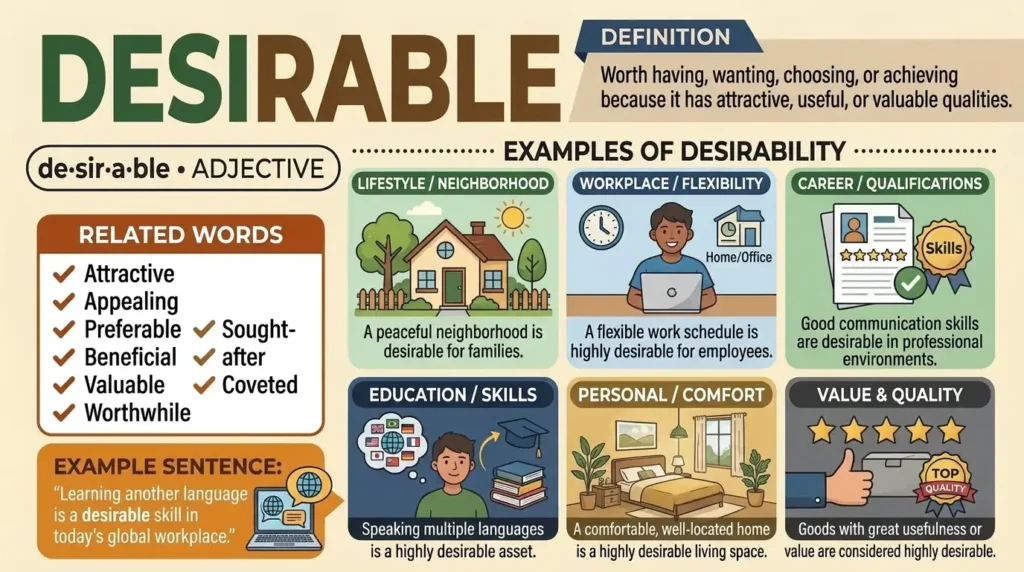
Synonyms for desirable include attractive, appealing, preferable, advantageous, beneficial, wanted, sought-after, and worthwhile. These words describe something people want, value, admire, or consider a good choice. The best alternative depends on the situation and intended meaning.
Synonyms for desirable can make everyday English more expressive. Imagine choosing a new job. You might call its salary attractive, its benefits appealing, and its flexible schedule advantageous.
The word desirable appears in conversations, advertisements, academic writing, and professional discussions. It helps people describe qualities, opportunities, and outcomes they would like to have.
Learning different alternatives makes your vocabulary stronger. Students, bloggers, content writers, and everyday English users can communicate their ideas with greater clarity and confidence.
What Does “Desirable” Really Mean?
Desirable means worth having, wanting, choosing, or achieving because something offers an attractive or valuable quality.
In simple English, if something is desirable, people generally consider it a good thing to have.
For example:
- A flexible working schedule is desirable for many employees.
- Good communication skills are desirable in most professional environments.
- A peaceful neighborhood is desirable for families.
Part of Speech
Desirable is an adjective.
It describes a person, quality, situation, object, or opportunity that someone wants or considers valuable.
Word forms:
- Desirable – Adjective
- Desirability – Noun
- Desirably – Adverb
- Desire – Noun and verb
- Desired – Adjective and past participle
Connotative Meaning
(Connotation means the emotional feeling or association connected with a word beyond its basic dictionary meaning.)
Positive tone: Desirable usually communicates approval, attractiveness, usefulness, or value.
Negative tone: The word itself is not negative. However, something desirable to one person might be undesirable to another.
Neutral tone: In professional and academic writing, it can simply describe a preferred or advantageous quality without expressing strong emotion.
Etymology of Desirable
The word desirable developed from the English word desire and the suffix -able.
The word desire traces back through Old French to Latin desiderare, meaning to long for, wish for, or want.
The suffix -able means capable of being or suitable for something. Together, these elements create the meaning of something worthy of desire.
Historical Development
Old English (450–1100)
The modern adjective desirable was not established in Old English. However, early English vocabulary included related expressions for wanting, wishing, and longing for something.
Middle English (1100–1500)
The influence of French and Latin vocabulary helped develop words connected with desire and preference. Desirable emerged during the later development of English.
Modern English (1500–Present)
Desirable became widely used for describing attractive qualities, favorable conditions, preferred characteristics, and valuable opportunities.
Pronunciation and Syllables
Pronunciation: dih-ZY-ruh-buhl
IPA: /dɪˈzaɪərəbəl/
Syllables: de-sir-a-ble (four syllables)
Affixation Pattern of Desirable
- Root: Desire
- Prefix: None
- Suffix: -able
The suffix changes the noun or verb-related base into an adjective describing something worthy of being wanted.
Synonyms List
The following alternatives describe something attractive, valuable, preferred, beneficial, or worth having. Some work better in particular situations, so consider their individual meanings before using them.
1. Attractive (Adjective)
Meaning: Something attractive has qualities that make people interested in it or want it.
Tone/Register: Neutral, conversational, and professional.
Example:
The company offers an attractive salary package.
Her creative ideas made the proposal attractive to investors.
2. Appealing (Adjective)
Meaning: Something appealing creates interest or makes someone feel positively about a choice.
Tone/Register: Neutral and conversational.
Example:
The flexible schedule sounds appealing to me.
This design has an appealing combination of colors.
3. Preferable (Adjective)
Meaning: Something preferable is considered a better choice than another available option.
Tone/Register: Formal and professional.
Example:
A direct conversation is preferable to a long email exchange.
Working from home is preferable for some employees.
4. Advantageous (Adjective)
Meaning: Something advantageous provides a useful benefit or improves someone’s position.
Tone/Register: Formal, academic, and business.
Example:
Learning another language is advantageous in international business.
The new agreement offers advantageous conditions.
5. Beneficial (Adjective)
Meaning: Something beneficial produces a positive result or provides an important advantage.
Tone/Register: Academic, professional, and neutral.
Example:
Regular reading is beneficial for language development.
The new policy could be beneficial for small businesses.
6. Favorable (Adjective)
Meaning: Something favorable creates good conditions or supports a positive outcome.
Tone/Register: Formal and professional.
Example:
The organization received favorable feedback from customers.
The weather conditions were favorable for the event.
7. Valuable (Adjective)
Meaning: Something valuable has considerable importance, usefulness, or worth.
Tone/Register: Neutral and professional.
Example:
Her experience is valuable to the entire team.
Good advice can be valuable during difficult decisions.
8. Desirable (Adjective)
Meaning: Worth having or choosing because of its attractive or useful qualities.
Tone/Register: Neutral and formal.
Example:
A quiet workplace is desirable for focused tasks.
Professional experience is desirable for this position.
9. Worthwhile (Adjective)
Meaning: Something worthwhile deserves the time, effort, or attention invested in it.
Tone/Register: Conversational and neutral.
Example:
Learning new vocabulary is a worthwhile activity.
The extra preparation made the presentation worthwhile.
10. Coveted (Adjective)
Meaning: Something coveted is strongly wanted or admired by many people.
Tone/Register: Formal and descriptive.
Example:
She received a coveted scholarship from the university.
The award is highly coveted among young writers.
11. Sought-after (Adjective)
Meaning: Something sought-after is popular because many people want it.
Tone/Register: Professional and conversational.
Example:
Digital marketing is a sought-after skill.
The designer created a sought-after collection.
12. Wanted (Adjective)
Meaning: Something wanted is desired or needed by a person or group.
Tone/Register: Simple and conversational.
Example:
Flexible working hours are wanted by many employees.
The position offers the experience she wanted.
13. Desirable-looking (Adjective)
Meaning: Something desirable-looking appears attractive or appealing to someone.
Tone/Register: Informal and descriptive.
Example:
The house looked desirable because of its spacious garden.
The restaurant displayed a desirable selection of desserts.
14. Pleasing (Adjective)
Meaning: Something pleasing creates satisfaction, enjoyment, or a positive feeling.
Tone/Register: Neutral and descriptive.
Example:
The room has a pleasing and peaceful atmosphere.
Her writing style is simple and pleasing to read.
15. Alluring (Adjective)
Meaning: Something alluring attracts attention through its appealing or fascinating qualities.
Tone/Register: Descriptive and literary.
Example:
The coastal town has an alluring natural beauty.
The offer sounded alluring to new graduates.
16. Tempting (Adjective)
Meaning: Something tempting makes someone feel strongly interested in accepting or choosing it.
Tone/Register: Informal and conversational.
Example:
The idea of taking a long weekend sounds tempting.
That chocolate cake looks tempting.
17. Enticing (Adjective)
Meaning: Something enticing attracts people by creating curiosity, interest, or excitement.
Tone/Register: Descriptive and persuasive.
Example:
The invitation included an enticing description of the event.
The restaurant introduced an enticing seasonal menu.
18. Deserving (Adjective)
Meaning: Something deserving has qualities that make it worthy of attention, recognition, or reward.
Tone/Register: Formal and neutral.
Example:
Her hard work makes her deserving of recognition.
The project is deserving of further attention.
19. Worthy (Adjective)
Meaning: Something worthy has enough value or importance to deserve consideration.
Tone/Register: Formal and conversational.
Example:
The proposal is worthy of serious consideration.
She found a worthy cause to support.
20. Promising (Adjective)
Meaning: Something promising shows signs of success, improvement, or future value.
Tone/Register: Professional and neutral.
Example:
The research has produced promising results.
He received a promising opportunity after graduation.
21. Desirable in Quality (Adjective Phrase)
Meaning: A characteristic that makes something suitable, attractive, or valuable.
Tone/Register: Formal and descriptive.
Example:
Reliability is a desirable quality in a team leader.
Patience is a desirable characteristic in a teacher.
22. Advantage-giving (Adjective)
Meaning: Something that provides an advantage or improves someone’s chances of success.
Tone/Register: Explanatory and professional.
Example:
Practical experience is an advantage-giving factor in this field.
The additional training provided an advantage-giving skill set.
23. Profitable (Adjective)
Meaning: Something profitable produces financial gain or a worthwhile return.
Tone/Register: Business and financial.
Example:
The investment became profitable within two years.
They are searching for profitable business opportunities.
24. Lucrative (Adjective)
Meaning: Something lucrative offers the possibility of substantial financial rewards.
Tone/Register: Business and formal.
Example:
Software development can be a lucrative career.
The company secured a lucrative contract.
25. Rewarding (Adjective)
Meaning: Something rewarding provides satisfaction, personal growth, or a valuable result.
Tone/Register: Positive and conversational.
Example:
Teaching children can be a rewarding experience.
She finds creative writing deeply rewarding.
26. Favorited (Adjective)
Meaning: Something marked or treated as a favorite choice rather than simply being generally desirable.
Tone/Register: Informal and digital.
Example:
I saved the favorited design for later.
The app displays my favorited articles.
27. Ideal (Adjective)
Meaning: Something ideal is considered the best or most suitable for a particular purpose.
Tone/Register: Neutral and professional.
Example:
A quiet room is ideal for studying.
This location is ideal for a family holiday.
28. Suitable (Adjective)
Meaning: Something suitable is appropriate for a particular person, purpose, or situation.
Tone/Register: Neutral and professional.
Example:
This book is suitable for intermediate English learners.
We need a suitable location for the meeting.
29. Appropriate (Adjective)
Meaning: Something appropriate fits the requirements or expectations of a situation.
Tone/Register: Formal and professional.
Example:
A polite response is appropriate in this situation.
The teacher selected appropriate reading material.
30. Beneficially Attractive (Adjective Phrase)
Meaning: Something that is appealing because it combines attractiveness with practical advantages.
Tone/Register: Explanatory and descriptive.
Example:
The property is beneficially attractive because it is close to schools.
The offer combines a good salary with beneficial working conditions.
31. Excellent (Adjective)
Meaning: Something excellent has an exceptionally high standard or quality.
Tone/Register: Positive and widely used.
Example:
The university provides excellent learning opportunities.
She has an excellent chance of receiving the scholarship.
32. Desirable (Adjective)
Meaning: A quality or outcome that people consider worth achieving or possessing.
Tone/Register: Formal and neutral.
Example:
A healthy work environment is desirable for everyone.
The company is looking for desirable professional qualities.
33. Admirable (Adjective)
Meaning: Something admirable deserves respect because of its positive qualities or actions.
Tone/Register: Positive and formal.
Example:
Her commitment to education is admirable.
He demonstrated admirable patience during the discussion.
34. Impressive (Adjective)
Meaning: Something impressive creates a strong positive reaction through its quality or achievement.
Tone/Register: Conversational and professional.
Example:
The candidate has an impressive academic background.
The team achieved impressive results this year.
35. Outstanding (Adjective)
Meaning: Something outstanding is exceptionally good and stands above other available choices.
Tone/Register: Professional and positive.
Example:
The organization offers outstanding career opportunities.
Her performance was outstanding throughout the competition.
36. Exceptional (Adjective)
Meaning: Something exceptional has unusually high quality or remarkable characteristics.
Tone/Register: Formal and positive.
Example:
The school provides exceptional educational support.
He demonstrated exceptional leadership skills.
37. Excellent-value (Adjective Phrase)
Meaning: Something that offers considerable benefits or quality in relation to its cost or effort.
Tone/Register: Informal and commercial.
Example:
The package offers excellent value for families.
This course provides excellent value for students.
38. Pleasurable (Adjective)
Meaning: Something pleasurable gives enjoyment, happiness, or satisfaction.
Tone/Register: Neutral and descriptive.
Example:
Reading a good novel can be a pleasurable experience.
They enjoyed a pleasurable afternoon together.
39. Desirable to Have (Adjective Phrase)
Meaning: Something that would be useful, attractive, or welcome to possess.
Tone/Register: Neutral and conversational.
Example:
A second language is desirable to have in international business.
A reliable internet connection is desirable to have when working remotely.
40. Satisfying (Adjective)
Meaning: Something satisfying fulfills expectations or creates a feeling of contentment.
Tone/Register: Conversational and neutral.
Example:
Completing a difficult assignment is satisfying.
The final result was satisfying for the entire team.
41. Intriguing (Adjective)
Meaning: Something intriguing creates curiosity and makes people want to learn more.
Tone/Register: Descriptive and conversational.
Example:
The documentary presents an intriguing explanation of history.
She introduced an intriguing idea during the discussion.
42. Fascinating (Adjective)
Meaning: Something fascinating attracts strong interest because it is extremely interesting or unusual.
Tone/Register: Positive and conversational.
Example:
The museum contains fascinating historical objects.
His presentation explored a fascinating scientific discovery.
43. Enviable (Adjective)
Meaning: Something enviable is so attractive or impressive that others might wish they had it.
Tone/Register: Descriptive and conversational.
Example:
She has an enviable collection of rare books.
The company has built an enviable reputation.
44. Lucratively Attractive (Adjective Phrase)
Meaning: Something that appears attractive because it offers promising financial rewards.
Tone/Register: Business and explanatory.
Example:
The investment became lucratively attractive after the market improved.
The new partnership presents a lucratively attractive opportunity.
45. Desirable to Own (Adjective Phrase)
Meaning: Something that people would like to possess because of its usefulness, quality, or appeal.
Tone/Register: Neutral and descriptive.
Example:
The latest model is desirable to own because of its reliability.
For collectors, this edition is particularly desirable to own.
46. Optimal (Adjective)
Meaning: Something optimal represents the best possible condition or result for a particular purpose.
Tone/Register: Academic, technical, and professional.
Example:
The researchers identified the optimal conditions for growth.
A balanced routine creates an optimal learning environment.
47. Prime (Adjective)
Meaning: Something prime is among the best or most important available options.
Tone/Register: Professional and conversational.
Example:
The building occupies a prime location.
This is a prime opportunity to develop new skills.
48. First-rate (Adjective)
Meaning: Something first-rate has excellent quality or a very high standard.
Tone/Register: Positive and conversational.
Example:
The school has a first-rate science department.
They provided first-rate customer support.
49. Desiderable (Not a Standard Synonym)
Meaning: This is a common spelling error rather than a correct English synonym for desirable.
Tone/Register: Not applicable.
Example:
Write desirable when describing something worth having.
Avoid using desiderable in formal or informal English.
50. Desideratum (Noun)
Meaning: A desideratum is something considered necessary, desirable, or especially important to achieve.
Tone/Register: Formal and academic.
Example:
Academic integrity is an important desideratum in research.
Greater transparency remains a key desideratum for the organization.
Synonyms for Desirable by Tone
Choosing an alternative depends on the feeling you want to communicate. Some words sound professional, while others express excitement or personal preference.
Positive Synonyms
These words highlight attractive qualities, benefits, or excellent characteristics.
- Attractive
- Appealing
- Beneficial
- Advantageous
- Valuable
- Rewarding
- Admirable
- Excellent
- Outstanding
- Exceptional
- Impressive
- Pleasing
- Worthwhile
- Promising
- Fascinating
Neutral Synonyms
These alternatives communicate suitability, preference, or general usefulness without strong emotional emphasis.
- Suitable
- Appropriate
- Preferable
- Ideal
- Worthy
- Wanted
- Favorable
- Satisfying
- Optimal
- Prime
- Pleasurable
Business and Professional Synonyms
Use these alternatives when discussing employment, investments, opportunities, or organizational decisions.
- Lucrative
- Profitable
- Advantageous
- Valuable
- Sought-after
- First-rate
- Favorable
- Outstanding
- Promising
- Coveted
Playful and Informal Synonyms
These words sound natural in casual conversations and friendly discussions.
- Tempting
- Alluring
- Enticing
- Appealing
- Attractive
- Fascinating
- Intriguing
Negative or Cautionary Associations
Desirable does not have a direct negative synonym. However, certain alternatives can communicate attraction that may involve risk, pressure, or questionable motives.
- Tempting – Something attractive that may encourage an unwise decision.
- Seductive – Something extremely appealing that may influence someone’s judgment.
- Alluring – Something attractive that can sometimes suggest a misleading appeal.
Why does tone matter?
The right word helps readers understand your intention. For example, lucrative suits financial opportunities, while rewarding describes personal satisfaction. Using the wrong alternative can change the meaning of your sentence.
Desirable vs. Close Alternatives
Some synonyms appear similar but communicate different ideas. Understanding these differences helps you select the most accurate word.
Desirable vs. Attractive
Desirable: Describes something worth having, choosing, or achieving.
Attractive: Describes something that draws attention or creates interest.
Tone difference: Desirable is often more formal. Attractive is common in everyday English.
When to use each: Use desirable for qualities and opportunities. Use attractive for appearance, offers, and interesting features.
Desirable vs. Beneficial
Desirable: Something people want or consider worth having.
Beneficial: Something that produces a positive effect or useful result.
Tone difference: Both are suitable for formal writing, but beneficial emphasizes practical advantages.
When to use each: Describe a flexible schedule as desirable. Describe regular exercise as beneficial.
Desirable vs. Preferable
Desirable: Something considered attractive or worth choosing.
Preferable: An option considered better than another alternative.
Tone difference: Preferable sounds more comparative and formal.
When to use each: Use desirable to describe an appealing opportunity. Use preferable when comparing two choices.
How Desirable Changes by Context
The best synonym depends on where and how you communicate. Understanding different contexts helps you avoid awkward expressions.
Daily Conversation
In everyday English, attractive, appealing, tempting, and worthwhile sound natural.
For example:
“That vacation package looks appealing.”
“Learning to cook is a worthwhile skill.”
These expressions make conversations friendly and easy to understand.
Writing and Blogging
Bloggers and content writers can use valuable, beneficial, appealing, and fascinating to make their writing more expressive.
For example:
“Reading regularly provides valuable knowledge.”
“A well-organized website creates an appealing experience.”
Use alternatives naturally instead of repeating the same adjective.
Professional and Academic Writing
Professional communication often requires precise vocabulary.
Words such as advantageous, preferable, suitable, favorable, and optimal can describe decisions, opportunities, and conditions.
For example:
“Previous experience is advantageous for this position.”
“A written agreement is preferable for both parties.”
Creative and Informal Writing
Creative writers can choose alluring, intriguing, fascinating, and enticing to create stronger descriptions.
For example:
“The mysterious garden had an alluring atmosphere.”
“The novel introduced an intriguing character.”
These alternatives help create a more vivid reading experience.
Common Mistakes Learners Make
Learning synonyms is not simply about replacing one word with another. Each alternative has its own meaning and grammatical requirements.
1. Using Every Synonym Interchangeably
Not every alternative works in every sentence.
For example, lucrative describes financial gain. It is not an appropriate replacement when discussing a pleasurable family experience.
2. Confusing Attractive With Beneficial
Attractive describes something that draws interest. Beneficial describes something that produces a positive result.
A beautiful advertisement may be attractive, but a useful educational program is beneficial.
3. Using Preferable Without a Clear Comparison
Preferable usually suggests that one option is better than another.
For example:
“Online learning is preferable to commuting for some students.”
The comparison makes the sentence clearer.
4. Overusing Formal Vocabulary
Words such as advantageous, optimal, and lucrative are useful in professional writing.
However, using them in every casual conversation can sound unnatural.
5. Confusing Desirable With Desired
Desirable means worth wanting or suitable to have.
Desired means specifically wanted by someone.
For example:
“Communication skills are desirable.”
“The desired result was achieved.”
Register Notes
Formal: Preferable, advantageous, optimal, lucrative, and favorable.
Informal: Tempting, appealing, worthwhile, and fascinating.
Written English: Beneficial, valuable, desirable, and advantageous.
Spoken English: Attractive, wanted, pleasing, and appealing.
Internal linking suggestion: Connect this article with your related vocabulary guide about synonyms for beneficial to help readers explore similar expressions.
Real-Life Examples Using Desirable
Here are some practical situations showing how these alternatives work in different settings.
Workplace Scenario
A manager is selecting a new employee.
Instead of saying, “We want a desirable candidate,” the manager could say:
“Strong communication skills are essential, and previous experience is advantageous.”
Social Situation
A friend is planning a weekend trip.
Instead of saying, “That destination looks desirable,” they could say:
“The peaceful location sounds appealing, and the beautiful scenery looks fascinating.”
Media and Pop Culture
A film reviewer wants to describe an interesting movie.
They might write:
“The film offers an intriguing storyline and an impressive performance.”
Writing and Storytelling
A novelist describes a beautiful place.
They could write:
“The village had an alluring atmosphere and a pleasing view of the mountains.”
These examples show why choosing the right alternative makes communication more natural.
Conclusion
Learning synonyms for desirable gives you more ways to describe attractive qualities, valuable opportunities, and positive experiences. Each alternative adds a different shade of meaning.
A stronger vocabulary also improves blogging, academic writing, professional communication, and everyday speaking. The right word makes your message clearer and more engaging.
Try using these expressions in your emails, essays, and daily conversations. Regular practice will help you choose words naturally and confidently.
Keep exploring new vocabulary, create your own sentences, and make every word count. Small improvements can lead to excellent communication skills.
Suggested external reference:
Merriam-Webster Dictionary — https://www.merriam-webster.com/dictionary/desirable
Interactive Practice Quiz: Choose the Best Synonym
Test your understanding with these 15 practical questions. Select the word that best matches the meaning and context of each sentence.
1. Which word describes something that attracts people’s attention?
A. Beneficial
B. Attractive
C. Profitable
D. Suitable
2. Which synonym describes an activity that provides useful results?
A. Beneficial
B. Alluring
C. Tempting
D. Coveted
3. Which word describes an opportunity that offers financial rewards?
A. Pleasing
B. Intriguing
C. Lucrative
D. Worthwhile
4. Which alternative means better than another available option?
A. Preferable
B. Fascinating
C. Admirable
D. Tempting
5. Which word describes something that many people strongly want?
A. Sought-after
B. Appropriate
C. Satisfying
D. Optimal
6. Which synonym describes an experience that gives personal satisfaction?
A. Lucrative
B. Rewarding
C. Coveted
D. Prime
7. Which word describes something that creates curiosity?
A. Intriguing
B. Profitable
C. Suitable
D. Favorable
8. Which alternative describes something extremely interesting?
A. Worthy
B. Fascinating
C. Preferable
D. Lucrative
9. Which word describes the best possible condition?
A. Alluring
B. Optimal
C. Tempting
D. Pleasing
10. Which synonym is most appropriate for describing a good job candidate’s professional qualities?
A. Advantageous
B. Seductive
C. Pleasurable
D. Enviable
Part Two
11. Which word describes something that deserves time and effort?
A. Worthwhile
B. Tempting
C. Coveted
D. Attractive
12. Which alternative describes something that creates enjoyment?
A. Profitable
B. Pleasurable
C. Preferable
D. Sought-after
13. Which word describes a highly respected quality or action?
A. Admirable
B. Lucrative
C. Enticing
D. Optimal
14. Which synonym best describes an offer that makes someone want to accept it?
A. Suitable
B. Tempting
C. Neutral
D. Outstanding
15. Which alternative describes something exceptionally good?
A. Wanted
B. Appropriate
C. Outstanding
D. Intriguing
Reflection and Application Task
Write four original sentences using any four different synonyms from this article.
Try including:
- One sentence about your education.
- One sentence about your professional goals.
- One sentence about a personal experience.
- One sentence about something you would like to achieve.
Answer Key: 1-B | 2-A | 3-C | 4-A | 5-A | 6-B | 7-A | 8-B | 9-B | 10-A | 11-A | 12-B | 13-A | 14-B | 15-C
FAQs
1. What is the closest synonym for desirable in everyday English?
Attractive and appealing are two of the closest everyday alternatives. Both describe something that creates interest or makes people want it. However, desirable can also describe useful qualities and valuable opportunities. Choose attractive when discussing appearance or appeal, and appealing when expressing personal interest or preference.
2. What is another word for desirable in a professional resume?
Valuable, advantageous, sought-after, and beneficial can work in professional writing. For example, you might describe communication as a valuable skill or previous experience as advantageous. Choose an alternative that accurately describes the qualification rather than adding impressive words without a clear meaning.
3. What is a more formal word for desirable?
Preferable, advantageous, favorable, and optimal are useful formal alternatives. Preferable works when comparing choices, while advantageous highlights a practical benefit. Optimal describes the best possible condition for a particular purpose. The correct selection depends on the sentence and the intended message.
4. What is the opposite of desirable?
The most direct opposite is undesirable. It describes something that is unwanted, unsuitable, or considered unfavorable. Other alternatives include unattractive, unfavorable, unwelcome, and disadvantageous. For example, an undesirable outcome is one that people would prefer to avoid.
5. Can beneficial and desirable be used interchangeably?
Not always. Desirable describes something people want or consider worth having. Beneficial specifically describes something that produces a positive effect. A luxury item might be desirable without being beneficial, while regular exercise is beneficial because it supports physical well-being.
6. What is a good synonym for highly desirable?
Coveted and sought-after are excellent alternatives when something is strongly wanted by many people. Enviable can also work when describing an attractive quality or position that others might wish to have. For professional writing, sought-after is particularly useful when discussing skills, qualifications, and career opportunities.
7. How can I avoid repeating the word desirable in an essay?
Replace repeated instances with accurate alternatives such as valuable, advantageous, appealing, preferable, or worthwhile. First, identify what you mean in each sentence. Then select a synonym that preserves the intended meaning. Avoid changing words simply for variety, because accuracy and clarity matter more than using many different expressions.

Sophia Carter is the founder and lead writer at SynonymVerse.com, a trusted online resource dedicated to English vocabulary and effective communication. She is passionate about helping students, writers, professionals, and lifelong learners find the most accurate words to express their ideas with clarity and confidence.
At SynonymVerse.com, every article is carefully researched and thoughtfully written to provide reliable guidance on synonyms, word meanings, and vocabulary. With a strong focus on accuracy, real-world usage, and easy-to-understand explanations, the website is committed to helping readers strengthen their language skills, enrich their vocabulary, and become more confident communicators.

