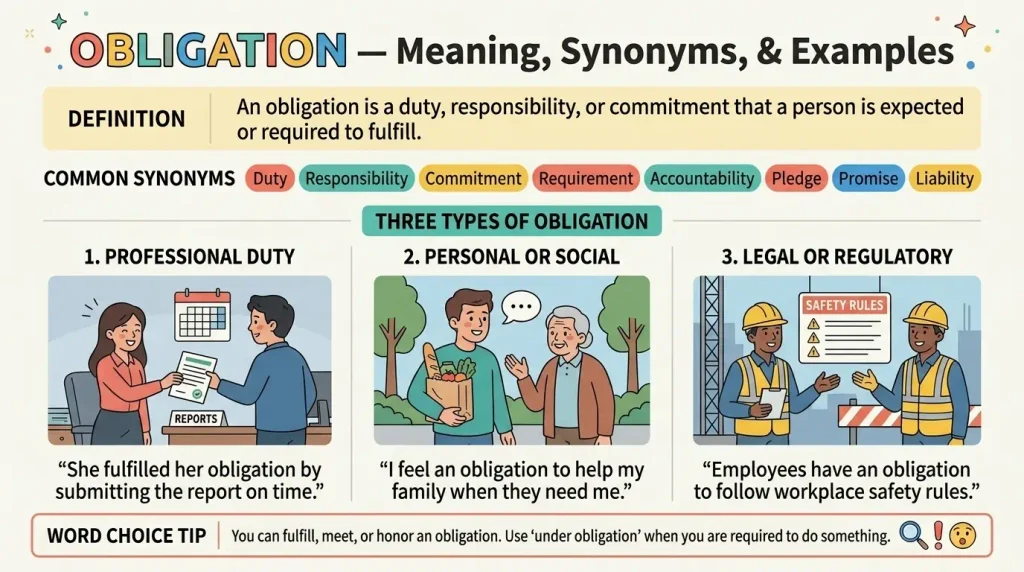
A synonym for obligation is a word that expresses a duty, responsibility, commitment, or requirement. Common alternatives include duty, responsibility, commitment, requirement, and mandate. The best choice depends on the situation and the level of formality.
Imagine promising your friend that you will help them move on Saturday. You have committed. If you must complete a work assignment, you have a responsibility. Both situations involve an obligation, but different words describe them more naturally.
The word obligation appears in everyday conversations, school assignments, workplace emails, legal documents, and personal agreements. Learning its alternatives helps you communicate your intentions with greater clarity and confidence.
For students, bloggers, and content writers, knowing a suitable synonym for obligation can make essays, articles, and professional messages more precise. Daily English users can also express duties without repeating the same word.
This guide explores 45 useful alternatives, explains their differences, and provides practical examples. You will also find a quiz to help you choose the right word in real-life situations.
What Does “Obligation” Really Mean?
An obligation is something you must do because of a promise, rule, law, responsibility, agreement, or sense of duty.
For example, paying your bills on time may be a financial obligation. Completing an assigned project may be a professional obligation. Helping someone you promised to support may be a personal obligation.
Part of speech: Noun.
The word can describe a formal requirement or a personal sense of duty. Sometimes an obligation comes from an external authority. In other cases, it comes from your own values or commitments.
Native English speakers commonly use obligation when discussing contracts, employment, family responsibilities, education, finances, and social expectations.
Simple Definition
An obligation is a duty or requirement that a person is expected or required to fulfill.
Connotative Meaning
(Connotation means the emotional feeling or association a word carries beyond its basic dictionary meaning.)
Positive tone: An obligation can suggest loyalty, dedication, or a meaningful promise.
Negative tone: It can describe pressure, an unwanted duty, or a burden that limits personal freedom.
Neutral tone: It can simply refer to a requirement that someone must meet.
The emotional meaning depends on context. A person may gladly accept an obligation to help a loved one but feel frustrated by an obligation to attend an unnecessary meeting.
Etymology of Obligation
The English word obligation entered English through French and ultimately comes from Latin obligatio, meaning a binding or tying together. It is related to the Latin verb obligare, meaning to bind or place under a duty.
Historical Development
Old English (450–1100): The modern word obligation was not a regular part of Old English vocabulary. Related ideas were expressed through words associated with duty, promises, loyalty, and being bound to another person.
Middle English (1100–1500): After the Norman Conquest, French and Latin vocabulary strongly influenced English. Forms related to obligation entered English through Anglo-French and legal language.
Modern English (1500–present): The word became established in legal, moral, financial, and everyday contexts. Today, it describes both enforceable requirements and personal responsibilities.
Pronunciation
- US: /ˌɑːblɪˈɡeɪʃən/
- UK: /ˌɒblɪˈɡeɪʃən/
Syllables
ob-li-ga-tion — four syllables.
Affixation Pattern
- Root: oblig- — related to binding or placing under a duty.
- Prefix: ob- — historically associated with a Latin element meaning toward or against; it is not a productive English prefix in this word.
- Suffix: -ation — forms a noun describing an action, process, or state.
The word developed through Latin and French, so its structure reflects its historical origins rather than a simple modern English word-building pattern.
Synonyms List
Not every alternative works in every situation. Some words describe legal requirements, while others emphasize personal responsibility, promises, or social expectations.
The following 45 words and expressions cover the most useful meanings. Choose the one that matches your intended message.
1. Duty (Noun)
Meaning: A task or responsibility that someone is expected or required to perform.
Tone/Register: Neutral, formal, professional.
Example:
- It is my duty to report the problem.
- The nurse performed her duties with care.
2. Responsibility (Noun)
Meaning: Something a person must manage, complete, or answer for.
Tone/Register: Neutral, professional, everyday.
Example:
- Paying the rent is my responsibility.
- She accepted responsibility for the mistake.
3. Commitment (Noun)
Meaning: A promise or firm decision to do something or remain dedicated to it.
Tone/Register: Positive, professional, personal.
Example:
- I have a commitment to finish this project.
- Their commitment to the team never wavered.
4. Requirement (Noun)
Meaning: Something that must be done or satisfied to meet a particular condition.
Tone/Register: Neutral, academic, administrative.
Example:
- Attendance is a requirement for the course.
- Please check every requirement before applying.
5. Mandate (Noun)
Meaning: An official instruction or authority that requires a particular action.
Tone/Register: Formal, governmental, organizational.
Example:
- The new mandate requires regular safety checks.
- The agency received a mandate to improve public services.
6. Commitment to Fulfill (Noun Phrase)
Meaning: A clear promise or intention to complete a particular responsibility.
Tone/Register: Formal, professional.
Example:
- We have a commitment to fulfill before Friday.
- Her commitment to fulfill the agreement remains unchanged.
7. Pledge (Noun)
Meaning: A serious promise to do something or support a cause.
Tone/Register: Formal, positive, public.
Example:
- The company made a pledge to reduce waste.
- He kept his pledge to support the local school.
8. Promise (Noun)
Meaning: A statement that someone will do something or ensure a particular outcome.
Tone/Register: Everyday, personal, neutral.
Example:
- I made a promise to call my grandmother.
- She kept her promise to return the book.
9. Duty of Care (Noun Phrase)
Meaning: A responsibility to take reasonable steps to protect others from harm.
Tone/Register: Formal, legal, professional.
Example:
- Teachers have a duty of care toward their students.
- The organization reviewed its duty of care policies.
10. Accountability (Noun)
Meaning: The expectation that someone will explain their actions and accept responsibility for the results.
Tone/Register: Professional, formal.
Example:
- Accountability is essential in effective leadership.
- The manager encouraged accountability across the team.
11. Liability (Noun)
Meaning: Legal responsibility for an action, debt, loss, or damage.
Tone/Register: Legal, financial, formal.
Example:
- The contract explains who carries liability for damage.
- The business reviewed its potential tax liability.
12. Duty to Perform (Noun Phrase)
Meaning: A specific responsibility to carry out an assigned action or contractual task.
Tone/Register: Legal, professional.
Example:
- The contractor has a duty to perform the agreed work.
- Both parties reviewed their duties to perform under the contract.
13. Obligation to Act (Noun Phrase)
Meaning: A requirement to take action rather than remain inactive.
Tone/Register: Formal, legal, ethical.
Example:
- The circumstances created an obligation to act quickly.
- Employees must understand when they have an obligation to act.
14. Charge (Noun)
Meaning: A responsibility or task entrusted to someone’s care.
Tone/Register: Formal, somewhat traditional.
Example:
- The head teacher took charge of the school.
- She treated the project as a serious charge.
15. Assignment (Noun)
Meaning: A specific task or piece of work given to someone.
Tone/Register: Academic, professional, neutral.
Example:
- My assignment must be submitted tomorrow.
- He completed the assignment before the deadline.
16. Task (Noun)
Meaning: A particular piece of work that someone needs to complete.
Tone/Register: Neutral, everyday, professional.
Example:
- My first task is to update the report.
- She finished every task on her checklist.
17. Chore (Noun)
Meaning: A routine job or duty, especially one involving household work.
Tone/Register: Informal, everyday.
Example:
- Washing the dishes is my chore tonight.
- We divided the household chores equally.
18. Burden (Noun)
Meaning: A responsibility that feels difficult, stressful, or exhausting.
Tone/Register: Negative, emotional.
Example:
- The extra paperwork became a burden.
- He felt the burden of supporting his family alone.
19. Onus (Noun)
Meaning: The responsibility for taking action or proving something, often placed on a particular person.
Tone/Register: Formal, legal, academic.
Example:
- The onus is on the applicant to provide accurate details.
- The report places the onus on management to respond.
20. Imperative (Noun)
Meaning: An urgent or essential requirement that must be addressed.
Tone/Register: Formal, academic, professional.
Example:
- Protecting customer data is a business imperative.
- Immediate action is an imperative in this situation.
21. Prerequisite (Noun)
Meaning: Something that must happen or be completed before another thing is possible.
Tone/Register: Academic, formal, administrative.
Example:
- Passing the first course is a prerequisite for enrollment.
- Experience is a prerequisite for this position.
22. Condition (Noun)
Meaning: A requirement that must be met for an agreement or arrangement to apply.
Tone/Register: Neutral, formal, contractual.
Example:
- Payment on time is a condition of the agreement.
- One condition must be met before the offer becomes valid.
23. Stipulation (Noun)
Meaning: A specific term or requirement included in an agreement.
Tone/Register: Formal, legal, business.
Example:
- The contract contains a stipulation about confidentiality.
- We accepted the stipulation before signing the agreement.
24. Covenant (Noun)
Meaning: A formal and often serious agreement that creates binding promises or duties.
Tone/Register: Formal, legal, religious.
Example:
- The document described a covenant between the parties.
- They viewed their promise as a lifelong covenant.
25. Contractual Duty (Noun Phrase)
Meaning: A responsibility that arises from a legally binding contract.
Tone/Register: Legal, business.
Example:
- Delivering the goods is a contractual duty.
- The firm reviewed each contractual duty before signing.
26. Moral Duty (Noun Phrase)
Meaning: A responsibility based on ethical principles or a personal sense of right and wrong.
Tone/Register: Ethical, reflective, formal.
Example:
- She felt a moral duty to tell the truth.
- Many people consider helping those in danger a moral duty.
27. Ethical Responsibility (Noun Phrase)
Meaning: A duty to act according to accepted moral principles.
Tone/Register: Professional, academic, ethical.
Example:
- Journalists have an ethical responsibility to verify facts.
- The team discussed its ethical responsibility toward customers.
28. Social Obligation (Noun Phrase)
Meaning: A duty arising from social expectations, relationships, or community norms.
Tone/Register: Neutral, social, academic.
Example:
- Attending the family gathering felt like a social obligation.
- She balanced social obligations with her study schedule.
29. Engagement (Noun)
Meaning: A commitment or arrangement to participate in an activity or meet someone.
Tone/Register: Formal, professional, sometimes traditional.
Example:
- I have a prior engagement this afternoon.
- She cancelled her engagement because she felt unwell.
30. Undertaking (Noun)
Meaning: A formal promise to perform a task or accept a responsibility.
Tone/Register: Formal, business, legal.
Example:
- The supplier gave an undertaking to repair the equipment.
- Completing the renovation was a major undertaking.
31. Agreement (Noun)
Meaning: A mutual understanding or arrangement that may create duties for the people involved.
Tone/Register: Neutral, business, legal.
Example:
- We reached an agreement about the payment schedule.
- The agreement outlines each person’s responsibilities.
32. Assurance (Noun)
Meaning: A statement intended to give confidence that someone will do something or that something is true.
Tone/Register: Professional, reassuring, formal.
Example:
- She gave me an assurance that the issue would be addressed.
- The client requested written assurance before proceeding.
33. Expectation (Noun)
Meaning: Something that others believe a person should do or achieve.
Tone/Register: Neutral, social, professional.
Example:
- Responding promptly is an expectation in this role.
- He struggled to meet everyone’s expectations.
34. Demand (Noun)
Meaning: A firm request or requirement that someone do something.
Tone/Register: Strong, formal, sometimes negative.
Example:
- The workers faced a demand to increase production.
- She rejected the unreasonable demand.
35. Compulsion (Noun)
Meaning: A strong pressure or force that makes someone feel they must act.
Tone/Register: Negative, psychological, formal.
Example:
- He felt a compulsion to explain every detail.
- She acted from personal conviction rather than compulsion.
36. Necessity (Noun)
Meaning: Something essential that must be done or obtained.
Tone/Register: Neutral, practical, formal.
Example:
- Regular maintenance is a necessity for the building.
- She viewed saving money as a necessity.
37. Need (Noun)
Meaning: A situation in which something is required or important.
Tone/Register: Everyday, neutral.
Example:
- There is a need to update the records.
- I understand the need to finish this work today.
38. Rule (Noun)
Meaning: An established instruction that people are expected or required to follow.
Tone/Register: Neutral, administrative, everyday.
Example:
- Every employee must follow the safety rules.
- The school introduced a rule about mobile phones.
39. Regulation (Noun)
Meaning: An official rule that controls how an activity must be carried out.
Tone/Register: Formal, legal, governmental.
Example:
- The company must follow the new safety regulations.
- The regulation requires accurate recordkeeping.
40. Legal Duty (Noun Phrase)
Meaning: A responsibility imposed by law.
Tone/Register: Legal, formal.
Example:
- Employers have a legal duty to follow applicable safety laws.
- The court considered whether a legal duty existed.
41. Fiscal Responsibility (Noun Phrase)
Meaning: A duty to manage money carefully and meet financial commitments.
Tone/Register: Financial, professional, formal.
Example:
- Fiscal responsibility matters when managing public funds.
- The director emphasized fiscal responsibility in the annual report.
42. Debt (Noun)
Meaning: Money owed to another person or organization, creating a financial duty to repay it.
Tone/Register: Financial, everyday, formal.
Example:
- She worked hard to repay her debt.
- The loan added to the company’s existing debt.
43. Payment Obligation (Noun Phrase)
Meaning: A requirement to pay money under an agreement, law, or other arrangement.
Tone/Register: Financial, contractual, formal.
Example:
- The invoice explains the payment obligation.
- They discussed the payment obligation before renewing the contract.
44. Service (Noun)
Meaning: Work or assistance performed as a duty, particularly in an official, military, or community role.
Tone/Register: Formal, institutional, civic.
Example:
- He completed his military service last year.
- The award recognized her years of public service.
45. Commitment to Duty (Noun Phrase)
Meaning: A strong dedication to fulfilling one’s responsibilities even when doing so is difficult.
Tone/Register: Positive, formal, professional.
Example:
- Her commitment to duty inspired the entire team.
- He showed a commitment to duty during the emergency.
Synonyms for Obligation by Tone
The emotional effect of a word can change how readers understand a sentence. A suitable alternative communicates not only what is required but also how the speaker views that requirement.
Positive
- Commitment
- Pledge
- Promise
- Moral duty
- Ethical responsibility
- Commitment to duty
These words can suggest loyalty, trust, dedication, or a willingness to help.
Neutral
- Responsibility
- Duty
- Requirement
- Task
- Assignment
- Agreement
- Expectation
- Need
Use these when you want to describe a responsibility without emphasizing strong emotion.
Negative
- Burden
- Compulsion
- Demand
- Onus
These words can emphasize pressure, difficulty, or an unwanted responsibility. Their effect still depends on the sentence.
Playful or Informal
- Chore
- Task
- Need
These options work in casual conversations when discussing everyday responsibilities. Chore is especially useful for routine household work.
Why Tone Matters
Compare these sentences:
- “Helping my neighbor is a responsibility.”
- “Helping my neighbor is a meaningful commitment.”
- “Helping my neighbor has become a burden.”
The basic situation may be similar, but each sentence expresses a different attitude. Choose words that accurately reflect your meaning instead of relying on the same alternative every time.
Obligation vs. Close Alternatives
Obligation vs. Responsibility
An obligation often emphasizes something a person is required to do because of a rule, promise, agreement, or moral principle. Responsibility can describe a wider range of duties, including tasks someone manages or outcomes they must answer for.
Use obligation when the requirement itself matters. Use responsibility when you want to emphasize ownership or accountability.
Obligation vs. Duty
Duty often refers to a role-based, moral, or socially recognized responsibility. Obligation can sound more formal and may suggest a binding requirement.
For example, a nurse may have a duty to care for patients. A company may have a contractual obligation to pay its suppliers.
Obligation vs. Commitment
A commitment usually emphasizes a promise, decision, or dedication. An obligation focuses more on the requirement to act.
Use commitment when you want to highlight willingness or loyalty. Use obligation when you need to stress that something is expected or required.
How Obligation Changes by Context
Daily Conversation
In casual speech, responsibility, promise, duty, and chore often sound more natural than obligation. The right choice depends on whether you mean a personal promise, a routine job, or a requirement.
Example: “I promised to help my brother” sounds more conversational than “I have an obligation to help my brother.”
Writing and Blogging
Writers can use responsibility, requirement, commitment, and expectation to make explanations more specific. The alternative should match the point being discussed.
For an article about parenting, responsibility may fit better. In a guide to application rules, requirement is usually clearer.
Professional and Academic English
Formal writing often uses obligation, mandate, stipulation, contractual duty, and accountability. These words help distinguish legal requirements from professional expectations.
However, formal vocabulary does not automatically improve writing. Prefer the clearest accurate term, especially when explaining rules to a general audience.
Creative and Informal Use
Stories and personal essays may use burden, promise, pledge, or chore to show how a character feels about a responsibility.
For example, calling a family duty a burden creates a different emotional impression from describing it as a promise. That difference can help establish a character’s attitude.
Common Mistakes Learners Make
Using Every Synonym Interchangeably
Words such as liability, promise, and requirement have distinct meanings. A liability often concerns legal or financial responsibility, while a promise emphasizes someone’s word.
Always check whether the alternative preserves the intended meaning.
Using Formal Words in Casual Conversation
Phrases such as contractual duty and stipulation can sound unnatural in everyday conversation. They are useful when precision matters, especially in business or legal contexts.
For casual situations, promise, task, or responsibility may be easier to understand.
Confusing a Requirement with a Preference
A necessity is something essential, while an expectation is something people believe should happen. An expectation may not be legally binding.
For example, arriving early may be an expectation at work. Attending a mandatory training session may be a requirement.
Overusing Obligation in One Paragraph
Repeating the same noun can make writing sound mechanical. Replace it with a suitable alternative when the meaning remains accurate.
Do not change the word merely to avoid repetition. Clarity should always come before variety.
Formal vs. Informal Register
Use obligation, mandate, and stipulation when the context requires formal precision. Choose promise, task, or chore for ordinary situations.
In spoken English, simpler expressions often feel more natural. In legal or academic writing, a more specific term may be necessary.
Internal linking suggestion: Link this article to a related guide on synonyms for responsibility to help readers explore closely connected vocabulary.
Real-Life Mini Scenarios
Workplace
A project manager must deliver a report by Friday. The deadline creates a professional responsibility. If the deadline appears in a signed agreement, it may also involve a contractual duty.
Social Situations
You tell a friend that you will attend their graduation. Your promise reflects your intention to be there. If you feel pressured to attend several events, you may describe them as social obligations.
Media and Public Life
A news report may explain that a public agency has a legal duty to protect private information. A commentator may discuss ioofcsc’s moral responsibility during a crisis.
Writing and Storytelling
A character might feel a burden when family expectations limit their freedom. Another character may view the same family role as a meaningful commitment.
The choice of synonym helps readers understand each character’s attitude.
How to Choose the Best Synonym
Before replacing obligation, ask yourself three questions:
- Is it legally required? Consider legal duty, liability, mandate, or contractual duty, depending on the exact meaning.
- Is it a personal promise? Consider commitment, pledge, or promise.
- Does it involve ordinary work or responsibility? Consider task, duty, responsibility, or requirement.
These questions help you avoid inaccurate substitutions. They also make your writing sound more natural and precise.
Conclusion
Learning a synonym for obligation helps you express duties, promises, and requirements more clearly. The right word adds precision to everyday conversations and professional writing.
Words such as duty, responsibility, and commitment share important meanings, but each carries a different emphasis. Understanding those differences makes your vocabulary more flexible.
Students, bloggers, and content writers can use these alternatives to create clearer essays, articles, and messages. Regular practice also helps everyday English speakers communicate with greater confidence.
Choose three synonyms from this guide and write your own sentences using them. Try each word in an email, an essay, or a daily conversation to strengthen your vocabulary naturally.
Suggested external resources:
- Merriam-Webster Dictionary — https://www.merriam-webster.com/
- Cambridge Dictionary — https://dictionary.cambridge.org/
Interactive Practice Quiz
Choose the most suitable answer for each situation. The questions test meaning, tone, and real-life usage.
1. Which word best describes money that you are legally required to repay?
A. Pledge
B. Debt
C. Chore
D. Expectation
2. A student must pass an introductory course before taking an advanced class. What is the introductory course?
A. Burden
B. Liability
C. Prerequisite
D. Assurance
3. Which word best describes a promise to support an environmental cause?
A. Pledge
B. Chore
C. Demand
D. Debt
4. A worker must explain their decisions and accept the results. Which word fits best?
A. Compulsion
B. Accountability
C. Engagement
D. Necessity
5. Which expression describes a responsibility imposed by law?
A. Social obligation
B. Personal promise
C. Legal duty
D. Household chore
6. Someone feels overwhelmed by too many responsibilities. Which word best describes that feeling?
A. Agreement
B. Burden
C. Mandate
D. Prerequisite
7. Which word best describes a routine household job?
A. Chore
B. Covenant
C. Liability
D. Stipulation
8. A contract specifies that a supplier must deliver products by a certain date. What is this responsibility?
A. Social expectation
B. Moral duty
C. Contractual duty
D. Personal preference
9. Which word best describes a firm promise to complete a project?
A. Commitment
B. Regulation
C. Compulsion
D. Burden
10. A school introduces an official rule about student safety. Which word is most suitable?
A. Pledge
B. Regulation
C. Assurance
D. Engagement
Part Two
11. A person feels they must tell the truth because it is ethically right. Which expression fits best?
A. Fiscal responsibility
B. Moral duty
C. Payment obligation
D. Household chore
12. Which word describes something essential for a particular purpose?
A. Necessity
B. Engagement
C. Promise
D. Covenant
13. A business agreement contains a specific condition about confidentiality. Which word best describes that term?
A. Chore
B. Stipulation
C. Compulsion
D. Burden
14. Which word best describes a task someone has been assigned at school?
A. Assignment
B. Liability
C. Mandate
D. Covenant
15. A friend says they will return your book tomorrow. Which word best describes their statement?
A. Regulation
B. Promise
C. Fiscal responsibility
D. Prerequisite
Reflection Task
Write two original sentences using different synonyms for obligation. One sentence should describe a professional situation, and the other should describe a personal situation.
Answer Key: 1-B, 2-C, 3-A, 4-B, 5-C, 6-B, 7-A, 8-C, 9-A, 10-B, 11-B, 12-A, 13-B, 14-A, 15-B.
FAQs
1. What is the best synonym for obligation in an essay?
Responsibility is often a strong choice for general essays because it is clear and widely understood. However, duty may fit discussions of ethics, while requirement works well when explaining rules or conditions. Select the word that matches your argument instead of choosing an alternative only to avoid repetition.
2. What is a formal synonym for obligation in business writing?
Mandate, contractual duty, stipulation, and requirement can work in formal business writing. Each has a different meaning. A mandate usually involves an official instruction or authority, while a stipulation identifies a specific term in an agreement. Choose the most precise option for the document and situation.
3. What is a synonym for obligation that means a personal promise?
Commitment, pledge, and promise can express a personal undertaking. Promise is the most direct option for everyday conversation. Pledge sounds more serious or public, while commitment often suggests continued dedication to a person, goal, or responsibility.
4. What is the difference between a moral obligation and a legal obligation?
A moral obligation comes from ethical beliefs or a sense of right and wrong. A legal obligation comes from laws or enforceable legal rules. An action may involve both, but the two are not identical. For example, helping a stranger may be considered morally good without being legally required.
5. Which synonym for obligation is best for a resume?
Responsibility, accountability, and commitment are useful choices for resumes. Use responsibility to describe duties you handled, accountability to emphasize ownership of results, and commitment to highlight dedication. Whenever possible, support the word with a concrete achievement or a specific example of your contribution.
6. Can obligation have a positive meaning?
Yes. An obligation can reflect loyalty, care, or a meaningful promise. Someone may gladly accept a responsibility to support a family member or contribute to a community. Although the word can suggest pressure in some situations, its emotional tone depends on the context and the speaker’s attitude.
7. What is the difference between obligation and necessity?
An obligation is a duty or requirement that someone is expected or required to fulfill. A necessity is something essential or needed. Paying a debt may be an obligation, while food and water are necessities. In some situations, one action can be both necessary and obligatory, but the words emphasize different ideas.
8. Where can I find reliable definitions and examples of obligation?
Consult established dictionaries for definitions, pronunciation, grammatical information, and example sentences. The Merriam-Webster Dictionary and Cambridge Dictionary are good places to start. Compare their definitions with the context of your sentence to decide whether duty, responsibility, commitment, or another alternative communicates your intended meaning most accurately.

Sophia Carter is the founder and lead writer at SynonymVerse.com, a trusted online resource dedicated to English vocabulary and effective communication. She is passionate about helping students, writers, professionals, and lifelong learners find the most accurate words to express their ideas with clarity and confidence.
At SynonymVerse.com, every article is carefully researched and thoughtfully written to provide reliable guidance on synonyms, word meanings, and vocabulary. With a strong focus on accuracy, real-world usage, and easy-to-understand explanations, the website is committed to helping readers strengthen their language skills, enrich their vocabulary, and become more confident communicators.