A synonym for nod is a word or phrase that describes a similar gesture or action, such as dip, incline, bow, or gesture. The best choice depends on whether you mean agreement, acknowledgment, greeting, or movement of the head.
Imagine asking a friend, “Are you ready?” Your friend moves their head up and down instead of speaking. That small gesture communicates a clear answer without a single word.
The word nod appears in everyday conversations, novels, workplace meetings, and online writing. Learning related words helps you describe reactions more precisely and avoid repeating the same expression.
Students can use alternatives in essays, while bloggers and content writers can make descriptions more engaging. Everyday English users can also choose expressions that better match the situation.
A good synonym for nod depends on the intended meaning. Some words describe head movement, while others express agreement or recognition. Understanding these differences makes your English sound clearer and more natural.
What Does “Nod” Really Mean?
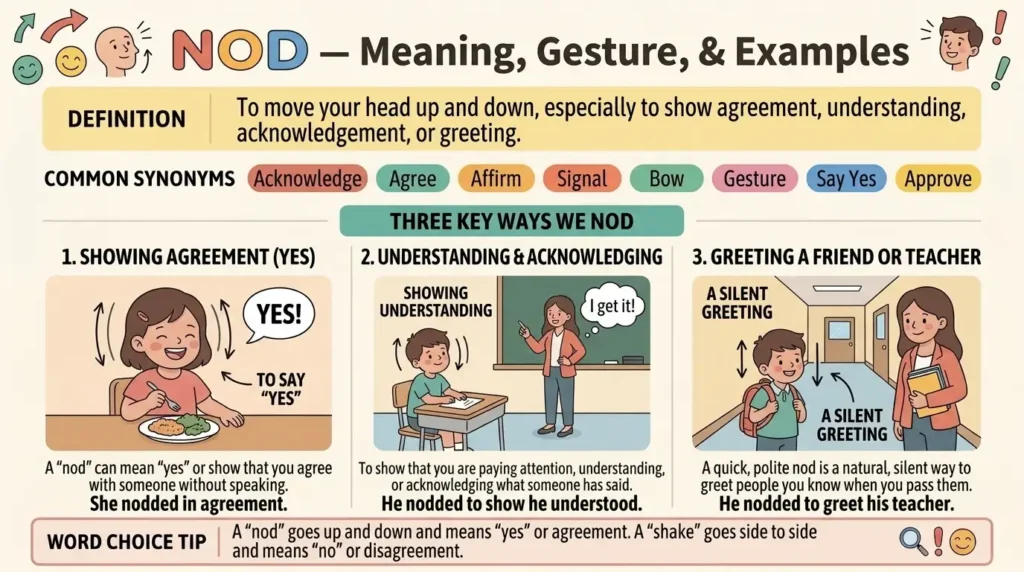
Nod means to move your head briefly, usually up and down, to show agreement, acknowledgment, greeting, or understanding. It can also describe a small movement made while listening or thinking.
Native English speakers commonly use nod in conversations, meetings, classrooms, stories, and social situations. It is a familiar word because people often communicate through facial expressions and body language.
Part of Speech
- Verb: To move your head to communicate something. Example: “She nodded to show that she understood.”
- Noun: A brief movement of the head. Example: “He gave me a friendly nod.”
Connotative Meaning
(Connotation means the feeling or association a word carries beyond its basic dictionary meaning.)
- Positive tone: A nod can suggest approval, agreement, encouragement, or friendly recognition.
- Negative tone: A nod may seem reluctant, dismissive, or impatient when the situation gives it that meaning.
- Neutral tone: A nod can simply acknowledge information or confirm that someone is listening.
The word itself is generally neutral. The speaker’s intention, facial expression, and situation determine its emotional effect.
Etymology of Nod
The English word nod has Germanic roots. It is associated with the idea of making a short movement of the head.
Old English (450–1100)
The word has roots in Old English hnodian, meaning to nod or move the head. It described a physical action used in communication.
Middle English (1100–1500)
The word continued in forms related to nodden. Its use remained connected to head movement, agreement, and acknowledgment.
Modern English (1500–Present)
Nod became established as both a noun and a verb. Today, it can describe a physical gesture, a sign of approval, or a figurative acknowledgment, such as “a nod to tradition.”
Pronunciation, Syllables, and Word Structure
- US pronunciation: /nɑːd/ or /nɑd/, depending on the transcription system and accent.
- UK pronunciation: /nɒd/
- Syllables: nod (one syllable)
- Root: nod
- Prefix: None
- Suffix: None in the base form
- Word forms: nods, nodded, nodding
The base word is short and simple. Its common grammatical forms change to match the tense or subject of a sentence.
Synonyms List
The following alternatives cover physical head movements and expressions of agreement, acknowledgment, or recognition. Some are direct substitutes for nod, while others work only in specific contexts.
1. Bob (Verb) — US / UK: /bɑːb/ / /bɒb/
Meaning: To move your head or another object quickly up and down.
Tone/Register: Neutral, conversational.
Example: The child bobbed his head to the rhythm of the music.
She gave a quick bob of her head when she spotted her friend.
2. Dip (Verb) — US / UK: /dɪp/ / /dɪp/
Meaning: To move your head briefly downward.
Tone/Register: Neutral.
Example: He dipped his head to acknowledge the guest.
She dipped her chin before entering the room.
3. Bow (Verb) — US / UK: /baʊ/ / /baʊ/
Meaning: To bend your head or upper body as a sign of respect, greeting, or formality.
Tone/Register: Formal, respectful.
Example: The performer bowed to the audience after the show.
He bowed his head politely when he met the elder.
4. Incline (Verb) — US / UK: /ɪnˈklaɪn/ / /ɪnˈklaɪn/
Meaning: To bend your head slightly in a particular direction, often as a formal gesture.
Tone/Register: Formal, literary.
Example: She inclined her head in acknowledgment.
The professor inclined his head toward the visitor.
5. Tilt (Verb) — US / UK: /tɪlt/ / /tɪlt/
Meaning: To move your head to one side or at an angle.
Tone/Register: Neutral, descriptive.
Example: He tilted his head to show curiosity.
She tilted her head toward the speaker to hear better.
6. Lower One’s Head (Phrase) — US / UK: /ˈloʊ.ɚ wʌnz hɛd/ / /ˈləʊ.ə wʌnz hɛd/
Meaning: To move your head downward as a sign of respect, thought, or acknowledgment.
Tone/Register: Neutral, formal.
Example: He lowered his head in silent recognition.
She lowered her head slightly when the ceremony began.
7. Nod One’s Head (Phrase) — US / UK: /nɑːd wʌnz hɛd/ / /nɒd wʌnz hɛd/
Meaning: To move the head up and down to communicate agreement or acknowledgment.
Tone/Register: Neutral, conversational.
Example: The student nodded his head when the teacher asked a question.
I nodded my head to let her know I was listening.
8. Jerk One’s Head (Phrase) — US / UK: /dʒɝːk wʌnz hɛd/ / /dʒɜːk wʌnz hɛd/
Meaning: To move the head suddenly in a quick, sharp motion.
Tone/Register: Informal, descriptive.
Example: He jerked his head toward the open door.
She jerked her head backward in surprise.
9. Gesture (Verb) — US / UK: /ˈdʒes.tʃɚ/ / /ˈdʒes.tʃə/
Meaning: To communicate an idea or intention through a physical movement.
Tone/Register: Neutral, professional.
Example: He gestured toward the empty chair to invite me to sit.
She gestured with her head to indicate the correct room.
10. Signal (Verb) — US / UK: /ˈsɪɡ.nəl/ / /ˈsɪɡ.nəl/
Meaning: To communicate information or an instruction through a movement or sign.
Tone/Register: Neutral, professional.
Example: The manager signaled approval with a small movement of her head.
He signaled for the team to begin.
11. Acknowledge (Verb) — US / UK: /əkˈnɑː.lɪdʒ/ / /əkˈnɒl.ɪdʒ/
Meaning: To show that you have noticed, heard, or recognized someone or something.
Tone/Register: Neutral, formal, business.
Example: She acknowledged my greeting with a brief nod.
The director acknowledged the question before answering it.
12. Assent (Verb) — US / UK: /əˈsent/ / /əˈsent/
Meaning: To express agreement with a suggestion, statement, or proposal.
Tone/Register: Formal, academic.
Example: He assented to the proposal after reviewing the details.
The committee assented to the change without further discussion.
13. Agree (Verb) — US / UK: /əˈɡriː/ / /əˈɡriː/
Meaning: To share another person’s opinion or accept a proposed idea.
Tone/Register: Neutral, everyday.
Example: I agree with your suggestion about the schedule.
She nodded to show that she agreed with him.
14. Confirm (Verb) — US / UK: /kənˈfɝːm/ / /kənˈfɜːm/
Meaning: To establish that something is correct, true, or settled.
Tone/Register: Neutral, professional.
Example: He confirmed the appointment with a quick nod.
Please confirm your attendance before Friday.
15. Affirm (Verb) — US / UK: /əˈfɝːm/ / /əˈfɜːm/
Meaning: To state or show firmly that something is true or accepted.
Tone/Register: Formal, academic.
Example: She affirmed her support for the new policy.
He affirmed the decision with a confident nod.
16. Indicate (Verb) — US / UK: /ˈɪn.dɪ.keɪt/ / /ˈɪn.dɪ.keɪt/
Meaning: To point out, show, or communicate something through words or actions.
Tone/Register: Neutral, professional.
Example: His nod indicated that he understood the instructions.
She indicated her choice by pointing to the second option.
17. Recognize (Verb) — US / UK: /ˈrek.əɡ.naɪz/ / /ˈrek.əɡ.naɪz/
Meaning: To identify someone or show awareness of their presence or achievement.
Tone/Register: Neutral, professional.
Example: The speaker recognized her contribution during the meeting.
He recognized his neighbor with a friendly nod.
18. Greet (Verb) — US / UK: /ɡriːt/ / /ɡriːt/
Meaning: To welcome or acknowledge someone when meeting them.
Tone/Register: Neutral, friendly.
Example: She greeted her colleague with a warm smile.
He greeted the visitors with a small nod.
19. Salute (Verb) — US / UK: /səˈluːt/ / /səˈluːt/
Meaning: To show respect or recognition through a formal gesture.
Tone/Register: Formal, respectful.
Example: The officer saluted the senior commander.
The audience saluted the athlete’s achievement with applause.
20. Approve (Verb) — US / UK: /əˈpruːv/ / /əˈpruːv/
Meaning: To express a favorable opinion or accept something as satisfactory.
Tone/Register: Neutral, professional.
Example: The supervisor approved the plan with a nod.
Her parents approved of her decision to study abroad.
21. Accept (Verb) — US / UK: /əkˈsept/ / /əkˈsept/
Meaning: To agree to receive, take, or recognize something as valid.
Tone/Register: Neutral, everyday.
Example: He accepted the invitation with a grateful smile.
She nodded to show that she accepted the explanation.
22. Acquiesce (Verb) — US / UK: /ˌæk.wiˈes/ / /ˌæk.wiˈes/
Meaning: To agree or comply without openly resisting, sometimes reluctantly.
Tone/Register: Formal, often negative or resigned.
Example: He acquiesced to the request after a long discussion.
She finally agreed, although her expression showed reluctance.
23. Concede (Verb) — US / UK: /kənˈsiːd/ / /kənˈsiːd/
Meaning: To admit that someone else is right or that a point is valid, often unwillingly.
Tone/Register: Formal, argumentative.
Example: He conceded that his colleague had a stronger argument.
She nodded reluctantly when the evidence became clear.
24. Comply (Verb) — US / UK: /kəmˈplaɪ/ / /kəmˈplaɪ/
Meaning: To act according to a request, instruction, or rule.
Tone/Register: Formal, business.
Example: The employee complied with the safety instructions.
He nodded and followed the supervisor’s directions.
25. Consent (Verb) — US / UK: /kənˈsent/ / /kənˈsent/
Meaning: To give permission or agree to something.
Tone/Register: Formal, legal.
Example: She consented to the interview after reviewing the conditions.
He gave a clear verbal response rather than relying on a nod.
26. Endorse (Verb) — US / UK: /ɪnˈdɔːrs/ / /ɪnˈdɔːrs/
Meaning: To publicly or formally express support for a person, idea, or decision.
Tone/Register: Formal, business.
Example: The board endorsed the revised strategy.
Her manager showed support for the idea with an approving nod.
27. Ratify (Verb) — US / UK: /ˈræt̬.ə.faɪ/ / /ˈræt.ɪ.faɪ/
Meaning: To formally approve an agreement or decision, usually through an official process.
Tone/Register: Legal, formal.
Example: The council ratified the agreement after reviewing its terms.
A simple nod cannot ratify a contract unless the relevant rules recognize it as sufficient approval.
28. Validate (Verb) — US / UK: /ˈvæl.ə.deɪt/ / /ˈvæl.ɪ.deɪt/
Meaning: To confirm that something is legitimate, reasonable, or acceptable.
Tone/Register: Professional, academic.
Example: The test results validated the researcher’s findings.
Her supportive nod helped him feel that his concerns mattered.
29. Acknowledge With a Gesture (Phrase) — US / UK: /əkˈnɑː.lɪdʒ wɪð ə ˈdʒes.tʃɚ/ / /əkˈnɒl.ɪdʒ wɪð ə ˈdʒes.tʃə/
Meaning: To show awareness of someone or something without necessarily speaking.
Tone/Register: Neutral, descriptive.
Example: She acknowledged the audience with a small gesture.
He acknowledged my arrival without interrupting the conversation.
30. Give a Sign (Phrase) — US / UK: /ɡɪv ə saɪn/ / /ɡɪv ə saɪn/
Meaning: To communicate a message or instruction through a recognizable signal.
Tone/Register: Neutral, conversational.
Example: Give me a sign when you’re ready to leave.
She gave a small nod to signal that we could begin.
31. Motion (Verb) — US / UK: /ˈmoʊ.ʃən/ / /ˈməʊ.ʃən/
Meaning: To direct or invite someone through a movement of the body.
Tone/Register: Neutral, descriptive.
Example: He motioned toward the door for us to follow.
She motioned with her head to show where the guests were sitting.
32. Beckon (Verb) — US / UK: /ˈbek.ən/ / /ˈbek.ən/
Meaning: To signal someone to approach or follow, usually with a hand or head movement.
Tone/Register: Neutral, literary.
Example: The guide beckoned the group to come closer.
She beckoned him forward with a slight movement of her head.
33. Bow One’s Head (Phrase) — US / UK: /baʊ wʌnz hɛd/ / /baʊ wʌnz hɛd/
Meaning: To bend the head downward to show respect, sadness, prayer, or humility.
Tone/Register: Respectful, solemn.
Example: Everyone bowed their heads during the moment of silence.
He bowed his head in respect for the speaker.
34. Give a Dip of the Head (Phrase) — US / UK: /ɡɪv ə dɪp əv ðə hɛd/ / /ɡɪv ə dɪp əv ðə hɛd/
Meaning: To make a brief downward head movement as acknowledgment or greeting.
Tone/Register: Neutral, descriptive.
Example: She gave a dip of the head to the receptionist.
He offered a slight dip of his head before taking his seat.
35. Tip One’s Head (Phrase) — US / UK: /tɪp wʌnz hɛd/ / /tɪp wʌnz hɛd/
Meaning: To move the head slightly, often to show recognition or curiosity.
Tone/Register: Neutral, conversational.
Example: He tipped his head toward the new visitor.
She tipped her head in acknowledgment as she passed.
36. Duck (Verb) — US / UK: /dʌk/ / /dʌk/
Meaning: To lower your head or body quickly, often to avoid something.
Tone/Register: Informal, descriptive.
Example: He ducked his head to pass under the low doorway.
She ducked when the ball flew toward her face.
Usage note: Ducking usually describes avoidance, not agreement, so it is not a direct substitute for nod.
37. Dip One’s Chin (Phrase) — US / UK: /dɪp wʌnz tʃɪn/ / /dɪp wʌnz tʃɪn/
Meaning: To lower the chin slightly as a subtle gesture of acknowledgment or thought.
Tone/Register: Neutral, descriptive.
Example: She dipped her chin to show that she had heard him.
He dipped his chin briefly before answering the question.
38. Shake One’s Head (Phrase) — US / UK: /ʃeɪk wʌnz hɛd/ / /ʃeɪk wʌnz hɛd/
Meaning: To move the head from side to side, usually to express disagreement, refusal, or disbelief.
Tone/Register: Neutral, conversational.
Example: He shook his head to indicate that he disagreed.
She shook her head when her friend asked if she needed help.
Usage note: This is often the opposite of a nod in English-speaking contexts.
39. Give a Nod (Phrase) — US / UK: /ɡɪv ə nɑːd/ / /ɡɪv ə nɒd/
Meaning: To make a brief head movement to acknowledge, greet, or agree with someone.
Tone/Register: Neutral, conversational.
Example: She gave me a nod as she entered the room.
The coach gave a nod to show that the player could begin.
40. Offer a Nod (Phrase) — US / UK: /ˈɔː.fɚ ə nɑːd/ / /ˈɒf.ə ə nɒd/
Meaning: To direct a brief, often polite head movement toward another person.
Tone/Register: Neutral, polite.
Example: He offered a nod to the host before sitting down.
She offered a small nod of thanks to the driver.
41. Give a Thumbs-Up (Phrase) — US / UK: /ɡɪv ə ˌθʌmz ˈʌp/ / /ɡɪv ə ˌθʌmz ˈʌp/
Meaning: To show approval or agreement by raising the thumb.
Tone/Register: Informal, positive.
Example: The director gave the crew a thumbs-up after the rehearsal.
I sent a thumbs-up to confirm that the plan worked for me.
42. Show Approval (Phrase) — US / UK: /ʃoʊ əˈpruː.vəl/ / /ʃəʊ əˈpruː.vəl/
Meaning: To communicate that you consider something good or acceptable.
Tone/Register: Neutral, professional.
Example: The teacher showed approval with a brief nod.
Her expression showed approval of the final design.
43. Express Agreement (Phrase) — US / UK: /ɪkˈspres əˈɡriː.mənt/ / /ɪkˈspres əˈɡriː.mənt/
Meaning: To communicate that you share someone’s opinion or accept a proposal.
Tone/Register: Neutral, professional.
Example: He agreed by nodding during the discussion.
She agreed with a short, clear response.
44. Give Assent (Phrase) — US / UK: /ɡɪv əˈsent/ / /ɡɪv əˈsent/
Meaning: To communicate formal agreement with a request or proposal.
Tone/Register: Formal, academic.
Example: The chair gave assent to the motion after the discussion.
He gave his assent by signing the final document.
45. Signal Agreement (Phrase) — US / UK: /ˈsɪɡ.nəl əˈɡriː.mənt/ / /ˈsɪɡ.nəl əˈɡriː.mənt/
Meaning: To show that you agree by using a gesture, expression, or other signal.
Tone/Register: Neutral, professional.
Example: She signaled agreement with a quick nod.
He raised his hand to signal agreement with the proposal.
46. Give Recognition (Phrase) — US / UK: /ɡɪv ˌrek.əɡˈnɪʃ.ən/ / /ɡɪv ˌrek.əɡˈnɪʃ.ən/
Meaning: To show awareness of someone’s presence, contribution, or achievement.
Tone/Register: Formal, professional.
Example: The manager gave recognition to the team’s hard work.
He acknowledged his colleague with a respectful nod.
47. Show Respect (Phrase) — US / UK: /ʃoʊ rɪˈspekt/ / /ʃəʊ rɪˈspekt/
Meaning: To communicate regard for another person through words or actions.
Tone/Register: Neutral, respectful.
Example: She showed respect by listening without interrupting.
He gave a small nod to show respect for the speaker.
48. Give a Curt Nod (Phrase) — US / UK: /ɡɪv ə kɝːt nɑːd/ / /ɡɪv ə kɜːt nɒd/
Meaning: To make a short, abrupt head movement that may seem cold or impatient.
Tone/Register: Negative, descriptive.
Example: He gave a curt nod and returned to his work.
She offered only a curt nod before walking away.
49. Give a Respectful Nod (Phrase) — US / UK: /ɡɪv ə rɪˈspekt.fəl nɑːd/ / /ɡɪv ə rɪˈspekt.fəl nɒd/
Meaning: To make a brief head movement that communicates courtesy or respect.
Tone/Register: Polite, formal.
Example: The young athlete gave the referee a respectful nod.
She gave a respectful nod to the guest speaker.
50. Give an Affirmative Nod (Phrase) — US / UK: /ɡɪv ən əˈfɝː.mə.tɪv nɑːd/ / /ɡɪv ən əˈfɜː.mə.tɪv nɒd/
Meaning: To move the head in a way that clearly communicates a positive answer or agreement.
Tone/Register: Neutral, professional.
Example: The interviewer asked if he was ready, and he gave an affirmative nod.
She gave an affirmative nod when the team leader asked for confirmation.
Synonyms for Nod by Tone
The tone of a word affects how readers interpret a gesture. Choose an expression that matches the relationship, setting, and intended message.
Positive
- Approve: Shows support or acceptance.
- Affirm: Communicates confident agreement.
- Endorse: Expresses formal support.
- Recognize: Shows awareness or appreciation.
- Give a respectful nod: Communicates courtesy.
- Give a thumbs-up: Shows informal approval.
Neutral
- Bob: Describes a short up-and-down movement.
- Dip: Describes a brief downward movement.
- Tilt: Describes an angled head movement.
- Acknowledge: Shows that you noticed someone.
- Confirm: Establishes that something is correct.
- Signal: Communicates a message through an action.
Negative or Reluctant
- Acquiesce: Suggests agreement without resistance, sometimes unwillingly.
- Concede: Suggests admitting another person’s point.
- Give a curt nod: Can imply impatience or coldness.
- Duck: Usually describes avoidance rather than acknowledgment.
- Shake one’s head: Commonly communicates disagreement or refusal.
Playful or Informal
- Bob: Can describe a rhythmic or exaggerated movement.
- Tip one’s head: Can convey curiosity or a light acknowledgment.
- Give a thumbs-up: Communicates casual approval.
- Jerk one’s head: Describes a sudden, emphatic movement.
- Give a nod: Works naturally in casual conversation.
Tone matters because the same physical movement can communicate warmth, reluctance, respect, or impatience. Select the wording that matches the message you want readers to understand.
“Nod” vs. Close Alternatives
Some alternatives share a similar meaning but differ in movement, intention, or formality. These distinctions help you choose the most accurate expression.
Nod vs. Bow
A nod is usually a small head movement used for agreement or acknowledgment. A bow involves bending the head or upper body to show respect, greeting, or formality.
Use nod in everyday conversations and meetings. Choose bow when describing a formal greeting, a respectful gesture, or a performer’s response to applause.
Nod vs. Bob
A nod often communicates a message, such as agreement or recognition. A bob emphasizes a quick up-and-down movement and does not necessarily communicate a clear message.
For example, “She nodded to confirm the answer” shows agreement. “Her head bobbed as she danced” describes physical movement.
Nod vs. Acknowledge
A nod describes a particular physical gesture. Acknowledge describes the act of showing that you have noticed, heard, or recognized someone or something.
Use nod when the head movement matters. Use acknowledge when the main point is recognition, whether through a gesture, words, or another action.
How “Nod” Changes by Context
Daily Conversation
In everyday speech, nod is a natural way to describe a brief response without words. It often replaces a spoken “yes,” although the meaning depends on the situation.
Example: “I asked if she wanted coffee, and she nodded.”
Writing and Blogging
Writers can use dip, tilt, bob, and incline to describe specific head movements. These choices make scenes more vivid when the physical action matters.
For SEO content, avoid replacing every occurrence of nod with another word simply to increase vocabulary variety. Accuracy and readability matter more than using many synonyms.
Professional and Academic English
In a workplace, acknowledge, confirm, affirm, and assent may describe the communicative purpose of a nod. However, these words do not always describe the physical movement itself.
Example: “The manager acknowledged the concern before explaining the decision.”
Use assent when formal agreement is important. Use confirm when someone verifies information.
Creative and Informal Writing
Stories and dialogue benefit from specific descriptions of body language. A curt nod may suggest impatience, while a respectful nod can communicate courtesy.
Example: “Maya gave him a quick nod and hurried toward the station.”
The right expression can communicate emotion without adding lengthy explanations.
Common Mistakes Learners Make
1. Treating Every Alternative as an Exact Synonym
Words such as bow, duck, and shake describe different movements. They cannot replace nod in every sentence.
2. Confusing Agreement With Acknowledgment
A nod can mean “I understand,” “I see you,” or “I agree.” These messages are related but not identical.
When the exact meaning matters, explain the purpose of the gesture rather than assuming that every nod signals approval.
3. Using Formal Words in Casual Conversations
Words such as assent, acquiesce, and ratify suit particular formal contexts. They can sound unnatural in ordinary conversation.
For example, “She agreed with me” is usually more natural than “She assented to my opinion” in a casual chat.
4. Ignoring Cultural Differences
Head gestures do not carry identical meanings in every culture. Even familiar movements can be interpreted differently depending on local customs and context.
Avoid assuming that every person uses or understands a nod in the same way.
5. Repeating the Same Word Too Often
Using nod repeatedly in a story can make descriptions feel monotonous. However, replacing it with an inaccurate word can confuse readers.
Choose an alternative only when it expresses the intended action or meaning more clearly.
Register Notes: Formal vs. Informal English
- Formal: assent, affirm, acknowledge, endorse, incline.
- Informal: bob, tip one’s head, give a thumbs-up.
- Neutral: nod, dip, tilt, signal, confirm.
- Literary: beckon, incline, bow one’s head.
- Potentially negative: acquiesce, concede, give a curt nod.
In spoken English, nod and agree are common choices. In formal writing, select a more precise word when the context calls for it. Remember that some alternatives describe intentions rather than physical movements.
Real-Life Examples Using “Nod”
Workplace
During a meeting, a team leader asks whether everyone understands the new deadline. One employee nods to indicate understanding. Another asks a question because agreement and understanding are not always the same.
Social Situations
You see a neighbor across a busy street. A small nod acknowledges their presence without requiring you to stop and talk.
Media and Pop Culture
In a film, a character may give a curt nod before leaving a tense conversation. That brief gesture can suggest frustration, reluctance, or emotional distance.
Writing and Storytelling
A novelist describes a character who inclines her head when an important guest enters. This wording creates a more formal atmosphere than a simple nod.
External Learning Resource
For additional guidance on word meanings and pronunciation, consult the Cambridge Dictionary. Its entries can help you compare definitions, listen to pronunciations, and understand how related words work in context.
You can visit the Cambridge Dictionary to explore more English vocabulary.
Conclusion
Learning a synonym for nod helps you describe gestures, agreement, and acknowledgment with greater accuracy. Each alternative adds a slightly different meaning to your English vocabulary.
Students can improve essays, bloggers can write more engaging articles, and everyday English users can communicate their thoughts more clearly. Small vocabulary choices make a difference.
You do not need to memorize every alternative at once. Start with familiar words such as acknowledge, agree, bow, and tilt, then explore more formal expressions as your confidence grows.
Practice these words in emails, essays, stories, and daily conversations. Choose one new synonym today and write your own sentence to make it part of your active vocabulary.
MCQs
1. What does “nod” usually mean?
A. Move your head up and down B. Run quickly C. Close your eyes D. Clap your hands
2. Which word is a synonym for nod?
A. Jump B. Bob C. Shout D. Walk
3. Which gesture often shows agreement?
A. Nod B. Cry C. Run D. Sleep
4. What does “bow” mean?
A. Speak loudly B. Bend your head or body C. Shake your hands D. Walk away
5. Which word means to show agreement?
A. Agree B. Hide C. Push D. Laugh
6. What does “tilt” mean?
A. Move at an angle B. Sit down C. Speak softly D. Look away
7. Which word means to recognize or notice someone?
A. Acknowledge B. Forget C. Ignore D. Escape
8. What does “shake one’s head” often express?
A. Agreement B. Disagreement C. Happiness D. Greeting
9. Which word means to show approval?
A. Approve B. Refuse C. Hide D. Sleep
10. Which phrase describes a quick, polite head movement?
A. Give a nod B. Take a walk C. Raise a voice D. Close a door
11. Which word means to communicate through a movement?
A. Gesture B. Listen C. Read D. Write
12. What does “confirm” mean?
A. Make something clear or certain B. Forget something C. Change direction D. Ask a question
Answer Key
- A — Move your head up and down
- B — Bob
- A — Nod
- B — Bend your head or body
- A — Agree
- A — Move at an angle
- A — Acknowledge
- B — Disagreement
- A — Approve
- A — Give a nod
- A — Gesture
- A — Make something clear or certain
FAQs
1. What is the best synonym for nod?
The best synonyms for nod include bob, dip, incline, and acknowledge. The right choice depends on the context. Use bob for a quick head movement and acknowledge when someone shows that they have noticed or heard something.
2. What is another word for nod in a sentence?
You can use dip, tilt, bow, or gesture, depending on the intended meaning. For example, “She tilted her head toward the speaker” describes a movement, while “He bowed to show respect” describes a respectful gesture.
3. What does nod mean in simple English?
Nod means to move your head up and down to show agreement, understanding, or acknowledgment. People often nod during conversations instead of speaking. A nod can also serve as a greeting or show that someone is listening.
4. Is nod a noun or a verb?
Nod is both a noun and a verb. As a verb, it describes the action of moving your head. For example, “She nodded at me.” As a noun, it describes the movement itself. For example, “He gave me a nod.”
5. What is the opposite of nod?
The common opposite of nod is shake one’s head, especially when expressing disagreement or refusal. A nod often communicates agreement, while shaking the head from side to side usually communicates “no.” However, the meaning of these gestures can vary across cultures.
6. What is a formal synonym for nod?
Formal alternatives include assent, acknowledge, affirm, and incline one’s head. Use assent to express agreement and acknowledge to show recognition. Choose incline one’s head when describing a formal or respectful physical gesture.
7. How can I use synonyms for nod in writing?
Use synonyms that match the action and tone of your sentence. For example, bow can describe respect, tilt can describe curiosity, and acknowledge can express recognition. These alternatives help students, bloggers, and writers create clear, engaging sentences without unnecessary repetition.

Sophia Carter is the founder and lead writer at SynonymVerse.com, a trusted online resource dedicated to English vocabulary and effective communication. She is passionate about helping students, writers, professionals, and lifelong learners find the most accurate words to express their ideas with clarity and confidence.
At SynonymVerse.com, every article is carefully researched and thoughtfully written to provide reliable guidance on synonyms, word meanings, and vocabulary. With a strong focus on accuracy, real-world usage, and easy-to-understand explanations, the website is committed to helping readers strengthen their language skills, enrich their vocabulary, and become more confident communicators.