A synonym for terrain is a word that describes land, ground, or a geographical area. Common alternatives include landscape, territory, region, ground, countryside, and topography. Each word highlights a different feature of the land.
Imagine planning a hiking trip through rocky mountains. You might describe the terrain as rough, uneven, or mountainous. Choosing the right alternative helps readers picture the environment more clearly.
The word terrain appears in geography, travel writing, outdoor activities, and everyday conversations. Learning a synonym for terrain gives you more precise ways to describe different types of land.
Students, bloggers, content writers, and English learners can benefit from these alternatives. They make descriptions more interesting and help you avoid repeating the same vocabulary.
What Does “Terrain” Really Mean?
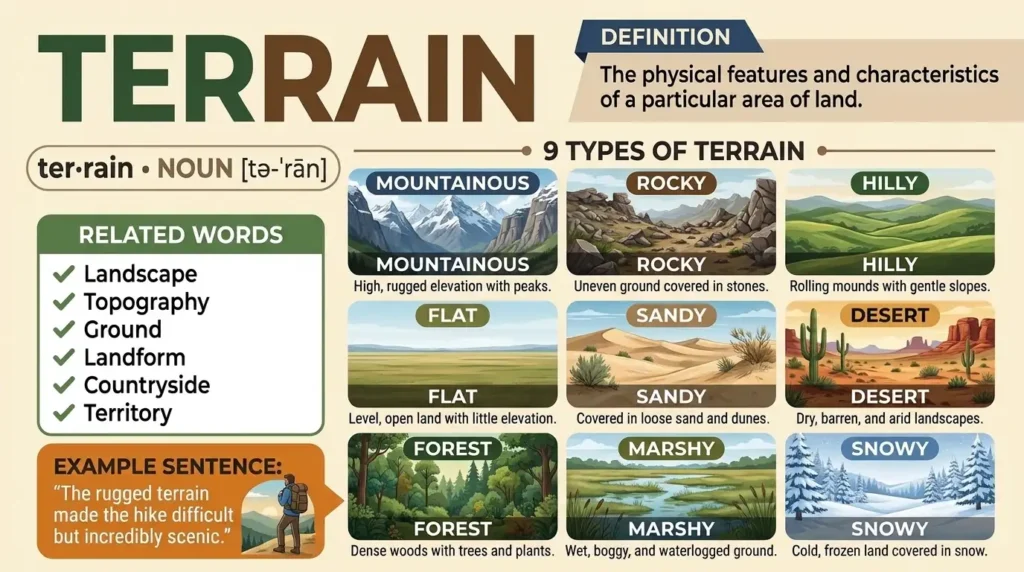
Terrain refers to a particular area of land, especially when describing its physical features, surface, or natural conditions.
In simple English, it means the type and physical shape of the land in a particular place.
For example, a region may have rocky terrain, flat terrain, mountainous terrain, or uneven terrain.
Native English speakers commonly use this word when discussing:
- Geography and natural environments.
- Hiking, climbing, and outdoor adventures.
- Military operations and transportation.
- Construction and land development.
- Travel, exploration, and environmental studies.
Part of Speech: Noun.
Simple Definition: An area of land with particular physical features, such as hills, valleys, rocks, and slopes.
Terrain generally carries a neutral meaning. Its emotional impression depends on the description. Beautiful terrain sounds appealing, while dangerous terrain suggests difficulty or risk.
Connotative Meaning of Terrain
(Connotation means the feelings, associations, or impressions a word creates beyond its basic dictionary definition.)
Positive Tone: Terrain can suggest beauty, adventure, natural variety, and exciting landscapes.
Negative Tone: It can describe difficult, dangerous, rough, or challenging ground.
Neutral Tone: It can simply identify the physical characteristics of a geographical area.
Etymology of Terrain
The word terrain comes from the French word terrain, meaning land or ground. It ultimately traces back to the Latin word terra, meaning earth or land.
Historical Development
Old English (450–1100):
The modern word terrain was not part of Old English vocabulary. Speakers used words such as eorþe to describe earth or land.
Middle English (1100–1500):
Words related to land, earth, and ground remained common. The French influence on English vocabulary also introduced many geographical terms.
Modern English (1500–Present):
Terrain entered English through French in the late eighteenth century. It gradually became an established geographical term for describing the physical characteristics of an area.
Syllables
Terrain: ter-rain.
Number of Syllables: 2.
Affixation Pattern of Terrain
Root: Terrain (derived from French terrain and Latin terra).
Prefix: None.
Suffix: No productive English suffix is attached to the word in its modern form.
Word Formation: Borrowed geographical noun.
45 Synonyms for Terrain: Meanings and Examples
The following alternatives help describe land, geographical features, and natural surroundings. Some are direct substitutes, while others work best in particular contexts.
1. Landscape (Noun)
Meaning: An area of land viewed in terms of its natural features and overall appearance.
Tone/Register: Neutral, descriptive, and creative.
Examples:
The mountain landscape looked breathtaking at sunrise.
Photographers often travel to capture beautiful landscapes.
2. Territory (Noun)
Meaning: A geographical area belonging to or controlled by a person, group, or government.
Tone/Register: Formal, geographical, and political.
Examples:
The explorers entered unfamiliar territory.
The animals protect their territory from intruders.
3. Region (Noun)
Meaning: A large geographical area that shares particular physical or cultural characteristics.
Tone/Register: Neutral and academic.
Examples:
This region receives heavy rainfall during summer.
The northern region has several beautiful mountain ranges.
4. Ground (Noun)
Meaning: The solid surface of the earth beneath your feet.
Tone/Register: Everyday and informal.
Examples:
The ground became slippery after the rain.
We found several stones scattered across the ground.
5. Topography (Noun)
Meaning: The arrangement and physical features of the surface of a particular area.
Tone/Register: Technical, geographical, and academic.
Examples:
The topography makes road construction difficult.
Students studied the topography of the island.
6. Land (Noun)
Meaning: The solid part of the earth that is not covered by water.
Tone/Register: Neutral and conversational.
Examples:
The land stretches across several miles.
Farmers use this land to grow vegetables.
7. Countryside (Noun)
Meaning: Rural areas characterized by natural scenery, fields, and open spaces.
Tone/Register: Descriptive and conversational.
Examples:
We spent the weekend exploring the countryside.
The countryside looks especially beautiful in spring.
8. Geography (Noun)
Meaning: The physical characteristics and spatial features of a particular place or region.
Tone/Register: Academic and educational.
Examples:
The geography of this island includes mountains and beaches.
Local geography influences the area’s climate.
9. Ground Surface (Noun)
Meaning: The uppermost physical layer of land in a particular location.
Tone/Register: Technical and descriptive.
Examples:
The ground surface became covered with fresh snow.
Workers examined the ground surface before construction.
10. Area (Noun)
Meaning: A particular part or section of a geographical location.
Tone/Register: Neutral and general.
Examples:
This area contains several rocky hills.
The area becomes difficult to access during winter.
11. Locale (Noun)
Meaning: A particular place or location where something happens.
Tone/Register: Formal and descriptive.
Examples:
The village provides a peaceful locale for visitors.
The film uses a remote locale for its opening scene.
12. Environment (Noun)
Meaning: The surrounding natural or physical conditions in which something exists.
Tone/Register: Academic and general.
Examples:
Desert plants survive in a harsh environment.
The surrounding environment affects wildlife behavior.
13. Surroundings (Noun)
Meaning: The places and physical features around a particular location.
Tone/Register: Conversational and descriptive.
Examples:
The cabin has beautiful natural surroundings.
We explored the surroundings before starting our journey.
14. Expanse (Noun)
Meaning: A wide, open stretch of land or another physical area.
Tone/Register: Literary and descriptive.
Examples:
An endless expanse of sand surrounded the village.
The travelers crossed a vast expanse of open land.
15. Tract (Noun)
Meaning: A defined or continuous stretch of land, often considered as one property or geographical unit.
Tone/Register: Formal and geographical.
Examples:
The government protected a large tract of forest.
The family purchased a tract of agricultural land.
16. District (Noun)
Meaning: A specific geographical division within a larger region or city.
Tone/Register: Formal and administrative.
Examples:
The district contains several rural communities.
Heavy rainfall affected the mountainous district.
17. Zone (Noun)
Meaning: An area identified by particular geographical, environmental, or functional characteristics.
Tone/Register: Technical and general.
Examples:
The northern zone contains steep mountain slopes.
Construction is restricted in this protected zone.
18. Countryscape (Noun)
Meaning: The visible scenery and physical character of a rural area.
Tone/Register: Descriptive and literary.
Examples:
The countryscape changes dramatically during autumn.
Rolling hills define much of the local countryscape.
19. Wilderness (Noun)
Meaning: A natural area that remains largely undeveloped and unaffected by human activity.
Tone/Register: Descriptive and adventurous.
Examples:
The hikers spent three days exploring the wilderness.
Wild animals roam freely across this wilderness.
20. Hinterland (Noun)
Meaning: An inland area located away from the coast or a major urban center.
Tone/Register: Formal and geographical.
Examples:
The coastal town depends on supplies from its hinterland.
Travelers explored the remote hinterland.
21. Landform (Noun)
Meaning: A natural physical feature of the earth’s surface, such as a hill, valley, or plateau.
Tone/Register: Scientific and academic.
Examples:
A volcano is an impressive natural landform.
Students identified different landforms during geography class.
22. Countryside Region (Noun Phrase)
Meaning: A geographical section characterized mainly by rural land and natural surroundings.
Tone/Register: Descriptive and conversational.
Examples:
The countryside region attracts nature lovers.
Several small villages are scattered throughout this countryside region.
23. Terrain Type (Noun Phrase)
Meaning: A particular classification of land based on its physical characteristics.
Tone/Register: Technical and educational.
Examples:
The guide explained each terrain type before the hike.
Different terrain types require different footwear.
24. Landmass (Noun)
Meaning: A large continuous area of land, especially one separated from other areas by water.
Tone/Register: Geographical and academic.
Examples:
Australia is a large landmass surrounded by oceans.
The island belongs to a volcanic landmass.
25. Plateau (Noun)
Meaning: An elevated area of relatively flat land, often surrounded by slopes.
Tone/Register: Geographical and descriptive.
Examples:
The village stands on a high plateau.
Farmers cultivate crops across the plateau.
26. Plain (Noun)
Meaning: A large area of flat or gently rolling land.
Tone/Register: Neutral and geographical.
Examples:
Herds of animals graze across the wide plain.
The river flows through a fertile plain.
27. Valley (Noun)
Meaning: A low area of land between hills or mountains, often containing a river.
Tone/Register: Descriptive and geographical.
Examples:
A small village sits inside the green valley.
The valley becomes covered with mist every morning.
28. Highland (Noun)
Meaning: An elevated area of land, often characterized by hills or mountains.
Tone/Register: Geographical and descriptive.
Examples:
The highland region experiences cool temperatures.
Local communities raise livestock in the highlands.
29. Lowland (Noun)
Meaning: An area of relatively low and often flat land.
Tone/Register: Geographical and academic.
Examples:
The lowland area floods during heavy rainfall.
Rice grows well across these fertile lowlands.
30. Upland (Noun)
Meaning: Land situated at a higher elevation than nearby surrounding areas.
Tone/Register: Geographical and formal.
Examples:
The upland region contains several small farms.
Sheep graze across the green uplands.
31. Mountainous Region (Noun Phrase)
Meaning: An area dominated by mountains and elevated landforms.
Tone/Register: Descriptive and geographical.
Examples:
The mountainous region receives heavy snowfall.
Tourists visit the mountainous region for hiking.
32. Foothills (Noun)
Meaning: Low hills located at the base of a mountain range.
Tone/Register: Geographical and descriptive.
Examples:
Small villages occupy the foothills.
Wildflowers grow throughout the mountain foothills.
33. Slope (Noun)
Meaning: A surface that rises or falls at an angle.
Tone/Register: Neutral and technical.
Examples:
The steep slope made the climb exhausting.
Rainwater flowed quickly down the slope.
34. Elevation (Noun)
Meaning: The height of a geographical location above a reference level, usually sea level.
Tone/Register: Technical and scientific.
Examples:
The village has a high elevation.
Elevation affects temperature in mountainous areas.
35. Contour (Noun)
Meaning: The outline or shape of a geographical surface, especially its curves and variations.
Tone/Register: Technical and geographical.
Examples:
The map shows the contours of the mountain.
Engineers studied the land’s contours before designing the road.
36. Surface (Noun)
Meaning: The outermost layer or top of the ground.
Tone/Register: Neutral and general.
Examples:
The surface was covered with loose gravel.
Snow covered the entire surface of the field.
37. Bedrock (Noun)
Meaning: The solid rock layer beneath soil and loose surface materials.
Tone/Register: Scientific and geological.
Examples:
The construction team discovered bedrock beneath the soil.
Bedrock provides a stable foundation in some locations.
38. Geological Formation (Noun Phrase)
Meaning: A naturally occurring structure of rock or earth created through geological processes.
Tone/Register: Scientific and academic.
Examples:
The region contains an unusual geological formation.
Researchers examined the geological formation near the coast.
39. Land Configuration (Noun Phrase)
Meaning: The arrangement and physical structure of land within a particular area.
Tone/Register: Formal and technical.
Examples:
The land configuration affects the drainage system.
Architects studied the land configuration before planning the settlement.
40. Geographic Feature (Noun Phrase)
Meaning: A natural or physical characteristic found in a geographical location.
Tone/Register: Academic and educational.
Examples:
A river is an important geographic feature.
The region contains several remarkable geographic features.
41. Natural Landscape (Noun Phrase)
Meaning: An area whose appearance is primarily shaped by natural processes rather than human development.
Tone/Register: Descriptive and environmental.
Examples:
The natural landscape remains untouched by construction.
Visitors admire the natural landscape around the lake.
42. Earth Surface (Noun Phrase)
Meaning: The outer physical layer of the planet where land and water are found.
Tone/Register: Scientific and educational.
Examples:
Volcanic activity can reshape the earth’s surface.
Plants grow across different parts of the earth’s surface.
43. Topographic Landscape (Noun Phrase)
Meaning: A geographical area described through its elevation, slopes, and physical variations.
Tone/Register: Technical and academic.
Examples:
The topographic landscape contains several steep ridges.
Scientists mapped the topographic landscape of the island.
44. Natural Terrain (Noun Phrase)
Meaning: Land in its natural physical condition, including its original slopes, rocks, and other features.
Tone/Register: Neutral and environmental.
Examples:
The builders preserved the natural terrain.
Wild animals move easily across the natural terrain.
45. Landform Region (Noun Phrase)
Meaning: A geographical area characterized by a particular collection of natural landforms.
Tone/Register: Academic and geographical.
Examples:
The landform region includes valleys and plateaus.
Researchers classified the area as a distinct landform region.
Synonyms for Terrain by Tone
Different alternatives create different impressions. Selecting the right word makes your writing more accurate and engaging.
Positive Synonyms
These words can create an attractive or inviting impression:
- Landscape
- Countryside
- Expanse
- Wilderness
- Natural landscape
- Foothills
- Valley
- Highland
Example: The beautiful landscape attracted hundreds of visitors.
Neutral Synonyms
These alternatives describe geographical areas without expressing a strong opinion:
- Land
- Ground
- Region
- Area
- Territory
- Surface
- District
- Zone
- Landmass
Example: The region contains several different geographical features.
Negative Synonyms
Terrain itself is neutral. However, certain descriptive alternatives can emphasize challenging or unfavorable physical conditions:
- Rough ground
- Rocky surface
- Steep slope
- Uneven ground
- Harsh landscape
- Difficult terrain
Example: The hikers struggled to cross the rocky surface.
Playful and Informal Alternatives
These expressions work in relaxed conversations and creative writing:
- Open ground
- Rolling hills
- Wild country
- Rocky ground
- Hilly land
Example: We spent the afternoon exploring the wild country.
Why does tone matter?
Tone helps communicate your intended message. A travel blogger may choose landscape to create an attractive image, while a geography student may prefer topography for technical accuracy.
Terrain vs. Close Alternatives
Some words appear interchangeable but have different meanings. Understanding these differences helps you select the most suitable option.
Terrain vs. Landscape
Terrain: Describes the physical characteristics and conditions of land.
Landscape: Describes the overall appearance and scenery of an area.
Tone: Both are neutral, but landscape often sounds more visual.
When to Use: Use terrain when discussing hills, rocks, and slopes. Choose landscape when describing beautiful scenery.
Terrain vs. Topography
Terrain: Refers to the physical character of a particular area of land.
Topography: Refers to the arrangement, elevation, and shape of land features.
Tone: Terrain is common in everyday and technical language. Topography is more specialized.
When to Use: Use terrain in travel descriptions. Choose topography in geographical research.
Terrain vs. Territory
Terrain: Focuses on the physical features of land.
Territory: Focuses on an area under someone’s ownership, control, or jurisdiction.
Tone: Terrain is geographical, while territory can have political or legal associations.
When to Use: Use terrain to describe the ground. Choose territory when discussing borders or controlled areas.
How Terrain Changes by Context
The best alternative depends on your subject, audience, and purpose.
Daily Conversation
In everyday English, simple words such as ground, land, and area sound natural.
Example: The ground is too muddy to walk on.
These expressions make conversations easier to understand.
Writing and Blogging
Bloggers can use landscape, countryside, wilderness, and expanse to create more descriptive content.
Example: The peaceful countryside offers a wonderful escape from busy city life.
These alternatives make travel articles and nature blogs more engaging.
Professional and Academic Writing
In scientific and professional contexts, topography, landform, elevation, and geological formation provide greater precision.
Example: Researchers examined the topography before beginning the environmental study.
Choose specialized vocabulary when accuracy matters.
Creative and Informal Writing
Writers can use foothills, valley, wilderness, and rolling hills to help readers imagine a location.
Example: A quiet village rested between the rolling hills.
Descriptive alternatives make storytelling more vivid.
Common Mistakes Learners Make
1. Using Every Synonym Interchangeably
Not every alternative has exactly the same meaning. Territory describes control or ownership, while topography describes the arrangement of geographical features.
2. Confusing Terrain With Scenery
Scenery focuses on visual appearance. Terrain focuses on the physical characteristics of the land.
3. Using Technical Words in Casual Conversations
Words such as topography and geological formation can sound unnecessarily formal in everyday discussions.
4. Ignoring Context
A valley, plateau, and mountain are different landforms. They cannot always replace the general word terrain.
5. Repeating the Same Word
Using terrain repeatedly can make an article sound monotonous. Choose suitable alternatives without sacrificing meaning.
Register Notes: Formal vs. Informal
Formal English: Topography, geographical region, land configuration, and geological formation.
Informal English: Ground, land, countryside, and rocky ground.
Spoken English: Ground, area, land, and landscape.
Written English: Terrain, topography, landscape, region, and landform.
Choose vocabulary according to your audience. Clear language is more valuable than complicated wording.
Real-Life Mini Scenarios Using Terrain
Workplace Scenario
A construction manager examines the ground before approving a building project.
Example: The uneven terrain requires additional preparation.
Social Scenario
Friends discuss their weekend hiking plans.
Example: We should choose a trail with easier terrain.
Media and Travel Scenario
A travel journalist describes a beautiful destination.
Example: The region features a spectacular natural landscape.
Writing and Storytelling Scenario
An author describes the setting of an adventure story.
Example: The travelers crossed a rocky expanse before reaching the village.
Interactive Practice Quiz
Test your understanding with these practical questions. Choose the alternative that best matches each situation.
1. Which word describes the overall visual appearance of an area?
A. Territory
B. Landscape
C. Bedrock
D. Elevation
2. A geography student studies the physical arrangement of hills and valleys. Which word fits best?
A. Topography
B. Countryside
C. Ground
D. Locale
3. Which word describes an area controlled by a government?
A. Surface
B. Expanse
C. Territory
D. Slope
4. What do we call a large, flat geographical area?
A. Valley
B. Plain
C. Foothills
D. Bedrock
5. Which word describes land between mountains or hills?
A. Plateau
B. District
C. Valley
D. Zone
6. A traveler explores an undeveloped natural area. Which word is most suitable?
A. Wilderness
B. Territory
C. Surface
D. Elevation
7. Which word describes the solid rock beneath soil?
A. Landscape
B. Bedrock
C. Locale
D. Region
8. Which word refers to land at a higher elevation than nearby areas?
A. Lowland
B. Plain
C. Upland
D. Ground
9. A writer describes a wide, open stretch of land. Which alternative is appropriate?
A. Expanse
B. District
C. Contour
D. Foothills
10. Which word describes the height of a place above sea level?
A. Surface
B. Elevation
C. Territory
D. Environment
Part Two
11. Which word is most appropriate for a rural area with fields and villages?
A. Countryside
B. Bedrock
C. Topography
D. Slope
12. A scientist examines naturally occurring rock structures. Which expression fits best?
A. Natural surroundings
B. Geological formation
C. Open ground
D. Rural district
13. Which word describes a low hill at the base of a mountain?
A. Plateau
B. Foothills
C. Lowland
D. Plain
14. A map displays the curved outlines of a mountain. Which word is suitable?
A. Contour
B. Territory
C. Expanse
D. Locale
15. Which word is most suitable for describing the outermost layer of the ground?
A. Region
B. Surface
C. Wilderness
D. Highland
Reflection and Application Task
Write three original sentences using these alternatives:
- Landscape
- Topography
- Wilderness
Try to use one word in a daily conversation, one in an academic sentence, and one in a creative description.
Answer Key
1-B | 2-A | 3-C | 4-B | 5-C | 6-A | 7-B | 8-C | 9-A | 10-B | 11-A | 12-B | 13-B | 14-A | 15-B
Suggested External Learning Resource
For additional definitions, pronunciation guidance, and real-world usage examples, explore the Merriam-Webster Dictionary:
https://www.merriam-webster.com/dictionary/terrain
FAQs
1. What is the most commonly used synonym for terrain?
Landscape is one of the most commonly used alternatives. It describes the overall appearance of an area, including its natural features. However, ground and land are often better choices in everyday conversations. The most suitable word depends on whether you want to describe physical conditions or the visual appearance of a place.
2. What is another word for difficult terrain?
Expressions such as rough ground, uneven ground, rocky surface, and challenging landscape can describe difficult terrain. For example, hikers may struggle to cross rocky ground because it contains loose stones and uneven surfaces. The best expression depends on the specific physical challenge being described.
3. What is a scientific word for terrain?
Topography is a scientific and geographical term closely associated with terrain. It describes the arrangement of physical features, including elevation, slopes, hills, and valleys. Geologists and geography researchers often use this term to study the physical structure of a location.
4. What is the difference between terrain and landform?
Terrain refers to the overall physical characteristics of an area. A landform is an individual natural feature found on the Earth’s surface, such as a mountain, valley, or plateau. Several landforms can combine to create the terrain of a particular geographical region.
5. What is the opposite of terrain?
Terrain does not have one exact opposite because it describes a physical area of land. However, water, sea, ocean, and open water can provide contrasts when discussing land-based environments. The appropriate contrast depends on the sentence and geographical context.
6. Which synonym for terrain is best for academic writing?
Topography, geographical region, landform, and geological formation are useful in academic writing. Topography is particularly suitable when discussing elevation, slopes, and the arrangement of land features. Choose the word that accurately describes the subject rather than selecting a complicated alternative simply to sound formal.
7. What is another word for mountainous terrain?
Mountainous region, highlands, uplands, and mountain country are useful alternatives. Each expression has a slightly different emphasis. Highlands and uplands describe elevated areas, while mountainous region directly communicates that mountains dominate the geographical area.
8. How can I avoid repeating the word terrain in an essay?
Use suitable alternatives such as landscape, ground, region, topography, and landform. First, identify what you want to describe. If you mean the appearance of an area, landscape may work. If you mean its physical arrangement, topography may be more accurate. Always maintain the original meaning.
Conclusion
Learning a synonym for terrain helps you describe geographical areas with greater accuracy. Words such as landscape and topography make your vocabulary more expressive.
These alternatives are useful in essays, travel blogs, professional writing, and everyday conversations. The right word makes your message easier to understand.
You do not need complicated vocabulary to become a better writer. Start with simple alternatives and learn when each expression fits naturally.
Practice these 45 words in your emails, essays, and daily conversations. Keep exploring new vocabulary and make every sentence more meaningful.

Sophia Carter is the founder and lead writer at SynonymVerse.com, a trusted online resource dedicated to English vocabulary and effective communication. She is passionate about helping students, writers, professionals, and lifelong learners find the most accurate words to express their ideas with clarity and confidence.
At SynonymVerse.com, every article is carefully researched and thoughtfully written to provide reliable guidance on synonyms, word meanings, and vocabulary. With a strong focus on accuracy, real-world usage, and easy-to-understand explanations, the website is committed to helping readers strengthen their language skills, enrich their vocabulary, and become more confident communicators.