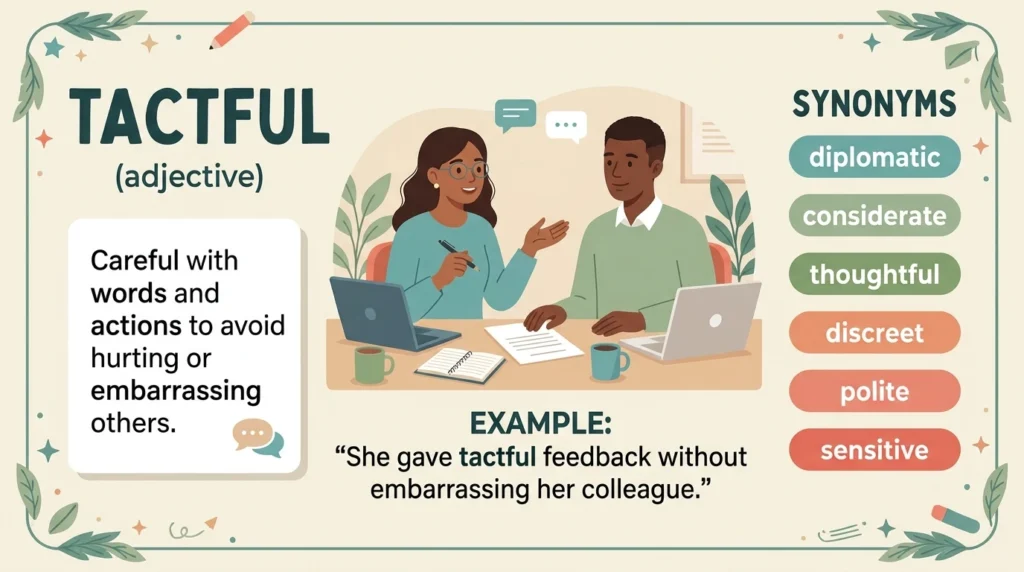
A synonym for tactful is a word such as diplomatic, considerate, discreet, or thoughtful. These words describe someone who communicates carefully, respects other people’s feelings, and handles sensitive situations without causing unnecessary offense.
Imagine a colleague makes a mistake during a meeting. Instead of embarrassing them in front of everyone, you explain the problem privately and offer a helpful suggestion. That response shows tact.
The word tactful is common in everyday conversations, workplace communication, relationships, and writing. Learning its alternatives helps you describe considerate behavior more precisely.
For students, bloggers, content writers, and everyday English users, choosing the right synonym can make messages clearer and more natural. It also helps you avoid repeating the same adjective in every sentence.
Whether you’re writing an email, describing a character, or discussing a difficult conversation, understanding a synonym for tactful can strengthen your vocabulary and communication skills.
What Does “Tactful” Really Mean?
Tactful means being careful about what you say or do so that you do not unnecessarily upset, embarrass, or offend another person.
A tactful person considers other people’s feelings before speaking. They can address sensitive issues honestly while remaining respectful.
For example, saying, “This report could be clearer if we reorganized the main points,” is more tactful than saying, “Your report is terrible.”
Tact does not mean avoiding every difficult conversation. It means handling that conversation with sensitivity, good judgment, and respect.
Part of Speech
Tactful is an adjective. It describes a person’s behavior, communication style, response, or approach.
- Person: She is tactful when giving feedback.
- Behavior: His tactful response calmed the discussion.
- Communication: We need a tactful way to explain the change.
How Native English Speakers Understand “Tactful”
Native speakers generally understand tactful as a positive quality associated with social awareness and emotional intelligence.
The word often appears when someone must communicate criticism, reject a request, discuss a personal issue, or resolve a disagreement. It suggests that the person understands how their words may affect others.
Connotative Meaning
(Connotation is the emotional or cultural association a word carries beyond its basic dictionary meaning.)
- Positive tone: Tactful behavior suggests kindness, diplomacy, maturity, and respect.
- Negative tone: In some contexts, excessive tact may suggest evasiveness or a reluctance to speak directly.
- Neutral tone: The word can simply describe a careful communication style without judging the person’s wider character.
Etymology of “Tactful”
The word tactful comes from tact, which entered English through French and ultimately derives from Latin tactus, meaning “touch” or “sense of touch.” The figurative meaning developed around sensitivity and skill in dealing with people.
Historical Development
- Old English (450–1100): The modern word tactful was not established in Old English. Ideas about careful speech existed, but people expressed them through different vocabulary.
- Middle English (1100–1500): English absorbed many French and Latin influences. The history of tact belongs to this broader development of vocabulary through contact with other languages.
- Modern English (1500–present): Tact developed its figurative sense of social sensitivity, and tactful became an adjective describing considerate, skillful behavior.
Pronunciation, Syllables, and Word Structure
- US pronunciation: /ˈtækt.fəl/
- UK pronunciation: /ˈtækt.fəl/
- Syllables: tact-ful
- Part of speech: Adjective
Affixation Pattern of “Tactful”
- Root: tact
- Prefix: None
- Suffix: -ful, meaning “full of” or “characterized by”
The suffix -ful turns tact into an adjective describing someone who shows tact. The related noun is tactfulness, while the opposite adjective is tactless.
Synonyms List
The best synonym depends on the situation. Some alternatives emphasize politeness, while others highlight discretion, emotional awareness, or the ability to resolve disagreements.
1. Diplomatic (Adjective) — US / UK: /ˌdɪp.ləˈmæt̬.ɪk/ / /ˌdɪp.ləˈmæt.ɪk/
Meaning: Skilled at handling disagreements or sensitive matters without creating unnecessary conflict.
Tone/Register: Professional, formal, business.
Example:
She gave a diplomatic answer when the manager questioned her decision.
A diplomatic response helped both teams reach an agreement.
2. Considerate (Adjective) — US / UK: /kənˈsɪd.ər.ət/ / /kənˈsɪd.ər.ət/
Meaning: Careful to consider how your actions or words affect other people.
Tone/Register: Warm, polite, everyday.
Example:
It was considerate of him to discuss the problem privately.
Please be considerate when giving feedback to new employees.
3. Discreet (Adjective) — US / UK: /dɪˈskriːt/ / /dɪˈskriːt/
Meaning: Careful to protect private information or avoid drawing unwanted attention to a sensitive matter.
Tone/Register: Formal, professional.
Example:
The counselor was discreet about the student’s personal concerns.
Could you handle this request discreetly until we have more information?
4. Thoughtful (Adjective) — US / UK: /ˈθɔːt.fəl/ / /ˈθɔːt.fəl/
Meaning: Showing care by considering another person’s feelings, needs, or circumstances.
Tone/Register: Warm, friendly, everyday.
Example:
Her thoughtful message made the difficult news easier to accept.
He offered a thoughtful suggestion instead of criticizing the idea.
5. Sensitive (Adjective) — US / UK: /ˈsen.sə.tɪv/ / /ˈsen.sə.tɪv/
Meaning: Aware of other people’s emotions and careful when dealing with delicate subjects.
Tone/Register: Personal, professional, emotional.
Example:
The teacher was sensitive when discussing the student’s mistake.
We need a sensitive approach to this family matter.
6. Polite (Adjective) — US / UK: /pəˈlaɪt/ / /pəˈlaɪt/
Meaning: Showing good manners and speaking respectfully, even when disagreeing.
Tone/Register: Neutral, everyday, formal.
Example:
She politely declined the invitation because she was busy.
Please remain polite during the discussion.
7. Courteous (Adjective) — US / UK: /ˈkɝː.t̬i.əs/ / /ˈkɜː.ti.əs/
Meaning: Showing respect and good manners through considerate behavior.
Tone/Register: Formal, professional.
Example:
The receptionist gave a courteous reply to every visitor.
A courteous email can make a disagreement easier to resolve.
8. Respectful (Adjective) — US / UK: /rɪˈspekt.fəl/ / /rɪˈspekt.fəl/
Meaning: Treating others with consideration for their feelings, rights, opinions, or position.
Tone/Register: Neutral, professional, academic.
Example:
He remained respectful even when he disagreed with the decision.
Use respectful language when responding to critical comments.
9. Judicious (Adjective) — US / UK: /dʒuːˈdɪʃ.əs/ / /dʒuːˈdɪʃ.əs/
Meaning: Showing good judgment when choosing what to say or do in a sensitive situation.
Tone/Register: Formal, academic, professional.
Example:
Her judicious choice of words prevented further confusion.
A judicious response can protect both honesty and goodwill.
10. Prudent (Adjective) — US / UK: /ˈpruː.dənt/ / /ˈpruː.dənt/
Meaning: Acting carefully and sensibly after considering possible consequences.
Tone/Register: Formal, professional.
Example:
It was prudent to discuss the disagreement before sending the email.
A prudent manager checks the facts before making a sensitive announcement.
11. Circumspect (Adjective) — US / UK: /ˈsɝː.kəm.spekt/ / /ˈsɜː.kəm.spekt/
Meaning: Careful about what you say or do because a situation may involve risks or uncertainty.
Tone/Register: Formal, academic, business.
Example:
The spokesperson was circumspect when answering questions about the investigation.
Be circumspect when discussing confidential plans.
12. Delicate (Adjective) — US / UK: /ˈdel.ə.kət/ / /ˈdel.ɪ.kət/
Meaning: Requiring care and sensitivity because the subject may upset or offend someone.
Tone/Register: Neutral, professional, personal.
Example:
They arranged a private meeting to discuss the delicate issue.
This is a delicate conversation, so choose your words carefully.
13. Subtle (Adjective) — US / UK: /ˈsʌt̬.əl/ / /ˈsʌt.əl/
Meaning: Expressing an idea indirectly or gently rather than making it obvious or forceful.
Tone/Register: Neutral, creative, conversational.
Example:
She made a subtle suggestion that the presentation needed revision.
His subtle hint helped me understand the problem without embarrassment.
14. Careful (Adjective) — US / UK: /ˈker.fəl/ / /ˈkeə.fəl/
Meaning: Giving attention to your words and actions to avoid mistakes or hurt feelings.
Tone/Register: Neutral, everyday, professional.
Example:
Be careful how you explain the change to your team.
He was careful not to blame anyone for the delay.
15. Gracious (Adjective) — US / UK: /ˈɡreɪ.ʃəs/ / /ˈɡreɪ.ʃəs/
Meaning: Showing kindness, courtesy, and generosity, especially in an uncomfortable situation.
Tone/Register: Positive, formal, social.
Example:
She offered a gracious response to the unexpected criticism.
He was gracious even after losing the competition.
16. Civil (Adjective) — US / UK: /ˈsɪv.əl/ / /ˈsɪv.əl/
Meaning: Remaining polite and respectful, particularly when there is disagreement.
Tone/Register: Neutral, formal.
Example:
The two neighbors stayed civil despite their ongoing dispute.
Let’s keep the conversation civil and focus on a solution.
17. Urbane (Adjective) — US / UK: /ɝːˈbeɪn/ / /ɜːˈbeɪn/
Meaning: Sophisticated, socially confident, and polished in dealing with other people.
Tone/Register: Formal, literary.
Example:
The urbane host made every guest feel comfortable.
Her urbane manner helped her navigate an awkward networking event.
18. Refined (Adjective) — US / UK: /rɪˈfaɪnd/ / /rɪˈfaɪnd/
Meaning: Showing polished manners and careful social judgment.
Tone/Register: Formal, descriptive.
Example:
His refined manner suited the formal reception.
She expressed her disagreement in a refined and composed way.
19. Deferential (Adjective) — US / UK: /ˌdef.əˈren.ʃəl/ / /ˌdef.əˈren.ʃəl/
Meaning: Showing respect toward someone else’s authority, experience, or position.
Tone/Register: Formal, hierarchical.
Example:
The junior employee used a deferential tone when addressing the chairperson.
His deferential manner reflected respect for the elder’s experience.
20. Restrained (Adjective) — US / UK: /rɪˈstreɪnd/ / /rɪˈstreɪnd/
Meaning: Controlled in speech or behavior, especially when strong emotions might lead to an unhelpful response.
Tone/Register: Neutral, formal.
Example:
She gave a restrained reply instead of reacting angrily.
His restrained criticism made the meeting more productive.
21. Measured (Adjective) — US / UK: /ˈmeʒ.ɚd/ / /ˈmeʒ.əd/
Meaning: Calm and carefully considered rather than rushed, emotional, or extreme.
Tone/Register: Professional, formal, analytical.
Example:
The director offered a measured response to the team’s concerns.
A measured tone helped prevent the discussion from becoming heated.
22. Compassionate (Adjective) — US / UK: /kəmˈpæʃ.ən.ət/ / /kəmˈpæʃ.ən.ət/
Meaning: Showing sympathy and a genuine desire to reduce another person’s distress.
Tone/Register: Warm, personal, professional.
Example:
The supervisor gave compassionate feedback after hearing about her difficult week.
A compassionate response can help someone feel understood.
23. Empathetic (Adjective) — US / UK: /ˌem.pəˈθet̬.ɪk/ / /ˌem.pəˈθet.ɪk/
Meaning: Able to understand or appreciate another person’s feelings and point of view.
Tone/Register: Positive, interpersonal, professional.
Example:
An empathetic manager listens before offering advice.
She wrote an empathetic reply to a reader who shared a personal struggle.
24. Understanding (Adjective) — US / UK: /ˌʌn.dɚˈstæn.dɪŋ/ / /ˌʌn.dəˈstæn.dɪŋ/
Meaning: Patient and accepting of another person’s feelings, difficulties, or mistakes.
Tone/Register: Friendly, supportive, everyday.
Example:
My teacher was understanding when I explained why I missed class.
An understanding response gave the new employee confidence.
25. Sympathetic (Adjective) — US / UK: /ˌsɪm.pəˈθet̬.ɪk/ / /ˌsɪm.pəˈθet.ɪk/
Meaning: Showing concern for someone’s difficulties or expressing support during a painful experience.
Tone/Register: Warm, personal, professional.
Example:
She offered a sympathetic response when her friend described the loss.
The editor was sympathetic to the writer’s concerns about the deadline.
26. Gentle (Adjective) — US / UK: /ˈdʒen.t̬əl/ / /ˈdʒen.təl/
Meaning: Mild and kind in manner, avoiding unnecessary harshness or pressure.
Tone/Register: Warm, everyday, personal.
Example:
He gave a gentle reminder about the unfinished assignment.
A gentle explanation helped the child understand the mistake.
27. Kind (Adjective) — US / UK: /kaɪnd/ / /kaɪnd/
Meaning: Caring about others and treating them with goodwill and consideration.
Tone/Register: Positive, informal, universal.
Example:
It was kind of her to correct my pronunciation privately.
Choose kind words when someone is already feeling discouraged.
28. Conciliatory (Adjective) — US / UK: /kənˈsɪl.i.ə.tɔːr.i/ / /kənˈsɪl.i.ə.tər.i/
Meaning: Intended to reduce hostility, repair a relationship, or bring opposing sides closer together.
Tone/Register: Formal, diplomatic, business.
Example:
He took a conciliatory approach after the disagreement.
Her conciliatory message opened the door to a fresh discussion.
29. Nonconfrontational (Adjective) — US / UK: /ˌnɑːn.kən.frʌnˈteɪ.ʃən.əl/ / /ˌnɒn.kɒn.frʌnˈteɪ.ʃən.əl/
Meaning: Avoiding an unnecessarily aggressive or directly challenging way of addressing a problem.
Tone/Register: Neutral, conversational, professional.
Example:
She used a nonconfrontational approach to discuss the missed deadline.
A nonconfrontational question helped the team explain what went wrong.
30. Politic (Adjective) — US / UK: /ˈpɑː.lə.tɪk/ / /ˈpɒl.ə.tɪk/
Meaning: Sensible and tactful in a way that considers how others may react.
Tone/Register: Formal, literary, sometimes old-fashioned.
Example:
It would be polite to inform the team before announcing the change.
His political remarks kept the discussion focused on practical solutions.
31. Artful (Adjective) — US / UK: /ˈɑːrt.fəl/ / /ˈɑːt.fəl/
Meaning: Skillful in choosing words or actions to achieve a particular effect, sometimes with an implication of cleverness or manipulation.
Tone/Register: Literary, formal, context-dependent.
Example:
Her artful phrasing made the difficult proposal easier to consider.
The novelist used artful dialogue to reveal tension without explaining it directly.
32. Skillful (Adjective) — US / UK: /ˈskɪl.fəl/ / /ˈskɪl.fəl/
Meaning: Showing ability and good judgment when handling a challenging conversation or interaction.
Tone/Register: Neutral, professional.
Example:
The mediator was skillful at guiding both sides toward agreement.
A skillful response acknowledged the mistake without blaming the intern.
33. Smooth (Adjective) — US / UK: /smuːð/ / /smuːð/
Meaning: Easy and natural in manner, especially when handling a potentially awkward social exchange.
Tone/Register: Informal, neutral, conversational.
Example:
He made a smooth transition to a less sensitive topic.
Her smooth handling of the question kept the interview moving.
34. Diplomatic-minded (Adjective) — US / UK: /ˌdɪp.ləˈmæt.ɪk ˈmaɪn.dɪd/ / /ˌdɪp.ləˈmæt.ɪk ˈmaɪn.dɪd/
Meaning: Inclined to consider different viewpoints and choose language that helps maintain cooperation.
Tone/Register: Descriptive, professional.
Example:
Our diplomatic-minded coordinator listened to every department before responding.
A diplomatic-minded leader considers the impact of a decision on the whole team.
35. Peacemaking (Adjective) — US / UK: /ˈpiːsˌmeɪ.kɪŋ/ / /ˈpiːsˌmeɪ.kɪŋ/
Meaning: Aimed at settling disagreements and restoring friendly relations.
Tone/Register: Positive, social, formal.
Example:
Her peacemaking efforts helped the two friends speak again.
The community leader took a peacemaking role during the dispute.
36. Tactically Sensitive (Adjective Phrase) — US / UK: /ˈtæk.tɪ.kəl.i ˈsen.sə.tɪv/ / /ˈtæk.tɪ.kəl.i ˈsen.sɪ.tɪv/
Meaning: Careful to recognize the social or emotional risks involved in a particular situation.
Tone/Register: Professional, analytical.
Example:
The announcement required a tactically sensitive approach to staff concerns.
She was tactically sensitive when discussing changes that affected several teams.
37. Socially Aware (Adjective Phrase) — US / UK: /ˈsoʊ.ʃəl.i əˈwer/ / /ˈsəʊ.ʃəl.i əˈweə/
Meaning: Aware of social expectations, interpersonal cues, and how behavior affects others.
Tone/Register: Neutral, educational, professional.
Example:
A socially aware speaker notices when the audience feels uncomfortable.
He is socially aware enough to give criticism in private.
38. Discerning (Adjective) — US / UK: /dɪˈsɝː.nɪŋ/ / /dɪˈsɜː.nɪŋ/
Meaning: Able to notice important differences and make thoughtful judgments about what a situation requires.
Tone/Register: Formal, intellectual, professional.
Example:
A discerning editor knows when a sentence sounds unnecessarily harsh.
Her discerning approach helped her choose the right moment to raise the issue.
39. Diplomatic in Tone (Adjective Phrase) — US / UK: /ˌdɪp.ləˈmæt.ɪk ɪn toʊn/ / /ˌdɪp.ləˈmæt.ɪk ɪn təʊn/
Meaning: Expressed in language that is respectful, balanced, and unlikely to create avoidable conflict.
Tone/Register: Professional, written, formal.
Example:
Keep your complaint diplomatic in tone, even if you feel frustrated.
The email was firm but diplomatic in tone.
40. Thoughtfully Worded (Adjective Phrase) — US / UK: /ˈθɔːt.fəl.i ˈwɝː.dɪd/ / /ˈθɔːt.fəl.i ˈwɜː.dɪd/
Meaning: Expressed with care so that the message communicates its point without unnecessary offense.
Tone/Register: Neutral, professional, everyday.
Example:
Her thoughtfully worded feedback gave the designer clear next steps.
A thoughtfully worded apology can help rebuild trust after a misunderstanding.
Usage note: The strongest direct alternatives are diplomatic, considerate, discreet, thoughtful, sensitive, and judicious. Other entries above describe particular aspects of tactful behavior or phrases used in specific contexts rather than exact one-word synonyms.
Synonyms for “Tactful” by Tone
The right word depends on the message you want to communicate. A word that sounds warm in a personal conversation may feel too casual in a formal report.
Positive Synonyms
Use these words when praising someone’s interpersonal skills or considerate behavior.
- Diplomatic: Handles disagreements constructively.
- Considerate: Thinks about other people’s feelings.
- Thoughtful: Shows personal care and attention.
- Gracious: Responds with kindness and dignity.
- Empathetic: Understands another person’s perspective.
- Compassionate: Responds with concern for someone’s distress.
- Gentle: Communicates without unnecessary harshness.
- Respectful: Recognizes other people’s dignity.
Neutral Synonyms
These words describe careful communication without strongly emphasizing emotion.
- Discreet: Protects privacy.
- Careful: Avoids careless or hurtful remarks.
- Measured: Responds calmly and deliberately.
- Judicious: Uses sound judgment.
- Circumspect: Considers potential risks.
- Polite: Follows accepted standards of good manners.
- Sensitive: Recognizes emotional concerns.
- Socially aware: Understands social cues and expectations.
Negative or Context-Dependent Alternatives
Some related words can suggest excessive caution, indirectness, or hidden motives. They are not always true synonyms.
- Evasive: Avoids answering directly.
- Overcautious: Shows more caution than necessary.
- Artful: Can suggest clever manipulation.
- Nonconfrontational: May avoid direct disagreement.
- Overly diplomatic: May imply that someone is avoiding an honest answer.
These expressions are useful when you want to describe the limitations of someone’s communication style rather than praise it.
Playful or Informal Alternatives
In casual conversation, simple expressions often sound more natural than formal vocabulary.
- Gentle: “She gave him a gentle reminder.”
- Smooth: “He handled that awkward question smoothly.”
- Thoughtful: “That was a thoughtful way to explain it.”
- Kind: “She was kind enough to tell me privately.”
Informal language works well with friends, family, and casual messages. Formal terms are generally more suitable for professional evaluations and academic writing.
“Tactful” vs. Close Alternatives
Several words have similar meanings, but they emphasize different qualities. Understanding these differences helps you choose more precise language.
Tactful vs. Diplomatic
Tactful emphasizes sensitivity when speaking or acting. Diplomatic emphasizes managing disagreement, competing interests, or delicate relationships.
Use tactful when someone gives criticism without causing embarrassment. Choose diplomatic when a manager negotiates between two disagreeing departments.
Tactful vs. Considerate
Tactful focuses on how someone handles a potentially sensitive situation. Considerate focuses on caring about another person’s needs and feelings.
A tactful person chooses the right words to discuss a mistake. A considerate person also thinks about whether the conversation should happen privately.
Tactful vs. Discreet
Tactful means communicating sensitively. Discreet means protecting privacy or avoiding unnecessary attention.
A tactful colleague gives constructive feedback politely. A discreet colleague keeps a confidential discussion private.
How “Tactful” Changes by Context
Daily Conversation
In everyday speech, kind, thoughtful, polite, and considerate are often natural choices.
For example, “That was a thoughtful way to explain the problem” sounds friendly and sincere. You do not need a formal word when a simple one communicates your meaning clearly.
Writing and Blogging
Writers can use sensitive, diplomatic, measured, and discreet to describe different communication styles.
For example, a blog about workplace relationships might explain how a diplomatic response helps colleagues discuss mistakes. A personal essay might use thoughtful to describe a friend’s reaction.
Avoid replacing every occurrence of tactful with another adjective simply to vary your vocabulary. Choose a synonym only when it expresses the intended meaning.
Professional and Academic Communication
In business emails, reports, and academic discussions, judicious, diplomatic, respectful, and circumspect may suit formal contexts.
For example: “The committee adopted a measured approach to the sensitive proposal.”
These terms can make writing more precise. However, simpler language is often preferable when the audience may not know advanced vocabulary.
Creative and Informal Writing
In stories, dialogue, and personal narratives, gentle, gracious, smooth, and thoughtful can help establish a character’s personality.
For example, a character might respond to an insult with a gracious smile. Another might use a subtle hint to communicate disappointment without starting an argument.
The best choice depends on the character, the setting, and the emotional effect you want to create.
Common Mistakes Learners Make
Confusing Tact With Dishonesty
Being tactful does not mean lying or hiding every uncomfortable fact. It means expressing the truth with appropriate sensitivity.
Instead of saying, “Your work is perfect,” when it needs improvement, explain what works and what needs attention.
Using Discreet When You Mean Diplomatic
Discreet is mainly about privacy and avoiding unwanted attention. Diplomatic is about managing sensitive interactions or disagreements.
A person can be discreet without being diplomatic, and diplomatic without keeping information secret.
Choosing Words That Sound Too Formal
Words such as circumspect, urbane, and judicious can sound unnatural in casual conversations.
For example, “Please be considerate” is usually more natural than “Please be circumspect” when asking a friend to respect someone’s feelings.
Assuming Tactful Means Weak
A tactful person can be direct, firm, and confident. The difference lies in how the person communicates.
“You missed the deadline, so we need to revise the schedule” is clear and firm. It can also be tactful when delivered respectfully.
Overusing Synonyms
Repeating diplomatic, considerate, or thoughtful too often can make writing monotonous. But using an unfamiliar synonym in every sentence can make it harder to read.
Choose words according to meaning, tone, and audience rather than variety alone.
Register Notes: Formal vs. Informal English
- Formal writing: Judicious, circumspect, diplomatic, and measured.
- Professional conversation: Respectful, considerate, discreet, and diplomatic.
- Everyday speaking: Polite, kind, thoughtful, and gentle.
- Creative writing: Gracious, subtle, urbane, and restrained.
Spoken English often favors familiar words. Written English allows more precise alternatives when the context supports them.
For related vocabulary, an internal article about synonyms for considerate could help readers explore the difference between kindness and tact.
Real-Life Scenarios Using “Tactful”
Workplace Scenario
A team member submits a report with several errors. Rather than criticizing the person in front of colleagues, the manager discusses the changes privately and offers practical suggestions.
This is a tactful and considerate response because it addresses the problem without unnecessary embarrassment.
Social Scenario
Your friend asks whether you enjoyed a meal that did not suit your taste. You thank them for the invitation and explain your preference politely.
Your response is polite and thoughtful. You remain honest without being unnecessarily harsh.
Media and Public Communication
A spokesperson receives a difficult question about a sensitive public issue. They acknowledge the concern, explain what is known, and avoid making unsupported claims.
This approach is diplomatic and measured. It maintains professionalism while respecting the audience.
Writing and Storytelling
A novelist wants to show that a character understands another person’s embarrassment. Instead of describing the character as kind, the writer shows them changing the subject gently and offering help later.
The action demonstrates a tactful, sensitive, and socially aware personality without directly explaining every emotion.
Interactive Practice Quiz
Test your understanding with these practical multiple-choice questions. Choose the word that best fits each situation.
Question 1
Your colleague makes a mistake. You explain it privately without embarrassing them. Which word best describes your approach?
- A. Careless
- B. Tactful
- C. Rude
- D. Impatient
Question 2
A manager helps two departments resolve a disagreement. Which synonym fits best?
- A. Diplomatic
- B. Evasive
- C. Impulsive
- D. Harsh
Question 3
Your friend keeps your personal information private. Which word describes this behavior?
- A. Gracious
- B. Discerning
- C. Discreet
- D. Urbane
Question 4
A teacher considers a student’s feelings before discussing a poor grade. Which word fits best?
- A. Considerate
- B. Aggressive
- C. Careless
- D. Confrontational
Question 5
A speaker responds calmly and carefully to a difficult question. Which word is most appropriate?
- A. Thoughtless
- B. Measured
- C. Impolite
- D. Reckless
Question 6
Someone shows concern for a colleague who is experiencing a difficult time. Which word best describes the response?
- A. Circumspect
- B. Sympathetic
- C. Evasive
- D. Restrained
Question 7
You want to describe a person who makes sensible choices after considering possible consequences. Which word should you use?
- A. Prudent
- B. Rude
- C. Careless
- D. Abrupt
Question 8
A person speaks politely to someone even when they disagree. Which word fits best?
- A. Hostile
- B. Respectful
- C. Impulsive
- D. Dismissive
Question 9
A colleague avoids an unnecessary argument and tries to restore cooperation. Which word is most suitable?
- A. Conciliatory
- B. Insensitive
- C. Aggressive
- D. Blunt
Question 10
A writer wants to describe a gentle, indirect hint rather than an obvious statement. Which word fits best?
- A. Subtle
- B. Loud
- C. Abrupt
- D. Explicit
Question 11
A person uses polished manners and sophisticated social behavior at a formal event. Which word is most appropriate?
- A. Urbane
- B. Careless
- C. Impatient
- D. Evasive
Question 12
You need to describe feedback that is honest but avoids unnecessary harshness. Which phrase fits best?
- A. Thoughtlessly delivered
- B. Thoughtfully worded
- C. Aggressively stated
- D. Carelessly expressed
Answer Key
B A C A B B A B A A A B
Reflection Task
Write two sentences using different synonyms for tactful. Use one in a professional email and the other in a daily conversation. Check whether each word matches the situation and tone.
Recommended External Learning Resource
For an authoritative dictionary definition, pronunciation guidance, and examples, consult the Merriam-Webster definition of tactful. Compare its meaning with the synonyms above, then write your own sentences to strengthen your vocabulary.
FAQs
1. What is the best synonym for tactful in a professional email?
Diplomatic is an excellent choice when you need to address disagreement, deliver criticism, or discuss a sensitive matter professionally. Considerate works well when emphasizing another person’s feelings, while respectful highlights courtesy. Choose the word that matches your intended meaning rather than selecting a formal alternative simply to sound professional.
2. What is another word for tactful when giving criticism?
Constructive, considerate, diplomatic, and thoughtful may work, depending on the sentence. Diplomatic emphasizes avoiding unnecessary conflict, while constructive emphasizes helping someone improve. For example, “She gave constructive feedback” suggests that her comments offered useful guidance, whereas “She gave diplomatic feedback” emphasizes her careful handling of a sensitive situation.
3. Is tactful a positive or negative word?
Tactful is generally positive. It describes someone who considers other people’s feelings when communicating. However, excessive tact can sometimes suggest indirectness or avoidance. The word’s overall meaning remains favorable, but the surrounding context can influence whether a person’s careful communication seems helpful, overly cautious, or evasive.
4. What is the difference between tactful and diplomatic in English?
Tactful focuses on choosing words or actions that avoid unnecessary offense. Diplomatic focuses more on managing disagreements, competing interests, or sensitive relationships. A tactful person might privately correct a friend’s mistake. A diplomatic person might help two colleagues negotiate a solution to a workplace dispute. The terms overlap, but their emphasis differs.
5. What is the opposite of tactful?
The most direct opposite is tactless, which describes someone who speaks or acts without considering the effect on other people. Other alternatives include insensitive, rude, blunt, and inconsiderate. These words have different levels of severity. For instance, blunt can describe honest, direct speech without necessarily implying deliberate rudeness.
6. How can I use tactful in a sentence naturally?
Use tactful before a noun or after a linking verb. For example, “She offered a tactful suggestion” or “His response was tactful.” You can also write, “We need to be tactful when discussing the change.” These patterns work in everyday conversation, workplace emails, essays, and professional reports.
7. Which synonym for tactful is best for academic writing?
Judicious, diplomatic, circumspect, and measured can work well in academic writing. Judicious emphasizes sound judgment, circumspect highlights caution, and measured suggests a balanced response. However, academic writing should prioritize precision and readability. A familiar word such as careful may be better when it expresses the intended meaning more clearly.
Conclusion
Learning a synonym for tactful helps you express kindness, sensitivity, and good judgment. The right word makes your message clearer and helps you describe communication more accurately.
From diplomatic to considerate, each alternative carries a slightly different meaning. Understanding these differences helps you choose language that suits the situation, audience, and purpose.
A stronger vocabulary can improve your essays, blog posts, emails, and everyday conversations. Practice using new words in realistic sentences instead of memorizing definitions alone.
Start with two or three synonyms today. Try using them in an email, a short paragraph, or a daily conversation, and notice how your English becomes more precise and natural.

Sophia Carter is the founder and lead writer at SynonymVerse.com, a trusted online resource dedicated to English vocabulary and effective communication. She is passionate about helping students, writers, professionals, and lifelong learners find the most accurate words to express their ideas with clarity and confidence.
At SynonymVerse.com, every article is carefully researched and thoughtfully written to provide reliable guidance on synonyms, word meanings, and vocabulary. With a strong focus on accuracy, real-world usage, and easy-to-understand explanations, the website is committed to helping readers strengthen their language skills, enrich their vocabulary, and become more confident communicators.