
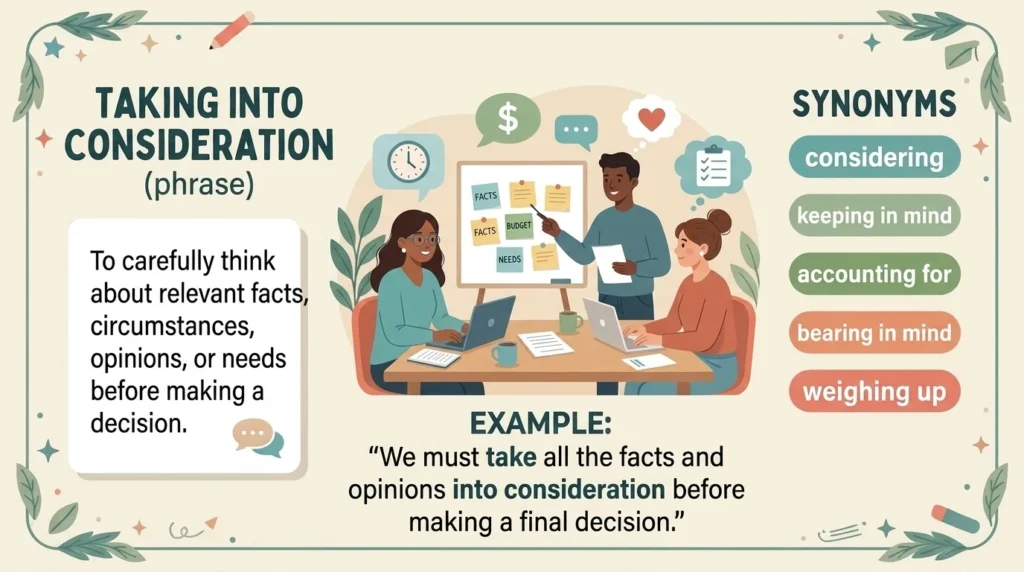
A synonym for taking into consideration is considering, taking into account, factoring in, bearing in mind, or accounting for. These expressions mean thinking about important facts, feelings, or circumstances before making a decision. The best alternative depends on the situation, the intended meaning, and whether you need formal or conversational language.
Imagine planning a family trip. You check everyone’s availability, the weather, and your budget before choosing a destination. You are taking several factors into consideration.
This phrase appears in daily conversations, business emails, academic essays, and professional discussions. It helps people explain why certain details matter.
Learning a synonym for taking into consideration can improve your vocabulary. It also helps you avoid repeating the same long expression throughout your writing.
Students, bloggers, content writers, and everyday English users can benefit from these alternatives. The right word makes every message clearer and more natural.
What Does Taking Into Consideration Really Mean?
Taking into consideration means thinking carefully about a fact, situation, feeling, or possibility before making a decision.
It involves recognizing that something matters and allowing it to influence your judgment.
For example:
Example 1: The teacher took the student’s illness into consideration before grading the assignment.
Example 2: We should take the weather into consideration before planning an outdoor event.
Both sentences show how people include relevant information in their decisions.
Native English speakers commonly use this expression when discussing fairness, planning, responsibilities, and personal choices.
The phrase usually sounds neutral and thoughtful. However, it can also suggest kindness, caution, or concern.
Part of Speech
Taking into consideration is a verb phrase.
It contains three main elements:
- Taking: The present participle of the verb take.
- Into: A preposition.
- Consideration: A noun that means careful thought.
The complete expression describes the act of considering something.
Example: The manager is taking employee feedback into consideration.
Other grammatical forms include:
- Take into consideration
- Takes into consideration
- Took into consideration
- Taking into consideration
- Will take into consideration
Connotative Meaning of Taking Into Consideration
(Connotation means the feelings, ideas, or associations that a word or phrase suggests beyond its basic definition.)
The emotional meaning of this expression changes according to the situation.
Positive Tone
It can suggest fairness, kindness, respect, and thoughtful decision-making.
Example: The principal took the student’s family circumstances into consideration.
This sentence suggests understanding and compassion.
Negative Tone
The phrase can highlight carelessness when someone fails to consider important information.
Example: The company failed to take employee concerns into consideration.
Here, the expression emphasizes a lack of attention.
Neutral Tone
In most situations, it simply describes including relevant facts before making a choice.
Example: We took the delivery time into consideration.
The sentence communicates a practical decision without expressing strong emotion.
Etymology of Taking Into Consideration
The expression developed through the history of its individual words.
The word consideration comes from Latin consideratio, meaning careful thought or examination.
It relates to the Latin verb considerare, which means to examine or think carefully about something.
Old English (450–1100)
The verb take entered English through Old Norse taka, meaning to grasp or seize.
Scandinavian influence helped introduce this word into English.
The complete expression did not exist in its modern form during this period.
Middle English (1100–1500)
English adopted consideration through Old French, ultimately from Latin.
The word became associated with reflection, careful thought, and judgment.
Modern English (1500–Present)
The expression take into consideration became established as a way to describe including relevant information in one’s thinking.
Today, people use it in professional communication, academic writing, legal discussions, and everyday conversations.
Syllables
The expression contains three words:
- Taking: tak-ing
- Into: in-to
- Consideration: con-sid-er-a-tion
Affixation Pattern
The phrase contains several grammatical elements.
Root: Consider
Prefix: No productive English prefix in consideration.
Suffix: -ation
Additional ending: -ing in taking.
The suffix -ation helps form nouns that describe actions, processes, or results.
Synonyms List
English offers several alternatives to this expression. Some work as direct replacements, while others describe a more specific type of consideration.
1. Considering (Verb)
Meaning: Thinking about a particular fact or situation before making a decision.
Tone/Register: Neutral, everyday, academic.
Example 1: We are considering several locations for the event.
Example 2: Considering the weather, we should leave early.
2. Taking Into Account (Verb Phrase)
Meaning: Including important information when making a judgment or decision.
Tone/Register: Neutral, professional.
Example 1: The bank is taking your income into account.
Example 2: We must take travel costs into account.
3. Factoring In (Phrasal Verb)
Meaning: Including a specific element when calculating or planning something.
Tone/Register: Business, analytical, conversational.
Example 1: Are you factoring in the extra expenses?
Example 2: She factored in traffic before choosing a departure time.
4. Bearing in Mind (Verb Phrase)
Meaning: Remembering an important detail while thinking or acting.
Tone/Register: Polite, professional, neutral.
Example 1: Bear in mind that the deadline is tomorrow.
Example 2: We planned the trip bearing everyone’s needs in mind.
5. Keeping in Mind (Verb Phrase)
Meaning: Remembering something relevant throughout a decision-making process.
Tone/Register: Friendly, conversational.
Example 1: Keep your budget in mind while shopping.
Example 2: She designed the room with young children in mind.
6. Accounting For (Phrasal Verb)
Meaning: Including a relevant factor when explaining, planning, or calculating something.
Tone/Register: Academic, business, analytical.
Example 1: The estimate accounts for possible delays.
Example 2: Our plan must account for seasonal changes.
7. Allowing For (Phrasal Verb)
Meaning: Making room for a possible situation or additional requirement.
Tone/Register: Neutral, practical.
Example 1: We allowed for unexpected travel expenses.
Example 2: The schedule allows for short breaks.
8. Giving Thought To (Verb Phrase)
Meaning: Spending time thinking carefully about a particular matter.
Tone/Register: Thoughtful, neutral.
Example 1: Give some thought to your future plans.
Example 2: He gave serious thought to her suggestion.
9. Paying Attention To (Verb Phrase)
Meaning: Noticing and concentrating on information that may be important.
Tone/Register: Everyday, neutral.
Example 1: The designer paid attention to customer preferences.
Example 2: Please pay attention to the safety instructions.
10. Reflecting On (Phrasal Verb)
Meaning: Thinking deeply about something to understand it better.
Tone/Register: Thoughtful, academic, personal.
Example 1: She reflected on her previous mistakes.
Example 2: I spent the evening reflecting on your advice.
11. Weighing (Verb)
Meaning: Carefully judging the importance of different facts or options.
Tone/Register: Professional, analytical.
Example 1: The committee is weighing the available options.
Example 2: He weighed the risks before investing.
12. Evaluating (Verb)
Meaning: Judging the quality, importance, or value of something.
Tone/Register: Academic, formal, business.
Example 1: The manager is evaluating the team’s suggestions.
Example 2: We evaluated several solutions before choosing one.
13. Assessing (Verb)
Meaning: Examining a situation to understand its condition or importance.
Tone/Register: Formal, professional.
Example 1: The doctor is assessing the patient’s symptoms.
Example 2: They assessed the damage before starting repairs.
14. Reviewing (Verb)
Meaning: Looking at information again before making a decision.
Tone/Register: Business, academic.
Example 1: The editor is reviewing your article.
Example 2: We reviewed the feedback before updating the policy.
15. Examining (Verb)
Meaning: Looking closely at something to understand its details.
Tone/Register: Academic, professional.
Example 1: Researchers are examining the survey results.
Example 2: She examined every proposal before responding.
16. Deliberating On (Verb Phrase)
Meaning: Discussing or thinking carefully about an important issue before deciding.
Tone/Register: Formal, legal, professional.
Example 1: The jury is deliberating on the evidence.
Example 2: The board deliberated on the proposed changes.
17. Contemplating (Verb)
Meaning: Thinking seriously about an idea, possibility, or future action.
Tone/Register: Thoughtful, literary, formal.
Example 1: Maya is contemplating a career change.
Example 2: He contemplated moving closer to his parents.
18. Pondering (Verb)
Meaning: Spending time thinking carefully about a question or possibility.
Tone/Register: Reflective, literary, conversational.
Example 1: She pondered the offer all weekend.
Example 2: I am still pondering your interesting question.
19. Thinking Over (Phrasal Verb)
Meaning: Considering something carefully before giving a final response.
Tone/Register: Informal, everyday.
Example 1: I need a day to think over your offer.
Example 2: He thought over the proposal before agreeing.
20. Mulling Over (Phrasal Verb)
Meaning: Thinking about something for a period before deciding what to do.
Tone/Register: Informal, conversational.
Example 1: I’m mulling over a few business ideas.
Example 2: She mulled over his suggestion during lunch.
21. Giving Weight To (Verb Phrase)
Meaning: Treating particular information as important when reaching a decision.
Tone/Register: Formal, analytical.
Example 1: The judge gave weight to the witness’s statement.
Example 2: We should give more weight to recent evidence.
22. Attaching Importance To (Verb Phrase)
Meaning: Recognizing something as significant or worthy of attention.
Tone/Register: Formal, academic.
Example 1: The school attaches importance to student well-being.
Example 2: She attaches great importance to honesty.
23. Recognizing (Verb)
Meaning: Accepting that a particular fact or circumstance exists and matters.
Tone/Register: Neutral, professional.
Example 1: The manager recognized the team’s limited resources.
Example 2: We must recognize the challenges facing new students.
24. Acknowledging (Verb)
Meaning: Accepting or openly recognizing an important fact or concern.
Tone/Register: Formal, professional, respectful.
Example 1: The director acknowledged the staff’s concerns.
Example 2: She acknowledged his experience during the discussion.
25. Taking Notice Of (Verb Phrase)
Meaning: Becoming aware of something and giving it attention.
Tone/Register: Neutral, conversational.
Example 1: The company took notice of customer complaints.
Example 2: He took notice of the warning signs.
26. Being Mindful Of (Verb Phrase)
Meaning: Staying aware of something important while behaving or deciding.
Tone/Register: Caring, professional, polite.
Example 1: Please be mindful of other people’s feelings.
Example 2: Our team remained mindful of the tight deadline.
27. Being Conscious Of (Verb Phrase)
Meaning: Maintaining awareness of a relevant fact, need, or limitation.
Tone/Register: Neutral, thoughtful.
Example 1: She is conscious of her family’s expectations.
Example 2: We remained conscious of the environmental impact.
28. Having Regard For (Verb Phrase)
Meaning: Showing appropriate attention or respect toward a relevant matter.
Tone/Register: Formal, legal, professional.
Example 1: The council acted with regard for public safety.
Example 2: Managers should have regard for employee welfare.
29. Giving Due Consideration To (Verb Phrase)
Meaning: Giving a matter the careful attention it deserves.
Tone/Register: Formal, legal, business.
Example 1: We gave due consideration to every application.
Example 2: The panel gave due consideration to her circumstances.
30. Taking Under Advisement (Verb Phrase)
Meaning: Accepting information or advice for careful consideration before deciding.
Tone/Register: Formal, professional, legal.
Example 1: The director took the recommendation under advisement.
Example 2: We will take your proposal under advisement.
31. Including in the Assessment (Verb Phrase)
Meaning: Adding a relevant detail to the information used when judging something.
Tone/Register: Academic, professional, analytical.
Example 1: The researchers included age in their assessment of the results.
Example 2: We included maintenance costs in the final assessment.
32. Weighing Up (Phrasal Verb)
Meaning: Comparing different factors before choosing between alternatives.
Tone/Register: Neutral, especially common in British English.
Example 1: She is weighing up two job offers.
Example 2: We weighed up the benefits before making changes.
33. Balancing (Verb)
Meaning: Considering competing needs or priorities fairly.
Tone/Register: Professional, neutral.
Example 1: Parents often balance work and family responsibilities.
Example 2: The committee balanced cost against quality.
34. Comparing (Verb)
Meaning: Looking at different options to understand their similarities and differences.
Tone/Register: Neutral, academic.
Example 1: We are comparing several travel packages.
Example 2: She compared both proposals before choosing one.
35. Analyzing (Verb)
Meaning: Studying information carefully to understand its meaning or effects.
Tone/Register: Academic, technical, business.
Example 1: The marketing team is analyzing customer behavior.
Example 2: He analyzed the results before writing his report.
36. Scrutinizing (Verb)
Meaning: Examining something very closely to identify details or possible problems.
Tone/Register: Formal, critical, investigative.
Example 1: The auditor scrutinized the financial records.
Example 2: Reporters scrutinized the politician’s claims.
37. Studying (Verb)
Meaning: Giving careful attention to information before forming an understanding.
Tone/Register: Academic, neutral.
Example 1: Scientists are studying the long-term effects.
Example 2: She studied the instructions before assembling the desk.
38. Looking At (Phrasal Verb)
Meaning: Examining or considering a particular situation or possibility.
Tone/Register: Informal, conversational.
Example 1: We’re looking at different ways to reduce waste.
Example 2: The manager is looking at your request.
39. Looking Into (Phrasal Verb)
Meaning: Investigating a matter before reaching a conclusion.
Tone/Register: Neutral, professional.
Example 1: The school is looking into the complaint.
Example 2: I’ll look into the problem before responding.
40. Taking Stock Of (Verb Phrase)
Meaning: Reviewing the current situation before deciding what to do next.
Tone/Register: Business, reflective, conversational.
Example 1: We took stock of our progress after six months.
Example 2: She took stock of her finances before moving.
41. Keeping Sight Of (Verb Phrase)
Meaning: Continuing to remember an important goal or factor while making decisions.
Tone/Register: Professional, motivational.
Example 1: Keep sight of your long-term goals.
Example 2: The team kept sight of customer needs during development.
42. Making Allowance For (Verb Phrase)
Meaning: Adjusting expectations because of someone’s circumstances or a possible difficulty.
Tone/Register: Thoughtful, professional.
Example 1: The teacher made allowance for his recent illness.
Example 2: We made allowance for possible shipping delays.
43. Taking Account Of (Verb Phrase)
Meaning: Including relevant information when making a judgment.
Tone/Register: Formal, academic, professional.
Example 1: The report takes account of regional differences.
Example 2: We must take account of changing customer needs.
44. Giving Attention To (Verb Phrase)
Meaning: Directing thought or effort toward something important.
Tone/Register: Neutral, professional.
Example 1: The school is giving attention to student safety.
Example 2: She gave special attention to the final paragraph.
45. Being Sensitive To (Verb Phrase)
Meaning: Considering how circumstances or actions may affect other people.
Tone/Register: Caring, diplomatic, professional.
Example 1: Please be sensitive to her personal situation.
Example 2: The company was sensitive to employees’ concerns.
46. Heeding (Verb)
Meaning: Paying serious attention to advice, warnings, or instructions.
Tone/Register: Formal, cautionary.
Example 1: The hikers heeded the weather warning.
Example 2: She heeded her mentor’s advice before applying.
47. Consulting (Verb)
Meaning: Seeking advice or information from someone or something before deciding.
Tone/Register: Professional, academic.
Example 1: The manager consulted her team before changing the schedule.
Example 2: He consulted several reliable sources for his essay.
48. Anticipating (Verb)
Meaning: Thinking ahead about something that may happen and preparing accordingly.
Tone/Register: Business, strategic.
Example 1: We anticipated heavy traffic during the festival.
Example 2: The organizers anticipated a larger audience this year.
49. Taking a Holistic View Of (Verb Phrase)
Meaning: Considering all relevant parts of a situation rather than focusing on one detail.
Tone/Register: Academic, professional.
Example 1: The doctor took a holistic view of the patient’s needs.
Example 2: Our team took a holistic view of the project.
50. Putting Into Perspective (Verb Phrase)
Meaning: Judging something by comparing it with the wider situation.
Tone/Register: Reflective, analytical.
Example 1: The latest figures put our progress into perspective.
Example 2: Her experience helped put the problem into perspective.
Synonyms for Taking Into Consideration by Tone
The tone of an expression affects how readers understand your message.
A professional report may require precise wording. A friendly conversation usually benefits from simpler language.
The following groups organize the alternatives according to their typical usage.
Positive Tone
These expressions often suggest respect, awareness, or thoughtful attention.
- Being mindful of
- Giving due consideration to
- Being sensitive to
- Having regard for
- Making allowance for
- Giving attention to
- Acknowledging
- Keeping in mind
Example: We are being mindful of everyone’s needs while planning the event.
Neutral Tone
These alternatives describe consideration without adding strong emotion.
- Considering
- Taking into account
- Factoring in
- Accounting for
- Reviewing
- Evaluating
- Assessing
- Examining
- Comparing
- Analyzing
Example: The committee is reviewing the available information.
Negative or Critical Tone
These words can suggest close inspection, concern, or caution. They are not inherently negative.
- Scrutinizing
- Heeding
- Weighing
- Deliberating on
- Looking into
Example: Investigators are scrutinizing the company’s financial records.
Playful or Informal Tone
These expressions sound more relaxed and natural in everyday conversations.
- Mulling over
- Thinking over
- Looking at
- Pondering
- Keeping in mind
Example: I’m still mulling over what to wear to the wedding.
Why tone matters: The wrong expression can make a simple message sound unnecessarily serious. Choose words that match your audience and purpose.
Taking Into Consideration vs Close Alternatives
Although several expressions share similar meanings, small differences affect their natural usage.
| Expression | Main Difference | Best Use |
|---|---|---|
| Taking into consideration | Thinking about a relevant circumstance | General decisions |
| Taking into account | Including information in a judgment | Reports and planning |
| Factoring in | Including a specific variable | Calculations and budgets |
| Bearing in mind | Remembering something important | Advice and reminders |
Taking Into Consideration vs Taking Into Account
These expressions are nearly interchangeable.
However, taking into account often sounds more concise in professional writing.
Example: We took the additional expenses into account.
Taking Into Consideration vs Factoring In
Factoring in places more emphasis on including a specific variable in a calculation or plan.
Example: We factored in the cost of transportation.
It is particularly useful when discussing budgets, schedules, and estimates.
Taking Into Consideration vs Bearing in Mind
Bearing in mind emphasizes remembering important information.
Example: Bear in mind that the office closes at five.
Unlike taking into consideration, it does not always suggest a complete decision-making process.
How Taking Into Consideration Changes by Context
The same idea can sound different depending on where and how you communicate it.
Daily Conversation
In casual English, people usually prefer shorter alternatives.
Example: I’ll keep your suggestion in mind.
This sounds more relaxed than saying, “I will take your suggestion into consideration.”
Writing or Blogging
Bloggers often use considering, accounting for, and keeping in mind.
These expressions make explanations clear without creating unnecessarily long sentences.
Example: Consider your audience before choosing a writing style.
Professional or Academic Tone
Formal communication often requires precise wording.
Expressions such as evaluating, assessing, and giving due consideration to work well when discussing research, evidence, or important decisions.
Example: The researchers assessed several environmental factors.
Creative or Informal Use
Creative writing can express consideration through a character’s thoughts and actions.
Example: She pondered his words long after the conversation ended.
This creates a reflective mood without using the original expression.
Common Mistakes Learners Make
Choosing a synonym for taking into consideration requires attention to grammar and meaning.
Some alternatives look similar but follow different sentence structures.
Mistake 1: Adding an Unnecessary Preposition
Incorrect: We considered about the problem.
Correct: We considered the problem.
The verb consider takes a direct object. It does not normally require about.
Mistake 2: Confusing Consider and Consideration
Incorrect: Please take my request into consider.
Correct: Please take my request into consideration.
Consider is a verb. Consideration is a noun.
Mistake 3: Using Account Incorrectly
Incorrect: We took account the weather.
Correct: We took account of the weather.
Also correct: We took the weather into account.
Both structures are natural, but their word order differs.
Mistake 4: Confusing Thinking About With Acting On
Considering someone’s advice does not automatically mean following it.
Example: I considered your suggestion, but I chose another approach.
This sentence shows that the speaker thought about the suggestion without accepting it.
Mistake 5: Overusing Long Expressions
Repeatedly using taking into consideration can make writing feel heavy.
Instead of:
Taking into consideration the weather, we decided to postpone the event.
Write:
Considering the weather, we decided to postpone the event.
The shorter version communicates the same idea.
Native Usage and Register Notes
Formal English
Use expressions such as:
- Giving due consideration to
- Taking into account
- Assessing
- Evaluating
- Having regard for
These suit official letters, reports, academic assignments, and professional discussions.
Informal English
Use:
- Thinking over
- Mulling over
- Looking at
- Keeping in mind
These sound natural in friendly conversations.
Spoken English
Native speakers often shorten longer expressions when speaking.
For example:
“I’ll take that into consideration.”
may become:
“I’ll keep that in mind.”
Both are polite, but the second sounds more conversational.
Written English
Formal writing benefits from precision rather than unnecessary length.
Use factoring in when discussing variables. Choose evaluating when judging quality. Use considering for general situations.
For related vocabulary practice, readers can also explore synonyms of consideration to understand the noun form.
Real-Life Examples Using Taking Into Consideration
Understanding a phrase becomes easier when you connect it with everyday experiences.
Workplace Scenario
A manager receives requests for flexible working hours.
She reviews employee needs before changing the schedule.
Example: The manager took everyone’s availability into consideration.
Alternative: The manager factored in everyone’s availability.
Social Situation
Your friend invites you to an outdoor celebration.
You check the weather forecast before accepting.
Example: I’ll take the weather into consideration before deciding.
Alternative: I’ll keep the forecast in mind.
Media and Pop Culture
A film critic reviews a movie that has a small production budget.
Instead of judging it only by visual effects, the critic considers its limitations.
Example: The reviewer took the film’s limited budget into account.
Writing and Storytelling
A novelist creates a character who must choose between two opportunities.
The character thinks about family responsibilities and future goals.
Example: She weighed her responsibilities before making a choice.
Interactive Practice Quiz: Choose the Best Alternative
Test your understanding of these expressions through practical situations.
Choose the most natural answer for each question.
Part One: Everyday Usage
1. You want your friend to remember the weather forecast. What should you say?
A) Scrutinize the weather
B) Keep the forecast in mind
C) Deliberate the weather
D) Evaluate your friend
2. A manager includes transport costs in a project budget. Which expression fits best?
A) Factoring in
B) Pondering
C) Heeding
D) Recognizing
3. You need more time before accepting a job offer. What should you say?
A) I will scrutinize you.
B) I will heed the office.
C) I’ll think it over.
D) I’ll account you.
4. A teacher adjusts expectations because a student has been ill.
A) Comparing
B) Scrutinizing
C) Anticipating
D) Making allowance for
5. Someone thinks deeply about a difficult personal decision.
A) Consulting
B) Contemplating
C) Comparing
D) Allowing for
6. A friend gives you useful advice. You want to respond politely.
A) I’ll keep that in mind.
B) I’ll examine you.
C) I’ll scrutinize your words.
D) I’ll calculate your advice.
7. A family reviews its current financial position before planning a holiday.
A) Heeding
B) Anticipating
C) Taking stock of
D) Acknowledging
Part Two: Professional and Academic Usage
8. A researcher carefully judges the quality of collected information.
A) Mulling over
B) Keeping sight of
C) Looking at
D) Evaluating
9. A company includes possible delays in its delivery plan.
A) Pondering
B) Allowing for
C) Recognizing
D) Consulting
10. A legal panel gives serious attention to every submitted document.
A) Giving due consideration to
B) Looking at casually
C) Thinking over
D) Keeping sight of
11. An investigator examines records very closely for possible errors.
A) Balancing
B) Anticipating
C) Scrutinizing
D) Acknowledging
12. A project leader considers two competing priorities fairly.
A) Heeding
B) Pondering
C) Consulting
D) Balancing
13. A business studies customer feedback to understand patterns.
A) Keeping in mind
B) Analyzing
C) Mulling over
D) Taking notice of
14. A committee discusses an important proposal before voting.
A) Deliberating on
B) Looking at
C) Anticipating
D) Taking stock of
15. A writer wants to replace a long expression with a concise, neutral alternative.
A) Scrutinizing
B) Pondering
C) Considering
D) Heeding
Answer Key
1-B | 2-A | 3-C | 4-D | 5-B | 6-A | 7-C | 8-D | 9-B | 10-A | 11-C | 12-D | 13-B | 14-A | 15-C
Reflection and Application Task
Write one sentence about a real decision you recently made.
Use one of these expressions:
- Factoring in
- Bearing in mind
- Considering
- Weighing
- Taking into account
Then rewrite your sentence using another suitable alternative.
Notice whether the tone or emphasis changes.
Suggested External Reference
For additional vocabulary verification, consult the Cambridge Dictionary entry for Consideration:
https://dictionary.cambridge.org/dictionary/english/consideration
It provides authoritative definitions and examples that help English learners understand the word’s natural usage.
Conclusion
Finding the right synonym for taking into consideration helps you express thoughtful decisions with clarity. Even small vocabulary changes can make a big difference.
These alternatives make writing, blogging, and speaking more natural. They also help you communicate your ideas with greater confidence and understanding.
Remember that every synonym has its own purpose. A simple phrase may suit a friendly chat, while a precise expression can strengthen professional communication.
Practice these words in emails, essays, and daily conversations. Try one new expression each day and watch your English become clearer and more expressive.
Frequently Asked Questions (FAQs)
1. What is another way to say “please take this into consideration” in a polite email?
You can write, “Please keep this in mind,” or “I would appreciate your consideration of this matter.”
For a more formal email, try “I kindly request that you take these circumstances into account.” These alternatives communicate respect without sounding demanding. Choose the shorter expression for routine emails and the formal version for sensitive requests.
2. Can I use “considering” instead of “taking into consideration” at the beginning of a sentence?
Yes. Considering often works as a shorter alternative at the beginning of a sentence.
For example, “Taking into consideration the limited time, we postponed the meeting” can become “Considering the limited time, we postponed the meeting.”
Both sentences communicate the same basic idea. The second version sounds more concise and natural in everyday writing.
3. What is a suitable replacement for “taking into consideration” in a resume?
A resume usually benefits from strong action verbs rather than long expressions.
For example, replace “Took customer feedback into consideration” with “Incorporated customer feedback into product improvements.”
You can also use evaluated, assessed, or analyzed when these verbs accurately describe your work. Choose wording that shows what you actually did and, where possible, the result you achieved.
4. How can I express taking someone’s feelings into consideration without sounding too formal?
Try “being mindful of their feelings” or “being sensitive to their needs.”
These expressions sound caring and natural. For example, “I wanted to be mindful of her feelings before discussing the problem.”
You can also say, “I thought about how she might feel.” This simpler sentence works particularly well in friendly conversations and personal storytelling.
5. Does “taking into consideration” mean agreeing with someone’s opinion?
No. Taking an opinion into consideration means giving it attention before making a judgment. It does not require agreement or acceptance.
For example, a manager may consider an employee’s suggestion but ultimately choose another solution.
The expression describes the thinking process rather than the final decision. This distinction matters in workplace discussions, negotiations, and formal communication.
6. Is “taking into consideration” too wordy for academic writing?
Not necessarily. The expression is grammatically correct and acceptable in academic English.
However, shorter alternatives often improve readability. You can use considering for general circumstances, accounting for when discussing variables, or evaluating when judging evidence.
Avoid replacing every occurrence mechanically. Select the expression that accurately reflects your intended meaning and sentence structure.
7. What can I say instead of “thank you for taking this into consideration”?
You can say “Thank you for considering my request” or “I appreciate your time and consideration.”
For a warmer message, try “Thank you for keeping my circumstances in mind.”
These alternatives work well when closing professional emails, applications, and personal requests. The best choice depends on your relationship with the recipient and the formality of the situation.
8. Is “with this in mind” a synonym for “taking into consideration”?
With this in mind is closely related, but it serves a slightly different grammatical purpose.
It introduces a decision or action based on information already mentioned.
For example: “The forecast predicts heavy rain. With this in mind, we postponed the picnic.”
The expression connects an earlier fact with a later decision. It is especially useful for improving transitions between sentences and paragraphs.

Sophia Carter is the founder and lead writer at SynonymVerse.com, a trusted online resource dedicated to English vocabulary and effective communication. She is passionate about helping students, writers, professionals, and lifelong learners find the most accurate words to express their ideas with clarity and confidence.
At SynonymVerse.com, every article is carefully researched and thoughtfully written to provide reliable guidance on synonyms, word meanings, and vocabulary. With a strong focus on accuracy, real-world usage, and easy-to-understand explanations, the website is committed to helping readers strengthen their language skills, enrich their vocabulary, and become more confident communicators.