The synonym for grievance is a phrase every writer, student, and professional looks up when trying to express dissatisfaction clearly. Imagine a team member feeling ignored after complaining about unfair workplace schedules.
A simple disagreement suddenly turns into an official complaint that requires formal resolution. This common workplace situation highlights the exact moment where the word grievance fits naturally into everyday English.
Using different terms for complaints helps you communicate emotions precisely. When you choose the right word, your writing becomes more professional, clear, and engaging for any audience.
The word grievance appears frequently in corporate emails, legal documents, news reports, and academic essays. Learning its alternatives helps students, bloggers, and daily English speakers sound more confident.
What Does “Grievance” Really Mean?
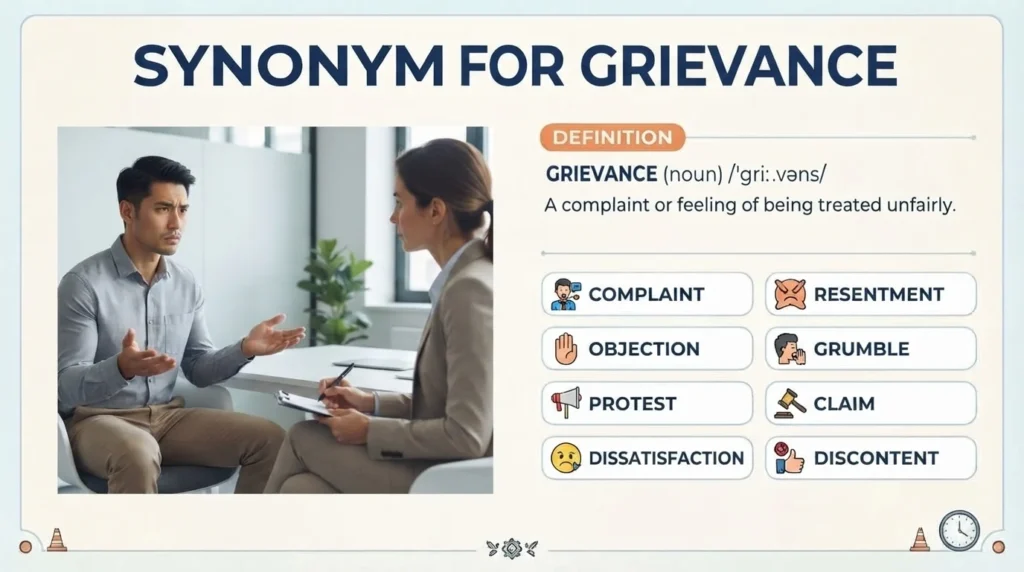
The word grievance refers to a real or perceived wrong that causes resentment and forms the basis for a formal complaint. Native speakers view it as a serious word tied to fairness, rights, and official processes.
You will often see it in workplace disputes, customer service policies, legal filings, and community discussions. It carries an emotional weight of feeling wronged or mistreated.
- Part of Speech: Noun (Countable)
- Simple Definition: A feeling of being treated unfairly, or an official complaint about an unfair situation.
Connotative Meaning
Connotation means the emotional feeling or hidden meaning that a word carries beyond its literal dictionary definition.
- Positive Tone: Very rare; usually describes a constructive process where a hidden problem is finally brought to light for healing or justice.
- Negative Tone: Highly common; carries strong feelings of resentment, unfairness, frustration, and systemic injustice.
- Neutral Tone: Appears in administrative contexts, such as a “grievance procedure” or “formal policy.”
Etymology
The word originates from Old French grevance, meaning “hardship, injury, or cause of anger.” It traces back to the Latin verb gravare, which means “to burden” or “make heavy.”
- Old English (450–1100): The word did not exist in Old English; earlier speakers used Germanic roots like sār (soreness) or tēona (injury).
- Middle English (1100–1500): Entered English after the Norman Conquest via Anglo-Norman French, taking on the sense of a heavy burden or formal injury.
- Modern English (1500–Present): Shifted into legal and labor contexts, becoming the standard term for formal complaints regarding rights and labor disputes.
Pronunciation (US & UK – IPA)
- US: /ˈɡriː.vəns/
- UK: /ˈɡriː.vəns/
Syllables & Affixation
- Syllables: grie-vance (2 syllables)
- Root: Grieve (verb)
- Prefix: None
- Suffix: -ance (forms nouns denoting an action, state, or quality)
Synonyms List
Complaint (Noun) — US: /kəmˈpleɪnt/ | UK: /kəmˈpleɪnt/
- Meaning: A statement that something is unsatisfactory or unacceptable.
- Tone/Register: Neutral / Everyday Business
- Example 1: She submitted a formal complaint to human resources about the noise level.
- Example 2: Customer complaints dropped significantly after the new software update was launched.
Ground (Noun) — US: /ɡraʊnd/ | UK: /ɡraʊnd/
- Meaning: A basic reason or justification for an action or belief.
- Tone/Register: Formal / Legal
- Example 1: The employee felt he had solid grounds for filing a grievance.
- Example 2: Unfair treatment provided clear grounds for terminating the agreement early.
Objection (Noun) — US: /əbˈdʒek.ʃən/ | UK: /əbˈdʒek.ʃən/
- Meaning: An expression or feeling of disapproval or opposition.
- Tone/Register: Neutral / Formal
- Example 1: Nobody raised an objection when the new schedule was proposed yesterday.
- Example 2: His primary objection was that the project budget was far too low.
Resentment (Noun) — US: /rɪˈzent.mənt/ | UK: /rɪˈzent.mənt/
- Meaning: Bitter indignation at having been treated unfairly.
- Tone/Register: Informal to Emotional
- Example 1: Years of low pay caused deep resentment among the factory workers.
- Example 2: She hid her resentment behind a polite smile during the meeting.
Injustice (Noun) — US: /ɪnˈdʒʌs.tɪs/ | UK: /ɪnˈdʒʌs.tɪs/
- Meaning: An instance of unfair treatment or a lack of fairness.
- Tone/Register: High Formal / Moral
- Example 1: Protesters gathered outside to speak out against civil injustice.
- Example 2: Ignoring qualified candidates is a clear injustice that damages team morale.
Injury (Noun) — US: /ˈɪn.dʒər.i/ | UK: /ˈɪn.dʒər.i/
- Meaning: A harm or wrong done to a person’s rights or reputation.
- Tone/Register: Formal / Legal
- Example 1: The breach of contract caused serious injury to the firm’s credibility.
- Example 2: He sought compensation for the financial injury caused by the delay.
Discontent (Noun) — US: /ˌdɪs.kənˈtent/ | UK: /ˌdɪs.kənˈtent/
- Meaning: A feeling of dissatisfaction with one’s circumstances.
- Tone/Register: General / Descriptive
- Example 1: Whispers of discontent spread through the office after the announcement.
- Example 2: The survey revealed widespread discontent regarding the new remote work policy.
Protest (Noun) — US: /ˈproʊ.test/ | UK: /ˈprəʊ.test/
- Meaning: An expression of strong objection or disapproval.
- Tone/Register: Direct / Public
- Example 1: Staff members staged a peaceful protest against the salary cuts.
- Example 2: Her letter of protest was delivered directly to the manager.
Grudge (Noun) — US: /ɡrʌdʒ/ | UK: /ɡrʌdʒ/
- Meaning: A persistent feeling of ill will or resentment resulting from a past insult.
- Tone/Register: Informal / Personal
- Example 1: He held a grudge against his former boss for many years.
- Example 2: Holding a grudge will only hurt your peace of mind.
Hardship (Noun) — US: /ˈhɑːrd.ʃɪp/ | UK: /ˈhɑːd.ʃɪp/
- Meaning: A condition that causes difficulty, pain, or suffering.
- Tone/Register: Serious / Descriptive
- Example 1: The sudden layoff created severe financial hardship for his family.
- Example 2: They persevered through every hardship during the winter months.
Wrong (Noun) — US: /rɑːŋ/ | UK: /rɒŋ/
- Meaning: An unfair, unjust, or immoral act.
- Tone/Register: General / Ethical
- Example 1: The legal system exists to right a wrong committed against citizens.
- Example 2: She determined to correct the wrong done to her colleague.
Charge (Noun) — US: /tʃɑːrdʒ/ | UK: /tʃɑːdʒ/
- Meaning: A formal claim that someone has done something wrong or illegal.
- Tone/Register: Formal / Legal
- Example 1: The committee investigated the charge of financial misconduct.
- Example 2: He faced a charge of negligence after skipping safety checks.
Accusation (Noun) — US: /ˌæk.jəˈzeɪ.ʃən/ | UK: /ˌæk.jʊˈzeɪ.ʃən/
- Meaning: A claim that someone has done something wrong.
- Tone/Register: Serious / Direct
- Example 1: The director rejected the accusation of favoritism instantly.
- Example 2: Her public accusation sparked a debate within the department.
Dispute (Noun) — US: /dɪˈspjuːt/ | UK: /dɪˈspjuːt/
- Meaning: A disagreement, argument, or debate.
- Tone/Register: Business / Formal
- Example 1: The labor union stepped in to settle the dispute smoothly.
- Example 2: Boundary disputes between neighbors can take months to resolve.
Unfairness (Noun) — US: /ʌnˈfer.nəs/ | UK: /ʌnˈfeə.nəs/
- Meaning: The quality of not being impartial or honest.
- Tone/Register: Conversational / General
- Example 1: Children notice unfairness very quickly during competitive games.
- Example 2: The team complained about the unfairness of the grading system.
Beef (Noun) — US: /biːf/ | UK: /biːf/
- Meaning: A complaint or disagreement between people.
- Tone/Register: Informal / Slang
- Example 1: He has a personal beef with the main store supervisor.
- Example 2: I have no beef with the new guidelines being introduced today.
Sore (Noun) — US: /sɔːr/ | UK: /sɔː/
- Meaning: A cause of deep annoyance, grief, or pain.
- Tone/Register: Figurative / Informal
- Example 1: Losing the final championship match remains a sore spot for the team.
- Example 2: The delayed bonus was a real sore point among staff.
Criticism (Noun) — US: /ˈkrɪt.ɪ.sɪ.zəm/ | UK: /ˈkrɪt.ɪ.sɪ.zəm/
- Meaning: An expression of disapproval based on perceived faults.
- Tone/Register: Academic / Analytical
- Example 1: Constructive criticism helps writers improve their final articles.
- Example 2: The policy faced harsh criticism from local business owners.
Disapproval (Noun) — US: /ˌdɪs.əˈpruː.vəl/ | UK: /ˌdɪs.əˈpruː.vəl/
- Meaning: Possession or expression of an unfavorable opinion.
- Tone/Register: Neutral / Social
- Example 1: Her parents showed clear disapproval of her decision to move.
- Example 2: The silence in the room signaled general disapproval.
Dissatisfaction (Noun) — US: /ˌdɪsˌsæt̬.əsˈfæk.ʃən/ | UK: /dɪsˌsæt.ɪsˈfæk.ʃən/
- Meaning: Lack of satisfaction or contentment with a situation.
- Tone/Register: Professional / Survey Tone
- Example 1: High turnover indicates employee dissatisfaction with management styles.
- Example 2: Client dissatisfaction must be addressed within 24 hours.
Reproach (Noun) — US: /rɪˈproʊtʃ/ | UK: /rɪˈprəʊtʃ/
- Meaning: An expression of disapproval or disappointment.
- Tone/Register: Formal / Literary
- Example 1: His conduct was beyond reproach throughout his entire career.
- Example 2: She looked at him with a silent reproach that hurt deeply.
Bitterness (Noun) — US: /ˈbɪt̬.ɚ.nəs/ | UK: /ˈbɪt.ə.nəs/
- Meaning: Sharp resentment or deep anger.
- Tone/Register: Psychological / Emotional
- Example 1: He spoke about his old job with obvious bitterness.
- Example 2: Avoid holding onto bitterness when resolving personal conflicts.
Ill Will (Noun) — US: /ˌɪl ˈwɪl/ | UK: /ˌɪl ˈwɪl/
- Meaning: Hostile feelings or animosity toward someone.
- Tone/Register: Social / Formal
- Example 1: We parted ways without any ill will between us.
- Example 2: The heated debate generated ill will among project members.
Malice (Noun) — US: /ˈmæl.ɪs/ | UK: /ˈmæl.ɪs/
- Meaning: The intention or desire to do evil or cause harm.
- Tone/Register: High Formal / Legal
- Example 1: The legal team proved the statement was made with actual malice.
- Example 2: There was no malice behind her accidental deletion of the file.
Animosity (Noun) — US: /ˌæn.əˈmɑː.sə.t̬i/ | UK: /ˌæn.ɪˈmɒs.ə.ti/
- Meaning: Strong dislike or active hostility.
- Tone/Register: Literary / Academic
- Example 1: Longstanding animosity between the departments slowed down production.
- Example 2: They set aside their animosity to work on the emergency goal.
Friction (Noun) — US: /ˈfrɪk.ʃən/ | UK: /ˈfrɪk.ʃən/
- Meaning: Conflict or animosity caused by disagreement.
- Tone/Register: Workplace / Casual Professional
- Example 1: Miscommunication created unnecessary friction between the sales team and support team.
- Example 2: The manager handled office friction before it escalated into arguments.
Trouble (Noun) — US: /ˈtrʌb.əl/ | UK: /ˈtrʌb.əl/
- Meaning: Difficulty, problems, or causes of distress.
- Tone/Register: General / Everyday
- Example 1: The mechanical failure caused a lot of trouble for travelers.
- Example 2: He explained his trouble to the customer support representative.
Distress (Noun) — US: /dɪˈstres/ | UK: /dɪˈstres/
- Meaning: Extreme anxiety, sorrow, or pain.
- Tone/Register: Formal / Emotional
- Example 1: Financial instability causes severe mental distress to individuals.
- Example 2: The emergency call signaled that the ship was in deep distress.
Agitation (Noun) — US: /ˌædʒ.əˈteɪ.ʃən/ | UK: /ˌædʒ.ɪˈteɪ.ʃən/
- Meaning: A state of anxiety or nervous excitement; public protest.
- Tone/Register: Political / Social
- Example 1: Political agitation led to rapid reform in labor rights.
- Example 2: He sensed the rising agitation among the waiting crowd.
Contention (Noun) — US: /kənˈten.ʃən/ | UK: /kənˈten.ʃən/
- Meaning: Heated disagreement or an assertion made in an argument.
- Tone/Register: Formal / Academic
- Example 1: The main point of contention was how to divide the profits.
- Example 2: This issue remains a source of contention among researchers.
Scandal (Noun) — US: /ˈskæn.dəl/ | UK: /ˈskæn.dəl/
- Meaning: An action or event regarded as morally or legally wrong.
- Tone/Register: Media / Public
- Example 1: The corporate scandal led to the immediate resignation of the executive.
- Example 2: News outlets reported on the political scandal for weeks.
Guilt (Noun) — US: /ɡɪlt/ | UK: /ɡɪlt/
- Meaning: The fact of having committed a specified offense or crime.
- Tone/Register: Legal / Psychological
- Example 1: The jury determined his guilt based on overwhelming physical evidence.
- Example 2: She felt a surge of guilt for missing the important deadline.
Offense (Noun) — US: /əˈfens/ | UK: /əˈfens/
- Meaning: Annoyance or resentment brought about by a perceived insult.
- Tone/Register: Conversational / Social
- Example 1: Please take no offense at my honest critique of the draft.
- Example 2: His direct tone caused offense among the attendees.
Indignation (Noun) — US: /ˌɪn.dɪɡˈneɪ.ʃən/ | UK: /ˌɪn.dɪɡˈneɪ.ʃən/
- Meaning: Anger or annoyance provoked by perceived unfair treatment.
- Tone/Register: High Literary / Expressive
- Example 1: She expressed natural indignation when accused of copying the essay.
- Example 2: The audience reacted with righteous indignation to the news report.
Pique (Noun) — US: /piːk/ | UK: /piːk/
- Meaning: A feeling of irritation or resentment resulting from a slight.
- Tone/Register: Formal / Literary
- Example 1: In a fit of pique, he packed his belongings and left the room.
- Example 2: Her sudden departure was prompted by personal pique.
Umbrage (Noun) — US: /ˈʌm.brɪdʒ/ | UK: /ˈʌm.brɪdʒ/
- Meaning: Offense or annoyance (used almost exclusively in “take umbrage”).
- Tone/Register: Formal / Idiomatic
- Example 1: He took umbrage at the suggestion that he lacked experience.
- Example 2: Avoid taking umbrage when receiving professional feedback.
Vexation (Noun) — US: /vekˈseɪ.ʃən/ | UK: /vekˈseɪ.ʃən/
- Meaning: The state of being annoyed, frustrated, or worried.
- Tone/Register: Classic / Formal
- Example 1: He threw his papers down in sheer vexation.
- Example 2: Traffic delays are a constant source of vexation for commuters.
Worry (Noun) — US: /ˈwɝː.i/ | UK: /ˈwʌr.i/
- Meaning: A state of anxiety and uncertainty over actual or potential problems.
- Tone/Register: Casual / Everyday
- Example 1: Financial strain is a major worry for young entrepreneurs.
- Example 2: Her primary worry was meeting the strict publication deadline.
Affliction (Noun) — US: /əˈflɪk.ʃən/ | UK: /əˈflɪk.ʃən/
- Meaning: Something that causes pain or suffering.
- Tone/Register: Formal / Serious
- Example 1: Poverty is a painful affliction affecting millions worldwide.
- Example 2: He bore his physical affliction with great dignity and strength.
Burden (Noun) — US: /ˈbɝː.dən/ | UK: /ˈbɜː.dən/
- Meaning: A heavy load, responsibility, or emotional strain.
- Tone/Register: General / Metaphorical
- Example 1: High interest rates place a heavy burden on small business owners.
- Example 2: Sharing your secrets can relieve a heavy emotional burden.
Synonyms for Grievance by Tone
Choosing the correct word depends heavily on your audience and setting. Words carry subtle emotional hues that alter your message completely.
- Positive / Constructive Tone: Grievance, Objection (when handled professionally).
- Neutral / Administrative Tone: Complaint, Dispute, Dissatisfaction, Charges.
- Negative / Emotional Tone: Resentment, Grudge, Bitterness, Animosity, Ill Will, Malice.
- Playful / Informal Tone: Beef, Sore spot.
Using a high-emotion word like bitterness in a formal corporate letter might sound unprofessional. Conversely, using dispute in a casual talk with a friend can sound overly distant.
Mini Comparison
Grievance vs. Complaint vs. Resentment
| Feature | Grievance | Complaint | Resentment |
| Primary Focus | Official injustice or infringement of rights. | Expressing dissatisfaction with a service or product. | Deep internal feeling of anger or bitterness. |
| Formal Action Needed? | Yes, usually filed formally. | Optional; can be spoken or written. | No, purely emotional and internal. |
| Best Context | Workplace, legal, union contracts. | Customer service, daily life. | Personal relationships, psychology. |
- When to use Grievance: Use when an official rule, contract, or human right has been violated.
- When to use Complaint: Use when a product or service fails to meet expectations.
- When to use Resentment: Use when describing silent, suppressed feelings of unfairness over time.
Context-Based Usage
Daily Conversation
In casual chats, avoid heavy words like grievance. Instead, use beef, trouble, or complaint.
- Example: “I have no beef with the new house rules.”
Writing & Blogging
Bloggers and essayists benefit from descriptive words that evoke emotion without sounding dry. Excellent choices include resentment, discontent, or friction.
- Example: “Growing discontent among users led to an app redesign.”
Professional & Academic Tone
In official settings, precision is essential. Rely on grievance, dispute, grounds, or objection.
- Example: “The employee union raised a formal dispute regarding overtime pay.”
Creative & Literary Use
Novelists and poets need expressive language that shows internal struggle. Terms like indignation, umbrage, pique, or bitterness fit nicely.
- Example: “She held a quiet bitterness that clouded her writing.”
Common Mistakes & Native Usage
- Misusing “Grievance” for Minor Inconveniences: Do not say “My grievance is that the coffee is cold.” Use complaint or annoyance instead.
- Confusing Grievance with Grief: While both share a Latin root (gravare), grief refers to deep sadness over loss, whereas grievance relates to unfair treatment.
- Overusing the Word: Repeating grievance in an essay makes prose feel repetitive. Swap it with dispute or complaint to maintain interest.
Register Notes:
Written business English prefers formal complaint or grievance. Spoken English favors phrases like “having an issue” or “having a problem.”
Real-Life Mini Scenarios
- Workplace: An employee files a grievance with HR after being passed over for a promotion despite meeting every requirement.
- Social Situations: Two friends resolve a long-standing beef after sitting down for an open conversation.
- Media & News: Journalists report on growing public discontent regarding rising electricity bills.
- Storytelling: A novel character harbors deep resentment toward his rival, driving the plot forward.
Conclusion
Learning synonyms for grievance expands your English toolkit, allowing you to match your tone precisely to any situation.
Mastering these vocabulary nuances helps you write persuasive essays, professional workplace emails, and clearer daily communications.
Try picking three new synonyms from this guide today and use them in your next email or journal entry to lock in your learning!
MCQs
1. Which word is a synonym for “grievance”?
A) Complaint
B) Praise
C) Reward
D) Celebration
2. What does “grievance” mean?
A) A complaint about something unfair or wrong
B) A joyful experience
C) A type of reward
D) A friendly greeting
3. Which word can replace “grievance”?
A) Complaint
B) Approval
C) Success
D) Agreement
4. Which is closest in meaning to “grievance”?
A) Objection
B) Happiness
C) Support
D) Encouragement
5. “She filed a grievance against the company.” What does “grievance” mean here?
A) Complaint
B) Promotion
C) Celebration
D) Invitation
6. Which word is NOT a synonym for “grievance”?
A) Complaint
B) Objection
C) Protest
D) Praise
7. A person who expresses a grievance is usually:
A) Reporting a problem or unfair treatment
B) Giving a reward
C) Offering congratulations
D) Sharing good news
8. Which word best replaces “grievance” in this sentence?
“He expressed his grievance to the manager.”**
A) Complaint
B) Greeting
C) Gift
D) Applause
9. Which phrase best describes a grievance?
A) A complaint about unfair treatment
B) A statement of happiness
C) An offer of help
D) A message of congratulations
10. Which is the best synonym for “grievance”?
A) Complaint
B) Praise
C) Approval
D) Satisfaction
Answer Key
- A | 2. A | 3. A | 4. A | 5. A
- D | 7. A | 8. A | 9. A | 10. A
Reflection Task: Write one short paragraph describing a fictional workplace disagreement using at least two synonyms learned in this article (e.g., complaint, dispute, friction).
FAQs
What is the most common synonym for grievance in business writing?
The most common synonym in business writing is “formal complaint.” While “grievance” implies an infringement of rights or labor agreements, “complaint” covers general dissatisfaction with workplace conditions, policies, or services.
Can grievance and grievance procedure be used interchangeably?
No, they cannot. A “grievance” refers to the actual wrong or feeling of unfairness, whereas a “grievance procedure” refers to the official step-by-step process used by organizations to investigate and resolve that issue.
Is grievance a formal or informal word in English?
“Grievance” is a formal word primarily used in legal, corporate, union, and academic contexts. In casual conversation, native speakers prefer words like “issue,” “complaint,” or “problem.”
What is the difference between grievance and resentment?
A grievance is an objective claim of unfair treatment that often leads to formal action. Resentment is a subjective, internal feeling of bitterness that may never be expressed publicly.

Sophia Carter is the founder and lead writer at SynonymVerse.com, a trusted online resource dedicated to English vocabulary and effective communication. She is passionate about helping students, writers, professionals, and lifelong learners find the most accurate words to express their ideas with clarity and confidence.
At SynonymVerse.com, every article is carefully researched and thoughtfully written to provide reliable guidance on synonyms, word meanings, and vocabulary. With a strong focus on accuracy, real-world usage, and easy-to-understand explanations, the website is committed to helping readers strengthen their language skills, enrich their vocabulary, and become more confident communicators.