Synonyms for hammer help you describe striking tools or forceful impacts without repeating the same word over and over. Picture a carpenter pounding nails into wood.
A judge driving a wooden gavel onto a bench shows this forceful action in real life. Finding an accurate synonym for hammer makes your speech more vivid.
Varied words help you express precise tools, actions, and heavy hits clearly. Knowing every synonym for hammer benefits students, writers, and speakers today.
What Does “Hammer” Really Mean?
“Hammer” refers to a handheld tool used for pounding objects or an action involving striking something forcefully. The word carries a strong, direct, and energetic attitude.
Native speakers understand it as a heavy tool or as a verb meaning to strike, shape, or repeat relentlessly. It appears in carpentry, sports reporting, courtroom scenes, and everyday idioms.
- Part of Speech: Noun / Verb
- Simple Definition: A heavy tool used to pound nails, or the act of striking something with force.
Connotative Meaning
Connotation is the emotional feeling or cultural association a word carries beyond its explicit dictionary definition.
- Positive tone: Productive, constructive, forceful, determined, and solid (e.g., hammering out a fair deal).
- Negative tone: Destructive, aggressive, harsh, or repetitive (e.g., hammering an opponent relentlessly).
- Neutral tone: Practical, mechanical, instrumental, and physical (e.g., holding a claw hammer).
Etymology
The word stems from the Old English term hamor, which means “stone tool, hammer, or mallet.” It connects to Proto-Germanic *hamaraz, rooted in ancient Indo-European terms for stone or rock.
- Old English (450–1100): Referred to stone or metal tools used for forging and crushing.
- Middle English (1100–1500): Written as hamer, describing blacksmithing tools and combat weapons.
- Modern English (1500–Present): Expanded to include metaphorical uses like hammering out agreements or hammering points home.
Pronunciation
- US: /ˈhæm.ɚ/
- UK: /ˈhæm.ər/
Syllables & Structure
- Syllables: ham-mer
- Root: Hammer
- Prefix: None
- Suffix: None
Synonyms List
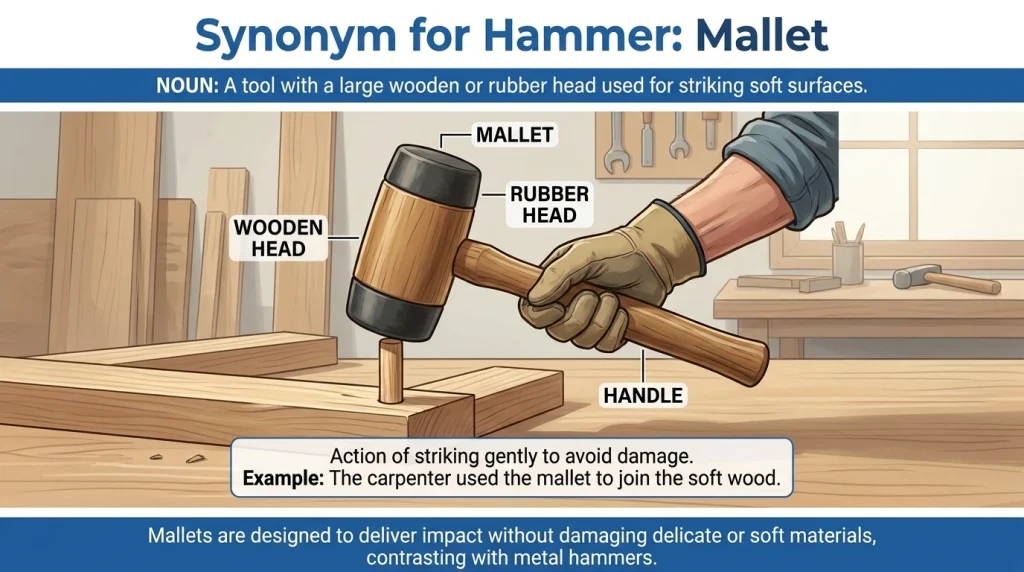
Mallet (Noun) — US: /ˈmæl.ət/ | UK: /ˈmæl.ɪt/
Meaning: A tool with a large wooden or rubber head used for striking soft surfaces.
Tone/Register: Technical / Practical
Example 1: The woodworker tapped the wooden chisel gently using a rubber mallet.
Example 2: She used a light mallet to shape the sheet metal carefully.
Sledgehammer (Noun) — US: /ˈsledʒˌhæm.ɚ/ | UK: /ˈsledʒˌhæm.ər/
Meaning: A large, heavy hammer used for demolition or heavy construction work.
Tone/Register: Forceful / Descriptive
Example 1: Workers used a heavy sledgehammer to break down the old brick wall.
Example 2: He swings the sledgehammer easily during workout training sessions.
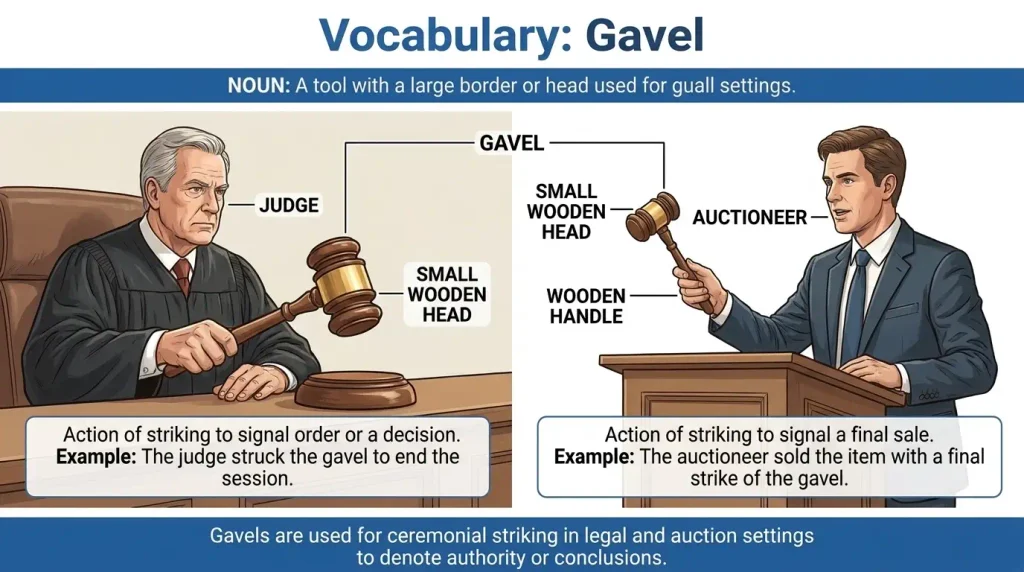
Gavel (Noun) — US: /ˈɡæv.əl/ | UK: /ˈɡæv.əl/
Meaning: A small wooden mallet used by judges or auctioneers to call order.
Tone/Register: Formal / Legal
Example 1: The judge struck his wooden gavel to bring order to the court.
Example 2: The auctioneer lowered her gavel after accepting the final bid.
Maul (Noun) — US: /mɑːl/ | UK: /mɔːl/
Meaning: A heavy long-handled hammer used for splitting wood logs or heavy striking.
Tone/Register: Practical / Industrial
Example 1: He lifted the heavy steel maul to split firewood before sunset.
Example 2: Farmers kept a wooden maul inside the barn for driving fence posts.
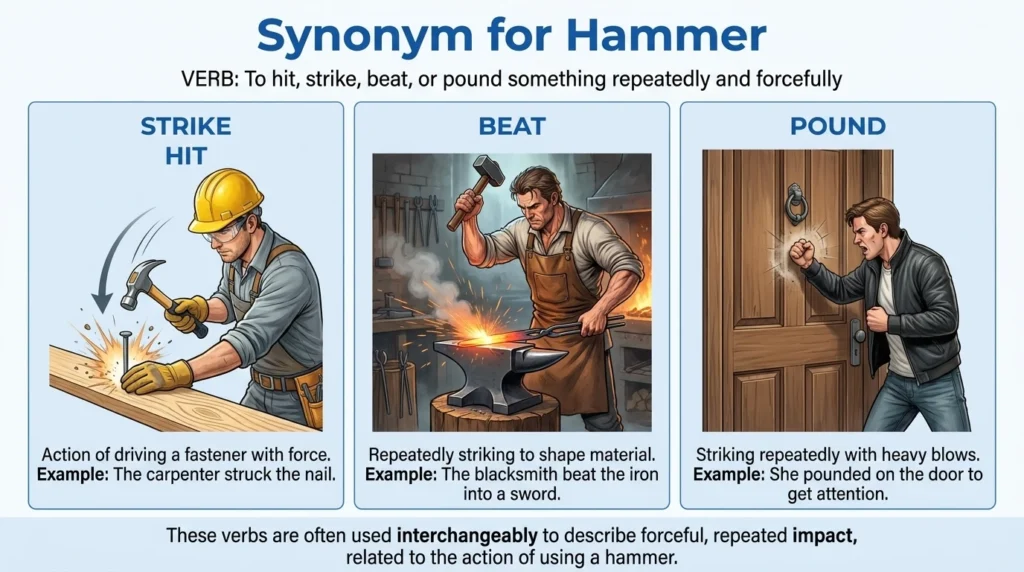
Pound (Verb) — US: /paʊnd/ | UK: /paʊnd/
Meaning: To strike repeatedly with heavy force or a blunt instrument.
Tone/Register: Everyday / Active
Example 1: Rain began to pound against the glass windowpane all night.
Example 2: She began to pound the garlic cloves into a smooth paste.
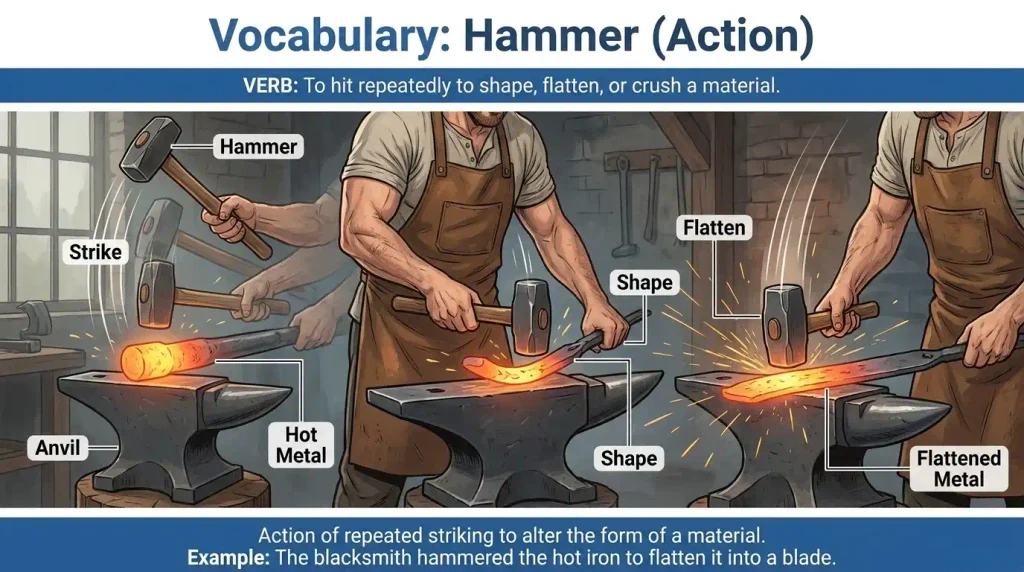
Beat (Verb) — US: /biːt/ | UK: /biːt/
Meaning: To hit repeatedly in order to shape, flatten, or crush a material.
Tone/Register: General / Casual
Example 1: Blacksmiths beat hot iron on an anvil to forge swords.
Example 2: He used a pan to beat the cutlets before cooking them.
Strike (Verb) — US: /straɪk/ | UK: /straɪk/
Meaning: To hit a surface forcefully with a tool, hand, or weapon.
Tone/Register: Formal / Standard
Example 1: The clock began to strike midnight across the city square.
Example 2: Make sure you strike the nail head dead center every time.
Patter (Verb) — US: /ˈpæt̬.ɚ/ | UK: /ˈpæt.ər/
Meaning: To make a quick succession of light tapping hits like small hammers.
Tone/Register: Gentle / Descriptive
Example 1: Soft drops began to patter on the roof as dawn broke.
Example 2: We heard footsteps patter across the upstairs wooden hallway.
Smite (Verb) — US: /smaɪt/ | UK: /smaɪt/
Meaning: To hit or strike with firm power or dramatic impact.
Tone/Register: Literary / Archaic
Example 1: The hero swore to smite the wicked giant with his mace.
Example 2: Ancient stories tell of thunderbolts sent to smite foes.
Batter (Verb) — US: /ˈbæt̬.ɚ/ | UK: /ˈbæt.ər/
Meaning: To strike hard repeatedly, causing wear, damage, or structural breakdown.
Tone/Register: Descriptive / Harsh
Example 1: High waves continued to batter the rocky coastline during storms.
Example 2: Strong winds started to batter the old barn doors overnight.
Pummel (Verb) — US: /ˈpʌm.əl/ | UK: /ˈpʌm.əl/
Meaning: To hit repeatedly with fists or a blunt tool with great force.
Tone/Register: Action / Intense
Example 1: The boxer managed to pummel his opponent against the ropes.
Example 2: Hailstones began to pummel parked cars across the avenue.
Thrash (Verb) — US: /θræʃ/ | UK: /θræʃ/
Meaning: To beat or strike heavily and violently as a form of punishment or force.
Tone/Register: Energetic / Casual
Example 1: The storm continued to thrash the sails throughout the night.
Example 2: He began to thrash the bushes with a stick to clear a path.
Whack (Verb) — US: /hwæk/ | UK: /wæk/
Meaning: To strike sharp, noisy hits against an object with a flat or heavy tool.
Tone/Register: Informal / Conversational
Example 1: He gave the loose wooden peg a quick whack with a wooden block.
Example 2: Kids love to whack the colorful piñata at birthday parties.
Cudgel (Noun) — US: /ˈkʌdʒ.əl/ | UK: /ˈkʌdʒ.əl/
Meaning: A short heavy stick or club used as a blunt weapon or striking tool.
Tone/Register: Historical / Literary
Example 1: The guard leaned upon his wooden cudgel near the gate.
Example 2: Ancient travelers carried a sturdy cudgel for personal defense.
Bludgeon (Noun) — US: /ˈblʌdʒ.ən/ | UK: /ˈblʌdʒ.ən/
Meaning: A heavy blunt tool or club used for forceful striking.
Tone/Register: Dramatic / Legal
Example 1: Detectives searched the yard for the heavy wooden bludgeon.
Example 2: The statue held a stone bludgeon high above its head.
Drive (Verb) — US: /draɪv/ | UK: /draɪv/
Meaning: To force an object into a surface by hitting it repeatedly.
Tone/Register: Practical / Precise
Example 1: He used a heavy tool to drive stakes deep into the dirt.
Example 2: You must drive the chisel carefully along the marked line.
Forge (Verb) — US: /fɔːrdʒ/ | UK: /fɔːdʒ/
Meaning: To shape metal by heating and pounding it continuously with heavy tools.
Tone/Register: Technical / Creative
Example 1: Craftsmen heat raw steel to forge durable hand tools.
Example 2: They worked tirelessly to forge a lasting peace agreement.
Banger (Noun) — US: /ˈbæŋ.ɚ/ | UK: /ˈbæŋ.ər/
Meaning: An informal term for a striking tool or device that makes loud hits.
Tone/Register: Colloquial / Casual
Example 1: Pass me that small rubber banger to tap the tiles down.
Example 2: He used a heavy metal banger to loosen the rusted pipe.
Pestle (Noun) — US: /ˈpes.əl/ | UK: /ˈpes.əl/
Meaning: A heavy club-shaped tool used for grinding or crushing substances in a mortar.
Tone/Register: Scientific / Culinary
Example 1: The chef used a stone pestle to crush fresh herbs finely.
Example 2: Pharmacists once used a porcelain pestle to grind remedies.
Beetle (Noun) — US: /ˈbiː.t̬əl/ | UK: /ˈbiː.təl/
Meaning: A heavy wooden mallet used for ramming, paving, or pounding cloth.
Tone/Register: Specialized / Historic
Example 1: Workers used a wooden beetle to level cobblestones on the street.
Example 2: Textile makers used a heavy beetle to press linen fabrics smoothly.
Ram (Noun) — US: /ræm/ | UK: /ræm/
Meaning: A heavy tool or weight dropped or driven to impact surfaces forcefully.
Tone/Register: Tactical / Engineering
Example 1: Officers used a steel ram to break open the reinforced door.
Example 2: Construction teams used a hydraulic ram to set heavy pilings.
Club (Noun) — US: /klʌb/ | UK: /klʌb/
Meaning: A heavy stick with one thick end used as a striking tool or weapon.
Tone/Register: General / Direct
Example 1: He picked up a wooden club to drive the wooden wedge home.
Example 2: Ancient hunters carved striking tools from dense oak branches.
Mace (Noun) — US: /meɪs/ | UK: /meɪs/
Meaning: A heavy spiked or fluted club-like tool used historically for heavy impact.
Tone/Register: Historical / Ceremonial
Example 1: The museum displayed a ceremonial iron mace from the Middle Ages.
Example 2: Knights carried a heavy mace into battles long ago.
Tap (Verb) — US: /tæp/ | UK: /tæp/
Meaning: To strike light, precise blows using a small hammer or light instrument.
Tone/Register: Delicate / Everyday
Example 1: Tap the small nail gently so you do not damage the frame.
Example 2: She began to tap the glass lightly to catch his attention.
Bang (Verb) — US: /bæŋ/ | UK: /bæŋ/
Meaning: To strike something hard, producing a sudden loud, sharp noise.
Tone/Register: Informal / Conversational
Example 1: Do not bang the cabinet doors shut late at night.
Example 2: He started to bang the drum with wooden sticks.
Wallop (Verb) — US: /ˈwɑː.ləp/ | UK: /ˈwɒl.əp/
Meaning: To hit or strike something with a powerful, heavy blow.
Tone/Register: Playful / Informal
Example 1: He managed to wallop the baseball clear over the outfield fence.
Example 2: She gave the rug a strong wallop to knock out the dust.
Slam (Verb) — US: /slæm/ | UK: /slæm/
Meaning: To strike or strike down with sudden speed, force, and noise.
Tone/Register: Expressive / Dynamic
Example 1: He was so angry he decided to slam his heavy boots on the floor.
Example 2: The wrestler tried to slam his rival onto the mat.
Belt (Verb) — US: /belt/ | UK: /belt/
Meaning: To hit something with great energy or forceful impact.
Tone/Register: Colloquial / Vivid
Example 1: Watch him belt the tennis ball across the court easily.
Example 2: He managed to belt the metal sheet flat in three blows.
Clobber (Verb) — US: /ˈklɑː.bɚ/ | UK: /ˈklɒb.ər/
Meaning: To strike heavily and repeatedly with a tool or heavy force.
Tone/Register: Casual / Slang
Example 1: The storm will clobber coastlines with high wind gusts tomorrow.
Example 2: He accidentally managed to clobber his knee against the coffee table.
Flatten (Verb) — US: /ˈflæt̬.ən/ | UK: /ˈflæt.ən/
Meaning: To strike an object repeatedly until its surface becomes completely level.
Tone/Register: Practical / General
Example 1: Blacksmiths flatten heated metal pieces using heavy anvils.
Example 2: Use a wooden mallet to flatten the leather strap smoothly.
Pelt (Verb) — US: /pelt/ | UK: /pelt/
Meaning: To strike repeatedly with small objects or rapid successive hits.
Tone/Register: Descriptive / Energetic
Example 1: Kids started to pelt snowballs at the tree trunk across the park.
Example 2: Heavy raindrops began to pelt the car windshield quickly.
Shape (Verb) — US: /ʃeɪp/ | UK: /ʃeɪp/
Meaning: To strike an object constructively to give it a desired form or structure.
Tone/Register: Creative / Professional
Example 1: Artisans shape raw copper sheets using small ball-peen mallets.
Example 2: They work continuously to shape raw ideas into solid plans.
Knock (Verb) — US: /nɑːk/ | UK: /nɒk/
Meaning: To strike a hard blow or tap against a firm surface repeatedly.
Tone/Register: Everyday / Standard
Example 1: Please knock on the wooden door before entering the office.
Example 2: He used a small wedge to knock the rusted pin free.
Pound Out (Phrase) — US: /paʊnd aʊt/ | UK: /paʊnd aʊt/
Meaning: To produce something or flatten metal through persistent pounding.
Tone/Register: Idiomatic / Casual
Example 1: The blacksmith managed to pound out a strong iron hinge.
Example 2: They sat down to pound out a draft agreement before noon.
Hammer Out (Phrase) — US: /ˈhæm.ɚ aʊt/ | UK: /ˈhæm.ər aʊt/
Meaning: To negotiate firmly until a complex problem or treaty is solved.
Tone/Register: Professional / Business
Example 1: Executives met to hammer out the details of the final contract.
Example 2: Lawyers spent hours trying to hammer out a fair deal.
Drive Home (Phrase) — US: /draɪv hoʊm/ | UK: /draɪv həʊm/
Meaning: To emphasize an argument or point until it is completely understood.
Tone/Register: Emphatic / Persuasive
Example 1: The speaker used charts to drive home her main arguments.
Example 2: His mistake helped drive home the value of safety rules.
Beat Down (Phrase) — US: /biːt daʊn/ | UK: /biːt daʊn/
Meaning: To strike continuously with heat, rain, or physical pressure.
Tone/Register: Descriptive / Intense
Example 1: The midsummer sun continued to beat down on workers all afternoon.
Example 2: Torrential rain threatened to beat down the delicate flowers.
Patter Down (Phrase) — US: /ˈpæt̬.ɚ daʊn/ | UK: /ˈpæt.ər daʊn/
Meaning: To hit softly and rapidly, like light rain striking leaf surfaces.
Tone/Register: Poetic / Soft
Example 1: Autumn leaves began to patter down upon the damp soil.
Example 2: Light rain started to patter down across the quiet garden.
Strike Down (Phrase) — US: /straɪk daʊn/ | UK: /straɪk daʊn/
Meaning: To knock over or overturn with authoritative or physical force.
Tone/Register: Legal / Dramatic
Example 1: The high court voted to strike down the unjust municipal law.
Example 2: The fighter managed to strike down his opponent in round two.
Heavy-Hit (Phrase) — US: /ˈhev.i hɪt/ | UK: /ˈhev.i hɪt/
Meaning: Delivering a massive impact or forceful blow to an object or idea.
Tone/Register: Informal / Dynamic
Example 1: The heavy-hitting demolition tool broke the concrete slab quickly.
Example 2: His heavy-hitting opening statement captured everyone’s attention instantly.
Synonyms for “Hammer” by Tone
Choosing the right tone ensures your vocabulary matches your specific topic accurately.
- Positive/Constructive: Shape, Forge, Hammer Out, Drive Home, Tap
- Neutral/Technical: Mallet, Sledgehammer, Gavel, Maul, Pestle, Ram
- Negative/Destructive: Pummel, Batter, Thrash, Clobber, Bludgeon, Beat Down
- Playful/Informal: Whack, Wallop, Bang, Belt, Banger
“Hammer” vs. Close Alternatives
| Feature | Hammer | Mallet | Sledgehammer |
| Core Focus | General-purpose metal tool for pounding nails or forging | Soft-headed wooden or rubber tool for gentle striking | Heavy long-handled tool used for crushing or demolition |
| Tone | Direct, versatile, constructive | Delicate, precise, careful | Extreme, heavy, forceful |
| Best Context | Home repairs, metalwork, general metaphors | Woodworking, tile setting, kitchen work | Wall removal, heavy construction, demolition |
How “Hammer” Changes by Context
- Daily Conversation: Used casually for basic driving or loud striking noises (e.g., “Stop hammering on the table”).
- Writing or Blogging: Creates strong physical rhythm, vivid sensory details, or forceful character actions.
- Professional Tone: Applied in carpentry, legal metaphors, business negotiations, and industrial manufacturing.
- Creative Use: Expresses relentless mental persistence, like pounding through tough challenges.
Common Mistakes Learners Make
- Misuse Scenarios: Using “sledgehammer” when describing fine, delicate woodworking instead of a light “mallet.”
- Confusing Tone: Using severe words like “bludgeon” when describing a judge using a court “gavel.”
- Overuse Warnings: Repeating “hammer” continuously when describing physical labor weakens descriptive quality.
Using precise alternatives like mallet, praise, or gavel elevates your descriptive writing immediately.
Real-Life Mini Scenarios
- Workplace: The carpenter selected a rubber mallet to join the delicate wooden furniture pieces.
- Social Situations: He used a small bottle opener to whack the top off his soda bottle playfully.
- Media / Pop Culture: Journalists reported how leaders met for hours to hammer out a global deal.
- Storytelling: The blacksmith worked near the fire, using steel tools to forge fine horseshoes.
MCQs
1. Which word is closest in meaning to “hammer” as a verb?
A) Strike
B) Whisper
C) Float
D) Fold
2. What does “hammer” mean when used as a verb?
A) To hit repeatedly
B) To walk slowly
C) To speak softly
D) To hide something
3. Which word can replace “hammer” in “He hammered the nail into the wood”?
A) Struck
B) Carried
C) Lifted
D) Painted
4. “The workers hammered the metal into shape.” What is the closest synonym?
A) Beat
B) Wash
C) Cut
D) Cover
5. Which word means to hit something forcefully?
A) Pound
B) Rest
C) Touch
D) Hold
6. Which synonym best fits “hammer” in “She hammered on the door”?
A) Banged
B) Opened
C) Closed
D) Entered
7. Which word is a synonym for “hammer” when it means to strike repeatedly?
A) Pound
B) Whisper
C) Slide
D) Watch
8. “The blacksmith hammered the hot iron.” Which word has a similar meaning?
A) Beat
B) Dropped
C) Cleaned
D) Stored
9. Which option is NOT a synonym for “hammer” as a verb?
A) Strike
B) Pound
C) Hit
D) Protect
10. “Hammer” can mean to hit something:
A) Repeatedly and forcefully
B) Quietly and gently
C) Carefully and rarely
D) Accidentally and slowly
Answer Key
- A
- A
- A
- A
- A
- A
- A
- A
- D
- A
Application Task: Write one short sentence describing a project where you had to work hard to hammer out a practical solution.
FAQs
1. What is the most accurate synonym for hammer in gentle carpentry?
“Mallet” is the best choice for delicate carpentry. Mallets have rubber or wooden heads that prevent denting or damaging soft wood surfaces during construction.
2. Can “hammer” be used as a verb in business contexts?
Yes, idioms like “hammer out a contract” or “drive home a strategy” are widely used in business to describe firm negotiations and clear communication.
3. What is the main difference between a maul and a sledgehammer?
A sledgehammer has two flat steel faces for crushing objects. A maul typically features a wedge-like head designed specifically for splitting wooden logs along the grain.
4. What word best describes striking small nails lightly into picture frames?
“Tapping” or “light striking” works best. These terms emphasize control, precision, and gentleness over destructive, heavy force during assembly.
5. Why is “gavel” not interchangeable with general construction hammers?
A gavel is a ceremonial wooden mallet used exclusively by judges, presiding officers, or auctioneers to maintain order or finalize bids, not for driving nails.
Conclusion
Mastering a new synonym for hammer transforms how you describe physical impacts, helping you express actions with absolute clarity.
Using a fresh synonym for hammer instantly elevates your daily writing, whether you are crafting essays, blogs, or business reports.
Exploring every synonym for hammer enriches your overall English vocabulary, making you a more precise, engaging communicator every day.
Start practicing these energetic new words in your next conversation or project to make your descriptive writing stand out!

Sophia Carter is the founder and lead writer at SynonymVerse.com, a trusted online resource dedicated to English vocabulary and effective communication. She is passionate about helping students, writers, professionals, and lifelong learners find the most accurate words to express their ideas with clarity and confidence.
At SynonymVerse.com, every article is carefully researched and thoughtfully written to provide reliable guidance on synonyms, word meanings, and vocabulary. With a strong focus on accuracy, real-world usage, and easy-to-understand explanations, the website is committed to helping readers strengthen their language skills, enrich their vocabulary, and become more confident communicators.