
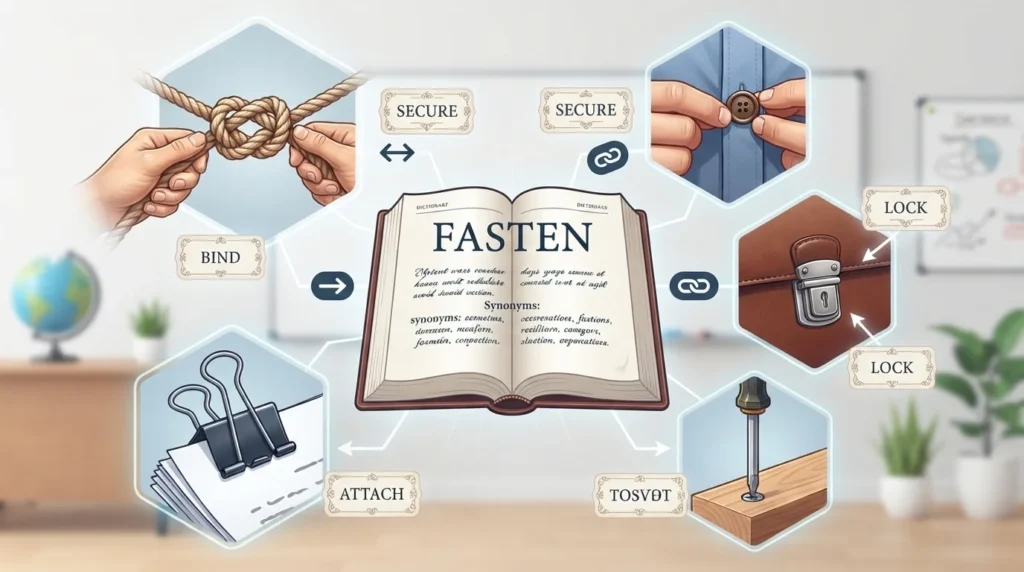
Synonyms for fasten help you describe securing objects, joining items, or locking things in place with complete clarity.
Imagine sitting on an airplane right before takeoff when the flight attendant reminds everyone to secure their seatbelts carefully.
That simple, routine action shows how frequently we need to fasten everyday items to ensure personal safety and stability.
Learning a synonym for fasten improves your writing skills and keeps your essays, manuals, and blog posts from sounding repetitive.
This versatile action verb appears everywhere in safety guides, DIY tutorials, fashion articles, and daily speech across the globe.
Students, bloggers, technical writers, and ESL learners can use these distinct terms to express precise shades of meaning instantly.
What Does “Fasten” Really Mean?
“Fasten” means to attach, join, bind, or secure two or more things together so they stay firmly in place. Native speakers understand it as closing a buckle, tightening a bolt, or tying a knot to prevent movement or loss.
You will see it used in automotive safety, woodworking, clothing design, and general daily routines.
- Part of Speech: Verb
- Definition: To make secure or bring together firmly so that movement is restricted.
Connotative Meaning
(Connotation is the emotional feeling or cultural association that a word carries beyond its literal definition.)
- Positive tone: Implies safety, protection, stability, care, and reliable security.
- Negative tone: Can suggest feeling trapped, overly restricted, or uncomfortably confined if done too tightly.
- Neutral tone: Merely describes the physical mechanics of joining two objects together.
Etymology
The word “fasten” comes from the Old English verb fæstnian, which meant to make firm, establish, or pledge.
- Old English (450–1100): Used as fæstnian, meaning to make firm, make fast, or ratify an agreement.
- Middle English (1100–1500): Evolved into fastnen, expanding from physical binding to securing promises.
- Modern English (1500–Present): Settled into modern usage focusing on physical attachment, buttons, and safety straps.
Pronunciation
- US: /ˈfæs.ən/
- UK: /ˈfɑː.sən/
Syllables
fas-ten
Root & Affixation
- Root: Fast (meaning firm or secure)
- Prefix: None
- Suffix: -en (verb-forming suffix)
Synonyms List
Attach (Verb) — US: /əˈtætʃ/ | UK: /əˈtætʃ/
- Meaning: To join or connect one object to another physical item.
- Tone/Register: Neutral / General
- Example 1: Please attach the document to your email before sending it.
- Example 2: He used a small clip to attach the badge to his shirt.
Secure (Verb) — US: /səˈkjʊr/ | UK: /sɪˈkjʊər/
- Meaning: To fix something firmly so that it will not move or fall.
- Tone/Register: Formal / Safety
- Example 1: Workers must secure the scaffolding before climbing up.
- Example 2: She turned the key to secure the heavy front door.
Bind (Verb) — US: /baɪnd/ | UK: /baɪnd/
- Meaning: To tie or wrap tightly with rope, cloth, or tape.
- Tone/Register: Descriptive / Physical
- Example 1: Use strong cord to bind the wooden sticks together.
- Example 2: The agreement serves to bind both companies to the project.
Tie (Verb) — US: /taɪ/ | UK: /taɪ/
- Meaning: To fasten two ends of string, rope, or laces together.
- Tone/Register: Everyday / Conversational
- Example 1: Remember to tie your shoelaces before running outside.
- Example 2: She used a red ribbon to tie the gift box nicely.
Lock (Verb) — US: /lɑːk/ | UK: /lɒk/
- Meaning: To fasten securely with a key, bolt, or latch mechanism.
- Tone/Register: General / Protective
- Example 1: Always lock the main gate when leaving the house.
- Example 2: Make sure the cabinet doors lock properly after use.
Bolt (Verb) — US: /boʊlt/ | UK: /bəʊlt/
- Meaning: To fasten firmly using a heavy metal bar or threaded rod.
- Tone/Register: Technical / Industrial
- Example 1: Engineers must bolt the steel beams to the concrete base.
- Example 2: He remembered to bolt the back door from the inside.
Latch (Verb) — US: /lætʃ/ | UK: /lætʃ/
- Meaning: To close or catch firmly using a mechanical lever or hook.
- Tone/Register: Household / Practical
- Example 1: Push the garden gate until you hear it latch shut.
- Example 2: The window failed to latch properly during the storm.
Buckle (Verb) — US: /ˈbʌk.əl/ | UK: /ˈbʌk.əl/
- Meaning: To fasten together using a metal clasp or belt strap.
- Tone/Register: Everyday / Safety
- Example 1: Drivers must buckle their seatbelts before starting the car.
- Example 2: She stopped to buckle her leather boots securely.
Button (Verb) — US: /ˈbʌt.ən/ | UK: /ˈbʌt.ən/
- Meaning: To close or attach clothing by pushing disks through slots.
- Tone/Register: Everyday / Casual
- Example 1: He took a moment to button his winter coat against the cold.
- Example 2: Please button your collar before attending the formal dinner.
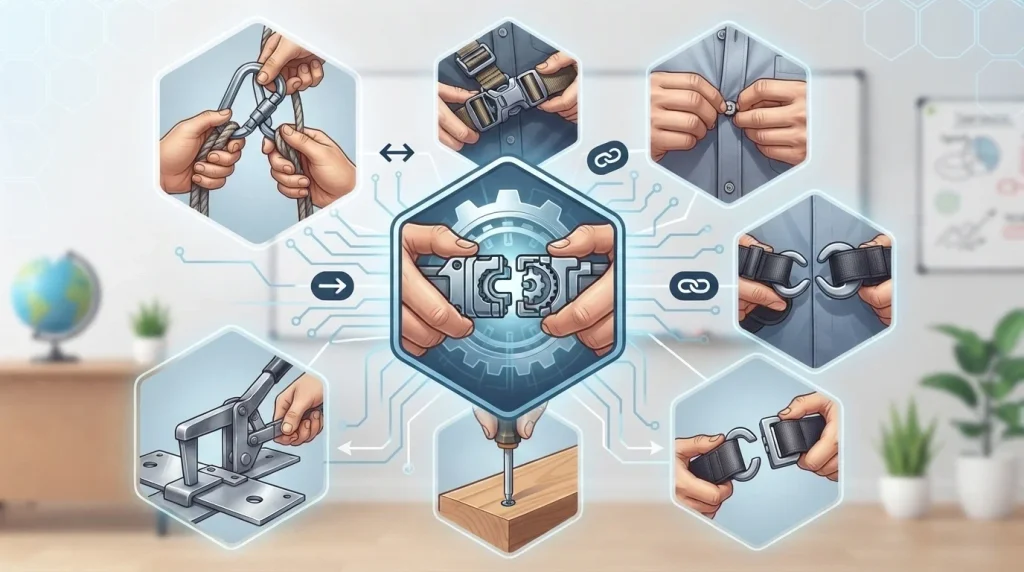
Zip (Verb) — US: /zɪp/ | UK: /zɪp/
- Meaning: To close or fasten an item using a sliding zipper device.
- Tone/Register: Everyday / Casual
- Example 1: Help your little brother zip up his jacket before school.
- Example 2: Make sure you zip your backpack to keep items safe.
Clasp (Verb) — US: /klæsp/ | UK: /klɑːsp/
- Meaning: To hold or fasten tightly with a small mechanical clip or hands.
- Tone/Register: Elegant / Personal
- Example 1: She reached behind her neck to clasp the gold necklace.
- Example 2: He managed to clasp the heavy bracelet around her wrist.
Clamp (Verb) — US: /klæmp/ | UK: /klæmp/
- Meaning: To hold two things together tightly using a mechanical tool.
- Tone/Register: Technical / DIY
- Example 1: Use wood glue and clamp the boards together for an hour.
- Example 2: The mechanic needed to clamp the pipe to stop the leak.
Pin (Verb) — US: /pɪn/ | UK: /pɪn/
- Meaning: To attach or hold in place using a thin piece of pointed metal.
- Tone/Register: Craft / General
- Example 1: The tailor will pin the fabric before sewing the seams.
- Example 2: She decided to pin the important note to the corkboard.
Anchor (Verb) — US: /ˈæŋ.kɚ/ | UK: /ˈæŋ.kər/
- Meaning: To fix something firmly to a solid base so it cannot drift or tip.
- Tone/Register: Heavy / Nautical
- Example 1: You should anchor heavy bookshelves directly to the wall.
- Example 2: The sailors lowered the iron chain to anchor the ship.
Fix (Verb) — US: /fɪks/ | UK: /fɪks/
- Meaning: To place or attach something firmly so it remains stationary.
- Tone/Register: Neutral / Standard
- Example 1: The carpenter used heavy screws to fix the shelf in place.
- Example 2: They decided to fix the solar panels directly onto the roof.
Connect (Verb) — US: /kəˈnekt/ | UK: /kəˈnekt/
- Meaning: To join or link two separate parts or systems together.
- Tone/Register: General / Technical
- Example 1: Connect the hose to the outdoor tap before watering plants.
- Example 2: Use the heavy cable to connect the trailer to the truck.
Link (Verb) — US: /lɪŋk/ | UK: /lɪŋk/
- Meaning: To connect objects like loop rings in a chain.
- Tone/Register: Descriptive / Systemic
- Example 1: The workers began to link the metal chain segments together.
- Example 2: A sturdy bridge serves to link the two islands permanently.
Join (Verb) — US: /dʒɔɪn/ | UK: /dʒɔɪn/
- Meaning: To bring two or more things into contact or union with each other.
- Tone/Register: General / Everyday
- Example 1: Use strong adhesive to join the broken ceramic pieces.
- Example 2: The path will join the main road near the town center.
Screw (Verb) — US: /skruː/ | UK: /skruː/
- Meaning: To turn a threaded metal pin to hold objects firmly together.
- Tone/Register: Technical / Assembly
- Example 1: Make sure to screw the legs tightly onto the wooden table.
- Example 2: He used a driver to screw the hinge to the door frame.
Nail (Verb) — US: /neɪl/ | UK: /neɪl/
- Meaning: To attach wood or materials using thin metal spikes hammered in.
- Tone/Register: Construction / DIY
- Example 1: Nail the wooden boards securely to build the fence structure.
- Example 2: He had to nail the loose floorboard down to stop squeaking.
Strap (Verb) — US: /stræp/ | UK: /stræp/
- Meaning: To secure something using a flexible band, belt, or harness.
- Tone/Register: Practical / Outdoors
- Example 1: Strap your surfboard tightly onto the roof rack of the car.
- Example 2: Make sure you strap the helmet under your chin correctly.
Harness (Verb) — US: /ˈhɑːr.nəs/ | UK: /ˈhɑː.nəs/
- Meaning: To attach or secure using a set of body straps for safety.
- Tone/Register: Safety / Industrial
- Example 1: Climbers must harness themselves securely before scaling walls.
- Example 2: Instructors show how to harness dogs for sled pulling.
Lash (Verb) — US: /læʃ/ | UK: /læʃ/
- Meaning: To bind or tie firmly with ropes or cords in outdoor settings.
- Tone/Register: Nautical / Survival
- Example 1: Campers learned how to lash logs together to form a raft.
- Example 2: Lash the loose equipment to the deck before storms hit.
Hitch (Verb) — US: /hɪtʃ/ | UK: /hɪtʃ/
- Meaning: To attach an item temporarily to a vehicle or post with a hook or knot.
- Tone/Register: Casual / Rural
- Example 1: He decided to hitch the horse to the wooden post outside.
- Example 2: Learn how to hitch the camper trailer to your SUV tow bar.
Tether (Verb) — US: /ˈteð.ɚ/ | UK: /ˈteð.ər/
- Meaning: To tie an animal or object with a rope to restrict movement.
- Tone/Register: Descriptive / Animal Care
- Example 1: Do not leave your dog tethered outside in the extreme heat.
- Example 2: Scientists tether weather balloons so they do not float away.
Moor (Verb) — US: /mʊr/ | UK: /mɔːr/
- Meaning: To secure a ship or boat in place using cables or anchors.
- Tone/Register: Maritime / Technical
- Example 1: The captain prepared to moor the yacht at the marina pier.
- Example 2: Sailors work together to moor heavy vessels during high tides.
Chain (Verb) — US: /tʃeɪn/ | UK: /tʃeɪn/
- Meaning: To secure or restrict movement using heavy metal links.
- Tone/Register: Security / Heavy
- Example 1: Be sure to chain your bicycle to the metal rack outside.
- Example 2: Security officers chain the perimeter gates every midnight.
Cement (Verb) — US: /səˈment/ | UK: /sɪˈment/
- Meaning: To join tightly using hardened building material or a strong bond.
- Tone/Register: Construction / Figurative
- Example 1: Workers will cement the stone blocks together for the retaining wall.
- Example 2: Shared goals helped cement their long-term business partnership.
Glue (Verb) — US: /ɡluː/ | UK: /ɡluː/
- Meaning: To stick items together using a liquid adhesive substance.
- Tone/Register: Everyday / Craft
- Example 1: Children love to glue paper shapes onto cardboard sheets.
- Example 2: Use waterproof resin to glue the broken vase handles back on.
Paste (Verb) — US: /peɪst/ | UK: /peɪst/
- Meaning: To attach materials using a soft, wet adhesive mixture.
- Tone/Register: Craft / Casual
- Example 1: Paste the event posters on the public notice board downtown.
- Example 2: Students use starch to paste wall art inside classrooms.
Seal (Verb) — US: /siːl/ | UK: /siːl/
- Meaning: To close or fasten tightly to prevent air, fluid, or access.
- Tone/Register: Formal / Protective
- Example 1: Seal the envelope carefully before dropping it in the mail.
- Example 2: Use silicone compound to seal around the bathroom sink edges.
Rivet (Verb) — US: /ˈrɪv.ɪt/ | UK: /ˈrɪv.ɪt/
- Meaning: To join metal plates permanently using short metal pins.
- Tone/Register: Industrial / Manufacturing
- Example 1: Technicians rivet aircraft wings to ensure high structural strength.
- Example 2: Builders rivet steel framing joints inside commercial towers.
Weld (Verb) — US: /weld/ | UK: /weld/
- Meaning: To join metal components permanently by melting and fusing edges.
- Tone/Register: Technical / Industrial
- Example 1: The welder needed to weld the broken steel frame together.
- Example 2: Robots weld car body panels together on modern assembly lines.
Solder (Verb) — US: /ˈsɑː.dɚ/ | UK: /ˈsəʊl.dər/
- Meaning: To join electrical or metal parts using melted low-temp alloy.
- Tone/Register: Electronics / Technical
- Example 1: You must solder copper wires carefully on the circuit board.
- Example 2: He learned how to solder jewelry joints in shop class.
Tape (Verb) — US: /teɪp/ | UK: /teɪp/
- Meaning: To join or seal items using sticky adhesive strips.
- Tone/Register: Casual / Household
- Example 1: Tape the cardboard shipping box shut before sending it out.
- Example 2: Use electrical strip material to tape worn wire ends safely.
Peg (Verb) — US: /peɡ/ | UK: /peɡ/
- Meaning: To fix or hold in position using wooden or plastic pins.
- Tone/Register: Practical / Outdoor
- Example 1: Use a mallet to peg the tent cords deep into the ground.
- Example 2: Hang washed clothes and peg them securely on the line.
Gird (Verb) — US: /ɡɝːd/ | UK: /ɡɜːd/
- Meaning: To encircle, bind, or secure around the waist with a belt.
- Tone/Register: Archaic / Literary
- Example 1: Warriors would gird their swords before marching into battle.
- Example 2: They prepare to gird themselves for upcoming challenges.
Cinch (Verb) — US: /sɪntʃ/ | UK: /sɪntʃ/
- Meaning: To pull a belt or strap tightly around an object or waist.
- Tone/Register: Informal / Western
- Example 1: Cinch the saddle belt tightly onto the horse before riding.
- Example 2: She used a wide belt to cinch her winter dress neatly.
Batten (Verb) — US: /ˈbæt.ən/ | UK: /ˈbæt.ən/
- Meaning: To fasten down securely using wooden strips, especially on ships.
- Tone/Register: Nautical / Technical
- Example 1: The crew must batten down the storm hatches immediately.
- Example 2: Homeowners prepare to batten down windows when hurricanes approach.
Snap (Verb) — US: /snæp/ | UK: /snæp/
- Meaning: To press together interlocking fasteners with a sharp sound.
- Tone/Register: Everyday / Casual
- Example 1: Snap the buttons on your jacket to keep the wind out.
- Example 2: Make sure you hear the lid snap onto the container.
Synonyms by Tone
Positive Tone
- Secure
- Anchor
- Protect
- Seal
- Cement
Neutral Tone
- Fasten
- Attach
- Connect
- Link
- Fix
Negative Tone
- Bind (when restricting freedom)
- Chain
- Tether
- Clamp (when causing pressure)
Informal / Playful Tone
- Zip
- Snap
- Cinch
- Hitch
Matching your word choice with your intended tone prevents confusion. For instance, using “chain” instead of “attach” makes a harmless connection sound harsh and restrictive.
Mini Comparison
Fasten vs. Secure vs. Attach
- Meaning Difference: Fasten focuses on bringing parts together using a mechanism (buttons, straps, locks). Secure means making something safe from falling or coming loose. Attach simply means joining one item to another without specifying firmness.
- Tone Difference: Attach is neutral and general. Fasten is practical and action-oriented. Secure is formal and safety-focused.
- When to Use Each: Use attach for files or light items, fasten for clothing and belts, and secure for heavy machinery or safety gear.
How “Fasten” Changes by Context
Daily Conversation
In casual talk, native speakers use direct terms like “tie,” “zip,” “button,” or “snap” rather than using formal vocabulary.
Writing & Blogging
Bloggers prefer versatile verbs like “attach,” “secure,” or “connect” to keep sentences easy to read.
Professional & Academic Tone
Technical manuals and safety reports rely on precise terms like “anchor,” “bolt,” “rivet,” or “weld.”
Creative & Literary Use
Authors use expressive verbs like “gird,” “lash,” “tether,” or “cinch” to build visual atmosphere in narrative scenes.
Common Mistakes & Native Usage
Misuse Scenarios
- Using attach for seatbelts: Native speakers say “fasten your seatbelt,” not “attach your seatbelt.”
- Confusing physical and digital joining: You “attach” an email file, but you never “fasten” a digital file.
Register Notes
- Formal Written English: Secure, anchor, affix, seal.
- Spoken Everyday English: Tie, zip, button, snap.
(Choosing the right register keeps writing professional and natural.)
Real-Life Mini Scenarios

- Workplace: A site manager tells team members to secure their hard hats before entering construction zones.
- Social Situations: A runner pauses along the trail to tie his shoelaces before continuing the race.
- Media & Pop Culture: Flight attendants remind passengers to fasten seatbelts during mid-flight turbulence.
- Writing or Storytelling: An author describes sailors rushing to lash equipment onto the deck during storm scenes.
Conclusion
Building a broad English vocabulary allows you to communicate with clarity, speed, and precision in every situation. Varying your word choices keeps your content engaging and readable for your target audience. Try practicing two new synonyms from this list in your next essay, email, or daily conversation.
Knowing a suitable synonym for fasten makes your language more flexible and engaging. Whether you are describing joining objects, securing items, or creating a firm connection, the right alternative can improve your expression.
Different synonyms carry slightly different meanings, so selecting the best word depends on the purpose and context of your sentence. Words such as attach, lock, secure, and bind each provide unique ways to describe fastening.
Expanding your vocabulary with these alternatives can make your writing sound more natural and professional. A strong understanding of synonyms for fasten helps you communicate ideas more effectively in various situations.
Interactive Practice Quiz
- Which synonym best fits securing an email attachment?
A) Weld
B) Attach
C) Moor
D) Rivet - What tone does the verb “chain” carry when applied to objects?
A) Gentle
B) Restrictive/Heavy
C) Playful
D) Romantic - Which action applies to joining metal plates permanently on an airplane?
A) Button
B) Zip
C) Rivet
D) Paste - Which informal verb describes closing a jacket using sliding teeth?
A) Zip
B) Bolt
C) Anchor
D) Cement - What is the main difference between attach and secure?
A) Attach implies heavy safety
B) Secure emphasizes safety and stability, while attach just means joining
C) Attach is used only for ships
D) There is no difference - Which word best describes tying a boat to a dock pier?
A) Button
B) Moor
C) Solder
D) Cinch - Choose the technical term for fusing metal parts using heat:
A) Weld
B) Zip
C) Latch
D) Peg - Which word fits closing a wooden garden gate with a catch mechanism?
A) Solder
B) Latch
C) Weld
D) Paste - What register does the word “zip” belong to?
A) Formal legal
B) Everyday casual
C) Industrial safety
D) Technical engineering - Which word fits holding wooden boards together with a tool while glue dries?
A) Clamp
B) Moor
C) Gird
D) Tether
Reflection Task: Write one original sentence about preparing for a road trip using the word secure or strap.
Answer Key:
1: B | 2: B | 3: C | 4: A | 5: B | 6: B | 7: A | 8: B | 9: B | 10: A
FAQs
1. What is the most common synonym for fasten when talking about clothes?
Button, zip, or tie are the most common synonyms when talking about clothing. While fasten is used for general clothing items or seatbelts, daily speakers specify the exact mechanism, such as zipping a jacket or buttoning a shirt.
2. Can attach be used as an exact synonym for fasten?
Yes, attach serves as a direct synonym for fasten in general contexts. However, attach simply means connecting one item to another, while fasten implies making that connection firm, tight, and secure against moving loose.
3. What is the best technical synonym for fasten in construction?
In construction and manufacturing, bolt, rivet, anchor, and weld are the best technical terms. These words explain the exact mechanical method used to hold structural components together under heavy physical loads.
4. How does fasten differ from secure?
Fasten refers to the physical act of joining parts together using fasteners like buckles, screws, or buttons. Secure has a broader meaning focused on safety, ensuring that an object will not fall, drift, or break loose.
5. Is bind closer in meaning to fasten or connect?
Bind is closer to fasten because both words emphasize holding things tightly together so they cannot separate. Connect simply means linking items together, which might not involve tight physical binding.

Sophia Carter is the founder and lead writer at SynonymVerse.com, a trusted online resource dedicated to English vocabulary and effective communication. She is passionate about helping students, writers, professionals, and lifelong learners find the most accurate words to express their ideas with clarity and confidence.
At SynonymVerse.com, every article is carefully researched and thoughtfully written to provide reliable guidance on synonyms, word meanings, and vocabulary. With a strong focus on accuracy, real-world usage, and easy-to-understand explanations, the website is committed to helping readers strengthen their language skills, enrich their vocabulary, and become more confident communicators.