
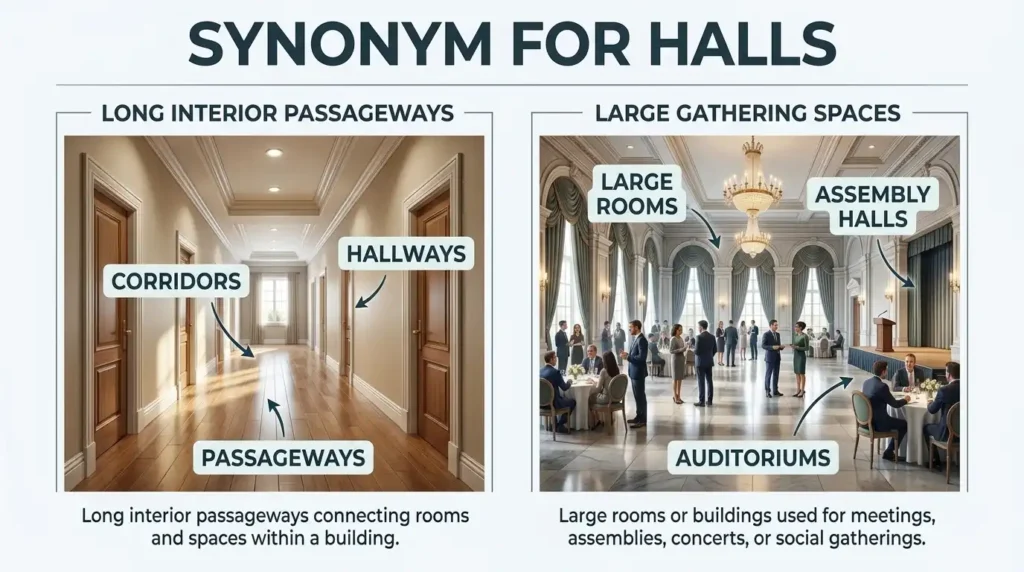
synonym for halls is essential when you want to describe passages, corridors, or grand public meeting rooms without sounding repetitive. Imagine walking through a bustling school where students rush to class.
A grand manor entryway welcoming guests shows this exact architectural feature in daily life. Finding a suitable synonym for halls elevates your descriptive writing instantly.
Learning varied architectural terms helps you convey distinct sizes, styles, and functions clearly. Discovering every synonym for halls benefits students, bloggers, writers, and speakers alike.
What Does “Halls” Really Mean?
Halls refers to corridors connecting rooms, large public buildings for gatherings, or spacious entryways inside structures. The word carries a functional, welcoming, or grand attitude depending on the structural context.
Native speakers view it as either a transitional pathway or a central gathering area. It frequently appears in architectural descriptions, academic settings, housing discussions, and event planning.
- Part of Speech: Noun (plural)
- Simple Definition: Covered passageways connecting rooms or large buildings used for public gatherings.
Connotative Meaning
Connotation is the emotional tone or cultural association a word carries beyond its explicit dictionary definition.
- Positive tone: Grand, majestic, welcoming, historic, and spacious (e.g., grand banquet halls).
- Negative tone: Cold, echoey, institutional, maze-like, or restrictive (e.g., sterile hospital corridors).
- Neutral tone: Functional, structural, spatial, and navigational (e.g., office hallways).
Etymology
The word stems from the Old English term heall, which means “covered place, residence, or main room.” It connects to the Proto-Germanic root *hallō, meaning “to cover or conceal.”
- Old English (450–1100): Referred to the primary large roofed building where a chief and feudal community gathered.
- Middle English (1100–1500): Expanded to describe large manor houses, college dining rooms, and civic buildings.
- Modern English (1500–Present): Shifted to denote long interior passageways as well as public assembly spaces.
Pronunciation
- US: /hɑːlz/
- UK: /hɔːlz/
Syllables & Structure
- Syllables: halls
- Root: Hall
- Prefix: None
- Suffix: -s
Synonyms List
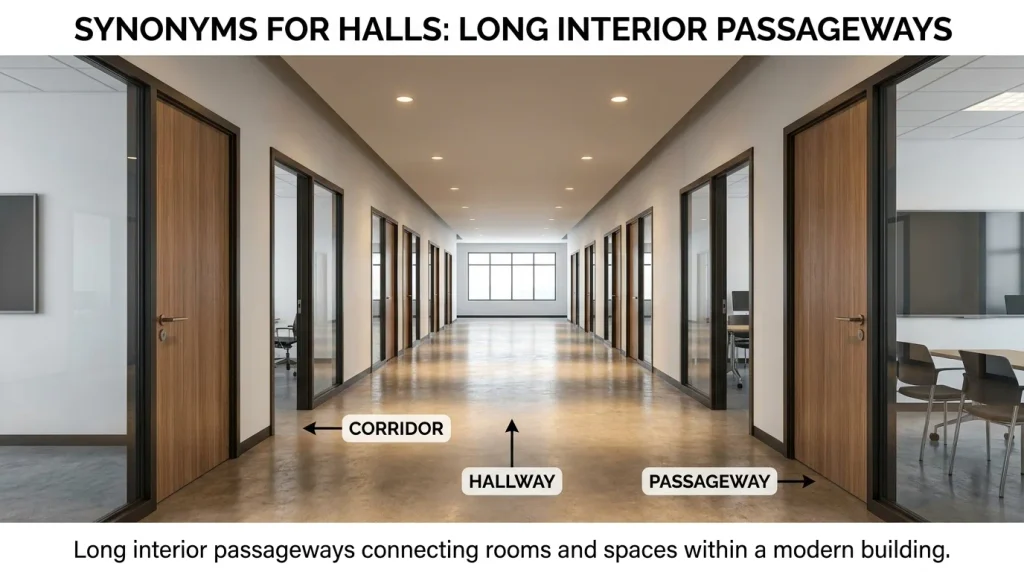
Corridors (Noun) — US: /ˈkɔːr.ə.dɚz/ | UK: /ˈkɒr.ɪ.dɔːz/
Meaning: Long enclosed passages in a building with doors opening into rooms.
Tone/Register: Neutral / Architectural
Example 1: The hotel corridors were quiet throughout the evening.
Example 2: Students lined up along the school corridors before class.
Hallways (Noun) — US: /ˈhɑːl.weɪz/ | UK: /ˈhɔːl.weɪz/
Meaning: Interior passages or entryways in a house or building.
Tone/Register: Everyday / Conversational
Example 1: Bright paintings hung along the residential hallways.
Example 2: Please keep your shoes out of the front hallways.
Passageways (Noun) — US: /ˈpæs.ɪdʒ.weɪz/ | UK: /ˈpæs.ɪdʒ/.weɪz/
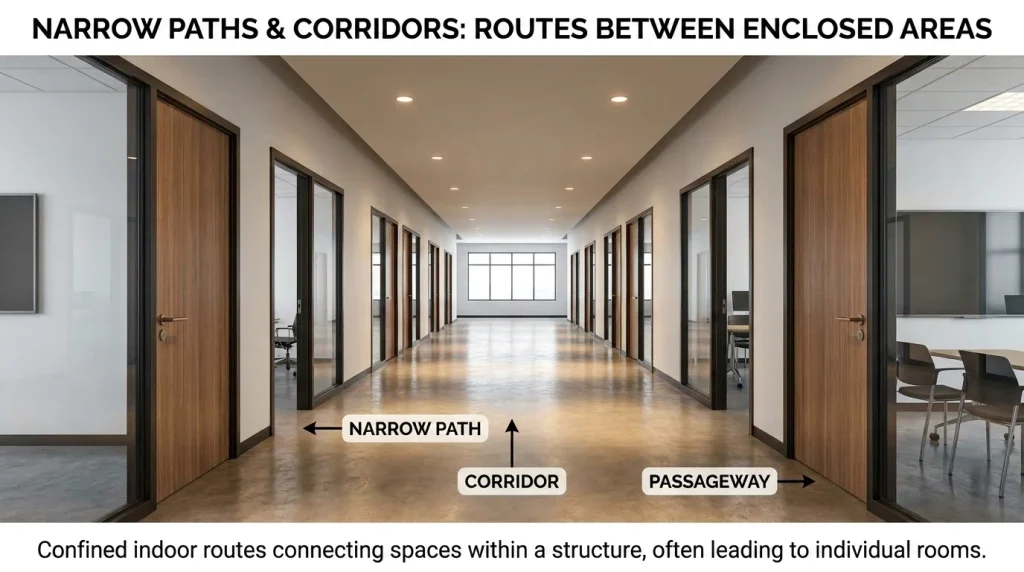
Meaning: Narrow paths or corridors providing routes between enclosed areas.
Tone/Register: Descriptive / General
Example 1: Stone passageways linked the ancient castle towers together.
Example 2: Emergency signs lit up the underground passageways.
Passages (Noun) — US: /ˈpæs.ɪdʒ/.ɪz/ | UK: /ˈpæs.ɪdʒ/.ɪz/
Meaning: Covered paths or corridors that allow movement from one place to another.
Tone/Register: Literary / Standard
Example 1: Narrow passages ran through the center of the old market.
Example 2: Secret passages were discovered beneath the mansion floor.
Foyers (Noun) — US: /ˈfɔɪ.ɚz/ | UK: /ˈfɔɪ.eɪz/
Meaning: Entrance halls or open lobbies in houses, theaters, or hotels.
Tone/Register: Formal / Elegant
Example 1: Guests gathered in the hotel foyers before the banquet.
Example 2: Marble tiles decorated the spacious residential foyers.
Lobbies (Noun) — US: /ˈlɑː.biːz/ | UK: /ˈlɒb.iːz/
Meaning: Large entrance areas inside public buildings near main entrances.
Tone/Register: Business / Public
Example 1: Security guards greeted visitors in the office lobbies.
Example 2: The theater lobbies were crowded before the show started.
Vestibules (Noun) — US: /ˈves.tə.bjuːlz/ | UK: /ˈves.tɪ.bjuːlz/
Meaning: Small lobby or entrance passages next to the outer door of a building.
Tone/Register: Formal / Technical
Example 1: Coat racks stood in the church vestibules near the front doors.
Example 2: Automatic glass doors sealed the building vestibules from cold wind.
Galleries (Noun) — US: /ˈɡæl.ɚ.iːz/ | UK: /ˈɡæl.ər.iːz/
Meaning: Long balconies or wide covered walkways often used to display artwork.
Tone/Register: Cultural / Artistic
Example 1: Visitors walked quietly through the museum galleries.
Example 2: Statues lined the upper galleries of the palace.
Auditoriums (Noun) — US: /ˌɑː.dəˈtɔːr.i.əmz/ | UK: /ˌɔː.dɪˈtɔː.ri.əmz/
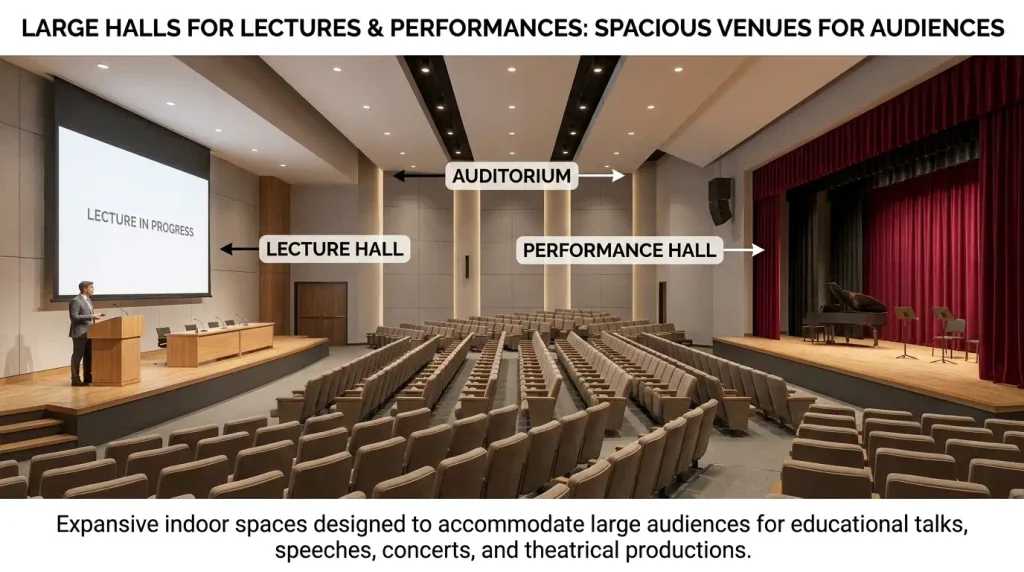
Meaning: Large halls designed for audiences to hear lectures or watch performances.
Tone/Register: Academic / Institutional
Example 1: Students gathered inside school auditoriums for the assembly.
Example 2: The university built modern auditoriums for large lectures.
Chambers (Noun) — US: /ˈtʃeɪm.bɚz/ | UK: /ˈtʃeɪm.bəz/
Meaning: Large rooms used for formal, legislative, or judicial meetings.
Tone/Register: Formal / Civic
Example 1: Parliament met inside the historical government chambers.
Example 2: Council members debated policy in the city chambers.
Salons (Noun) — US: saːˈlɑːnz/ | UK: /ˈsæl.ɒnz/
Meaning: Elegant reception rooms or large halls in aristocratic homes used for entertaining guests.
Tone/Register: Formal / Historical
Example 1: Artists gathered in royal salons to discuss literature.
Example 2: Chandeliers lit up the grand palace salons.
Concourses (Noun) — US: /ˈkɑːn.kɔːrs.ɪz/ | UK: /ˈkɒŋ.kɔːs.ɪz/
Meaning: Open central halls in stations or airports where crowds gather or pass through.
Tone/Register: Public / Commercial
Example 1: Travelers walked through busy airport concourses toward their gates.
Example 2: Information desks stood in train concourses across the city.
Arcades (Noun) — US: ɑːrˈkeɪdz/ | UK: ɑːˈkeɪdz/
Meaning: Covered passages with arches along one or both sides.
Tone/Register: Architectural / Urban
Example 1: Boutique shops lined the historic street arcades.
Example 2: Pedestrians walked under stone arcades to avoid the rain.
Cloisters (Noun) — US: /ˈklɔɪ.stɚz/ | UK: /ˈklɔɪ.stəz/
Meaning: Covered walkways surrounding open courtyards in monasteries or universities.
Tone/Register: Historical / Academic
Example 1: Monks walked along quiet cloisters for daily meditation.
Example 2: Stone arches framed university cloisters on campus.
Loggias (Noun) — US: /ˈloʊ.dʒəz/ | UK: /ˈlɒdʒ.əz/
Meaning: Open-sided covered galleries or arcades at ground level or higher floors.
Tone/Register: Architectural / Elegant
Example 1: Guests enjoyed iced tea under cool garden loggias.
Example 2: The villa featured scenic loggias overlooking the bay.
Porticos (Noun) — US: /ˈpɔːr.t̬ə.koʊz/ | UK: /ˈpɔː.tɪ.kəʊz/
Meaning: Covered walkways or entrances supported by columns at regular intervals.
Tone/Register: Classic / Architectural
Example 1: Marble porticos adorned the front entrance of the museum.
Example 2: Visitors stood under tall porticos during rainstorms.
Colonnades (Noun) — US: /ˌkɑː.ləˈneɪdz/ | UK: /ˌkɒl.əˈneɪdz/
Meaning: Sequences of columns supporting roofs over long open pathways.
Tone/Register: Majestic / Classic
Example 1: White colonnades stretched along the civic plaza entrance.
Example 2: Tourists photographed ancient colonnades surrounding temple grounds.
Atriums (Noun) — US: /ˈeɪ.tri.əmz/ | UK: /ˈeɪ.tri.əmz/
Meaning: Open central halls or court spaces inside modern buildings.
Tone/Register: Modern / Commercial
Example 1: Sunlight streamed into glass-roofed office atriums.
Example 2: Potted plants decorated corporate atriums across town.
Entryways (Noun) — US: /ˈen.tri.weɪz/ | UK: /ˈen.tri.weɪz/
Meaning: Passages or small halls giving access into a house or building.
Tone/Register: Everyday / Practical
Example 1: Shoes and coats were organized in home entryways.
Example 2: Bright lights lit up office entryways overnight.
Antechambers (Noun) — US: /ˈæn.ti.tʃeɪm.bɚz/ | UK: /ˈæn.ti.tʃeɪm.bəz/
Meaning: Smaller outer rooms leading into larger main halls or chambers.
Tone/Register: Formal / Historical
Example 1: Diplomats waited inside private antechambers before meetings.
Example 2: Officers guarded antechambers leading into executive offices.
Anterooms (Noun) — US: /ˈæn.ti.ruːmz/ | UK: /ˈæn.ti.ruːmz/
Meaning: Waiting rooms or smaller halls leading into primary offices or rooms.
Tone/Register: Corporate / Official
Example 1: Visitors waited comfortably inside bright office anterooms.
Example 2: Secretary desks were situated in private anterooms.
Breezeways (Noun) — US: /ˈbriːz.weɪz/ | UK: /ˈbriːz.weɪz/
Meaning: Covered open-sided passages connecting two buildings or house sections.
Tone/Register: Informal / Domestic
Example 1: Cool winds blew through garden breezeways during summer.
Example 2: The garage was linked to the main home by breezeways.
Alleyways (Noun) — US: /ˈæl.i.weɪz/ | UK: /ˈæl.i.weɪz/
Meaning: Narrow paths or passages between or behind city buildings.
Tone/Register: Casual / Urban
Example 1: Delivery trucks parked in narrow brick alleyways.
Example 2: Lights illuminated dark alleyways near downtown shops.
Gangways (Noun) — US: /ˈɡæŋ.weɪz/ | UK: /ˈɡæŋ.weɪz/
Meaning: Narrow passages, walkways, or board ramps used for walking.
Tone/Register: Nautical / Practical
Example 1: Passengers walked along metal gangways onto ships.
Example 2: Crew members kept ship gangways clear of clutter.
Aisles (Noun) — US: /aɪlz/ | UK: /aɪlz/
Meaning: Passages between rows of seats, shelves, or structures.
Tone/Register: Practical / Retail
Example 1: Shoppers walked down grocery aisles to find items.
Example 2: Brides walk down church aisles during weddings.
Promenades (Noun) — US: /ˌprɑː.məˈneɪdz/ | UK: /ˌprɒm.əˈnɑːdz/
Meaning: Wide open pathways or halls intended for walking slowly.
Tone/Register: Leisure / Scenic
Example 1: Families strolled along coastal promenades on weekends.
Example 2: Tree-lined promenades connected park entrances together.
Walkways (Noun) — US: /ˈwɑːk.weɪz/ | UK: /ˈwɔːk.weɪz/
Meaning: Paths set aside specifically for pedestrian traffic indoors or outdoors.
Tone/Register: Practical / General
Example 1: Raised walkways connected campus buildings smoothly.
Example 2: Covered walkways kept shoppers dry during downpours.
Vaults (Noun) — US: /vɑːlts/ | UK: /vɔːlts/
Meaning: Arched halls or subterranean chambers constructed of stone or brick.
Tone/Register: Historical / Architectural
Example 1: Echoes bounced off stone vaults inside ancient cathedrals.
Example 2: Wine casks were stored in cool underground vaults.
Ballrooms (Noun) — US: /ˈbɑːl.ruːmz/ | UK: /ˈbɔːl.ruːmz/
Meaning: Very large rooms or halls used for formal dancing or large parties.
Tone/Register: Elegant / Festive
Example 1: Musicians played in hotel ballrooms for wedding receptions.
Example 2: Dancers glided across grand palace ballrooms.
Assembly Rooms (Noun) — US: /əˈsem.bli ruːmz/ | UK: /əˈsem.bli ruːmz/
Meaning: Public halls set aside for large community gatherings or meetings.
Tone/Register: Formal / Community
Example 1: Local elections were held in civic assembly rooms.
Example 2: Community members gathered in school assembly rooms.
Exits (Noun) — US: /ˈeɡ.zɪts/ | UK: /ˈek.sɪts/
Meaning: Passageways or doors leading out of buildings or enclosures.
Tone/Register: Functional / Emergency
Example 1: Clear signs pointed toward emergency exits in halls.
Example 2: Crowds poured out of stadium exits after games.
Entryways (Noun) — US: /ˈen.tri/ | UK: /ˈen.tri/
Meaning: Rooms, halls, or paths used for entering a building or house.
Tone/Register: General / Casual
Example 1: Decorative mirrors brightened small home entryways.
Example 2: Security checkpoints monitored corporate entryways daily.
Amphitheaters (Noun) — US: /ˈæm.fəˌθiː.ə.t̬ɚz/ | UK: /ˈæm.fɪˌθɪə.tərz/
Meaning: Circular or oval halls with tiered seating surrounding central open spaces.
Tone/Register: Academic / Classic
Example 1: Professors lectured in historical university amphitheaters.
Example 2: Outdoor amphitheaters hosted musical concerts during summer.
Reception Rooms (Noun) — US: /rɪˈsep.ʃən ruːmz/ | UK: /rɪˈsep.ʃən ruːmz/
Meaning: Formal halls designed specifically for receiving or entertaining guests.
Tone/Register: Executive / Formal
Example 1: VIP guests waited inside private reception rooms.
Example 2: Caterers prepared food inside corporate reception rooms.
Keep Passages (Noun) — US: /kiːp ˈpæs.ɪdʒ.ɪz/ | UK: /kiːp ˈpæs.ɪdʒ.ɪz/
Meaning: Internal fortified hallways inside ancient castles or fortresses.
Tone/Register: Historical / Military
Example 1: Soldiers defended stone keep passages during sieges.
Example 2: Guides led tourists through dark keep passages.
Atria (Noun) — US: /ˈeɪ.tri.ə/ | UK: /ˈeɪ.tri.ə/
Meaning: Multiple open central court spaces or glass skylit halls in modern buildings.
Tone/Register: Technical / Plural Architectural
Example 1: Modern architectural designs feature spacious indoor atria.
Example 2: Skylights illuminate broad central atria in hospitals.
Skyways (Noun) — US: /ˈskaɪ.weɪz/ | UK: /ˈskaɪ.weɪz/
Meaning: Enclosed pedestrian bridges connecting two or more tall buildings.
Tone/Register: Modern / Urban
Example 1: Pedestrians used skyways to cross city streets overhead.
Example 2: Glass skyways connected hotel towers directly across blocks.
Concourse Halls (Noun) — US: /ˈkɑːn.kɔːrs hɑːlz/ | UK: /ˈkɒŋ.kɔːs hɔːlz/
Meaning: Broad gathering passageways inside terminal hubs or stadiums.
Tone/Register: Travel / Infrastructure
Example 1: Travelers checked flight boards in concourse halls.
Example 2: Food vendors operated across arena concourse halls.
Entry Passages (Noun) — US: /ˈen.tri ˈpæs.ɪdʒ.ɪz/ | UK: /ˈen.tri ˈpæs.ɪdʒ.ɪz/
Meaning: Specific corridors leading directly from exterior doorways into main interior spaces.
Tone/Register: Descriptive / Practical
Example 1: Welcome signs hung inside entry passages at schools.
Example 2: Cleaners mopped long entry passages early every morning.
Meeting Halls (Noun) — US: /ˈmiː.t̬ɪŋ hɑːlz/ | UK: /ˈmiː.tɪŋ hɔːlz/
Meaning: Structures or large rooms dedicated to hosting group discussions.
Tone/Register: Civic / Formal
Example 1: Residents met in town meeting halls to vote on budgets.
Example 2: Organizations reserved meeting halls for annual conventions.
Dining Halls (Noun) — US: /ˈdaɪ.nɪŋ hɑːlz/ | UK: /ˈdaɪ.nɪŋ hɔːlz/
Meaning: Large rooms or halls where groups gather to eat meals together.
Tone/Register: Institutional / Campus
Example 1: University students ate lunch inside residential dining halls.
Example 2: Boarding schools maintain historic dining halls for students.
Exhibition Halls (Noun) — US: /ˌek.səˈbɪʃ.ən hɑːlz/ | UK: /ˌek.sɪˈbɪʃ.ən hɔːlz/
Meaning: Spacious venues designed for public displays, trade shows, or art.
Tone/Register: Business / Cultural
Example 1: Tech companies showcased new devices in exhibition halls.
Example 2: Thousands visited convention center exhibition halls daily.
Lecture Halls (Noun) — US: /ˈlek.tʃɚ hɑːlz/ | UK: /ˈlek.tʃər hɔːlz/
Meaning: Large sloped rooms used for teaching large college classes.
Tone/Register: Educational / Academic
Example 1: Science students gathered inside campus lecture halls.
Example 2: Microphones were installed inside broad lecture halls.
Town Halls (Noun) — US: /taʊn hɑːlz/ | UK: /taʊn hɔːlz/
Meaning: Public administration buildings or gathering events for local communities.
Tone/Register: Civic / Political
Example 1: Local officials answered questions inside town halls.
Example 2: Mayors host public town halls to discuss city improvements.
Great Halls (Noun) — US: /ɡreɪt hɑːlz/ | UK: /ɡreɪt hɔːlz/
Meaning: Main central gathering rooms in historic castles, manors, or estates.
Tone/Register: Majestic / Historical
Example 1: Kings held grand feasts inside castle great halls.
Example 2: Fireplaces warmed expansive estate great halls in winter.
Synonyms for “Halls” by Tone
Selecting appropriate words depends heavily on whether you describe a cozy home, an office, or an ancient castle.
- Positive/Grand: Great Halls, Ballrooms, Salons, Galleries, Foyers, Atriums
- Neutral/Structural: Corridors, Hallways, Passageways, Entryways, Walkways, Passages
- Public/Civic: Town Halls, Concourses, Auditoriums, Exhibition Halls, Lecture Halls
- Informal/Urban: Alleyways, Breezeways, Skyways, Gangways
“Halls” vs. Close Alternatives
| Feature | Halls | Corridors | Foyers |
| Core Focus | General passageways or broad public gathering spaces | Long enclosed passages connecting multiple rooms | Entrance areas or lobby spaces near exterior doors |
| Tone | Standard, versatile, potentially grand | Architectural, neutral, institutional | Elegant, welcoming, formal |
| Best Context | Schools, castles, civic spaces, general housing | Hotels, hospitals, office floors, train layouts | Homes, theaters, luxury hotels, grand venues |
How “Halls” Changes by Context
- Daily Conversation: Used casually to describe simple indoor walkways or residential passages (e.g., “Walk down the hall”).
- Writing or Blogging: Sets physical atmosphere in storytelling, from spooky corridors to regal palace chambers.
- Professional Tone: Applied in architecture, urban planning, facility management, and real estate listings.
- Creative Use: Evokes historic grandeur or emotional scale, like describing echoing halls of memory.
Common Mistakes Learners Make
- Misuse Scenarios: Using “foyer” for a long, narrow second-floor connecting corridor instead of “hallway.”
- Confusing Tone: Using grand historical terms like “chambers” or “salons” to describe a basic office hallway.
- Overuse Warnings: Repeating “hall” constantly in architectural descriptions makes text feel uninspired.
Using precise terms like corridor, foyer, or concourse enhances descriptive clarity instantly.
Real-Life Mini Scenarios
- Workplace: Employees walked down bright corridors to enter the main conference room.
- Social Situations: Wedding guests gathered inside elegant hotel foyers before dinner.
- Media / Pop Culture: Concertgoers filled stadium concourses to purchase merchandise.
- Storytelling: The knight walked through echoing stone passageways inside the fortress.
MCQs
1. Which word is closest in meaning to “halls”?
A) Corridors
B) Gardens
C) Windows
D) Roofs
2. A long passage inside a building is called a:
A) Corridor
B) Balcony
C) Basement
D) Courtyard
3. Which synonym can replace “halls” when referring to passageways?
A) Passageways
B) Bedrooms
C) Kitchens
D) Staircases
4. “The students walked through the school halls.” Which word can replace “halls”?
A) Corridors
B) Fields
C) Classrooms
D) Doors
5. Which word means a passage inside a building?
A) Hallway
B) Garden
C) Garage
D) Roof
6. What is another word for a building’s interior passage?
A) Passage
B) Window
C) Ceiling
D) Wall
7. Which option is NOT a synonym for “halls”?
A) Corridors
B) Hallways
C) Passageways
D) Gardens
8. “The guests gathered in the large halls.” Here, “halls” could mean:
A) Large rooms
B) Small windows
C) Outdoor paths
D) Private gardens
9. Which word best describes a long area connecting rooms?
A) Corridor
B) Balcony
C) Porch
D) Yard
10. “Halls” can refer to large rooms or:
A) Passageways
B) Vehicles
C) Trees
D) Bridges
Answer Key
- A
- A
- A
- A
- A
- A
- D
- A
- A
Application Task: Write one short sentence describing your favorite building using one new synonym learned today.
FAQs
1. What is the most common synonym for halls in modern homes?
“Hallway” or “entryway” are the most common everyday choices for residential settings. They refer to domestic passages connecting front doors, living rooms, and bedrooms smoothly.
2. Is “corridor” fully interchangeable with “hall”?
“Corridor” specifically refers to long passageways with doors leading into separate rooms. While “hall” can mean this, “hall” also describes large public meeting rooms or event spaces.
3. What is the difference between a foyer and a lobby?
A foyer is typically a residential or theater entrance area. A lobby refers to larger public entrance spaces in hotels, office buildings, or corporate facilities.
4. What word best describes a covered walkway supported by pillars?
Terms like “colonnade,” “portico,” or “arcade” describe pathways flanked by pillars or arches. They are common in classic, academic, or historic architectural designs.
5. What synonym works best for large academic teaching spaces?
“Lecture hall” or “auditorium” work best for academic settings. These terms specify spaces built with sloped seating designed for presentations, teaching, and large audiences.
Conclusion
Mastering a new synonym for halls transforms how you express structural spatial design, helping you describe interior passages with absolute clarity.
Using a fresh synonym for halls instantly elevates your daily descriptive writing, whether you are crafting academic essays, real estate listings, or creative stories.
Exploring every synonym for halls enriches your overall English vocabulary, making you a more versatile, precise speaker and writer every day.
Start practicing these vibrant architectural words in your next project or daily conversation to make your writing stand out effortlessly!

Sophia Carter is the founder and lead writer at SynonymVerse.com, a trusted online resource dedicated to English vocabulary and effective communication. She is passionate about helping students, writers, professionals, and lifelong learners find the most accurate words to express their ideas with clarity and confidence.
At SynonymVerse.com, every article is carefully researched and thoughtfully written to provide reliable guidance on synonyms, word meanings, and vocabulary. With a strong focus on accuracy, real-world usage, and easy-to-understand explanations, the website is committed to helping readers strengthen their language skills, enrich their vocabulary, and become more confident communicators.