

Synonyms for handoff: searchers often look for clear ways to express a transfer of control. Picture a fast-paced project where one team finishes their work and passes the task to the next group smoothly and quickly.
A clean transition prevents costly delays and mistakes. Searching for a synonym for handoff helps you find precise words for business emails, essays, and casual workplace chats.
Using varied terms improves your writing, keeps your blogs fresh, and boosts professional authority. It helps you articulate operational shifts with clarity and confidence.
Students, content creators, and remote teams rely on this word daily. Choosing the right synonym for handoff ensures your message remains sharp, engaging, and clear across all channels.
What Does “Handoff” Really Mean?
The word “handoff” refers to the act of passing control, responsibility, or information from one person or group to another. It carries a neutral to constructive tone, signaling organized continuity. Native speakers view it as an active operational term used in technology, management, and team sports.
Part of Speech: Noun
Definition: The official transfer of responsibility, authority, or data from one entity to another.
Connotation
Connotation is the emotional feeling or cultural association attached to a word beyond its strict definition.
- Positive: Smooth delegation, seamless teamwork, effective collaboration.
- Negative: Relinquishing control, shedding burden, abrupt abandonment.
- Neutral: Routine administrative transfer, procedural update.
Etymology
The term combines the verb “hand” (from Proto-Germanic handuz, meaning the human hand) with the preposition “off.”
- Old English (450–1100): Hand signified physical holding or agency.
- Middle English (1100–1500): The physical action evolved into figurative expressions of agency and control.
- Modern English (1500–Present): Formed as a compound noun in the 20th century, popularized by American football and software engineering.
Pronunciation
- US: /ˈhændˌɔf/
- UK: /ˈhændˌɒf/
Syllables & Structure
- Breakdown: hand-off
- Root: hand
- Prefix: None
- Suffix: None (Compound word formed with preposition “off”)
Synonyms List
Transfer (Noun) — US: /ˈtræns.fɚ/ | UK: /ˈtræns.fɜːr/
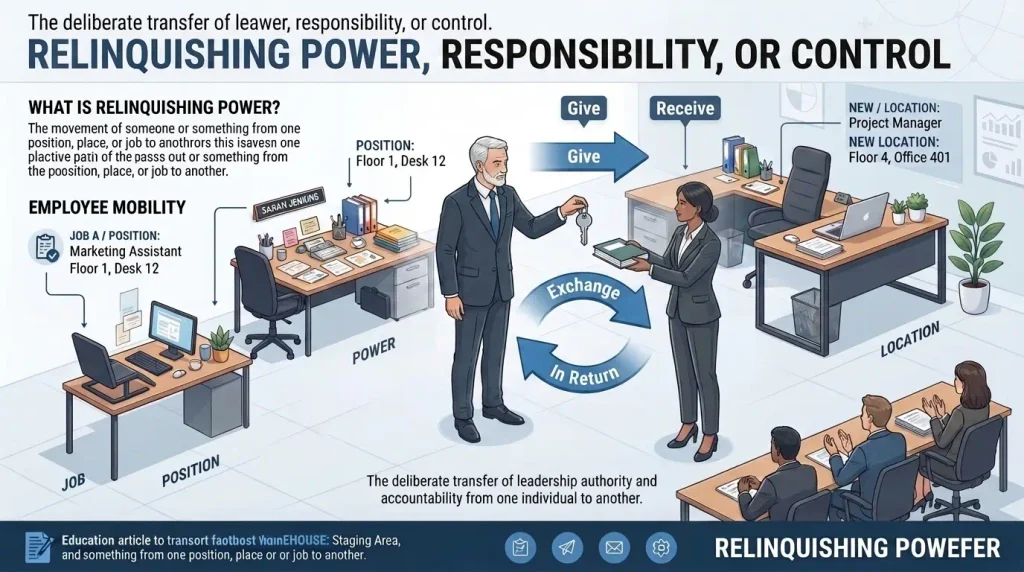
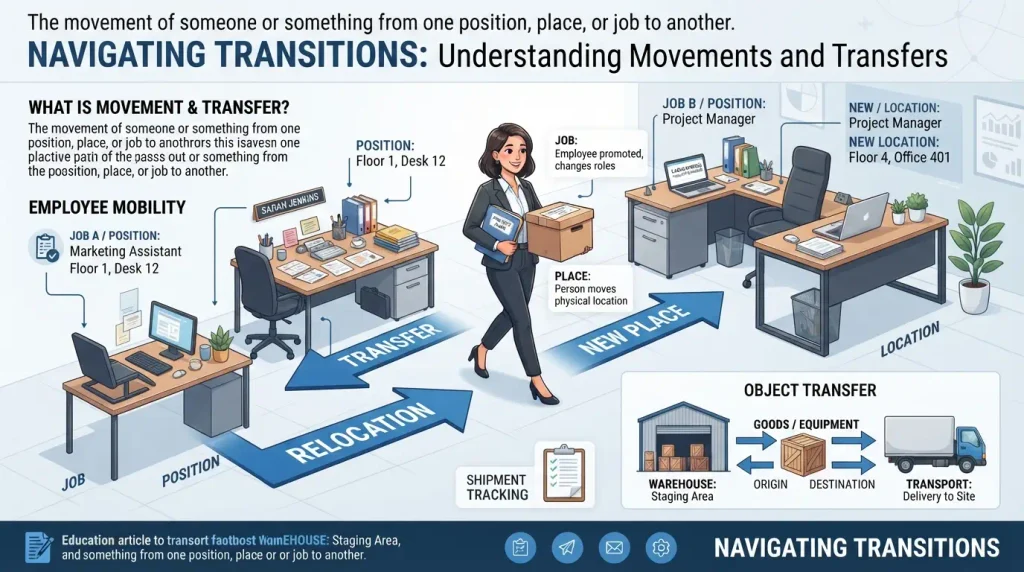
- Meaning: The movement of someone or something from one position, place, or job to another.
- Tone/Register: Formal, Business
- Example 1: The manager completed the transfer of files before leaving the office.
- Example 2: We watched the file transfer complete on the server monitor.
Transition (Noun) — US: /trænˈzɪʃ.ən/ | UK: /trænˈzɪʃ.ən/
- Meaning: A process or period of changing from one state or condition to another.
- Tone/Register: Academic, Formal
- Example 1: The company underwent a smooth transition to its new leadership team.
- Example 2: Her transition into the new role required two weeks of training.
Handover (Noun) — US: /ˈhændˌoʊ.vɚ/ | UK: /ˈhændˌəʊ.və/
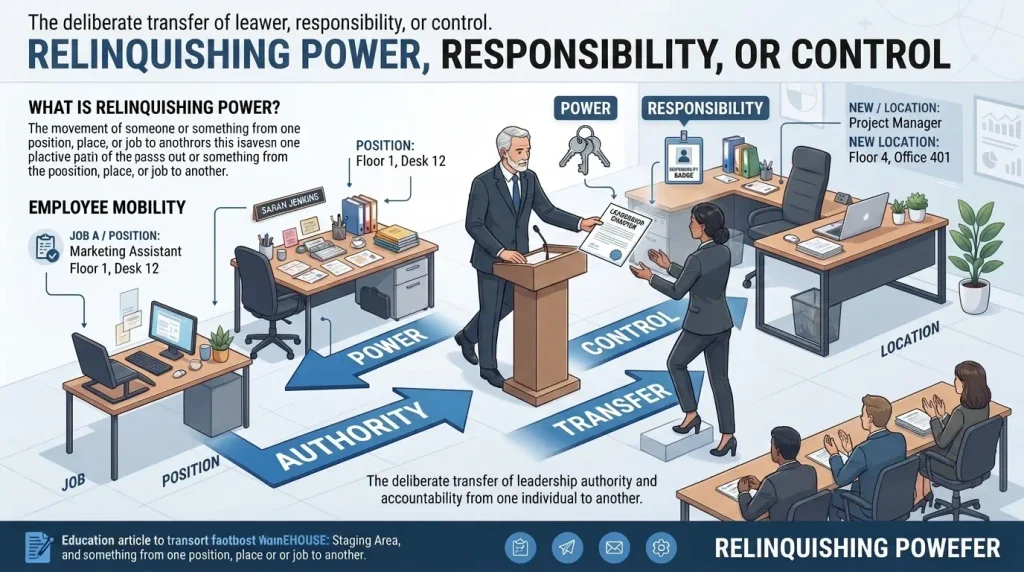
- Meaning: The act of relinquishing power, responsibility, or control to another person.
- Tone/Register: Business, International English
- Example 1: The shift handover occurred right at seven in the morning.
- Example 2: They scheduled an official handover meeting with the client team.
Pass (Noun) — US: /pæs/ | UK: /pɑːs/
- Meaning: An act of moving something to another person, especially in sports or physical work.
- Tone/Register: Informal, General
- Example 1: His lateral pass saved the team from losing possession.
- Example 2: Make a clean pass of the documents across the desk.
Shift (Noun) — US: /ʃɪft/ | UK: /ʃɪft/
- Meaning: A slight change in position, direction, focus, or responsibility.
- Tone/Register: General, Technical
- Example 1: The paradigm shift changed how we approach software development.
- Example 2: A subtle shift in authority confused staff.
Delegation (Noun) — US: /ˌdel.əˈɡeɪ.ʃən/ | UK: /ˌdel.ɪˈɡeɪ.ʃən/
- Meaning: The assignment of authority to another person to carry out specific activities.
- Tone/Register: Professional, Management
- Example 1: Proper delegation allows managers to focus on high-level strategy.
- Example 2: The project succeeded due to effective task delegation.
Conveyance (Noun) — US: /kənˈveɪ.əns/ | UK: /kənˈveɪ.əns/
- Meaning: The legal or formal action of transferring property or title to another.
- Tone/Register: Legal, Formal
- Example 1: The legal conveyance of the property took three full weeks.
- Example 2: Lawyers handled the conveyance of assets with great care.
Relinquishment (Noun) — US: /rɪˈlɪŋ.kwɪʃ.mənt/ | UK: /rɪˈlɪŋ.kwɪʃ.mənt/
- Meaning: The act of giving up, surrendering, or letting go of a claim or control.
- Tone/Register: Formal, Academic
- Example 1: His relinquishment of the title surprised the entire board.
- Example 2: The contract detailed the relinquishment of all operational rights.
Surrender (Noun) — US: /səˈren.dɚ/ | UK: /səˈren.dər/
- Meaning: The act of yielding ownership, control, or management to another party.
- Tone/Register: Formal, Dramatic
- Example 1: The surrender of control was necessary during the bankruptcy process.
- Example 2: Officials agreed to the peaceful surrender of administrative duties.
Assignment (Noun) — US: /əˈsaɪn.mənt/ | UK: /əˈsaɪn.mənt/
- Meaning: The allocation or transfer of a task, right, or property to a specific person.
- Tone/Register: Corporate, Educational
- Example 1: The assignment of new duties happened early Monday morning.
- Example 2: She accepted the assignment of managing the regional accounts.
Cession (Noun) — US: /ˈseʃ.ən/ | UK: /ˈseʃ.ən/
- Meaning: The formal giving up of rights, property, or territory by a state or organization.
- Tone/Register: Legal, Political
- Example 1: The historical treaty involved the cession of northern lands.
- Example 2: Financial lawyers completed the cession of claims yesterday.
Delivery (Noun) — US: /dɪˈlɪv.ɚ.i/ | UK: /dɪˈlɪv.ər.i/
- Meaning: The act of handing over goods, letters, or responsibilities to a recipient.
- Tone/Register: General, Business
- Example 1: The delivery of the finished project met the client’s deadline.
- Example 2: We are waiting for the final delivery of technical specifications.
Turnover (Noun) — US: /ˈtɝːnˌoʊ.vɚ/ | UK: /ˈtɜːnˌəʊ.və/
- Meaning: The rate or process of replacing people, tasks, or items with new ones.
- Tone/Register: Business, Corporate
- Example 1: Smooth project turnover requires clear documentation for all steps.
- Example 2: The turnover of inventory happens at the end of each quarter.
Transmission (Noun) — US: /trænzˈmɪʃ.ən/ | UK: /trænzˈmɪʃ.ən/
- Meaning: The process of passing something from one person, place, or system to another.
- Tone/Register: Technical, Scientific
- Example 1: The rapid transmission of data ensured real-time system updates.
- Example 2: Secure data transmission is essential for corporate safety.
Passage (Noun) — US: /ˈpæs.ɪdʒ/ | UK: /ˈpæs.ɪdʒ/
- Meaning: The process of transitioning from one condition, stage, or place to another.
- Tone/Register: Literary, Formal
- Example 1: The passage of power went smoothly after the recent elections.
- Example 2: He noted the passage of responsibilities in his daily logbook.
Exchange (Noun) — US: /ɪksˈtʃeɪndʒ/ | UK: /ɪksˈtʃeɪndʒ/
- Meaning: An act of giving one thing and receiving another in return.
- Tone/Register: General, Casual
- Example 1: The exchange of duties allowed both employees to learn new skills.
- Example 2: We had a quick exchange of ideas before starting the meeting.
Transposition (Noun) — US: /ˌtræn.spəˈzɪʃ/.ən/ | UK: /ˌtræn.spəˈzɪʃ/.ən/
- Meaning: The act of swapping two or more things or changing their order and roles.
- Tone/Register: Technical, Academic
- Example 1: The transposition of administrative roles streamlined our workflow.
- Example 2: Math routines require precise transposition of variable data.
Dispersal (Noun) — US: /dɪˈspɝː.səl/ | UK: /dɪˈspɜː.səl/
- Meaning: The action of distributing or spreading things over a wide area or group.
- Tone/Register: Formal, Scientific
- Example 1: The dispersal of tasks kept any single person from burning out.
- Example 2: Systematic funds dispersal helped all departments finish on schedule.
Allocation (Noun) — US: /ˌæl.əˈkeɪ.ʃən/ | UK: /ˌæl.əˈkeɪ.ʃən/
- Meaning: The process of distributing resources or duties for a specific purpose.
- Tone/Register: Professional, Financial
- Example 1: The allocation of design tasks took place during the sprint.
- Example 2: Resource allocation must happen before launching the project.
Transferral (Noun) — US: /trænsˈfɝː.əl/ | UK: /trænsˈfɜː.rəl/
- Meaning: The formal act of transferring something from one entity to another.
- Tone/Register: Legal, Formal
- Example 1: The transferral of land ownership required explicit legal oversight.
- Example 2: Official record transferral was completed late Tuesday evening.
Conveying (Noun) — US: /kənˈveɪ.ɪŋ/ | UK: /kənˈveɪ.ɪŋ/
- Meaning: The process of transporting or communicating information or goods to a target.
- Tone/Register: Formal, General
- Example 1: The effective conveying of updates kept all stakeholders informed.
- Example 2: Automated systems handle the conveying of physical materials.
Succession (Noun) — US: /səkˈseʃ.ən/ | UK: /səkˈseʃ.ən/
- Meaning: The process of inheriting or taking over an office, title, or duty.
- Tone/Register: Corporate, Formal
- Example 1: Corporate leadership prepared a succession plan for executive roles.
- Example 2: The succession of duty moved forward without any internal friction.
Devolment (Noun) — US: /dɪˈvɑːlv.mənt/ | UK: /dɪˈvɒlv.mənt/
- Meaning: The transfer of power or duty from a central authority to lower levels.
- Tone/Register: Academic, Political
- Example 1: The devolution of decision-making authority empowered local teams.
- Example 2: Regional branch heads welcomed the devolution of budget control.
Devolution (Noun) — US: /ˌdev.əˈluː.ʃən/ | UK: /ˌdev.əˈluː.ʃən/
- Meaning: The statutory delegation of power from a central government to regional levels.
- Tone/Register: Formal, Political
- Example 1: Political devolution granted more autonomy to regional assemblies.
- Example 2: The devolution of operations simplified local factory decisions.
Passing (Noun) — US: /ˈpæs.ɪŋ/ | UK: /ˈpɑː.sɪŋ/
- Meaning: The act of giving something to another person or moving past a stage.
- Tone/Register: Casual, General
- Example 1: The passing of the baton in the race required precise timing.
- Example 2: Regular passing of information prevents team miscommunication.
Shift-change (Noun) — US: /ʃɪft tʃeɪndʒ/ | UK: /ʃɪft tʃeɪndʒ/
- Meaning: The specific time or process when one group of workers replaces another.
- Tone/Register: Industrial, Workplace
- Example 1: Safety checks are mandatory during every factory shift change.
- Example 2: Nurses log patient notes during the evening shift change.
Reassignment (Noun) — US: /ˌriː.əˈsaɪn.mənt/ | UK: /ˌriː.əˈsaɪn.mənt/
- Meaning: The act of assigning someone or something to a different position or task.
- Tone/Register: Professional, HR
- Example 1: Her reassignment to the European branch expanded her experience.
- Example 2: Task reassignment resolved our recent scheduling bottleneck.
Pass-off (Noun) — US: /pæs ɑːf/ | UK: /pɑːs ɒf/
- Meaning: An informal or technical handoff of tasks or components.
- Tone/Register: Informal, Technical
- Example 1: The developer completed the quick pass-off to the QA tester.
- Example 2: Let us schedule a brief pass-off call before the weekend.
Passing-on (Noun) — US: /ˈpæs.ɪŋ ɑːn/ | UK: /ˈpɑː.sɪŋ ɒn/
- Meaning: The act of transmitting information, duties, or items to the next recipient.
- Tone/Register: Casual, Conversational
- Example 1: The passing on of client updates keeps account leads aligned.
- Example 2: Constant passing on of feedback helped improve product design.
Subdelegation (Noun) — US: /sʌbˌdel.əˈɡeɪ.ʃən/ | UK: /sʌbˌdel.ɪˈɡeɪ.ʃən/
- Meaning: The delegation of assigned authority down to a lower operational level.
- Tone/Register: Corporate, Legal
- Example 1: Clear subdelegation rules prevent confusion in field operations.
- Example 2: Managers approved subdelegation of daily administrative duties.
Entrustment (Noun) — US: /ɪnˈtrʌst.mənt/ | UK: /ɪnˈtrʌst.mənt/
- Meaning: The act of giving someone responsibility for taking care of something vital.
- Tone/Register: Formal, Emotional
- Example 1: The entrustment of company secrets requires complete confidence.
- Example 2: Her entrustment with key client accounts boosted her career.
Committal (Noun) — US: /kəˈmɪt.əl/ | UK: /kəˈmɪt.əl/
- Meaning: The official act of committing or entrusting something to another entity.
- Tone/Register: Formal, Legal
- Example 1: The committal of case records to the court clerk went smoothly.
- Example 2: Formal committal of responsibility was documented in writing.
Consignment (Noun) — US: /kənˈsaɪn.mənt/ | UK: /kənˈsaɪn.mənt/
- Meaning: The delivery of goods to another person or agent for care or sale.
- Tone/Register: Business, Commercial
- Example 1: The shipment arrived at the warehouse as a bulk consignment.
- Example 2: Goods were held in consignment until final payment cleared.
Bailment (Noun) — US: /ˈbeɪl.mənt/ | UK: /ˈbeɪl.mənt/
- Meaning: The transfer of possession of personal property without transfer of ownership.
- Tone/Register: Legal, Highly Specialized
- Example 1: The parking contract created a temporary legal bailment.
- Example 2: Lawyers discussed bailment conditions for the stored equipment.
Demise (Noun) — US: /dɪˈmaɪz/ | UK: /dɪˈmaɪz/
- Meaning: The transfer of property or sovereignty by lease or official will.
- Tone/Register: Legal, Archaic
- Example 1: Estate charters detailed the legal demise of property rights.
- Example 2: The demise of the land lease occurred after fifty years.
Sign-over (Noun) — US: /saɪn oʊ.vɚ/ | UK: /saɪn əʊ.və/
- Meaning: The formal act of signing documents to transfer ownership or duty.
- Tone/Register: Business, Casual
- Example 1: The vehicle sign-over required two witnesses’ signatures today.
- Example 2: We finalized the property sign-over at the notary office.
Relay (Noun) — US: /ˈriː.leɪ/ | UK: /ˈriː.leɪ/
- Meaning: A system or group passing something along in stages.
- Tone/Register: General, Operational
- Example 1: The news relay carried the urgent message across branches.
- Example 2: Communication works best as a clear, structured relay.
Step-down (Noun) — US: /step daʊn/ | UK: /step daʊn/
- Meaning: A planned reduction in role or transfer of executive power.
- Tone/Register: Business, News
- Example 1: The founder announced a step-down during the annual meeting.
- Example 2: A gradual step-down allowed the new director to adjust.
Offloading (Noun) — US: /ˌɑːfˈloʊd.ɪŋ/ | UK: /ˌɒfˈləʊd.ɪŋ/
- Meaning: The act of transferring tasks or operational burdens to another party.
- Tone/Register: Corporate, Informal
- Example 1: Task offloading helped reduce stress on engineering teams.
- Example 2: Smart offloading of logistics streamlined our delivery process.
Shift-over (Noun) — US: /ʃɪft oʊ.vɚ/ | UK: /ʃɪft əʊ.və/
- Meaning: A complete movement from one system, team, or method to another.
- Tone/Register: Technical, Informal
- Example 1: The shift-over to cloud storage took place over the weekend.
- Example 2: We planned a seamless shift-over between project phases.
Release (Noun) — US: /rɪˈliːs/ | UK: /rɪˈliːs/
- Meaning: The act of letting go or making something available to others.
- Tone/Register: Professional, Technical
- Example 1: Product software release marks the final client handoff point.
- Example 2: The release of duty let him start his new assignment.
Trade-off (Noun) — US: /ˈtreɪd.ɑːf/ | UK: /ˈtreɪd.ɒf/
- Meaning: A balance achieved between two desirable but opposing features or tasks.
- Tone/Register: Business, Conversational
- Example 1: Speed and quality represented a necessary trade-off here.
- Example 2: The management exchange was a fair trade-off for efficiency.
Delegation-over (Noun) — US: /ˌdel.əˈɡeɪ.ʃən oʊ.vɚ/ | UK: /ˌdel.ɪˈɡeɪ.ʃən əʊ.və/
- Meaning: The systematic transfer of operational authority to regional managers.
- Tone/Register: Corporate, Formal
- Example 1: Delegation-over of regional hiring streamlined human resources.
- Example 2: Clear delegation-of-authority rules avoided corporate confusion.
Transfer-of-control (Noun) — US: /ˈtræns.fɚ ʌv kənˈtroʊl/ | UK: /ˈtræns.fɜːr ɒv kənˈtrəʊl/
- Meaning: The official act of passing direct authority over a system or project.
- Tone/Register: Formal, Technical
- Example 1: Air traffic operators confirmed the transfer-of-control.
- Example 2: Transfer-of-control protocols prevented system downtime.
Passing-the-torch (Noun) — US: /ˈpæs.ɪŋ ðə tɔːrtʃ/ | UK: /ˈpɑː.sɪŋ ðə tɔːtʃ/
- Meaning: Figurative transfer of leadership, tradition, or core duties to a successor.
- Tone/Register: Idiomatic, Expressive
- Example 1: The retiring CEO spoke of passing the torch to youth.
- Example 2: Mentorship programs represent a real passing-the-torch moment.
Synonyms by Tone
- Positive: Delegation, Entrustment, Transition, Passing-the-torch.
- Neutral: Transfer, Handover, Assignment, Delivery, Relay, Shift, Conveyance.
- Negative: Relinquishment, Surrender, Offloading, Cession.
- Playful/Informal: Pass, Pass-off, Sign-over, Shift-over.
Tone determines how your reader perceives intent. Using “entrustment” signals confidence and respect, while “offloading” implies dumping work onto someone else.
Mini Comparison
Handoff vs. Handover vs. Transfer
- Handoff: Focuses on real-time operational execution, common in tech, Agile management, and sports.
- Handover: Preferred in British and international business contexts for administrative transitions.
- Transfer: A broad term covering physical movement, corporate job changes, or data routing.
Use handoff for software processes or workflow steps, handover for formal job transitions, and transfer for moving physical assets or data files.
Context-Based Usage
- Daily Conversation: Casual terms like “pass” or “sign-over” keep interactions light and clear.
- Writing & Blogging: Words like “transition” or “shift” keep readers engaged without technical jargon.
- Professional & Academic: Precise terms like “delegation,” “conveyance,” or “devolution” show authority.
- Creative Writing: Expressive phrases like “passing-the-torch” add emotional weight to narrative arcs.
Common Mistakes & Native Usage
- Confusing Handoff (Noun) with Hand Off (Verb): Combine into one word for the noun (“the handoff was clear”). Use two words for the action (“please hand off the file”).
- Tone Mismatch: Using “surrender” in routine business emails sounds alarmist. Stick to “transfer” or “handover.”
- Overusing Tech Jargon: Avoid technical terms like “transfer-of-control” in informal team chats.
Real-Life Mini Scenarios
- Workplace: An outbound engineer completes a code handoff to QA before taking leave.
- Social Situations: An outgoing committee head coordinates a smooth handover with the new volunteer lead.
- Media & Pop Culture: Commentators highlight the smooth relay during an Olympic track victory.
- Storytelling: A veteran detective marks his retirement with a classic passing-the-torch to his junior partner.
Conclusion
Learning a clear synonym for handoff enhances communication precision across professional and academic environments. Expressing transitions accurately strengthens your writing style and builds workplace confidence.
Integrating varied vocabulary into everyday speech makes your content engaging and readable. Choosing precise words ensures your message resonates clearly with your intended audience.
Explore these options in your upcoming emails, reports, or blog posts. Practicing new vocabulary daily unlocks stronger, clearer, and more expressive English communication.
Interactive Practice Quiz
- Which synonym best fits an official corporate asset transfer?
a) Pass-off
b) Conveyance
c) Offloading
d) Trade-off - “Devolution” is most commonly used in which context?
a) Track and field
b) Political and government structures
c) Casual conversation
d) Creative fiction - Which term carries a negative connotation implying dumping work?
a) Entrustment
b) Offloading
c) Delegation
d) Transition - What is the main difference between “handoff” and “hand off”?
a) One is British, one is American
b) “Handoff” is a noun, “hand off” is a verb phrase
c) “Handoff” is plural
d) There is no difference - Which phrase works best for an inspirational leadership transition?
a) Pass-off
b) Cession
c) Passing-the-torch
d) Bailment - Choose the best formal synonym for shift change in healthcare:
a) Offloading
b) Handover
c) Subdelegation
d) Demise - What part of speech is “handoff”?
a) Verb
b) Noun
c) Adjective
d) Adverb - Which synonym suits daily casual conversation best?
a) Conveyance
b) Pass
c) Devolment
d) Committal - Software development teams typically prefer which term for task shifts?
a) Demise
b) Handoff
c) Cession
d) Bailment - “Entrustment” implies which kind of tone?
a) Negative
b) Playful
c) Positive and respectful
d) Neutral administrative
Reflection Task: Write two short sentences describing a recent task transfer at work or school using two different synonyms from this guide.
Answer Key:
1-b, 2-b, 3-b, 4-b, 5-c, 6-b, 7-b, 8-b, 9-b, 10-c
FAQs
What is the most common synonym for handoff in business?
The most common synonym in corporate settings is “handover” or “transfer.” “Handover” is widely used in international business to describe shifts in operational responsibility, while “transfer” applies broadly to assets, employees, and electronic files.
Is handoff one word or two words?
“Handoff” as a single word is a noun referring to the transfer event itself. When used as an action verb phrase, write it as two words (“hand off”).
How does handoff differ from delegation?
A handoff usually transfers total responsibility or ownership of a finished component. Delegation assigns specific task execution to someone while keeping overall authority with the delegator.
Can handoff be used in informal situations?
Yes, handoff works well in casual contexts like sports or household chores. However, terms like “pass” or “turnover” feel more natural for everyday casual conversations.
What is the difference between handoff and turnover?
A handoff refers to passing a specific project or responsibility to a successor. Turnover usually describes the rate at which employees or inventory items are replaced over time.

Sophia Carter is the founder and lead writer at SynonymVerse.com, a trusted online resource dedicated to English vocabulary and effective communication. She is passionate about helping students, writers, professionals, and lifelong learners find the most accurate words to express their ideas with clarity and confidence.
At SynonymVerse.com, every article is carefully researched and thoughtfully written to provide reliable guidance on synonyms, word meanings, and vocabulary. With a strong focus on accuracy, real-world usage, and easy-to-understand explanations, the website is committed to helping readers strengthen their language skills, enrich their vocabulary, and become more confident communicators.