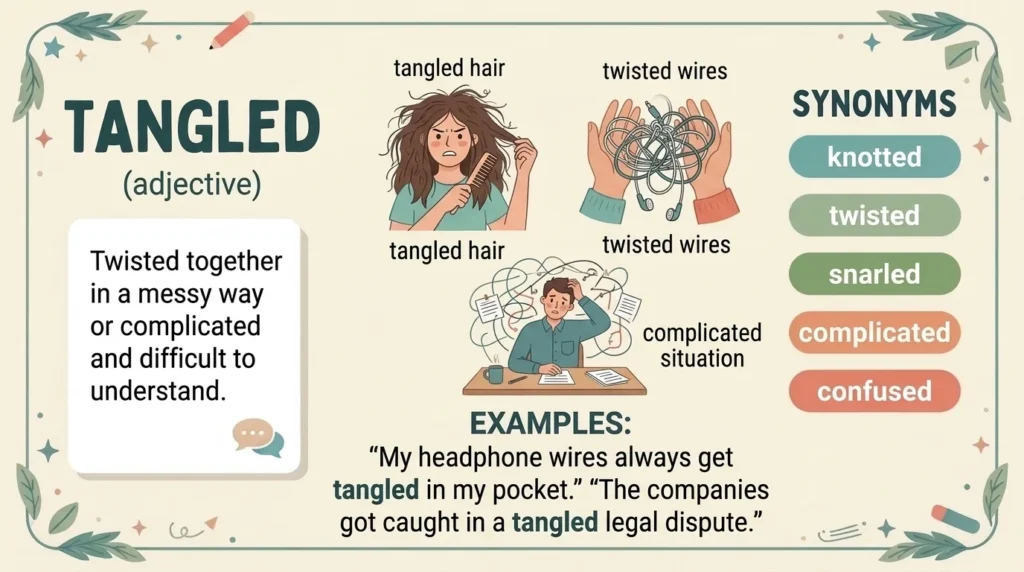
A synonym for tangled is a word such as knotted, twisted, entangled, or complicated. These alternatives describe things caught together, difficult to separate, or confusing to understand. The best choice depends on whether you mean a physical mess or a difficult situation.
Imagine reaching into your bag for your headphones before an important call. The wires have twisted around each other, creating a frustrating mess. You might describe them as tangled, knotted, or snarled.
The word also applies to everyday problems. A tangled misunderstanding can damage a friendship, while a complicated situation may require patience and careful thinking to resolve.
Learning synonyms for tangled helps students, bloggers, and content writers express ideas more clearly. Everyday English users can also improve their conversations by choosing words that communicate the exact meaning.
What Does “Tangled” Really Mean?
Tangled describes something twisted, knotted, mixed together, or difficult to separate. It can also refer to a confusing situation that requires effort to understand or resolve.
People commonly use this word for hair, wires, ropes, threads, relationships, arguments, and complicated problems.
- Part of speech: Adjective and past participle of the verb tangle.
- Simple definition: Twisted together or complicated in a way that makes separation or understanding difficult.
- Emotional tone: Often suggests confusion, frustration, or disorder, although it can create a sense of mystery in creative writing.
Native English speakers use tangled for both physical and figurative situations. Tangled cables need sorting out, while tangled relationships may require honest conversations and thoughtful decisions.
Connotative Meaning of Tangled
(Connotation means the feelings or associations a word creates beyond its literal definition.)
Positive tone: A tangled garden of vines might suggest natural beauty, mystery, or adventure.
Negative tone: Tangled wires or a tangled dispute often suggest frustration and disorder.
Neutral tone: Tangled threads simply describe a physical condition without necessarily expressing an emotion.
The surrounding sentence determines the impression. A tangled mystery may sound exciting, while a tangled legal dispute suggests a difficult problem.
Etymology: Where Does “Tangled” Come From?
The word tangled comes from the English verb tangle, which means to twist things together or create knots. Its precise earliest origin is uncertain, so claims about a specific ancient root should be treated cautiously.
Old English Period (450–1100)
Old English had words associated with binding, twisting, and knots. However, the modern word tangle is not securely established as an Old English word with exactly its current meaning.
Middle English Period (1100–1500)
Forms related to tangle emerged in English during the Middle English period. The word became associated with twisting objects together and making them difficult to separate.
Modern English Period (1500–Present)
Tangled developed into a common adjective and past participle. Modern speakers use it for physical knots as well as complicated relationships, confusing ideas, and difficult circumstances.
Syllables and Word Formation
- Syllables: tan-gled (2 syllables)
- Root word: Tangle
- Prefix: None
- Suffix: -ed, which forms the past participle and can create an adjective.
- Word family: Tangle, tangled, tangling, untangle, untangled.
The word tangled describes a condition, while untangle means to remove knots or resolve confusion.
Synonyms List
The most suitable synonym depends on what you want to describe. Some words refer to physical knots, while others explain confusion, complicated connections, or disorder.
1. Knotted (Adjective)
Meaning: Tied or twisted into one or more knots.
Tone/Register: Neutral; common in everyday English.
Example:
My shoelaces became knotted during the hike.
She carefully loosened the knotted string.
2. Twisted (Adjective)
Meaning: Turned or wound around itself, making it difficult to straighten.
Tone/Register: Neutral; suitable for speech and writing.
Example:
The twisted cable would not fit behind the desk.
He straightened the twisted handle before using it.
3. Entangled (Adjective)
Meaning: Caught or interwoven with something else so that separation becomes difficult.
Tone/Register: Neutral to formal.
Example:
The fishing line became entangled in the weeds.
Their financial interests became entangled in the dispute.
4. Snarled (Adjective)
Meaning: Twisted into a confused or tightly mixed mass.
Tone/Register: Informal to neutral.
Example:
I found a snarled bundle of charging cables.
The thread snarled around the sewing machine needle.
5. Intertwined (Adjective)
Meaning: Twisted or closely connected with other things.
Tone/Register: Neutral to formal; often figurative.
Example:
The plant’s stems were intertwined around the fence.
Their personal and professional lives became intertwined.
6. Muddled (Adjective)
Meaning: Confused, unclear, or poorly organized.
Tone/Register: Informal to neutral.
Example:
His muddled explanation left everyone with questions.
I felt muddled after reading the confusing instructions.
7. Complicated (Adjective)
Meaning: Made up of many connected parts that are difficult to understand or manage.
Tone/Register: Neutral; suitable for most contexts.
Example:
The application process became complicated.
She explained the complicated rule in simple words.
8. Convoluted (Adjective)
Meaning: Extremely complicated or indirect, making something difficult to follow.
Tone/Register: Formal; common in professional writing.
Example:
The report used convoluted language that confused readers.
His convoluted explanation hid the main point.
9. Confused (Adjective)
Meaning: Unclear or difficult to understand because details or ideas are mixed up.
Tone/Register: Neutral.
Example:
The confused instructions made the task harder.
Her account left several details unexplained.
10. Disordered (Adjective)
Meaning: Lacking a clear arrangement or proper organization.
Tone/Register: Formal to neutral.
Example:
The papers lay in a disordered pile.
The disordered notes made revision difficult.
11. Messy (Adjective)
Meaning: Untidy, disorganized, or difficult to manage neatly.
Tone/Register: Informal; very common in conversation.
Example:
My messy hair needed a quick brush.
The disagreement turned into a messy situation.
12. Jumbled (Adjective)
Meaning: Mixed together without a clear order.
Tone/Register: Neutral; everyday English.
Example:
The jumbled letters formed a hidden message.
My thoughts felt jumbled before the interview.
13. Snagged (Adjective)
Meaning: Caught on a sharp point or object, sometimes pulling material out of shape.
Tone/Register: Informal to neutral.
Example:
My sweater snagged on the metal hook.
The fishing line snagged on a branch.
14. Coiled (Adjective)
Meaning: Wound into circular loops, which may be neat or disorderly.
Tone/Register: Neutral; descriptive.
Example:
A coiled rope rested beside the boat.
She placed the coiled cable inside the storage box.
15. Wound (Adjective or Past Participle)
Meaning: Wrapped or twisted around something, often in layers or loops.
Tone/Register: Neutral; descriptive.
Example:
The wire was wound tightly around the pole.
A thin vine wound itself around the railing.
16. Twisted Up (Phrase)
Meaning: Twisted into a messy or difficult arrangement.
Tone/Register: Informal.
Example:
My headphones got twisted up in my pocket.
The ribbons were twisted up inside the gift box.
17. Snarled Up (Phrase)
Meaning: Caught in a tight, confused mass.
Tone/Register: Informal.
Example:
The kite string became snarled up in a tree.
We spent ten minutes freeing the snarled-up thread.
18. Tangled Up (Phrase)
Meaning: Caught or mixed together physically or involved in a complicated situation.
Tone/Register: Informal to neutral.
Example:
The dog’s leash got tangled up around the chair.
He became tangled up in a disagreement between friends.
19. Interlaced (Adjective)
Meaning: Crossed or woven through one another in an alternating pattern.
Tone/Register: Formal to neutral.
Example:
The basket had interlaced strips of bamboo.
Interlaced branches formed a natural canopy.
20. Interwoven (Adjective)
Meaning: Woven together so that separate parts become closely connected.
Tone/Register: Neutral to formal.
Example:
The fabric contained interwoven threads of gold.
History and culture are interwoven in the novel.
21. Enmeshed (Adjective)
Meaning: Deeply caught up in a complicated situation or network.
Tone/Register: Formal; often negative when describing problems.
Example:
The company became enmeshed in a legal dispute.
She felt enmeshed in other people’s expectations.
22. Involved (Adjective)
Meaning: Connected with a situation that may contain many parts or complications.
Tone/Register: Neutral to formal.
Example:
Several departments were involved in the investigation.
He became involved in a complicated family disagreement.
23. Intricate (Adjective)
Meaning: Made up of many small, connected details or parts.
Tone/Register: Neutral to formal; often positive when describing craftsmanship.
Example:
The artist created an intricate pattern on the wall.
The case involved an intricate network of relationships.
24. Complex (Adjective)
Meaning: Having several connected parts that require careful thought or explanation.
Tone/Register: Neutral to formal; common in academic writing.
Example:
The researcher examined a complex social issue.
Our project has a complex set of requirements.
25. Bewildering (Adjective)
Meaning: So confusing that it becomes difficult to understand what is happening.
Tone/Register: Neutral to formal.
Example:
The bewildering map sent us in the wrong direction.
She faced a bewildering number of choices.
26. Perplexing (Adjective)
Meaning: Difficult to explain or understand, often because something seems unusual.
Tone/Register: Formal to neutral.
Example:
The missing document created a perplexing problem.
His sudden change of attitude was perplexing.
27. Confounding (Adjective)
Meaning: Confusing or surprising in a way that makes a situation difficult to explain.
Tone/Register: Formal; common in analytical writing.
Example:
The conflicting results presented a confounding puzzle.
Her response was confounding to the entire team.
28. Chaotic (Adjective)
Meaning: Completely disorganized, with little apparent order or control.
Tone/Register: Neutral to negative.
Example:
The office became chaotic before the deadline.
A chaotic schedule left everyone feeling exhausted.
29. Disorganized (Adjective)
Meaning: Not arranged or managed in a clear, effective way.
Tone/Register: Neutral; sometimes mildly critical.
Example:
The disorganized folder made the files hard to find.
Our disorganized meeting wasted valuable time.
30. Disheveled (Adjective)
Meaning: Untidy in appearance, especially when hair or clothing looks unkempt.
Tone/Register: Neutral to formal.
Example:
He arrived with disheveled hair after the long journey.
Her disheveled appearance suggested a busy morning.
31. Matted (Adjective)
Meaning: Formed into dense, tangled clumps, especially hair, fur, or fibers.
Tone/Register: Neutral; descriptive.
Example:
The wet dog’s fur became matted after the walk.
She gently brushed the matted fibers apart.
32. Fused (Adjective)
Meaning: Joined or blended together so closely that separating the parts may be difficult.
Tone/Register: Neutral to formal; sometimes technical.
Example:
The heat fused the plastic pieces together.
Their musical styles fused into a distinctive sound.
33. Knotty (Adjective)
Meaning: Full of knots or difficult problems that require careful thought.
Tone/Register: Neutral to formal.
Example:
The old tree had a knotty trunk.
The committee discussed a knotty question about privacy.
34. Labyrinthine (Adjective)
Meaning: So complicated or winding that finding a clear route through it becomes difficult.
Tone/Register: Formal; literary or academic.
Example:
We wandered through the building’s labyrinthine corridors.
The report described a labyrinthine system of regulations.
35. Byzantine (Adjective)
Meaning: Extremely complicated, often involving many rules, procedures, or hidden connections.
Tone/Register: Formal; often critical.
Example:
The Byzantine paperwork discouraged new applicants.
She struggled to understand the Byzantine tax rules.
36. Thorny (Adjective)
Meaning: Difficult and sensitive, especially when a problem has no easy solution.
Tone/Register: Neutral to formal.
Example:
The panel debated a thorny question about fairness.
They needed a careful approach to the thorny issue.
37. Fraught (Adjective)
Meaning: Filled with difficulties, tension, or potential problems.
Tone/Register: Formal to neutral.
Example:
Their fraught negotiations continued late into the evening.
The journey was fraught with unexpected delays.
38. Disentangled (Adjective or Past Participle)
Meaning: Freed from knots, confusion, or complicated connections.
Tone/Register: Neutral to formal.
Example:
She disentangled the necklace from the chain.
The mediator disentangled the facts from the rumors.
39. Unraveled (Adjective or Past Participle)
Meaning: Loosened from a woven structure or gradually exposed as a confusing situation becomes clearer.
Tone/Register: Neutral; common in storytelling.
Example:
The scarf unraveled after catching on a nail.
The mystery unraveled as new evidence emerged.
40. Disentwined (Adjective or Past Participle)
Meaning: Separated from something with which it was twisted or interwoven.
Tone/Register: Formal or literary; less common than untangled.
Example:
The gardener disentwined the vine from the wire frame.
Their responsibilities were slowly disentwined during the review.
41. Overlapping (Adjective)
Meaning: Extending over or sharing parts with one another, sometimes creating a confusing arrangement.
Tone/Register: Neutral to formal.
Example:
The overlapping cables made the desk area look cluttered.
The report contained overlapping responsibilities across departments.
42. Mixed Up (Adjective or Phrase)
Meaning: Confused, disordered, or combined in a way that makes things hard to distinguish.
Tone/Register: Informal; very common in conversation.
Example:
I got my appointment dates mixed up.
The mixed-up papers made it difficult to locate the contract.
43. Confounded (Adjective)
Meaning: Confused or frustrated by something difficult to explain; in some uses, mixed up or combined.
Tone/Register: Formal, literary, or old-fashioned in some expressions.
Example:
The confounded instructions made a simple task frustrating.
The investigator was confounded by the contradictory evidence.
44. Complicatedly Connected (Phrase)
Meaning: Linked through many relationships or details that are difficult to separate.
Tone/Register: Formal and explanatory.
Example:
The events were complicatedly connected to earlier decisions.
The characters’ lives were complicatedly connected through family history.
45. Tangled in Complexity (Phrase)
Meaning: Caught in a situation with so many connected details that understanding or resolving it becomes difficult.
Tone/Register: Descriptive; suitable for explanatory or creative writing.
Example:
The team became tangled in complexity after several rules changed.
The novel’s hero was tangled in complexity as secrets emerged.
Important vocabulary note: These alternatives are related to tangled, but they are not all exact replacements. Knotted, snarled, and matted describe physical conditions. Complex, perplexing, and thorny describe difficult ideas or situations. Disentangled and unraveled describe movement away from a tangled state.
Synonyms for Tangled by Tone
Tone influences how readers interpret your message. A word that works in a friendly conversation may feel unsuitable in a formal report.
Positive Synonyms
These words can suggest beauty, detail, or meaningful connections when the context supports that interpretation.
- Intertwined: Highlights close connections between people or ideas.
- Interwoven: Suggests elements that combine into a meaningful whole.
- Intricate: Emphasizes detailed and skillful construction.
- Interlaced: Describes a deliberate crossing pattern.
- Coiled: Creates a clear image of loops.
Neutral Synonyms
These words describe physical arrangements or difficult situations without adding strong emotional judgment.
- Knotted
- Twisted
- Entangled
- Jumbled
- Muddled
- Complicated
- Complex
- Disordered
- Involved
- Overlapping
Negative Synonyms
Choose these when you want to emphasize confusion, disorder, tension, or frustration.
- Snarled
- Chaotic
- Disorganized
- Bewildering
- Perplexing
- Convoluted
- Enmeshed
- Labyrinthine
- Byzantine
- Fraught
Playful and Informal Synonyms
These expressions sound natural in everyday conversations and casual storytelling.
- Messy
- Mixed up
- Twisted up
- Tangled up
- Snarled up
Why does tone matter? Compare “a tangled problem” with “a knotty problem.” Both suggest difficulty, but knotty often sounds more analytical. Similarly, a messy room feels conversational, while a disordered room sounds more formal.
Tangled vs. Close Alternatives
| Word | Main difference | Best use |
|---|---|---|
| Tangled | Twisted together or difficult to sort out | Hair, wires, relationships, problems |
| Knotted | Specifically tied or formed into knots | Rope, shoelaces, string |
| Entangled | Caught together or involved in complicated connections | Fishing lines, disputes, relationships |
| Complicated | Contains parts or steps that are difficult to understand | Instructions, systems, situations |
| Jumbled | Mixed without a clear order | Notes, words, thoughts, objects |
| Convoluted | Excessively complex or indirect | Arguments, explanations, plots |
Which Word Should You Choose?
Use knotted when you can picture actual knots. Choose entangled when separate things have become caught together. Use complicated when the main issue is difficulty rather than physical twisting.
For example, “The rope is knotted” describes its condition. “The families became entangled in a dispute” describes their involvement. “The rules are complicated” focuses on understanding the rules.
How Tangled Changes by Context
Daily Conversation
In everyday English, tangled, messy, knotted, and mixed up are useful choices. They help people describe common problems without sounding overly formal.
Example: “My earphones are tangled again. I need a better way to store them.”
For a personal misunderstanding, you could say, “Things got complicated between us.” This sounds more natural than a technical or literary term.
Writing and Blogging
Bloggers can use varied vocabulary to make descriptions more vivid and avoid unnecessary repetition. Physical descriptions often benefit from knotted, snarled, or interwoven. Articles about difficult situations may use complex, muddled, or convoluted.
Choose each alternative based on the sentence’s meaning. Replacing every occurrence of tangled with a different word can make writing sound unnatural.
Professional and Academic Writing
In professional writing, precision matters more than variety. Words such as complex, interrelated, convoluted, and enmeshed may suit reports, research, and analytical discussions.
Example: “The departments have overlapping responsibilities” is more precise than “The departments are tangled.” The first statement identifies the actual problem.
Creative and Informal Writing
Writers can use snarled, labyrinthine, intertwined, and matted to create a clear mental picture. These words can make a setting feel mysterious, a character’s hair look unkempt, or a plot seem difficult to follow.
In dialogue, simple phrases such as all mixed up and tangled up often sound more believable than formal vocabulary.
Common Mistakes Learners Make
1. Treating Every Synonym as Interchangeable
Not every alternative fits every sentence. Matted usually describes hair, fur, or fibers. Complicated describes problems or systems. Replacing one with the other can change the meaning.
2. Using Formal Words in Casual Conversation
Words such as labyrinthine and Byzantine can sound unnecessarily elaborate in everyday speech. In most conversations, complicated or confusing communicates the idea more naturally.
3. Confusing Physical and Figurative Meanings
“Tangled cables” describes a physical arrangement. “Entangled in a dispute” describes complicated involvement. The surrounding context helps readers understand the intended meaning.
4. Overusing Synonyms for SEO
Writers sometimes add too many keyword variations in an attempt to improve search visibility. This can make an article repetitive and difficult to read.
Use the focus keyword naturally, then select alternatives when they improve clarity. Search-focused writing should still prioritize readers’ needs.
5. Forgetting the Difference Between a State and an Action
Tangled describes a condition, while disentangled and unraveled can describe movement away from that condition.
Example: “The wires were tangled” describes the original problem. “She disentangled the wires” describes the solution.
Register Notes: Formal vs. Informal English
Formal and academic: Complex, convoluted, intricate, enmeshed, labyrinthine, and interwoven can suit analytical or descriptive writing. Choose them when their precise meanings fit.
Informal and spoken: Messy, mixed up, tangled up, and twisted up are natural in conversations with friends, family, and colleagues.
Descriptive writing: Knotted, snarled, matted, and coiled create specific physical images.
Professional communication: Prefer direct terms that identify the problem. “The workflow is complicated” or “The responsibilities overlap” usually communicates more than a vague description of a tangled process.
For additional vocabulary practice, an article about synonyms for complicated can complement this topic by exploring words for difficult ideas and situations.
Real-Life Mini Scenarios Using Tangled Synonyms
Workplace Scenario
A team discovers that two departments are responsible for the same task. Instead of describing the whole project as tangled, a manager might explain that their responsibilities overlap. This identifies the issue clearly.
Social Scenario
Two friends misunderstand a message and begin arguing. Their friendship may become complicated, or they may become entangled in a disagreement. The second choice emphasizes their involvement in the conflict.
Media and Pop Culture Scenario
A mystery series includes several clues, unexpected events, and hidden relationships. A reviewer might call the plot convoluted if the story becomes unnecessarily difficult to follow, or intricate if its complexity feels carefully designed.
Writing and Storytelling Scenario
A character enters an abandoned garden filled with vines. The writer might describe intertwined branches, a snarled hedge, or matted roots. Each phrase creates a different visual impression.
Interactive Practice Quiz: Choose the Best Synonym
Test your understanding with these 10 practical questions. Choose the word that best fits each situation before checking the answer key.
1. Your shoelaces have formed several tight knots. Which word fits best?
- A. Intricate
- B. Knotted
- C. Fraught
- D. Bewildering
2. A report contains many connected details and is difficult to understand. Which word is most suitable?
- A. Coiled
- B. Matted
- C. Complex
- D. Snagged
3. A fishing line gets caught among underwater plants. Which word describes this situation?
- A. Entangled
- B. Disordered
- C. Thorny
- D. Disheveled
4. Your notes contain words and ideas in no clear order. Which word fits best?
- A. Interwoven
- B. Coiled
- C. Fused
- D. Jumbled
5. A writer creates a highly detailed and beautiful design. Which word emphasizes the detail?
- A. Chaotic
- B. Intricate
- C. Muddled
- D. Snarled
6. A company’s approval process has too many confusing steps. Which word best describes it?
- A. Knotted
- B. Matted
- C. Convoluted
- D. Coiled
7. A person’s hair looks untidy after a long journey. Which word fits best?
- A. Disheveled
- B. Interlaced
- C. Complex
- D. Fused
8. Two colleagues disagree, and the problem becomes increasingly difficult to resolve. Which word describes the issue?
- A. Coiled
- B. Snagged
- C. Interwoven
- D. Complicated
9. Several vines cross through one another along a garden fence. Which word fits best?
- A. Bewildering
- B. Intertwined
- C. Disorganized
- D. Perplexing
10. You accidentally confuse the dates of two appointments. Which expression sounds most natural?
- A. Labyrinthine
- B. Enmeshed
- C. Mixed up
- D. Intricate
Reflection Task
Write two short sentences about a real-life situation. Use one synonym for a physical tangle and another for a confusing problem. Explain why each word fits its context.
Answer key: 1-B, 2-C, 3-A, 4-D, 5-B, 6-C, 7-A, 8-D, 9-B, 10-C.
Frequently Asked Questions
1. What is the closest synonym for tangled in everyday English?
The closest synonym depends on what you are describing. Knotted works best for rope, string, and shoelaces. Twisted describes something wound around itself. Entangled suggests that two or more things have become caught together. When describing a difficult situation, complicated or confusing may sound more natural.
2. What is another word for tangled hair?
Common alternatives include knotted, matted, snarled, and disheveled, but they describe different conditions. Knotted hair contains visible knots, while matted hair forms dense clumps that are difficult to separate. Snarled hair is twisted into a messy mass. Disheveled hair simply looks untidy and may not contain actual knots.
3. What is a synonym for tangled when describing a complicated situation?
Use complicated, complex, convoluted, or entangled, depending on the situation. A complicated problem has several difficult parts. A complex issue involves connected elements that need careful consideration. A convoluted explanation is unnecessarily difficult to follow. An entangled situation often involves people, responsibilities, or circumstances that are difficult to separate.
4. Is tangled a positive or negative word?
Tangled is usually neutral to negative because it often suggests disorder, confusion, or difficulty. However, its tone depends on context. Tangled wires may be frustrating, while intertwined branches can look beautiful. In storytelling, a tangled mystery can create excitement. Consider the surrounding sentence before deciding whether the word communicates a positive, negative, or neutral impression.
5. What is the difference between tangled and entangled?
Tangled is a broad term for things twisted together or situations that are difficult to resolve. Entangled emphasizes being caught up with something else or involved in a complicated connection. You might describe a necklace as tangled and a company as entangled in a legal dispute. Both words can describe physical or figurative relationships.
6. What is a formal synonym for tangled in academic writing?
Complex, intricate, convoluted, and interwoven can work in formal writing, depending on the meaning. Use complex for systems with many connected parts, intricate for detailed structures, and convoluted for reasoning that is difficult to follow. Choose interwoven when several themes or factors are closely connected. Accuracy matters more than using an impressive-sounding word.
7. How can I avoid repeating tangled in an essay?
Identify what the word describes before choosing a replacement. Use knotted for physical knots, intertwined for closely connected elements, and complicated for difficult situations. You can also restructure a sentence instead of replacing the word directly. Read the paragraph aloud to check whether the alternatives sound natural and preserve the intended meaning.
Recommended External Reference
For a reliable definition and additional examples, consult the Cambridge Dictionary entry for “tangled”. It can help readers explore the word’s meaning and usage further.
Conclusion
Choosing a suitable synonym for tangled helps you describe knots, confusion, and complicated situations with greater accuracy. Each alternative brings a slightly different meaning to your sentence.
Vocabulary becomes more useful when you understand context. Words such as knotted, entangled, and complex can strengthen your writing without making it unnecessarily difficult.
For students, bloggers, and everyday English users, learning related words improves essays, articles, emails, and conversations. Precise language helps readers understand your message quickly and confidently.
Start practicing today. Write a few sentences using these alternatives, then try them in everyday conversations or short paragraphs. Small steps can build lasting vocabulary skills.

Sophia Carter is the founder and lead writer at SynonymVerse.com, a trusted online resource dedicated to English vocabulary and effective communication. She is passionate about helping students, writers, professionals, and lifelong learners find the most accurate words to express their ideas with clarity and confidence.
At SynonymVerse.com, every article is carefully researched and thoughtfully written to provide reliable guidance on synonyms, word meanings, and vocabulary. With a strong focus on accuracy, real-world usage, and easy-to-understand explanations, the website is committed to helping readers strengthen their language skills, enrich their vocabulary, and become more confident communicators.