A synonym for hum can instantly transform flat writing into vivid imagery. Imagine sitting in a quiet office when a low background sound fills the space.
Instead of writing that the machine makes a noise, you say it hums. That simple choice paints a clear picture for your readers immediately.
Learning a synonym for hum helps students, bloggers, and writers avoid dull repetition. It expands your vocabulary and sharpens everyday English communication effortlessly.
Using a fresh synonym for hum gives your essays and blogs more color. It allows you to describe soft sounds, busy rooms, or quiet thoughts precisely.
What Does “Hum” Really Mean?
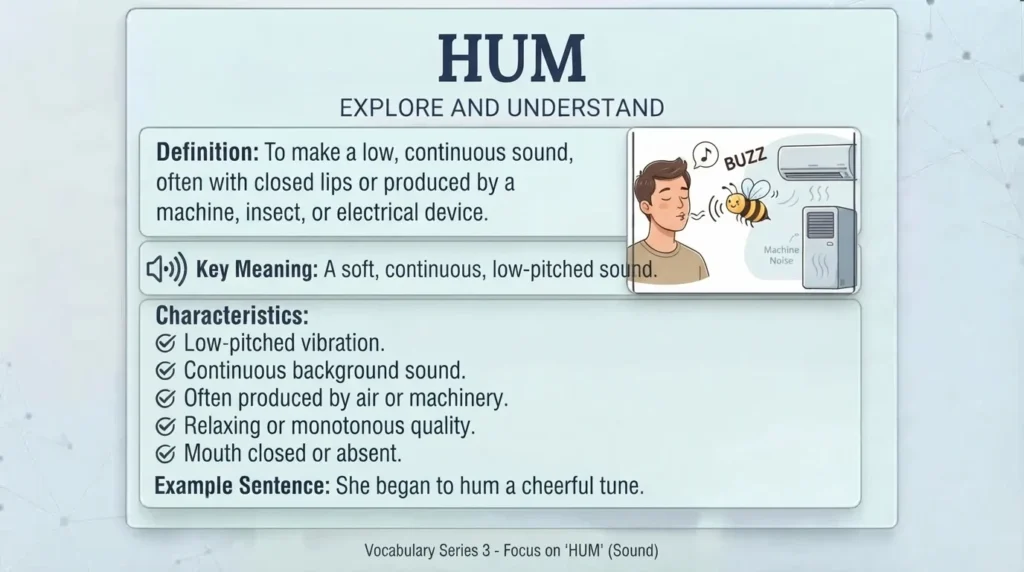
The word hum refers to a low, continuous, and monotonous sound. It often describes the steady noise of machinery, insects, or a person singing with closed lips. Native speakers also use it metaphorically to describe a place filled with subtle activity.
As a verb or noun, its tone is generally neutral. It simply describes a persistent vibration or continuous low audio frequency without inherent negative or positive judgment.
Part of Speech: Verb / Noun
Definition: To make a low, steady, continuous sound, or the sound itself.
Connotation
(Connotation refers to the emotional feeling or secondary meaning that a word carries beyond its explicit dictionary definition.)
- Positive Tone: Suggests warm energy, steady productivity, or a soothing melody (e.g., a hive buzzing with activity).
- Negative Tone: Implies annoying background noise, mechanical drone, or eerie vibration.
- Neutral Tone: Simply denotes an acoustic frequency or low sound level.
Etymology
The word originated in Late Middle English as an imitative word (onomatopoeia), mimicking the actual physical sound of a low murmur or closed-mouth vocalization.
- Old English (450–1100): No direct recorded form; sound concepts were described using general terms like murmurian.
- Middle English (1100–1500): Emerged as hummen, meaning to make a low sound or mumble.
- Modern English (1500–Present): Standardized as hum, expanding from physical vocalization to mechanical and atmospheric descriptions.
Pronunciation & Syllables
- US IPA: /hʌm/
- UK IPA: /hʌm/
- Syllables: hum (1 syllable)
Affixation Pattern:
- Root: Hum
- Prefix: None
- Suffix: None
Synonyms List
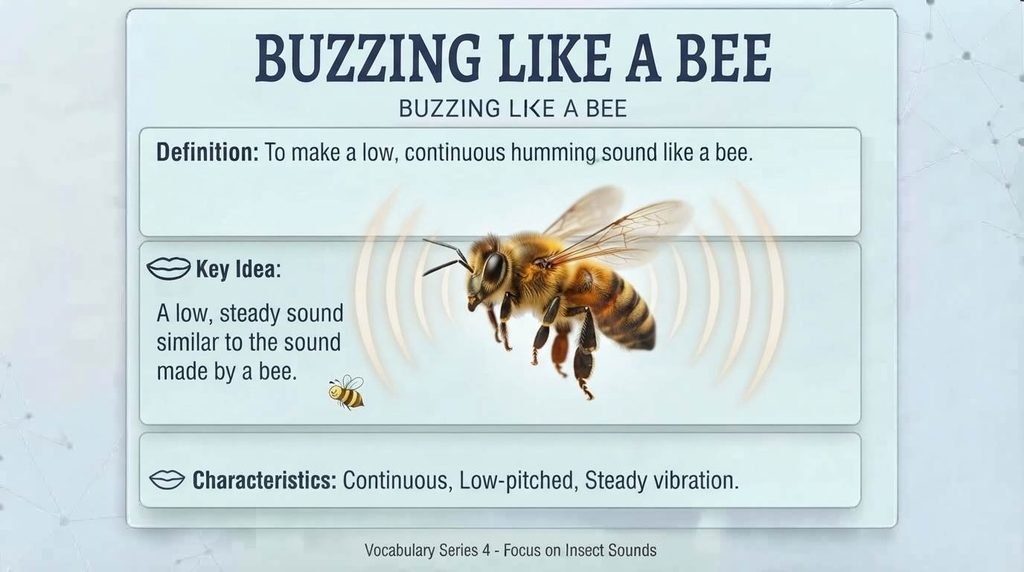
Buzz (Verb / Noun) — US: /bʌz/ | UK: /bʌz/
- Meaning: To make a low, continuous humming sound like a bee.
- Tone/Register: Informal / General
- Example 1: The neon light began to buzz in the quiet room.
- Example 2: Her phone started to buzz on the wooden desk.
Drone (Verb / Noun) — US: /droʊn/ | UK: /drəʊn/
- Meaning: To make a continuous low dull humming sound.
- Tone/Register: Neutral / Descriptive
- Example 1: The airplane engines drone during long flights.
- Example 2: A distant lawnmower continued to drone all afternoon.
Murmur (Verb / Noun) — US: /ˈmɜːrmər/ | UK: /ˈmɜːmə/
- Meaning: To produce a low, faint, continuous sound.
- Tone/Register: Gentle / Literary
- Example 1: The stream began to murmur over the smooth rocks.
- Example 2: Soft voices murmur in the lecture hall.
Purr (Verb / Noun) — US: /pɜːr/ | UK: /pɜː/
- Meaning: To make a low, continuous, vibratory sound expressing contentment or smooth operation.
- Tone/Register: Positive / Descriptive
- Example 1: The car engine started to purr smoothly.
- Example 2: The cat began to purr on my lap.
Whir (Verb / Noun) — US: /wɜːr/ | UK: /wɜː/
- Meaning: To make a low sound of rapid movement or rotation.
- Tone/Register: Neutral / Technical
- Example 1: Computer fans whir inside the server room.
- Example 2: The camera lens gave a quick whir.
Reiterate (Verb) — US: /riːˈɪtəreɪt/ | UK: /riːˈɪtəreɪt/
- Meaning: To repeat a sound or statement continually in the background.
- Tone/Register: Formal
- Example 1: Shadows seem to reiterate the sound of the wind.
- Example 2: Distant speakers reiterate a steady tone.
Thrum (Verb / Noun) — US: /θrʌm/ | UK: /θrʌm/
- Meaning: To make a continuous rhythmic humming or drumming sound.
- Tone/Register: Literary
- Example 1: Rain began to thrum against the windowpane.
- Example 2: Heavy bass notes thrum through the floor.
Vibrate (Verb) — US: /ˈvaɪbreɪt/ | UK: /vaɪˈbreɪt/
- Meaning: To move rapidly to and fro, creating a low sound.
- Tone/Register: Technical / Neutral
- Example 1: Heavy trucks cause the bridge to vibrate.
- Example 2: The speakers vibrate with deep musical sound.
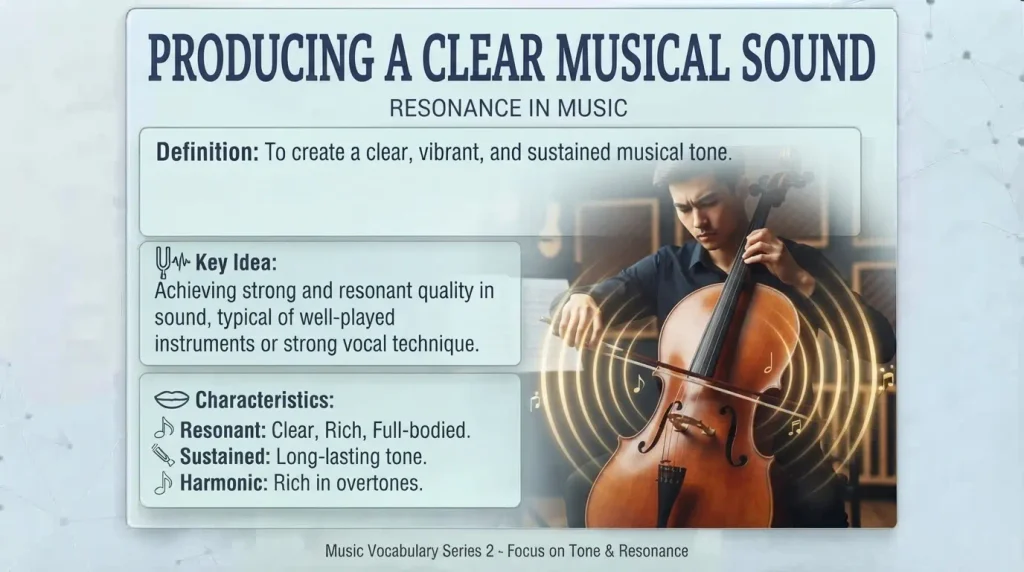
Resonate (Verb) — US: /ˈrezəneɪt/ | UK: /ˈrezəneɪt/
- Meaning: To produce or be filled with a deep, full, reverberating sound.
- Tone/Register: Formal / Academic
- Example 1: His deep voice began to resonate across the room.
- Example 2: The cello string will resonate loudly in the acoustic hall.
Reverberate (Verb) — US: /rɪˈvɜːrbəreɪt/ | UK: /rɪˈvɜːbəreɪt/
- Meaning: To echo repeatedly as a low sound.
- Tone/Register: Formal / Descriptive
- Example 1: Church bells reverberate through the valley.
- Example 2: Thunder started to reverberate over the mountain peak.
Sound (Verb / Noun) — US: /saʊnd/ | UK: /saʊnd/
- Meaning: To emit an acoustic vibration or low tone.
- Tone/Register: General
- Example 1: The alarm began to sound in the hall.
- Example 2: Low notes sound clearly from the pipe organ.
Sing (Verb) — US: /sɪŋ/ | UK: /sɪŋ/
- Meaning: To make a high musical or continuous humming noise.
- Tone/Register: Informal / Poetic
- Example 1: The kettle began to sing on the stove.
- Example 2: High wires sing softly in the winter wind.
Whistle (Verb / Noun) — US: /ˈwɪsl/ | UK: /ˈwɪsl/
- Meaning: To make a clear, high-pitched audio tone.
- Tone/Register: General
- Example 1: Winds whistle through the tiny window cracks.
- Example 2: The kettle will whistle when water boils.
Drone-on (Verb) — US: /droʊn ɑːn/ | UK: /drəʊn ɒn/
- Meaning: To speak or make noise in a dull, monotonous tone.
- Tone/Register: Negative / Informal
- Example 1: The speaker continued to drone on for an hour.
- Example 2: Exhaust fans drone on throughout the night.
Strum (Verb / Noun) — US: /strʌm/ | UK: /strʌm/
- Meaning: To play an instrument and produce sweeping rhythmic sounds.
- Tone/Register: Casual / Artistic
- Example 1: She began to strum a gentle tune on guitar.
- Example 2: Musicians thrum and strum soft acoustic notes.
Croon (Verb) — US: /kruːn/ | UK: /kruːn/
- Meaning: To hum or sing softly in a low voice.
- Tone/Register: Warm / Expressive
- Example 1: Parents croon quiet lullabies to sleepy infants.
- Example 2: Radios croon old melodies late at night.
Chime (Verb / Noun) — US: /tʃaɪm/ | UK: /tʃaɪm/
- Meaning: To make a clear, resonant musical sound.
- Tone/Register: Positive
- Example 1: Wall clocks chime gently on the hour.
- Example 2: Wind ornaments chime outside the front porch.
Ring (Verb / Noun) — US: /rɪŋ/ | UK: /rɪŋ/
- Meaning: To emit a clear resonant acoustic frequency.
- Tone/Register: General
- Example 1: Ears begin to ring in total silence.
- Example 2: Clear bells ring out over the quiet town.
Peal (Verb / Noun) — US: /piːl/ | UK: /piːl/
- Meaning: To ring loudly and continuously.
- Tone/Register: Literary
- Example 1: Thunder began to peal across dark storm clouds.
- Example 2: High bells peal out during festival day.
Toll (Verb / Noun) — US: /toʊl/ | UK: /təʊl/
- Meaning: To sound slowly and repeatedly with a deep tone.
- Tone/Register: Formal / Solemn
- Example 1: Heavy bells toll at the ceremony.
- Example 2: Iron tower chimes toll across old streets.
Hiss (Verb / Noun) — US: /hɪs/ | UK: /hɪs/
- Meaning: To make a sharp, continuous sibilant sound.
- Tone/Register: Neutral / Technical
- Example 1: Steam lines hiss in old radiator systems.
- Example 2: High-pressure valves hiss softly in plants.
Fizz (Verb / Noun) — US: /fɪz/ | UK: /fɪz/
- Meaning: To make a hissing or bubbling sound.
- Tone/Register: Informal
- Example 1: Carbonated drinks fizz when opened fresh.
- Example 2: Battery terminals fizz during chemical tests.
Sizzle (Verb / Noun) — US: /ˈsɪzl/ | UK: /ˈsɪzl/
- Meaning: To make a hissing sound like frying food.
- Tone/Register: Informal / Sensory
- Example 1: Hot pans sizzle when oil heats up.
- Example 2: Raindrops sizzle on hot summer pavement.
Buzzing (Noun / Adjective) — US: /ˈbʌzɪŋ/ | UK: /ˈbʌzɪŋ/
- Meaning: Continuous low vibration tone quality.
- Tone/Register: General
- Example 1: A buzzing sound came from the refrigerator coils.
- Example 2: The buzzing insect flew near the window.
Vibrating (Adjective) — US: /ˈvaɪbreɪtɪŋ/ | UK: /vaɪˈbreɪtɪŋ/
- Meaning: Moving back and forth rapidly, creating continuous sound.
- Tone/Register: Technical
- Example 1: A vibrating motor powers the small device.
- Example 2: High vibrating frequencies affect exact measurements.
Pulsate (Verb) — US: /ˈpʌlseɪt/ | UK: /pʌlˈseɪt/
- Meaning: To expand and contract rhythmically, producing sound pulses.
- Tone/Register: Academic
- Example 1: Deep speakers pulsate with heavy electronic beats.
- Example 2: Lights pulsate in time with background music.
Pulse (Verb / Noun) — US: /pʌls/ | UK: /pʌls/
- Meaning: To throb or emit steady low sound waves.
- Tone/Register: Neutral
- Example 1: Engine waves pulse across the vessel deck.
- Example 2: Low radio signals pulse every few seconds.
Beat (Verb / Noun) — US: /biːt/ | UK: /biːt/
- Meaning: To make a regular rhythmic sound or movement.
- Tone/Register: General
- Example 1: Wings beat rapidly against the morning air.
- Example 2: Heart tones beat steadily on hospital monitors.
Throbbing (Adjective) — US: /ˈθrɑːbɪŋ/ | UK: /ˈθrɒbɪŋ/
- Meaning: Beating with a strong, steady, low rhythm.
- Tone/Register: Descriptive
- Example 1: The throbbing motor kept everyone awake.
- Example 2: A throbbing sound filled the factory room.
Humming (Noun / Adjective) — US: /ˈhʌmɪŋ/ | UK: /ˈhʌmɪŋ/
- Meaning: Present participle of hum; making a continuous low noise.
- Tone/Register: General
- Example 1: The humming refrigerator filled the quiet house.
- Example 2: Hummingbirds moved quickly between garden trees.
Echo (Verb / Noun) — US: /ˈekoʊ/ | UK: /ˈekəʊ/
- Meaning: To repeat a sound by reflecting wave energy.
- Tone/Register: General
- Example 1: Voices echo along empty stone corridors.
- Example 2: Loud hums echo in the hollow garage.
Resound (Verb) — US: /rɪˈzaʊnd/ | UK: /rɪˈzaʊnd/
- Meaning: To fill a place with a ringing or echoing sound.
- Tone/Register: Literary
- Example 1: Shouts resound across open sports stadiums.
- Example 2: Deep notes resound throughout the wooden cathedral.
Babble (Verb / Noun) — US: /ˈbæbl/ | UK: /ˈbæbl/
- Meaning: To make a continuous murmur sound like flowing water.
- Tone/Register: Gentle
- Example 1: Streams babble through mountain pine forests.
- Example 2: Children babble happily in early daycare.
Patter (Verb / Noun) — US: /ˈpætər/ | UK: /ˈpætə/
- Meaning: To make a rapid succession of light tapping sounds.
- Tone/Register: Sensory
- Example 1: Raindrops patter gently on wood roofs.
- Example 2: Small feet patter across bedroom carpets.
Clatter (Verb / Noun) — US: /ˈklætər/ | UK: /ˈklætə/
- Meaning: To make a continuous rattling sound of hard objects.
- Tone/Register: Casual
- Example 1: Dishes clatter inside crowded restaurant kitchens.
- Example 2: Metal tools clatter on concrete garage floors.
Rattle (Verb / Noun) — US: /ˈrætl/ | UK: /ˈrætl/
- Meaning: To make rapid, short, harsh knocking sounds continuously.
- Tone/Register: General
- Example 1: Old windows rattle during strong wind storms.
- Example 2: Loose parts rattle inside vintage car doors.
Rustle (Verb / Noun) — US: /ˈrʌsl/ | UK: /ˈrʌsl/
- Meaning: To make a soft, dry crackling sound.
- Tone/Register: Soft / Descriptive
- Example 1: Autumn leaves rustle under walking boots.
- Example 2: Paper sheets rustle as readers turn pages.
Swish (Verb / Noun) — US: /swɪʃ/ | UK: /swɪʃ/
- Meaning: To move with a soft rushing or hissing sound.
- Tone/Register: Sensory
- Example 1: Long dresses swish across polished dance floors.
- Example 2: Heavy curtains swish shut against bright sunlight.
Swoosh (Verb / Noun) — US: /swuːʃ/ | UK: /swuːʃ/
- Meaning: To move rapidly with a rushing sound.
- Tone/Register: Casual
- Example 1: Basketball nets swoosh when players score clean goals.
- Example 2: Fast cars swoosh past highway dividers quickly.
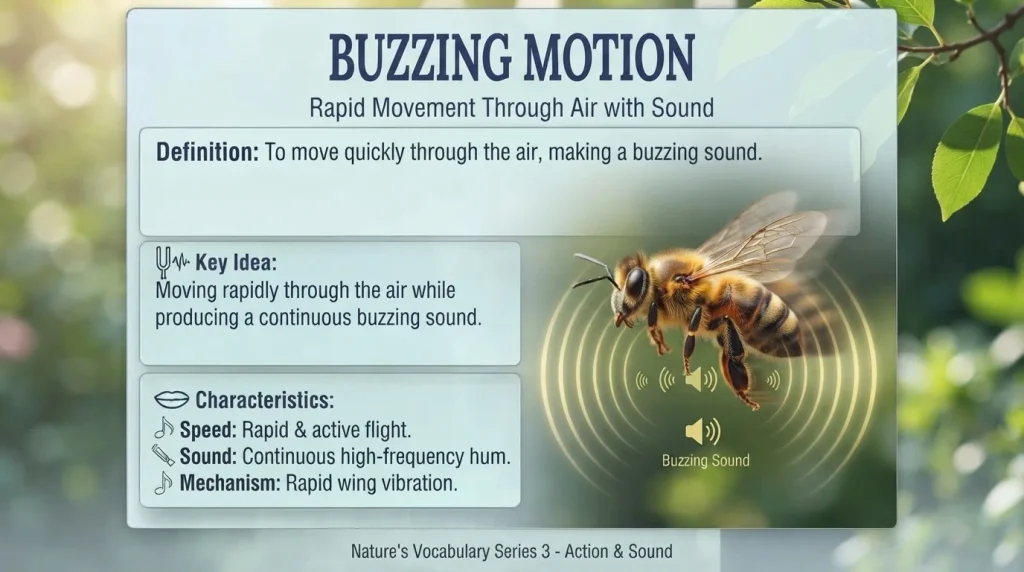
Whiz (Verb / Noun) — US: /wɪz/ | UK: /wɪz/
- Meaning: To move quickly through the air, making a buzzing sound.
- Tone/Register: Informal
- Example 1: Small arrows whiz past wooden target boards.
- Example 2: Fast bikes whiz by on country roads.
Zip (Verb / Noun) — US: /zɪp/ | UK: /zɪp/
- Meaning: To move very fast with a sharp hum sound.
- Tone/Register: Informal
- Example 1: Insects zip past outdoor lawn patio lights.
- Example 2: Small electric cars zip around city blocks.
Purring (Noun / Adjective) — US: /ˈpɜːrɪŋ/ | UK: /ˈpɜːrɪŋ/
- Meaning: Producing a soft, smooth continuous vibratory tone.
- Tone/Register: Warm
- Example 1: The purring engine indicated excellent mechanical repair.
- Example 2: A purring cat brings comfort to owners.
Droning (Noun / Adjective) — US: /ˈdroʊnɪŋ/ | UK: /ˈdrəʊnɪŋ/
- Meaning: Making a dull, persistent background hum sound.
- Tone/Register: Monotonous
- Example 1: The droning air conditioner helped mask street noises.
- Example 2: His droning voice bored the evening audience.
Thrumming (Noun / Adjective) — US: /ˈθrʌmɪŋ/ | UK: /ˈθrʌmɪŋ/
- Meaning: Characterized by rhythmic low humming vibrations.
- Tone/Register: Rhythmic
- Example 1: The thrumming sound of boat motors echoed.
- Example 2: We felt thrumming vibrations beneath our feet.
Vibrancy (Noun) — US: /ˈvaɪbrənsi/ | UK: /ˈvaɪbrənsi/
- Meaning: State of pulsing or humming with lively energy or sound.
- Tone/Register: Energetic / Abstract
- Example 1: City streets possess a humming vibrancy at night.
- Example 2: The market is filled with cultural acoustic vibrancy.
Synonyms by Tone
Positive
- Purr
- Croon
- Chime
- Resonate
Neutral
- Whir
- Vibrate
- Sound
- Murmur
Negative
- Drone
- Drone-on
- Hiss
- Rattle
Playful / Informal
- Buzz
- Zip
- Swoosh
- Fizz
Understanding tone ensures you select a word matching your scene’s precise emotional weight.
Mini Comparison
Hum vs. Drone vs. Whir
- Hum: Implies a smooth, soft, continuous low pitch (vocal or mechanical). Tone is neutral to warm.
- Drone: Implies a monotonous, dull, boring, or heavy low pitch. Tone leans negative or tedious.
- Whir: Implies rapid rotational movement, like gears or electric fans. Tone is mechanical and light.
Use hum for cozy atmospheres, drone for tiring background noise, and whir for rotating machinery.
Context-Based Usage
- Daily Conversation: Use buzz or hum when talking about busy rooms or electronic gadgets (“My phone is buzzing”).
- Writing & Blogging: Swap repetitive terms for murmur or thrum to create rich sensory descriptions.
- Professional & Academic Tone: Use terms like vibrate, resonate, or reverberate to convey precision.
- Creative Writing: Use croon, purr, or swoosh to add deep emotional resonance to fictional scenes.
Common Mistakes & Native Usage
- Mistake 1: Using drone when describing pleasant musical sounds. (Correction: Use croon or hum).
- Mistake 2: Using whir for still, stationary sound sources. Whir requires spinning motion.
- Overuse Warning: Avoid overusing mechanical sound descriptors; alternate with ambient tone words.
(For dynamic vocabulary development guides, review broader English writing resources.)
Real-Life Mini Scenarios
- Workplace: “The office was quiet, save for the low whir of the server stack.”
- Social Situations: “The coffee shop began to hum with early morning customers.”
- Media & Storytelling: “Deep bass notes thrummed through the stadium speakers.”
- Writing: “The old engine began to purr as soon as she turned the key.”
MCQs: Synonyms for Hum
1. What is the closest synonym of “hum”?
A) Shout
B) Buzz
C) Cry
D) Whisper
2. Which word means a low, continuous sound?
A) Murmur
B) Scream
C) Roar
D) Clap
3. “The machine made a soft ___.”
A) Buzz
B) Crash
C) Bang
D) Ring
4. Which word can describe the sound of a bee?
A) Hum
B) Cheer
C) Shout
D) Laugh
5. Which is a synonym for “hum” when referring to singing softly?
A) Murmur
B) Scream
C) Yell
D) Roar
6. What does “hum” mean in “She hummed a song”?
A) She sang softly with closed lips
B) She shouted loudly
C) She stopped singing
D) She spoke angrily
7. Which word is closest in meaning to “hum” as a soft sound?
A) Buzz
B) Explosion
C) Silence
D) Crash
8. “The refrigerator gave off a quiet ___.”
A) Hum
B) Scream
C) Cheer
D) Whistle
9. Which word is NOT a synonym for “hum”?
A) Buzz
B) Murmur
C) Roar
D) Drone
10. Which sentence uses “hum” correctly?
A) The engine hummed quietly.
B) The baby hummed a scream.
C) He hummed the door open.
D) She hummed the table away.
Answer Key
- B
- A
- A
- A
- A
- A
- A
- A
- C
- A
Application Task: Write one short sentence describing your current room using the word murmur or thrum.
FAQs
What is the most common synonym for hum when describing machinery?
The most common synonym for hum in mechanical contexts is whir or drone. Whir indicates fast-moving rotational components like cooling fans, whereas drone describes heavy, flat background noise produced by engines or large electrical generators operating continuously over long periods.
Can the word hum be used to describe a busy place?
Yes, hum frequently describes places bustling with quiet activity. You can say a room, market, or office is “humming with activity.” Good substitutes for this specific situational context include buzzing, throbbing, or pulsing.
Is hum different from buzz in everyday English?
While closely related, hum usually suggests a lower, smoother, and continuous acoustic frequency. In contrast, buzz implies a slightly higher, harsher, or vibrating tone, often associated with flying insects, electrical short circuits, or smartphone notifications.
How do I use hum as a verb versus a noun?
As a verb, hum describes the action of making a low sound (e.g., “She hums a tune”). As a noun, it refers directly to the sound itself (e.g., “There was a low hum in the background”).
What is a poetic synonym for hum in creative writing?
In literature and poetry, effective descriptive alternatives include murmur, thrum, croon, or resonate. These choices evoke sensory imagery and subtle emotional tones far better than basic acoustic descriptions.
Conclusion
Expanding your range of descriptive terms builds stronger communication skills daily. Replacing repetitive words like hum makes your writing far more engaging and visually expressive.
Using precise sound descriptors helps bloggers, students, and professionals convey exact meanings effortlessly. Simple word choices transform plain descriptions into vivid sensory experiences for readers.
Try incorporating words like thrum, whir, or murmur into your next email, essay, or creative draft. Practicing new vocabulary daily is the fastest way to build confidence and natural language fluency.

Sophia Carter is the founder and lead writer at SynonymVerse.com, a trusted online resource dedicated to English vocabulary and effective communication. She is passionate about helping students, writers, professionals, and lifelong learners find the most accurate words to express their ideas with clarity and confidence.
At SynonymVerse.com, every article is carefully researched and thoughtfully written to provide reliable guidance on synonyms, word meanings, and vocabulary. With a strong focus on accuracy, real-world usage, and easy-to-understand explanations, the website is committed to helping readers strengthen their language skills, enrich their vocabulary, and become more confident communicators.