Synonym for humiliate is a search phrase used by writers who need the exact right word to express intense embarrassment.
Imagine giving a major presentation when your main slide suddenly displays a personal photo. You feel your face turn hot instantly.
That sharp feeling of sudden public shame is precisely when you need a strong synonym for humiliate in your writing.
Learning a synonym for humiliate helps students, bloggers, and content creators express specific emotional shades without using repetitive language.
What Does “Humiliate” Really Mean?
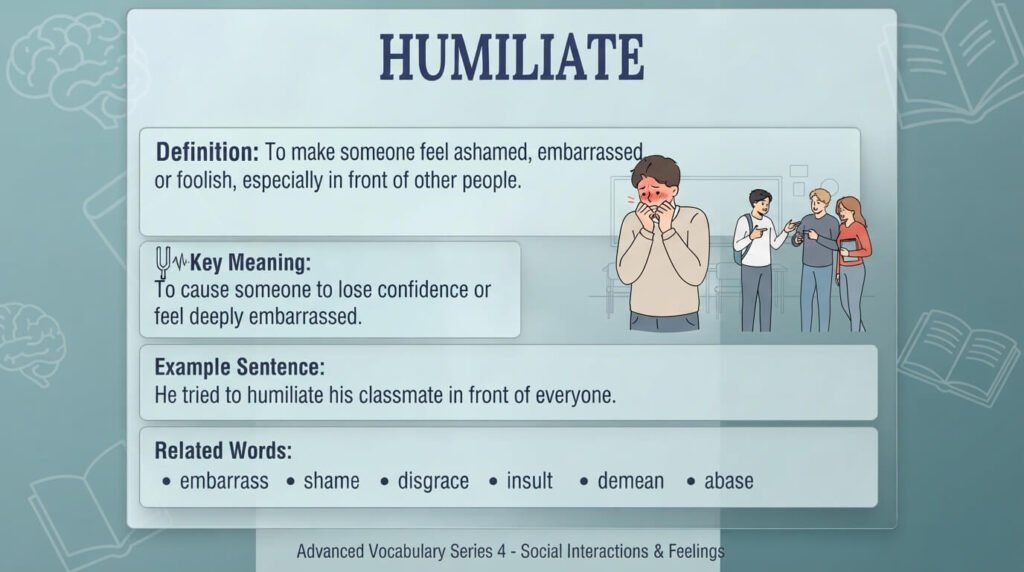
The word humiliate means to reduce someone’s dignity, self-respect, or pride, usually in a public or visible setting.
It carries a strongly negative emotional tone because it targets a person’s honor and standing among peers.
Native English speakers view it as an intentional or severe act that leaves a lasting emotional impact.
Part of Speech: Verb
Definition: To cause someone to feel ashamed, foolish, or degraded, especially in front of others.
Connotative Meaning
(Connotation refers to the emotional feeling or secondary meaning that a word carries beyond its literal definition.)
- Positive tone: None.
- Negative tone: High. It implies destruction of pride, public embarrassment, and social degradation.
- Neutral tone: Extremely rare; only used in technical or objective psychological descriptions.
Etymology
Humiliate comes from the Latin word humiliatus, past participle of humiliare, which means “to make low.” This traces back to humilis, meaning “lowly” or “near the ground” (from humus, meaning earth).
- Old English (450–1100): Not present in Old English; native Germanic words like scamian (to shame) were used.
- Middle English (1100–1500): Adapted from Old French humilier into late Middle English, primarily in religious texts, meaning to make oneself humble before God.
- Modern English (1500–Present): Shifted from spiritual self-humbling to the active public degrading of another person’s dignity.
Pronunciation
- US: /hjuːˈmɪl.i.eɪt/
- UK: /hjuːˈmɪl.i.eɪt/
Syllables
hu-mil-i-ate
Affixation Pattern
- Root: humil (low/earth)
- Prefix: None
- Suffix: -ate (verb-forming suffix)
Synonyms for Humiliate
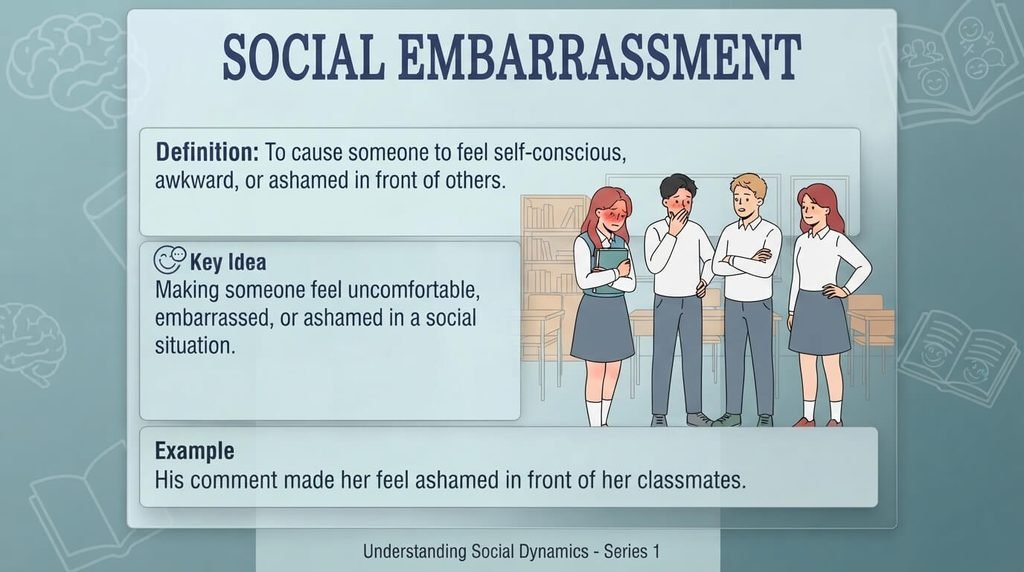
Embarrass (Verb) — US: /ɪmˈbær.əs/ | UK: /ɪmˈbær.əs/
- Meaning: To cause someone to feel self-conscious, awkward, or ashamed in front of others.
- Tone/Register: Neutral / General
Examples:
She did not mean to embarrass her friend by pointing out the food stuck in his teeth.
He turned bright red when the teacher called him to the front of the room.
Mortify (Verb) — US: /ˈmɔːr.t̬ə.faɪ/ | UK: /ˈmɔː.tɪ.faɪ/
- Meaning: To inflict severe psychological shame or extreme embarrassment on someone.
- Tone/Register: Informal to Formal / Expressive
Examples:
The loud stomach noise during the quiet exam managed to mortify her completely.
He felt mortified when he accidentally sent a private text to the company group chat.
Shame (Verb) — US: /ʃeɪm/ | UK: /ʃeɪm/
- Meaning: To make someone feel guilty or inadequate regarding their actions or character.
- Tone/Register: General / Moral
Examples:
Critics tried to shame the company into cleaning up its local pollution.
Her harsh words were designed to shame him for making a minor mistake.
Degrade (Verb) — US: /dɪˈɡreɪd/ | UK: /dɪˈɡreɪd/
- Meaning: To lower someone’s character, status, or self-respect in a harsh manner.
- Tone/Register: Formal / Serious
Examples:
No supervisor has the right to degrade employees in front of their colleagues.
The cruel punishment was intended to degrade the prisoner’s spirit.
Disgrace (Verb) — US: /dɪsˈɡreɪs/ | UK: /dɪsˈɡreɪs/
- Meaning: To bring shame, dishonor, or loss of reputation upon oneself or others.
- Tone/Register: Formal / High-stakes
Examples:
His unethical behavior managed to disgrace the entire athletic department.
She feared her poor choices would disgrace her family’s good name.
Abase (Verb) — US: /əˈbeɪs/ | UK: /əˈbeɪs/
- Meaning: To behave in a way that belittles or degrades someone, often forcing submission.
- Tone/Register: Formal / Literary
Examples:
He refused to abase himself just to secure a promotion from his boss.
The king expected conquered leaders to abase themselves before his throne.
Demean (Verb) — US: /dɪˈmiːn/ | UK: /dɪˈmiːn/
- Meaning: To cause a severe loss in the respect shown to someone.
- Tone/Register: Formal / Professional
Examples:
Screaming at staff members will only demean your standing as a leader.
She felt it would demean her dignity to argue over petty gossip.
Humbled (Verb) — US: /ˈhʌm.bəl/ | UK: /ˈhʌm.bəl/
- Meaning: To lower someone’s pride, vanity, or sense of superiority.
- Tone/Register: General / Reflective
Examples:
The sudden defeat served to humble the arrogant champion.
Facing a difficult challenge will humble even the most experienced expert.
Discomfit (Verb) — US: /dɪsˈkʌm.fɪt/ | UK: /dɪsˈkʌm.fɪt/
- Meaning: To make someone feel uneasy, confused, or mildly embarrassed.
- Tone/Register: Formal / Academic
Examples:
Direct questions about the missing budget seemed to discomfit the director.
The unexpected applause began to discomfit the quiet researcher.
Chasten (Verb) — US: /ˈtʃeɪ.sən/ | UK: /ˈtʃeɪ.sən/
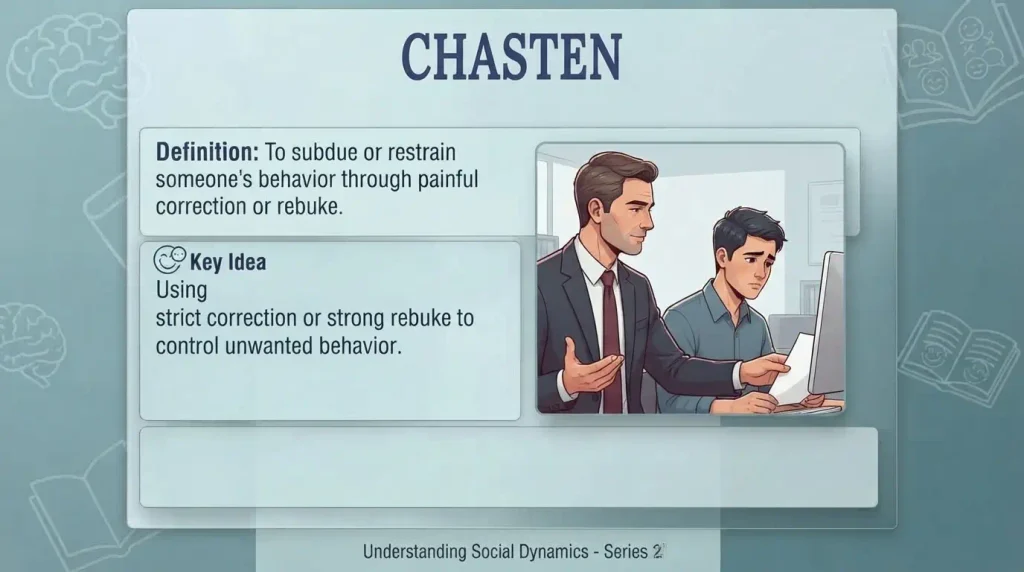
- Meaning: To subdue or restrain someone’s behavior through painful correction or rebuke.
- Tone/Register: Formal / Literary
Examples:
The harsh criticism served to chasten the young author’s wild ego.
He returned home chastened after failing his initial attempt at business.
Abash (Verb) — US: /əˈbæʃ/ | UK: /əˈbæʃ/
- Meaning: To make someone feel self-conscious, ashamed, or embarrassed.
- Tone/Register: Formal / Literary
Examples:
Nothing could abash the confident public speaker, not even technical glitches.
She stood abashed by the sudden flood of unexpected compliments.
Belittle (Verb) — US: /bɪˈlɪt̬.əl/ | UK: /bɪˈlɪt.əl/
- Meaning: To dismiss someone or their achievements as unimportant or small.
- Tone/Register: General / Interpersonal
Examples:
A good manager does not belittle the efforts of junior team members.
He tended to belittle her ideas whenever they discussed project strategy.
Disparage (Verb) — US: /dɪˈspær.ɪdʒ/ | UK: /dɪˈspær.ɪdʒ/
- Meaning: To speak of someone or something in a derogatory or slighting manner.
- Tone/Register: Formal / Academic
Examples:
It is unprofessional to disparage your previous employers during an interview.
The review seemed designed to disparage the artist’s years of hard work.
Depreciate (Verb) — US: /dɪˈpriː.ʃi.eɪt/ | UK: /dɪˈpriː.ʃi.eɪt/
- Meaning: To disparage or belittle the value or importance of a person or effort.
- Tone/Register: Formal
Examples:
He constantly tried to depreciate her contributions to the final report.
Do not depreciate your own accomplishments when presenting your portfolio.
Discount (Verb) — US: /ˈdɪs.kaʊnt/ | UK: /ˈdɪs.kaʊnt/
- Meaning: To minimize the significance of someone’s presence, input, or feelings.
- Tone/Register: Professional / General
Examples:
The panel chose to discount his warnings regarding safety compliance.
She felt hurt when the team decided to discount her original proposal.
Dishonor (Verb) — US: /dɪsˈɑː.nɚ/ | UK: /dɪsˈɒn.ər/
- Meaning: To bring shame or shame upon a person, group, or legacy.
- Tone/Register: Formal / Traditional
Examples:
Breaking a solemn promise will dishonor your professional reputation.
He swore he would never dishonor the trust his family placed in him.
Humble-pie (Idiomatic Verb) — US: /ˈhʌm.bəl paɪ/ | UK: /ˈhʌm.bəl paɪ/
- Meaning: To force someone to admit a mistake and act with humility.
- Tone/Register: Informal / Idiomatic
Examples:
The surprise audit forced the arrogant department head to eat humble pie.
Losing the game served him a giant slice of humble pie.
Put down (Phrasal Verb) — US: /pʊt daʊn/ | UK: /pʊt daʊn/
- Meaning: To criticize or humiliate someone in front of others.
- Tone/Register: Informal / Conversational
Examples:
He constantly tries to put down his coworkers to make himself look good.
It is hurtful to put down someone for trying something new.
Cut down to size (Idiomatic Verb) — US: /kʌt daʊn tuː saɪz/ | UK: /kʌt daʊn tuː saɪz/
- Meaning: To reduce someone’s exaggerated self-importance or arrogance.
- Tone/Register: Informal / Idiomatic
Examples:
The sharp counter-argument quickly cut the arrogant speaker down to size.
Her manager used facts to cut the boastful client down to size.
Take down a peg (Idiomatic Verb) — US: /teɪk daʊn ə peɡ/ | UK: /teɪk daʊn ə peɡ/
- Meaning: To lower someone’s high opinion of themselves.
- Tone/Register: Informal / Conversational
Examples:
That difficult pop quiz took the overly confident students down a peg.
Someone needs to take him down a peg before his ego ruins the team dynamic.
Show up (Phrasal Verb) — US: /ʃoʊ ʌp/ | UK: /ʃəʊ ʌp/
- Meaning: To embarrass someone by outperforming them significantly.
- Tone/Register: Informal / Conversational
Examples:
The rookie player tried hard not to show up the veteran athlete.
She ended up showing up the entire class by solving the puzzle in seconds.
Drag through the mud (Idiomatic Verb) — US: /dræɡ ˈθruː ðə mʌd/ | UK: /dræɡ ˈθruː ðə mʌd/
- Meaning: To ruin someone’s public reputation by revealing shameful details.
- Tone/Register: Informal / Media
Examples:
The tabloid news tried to drag the actor’s reputation through the mud.
Political campaigns often attempt to drag opponents through the mud.
Pillory (Verb) — US: /ˈpɪl.ɚ.i/ | UK: /ˈpɪl.ər.i/
- Meaning: To attack or ridicule someone publicly.
- Tone/Register: Formal / Journalistic
Examples:
The press chose to pillory the executive following the financial scandal.
Public opinion will pillory leaders who fail to take accountability.
Ridicule (Verb) — US: /ˈrɪd.ə.kjuːl/ | UK: /ˈrɪd.ɪ.kjuːl/
- Meaning: To make fun of someone in an unkind or dismissive way.
- Tone/Register: General / Social
Examples:
It is cruel to ridicule someone for their accent or background.
The audience began to ridicule the terrible performance.
Deride (Verb) — US: /dɪˈraɪd/ | UK: /dɪˈraɪd/
- Meaning: To express contempt for someone; to mock openly.
- Tone/Register: Formal / Literary
Examples:
Critics were quick to deride the novel when it was first published.
He feared his peers would deride his unconventional theories.
Mock (Verb) — US: /mɑːk/ | UK: /mɒk/
- Meaning: To tease or imitate someone scornfully or contemptuously.
- Tone/Register: General / Casual
Examples:
Do not mock people who are genuine in their efforts to learn.
The comedians began to mock the politician’s unusual walking style.
Taunt (Verb) — US: /tɑːnt/ | UK: /tɔːnt/
- Meaning: To provoke or challenge someone with insulting or insulting remarks.
- Tone/Register: General / Informal
Examples:
Opposing fans began to taunt the pitcher after his third consecutive error.
It is unkind to taunt someone about things they cannot change.
Jeer (Verb) — US: /dʒɪr/ | UK: /dʒɪər/
- Meaning: To shout rude, mocking remarks at someone in public.
- Tone/Register: General / Public
Examples:
The crowd started to jeer as the referee made another controversial call.
Protesters gathered outside the building to jeer at arriving official cars.
Lampoon (Verb) — US: /læmˈpuːn/ | UK: /læmˈpuːn/
- Meaning: To publicly criticize or mock someone using satire or caricature.
- Tone/Register: Formal / Media
Examples:
The late-night show loves to lampoon celebrities and public figures.
Her political cartoons manage to lampoon current government policies effectively.
Caricature (Verb) — US: /ˈkær.ɪ.kə.tʃʊr/ | UK: /ˈkær.ɪ.kə.tʃʊər/
- Meaning: To represent someone in an exaggerated or grossly distorted way.
- Tone/Register: Formal / Artistic
Examples:
The article attempted to caricature his beliefs as simple and foolish.
Comics often caricature public figures for quick humor.
Chagrined (Verb/Adjective Form) — US: /ʃəˈɡrɪnd/ | UK: /ʃəˈɡrɪnd/
- Meaning: To feel distressed or humiliated due to failure or disappointment.
- Tone/Register: Formal / Literary
Examples:
He felt chagrined when he realized he had been mispronouncing the word all day.
She was visibly chagrined by her poor test results.
Mortified (Adjective/Verb Form) — US: /ˈmɔːr.t̬ə.faɪd/ | UK: /ˈmɔː.tɪ.faɪd/
- Meaning: Feeling extremely embarrassed, ashamed, or humiliated.
- Tone/Register: Informal / General
Examples:
I was mortified when I realized my shirt was inside out during the meeting.
He stood mortified as the crowd laughed at his clumsy mistake.
Floor (Verb) — US: /flɔːr/ | UK: /flɔːr/
- Meaning: To knock down or overwhelm someone completely with surprise or shame.
- Tone/Register: Informal / Conversational
Examples:
The unexpected public exposure managed to floor the secretive politician.
Her sharp comeback managed to completely floor the boastful speaker.
Crush (Verb) — US: /krʌʃ/ | UK: /krʌʃ/
- Meaning: To ruin someone’s pride, confidence, or spirit completely.
- Tone/Register: General / Expressive
Examples:
The harsh rejection letter threatened to crush his remaining confidence.
Her cutting remarks succeeded in crushing his fragile pride.
Squash (Verb) — US: /skwɑːʃ/ | UK: /skwɒʃ/
- Meaning: To suppress or silence someone’s pride or spirit firmly.
- Tone/Register: Informal / Conversational
Examples:
The manager acted quickly to squash his arrogant behavior in front of clients.
Don’t let one failure squash your enthusiasm for the project.
Flatten (Verb) — US: /ˈflæt men/ | UK: /ˈflæt.ən/
- Meaning: To thoroughly defeat or deflate someone’s sense of self-worth.
- Tone/Register: Informal / Expressive
Examples:
The tough debate performance served to flatten his inflated ego.
His critical response flattened her initial excitement completely.
Deflate (Verb) — US: /dɪˈfleɪt/ | UK: /dɪˈfleɪt/
- Meaning: To reduce someone’s confidence or pride suddenly.
- Tone/Register: General / Expressive
Examples:
Watching her opponent score easily helped deflate her overconfident attitude.
A single cold response can deflate an eager speaker’s confidence.
Unman (Verb) — US: /ʌnˈmæn/ | UK: /ʌnˈmæn/
- Meaning: To deprive someone of courage, dignity, or self-possession.
- Tone/Register: Formal / Archaic
Examples:
The public failure seemed to unman his usual steady demeanor.
Fear of public embarrassment can unman even seasoned presenters.
Shamefaced (Adjective/State) — US: /ˈʃeɪm.feɪst/ | UK: /ˈʃeɪm.feɪst/
- Meaning: Showing clear, visible embarrassment or shame.
- Tone/Register: Literary / Descriptive
Examples:
He offered a shamefaced apology after realizing his mistake.
She gave a shamefaced smile when caught breaking the rules.
Take down (Phrasal Verb) — US: /teɪk daʊn/ | UK: /teɪk daʊn/
- Meaning: To dismantle someone’s authority or status in public.
- Tone/Register: Informal / Conversational
Examples:
The investigator set out to take down the corrupt leader publicly.
Her well-reasoned speech worked to take down the opponent’s main argument.
Synonyms by Tone
Understanding tone ensures you select the correct word for your specific writing context.
Positive Tone (Rare)
- Humble: Focuses on constructive growth or learning self-awareness rather than malice.
Neutral Tone
- Embarrass: Expresses self-consciousness without implying intentional cruelty.
- Discomfit: Focuses on mild social discomfort or awkwardness.
- Discount: Focuses on minimizing input rather than personal attack.
Negative Tone
- Humiliate: Direct attack on dignity.
- Degrade: Reduces moral or social standing severely.
- Mortify: Inflicts intense internal shame.
- Pillory: Attacks someone publicly and aggressively.
- Deride: Mocks someone with open contempt.
Playful / Informal Tone
- Put down: Casual everyday criticism.
- Take down a peg: Mildly reducing someone’s arrogance.
- Show up: Outperforming a peer socially or professionally.
Mini Comparison: Humiliate vs. Embarrass vs. Mortify
| Word | Intensity | Intent | Emotional Result |
| Embarrass | Mild to Moderate | Often accidental | Brief self-consciousness |
| Mortify | High | Usually accidental | Extreme internal shame |
| Humiliate | Severe | Often intentional | Destruction of public dignity |
- Use Embarrass when someone spills coffee on their shirt before a chat.
- Use Mortify when you realize you walked around all day with a huge stain on your back.
- Use Humiliate when someone intentionally points out your mistakes in front of an audience to ruin your reputation.
Context-Based Usage
Daily Conversation
In casual speech, native speakers rarely use heavy words like abase or pillory. Instead, stick to words like embarrass, put down, or show up.
- Example: “I didn’t mean to embarrass you in front of your friends.”
Writing or Blogging
For digital articles and storytelling, expressive words like mortify, belittle, and take down a peg keep readers engaged without sounding overly academic.
- Example: “A bad review can mortify a new author, but feedback helps them grow.”
Professional or Academic Tone
In business, legal, or academic contexts, select precise formal verbs like demean, degrade, disparage, or discomfit.
- Example: “Unprofessional behavior will demean the organization’s reputation.”
Common Mistakes & Native Usage
Misuse Scenarios
- Confusing accidental vs. intentional acts: Saying someone “humiliated” you over a simple slip of the tongue exaggerates the event. Use embarrassed instead.
- Tone mismatch: Using heavy literary terms like abase in casual text messages sounds unnatural.
Register Notes
For polished writing, vary your word choices based on the audience. If you want to expand your vocabulary, studying formal synonyms helps build a mature writing style.
Real-Life Mini Scenarios
Workplace
A manager criticizes an employee’s basic mistake during an all-hands meeting.
- Better choice: Belittle or Demean.
- Sentence: “Publicly calling out minor mistakes serves only to demean hard-working staff.”
Social Situations
You accidentally call your teacher “Mom” in front of the whole class.
- Better choice: Mortify or Embarrass.
- Sentence: “The slip of the tongue managed to mortify the student instantly.”
Media & Pop Culture
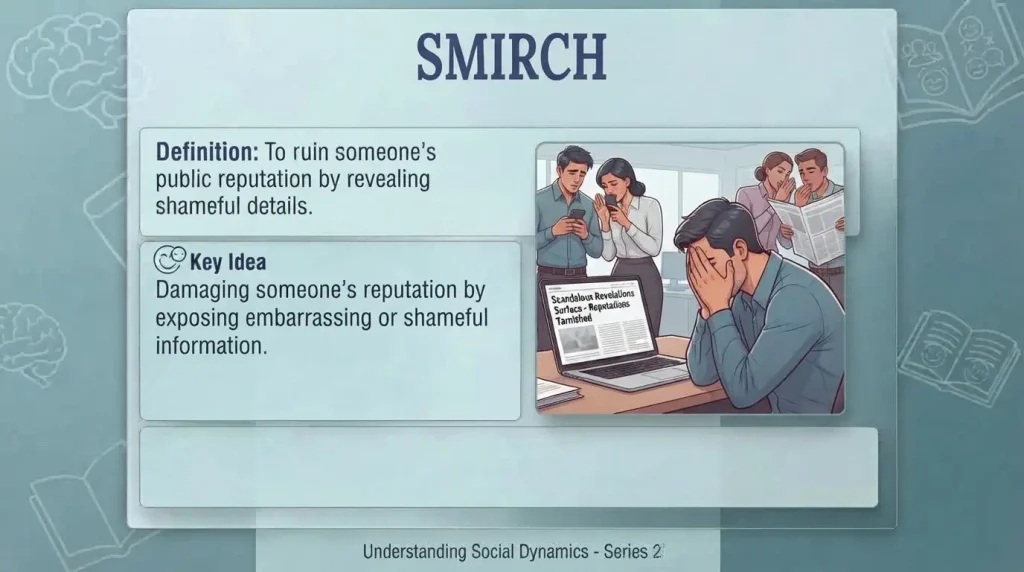
A tabloid runs a harsh front-page article exposing a celebrity’s private argument.
- Better choice: Pillory or drag through the mud.
- Sentence: “The press chose to pillory the actor following his public mistake.”
Practice Quiz
1. What is the closest synonym of “humiliate”?
A) Embarrass
B) Praise
C) Encourage
D) Support
2. Which word means to make someone feel ashamed or embarrassed?
A) Honor
B) Humiliate
C) Admire
D) Comfort
3. “The teacher did not want to ___ the student.”
A) Praise
B) Embarrass
C) Help
D) Reward
4. Which is a synonym for “humiliate”?
A) Shame
B) Respect
C) Celebrate
D) Protect
5. What does “humiliate” mean?
A) To make someone feel embarrassed or ashamed
B) To make someone happy
C) To give someone a reward
D) To show kindness
6. Which word is closest in meaning to “humiliate”?
A) Insult
B) Praise
C) Welcome
D) Assist
7. “He felt ___ when his mistake became public.”
A) Honored
B) Humiliated
C) Excited
D) Proud
8. Which word is NOT a synonym for “humiliate”?
A) Shame
B) Embarrass
C) Disgrace
D) Honor
9. Which sentence uses “humiliate” correctly?
A) She tried to humiliate him in front of everyone.
B) She humiliated him with a beautiful gift.
C) He humiliated the team by congratulating them.
D) They humiliated her by helping her.
10. Which word can replace “humiliate” in this sentence? “The joke humiliated him.”
A) Embarrassed
B) Encouraged
C) Delighted
D) Supported
Answer Key
A B B A A A B D A A
Reflection Task
Write one original sentence about a workplace or school scenario using one formal synonym from this guide (e.g., demean, disparage, or mortify).
FAQs
1. What is the closest formal synonym for humiliate?
The closest formal synonyms are demean, degrade, and abase. These words specifically describe actions that reduce a person’s status, dignity, or self-respect in serious, official, or written contexts.
2. Is there a mild synonym for humiliate?
Yes, embarrass and discomfit are much milder choices. They describe social awkwardness or temporary self-consciousness without implying the total loss of pride or severe psychological impact that humiliate carries.
3. What is the difference between humiliate and mortify?
While both imply deep shame, humiliate usually involves a public act meant to lower someone’s dignity, whereas mortify focuses on the intense internal feeling of shock and shame, often caused by one’s own blunder.
4. Can humiliate be used positively?
No, humiliate carries a strongly negative connotation. However, the related word humble can be used positively to describe gaining self-awareness, modesty, or learning a valuable lesson after a defeat.
5. What is a popular idiom used as a synonym for humiliate?
Popular idioms include take down a peg, cut down to size, eat humble pie, and drag through the mud. These expressions describe lowering someone’s ego or ruining their public standing in informal speech.
Conclusion
Building a strong vocabulary helps you select precise words that match the exact emotion of your story.
Using the right synonym for humiliate allows your writing to capture subtle details between light social awkwardness and severe public shame.
Try incorporating words like mortify, belittle, or demean into your next essay, blog post, or daily email practice.

Sophia Carter is the founder and lead writer at SynonymVerse.com, a trusted online resource dedicated to English vocabulary and effective communication. She is passionate about helping students, writers, professionals, and lifelong learners find the most accurate words to express their ideas with clarity and confidence.
At SynonymVerse.com, every article is carefully researched and thoughtfully written to provide reliable guidance on synonyms, word meanings, and vocabulary. With a strong focus on accuracy, real-world usage, and easy-to-understand explanations, the website is committed to helping readers strengthen their language skills, enrich their vocabulary, and become more confident communicators.