Synonyms for gem words can instantly transform your everyday writing into captivating content. Imagine finding an old, hidden book in a dusty attic that changes your entire perspective. That discovery is a true gem in every sense of the word.
You might say, “This small café in town is a total gem.” We use this term frequently because it expresses rare value and beauty effortlessly. Learning a synonym for gem helps you avoid repeating the same word constantly.
A varied vocabulary allows you to express precise emotions in your essays and stories. Students, bloggers, content writers, and daily speakers can all benefit from rich word choices. Using dynamic alternatives makes your communication far more engaging and persuasive.
What Does “Gem” Really Mean?
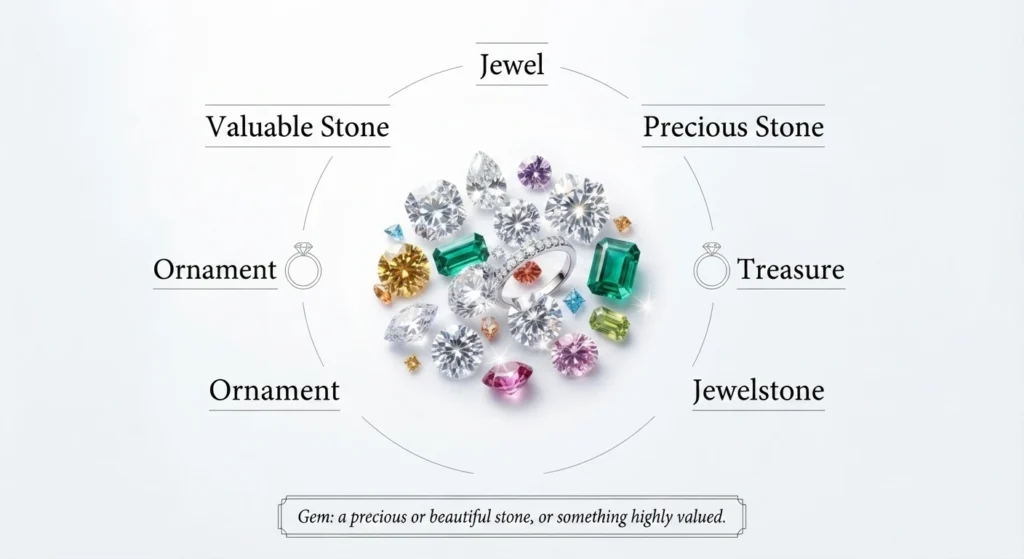
A gem is a precious or semi-precious stone that has been cut and polished for use in jewelry. Beyond its physical meaning, native speakers use it to describe an exceptional person, place, or object. It carries a deeply appreciative, warm, and highly positive emotional tone.
- Part of Speech: Noun
- Definition: A precious stone, or a person or thing that is highly valued and admired for exceptional beauty or quality.
Connotative Meaning
Connotation is the cultural or emotional association that a word carries beyond its explicit dictionary definition.
- Positive Tone: Connotes rarity, brilliant quality, high value, beauty, and deep appreciation.
- Negative Tone: Rarely carries a negative tone, except when used sarcastically to describe someone problematic.
- Neutral Tone: Refers strictly to geological minerals or cut stones without added emotion.
Etymology and History
The word comes from the Latin gemma, meaning a leaf bud or a precious stone. It entered English through Old French (gemme).
- Old English (450–1100): Borrowed directly from Latin as gim, referring to jewels.
- Middle English (1100–1500): Adapted from Old French as gemme, expanding to mean fine ornaments.
- Modern English (1500–Present): Evolved to metaphorically describe extraordinary people and prized items.
Pronunciation and Structure
- US Pronunciation: /dʒɛm/
- UK Pronunciation: /dʒɛm/
- Syllables: gem (1 syllable)
- Affixation Pattern: Root word without active prefixes or suffixes.
Synonyms List
Jewel (Noun) — US /dʒuːəl/ | UK /dʒuːəl/
Meaning: A precious stone used as an ornament or a highly prized element of something.
Tone/Register: Neutral to Formal
Example:
The museum displayed a rare emerald jewel in the main gallery.
Her latest novel is the crown jewel of her literary career.
Precious Stone (Noun) — US /ˈprɛʃəs stoʊn/ | UK /ˈprɛʃəs stəʊn/
Meaning: A mineral valued for its beauty, durability, and extreme rarity.
Tone/Register: Formal / Technical
Example:
Geologists examined the newly unearthed precious stone under ultraviolet light.
The antique ring was set with a flawless precious stone.
Treasure (Noun) — US /ˈtrɛʒər/ | UK /ˈtrɛʒə/
Meaning: A collection of valuable items or a person who is deeply cherished.
Tone/Register: Warm / Informal to Neutral
Example:
The local library is a community treasure filled with rare historic manuscripts.
Thank you for helping me clean up today; you are an absolute treasure.
Masterpiece (Noun) — US /ˈmæstərˌpis/ | UK /ˈmɑːstəˌpiːs/
Meaning: A work of outstanding skill, creativity, or artistry.
Tone/Register: Formal / Artistic
Example:
The artist spent five years crafting his ultimate masterpiece.
This film is a narrative masterpiece that will stand the test of time.
Wonder (Noun) — US /ˈwʌndər/ | UK /ˈwʌndə/
Meaning: A remarkable feature or thing that causes feelings of admiration and amazement.
Tone/Register: Enthusiastic / General
Example:
The ancient cathedral stands as an architectural wonder.
Visiting the Grand Canyon was a true wonder of my travels.
Marvel (Noun) — US /ˈmɑːrvəl/ | UK /ˈmɑːvəl/
Meaning: A wonderful or astonishing person or thing.
Tone/Register: Expressive / General
Example:
The new bridge is an engineering marvel that connects two regions.
Her ability to remember every student’s name is a small marvel.
Prize (Noun) — US /praɪz/ | UK /praɪz/
Meaning: Something valuable or highly desirable that has been achieved or won.
Tone/Register: General / Positive
Example:
The vintage car in his collection was his most cherished prize.
Finding a quiet apartment near work was a real prize for her.
Find (Noun) — US /faɪnd/ | UK /faɪnd/
Meaning: A valuable or interesting discovery made by chance.
Tone/Register: Informal / Casual
Example:
This vintage jacket was an amazing thrift store find.
Our new software engineer turned out to be a brilliant find.
Pearl (Noun) — US /pɜːrl/ | UK /pɜːl/
Meaning: A smooth luster-rich stone or a highly valuable piece of wisdom.
Tone/Register: Expressive / Literary
Example:
She shared a useful pearl of advice during the meeting.
The quiet coastal village is a hidden pearl along the bay.
Rarity (Noun) — US /ˈrɛrəti/ | UK /ˈreərəti/
Meaning: A person or thing that is particularly unusual or uncommon.
Tone/Register: Neutral / Academic
Example:
An honest political speech is a true rarity these days.
This first-edition book is a collector’s rarity.
Specialty (Noun) — US /ˈspɛʃəlti/ | UK /ˈspɛʃəlti/
Meaning: A feature, product, or skill in which someone excels.
Tone/Register: Professional / Daily
Example:
Handmade pasta is the main specialty of this tiny bistro.
Troubleshooting complex code is her technical specialty.
Highlight (Noun) — US /ˈhaɪˌlaɪt/ | UK /ˈhaɪˌlaɪt/
Meaning: The most outstanding or enjoyable part of an event or experience.
Tone/Register: General / Conversational
Example:
The trip to the waterfall was the main highlight of our vacation.
His acoustic guitar solo was the highlight of the concert.
Phenomenon (Noun) — US /fəˈnɑːməˌnɑːn/ | UK /fəˈnɒmɪnən/
Meaning: A remarkable person, thing, or event that is extraordinary.
Tone/Register: Formal / Academic
Example:
The young chess master became an international phenomenon overnight.
The northern lights remain a mesmerizing natural phenomenon.
Nonpareil (Noun) — US /ˌnɑːnpəˈrɛl/ | UK /ˌnɒnpəˈreɪl/
Meaning: An unrivaled person or thing having no equal.
Tone/Register: Very Formal / Literary
Example:
In the world of opera, her voice was considered a nonpareil.
The restaurant’s dessert platter is a nonpareil of culinary art.
Paragon (Noun) — US /ˈpærəˌɡɑːn/ | UK /ˈpærəɡən/
Meaning: A person or thing regarded as a perfect example of a particular quality.
Tone/Register: Formal / High Register
Example:
He is regarded as a paragon of integrity in corporate business.
The renovated mansion is a paragon of modern interior design.
Epitome (Noun) — US /ɪˈpɪtəmi/ | UK /ɪˈpɪtəmi/
Meaning: A person or thing that is a perfect example of a particular type or quality.
Tone/Register: Academic / Business
Example:
Her crisp presentation was the epitome of professional poise.
This small coastal city is the epitome of quiet luxury.
Classic (Noun) — US /ˈklæsɪk/ | UK /ˈklæsɪk/
Meaning: A work or item of recognized and enduring quality.
Tone/Register: General / Cultural
Example:
His debut film instantly became a classic in modern cinema.
That leather jacket design is a timeless fashion classic.
Delight (Noun) — US /dɪˈlaɪt/ | UK /dɪˈlaɪt/
Meaning: Something that gives great pleasure and joy.
Tone/Register: Warm / Casual
Example:
Working with such a creative team has been an absolute delight.
The quiet garden patio was a delight on sunny mornings.
Pride (Noun) — US /praɪd/ | UK /praɪd/
Meaning: The best or most valued feature of a group, place, or family.
Tone/Register: Emotional / Warm
Example:
The newly built sports complex is the pride of our town.
Her academic achievement was the pride of her family.
Standard-Bearer (Noun) — US /ˈstændərdˌbɛrər/ | UK /ˈstændədˌbeərə/
Meaning: A leading figure or exemplary item in a movement or field.
Tone/Register: Professional / Media
Example:
This smartphone model is the standard-bearer for mobile design.
She became the standard-bearer for ethical research practices.
Ideal (Noun) — US /aɪˈdiːəl/ | UK /aɪˈdɪəl/
Meaning: A concept or thing regarded as a standard of perfection.
Tone/Register: Academic / Philosophical
Example:
The minimalist studio apartment was an ideal for modern living.
Free expression remains a core ideal of democratic societies.
Gold Standard (Noun) — US /ɡoʊld ˈstændərd/ | UK /ɡəʊld ˈstændəd/
Meaning: The best, highest quality, or most reliable example of something.
Tone/Register: Business / Professional
Example:
Their customer service system sets the gold standard for retail.
Double-blind clinical trials are the gold standard in medical studies.
Landmark (Noun) — US /ˈlændˌmɑːrk/ | UK /ˈlændˌmɑːk/
Meaning: An outstanding or historic event, achievement, or physical feature.
Tone/Register: Formal / Informational
Example:
The court ruling was a historic landmark for consumer rights.
The clock tower serves as a central landmark in the city center.
Beauty (Noun) — US /ˈbjuti/ | UK /ˈbjuːti/
Meaning: An exceptionally good or pleasing feature or item.
Tone/Register: Informal / Conversational
Example:
Your newly restored vintage bicycle is an absolute beauty.
The goal he scored in the final minutes was a real beauty.
Sensation (Noun) — US /sɛnˈseɪʃən/ | UK /sɛnˈseɪʃən/
Meaning: A widespread reaction of interest, excitement, or admiration.
Tone/Register: Media / Popular
Example:
The viral video turned the local singer into a national sensation.
The novel became a bestseller and a literary sensation within weeks.
Triumph (Noun) — US /ˈtraɪəmf/ | UK /ˈtraɪʌmf/
Meaning: A great victory, achievement, or highly successful feature.
Tone/Register: Expressive / Inspirational
Example:
The successful space launch was a triumph of international teamwork.
Her detailed painting is a creative triumph over adversity.
Choice Item (Noun) — US /tʃɔɪs ˈaɪtəm/ | UK /tʃɔɪs ˈaɪtəm/
Meaning: An article selected specifically for its superior quality.
Tone/Register: Commercial / Descriptive
Example:
The boutique offered a rare choice item for collectors.
This imported cheese is a choice item on the tasting menu.
Ace (Noun) — US /eɪs/ | UK /eɪs/
Meaning: An outstanding person or element that excels above others.
Tone/Register: Informal / Casual
Example:
She was the team’s pitching ace throughout the entire season.
He kept an ace up his sleeve for final contract negotiations.
Keystone (Noun) — US /ˈkiˌstoʊn/ | UK /ˈkiːˌstəʊn/
Meaning: The central, vital element that holds a system together.
Tone/Register: Formal / Conceptual
Example:
Trust is the essential keystone of any lasting relationship.
This policy document is the keystone of our strategic plan.
Plum (Noun) — US /plʌm/ | UK /plʌm/
Meaning: Something highly desirable, especially a choice job or position.
Tone/Register: Informal / Workplace
Example:
He managed to land a plum assignment in the overseas office.
Winning the primary contract was a plum result for the startup.
Spectacle (Noun) — US /ˈspɛktəkəl/ | UK /ˈspɛktəkəl/
Meaning: An impressive, striking, or memorable display or performance.
Tone/Register: Expressive / Cultural
Example:
The annual fireworks show was a stunning visual spectacle.
The theatrical performance proved to be a grand spectacle.
Benchmark (Noun) — US /ˈbɛntʃˌmɑːrk/ | UK /ˈbɛntʃˌmɑːk/
Meaning: A standard or point of reference against which things may be measured.
Tone/Register: Corporate / Technical
Example:
Their eco-friendly factory established a new benchmark for industry.
This processor speed serves as a benchmark for gaming performance.
Gemstone (Noun) — US /ˈdʒɛmˌstoʊn/ | UK /ˈdʒɛmˌstəʊn/
Meaning: A mineral or petrified material that can be cut and polished.
Tone/Register: Literal / Scientific
Example:
The jeweler carefully set the uncut gemstone into the gold ring.
Ruby is a durable gemstone prized for its deep red color.
Solitaire (Noun) — US /ˈsɑːləˌtɛr/ | UK /ˈsɒlɪˌteə/
Meaning: A single gem set alone in a piece of jewelry.
Tone/Register: Specialized / Jewelry
Example:
She wore a delicate diamond solitaire on a thin platinum chain.
The classic engagement ring featured a central solitaire.
Crown Jewel (Noun) — US /kraʊn ˈdʒuːəl/ | UK /kraʊn ˈdʒuːəl/
Meaning: The most valuable or prized asset of a group or corporation.
Tone/Register: Corporate / High-Register
Example:
The research division is the crown jewel of our tech firm.
That historic castle is the crown jewel of the national park.
Standout (Noun) — US /ˈstændˌaʊt/ | UK /ˈstændˌaʊt/
Meaning: A person or thing that is exceptionally noticeable or superior.
Tone/Register: Casual / Media
Example:
Her clear presentation was the standout of the entire conference.
The young midfielder was a standout during yesterday’s match.
Prize Catch (Noun) — US /praɪz kætʃ/ | UK /praɪz kætʃ/
Meaning: A highly desirable person or item to acquire or recruit.
Tone/Register: Idiomatic / Conversational
Example:
Hiring that veteran designer was a real prize catch for us.
The rare signed vinyl record was a prize catch at the market.
Pick (Noun) — US /pɪk/ | UK /pɪk/
Meaning: The best choice or item from a group.
Tone/Register: Direct / Everyday
Example:
This organic roast is my top pick for morning coffee.
She was the manager’s first pick to lead the project.
Asset (Noun) — US /ˈæsɛt/ | UK /ˈæsɛt/
Meaning: A useful or valuable quality, person, or thing.
Tone/Register: Professional / Neutral
Example:
Her fluent Spanish proved to be a huge asset during the trip.
Strategic thinking is a primary asset for any project manager.
Sparkler (Noun) — US /ˈspɑːrklər/ | UK /ˈspɑːklə/
Meaning: A brilliant or flashing gem, especially a diamond.
Tone/Register: Informal / Playful
Example:
She was wearing a huge sparkler on her left hand.
The display case held an array of brilliant sparklers.
Synonyms for “Gem” by Tone
Tone controls how your listener receives your message. Choosing the wrong register can make your writing sound overly dramatic or inappropriately casual.
Positive Tone
- Words: Treasure, Crown Jewel, Marvel, Masterpiece, Paragon
- Usage: Use these when you want to show deep admiration or express high emotional value.
Neutral Tone
- Words: Gemstone, Precious Stone, Jewel, Rarity, Asset
- Usage: Perfect for factual descriptions, news writing, science, and academic papers.
Negative Tone
- Words: Sarcastic use of “Gem” or “Prize” (e.g., “Well, that excuse was a real gem.”)
- Usage: Used when mockingly highlighting a mistake or troublesome person.
Playful & Informal Tone
- Words: Find, Beauty, Sparkler, Standout, Plum
- Usage: Ideal for casual blog posts, social media, conversational emails, and daily speech.
“Gem” vs Close Alternatives
Understanding small distinctions keeps your writing precise and natural.
| Word | Key Shade of Meaning | Best Context | Tone |
| Gem | Exceptional quality or value in a person, place, or object. | Casual & professional writing | Warm / Flexible |
| Jewel | Typically physical ornaments or precious components. | Descriptive & formal contexts | Neutral / Formal |
| Treasure | Items or people evoking strong emotional attachment. | Personal narratives & stories | Highly Warm |
- Gem vs. Jewel: Use gem when emphasizing unique value or rare personal quality. Use jewel when referring literally to jewelry or fine components.
- Gem vs. Treasure: A gem stands out for its exceptional quality, while a treasure is valued for its emotional importance or historical weight.
How “Gem” Changes by Context
Daily Conversation
In spoken English, gem almost always refers to a helpful person or a great local spot.
“Thanks for helping me move apartments—you’re a gem!”
Writing and Blogging
Bloggers use gem to describe hidden recommendations, tools, or tips.
“This budget travel app is a hidden gem for solo travelers.”
Professional and Academic Tone
In business or academic writing, authors swap gem for precise alternatives like asset, benchmark, or paragon.
“The employee’s analytical skill is a vital asset to our firm.”
Creative Writing
Fiction authors use metaphors like jewel, solitaire, or pearl to build rich sensory images.
“The small coastal city sat like a polished pearl along the dark shore.”
Common Mistakes & Native Usage
Misuse Scenarios
- Overusing “Gem”: Calling every decent restaurant or book a “gem” dilutes its meaning. Reserve it for truly special things.
- Using literal terms metaphorically: Saying “This person is an unpolished gemstone” sounds awkward. Stick to “hidden gem” or “rough diamond.”
Tone Conflicts
Using playful terms like sparkler in formal business reports reduces your authority. Opt for asset or keystone instead.
Register Notes
In written English, native speakers prefer descriptive alternatives (rarity, standout) to keep their style dynamic and avoid repeating the focus keyword too often.
Real-Life Mini Scenarios
- Workplace: “Our senior project coordinator is an absolute gem; she resolved the client crisis in under ten minutes.”
- Social Situations: “We found a tiny family-owned pizza place downtown that turned out to be a real gem.”
- Media & Pop Culture: “Critics praised the indie film as a hidden gem of the autumn festival circuit.”
- Storytelling: “Tucked inside the ancient wooden box was a single, flawless gem.”
Conclusion
Expanding your range with a synonym for gem helps you communicate with far greater precision. Choosing terms like masterpiece, treasure, or asset keeps your essays and articles fresh.
Varying your word choice improves your natural writing flow and strengthens your overall vocabulary. Practicing these words regularly builds confidence in both spoken and written English.
Try incorporating two or three of these new alternatives into your next blog post, essay, or email. Small daily changes in your word choice will quickly elevate your language skills.
Synonym for Gem – MCQs
1. Which word is a synonym for “gem”?
A) Stone
B) Jewel
C) Dust
D) Sand
2. What does “gem” mean?
A) A valuable or beautiful stone
B) A broken object
C) A common plant
D) A large building
3. Which word can replace “gem” in a sentence?
A) Jewel
B) Noise
C) Road
D) Cloud
4. Which of these is closest in meaning to “gem”?
A) Treasure
B) Problem
C) Waste
D) Tool
5. A precious stone can also be called a:
A) Jewel
B) Branch
C) Shell
D) Rope
6. Which word is NOT a synonym for “gem”?
A) Jewel
B) Treasure
C) Precious stone
D) Ordinary object
7. “The diamond was a beautiful gem.” What can replace “gem”?
A) Jewel
B) Box
C) Paper
D) Cloth
8. Which word best describes a “gem”?
A) Valuable
B) Broken
C) Empty
D) Useless
9. Which is another word for a precious gem?
A) Jewel
B) Pebble
C) Brick
D) Stick
10. “Gem” can also refer to something that is:
A) Rare and valuable
B) Dirty and useless
C) Large and heavy
D) Old and broken
Answer Key
- B
- A
- A
- A
- A
- D
- A
- A
- A
- A
Reflection Task
Write two sentences about your favorite book or place using one neutral and one positive synonym from the list above.
Frequently Asked Questions
1. What is the most common synonym for gem in daily conversation?
The most common daily synonym for gem is jewel when talking about physical objects, or treasure when referring to people or places. In casual speech, words like find or beauty are also used frequently to describe exceptional items or discoveries.
2. Can the word gem be used to describe a person?
Yes, calling a person a gem is a very common native English compliment. It means the person is exceptionally kind, helpful, reliable, or delightful. For instance, “Thank you for helping me; you are an absolute gem,” is a warm expression of gratitude.
3. What is the difference between a gem and a gemstone?
A gemstone refers strictly to the raw or cut mineral used in jewelry making (a literal geological term). A gem can refer to the physical stone, but it is also widely used as a metaphor for extraordinary people, places, or achievements.
4. What is a hidden gem in English vocabulary?
A hidden gem is an idiom used to describe something outstanding that is not widely known or easily noticed by the public. Common examples include underrated restaurants, quiet travel destinations, obscure indie movies, or underappreciated books.
5. Which formal synonym for gem should I use in academic writing?
In academic or formal writing, avoid metaphorical slang. Replace gem with precise nouns such as asset, paragon, epitome, keystone, or benchmark, depending on whether you are describing a person, quality, or standard.

Sophia Carter is the founder and lead writer at SynonymVerse.com, a trusted online resource dedicated to English vocabulary and effective communication. She is passionate about helping students, writers, professionals, and lifelong learners find the most accurate words to express their ideas with clarity and confidence.
At SynonymVerse.com, every article is carefully researched and thoughtfully written to provide reliable guidance on synonyms, word meanings, and vocabulary. With a strong focus on accuracy, real-world usage, and easy-to-understand explanations, the website is committed to helping readers strengthen their language skills, enrich their vocabulary, and become more confident communicators.