
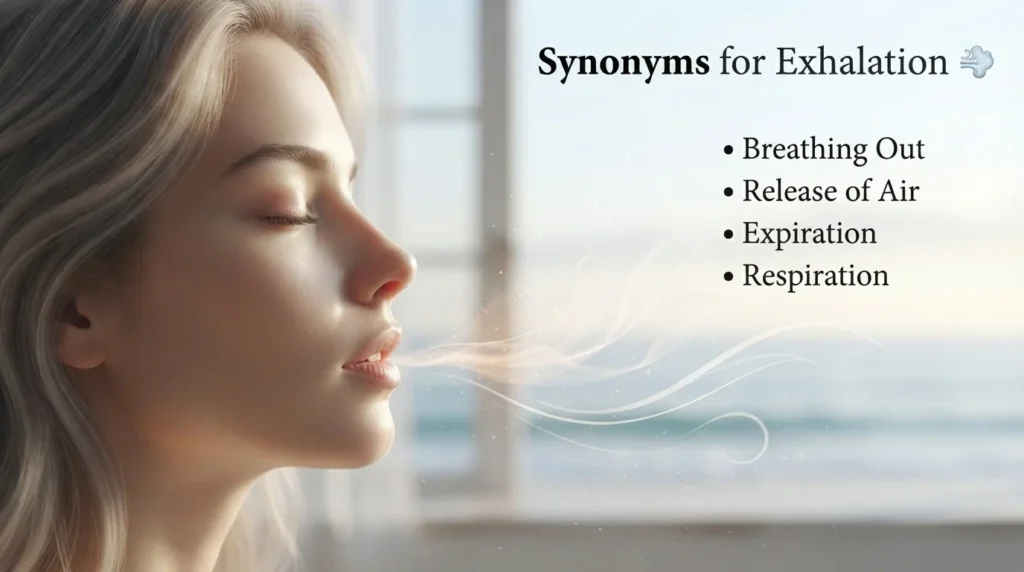
synonym for exhalation lets you describe breathing, steam, or moments of profound relief with clarity. Imagine sitting down after a long day and letting out a deep breath of calm air.
A tired marathon runner releases a soft sigh of relief upon crossing the finish line. Learning exact descriptive words helps your writing express these natural human moments with vivid detail.
Exploring related vocabulary enriches your communication and sharpens your storytelling skills across every format. It enables bloggers, essayists, and creative writers to avoid repeating basic terms continuously.
Using a synonym for exhalation brings authenticity to medical descriptions, poetic stories, and daily talk. Mastering descriptive words expands your expressive capacity and builds language mastery over time.
What Does “Exhalation” Really Mean?
Exhalation refers to the physical act of breathing air or vapor out from the lungs or an enclosed space. Native English speakers understand it as a release of breath, gas, or emotional tension. The emotional tone can feel peaceful, exhausted, or purely scientific.
You will encounter this term in biology classes, health articles, and romantic or dramatic literature. It acts primarily as a noun in English grammar. Simply defined, it means the act of breathing out or emitting air.
Connotative Meaning
Connotation is the emotional feeling or idea associated with a word beyond its strict definition.
- Positive tone: Deep relief, relaxation, mindfulness, and soothing peace.
- Negative tone: Exhaustion, defeat, frustration, or toxic fumes.
- Neutral tone: Biological breathing, steam emissions, or physical vapor.
Etymology
The word comes from the Latin verb exhalare, which combines ex- (out) and halare (to breathe).
- Old English (450–1100): Absent; Anglo-Saxons used native terms like æthm or æðem for breath.
- Middle English (1100–1500): Borrowed late from Old French exhalacion to describe vapors or steam.
- Modern English (1500–Present): Adopted broadly for biological breathing, medical science, and literary metaphor.
Pronunciation (US & UK – IPA)
- US: /ˌek.səˈleɪ.ʃən/
- UK: /ˌeks.həˈleɪ.ʃən/
Syllables
ex-ha-la-tion
Affixation Pattern
- Root: hale (meaning to breathe)
- Prefix: ex- (meaning out or away)
- Suffix: -ation (noun-forming suffix indicating process or act)
Synonyms List
Expiration (Noun) — US: /ˌek.spəˈreɪ.ʃən/ | UK: /ˌek.spɪˈreɪ.ʃən/
Meaning: The physical process of breathing air out of the lungs.
Tone/Register: Medical / Academic
Example 1: Doctors measured the volume of air during forced expiration.
Example 2: Normal expiration occurs automatically without active conscious effort.
Breath out (Noun/Verb phrase) — US: /breθ aʊt/ | UK: /breθ aʊt/
Meaning: The simple action of expelling air from the mouth or nose.
Tone/Register: Informal / Conversational
Example 1: Take a slow breath out through your mouth during meditation.
Example 2: Her warm breath out formed a soft mist in the cold night.
Sigh (Noun) — US: /saɪ/ | UK: /saɪ/
Meaning: A long, audible exhalation expressing sadness, relief, or exhaustion.
Tone/Register: Emotional / General
Example 1: He released a quiet sigh of relief when the exam ended.
Example 2: She let out a weary sigh after carrying heavy groceries home.
Gasp (Noun) — US: /ɡæsp/ | UK: /ɡɑːsp/
Meaning: A sudden, sharp intake or release of breath from shock or pain.
Tone/Register: Dramatic / Conversational
Example 1: A dramatic gasp echoed through the crowded theater during the surprise reveal.
Example 2: He let out a ragged gasp after running up three flights of stairs.
Puff (Noun) — US: /pʌf/ | UK: /pʌf/
Meaning: A short, quick release of air, smoke, or vapor.
Tone/Register: Informal / Visual
Example 1: A light puff of steam escaped from the hot kettle spout.
Example 2: The dragon breathed a gentle puff of smoke in the cartoon story.
Gust (Noun) — US: /ɡʌst/ | UK: /ɡʌst/
Meaning: A sudden, strong rush or burst of air from a source.
Tone/Register: General / Descriptive
Example 1: A warm gust of air blew out from the building doorway.
Example 2: Her quick exhalation felt like a miniature gust against the cold windowpane.
Outbreath (Noun) — US: /ˈaʊt.breθ/ | UK: /ˈaʊt.breθ/
Meaning: The specific act or moment of expelling breath from the body.
Tone/Register: Health / Mindfulness
Example 1: Focus entirely on your outbreath during the evening yoga session.
Example 2: Every long outbreath helped lower his steady heart rate.
Emission (Noun) — US: /iˈmɪʃ.ən/ | UK: /iˈmɪʃ.ən/
Meaning: The act of sending out gas, radiation, or vapor into the air.
Tone/Register: Scientific / Formal
Example 1: The factory reduced carbon gas emissions to protect the surrounding air.
Example 2: Volcanic emission of sulfur gases increased over the summer.
Discharge (Noun) — US: /ˈdɪs.tʃɑːrdʒ/ | UK: /ˈdɪs.tʃɑːdʒ/
Meaning: The release or expulsion of trapped air, liquid, or gas.
Tone/Register: Technical / Medical
Example 1: Engineers monitored the sudden discharge of pressurized steam.
Example 2: A quick discharge of trapped gas opened the safety valve.
Vapor (Noun) — US: /ˈveɪ.pɚ/ | UK: /ˈveɪ.pər/

Meaning: Moisture or gas suspended in the air expelled from a breathing source.
Tone/Register: Descriptive / Scientific
Example 1: Cold winter air turns your warm exhalation into visible vapor.
Example 2: Hot geothermal vents release water vapor high into the sky.
Fume (Noun) — US: /fjuːm/ | UK: /fjuːm/
Meaning: Gas, smoke, or vapor released from a chemical or burning source.
Tone/Register: Industrial / Negative
Example 1: Heavy exhaust fumes filled the busy underground parking garage.
Example 2: A dark plume of smoke drifted away from the burning wood.
Exhaustion (Noun) — US: /ɪɡˈzɑː.stʃən/ | UK: /ɪɡˈzɔː.stʃən/
Meaning: The physical releasing of air or gas from an engine or system.
Tone/Register: Technical / Formal
Example 1: System testing measures total gas exhaustion from the internal pump.
Example 2: Exhaustion of stagnant air improves indoor room circulation.
Expulsion (Noun) — US: /ɪkˈspʌl.ʃən/ | UK: /ɪkˈspʌl.ʃən/
Meaning: The forceful squeezing out or pushing out of air or gas.
Tone/Register: Scientific / Formal
Example 1: Rapid expulsion of air causes the sound during a sneeze.
Example 2: The balloon flew away due to the sudden expulsion of air.
Effluence (Noun) — US: /ˈef.lu.əns/ | UK: /ˈef.lu.əns/
Meaning: A flowing out or outflow of gas, air, or liquid stream.
Tone/Register: Academic / Literary
Example 1: Clean air washed away the gaseous effluence from the factory chimney.
Example 2: A gentle effluence of warm breeze lifted the thin curtains.
Outflow (Noun) — US: /ˈaʊt.floʊ/ | UK: /ˈaʊt.fləʊ/
Meaning: The movement of air, gas, or fluid pouring out of a space.
Tone/Register: Technical / Neutral
Example 1: The atmospheric outflow swept smoke away from city streets.
Example 2: Ventilation fans maintain a steady outflow of stale indoor air.
Ejection (Noun) — US: /ɪˈdʒek.ʃən/ | UK: /ɪˈdʒek.ʃən/
Meaning: The sudden or violent forcing out of air or material.
Tone/Register: Mechanical / Formal
Example 1: The rapid ejection of air propelled the small rocket model upward.
Example 2: Automatic valves control the ejection of excess steam pressure.
Blow (Noun) — US: /bloʊ/ | UK: /bləʊ/
Meaning: An act of expelling air forcefully through the mouth or nose.
Tone/Register: Daily / Informal
Example 1: Give a hard blow to the birthday candles to put them out.
Example 2: A quick blow into the paper bag inflated it fully.
Venting (Noun) — US: /ˈvent.ɪŋ/ | UK: /ˈvent.ɪŋ/
Meaning: The release of gas or air through a narrow opening or pipe.
Tone/Register: Industrial / Technical
Example 1: Proper roof venting prevents moisture buildup inside cold attics.
Example 2: The safety technician managed the manual venting of gas tanks.
Breath (Noun) — US: /breθ/ | UK: /breθ/
Meaning: The air taken into or expelled from the lungs during respiration.
Tone/Register: General / Daily
Example 1: He took a deep breath before stepping onto the public stage.
Example 2: Her warm breath fogged up the glass window on the bus.
Respiration (Noun) — US: /ˌres.pəˈreɪ.ʃən/ | UK: /ˌres.pɪˈreɪ.ʃən/
Meaning: The entire biological process of inhaling and exhaling air.
Tone/Register: Medical / Academic
Example 1: Healthy lung respiration supplies vital oxygen to the whole body.
Example 2: The doctor checked the sleeping patient’s regular respiration rate.
Hiss (Noun) — US: /hɪs/ | UK: /hɪs/
Meaning: A sharp, sibilant sound produced by escaping air or steam.
Tone/Register: Auditory / Descriptive
Example 1: A loud hiss marked the sudden release of air from the bus brakes.
Example 2: Steam released with a sharp hiss from the pressing iron.
Whiff (Noun) — US: /wɪf/ | UK: /wɪf/
Meaning: A brief, light gust or puff of air or odor carrying air.
Tone/Register: Informal / Sensory
Example 1: A fresh whiff of ocean air blew through the open window.
Example 2: Catching a sweet whiff of fresh bread made him feel hungry.
Pant (Noun) — US: /pænt/ | UK: /pænt/
Meaning: A short, quick, heavy breath released after physical exertion.
Tone/Register: Physical / Descriptive
Example 1: Heavy pants escaped the tired dog after chasing the ball.
Example 2: She paused her run to catch her breath between raspy pants.
Wheeze (Noun) — US: /wiːz/ | UK: /wiːz/
Meaning: A whistling sound produced while breathing out through tight airways.
Tone/Register: Medical / Descriptive
Example 1: The allergy caused a dry wheeze every time he breathed out.
Example 2: Doctors listened closely to the child’s faint bronchial wheeze.
Snort (Noun) — US: /snɔːrt/ | UK: /snɔːt/
Meaning: An explosive release of air forced through the nose loudly.
Tone/Register: Expressive / Informal
Example 1: The stallion let out a loud snort in the grassy field.
Example 2: He covered his face to hide an unexpected snort of laughter.
Huff (Noun) — US: /hʌf/ | UK: /hʌf/

Meaning: An angry or tired blow of breath showing annoyance.
Tone/Register: Emotional / Conversational
Example 1: She walked away with an annoyed huff when plans changed.
Example 2: He sat down in his chair with a noisy huff.
Exhalement (Noun) — US: /ekˈskeɪl.mənt/ | UK: /eksˈheɪl.mənt/
Meaning: The physical product or act of exhaling moisture or breath.
Tone/Register: Archaic / Literary
Example 1: Morning sunlight illuminated the damp exhalement of the valley forest.
Example 2: Poetic lines described the ghostly exhalation of winter ocean air.
Evaporation (Noun) — US: /ɪˌvæp.əˈreɪ.ʃən/ | UK: /ɪˌvæp.əˈreɪ.ʃən/
Meaning: The process of turning liquid moisture into vapor or gas.
Tone/Register: Scientific / Academic
Example 1: Rapid evaporation from hot soil cooled the greenhouse temperature down.
Example 2: Sun heat speeds up the evaporation of water on streets.
Egress (Noun) — US: /ˈiː.ɡres/ | UK: /ˈiː.ɡres/
Meaning: The physical action of coming out or exiting a confined space.
Tone/Register: Formal / Legal
Example 1: Emergency vents ensure safe egress of dangerous gas from rooms.
Example 2: High pressure provided rapid egress for air through the pipe.
Dispersal (Noun) — US: /dɪˈspɝː.səl/ | UK: /dɪˈspɜː.səl/
Meaning: The spreading or scattering of air or vapor in different directions.
Tone/Register: Scientific / Technical
Example 1: Wind sped up the dispersal of smoke across open fields.
Example 2: Fans helped the quick dispersal of steam inside the bathroom.
Stream (Noun) — US: /striːm/ | UK: /striːm/
Meaning: A continuous flow of air, gas, or vapor moving outward.
Tone/Register: General / Visual
Example 1: A thin stream of breath rose into the frozen air.
Example 2: Warm air streams out from the furnace vent steadily.
Jet (Noun) — US: /dʒet/ | UK: /dʒet/
Meaning: A rapid, strong stream of air or gas forced from a small hole.
Tone/Register: Technical / Dynamic
Example 1: A sharp jet of compressed air blew dust off the keyboard.
Example 2: Steam issued in a powerful jet from the pressure boiler.
Plume (Noun) — US: /pluːm/ | UK: /pluːm/
Meaning: A tall, feather-like column of vapor or gas rising outward.
Tone/Register: Literary / Visual
Example 1: A thick plume of white steam rose above the industrial factory.
Example 2: The volcano created a massive plume of ash in the sky.
Exudation (Noun) — US: /ˌek.sjʊˈdeɪ.ʃən/ | UK: /ˌek.sjuːˈdeɪ.ʃən/
Meaning: The slow oozing or release of moisture or vapor outward.
Tone/Register: Academic / Botanical
Example 1: The damp plant leaves produced a steady exudation of moisture.
Example 2: Morning heat caused exudation of fragrant pine resin.
Transpiration (Noun) — US: /ˌtræn.spəˈreɪ.ʃən/ | UK: /ˌtræn.spɪˈreɪ.ʃən/
Meaning: The release of water vapor through plant leaves into the air.
Tone/Register: Biological / Academic
Example 1: Plant transpiration releases humidity directly into the surrounding forest atmosphere.
Example 2: High summer temperatures increase leaf transpiration in garden plants.
Gas release (Noun) — US: /ɡæs rɪˈliːs/ | UK: /ɡæs rɪˈliːs/
Meaning: The freeing of trapped air or gaseous compounds into the environment.
Tone/Register: Technical / Direct
Example 1: Safety alarms detected an accidental gas release inside the laboratory.
Example 2: Regular gas release prevents pressure buildup in ocean pipes.
Extravasation (Noun) — US: /ɪkˌstræv.əˈseɪ.ʃən/ | UK: /ɪkˌstræv.əˈseɪ.ʃən/
Meaning: The forced escape of fluid or gas from specialized inner vessels.
Tone/Register: Medical / Rare
Example 1: Medical scans showed fluid extravasation around damaged lung tissue.
Example 2: Geologists studied gas extravasation through deep rock fissures.
Airflow (Noun) — US: /ˈer.floʊ/ | UK: /ˈeə.fləʊ/
Meaning: The movement of air outward or through a specific space.
Tone/Register: Technical / General
Example 1: Proper fan placement creates strong outward airflow in the hall.
Example 2: Gentle airflow from the vent kept the room comfortable all day.
Blowout (Noun) — US: /ˈbloʊ.aʊt/ | UK: /ˈbləʊ.aʊt/
Meaning: A sudden, violent escape or release of air or gas under pressure.
Tone/Register: Informal / Technical
Example 1: A tire blowout released trapped air with a loud bang.
Example 2: Engineers repaired the pipe to prevent another gas blowout.
Purge (Noun) — US: /pɝːdʒ/ | UK: /pɜːdʒ/
Meaning: The complete clearing or emptying of air or gas from a line.
Tone/Register: Industrial / Technical
Example 1: Perform a system purge to clean old gas out of pipes.
Example 2: Air purge cycle runs before starting the heating furnace.
Sneeze (Noun) — US: /sniːz/ | UK: /sniːz/
Meaning: An involuntary, convulsive exhalation of air through the nose and mouth.
Tone/Register: Daily / Physical
Example 1: Dust in the attic triggered a sudden, loud sneeze.
Example 2: She covered her face with a tissue during her sneeze.
Cough (Noun) — US: /kɑːf/ | UK: /kɒf/
Meaning: A sudden, noisy expulsion of air from the lungs to clear the throat.
Tone/Register: Medical / General
Example 1: A dry cough cleared the dust trapped in his throat.
Example 2: The doctor asked him to give a short cough during the checkup.
Chuff (Noun) — US: /tʃʌf/ | UK: /tʃʌf/
Meaning: A sharp, noisy puff of breath or steam from an engine or animal.
Tone/Register: Onomatopoeic / Literary
Example 1: The steam locomotive started moving with a heavy chuff.
Example 2: The tiger released a friendly chuff to greet its trainer.
Flatus (Noun) — US: /ˈfleɪ.t̬əs/ | UK: /ˈfleɪ.təs/
Meaning: Gas generated in the stomach or intestines released outward.
Tone/Register: Medical / Formal
Example 1: Medical charts documented severe abdominal pain caused by flatus.
Example 2: Dietary adjustments helped reduce uncomfortable intestinal flatus in patients.
Sough (Noun) — US: /saʊ/ | UK: /sʌf/
Meaning: A soft, moaning, or sighing sound made by blowing wind or air.
Tone/Register: Poetic / Literary
Example 1: A gentle sough of wind passed through mountain pine trees.
Example 2: She listened to the soothing sough of winter breezes outside.
Synonyms for Exhalation by Tone
- Positive: Outbreath, sigh, puff, sough, whiff.
- Neutral: Respiration, breath, vapor, airflow, stream, plume.
- Negative: Fume, wheeze, blowout, pant, flatus.
- Playful/Informal: Huff, blow, snort, chuff, gasp.
Selecting the right tone prevents odd phrasing in writing. Using “fume” to describe a relaxed breath sounds unpleasant, whereas “outbreath” fits smoothly.
Exhalation vs Close Alternatives
| Feature | Exhalation | Expiration | Sigh |
| Meaning Difference | Broad term for breathing out or vapor release | Scientific or medical term for expelling lung air | Audible breath out showing emotion or tiredness |
| Tone Difference | Descriptive, natural, and clear | Clinical, formal, and academic | Emotional, personal, and expressive |
| When to Use | Biology, winter vapor, daily respiration | Medical reports, respiratory physiology | Stories, emotional scenes, relaxing moments |
How Exhalation Changes by Context
In daily conversation, people use exhalation to talk about breathing exercises or cold winter vapor. You might say your exhalation turned to fog in the cold morning.
In writing or blogging, the word describes emotional relief, a peaceful atmosphere, or natural steam. Authors use it to set a relaxing or dramatic tone in scenes.
In a professional or academic tone, scientists use exhalation when studying human respiration rates, lung function testing, or gaseous chemical emissions.
In creative or informal use, writers use it metaphorically to describe wind passing through trees or steam rising from hot teacups.
Common Mistakes Learners Make
- Confusing Exhalation and Inhalation: Exhalation means breathing outward, while inhalation means breathing inward.
- Confusing Expiration with Expiry: While expiration means breathing out in medicine, in business it means an end date for contracts or food items.
- Overusing Fume: Do not use fume for clean breath. Fume specifically implies toxic, unpleasant, or chemical smoke.
To polish your essay writing skills, review our master list of academic vocabulary registers to refine your tone.
Real-Life Mini Scenarios

- Workplace: After finishing the massive project pitch, the presenter let out a soft exhalation of relief.
- Social Situations: Yoga instructors guided class members to sync each movement with a long, steady exhalation.
- Media / Pop Culture: Movie directors used close-up shots of frozen exhalation to emphasize severe Arctic weather conditions.
- Storytelling: The sleeping dragon released a warm exhalation that gently rustled dry leaves across the cave floor.
Conclusion
Learning various synonyms for biological process words expands your descriptive toolkit immensely. Selecting precise words enables you to capture physical actions and emotional moods effortlessly.
Practicing these descriptive options improves your creative writing, health blogging, and academic communication skills. Your essays and speeches will sound far more natural and engaging.
Pick three words from this guide and try using them in your journal entries or emails today!
Interactive Practice Quiz
- Which synonym best describes an audible breath showing relief or exhaustion?
A) Flatus
B) Sigh
C) Egress
D) Purge - What is the medical term for breathing air out of the lungs?
A) Expiration
B) Huff
C) Whiff
D) Snort - Which term carries a negative or toxic emotional tone?
A) Outbreath
B) Fume
C) Plume
D) Vapor - What happens to plant water moisture during leaf respiration?
A) Transpiration
B) Blowout
C) Gasp
D) Wheeze - What is the key difference between exhalation and inhalation?
A) Exhalation is breathing out; inhalation is breathing in
B) Exhalation is fast; inhalation is slow
C) Exhalation is silent; inhalation is loud
D) They are identical - Which word describes a quick puff of air forced through the nose?
A) Snort
B) Purge
C) Dispersal
D) Effluence - What is a poetic term for the sound of blowing wind?
A) Sough
B) Flatus
C) Egress
D) Purge - Yoga teachers often tell students to focus on their:
A) Outbreath
B) Blowout
C) Fume
D) Extravasation - Which word fits cold winter breath turning to visible mist?
A) Vapor
B) Purge
C) Flatus
D) Egress - What is the Latin root meaning of halare in exhalation?
A) To move
B) To breathe
C) To heat
D) To clear
Application Task: Write one short sentence using the synonym “sigh” to describe a relaxing moment after work.
Answer Key: 1-B, 2-A, 3-B, 4-A, 5-A, 6-A, 7-A, 8-A, 9-A, 10-B
FAQs
What is the most common synonym for exhalation in daily life?
The most common everyday synonyms for exhalation are “outbreath,” “breath out,” “sigh,” and “puff.” These words describe breathing actions simply without sounding clinical or technical.
How do I use exhalation in a sentence about mindfulness?
You can say: “Focus on making every exhalation slower and deeper than your inhalation to calm your nervous system.”
Is expiration always used for breathing out?
In medical and biological contexts, expiration means breathing out. However, in general English, expiration often refers to the ending date of a card, contract, or food product.
What is a poetic synonym for exhalation?
Poetic synonyms include “exhalement,” “sough,” “plume,” and “whisper of air.” These words create vivid sensory images in creative writing and poetry.
What is the difference between puff and gust?
A puff is a small, light, quick release of air or smoke. A gust implies a stronger, sudden rush of air moving forcefully across a space.

Sophia Carter is the founder and lead writer at SynonymVerse.com, a trusted online resource dedicated to English vocabulary and effective communication. She is passionate about helping students, writers, professionals, and lifelong learners find the most accurate words to express their ideas with clarity and confidence.
At SynonymVerse.com, every article is carefully researched and thoughtfully written to provide reliable guidance on synonyms, word meanings, and vocabulary. With a strong focus on accuracy, real-world usage, and easy-to-understand explanations, the website is committed to helping readers strengthen their language skills, enrich their vocabulary, and become more confident communicators.