Synonyms for generative terms can help you express ideas about creation and growth with accuracy. Imagine trying to describe an innovative idea that keeps spawning new possibilities, but you lack the right vocabulary. Finding the perfect synonym for generative solves that problem instantly.
For example, a teacher might describe a student’s mind as a place of endless creation. We often use this word when discussing art, nature, and modern technology. Learning a synonym for generative will keep your language vibrant and modern.
A rich vocabulary helps you write better essays, technical reports, and daily emails. Students, bloggers, content writers, and professionals can all benefit from using specialized terms. Replacing repeated words with exact alternatives makes your communication far more powerful.
What Does “Generative” Really Mean?
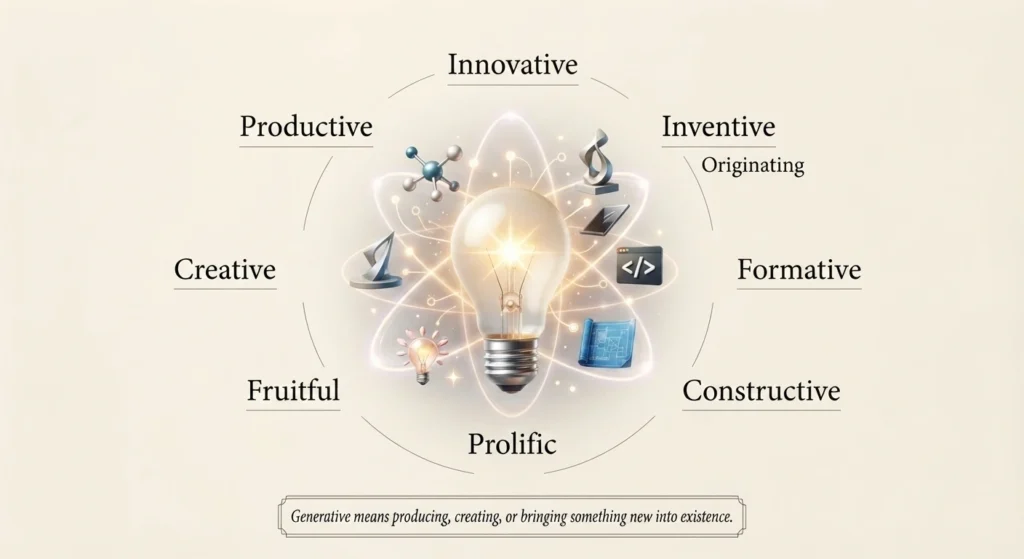
Generative describes something that has the power, capability, or function of producing, creating, or originating something new. Native speakers use it to describe processes, ideas, or systems that produce ongoing output rather than remaining passive. It carries an active, constructive, and forward-thinking emotional tone in professional and daily contexts.
- Part of Speech: Adjective
- Definition: Having the power or function of originating, producing, or creating something new.
Connotative Meaning
Connotation is the cultural or emotional association that a word carries beyond its explicit dictionary definition.
- Positive Tone: Connotes productivity, invention, growth, creativity, and abundant potential.
- Negative Tone: Can rarely imply unchecked growth or chaotic, uncontrolled output if used in a critical context.
- Neutral Tone: Refers strictly to biological reproduction or automated technical processes.
Etymology and History
The word originates from the Latin generativus, derived from generare, meaning to beget, produce, or bring forth. It passed into Middle French before being adopted into English.
- Old English (450–1100): Concept expressed through native Germanic roots like cennan (to produce) or wyrcan (to work/create).
- Middle English (1100–1500): Borrowed from French to describe natural reproductive capability and growth.
- Modern English (1500–Present): Expanded from biology into linguistics, systems theory, and advanced digital intelligence.
Pronunciation and Structure
- US Pronunciation: /ˈdʒɛnəreɪtɪv/
- UK Pronunciation: /ˈdʒɛnərətɪv/
- Syllables: gen-er-a-tive (4 syllables)
- Affixation Pattern: Root with suffix.
- Root: Generate (from Latin generatus)
- Prefix: None
- Suffix: -ive
Synonyms List
Productive (Adjective) — US /prəˈdʌktɪv/ | UK /prəˈdʌktɪv/
Meaning: Yielding or producing results, benefits, or large amounts of output.
Tone/Register: Neutral / Everyday
Example: We had a very productive brainstorming session this morning. Her morning routine keeps her feeling focused and productive.
Creative (Adjective) — US /kriˈeɪtɪv/ | UK /kriːˈeɪtɪv/
Meaning: Having the ability or power to make or imagine new original ideas.
Tone/Register: General / Positive
Example: The design team proposed several creative solutions to the problem. She enjoys spending her free time doing creative writing.
Inventive (Adjective) — US /ɪnˈvɛntɪv/ | UK /ɪnˈvɛntɪv/
Meaning: Showing creativity and the ability to design or build original things.
Tone/Register: Positive / Professional
Example: The chef is known for his inventive approach to traditional recipes. An inventive engineer solved the structural issue within hours.
Prolific (Adjective) — US /prəˈlɪfɪk/ | UK /prəˈlɪfɪk/
Meaning: Producing a large quantity of work, fruit, or original results.
Tone/Register: Formal / Academic
Example: The author was remarkably prolific, writing two books every year. This apple tree is known for being extremely prolific in the fall.
Fecund (Adjective) — US /ˈfiːkənd/ | UK /ˈfɛkənd/
Meaning: Producing or capable of producing an abundance of offspring or new growth.
Tone/Register: Formal / Literary
Example: The river valley has exceptionally fecund soil for agriculture. Her fecund imagination inspired a whole series of fantasy novels.
Fertile (Adjective) — US /ˈfɜːrtəl/ | UK /ˈfɜːtaɪl/
Meaning: Producing or capable of producing abundant vegetation, crops, or ideas.
Tone/Register: Neutral / Educational
Example: The region is famous for its fertile land and vineyards. Curiosity provides a fertile ground for intellectual discovery.
Constructive (Adjective) — US /kənˈstrʌktɪv/ | UK /kənˈstrʌktɪv/
Meaning: Serving a useful purpose or helping to build and create something positive.
Tone/Register: Professional / Business
Example: She offered constructive feedback during the peer review process. The two teams engaged in a constructive dialogue about the budget.
Innovative (Adjective) — US /ˈɪnəveɪtɪv/ | UK /ˈɪnəvətɪv/
Meaning: Featuring new methods, advanced ideas, or original thinking.
Tone/Register: Business / Modern
Example: The startup introduced an innovative method for recycling water. Her innovative leadership transformed the entire department.
Originative (Adjective) — US /əˈrɪdʒəneɪtɪv/ | UK /əˈrɪdʒɪnətɪv/
Meaning: Having the capacity or quality to bring new things into existence.
Tone/Register: Formal / Analytical
Example: Human thought possesses an originative power that machines mimic. His originative vision led to the founding of a new artistic movement.
Formative (Adjective) — US /ˈfɔːrmətɪv/ | UK /ˈfɔːmətɪv/
Meaning: Serving to form, shape, or develop something over time.
Tone/Register: Academic / Educational
Example: Her early childhood years were a highly formative period. The teacher played a formative role in shaping his career choice.
Reproductive (Adjective) — US /ˌriːprəˈdʌktɪv/ | UK /ˌriːprəˈdʌktɪv/
Meaning: Relating to the natural process of producing offspring or copies.
Tone/Register: Scientific / Technical
Example: Biologists studied the reproductive habits of the sea turtles. Cellular division is a fundamental reproductive process in nature.
Procreative (Adjective) — US /ˈproʊkrieɪtɪv/ | UK /ˈprəʊkrieɪtɪv/
Meaning: Relating to or capable of reproducing life or offspring.
Tone/Register: Formal / Biological
Example: The study examined the procreative cycles of migratory birds. Springtime marks a season of procreative activity in the wild.
Fruitful (Adjective) — US /ˈfruːtfəl/ | UK /ˈfruːtfʊl/
Meaning: Producing good or helpful results; highly profitable or productive.
Tone/Register: Warm / Professional
Example: Our partnership with the research firm proved to be very fruitful. They had a fruitful discussion regarding next year’s strategy.
Propagation-focused (Adjective) — US /ˌprɑːpəˈɡeɪʃən ˈfoʊkəst/ | UK /ˌprɒpəˈɡeɪʃən ˈfəʊkəst/
Meaning: Designed to spread, reproduce, or extend information or life forms.
Tone/Register: Technical / Specialized
Example: The greenhouse uses propagation-focused methods to grow rare plants. The software relies on a propagation-focused network model.
Yielding (Adjective) — US /ˈjiːldɪŋ/ | UK /ˈjiːldɪŋ/
Meaning: Giving a product, crop, or specified result upon effort.
Tone/Register: Neutral / Agricultural
Example: The high-yielding crops helped farmers withstand the summer drought. Investments in green energy are yielding positive returns.
Germinal (Adjective) — US /ˈdʒɜːrmɪnəl/ | UK /ˈdʒɜːmɪnəl/
Meaning: In the earliest stage of development with potential to grow.
Tone/Register: Academic / Literary
Example: He shared a few germinal ideas during the initial project kickoff. The manuscript was still in its germinal phase when reviewed.
Instigative (Adjective) — US /ˈɪnstɪɡeɪtɪv/ | UK /ˈɪnstɪɡətɪv/
Meaning: Tending to provoke, prompt, or initiate action or production.
Tone/Register: Formal / Analytical
Example: Her comments acted as an instigating force for company-wide reform. The new policy had an instigative effect on market competition.
Stimulative (Adjective) — US /ˈstɪmjəleɪtɪv/ | UK /ˈstɪmjʊlətɪv/
Meaning: Encouraging or rousing interest, action, or output.
Tone/Register: Business / Economic
Example: The government introduced stimulative measures to boost the economy. A bright environment can have a stimulative effect on creative work.
Dynamic (Adjective) — US /daɪˈnæmɪk/ | UK /daɪˈnæmɪk/
Meaning: Characterized by constant change, activity, progress, or production.
Tone/Register: Positive / Professional
Example: The tech industry offers a dynamic environment for young developers. Her dynamic energy inspired everyone on the volunteer project.
Regenerative (Adjective) — US /riˈdʒɛnərətɪv/ | UK /riˈdʒɛnərətɪv/
Meaning: Tending to restore, renew, or produce new tissue or strength.
Tone/Register: Technical / Scientific
Example: Regenerative farming practices help restore natural soil health. Lizards have remarkable regenerative abilities to regrow lost tails.
Evolutionary (Adjective) — US /ˌɛvəˈluːʃənɛri/ | UK /ˌiːvəˈluːʃənəri/
Meaning: Relating to gradual development and progressive creation over time.
Tone/Register: Scientific / Academic
Example: The software undergoes evolutionary updates based on user feedback. Human speech is an evolutionary breakthrough in communication.
Propagation-ready (Adjective) — US /ˌprɑːpəˈɡeɪʃən ˈrɛdi/ | UK /ˌprɒpəˈɡeɪʃən ˈrɛdi/
Meaning: Prepared and suitable for generating new instances or spreading.
Tone/Register: Industrial / Technical
Example: These plant cuttings are propagation-ready for nursery planting. The updated data model is propagation-ready across server nodes.
Teeming (Adjective) — US /ˈtiːmɪŋ/ | UK /ˈtiːmɪŋ/
Meaning: Full of or swarming with life, activity, or continuous output.
Tone/Register: Descriptive / Expressive
Example: The coral reef was teeming with vibrant marine life. His brain was teeming with new project concepts.
Procreative-nature (Adjective) — US /ˈproʊkrieɪtɪv ˈneɪtʃər/ | UK /ˈprəʊkrieɪtɪv ˈneɪtʃə/
Meaning: Exhibiting an inherent drive or capacity to generate new output.
Tone/Register: Academic / Formal
Example: The procreative nature of natural ecosystems maintains balance. Art reflects the procreative nature of human culture.
Self-generating (Adjective) — US /ˌsɛlfˈdʒɛnəreɪtɪŋ/ | UK /ˌsɛlfˈdʒɛnəreɪtɪŋ/
Meaning: Able to produce or renew itself without external assistance.
Tone/Register: Technical / Systems
Example: Solar power systems offer a self-generating source of clean energy. The online community created a self-generating cycle of content.
Proactive (Adjective) — US /proʊˈæktɪv/ | UK /prəʊˈæktɪv/
Meaning: Creating or controlling a situation by causing things to happen.
Tone/Register: Corporate / Everyday
Example: Taking a proactive approach prevents major errors later on. She is a proactive problem solver who anticipates challenges.
Fount-like (Adjective) — US /ˈfaʊnt laɪk/ | UK /ˈfaʊnt laɪk/
Meaning: Acting as a continuous source or spring of ideas or output.
Tone/Register: Literary / Descriptive
Example: The senior director served as a fount-like source of industry knowledge. Her notebook was fount-like, overflowing with fresh sketches.
Abundant (Adjective) — US /əˈbʌndənt/ | UK /əˈbʌndənt/
Meaning: Existing or available in large, rich quantities; yielding plenty.
Tone/Register: Neutral / General
Example: The region enjoys abundant natural resources like timber and water. We received abundant support from the local community.
Prolific-grade (Adjective) — US /prəˈlɪfɪk ɡreɪd/ | UK /prəˈlɪfɪk ɡreɪd/
Meaning: Demonstrating a consistently high level of output capability.
Tone/Register: Specialized / Industry
Example: The farm installed prolific-grade irrigation to boost output. He maintains a prolific-grade publishing schedule on his blog.
Generative-type (Adjective) — US /ˈdʒɛnəreɪtɪv taɪp/ | UK /ˈdʒɛnərətɪv taɪp/
Meaning: Classifiable as something that creates or generates new content.
Tone/Register: Technical / Informational
Example: The team relies on generative-type tools for early drafting. This engine is a generative-type model designed for audio output.
Prototypical (Adjective) — US /ˌproʊtəˈtɪpɪkəl/ | UK /ˌprəʊtəˈtɪpɪkəl/
Meaning: Serving as an original model from which other things are formed.
Tone/Register: Formal / Technical
Example: They built a prototypical device to demonstrate the technology. This draft represents the prototypical design for future models.
Sprouting (Adjective) — US /ˈspraʊtɪŋ/ | UK /ˈspraʊtɪŋ/
Meaning: Beginning to grow, develop, or produce new elements rapidly.
Tone/Register: Casual / Descriptive
Example: Sprouting ideas began to fill the whiteboard during our meeting. Springtime brought sprouting greenery along the hillside paths.
Formational (Adjective) — US /fɔːrˈmeɪʃənəl/ | UK /fɔːˈmeɪʃənəl/
Meaning: Relating to the creation, shaping, or structural development of things.
Tone/Register: Academic / Scientific
Example: Geologists studied the formational history of the rock layers. The course covers the formative stages of modern democracies.
Progressive (Adjective) — US /prəˈɡrɛsɪv/ | UK /prəˈɡrɛsɪv/
Meaning: Developing continuously or in favor of new, forward-thinking ideas.
Tone/Register: Neutral / Social
Example: The firm adopts progressive methods to reduce workplace stress. Her progressive ideas reshaped the department’s future strategy.
Catalytic (Adjective) — US /ˌkætəˈlɪtɪk/ | UK /ˌkætəˈlɪtɪk/
Meaning: Precipitating or causing a rapid process of change or creation.
Tone/Register: Formal / Business
Example: The new investment played a catalytic role in company growth. Her speech had a catalytic impact on local environmental action.
Conceptive (Adjective) — US /kənˈsɛptɪv/ | UK /kənˈsɛptɪv/
Meaning: Capable of forming, originating, or imagining new concepts.
Tone/Register: Philosophical / Academic
Example: Human intellect has a conceptive capacity that guides innovation. The project is still in its conceptive phase of planning.
Multiplying (Adjective) — US /ˈmʌltɪplaɪɪŋ/ | UK /ˈmʌltɪplaɪɪŋ/
Meaning: Increasing rapidly in number, quantity, or generated output.
Tone/Register: Neutral / Everyday
Example: The startup experienced multiplying demand for its software. We observed multiplying signs of recovery in the local market.
Production-oriented (Adjective) — US /prəˈdʌkʃən ˈɔːriɛntəd/ | UK /prəˈdʌkʃən ˈɔːriɛntɪd/
Meaning: Focused primarily on yielding, manufacturing, or creating results.
Tone/Register: Corporate / Technical
Example: The factory adopted a production-oriented workflow to meet deadlines. She maintains a production-oriented mindset during project crunches.
Life-giving (Adjective) — US /ˈlaɪf ˌɡɪvɪŋ/ | UK /ˈlaɪf ˌɡɪvɪŋ/
Meaning: Providing the necessary vitality, force, or power to sustain growth.
Tone/Register: Warm / Expressive
Example: Rain brought life-giving relief to the parched farmland. Her encouraging words had a life-giving effect on the exhausted team.
Output-driven (Adjective) — US /ˈaʊtpʊt ˈdrɪvən/ | UK /ˈaʊtpʊt ˈdrɪvən/
Meaning: Motivated or defined by the generation of continuous results.
Tone/Register: Business / Analytical
Example: Our company maintains an output-driven strategy for software updates. The team’s output-driven focus ensured the project launched on time.
Synonyms for “Generative” by Tone
Tone determines how your writing is received by different audiences. Match your word choice to your specific writing goal.
Positive Tone
- Words: Creative, Innovative, Fruitful, Inventive, Constructive, Prolific
- Usage: Use these when praising original work, effective teamwork, or brilliant problem-solving.
Neutral Tone
- Words: Productive, Formative, Yielding, Self-generating, Formational
- Usage: Best for factual reporting, technical documentation, objective analysis, and academic writing.
Negative Tone
- Words: Uncontrolled (when describing unchecked output), Over-productive (in contexts of burnout)
- Usage: Use rarely when highlighting chaotic, overwhelming, or unrefined generation of items.
Playful & Informal Tone
- Words: Sprouting, Teeming, Fount-like
- Usage: Ideal for casual blog posts, creative storytelling, social media updates, and light conversations.
“Generative” vs Close Alternatives
| Word | Key Shade of Meaning | Best Context | Tone |
|---|---|---|---|
| Generative | Producing new content, life, or output continuously. | Technical, biological, systemic | Analytical / Modern |
| Creative | Using imagination to make original, artistic things. | Art, writing, problem-solving | Warm / Expressive |
| Productive | Completing tasks or yielding large quantities of work. | Business, daily work, study | Neutral / Practical |
- Generative vs. Creative: Generative focuses on the process of producing ongoing output or new forms. Creative emphasizes imagination, art, and original human thought.
- Generative vs. Productive: Generative implies creating new things from a system or process. Productive means getting tasks completed efficiently.
How “Generative” Changes by Context
Daily Conversation
In everyday speech, people replace generative with simpler terms like productive, creative, or active.
“We had a really productive afternoon planning our upcoming trip.”
Writing and Blogging
Bloggers often use words like innovative, fruitful, or sprouting to make their posts engaging.
“Brainstorming with a partner leads to fruitful ideas for your next post.”
Professional and Academic Tone
In formal and technical fields, scholars prefer formative, originative, systemic, or self-generating.
“The committee studied the formative stages of policy development.”
Creative Writing
Authors select rich descriptive alternatives like fecund, germinal, or teeming to evoke sensory imagery.
“Her mind was a germinal garden where dark stories began to grow.”
Common Mistakes & Native Usage
Misuse Scenarios
- Confusing Generative with Productive: Saying a worker is “generative” when they are simply fast can sound strange. Use productive for speed and task completion.
- Overusing Generative in Non-Tech Contexts: Calling a standard business meeting “generative” can sound like corporate jargon. Opt for fruitful or constructive.
Tone Conflicts
Avoid using scientific terms like procreative when writing light marketing copy or casual social posts.
Register Notes
In written English, native speakers use generative primarily when discussing systems, AI, biology, or linguistic theory. For general topics, alternatives like inventive or constructive sound more natural.
Real-Life Mini Scenarios
- Workplace: “Our team held a constructive workshop to map out the new product features.”
- Social Situations: “Planning the party together turned out to be a really fruitful experience for our group.”
- Media & Pop Culture: “Critics described the director’s new sci-fi film as an inventive visual triumph.”
- Storytelling: “The spring rains turned the dry valley into a fertile landscape overnight.”
Conclusion
Mastering a synonym for generative allows you to articulate ideas about creation, growth, and production with precision. Replacing repeated terms with options like innovative, prolific, or constructive elevates your style.
Using a diverse vocabulary improves your sentence structure and keeps your readers engaged across all platforms. Developing this skill enhances your confidence in academic, professional, and daily communication.
Try using two or three of these new alternatives in your next document, essay, or email. Consistent practice will naturally expand your command of the English language.
MCQs
1. Which word is a synonym for “generative”?
A) Creative
B) Destructive
C) Empty
D) Passive
2. What does “generative” mean?
A) Producing or creating something
B) Removing something
C) Stopping an activity
D) Hiding information
3. Which word can replace “generative”?
A) Productive
B) Useless
C) Limited
D) Silent
4. Which is closest in meaning to “generative”?
A) Innovative
B) Repetitive
C) Destructive
D) Inactive
5. A generative process mainly focuses on:
A) Creating something new
B) Destroying something
C) Avoiding work
D) Reducing activity
6. Which word is NOT a synonym for “generative”?
A) Creative
B) Productive
C) Inventive
D) Destructive
7. “Generative ideas” are ideas that:
A) Produce new possibilities
B) Prevent progress
C) Copy everything exactly
D) End a discussion
8. Which word best describes a generative person?
A) Inventive
B) Unproductive
C) Passive
D) Careless
9. “The software uses generative technology to create images.” Which word could replace “generative”?
A) Creative
B) Destructive
C) Restrictive
D) Inactive
10. Which is the best synonym for “generative”?
A) Productive
B) Empty
C) Harmful
D) Stagnant
Answer Key
- A
- A
- A
- A
- A
- D
- A
- A
- A
- A
Reflection Task
Write two sentences about a project or hobby you enjoy, using one technical synonym and one creative synonym from the list above.
FAQs
1. What is the most common synonym for generative in daily conversation?
The most common everyday synonyms for generative are creative, productive, or innovative. People use these words when talking about new ideas, successful work sessions, or inventive solutions in daily life.
2. Is generative only used when talking about artificial intelligence?
No, while the term gained massive popularity with generative AI, it is a classic English word. It has been used for centuries in biology, linguistics, mathematics, and philosophy to describe anything that produces new growth or output.
3. What is the difference between generative and creative?
Generative emphasizes the process or system of producing new output continuously (like a system or natural cycle). Creative highlights imagination, artistic vision, and original human expression.
4. Which synonym for generative works best in business reports?
In formal business reports, replace generative with terms like innovative, constructive, productive, catalytic, or value-adding. These terms convey professional progress without sounding overly technical.
5. How does prolific differ from generative?
Generative refers to the capability or mechanism of producing new things. Prolific specifically describes the high volume or abundance of results produced by an individual, artist, or system.

Sophia Carter is the founder and lead writer at SynonymVerse.com, a trusted online resource dedicated to English vocabulary and effective communication. She is passionate about helping students, writers, professionals, and lifelong learners find the most accurate words to express their ideas with clarity and confidence.
At SynonymVerse.com, every article is carefully researched and thoughtfully written to provide reliable guidance on synonyms, word meanings, and vocabulary. With a strong focus on accuracy, real-world usage, and easy-to-understand explanations, the website is committed to helping readers strengthen their language skills, enrich their vocabulary, and become more confident communicators.