A synonym for tenable is a word or phrase that describes something reasonable, defensible, acceptable, or capable of being maintained. Common alternatives include defensible, reasonable, sustainable, justifiable, viable, and plausible. The best choice depends on whether you are describing an argument, belief, position, plan, or situation.
Imagine presenting a new idea at work. Your manager asks whether the proposal can withstand criticism. Instead of saying it is tenable, you might call it defensible or reasonable.
Learning alternatives to tenable helps you express ideas with greater precision. Each synonym highlights a slightly different quality, making your writing clearer and more persuasive.
Whether you are a student writing an essay, a blogger explaining an argument, or a professional preparing a report, understanding tenable synonyms can strengthen your vocabulary and communication.
What Does “Tenable” Really Mean?
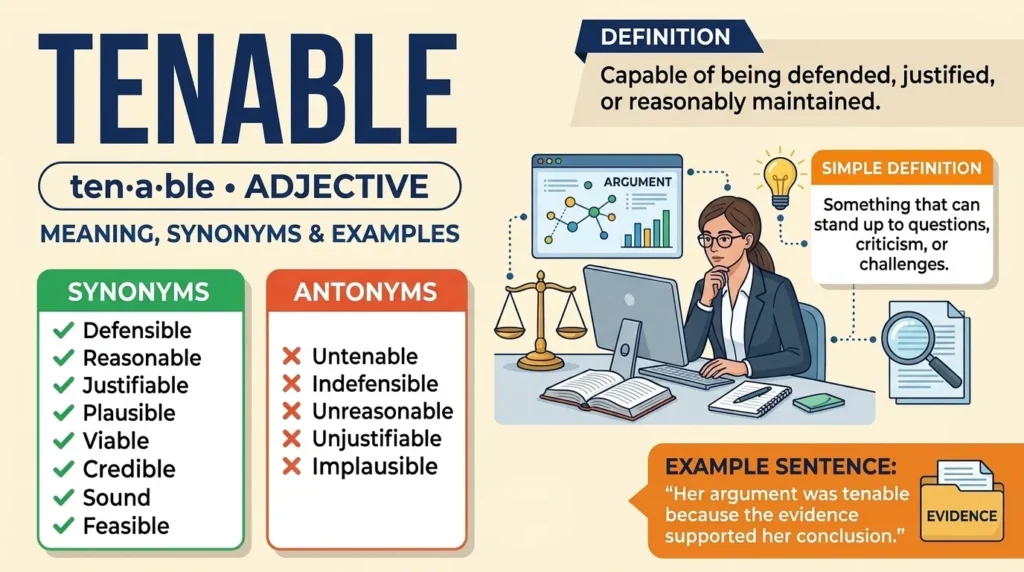
Tenable means capable of being defended, justified, maintained, or considered reasonable under particular circumstances.
In simple English, something is tenable when it can stand up to questions, criticism, or practical challenges without falling apart.
The word is an adjective. Native English speakers commonly use it when discussing arguments, opinions, theories, positions, explanations, and plans.
For example:
- Her explanation was tenable because the evidence supported it.
- The company needed a tenable strategy before entering the market.
Tenable often appears in formal, academic, legal, and professional communication. It suggests that an idea or position has enough support to remain credible.
Connotative Meaning
(Connotation is the emotional or implied meaning a word carries beyond its basic definition.)
Positive tone: Tenable can suggest that an argument is well-supported, sensible, or capable of surviving criticism.
Negative tone: It may imply that a position is only barely defensible or that its support is weak.
Neutral tone: It can simply describe whether an idea, explanation, or position can reasonably be maintained.
The word itself is generally neutral, but its surrounding context determines whether it sounds approving or critical.
Etymology of Tenable
The word tenable comes from the French tenable, meaning “that can be held.” It is connected to the Latin verb tenere, meaning “to hold.”
The word entered English through French and developed its modern meaning of something that can be held, maintained, or defended.
Historical Development
Old English (450–1100): The word tenable was not part of the Old English vocabulary. However, the related idea of holding or keeping was expressed through native words such as healdan, meaning “to hold” or “keep.”
Middle English (1100–1500): Following the Norman French influence, English adopted many French-derived terms. Tenable developed through French and Latin influences during this broader period of linguistic change.
Modern English (1500–Present): Tenable became established as a word describing arguments, positions, and situations that could be defended or maintained. Today, it is especially common in academic, legal, and professional writing.
Pronunciation
- US: /ˈtɛnəbəl/
- UK: /ˈtɛnəbəl/
Syllables
ten-a-ble — 3 syllables
Affixation Pattern of Tenable
- Root: ten (from Latin tenere, meaning “to hold”)
- Prefix: None
- Suffix: -able (indicates capability or suitability)
The suffix helps express the idea of something that can be held, maintained, or defended.
40 Synonyms for Tenable
The following alternatives share the core meaning of tenable but differ in strength, tone, and context. Choosing the right one makes your message more accurate.
1. Defensible (Adjective) — US / UK: /dɪˈfɛnsəbəl/
Meaning: Capable of being supported with reasons or evidence against criticism.
Tone/Register: Formal, academic, professional.
Example:
Her conclusion is defensible because the research supports it.
The lawyer presented a defensible interpretation of the contract.
2. Justifiable (Adjective) — US / UK: /ˈdʒʌstɪˌfaɪəbəl/
Meaning: Able to be shown as reasonable, necessary, or correct through explanation.
Tone/Register: Formal, business, academic.
Example:
The additional expense was justifiable given the project’s benefits.
His decision was justifiable under the circumstances.
3. Reasonable (Adjective) — US / UK: /ˈrizənəbəl/
Meaning: Fair, sensible, and supported by sound judgment.
Tone/Register: Neutral, conversational, professional.
Example:
Her request for more time was reasonable.
That seems like a reasonable explanation for the delay.
4. Sustainable (Adjective) — US / UK: /səˈsteɪnəbəl/
Meaning: Capable of continuing or being maintained over time without becoming impractical.
Tone/Register: Business, environmental, academic.
Example:
The company needs a sustainable growth strategy.
Working twelve hours every day is not a sustainable routine.
5. Viable (Adjective) — US / UK: /ˈvaɪəbəl/
Meaning: Capable of working successfully or producing the intended result.
Tone/Register: Business, technical, professional.
Example:
The team developed a viable solution to the problem.
We need to determine whether this plan is financially viable.
6. Plausible (Adjective) — US / UK: /ˈplɔzəbəl/
Meaning: Appearing believable or reasonable based on the available information.
Tone/Register: Neutral, academic, conversational.
Example:
Her explanation sounded plausible at first.
The researcher proposed a plausible theory about the results.
7. Credible (Adjective) — US / UK: /ˈkrɛdəbəl/
Meaning: Worth believing because it appears trustworthy or well-supported.
Tone/Register: Professional, academic, journalistic.
Example:
The witness provided a credible account of the incident.
Readers need credible sources when researching a topic.
8. Sound (Adjective) — US / UK: /saʊnd/
Meaning: Based on reliable reasoning, evidence, or judgment.
Tone/Register: Formal, academic, professional.
Example:
The committee approved a sound financial plan.
Her argument rests on sound scientific evidence.
9. Logical (Adjective) — US / UK: /ˈlɑdʒɪkəl/
Meaning: Following clear reasoning and making sense according to established principles.
Tone/Register: Neutral, academic, professional.
Example:
His conclusion was logical given the available facts.
That is a logical next step for the project.
10. Rational (Adjective) — US / UK: /ˈræʃənəl/
Meaning: Based on reason rather than emotion or unsupported assumptions.
Tone/Register: Formal, academic, professional.
Example:
The board made a rational decision after reviewing the evidence.
A rational response can prevent unnecessary conflict.
11. Valid (Adjective) — US / UK: /ˈvælɪd/
Meaning: Acceptable or well-founded according to relevant facts, rules, or reasoning.
Tone/Register: Academic, legal, professional.
Example:
Your concern is valid and deserves attention.
The researcher used a valid method to collect the data.
12. Soundly Founded (Adjective Phrase) — US / UK: /ˈsaʊndli ˈfaʊndɪd/
Meaning: Based on strong evidence, reliable principles, or a solid foundation.
Tone/Register: Formal, academic.
Example:
The proposal was soundly founded on customer research.
Her opinion is soundly founded on years of experience.
13. Well-Founded (Adjective) — US / UK: /ˌwɛl ˈfaʊndɪd/
Meaning: Supported by good reasons or reliable evidence.
Tone/Register: Formal, neutral, professional.
Example:
The residents had well-founded concerns about safety.
His criticism was well-founded and deserved a response.
14. Supportable (Adjective) — US / UK: /səˈpɔrtəbəl/
Meaning: Capable of being supported with facts, arguments, or evidence.
Tone/Register: Formal, academic, legal.
Example:
The claim is supportable with the available research.
We need a supportable explanation before publishing the report.
15. Maintainable (Adjective) — US / UK: /meɪnˈteɪnəbəl/
Meaning: Capable of being continued, preserved, or kept in a particular condition.
Tone/Register: Technical, business, professional.
Example:
The software uses a maintainable structure.
The team proposed a maintainable schedule for future work.
16. Practicable (Adjective) — US / UK: /ˈpræktɪkəbəl/
Meaning: Capable of being put into practice successfully.
Tone/Register: Formal, professional, technical.
Example:
The manager suggested a practicable way to reduce delays.
We need a practicable solution before the deadline.
17. Feasible (Adjective) — US / UK: /ˈfizəbəl/
Meaning: Possible to accomplish with available resources, time, and conditions.
Tone/Register: Business, academic, professional.
Example:
The team considered several feasible options.
A shorter deadline may not be feasible with our current staff.
18. Workable (Adjective) — US / UK: /ˈwɜrkəbəl/
Meaning: Practical enough to function or achieve a useful result.
Tone/Register: Neutral, conversational, business.
Example:
They finally agreed on a workable compromise.
The new schedule seems workable for everyone.
19. Tenable in Practice (Adjective Phrase) — US / UK: /ˈtɛnəbəl ɪn ˈpræktɪs/
Meaning: Capable of remaining effective or reasonable when applied to real situations.
Tone/Register: Formal, professional.
Example:
The policy looks good on paper but must be tenable in practice.
We need a tenable approach that works beyond the planning stage.
20. Defensible in Court (Adjective Phrase) — US / UK: /dɪˈfɛnsəbəl ɪn kɔrt/
Meaning: Capable of being supported through legal reasoning or evidence in court.
Tone/Register: Legal, formal.
Example:
The attorney reviewed whether the decision was defensible in court.
Every claim in the filing needed a defensible legal basis.
21. Persuasive (Adjective) — US / UK: /pərˈsweɪsɪv/
Meaning: Convincing enough to influence someone’s beliefs or decisions.
Tone/Register: Academic, professional, conversational.
Example:
She presented a persuasive argument for changing the policy.
The article offers a persuasive explanation of the issue.
22. Convincing (Adjective) — US / UK: /kənˈvɪnsɪŋ/
Meaning: Capable of making someone believe that a statement or argument is true.
Tone/Register: Neutral, conversational, professional.
Example:
His explanation was convincing and easy to understand.
The writer provided convincing evidence for the claim.
23. Believable (Adjective) — US / UK: /bɪˈlivəbəl/
Meaning: Easy to accept as true or realistic.
Tone/Register: Neutral, informal, creative.
Example:
The character’s motivation felt believable.
Her excuse was believable because it matched the facts.
24. Creditable (Adjective) — US / UK: /ˈkrɛdɪtəbəl/
Meaning: Deserving recognition or belief because of acceptable quality or performance.
Tone/Register: Formal, professional.
Example:
The report offered a creditable explanation of the results.
The team made a creditable effort to resolve the issue.
25. Acceptable (Adjective) — US / UK: /əkˈsɛptəbəl/
Meaning: Good enough to be approved or considered satisfactory.
Tone/Register: Neutral, business, conversational.
Example:
The revised proposal was acceptable to both departments.
We need an acceptable alternative before moving forward.
26. Permissible (Adjective) — US / UK: /pərˈmɪsəbəl/
Meaning: Allowed under a particular rule, law, or standard.
Tone/Register: Formal, legal, academic.
Example:
The requested change is permissible under company policy.
Only permissible methods should be used during the examination.
27. Legitimate (Adjective) — US / UK: /lɪˈdʒɪtəmət/
Meaning: Recognized as valid, lawful, or reasonable according to accepted standards.
Tone/Register: Formal, legal, professional.
Example:
The employee raised a legitimate concern about workplace safety.
The organization has a legitimate reason to review the policy.
28. Soundly Reasoned (Adjective Phrase) — US / UK: /ˈsaʊndli ˈrizənd/
Meaning: Developed through clear, careful, and reliable reasoning.
Tone/Register: Academic, formal.
Example:
The judge delivered a soundly reasoned decision.
Her essay contains a soundly reasoned conclusion.
29. Coherent (Adjective) — US / UK: /koʊˈhɪrənt/
Meaning: Clear, consistent, and logically connected.
Tone/Register: Academic, professional, neutral.
Example:
The student presented a coherent argument.
We need a coherent explanation of the proposed changes.
30. Consistent (Adjective) — US / UK: /kənˈsɪstənt/
Meaning: In agreement with established facts, principles, or other statements.
Tone/Register: Neutral, academic, professional.
Example:
Her account was consistent with the available evidence.
The new policy must remain consistent with existing regulations.
31. Reliable (Adjective) — US / UK: /rɪˈlaɪəbəl/
Meaning: Able to be trusted because it performs or provides information dependably.
Tone/Register: Neutral, professional, academic.
Example:
The researcher used reliable data to support the conclusion.
We need a reliable method for measuring progress.
32. Robust (Adjective) — US / UK: /roʊˈbʌst/
Meaning: Strong enough to withstand challenges, criticism, or changing conditions.
Tone/Register: Business, academic, technical.
Example:
The company developed a robust plan for unexpected risks.
Her argument remained robust during the debate.
33. Resilient (Adjective) — US / UK: /rɪˈzɪliənt/
Meaning: Able to recover or continue functioning despite difficulties.
Tone/Register: Professional, positive, conversational.
Example:
The community built a resilient response to future emergencies.
A resilient strategy can adapt to changing circumstances.
34. Stable (Adjective) — US / UK: /ˈsteɪbəl/
Meaning: Firm, steady, or unlikely to change unexpectedly.
Tone/Register: Neutral, professional.
Example:
The organization needs a stable financial foundation.
Their agreement created a stable working relationship.
35. Secure (Adjective) — US / UK: /sɪˈkjʊr/
Meaning: Firmly established or protected against threats and challenges.
Tone/Register: Neutral, professional, legal.
Example:
The company needs a secure basis for its investment decision.
The evidence gave her a secure position in the discussion.
36. Enduring (Adjective) — US / UK: /ɪnˈdʊrɪŋ/
Meaning: Able to last or remain effective over a long period.
Tone/Register: Formal, literary, positive.
Example:
The team created an enduring solution to the problem.
Their agreement established an enduring foundation for cooperation.
37. Tenable Under Scrutiny (Adjective Phrase) — US / UK: /ˈtɛnəbəl ˈʌndər ˈskrutəni/
Meaning: Able to withstand careful examination or questioning.
Tone/Register: Formal, academic, professional.
Example:
The research findings must be tenable under scrutiny.
Her argument remained tenable under scrutiny from the review panel.
38. Reasonably Grounded (Adjective Phrase) — US / UK: /ˈrizənəbli ˈɡraʊndɪd/
Meaning: Based on sensible assumptions or an adequate foundation of evidence.
Tone/Register: Neutral, academic, professional.
Example:
The recommendation was reasonably grounded in the available data.
His concerns were reasonably grounded in past experience.
39. Credible in Context (Adjective Phrase) — US / UK: /ˈkrɛdəbəl ɪn ˈkɑntɛkst/
Meaning: Believable or acceptable when considered alongside the surrounding facts.
Tone/Register: Academic, professional.
Example:
The explanation was credible in context.
A claim may seem unusual but remain credible in context.
40. Intellectually Defensible (Adjective Phrase) — US / UK: /ˌɪntəˈlɛktʃuəli dɪˈfɛnsəbəl/
Meaning: Capable of being supported through careful reasoning and intellectual examination.
Tone/Register: Academic, formal.
Example:
The philosopher offered an intellectually defensible position.
The essay presents an intellectually defensible interpretation of the text.
Synonyms for Tenable by Tone
The tone of a synonym affects how readers understand your message. A word that sounds appropriate in an academic essay may feel too formal in a casual conversation.
Positive Synonyms
These words emphasize strength, credibility, and sound reasoning.
- Defensible
- Justifiable
- Sound
- Well-founded
- Credible
- Persuasive
- Robust
- Reliable
- Intellectually defensible
Example: Her well-founded argument gave the committee confidence in the proposal.
Neutral Synonyms
These words describe whether something is reasonable, possible, or acceptable without adding strong emotional judgment.
- Reasonable
- Valid
- Logical
- Rational
- Feasible
- Viable
- Workable
- Acceptable
- Consistent
- Stable
Example: The team selected a workable solution that met its requirements.
Negative Synonyms
These expressions can describe a position that is weak, questionable, or only barely acceptable.
- Barely defensible
- Weakly supported
- Questionable
- Difficult to justify
- Unconvincing
- Hard to maintain
These are contextual alternatives rather than direct one-word synonyms. They are useful when discussing the opposite of a strong, tenable position.
Example: His explanation was difficult to justify after the new evidence emerged.
Playful or Informal Synonyms
These expressions work better in casual conversations than in formal reports.
- Makes sense
- Holds up
- Checks out
- Adds up
- Seems fair
Example: Your explanation checks out, so I understand why you made that choice.
Why Tone Matters
Choosing the right synonym helps you communicate the exact strength of your opinion.
For instance, plausible suggests that something seems believable, while defensible emphasizes the ability to support it against criticism.
Similarly, workable focuses on practical success, while justifiable focuses on whether a decision can be reasonably explained.
Tenable vs. Close Alternatives
Several synonyms for tenable appear similar but communicate different ideas.
Tenable vs. Defensible
Tenable: Something can reasonably be maintained or accepted.
Defensible: Something can be supported against criticism or opposition.
Tone: Both words are formal, but defensible places greater emphasis on responding to challenges.
When to use each: Use tenable for a position that remains reasonable. Use defensible when you want to emphasize evidence or arguments that protect a claim.
Example:
- The theory remains tenable.
- The theory is defensible because the researchers provided supporting evidence.
Tenable vs. Plausible
Tenable: Something can be maintained as reasonable after examination.
Plausible: Something appears believable or likely to be true.
Tone: Plausible is more neutral and often expresses uncertainty.
When to use each: Use plausible when evaluating whether an explanation sounds believable. Use tenable when evaluating whether it can withstand further examination.
Example:
- Her explanation sounds plausible.
- Her explanation remains tenable after reviewing the evidence.
Tenable vs. Viable
Tenable: Something can be defended or reasonably maintained.
Viable: Something is capable of working or succeeding.
Tone: Both are common in professional communication, but viable emphasizes practical success.
When to use each: Use tenable for arguments, beliefs, and positions. Use viable for plans, projects, solutions, and business opportunities.
Example:
- The argument is tenable.
- The business proposal is viable.
How Tenable Changes by Context
The meaning of tenable becomes clearer when you examine how people use it in different situations.
Daily Conversation
In everyday speech, people often replace tenable with simpler expressions such as reasonable, fair, or makes sense.
Instead of saying, “Your position is tenable,” you might say, “Your point makes sense.”
These expressions sound more natural in casual conversations.
Writing and Blogging
Bloggers and content writers can use tenable when evaluating claims, explanations, or opinions.
For example:
“The argument remains tenable because the available research supports its main points.”
Using alternatives such as credible, defensible, and well-founded can improve readability and prevent repetitive wording.
Professional or Academic Tone
Tenable is particularly useful in academic essays, research papers, legal discussions, and business reports.
It helps writers discuss whether an argument, policy, or position can withstand examination.
Example:
“The proposed interpretation is tenable within the framework of the available evidence.”
Creative or Informal Use
In storytelling, tenable can describe a character’s belief, excuse, or decision.
However, simpler words may create a more natural voice.
Example:
“His excuse barely held up when his friends started asking questions.”
The phrase barely held up communicates a similar idea in a more conversational style.
Common Mistakes Learners Make
Using Tenable When You Mean Possible
Tenable and possible are not interchangeable in every sentence.
- Tenable: The argument is tenable.
- Possible: The meeting is possible tomorrow.
Tenable concerns whether something can be reasonably maintained or defended. Possible simply means that something can happen.
Confusing Plausible With Proven
A plausible explanation may sound believable, but it is not necessarily proven.
Use plausible when evidence is incomplete. Use well-founded or defensible when the available evidence provides stronger support.
Using Viable for Every Argument
Viable usually describes whether something can work successfully.
A business plan may be viable, but an argument is more naturally described as defensible, credible, or tenable.
Overusing Formal Vocabulary
Tenable is useful in formal writing, but it can sound unnecessarily complicated in everyday conversation.
Instead of writing:
“Your suggestion is tenable.”
You could write:
“Your suggestion makes sense.”
Choose words that suit your audience and purpose.
Register Notes
Formal vs. informal: Tenable, defensible, and justifiable are more formal. Reasonable, workable, and makes sense are more conversational.
Spoken vs. written English: Tenable appears more frequently in professional and academic writing. In everyday speech, native speakers often prefer simpler alternatives.
For additional vocabulary practice, consider linking this article internally to your related guide on synonyms for reasonable.
Real-Life Examples Using Tenable
These short scenarios show how the word and its alternatives work in practical situations.
Workplace Scenario
A project manager presents a plan that fits the company’s budget and timeline.
Example: The proposal is viable because the team has enough resources to complete it.
Social Situation
A friend explains why they cancelled a meeting.
Example: Her reason was reasonable, so nobody questioned her decision.
Media and Pop Culture
A film reviewer discusses whether a character’s actions make sense.
Example: The character’s decision was plausible, given the difficult circumstances.
Writing and Storytelling
A novelist creates a mystery with clues that support the final explanation.
Example: The detective’s conclusion was defensible because every clue supported the theory.
Conclusion
Learning a synonym for tenable helps you express whether an idea is reasonable, defensible, or capable of being maintained. Each alternative adds a different shade of meaning.
For students, these words strengthen essays and arguments. Bloggers and content writers can use them to create clearer explanations and more engaging articles.
In everyday communication, choosing the right synonym helps you explain opinions without sounding repetitive or overly formal.
Start practicing these alternatives in emails, essays, and daily conversations. Try using one new word each day and notice how it changes the meaning of your sentence.
Suggested External Link Source:
Merriam-Webster: Tenable Definition and Usage
Interactive Practice Quiz: Choose the Best Synonym
Test your understanding of tenable and its alternatives with these practical questions.
Multiple-Choice Questions
1. The lawyer presented an argument that could withstand criticism. Which word fits best?
A. Defensible
B. Playful
C. Unrelated
D. Confusing
2. A business plan has enough resources to succeed. Which synonym is most appropriate?
A. Plausible
B. Viable
C. Emotional
D. Questionable
3. Your friend gives a sensible explanation for arriving late. Which word describes it?
A. Reasonable
B. Fragile
C. Uncertain
D. Complicated
4. A theory seems believable but has not been proven. Which word should you use?
A. Reliable
B. Plausible
C. Permissible
D. Stable
5. A decision can be explained with good reasons. Which word fits best?
A. Justifiable
B. Informal
C. Unclear
D. Temporary
6. A research paper presents an argument based on strong evidence. Which expression is most appropriate?
A. Weakly supported
B. Well-founded
C. Unconvincing
D. Impractical
7. A company needs a strategy that can continue for many years. Which word fits best?
A. Sustainable
B. Temporary
C. Questionable
D. Uncertain
8. A proposed solution can be put into practice successfully. Which synonym is most suitable?
A. Practicable
B. Emotional
C. Unrelated
D. Doubtful
9. A student presents an argument that follows clear reasoning. Which word describes it?
A. Logical
B. Playful
C. Fragile
D. Uncertain
10. A new policy follows existing rules and regulations. Which word fits best?
A. Permissible
B. Believable
C. Creative
D. Persuasive
11. A project can be completed with the available time and resources. Which word is most appropriate?
A. Feasible
B. Enduring
C. Credible
D. Informal
12. A claim appears trustworthy because it comes from a reliable source. Which word fits best?
A. Credible
B. Temporary
C. Impractical
D. Emotional
Reflection Task
Write one original sentence using any synonym for tenable.
Try using defensible, reasonable, viable, or well-founded in a situation from your daily life.
Answer Key
1. A — Defensible | 2. B — Viable | 3. A — Reasonable | 4. B — Plausible | 5. A — Justifiable | 6. B — Well-founded | 7. A — Sustainable | 8. A — Practicable | 9. A — Logical | 10. A — Permissible | 11. A — Feasible | 12. A — Credible
FAQs
1. What is the closest synonym for tenable in academic writing?
The closest synonym for tenable in academic writing is defensible. It describes an argument that can be supported with evidence and reasoning. Other suitable alternatives include well-founded, sound, valid, and justifiable. The best choice depends on whether you want to emphasize evidence, logic, or the ability to withstand criticism.
2. What is another word for tenable in a business context?
In business writing, viable, workable, feasible, and sustainable are useful alternatives. Viable describes a plan that can succeed, while feasible emphasizes whether it can be completed with available resources. Sustainable focuses on long-term success. Choose the word that best describes the specific business situation.
3. Is tenable a positive or negative word?
Tenable is generally a neutral word. It describes whether an argument, position, or explanation can reasonably be maintained. It can sound positive when discussing a strong argument. However, phrases such as barely tenable suggest that a position is weak or difficult to defend.
4. What is the difference between tenable and sustainable?
Tenable means capable of being defended or reasonably maintained. Sustainable means capable of continuing over time. An argument can be tenable because evidence supports it, while a business strategy can be sustainable because it can continue without exhausting resources. The words overlap when discussing positions or systems that need to remain viable.
5. What is the opposite of tenable?
Common opposites of tenable include indefensible, untenable, unreasonable, unjustifiable, and unsustainable. Untenable is the direct opposite and describes something that cannot reasonably be maintained or defended. For example, “The claim became untenable after the evidence contradicted it.”
6. Can I use tenable in everyday conversation?
Yes, but tenable sounds more formal than many everyday alternatives. In casual conversations, people often say reasonable, makes sense, or holds up. For example, instead of saying “Your explanation is tenable,” you could say “Your explanation makes sense.” Both communicate a similar idea, but the second sounds more conversational.
7. How do I use tenable in a sentence correctly?
Use tenable as an adjective to describe an argument, position, explanation, theory, or situation that can reasonably be maintained. For example, “Her position remains tenable because the evidence supports her conclusion.” You can also use it in expressions such as tenable under scrutiny or a tenable argument.

Sophia Carter is the founder and lead writer at SynonymVerse.com, a trusted online resource dedicated to English vocabulary and effective communication. She is passionate about helping students, writers, professionals, and lifelong learners find the most accurate words to express their ideas with clarity and confidence.
At SynonymVerse.com, every article is carefully researched and thoughtfully written to provide reliable guidance on synonyms, word meanings, and vocabulary. With a strong focus on accuracy, real-world usage, and easy-to-understand explanations, the website is committed to helping readers strengthen their language skills, enrich their vocabulary, and become more confident communicators.