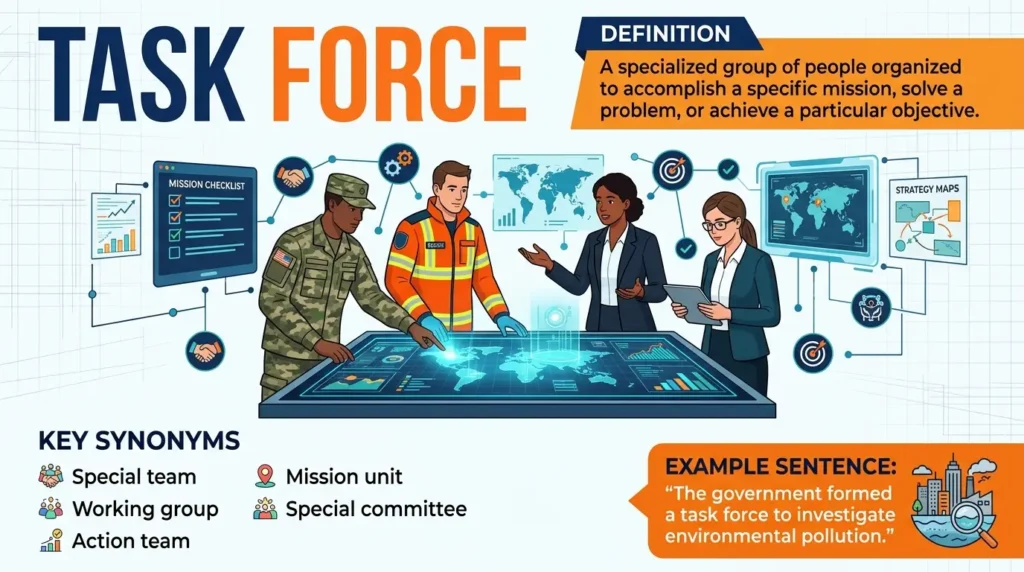
A synonym for task force is a word or phrase that describes a group of people organized to complete a specific mission, solve a problem, or achieve a shared goal. Common alternatives include working group, special committee, action team, response team, and operational unit. The best choice depends on the group’s purpose, authority, and working environment.
Imagine a company facing a serious customer service problem. The manager brings together employees from different departments to find a solution. Instead of repeatedly calling them a task force, you could describe them as a working group, problem-solving team, or action team.
A synonym for task force helps you explain teamwork more precisely. Each alternative highlights a different quality, such as expertise, urgency, cooperation, or authority.
The phrase is common in business, government, military operations, education, journalism, and everyday communication. Understanding its alternatives helps students, bloggers, content writers, and English learners express ideas clearly.
Learning synonyms also makes your writing more engaging. You can avoid repetitive wording while choosing expressions that match the situation and communicate the intended meaning naturally.
What Does “Task Force” Really Mean?
A task force is a group of people brought together to complete a particular job, investigate an issue, or achieve a specific objective.
The group may include experts from different departments, organizations, or professional backgrounds. It often works for a limited period, although some task forces continue operating for longer.
Part of Speech
Noun: Task force is a compound noun.
- Singular: task force
- Plural: task forces
- Example: The government established a task force to investigate the incident.
Simple Definition
A task force is a specially organized group that works together to complete a particular mission or solve a specific problem.
Emotional Tone and Attitude
The phrase usually sounds professional, organized, and purposeful. It can suggest urgency, authority, expertise, or cooperation.
Native English speakers commonly use it when describing a group formed for a focused objective rather than ordinary daily responsibilities.
Common Contexts
- Business and management
- Government and public policy
- Military and security operations
- Emergency response
- Academic research
- Investigations and reviews
- Community improvement projects
Connotative Meaning
(Connotation is the feeling, association, or emotional impression a word creates beyond its literal definition.)
Positive Tone
A task force can suggest teamwork, expertise, leadership, and effective problem-solving.
Example: The task force developed an innovative plan to improve local education.
Negative Tone
In some situations, the phrase may suggest bureaucracy, unnecessary meetings, or slow decision-making.
Example: Employees questioned whether another task force would actually solve the problem.
Neutral Tone
The phrase can simply describe a group assigned to a particular responsibility without expressing praise or criticism.
Example: The task force will submit its findings next month.
Etymology of Task Force
The phrase task force combines two English words: task and force.
According to etymological references, the phrase emerged as a military term during World War II, with its earliest recorded use dating to around 1941. It described a military force organized for a particular operation. Etymology, Origin & Meaning+1
Historical Development
Old English (450–1100)
The complete phrase task force did not exist in Old English. However, the word force developed from older linguistic roots associated with strength and power.
Middle English (1100–1500)
The word task entered English through Anglo-French and Old French forms. It originally referred to a duty, assigned work, or required amount of labor.
Modern English (1500–Present)
The general meaning of task expanded to include any piece of work that needs to be completed. During World War II, task force became established as a military expression and later gained widespread use in business, government, and other professional settings. Etymology, Origin & Meaning+1
Pronunciation, Syllables, and Affixation
Pronunciation (US & UK – IPA)
- US: /ˈtæsk ˌfɔːrs/
- UK: /ˈtɑːsk ˌfɔːs/
definition in the Cambridge English Dictionary+1
Syllables
task-force
The phrase contains two syllables.
Affixation Pattern
- Root: task + force
- Prefix: None
- Suffix: None
Task force is a compound noun formed by joining two independent words.
40 Synonyms for Task Force
The following alternatives describe groups organized for a particular assignment, investigation, operation, or objective.
Some are direct substitutes in professional writing. Others fit specialized contexts, such as emergencies, military operations, or academic research.
1. Working Group (Noun) — US / UK: /ˈwɝːkɪŋ ɡruːp/ /ˈwɜːkɪŋ ɡruːp/
Meaning: A group of people who collaborate to study an issue or complete a specific assignment.
Tone/Register: Neutral, professional, academic.
Example:
The working group will review the new school policy.
Our team joined a working group to improve communication.
2. Special Committee (Noun) — US / UK: /ˈspeʃəl kəˈmɪti/ /ˈspeʃəl kəˈmɪti/
Meaning: A committee created to address a particular issue or responsibility.
Tone/Register: Formal, governmental, organizational.
Example:
The board formed a special committee to investigate the complaint.
A special committee will examine the proposed changes.
3. Action Team (Noun) — US / UK: /ˈækʃən tiːm/ /ˈækʃən tiːm/
Meaning: A group focused on taking practical steps to achieve a specific goal.
Tone/Register: Professional, energetic, business.
Example:
The action team introduced a new customer support plan.
We need an action team to handle the urgent requests.
4. Response Team (Noun) — US / UK: /rɪˈspɑːns tiːm/ /rɪˈspɒns tiːm/
Meaning: A group prepared to respond to an incident, emergency, or developing situation.
Tone/Register: Professional, emergency-related, neutral.
Example:
The response team arrived shortly after the accident.
A response team is monitoring the situation.
5. Strike Team (Noun) — US / UK: /ˈstraɪk tiːm/ /ˈstraɪk tiːm/
Meaning: A specialized group assembled to carry out a focused, often urgent operation.
Tone/Register: Military, emergency, tactical.
Example:
The strike team moved quickly to secure the area.
Officials deployed a strike team to manage the crisis.
6. Task Group (Noun) — US / UK: /ˈtæsk ɡruːp/ /ˈtɑːsk ɡruːp/
Meaning: A group organized to complete a particular task or mission.
Tone/Register: Formal, military, professional.
Example:
The task group will coordinate the upcoming operation.
A task group was established to review the proposal.
7. Operations Team (Noun) — US / UK: /ˌɑːpəˈreɪʃənz tiːm/ /ˌɒpəˈreɪʃənz tiːm/
Meaning: A group responsible for coordinating or carrying out operational activities.
Tone/Register: Business, professional, technical.
Example:
The operations team resolved the scheduling issue.
Our operations team is preparing for the launch.
8. Project Team (Noun) — US / UK: /ˈprɑːdʒekt tiːm/ /ˈprɒdʒekt tiːm/
Meaning: A group working together to complete a defined project.
Tone/Register: Business, academic, neutral.
Example:
The project team completed the website redesign.
Our project team meets every Monday.
9. Advisory Committee (Noun) — US / UK: /ədˈvaɪzəri kəˈmɪti/ /ədˈvaɪzəri kəˈmɪti/
Meaning: A group of specialists who provide advice and recommendations.
Tone/Register: Formal, academic, governmental.
Example:
The advisory committee recommended several improvements.
She joined the advisory committee as an education expert.
10. Steering Committee (Noun) — US / UK: /ˈstɪrɪŋ kəˈmɪti/ /ˈstɪərɪŋ kəˈmɪti/
Meaning: A committee that guides a project, sets priorities, and oversees progress.
Tone/Register: Formal, business, organizational.
Example:
The steering committee approved the project timeline.
Our steering committee meets to discuss major decisions.
11. Study Group (Noun) — US / UK: /ˈstʌdi ɡruːp/ /ˈstʌdi ɡruːp/
Meaning: A group formed to examine a subject, learn together, or research an issue.
Tone/Register: Academic, educational, neutral.
Example:
The study group examined the effects of climate change.
Researchers formed a study group to explore the issue.
12. Review Panel (Noun) — US / UK: /rɪˈvjuː ˈpænəl/ /rɪˈvjuː ˈpænəl/
Meaning: A group of people appointed to assess, evaluate, or review something.
Tone/Register: Formal, academic, professional.
Example:
The review panel assessed the submitted applications.
A review panel will examine the proposed regulations.
13. Commission (Noun) — US / UK: /kəˈmɪʃən/ /kəˈmɪʃən/
Meaning: An officially appointed group responsible for investigating or addressing a particular matter.
Tone/Register: Formal, governmental, legal.
Example:
The commission investigated the safety concerns.
A national commission will review the policy.
14. Investigation Team (Noun) — US / UK: /ɪnˌvestɪˈɡeɪʃən tiːm/ /ɪnˌvestɪˈɡeɪʃən tiːm/
Meaning: A group assigned to discover facts about an incident or suspected problem.
Tone/Register: Formal, investigative, professional.
Example:
The investigation team interviewed several witnesses.
An investigation team is examining the reported incident.
15. Investigative Unit (Noun) — US / UK: /ɪnˈvestɪɡətɪv ˈjuːnɪt/ /ɪnˈvestɪɡətɪv ˈjuːnɪt/
Meaning: A specialized organizational unit responsible for conducting investigations.
Tone/Register: Formal, law enforcement, professional.
Example:
The investigative unit uncovered new evidence.
An investigative unit is reviewing the financial records.
16. Enforcement Team (Noun) — US / UK: /ɪnˈfɔːrsmənt tiːm/ /ɪnˈfɔːsmənt tiːm/
Meaning: A group responsible for ensuring that laws, rules, or regulations are followed.
Tone/Register: Formal, legal, governmental.
Example:
The enforcement team inspected several businesses.
An enforcement team is addressing repeated violations.
17. Tactical Unit (Noun) — US / UK: /ˈtæktɪkəl ˈjuːnɪt/ /ˈtæktɪkəl ˈjuːnɪt/
Meaning: A specialized group trained to handle operational situations requiring specific tactics.
Tone/Register: Military, security, professional.
Example:
The tactical unit prepared for the operation.
A tactical unit was assigned to manage the high-risk situation.
18. Rapid Response Team (Noun) — US / UK: /ˈræpɪd rɪˈspɑːns tiːm/ /ˈræpɪd rɪˈspɒns tiːm/
Meaning: A group designed to respond quickly to urgent situations.
Tone/Register: Emergency, professional, urgent.
Example:
The rapid response team addressed the sudden outage.
A rapid response team was sent to the affected area.
19. Crisis Response Team (Noun) — US / UK: /ˈkraɪsɪs rɪˈspɑːns tiːm/ /ˈkraɪsɪs rɪˈspɒns tiːm/
Meaning: A group organized to manage a crisis and reduce its effects.
Tone/Register: Professional, emergency, organizational.
Example:
The crisis response team coordinated the evacuation.
Our crisis response team is supporting affected families.
20. Emergency Team (Noun) — US / UK: /ɪˈmɜːrdʒənsi tiːm/ /ɪˈmɜːdʒənsi tiːm/
Meaning: A group prepared to handle emergencies and provide immediate assistance.
Tone/Register: Neutral, emergency-related.
Example:
The emergency team arrived within minutes.
An emergency team is helping residents after the storm.
21. Coordination Team (Noun) — US / UK: /koʊˌɔːrdɪˈneɪʃən tiːm/ /kəʊˌɔːdɪˈneɪʃən tiːm/
Meaning: A group responsible for organizing activities and ensuring different people or departments work together.
Tone/Register: Business, professional, neutral.
Example:
The coordination team managed the event schedule.
Our coordination team connected all participating departments.
22. Interagency Team (Noun) — US / UK: /ˌɪntərˈeɪdʒənsi tiːm/ /ˌɪntərˈeɪdʒənsi tiːm/
Meaning: A group whose members represent different agencies working toward a shared objective.
Tone/Register: Governmental, formal, professional.
Example:
The interagency team reviewed the public safety plan.
An interagency team is coordinating the investigation.
23. Multidisciplinary Team (Noun) — US / UK: /ˌmʌltiˈdɪsəplɪneri tiːm/ /ˌmʌltiˈdɪsɪplɪnəri tiːm/
Meaning: A group of professionals from different fields who combine their expertise to address a problem.
Tone/Register: Academic, medical, professional.
Example:
A multidisciplinary team developed the treatment plan.
The multidisciplinary team studied the environmental impact.
24. Cross-Functional Team (Noun) — US / UK: /ˌkrɔːs ˈfʌŋkʃənəl tiːm/ /ˌkrɒs ˈfʌŋkʃənəl tiːm/
Meaning: A group containing members from different departments or business functions.
Tone/Register: Business, corporate, professional.
Example:
The cross-functional team improved the customer experience.
A cross-functional team is developing the new product.
25. Specialist Team (Noun) — US / UK: /ˈspeʃəlɪst tiːm/ /ˈspeʃəlɪst tiːm/
Meaning: A group of people with specialized knowledge or skills in a particular area.
Tone/Register: Professional, technical, formal.
Example:
A specialist team examined the damaged equipment.
The specialist team will review the technical requirements.
26. Expert Panel (Noun) — US / UK: /ˈekspɜːrt ˈpænəl/ /ˈekspɜːt ˈpænəl/
Meaning: A group of knowledgeable people assembled to evaluate a topic or provide informed opinions.
Tone/Register: Academic, professional, formal.
Example:
An expert panel discussed the latest research.
The expert panel evaluated the proposed standards.
27. Working Party (Noun) — US / UK: /ˈwɜːrkɪŋ ˈpɑːrti/ /ˈwɜːkɪŋ ˈpɑːti/
Meaning: A group appointed to study a subject or complete a specific assignment.
Tone/Register: Formal, especially British English.
Example:
The working party submitted its recommendations.
A working party was formed to review the education system.
28. Mission Team (Noun) — US / UK: /ˈmɪʃən tiːm/ /ˈmɪʃən tiːm/
Meaning: A group organized to carry out a defined mission or objective.
Tone/Register: Professional, military, organizational.
Example:
The mission team prepared for its overseas assignment.
Our mission team is working toward the project deadline.
29. Operational Unit (Noun) — US / UK: /ˌɑːpəˈreɪʃənəl ˈjuːnɪt/ /ˌɒpəˈreɪʃənəl ˈjuːnɪt/
Meaning: An organized unit responsible for carrying out practical or operational activities.
Tone/Register: Military, technical, formal.
Example:
The operational unit managed the field activities.
An operational unit was assigned to support the mission.
30. Special Unit (Noun) — US / UK: /ˈspeʃəl ˈjuːnɪt/ /ˈspeʃəl ˈjuːnɪt/
Meaning: A specialized group created for a particular responsibility or unusual assignment.
Tone/Register: Formal, security, professional.
Example:
A special unit was created to examine the case.
The special unit will oversee the new initiative.
31. Response Unit (Noun) — US / UK: /rɪˈspɑːns ˈjuːnɪt/ /rɪˈspɒns ˈjuːnɪt/
Meaning: An organized unit responsible for responding to a particular event or need.
Tone/Register: Professional, emergency, technical.
Example:
The response unit handled the reported system failure.
A response unit is assisting local officials.
32. Intervention Team (Noun) — US / UK: /ˌɪntərˈvenʃən tiːm/ /ˌɪntəˈvenʃən tiːm/
Meaning: A group that takes action to improve a situation or prevent a problem from becoming worse.
Tone/Register: Professional, medical, social services.
Example:
The intervention team helped resolve the conflict.
An intervention team is supporting students who need assistance.
33. Assessment Team (Noun) — US / UK: /əˈsesmənt tiːm/ /əˈsesmənt tiːm/
Meaning: A group responsible for evaluating a situation, performance, or set of conditions.
Tone/Register: Academic, business, professional.
Example:
The assessment team reviewed the school facilities.
An assessment team will examine the project’s progress.
34. Implementation Team (Noun) — US / UK: /ˌɪmplɪmenˈteɪʃən tiːm/ /ˌɪmplɪmenˈteɪʃən tiːm/
Meaning: A group responsible for putting a plan, policy, or project into practice.
Tone/Register: Business, technical, professional.
Example:
The implementation team introduced the new system.
Our implementation team is preparing the training materials.
35. Planning Group (Noun) — US / UK: /ˈplænɪŋ ɡruːp/ /ˈplænɪŋ ɡruːp/
Meaning: A group that develops strategies, schedules, or plans for a particular objective.
Tone/Register: Neutral, professional, organizational.
Example:
The planning group discussed the annual event.
A planning group is preparing the community project.
36. Project Group (Noun) — US / UK: /ˈprɑːdʒekt ɡruːp/ /ˈprɒdʒekt ɡruːp/
Meaning: A group of people assigned to work on a specific project or shared outcome.
Tone/Register: Business, academic, neutral.
Example:
The project group completed its initial research.
Our project group is preparing the final presentation.
37. Task Team (Noun) — US / UK: /ˈtæsk tiːm/ /ˈtɑːsk tiːm/
Meaning: A team assigned to complete a defined task or responsibility.
Tone/Register: Professional, neutral, organizational.
Example:
The task team reviewed the new procedures.
A task team was created to improve workplace safety.
38. Task Unit (Noun) — US / UK: /ˈtæsk ˈjuːnɪt/ /ˈtɑːsk ˈjuːnɪt/
Meaning: An organized unit assigned to carry out a specific operational task.
Tone/Register: Military, formal, technical.
Example:
The task unit prepared for the scheduled operation.
A task unit was assigned to support the larger mission.
39. Problem-Solving Team (Noun) — US / UK: /ˈprɑːbləm ˌsɑːlvɪŋ tiːm/ /ˈprɒbləm ˌsɒlvɪŋ tiːm/
Meaning: A group that works together to identify problems and develop practical solutions.
Tone/Register: Business, educational, neutral.
Example:
The problem-solving team found a way to reduce delays.
Our problem-solving team is reviewing customer feedback.
40. Joint Task Group (Noun) — US / UK: /ˌdʒɔɪnt ˈtæsk ɡruːp/ /ˌdʒɔɪnt ˈtɑːsk ɡruːp/
Meaning: A group formed by people or units from different organizations to accomplish a shared mission.
Tone/Register: Military, governmental, formal.
Example:
The joint task group coordinated the regional operation.
A joint task group was established to address the security concerns.
Synonyms for Task Force by Tone
The right synonym depends on the impression you want to create. A formal expression may suit a government report, while a simple phrase may work better in a casual conversation.
Positive Synonyms
These expressions highlight teamwork, expertise, and productive action.
- Action team
- Problem-solving team
- Expert panel
- Multidisciplinary team
- Specialist team
- Implementation team
Example: The problem-solving team developed an effective strategy for improving customer satisfaction.
Neutral Synonyms
These expressions describe a group without adding strong emotional meaning.
- Working group
- Project team
- Task group
- Planning group
- Project group
- Task team
Example: The working group will review the proposal before making a decision.
Negative Synonyms
These expressions are not direct negative synonyms. However, they can communicate criticism when used in a context that suggests inefficiency, unnecessary bureaucracy, or excessive investigation.
- Special committee
- Review panel
- Commission
- Working party
Example: The company created another review panel, but employees doubted its effectiveness.
Playful or Informal Alternatives
These phrases are useful in casual conversations when the situation does not require formal language.
- Dream team
- Brainstorming crew
- Problem-solving squad
- Action squad
Example: Let’s get our brainstorming crew together and find a creative solution.
Why Tone Matters in Word Choice
Tone helps readers understand how you feel about a group or its work.
For example, an expert panel highlights knowledge, while a bureaucratic committee may suggest unnecessary complexity.
Choosing the right expression makes your writing more accurate and natural.
Task Force vs Close Alternatives
Several expressions look similar but communicate different ideas. Understanding their differences helps you select the most accurate synonym.
Task Force vs Working Group
| Feature | Task Force | Working Group |
|---|---|---|
| Main purpose | Complete a specific mission | Study or develop a solution |
| Tone | Professional, sometimes urgent | Neutral, collaborative |
| Typical use | Business, government, military | Research, policy, business |
Example: A task force may implement an emergency plan, while a working group may study how to improve that plan.
Task Force vs Special Committee
| Feature | Task Force | Special Committee |
|---|---|---|
| Main purpose | Complete a focused mission | Address a particular issue |
| Structure | May be operational | Often formal and appointed |
| Typical use | Projects, emergencies, operations | Reviews, investigations, governance |
Example: The task force may respond to a crisis, while the special committee examines the decisions made during that crisis.
Task Force vs Action Team
| Feature | Task Force | Action Team |
|---|---|---|
| Main purpose | Handle a specific assignment | Take practical action |
| Tone | Formal and organized | Energetic and direct |
| Typical use | Government, business, military | Workplace improvement, projects |
Example: A task force may investigate declining sales, while an action team works directly on improving them.
How Task Force Changes by Context
The best synonym depends on where and how you use the expression.
Daily Conversation
In everyday English, simple expressions such as team, working group, and action team sound natural.
Instead of saying, “The task force is meeting tomorrow,” you could say, “The team is meeting tomorrow to solve the problem.”
Writing and Blogging
Content writers can use working group, special committee, investigation team, and response team to describe different organizational activities.
Using these alternatives naturally improves readability and reduces repetitive wording.
Professional or Academic Writing
Formal writing often requires precise terminology.
Use advisory committee when a group provides recommendations, review panel when it evaluates something, and implementation team when it puts a plan into action.
Creative or Informal Writing
Creative writers can use expressions such as problem-solving squad or brainstorming crew to create a relaxed tone.
These phrases work well in dialogue, storytelling, and casual descriptions of teamwork.
Common Mistakes Learners Make
Using Every Synonym Interchangeably
Not every synonym describes the same kind of group.
For example, an advisory committee usually provides recommendations, while an enforcement team ensures compliance with rules.
Choose a synonym that matches the group’s actual responsibility.
Confusing Expertise with Authority
An expert panel may provide professional advice without having the authority to make final decisions.
A commission or steering committee may have more formal responsibilities, depending on its organization.
Using Informal Expressions in Formal Writing
Expressions such as dream team or brainstorming crew may sound too casual in a government report or academic essay.
Use professional alternatives when the audience expects formal language.
Repeating the Same Phrase Too Often
Repeatedly using task force can make an article sound monotonous.
Replace it with a suitable alternative when the context clearly supports the change.
Register Notes
- Formal: Commission, advisory committee, investigative unit.
- Professional: Working group, project team, implementation team.
- Informal: Problem-solving squad, brainstorming crew.
- Military: Task group, tactical unit, operational unit.
For further vocabulary practice, explore related articles about synonyms for team, committee, and mission.
Real-Life Examples Using Task Force
Workplace Scenario
A company experiences a decline in customer satisfaction.
The manager creates a task force to identify the reasons and improve service quality.
Alternative: A customer experience working group investigates the issue and recommends improvements.
Social Scenario
A neighborhood faces repeated problems with waste collection.
Residents organize a task force to work with local authorities.
Alternative: A community action team coordinates cleanup activities and encourages residents to participate.
Media and Pop Culture Scenario
A television series features detectives investigating a complicated crime.
The department creates a task force to connect different pieces of evidence.
Alternative: An investigative unit works together to identify the suspect.
Writing and Storytelling Scenario
A novelist describes a group of scientists working to prevent a global disaster.
The task force races against time to develop a solution.
Alternative: A multidisciplinary team combines scientific knowledge to address the crisis.
Interactive Practice Quiz
Test your understanding of task force synonyms through these practical questions.
Questions
1. A group of employees from different departments is formed to improve customer service. What is the best expression?
A. Tactical unit
B. Cross-functional team
C. Enforcement team
D. Commission
2. A group of specialists provides recommendations to a school board. What should you call it?
A. Advisory committee
B. Strike team
C. Response unit
D. Task unit
3. A group is created to respond quickly to a sudden emergency. Which expression fits best?
A. Study group
B. Planning group
C. Rapid response team
D. Working party
4. Researchers from several academic fields investigate climate change together. What is the best choice?
A. Enforcement team
B. Multidisciplinary team
C. Tactical unit
D. Special unit
5. A group evaluates applications and selects the most qualified candidates. What is the best expression?
A. Review panel
B. Action squad
C. Operations team
D. Task unit
6. A company creates a group to put a new software system into practice. Which synonym fits?
A. Expert panel
B. Implementation team
C. Study group
D. Advisory committee
7. A group investigates suspected violations of the law. What is the best choice?
A. Planning group
B. Enforcement team
C. Project group
D. Brainstorming crew
8. A group of professionals develops a plan to prevent a crisis from becoming worse. Which expression is most suitable?
A. Crisis response team
B. Review panel
C. Study group
D. Project team
9. A group studies an issue and works together to develop a practical solution. What is the best expression?
A. Special unit
B. Problem-solving team
C. Strike team
D. Enforcement team
10. A group of military units is organized to carry out a specific operation. Which expression is most appropriate?
A. Study group
B. Advisory committee
C. Task group
D. Planning group
Reflection and Application Task
Write one sentence using a synonym for task force to describe a group working toward a specific goal in your school, workplace, or community.
Try using a different synonym in a second sentence. Notice how the meaning or tone changes.
Answer Key
1-B | 2-A | 3-C | 4-B | 5-A | 6-B | 7-B | 8-A | 9-B | 10-C
Suggested External Sources:
- Cambridge Dictionary: Task Force Definition and Usage
- Etymonline: Task Force Origin and Etymology
- Collins Dictionary: Task Force Meaning and Examples
FAQs
1. What is the most common synonym for task force in business English?
The most common alternatives in business English include working group, project team, and action team. A working group usually studies an issue or develops recommendations. A project team focuses on completing a defined project. An action team emphasizes practical steps and results. Choose the expression that best describes the group’s actual responsibility.
2. What is another word for task force in government?
Government organizations often use special committee, commission, working group, or interagency team. A commission may have an official investigative or advisory role. An interagency team includes representatives from different agencies. The most accurate expression depends on the group’s authority, structure, and assigned responsibility.
3. What is a synonym for task force in a military context?
Military alternatives include task group, tactical unit, operational unit, and special unit. These expressions have distinct organizational meanings. A task group may refer to a particular military grouping, while a tactical unit highlights specialized operational capabilities. Military terminology should match the specific structure and mission being described.
4. Is a task force the same as a committee?
Not necessarily. A task force is usually organized around a specific mission or problem. A committee often has a formal role in reviewing issues, making recommendations, or overseeing decisions. Both may work on similar assignments, but their responsibilities and structures can differ. A special committee can sometimes perform the same function as a task force.
5. What is a good synonym for task force in an academic essay?
Working group, research team, expert panel, and multidisciplinary team are useful academic alternatives. A research team conducts research, while an expert panel evaluates a subject using specialized knowledge. A multidisciplinary team brings together professionals from different fields. Select the phrase that accurately represents the group’s work.
6. What is the difference between a task force and a response team?
A task force may investigate, plan, coordinate, or complete a specific assignment. A response team focuses on reacting to an event or situation. A rapid response team emphasizes speed, while a crisis response team focuses on managing a serious disruption. The expressions overlap when a task force is created specifically to handle an emergency.
7. Can I use the word team instead of task force?
Yes, when the context makes the group’s purpose clear. Team is a broader and more conversational expression. Task force communicates that the group was organized for a particular mission or problem. In formal writing, the more specific phrase may provide useful information about the group’s purpose and structure.
Conclusion
Learning a synonym for task force helps you describe teamwork with greater accuracy. Words such as working group, action team, and special committee highlight different responsibilities and professional settings.
The right alternative can make your writing clearer, more engaging, and easier to understand. It also helps bloggers and content writers avoid repetition while maintaining the meaning of their message.
Vocabulary development improves speaking, blogging, academic writing, and everyday communication. Practicing synonyms in emails, essays, and conversations helps you become more confident with English.
Start using these alternatives in your daily writing. Choose one new synonym today, create your own sentence, and practice using it in a real conversation.

Sophia Carter is the founder and lead writer at SynonymVerse.com, a trusted online resource dedicated to English vocabulary and effective communication. She is passionate about helping students, writers, professionals, and lifelong learners find the most accurate words to express their ideas with clarity and confidence.
At SynonymVerse.com, every article is carefully researched and thoughtfully written to provide reliable guidance on synonyms, word meanings, and vocabulary. With a strong focus on accuracy, real-world usage, and easy-to-understand explanations, the website is committed to helping readers strengthen their language skills, enrich their vocabulary, and become more confident communicators.