Synonyms for cowboy help you describe cattle handlers, rugged adventurers, and reckless workers with precision. Imagine describing an independent rancher versus an irresponsible contractor; choosing the exact word elevates your writing immediately.
For instance, calling a ranch worker a wrangler fits herding scenes, while calling a reckless driver a cowboy highlights unsafe risk-taking. Using synonyms for cowboy improves your vocabulary and expands your storytelling skills.
This term appears frequently in western folklore, modern media, business jargon, and daily English conversations. Exploring synonyms for cowboy benefits students, bloggers, fiction writers, and language learners who want clearer expression.
What Does “Cowboy” Really Mean?
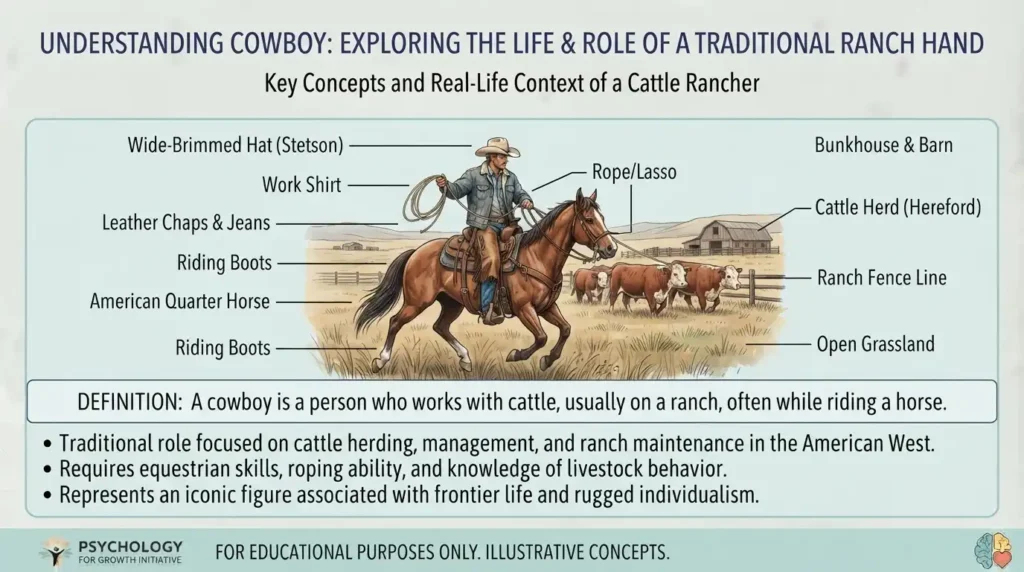
The word cowboy primarily refers to a mounted worker who herds and tends cattle on ranches. In modern informal usage, it also describes a reckless, independent, or unprincipled person who ignores rules or safety standards. It functions as a noun and as an informal descriptive adjective.
Connotation
(Connotation is the emotional tone, attitude, or implied association a word carries beyond its literal dictionary definition.)
- Positive tone: Implies bravery, hard work, independence, outdoor skill, and rugged charm.
- Negative tone: Implies recklessness, lack of discipline, unprofessionalism, and dangerous risk-taking.
- Neutral tone: Refers strictly to agricultural cattle management or historical western trades.
Etymology and Pronunciation
The term combines two Old English roots: cū (cow) and bofa or bof (boy). It is a direct translation of the Spanish word vaquero (from vaca, meaning cow).
- Old English (450–1100): The individual roots cū and boia existed, but the combined compound word was not used.
- Middle English (1100–1500): The compound appeared occasionally as a literal description for young boys tending cattle.
- Modern English (1500–Present): Gained its iconic cultural meaning in the 19th-century American West and later developed its slang sense of a reckless operator.
Pronunciation:
- US: /ˈkaʊ.bɔɪ/
- UK: /ˈkaʊ.bɔɪ/
Syllables:
cow-boy
Affixation Pattern:
- Root: Cow, Boy
- Prefix: None
- Suffix: None
Synonyms for Cowboy
Cowhand (Noun) — US: /ˈkaʊ.hænd/ | UK: /ˈkaʊ.hænd/
- Meaning: A hired worker who tends cattle on a farm or ranch.
- Tone/Register: Neutral / Practical
- Example 1: The ranch owner hired three new cowhands for the seasonal roundup.
- Example 2: An experienced cowhand knows how to care for sick animals.
Wrangler (Noun) — US: /ˈræŋ.ɡlɚ/ | UK: /ˈræŋ.ɡlər/
- Meaning: A person who handles horses or cattle professionally on a ranch or movie set.
- Tone/Register: Neutral / Technical
- Example 1: The horse wrangler kept the animals calm during the loud storm.
- Example 2: She worked as a wrangler in Wyoming before moving to California.
Vaquero (Noun) — US: /vɑːˈkɛr.oʊ/ | UK: /væˈkɛə.rəʊ/
- Meaning: A traditional Spanish or Mexican cattle herder who developed western riding skills.
- Tone/Register: Cultural / Historical
- Example 1: Modern roping techniques originated with the skilled vaqueros of northern Mexico.
- Example 2: The vaquero rode gracefully across the open plain.
Buckaroo (Noun) — US: /ˌbʌk.əˈruː/ | UK: /ˌbʌk.əˈruː/
- Meaning: An informal American regional term for a cowboy, especially in the Great Basin region.
- Tone/Register: Informal / Regional
- Example 1: The old buckaroo wore a wide hat and sturdy leather boots.
- Example 2: Young buckaroos gathered around the campfire to hear stories.
Gaucho (Noun) — US: /ˈɡaʊ.tʃoʊ/ | UK: /ˈɡaʊ.tʃəʊ/
- Meaning: A South American horseman and cattle handler from the fertile pampas region.
- Tone/Register: Cultural / Historical
- Example 1: The Argentine gaucho demonstrated exceptional horsemanship at the festival.
- Example 2: Traditional clothing remains an important symbol for every local gaucho.
Cattleman (Noun) — US: /ˈkæt̬.əl.mæn/ | UK: /ˈkæt.əl.mən/
- Meaning: An owner, manager, or experienced worker involved in raising beef cattle.
- Tone/Register: Business / Formal
- Example 1: The local cattleman attended the agricultural summit to discuss market prices.
- Example 2: He built a prosperous estate after working as a cattleman for decades.
Rancher (Noun) — US: /ˈræn.tʃɚ/ | UK: /ˈrɑːn.tʃər/
- Meaning: A person who owns or manages a large farm dedicated to raising livestock.
- Tone/Register: General / Professional
- Example 1: The rancher inspected the perimeter fences before the winter snow fell.
- Example 2: Successful ranchers carefully manage their land and water resources.
Herder (Noun) — US: /ˈhɝː.dɚ/ | UK: /ˈhɜː.dər/
- Meaning: A person who manages, feeds, and guards groups of livestock animals.
- Tone/Register: Neutral / Universal
- Example 1: The mountain herder guided the flock safely down the steep valley.
- Example 2: Herders across the region faced difficulties during the prolonged dry season.
Drover (Noun) — US: /ˈdroʊ.vɚ/ | UK: /ˈdrəʊ.vər/
- Meaning: A person who moves herds of cattle or sheep across long distances overland.
- Tone/Register: Historical / Literary
- Example 1: Long-distance drovers spent weeks on trail drives moving cattle toward railheads.
- Example 2: The weary drover rested near the river after a long day of travel.
Cowman (Noun) — US: /ˈkaʊ.mæn/ | UK: /ˈkaʊ.mən/
- Meaning: A man who breeds, owns, or cares for dairy or beef cattle.
- Tone/Register: Neutral / Traditional
- Example 1: The veteran cowman sold his prize bull at the annual livestock auction.
- Example 2: Every local cowman joined forces to rebuild the damaged barn.
Cowpuncher (Noun) — US: /ˈkaʊ.pʌn.tʃɚ/ | UK: /ˈkaʊ.pʌn.tʃər/
- Meaning: An informal western term for a cowboy who drives cattle using prods or ropes.
- Tone/Register: Informal / Regional
- Example 1: The tough cowpuncher rode all day to secure the stray calves.
- Example 2: Dusty cowpunchers stopped at the trading post for supplies.
Stockman (Noun) — US: /ˈstɑːk.mən/ | UK: /ˈstɒk.mən/
- Meaning: A person who breeds, cares for, or manages farm livestock animals.
- Tone/Register: Official / Commonwealth
- Example 1: Australian stockmen are famous for driving cattle across harsh desert landscapes.
- Example 2: The stockman carefully monitored the health of the young calves.
Broncobuster (Noun) — US: /ˈbrɑːŋ.koʊ.bʌs.tɚ/ | UK: /ˈbrɒŋ.kəʊ.bʌs.tər/
- Meaning: A specialized rider who trains and tames wild or unbroken horses.
- Tone/Register: Colorful / Western
- Example 1: It takes patience and strength to be a successful broncobuster.
- Example 2: The legendary broncobuster tamed the wild stallion without injury.
Trail Boss (Noun) — US: /treɪl bɑːs/ | UK: /treɪl bɒs/
- Meaning: The lead manager in charge of a cattle drive across long distances.
- Tone/Register: Historical / Leadership
- Example 1: The trail boss decided to cross the swollen river before sunset.
- Example 2: Respecting the trail boss was essential for survival on long journeys.
Roper (Noun) — US: /ˈroʊ.pɚ/ | UK: /ˈrəʊ.pər/
- Meaning: A cattle handler or rodeo competitor skilled at throwing a lasso.
- Tone/Register: Sports / Western
- Example 1: The rodeo roper caught the calf in under five seconds flat.
- Example 2: She practiced daily to become an elite roper in western competitions.
Horseman (Noun) — US: /ˈhɔːrs.mən/ | UK: /ˈhɔːs.mən/
- Meaning: A rider who possesses great skill and expertise in managing horses.
- Tone/Register: Formal / Descriptive
- Example 1: He is an exceptional horseman who understands animal behavior deeply.
- Example 2: The young officer was praised as a brave horseman during operations.
Grazier (Noun) — US: /ˈɡreɪ.ʒɚ/ | UK: /ˈɡreɪ.zi.ər/
- Meaning: A person who pastures and fattens cattle or sheep for market sales.
- Tone/Register: Formal / Agricultural
- Example 1: The sheep grazier monitored grass growth across the western pastures.
- Example 2: Local graziers formed a cooperative to negotiate better market prices.
Cowpoke (Noun) — US: /ˈkaʊ.poʊk/ | UK: /ˈkaʊ.pəʊk/
- Meaning: A casual, slightly humorous American slang term for a ranch worker.
- Tone/Register: Informal / Casual
- Example 1: A couple of tired cowpokes sat on the wooden porch drinking coffee.
- Example 2: The old movie featured a friendly cowpoke saving the small town.
Paniolo (Noun) — US: /ˌpɑː.niˈoʊ.loʊ/ | UK: /ˌpɑː.niˈəʊ.ləʊ/
- Meaning: A Hawaiian cattle rancher or horseman with a unique regional heritage.
- Tone/Register: Cultural / Regional
- Example 1: Hawaiian paniolos developed distinct cattle driving styles in high-altitude ranches.
- Example 2: The paniolo wore a traditional flower lei around his hat brim.
Cow herder (Noun) — US: /ˈkaʊ ˌhɝː.dɚ/ | UK: /ˈkaʊ ˌhɜː.dər/
- Meaning: A person whose main job is guarding and driving groups of cows.
- Tone/Register: Plain / General
- Example 1: The young cow herder guided the cattle away from the cliff.
- Example 2: Life as a rural cow herder requires early morning wake-up calls.
Lancer (Noun) — US: /ˈlæn.sɚ/ | UK: /ˈlɑːn.sər/
- Meaning: A cavalry soldier or horseman equipped with a lance, historically related in riding style.
- Tone/Register: Historical / Military
- Example 1: The mounted lancer rode swiftly ahead of the main army unit.
- Example 2: Historical accounts praise the light lancer regiments for speed and agility.
Outrider (Noun) — US: /ˈaʊt.raɪ.dɚ/ | UK: /ˈaʊt.raɪ.dər/
- Meaning: A mounted rider who travels in front of or beside a herd or vehicle.
- Tone/Register: Descriptive / Operational
- Example 1: Outriders galloped ahead to scout for potential dangers along the trail.
- Example 2: The coach was accompanied by two armed outriders for protection.
Ranch hand (Noun) — US: /ræntʃ hænd/ | UK: /rɑːntʃ hænd/
- Meaning: An employee who performs general labor and livestock maintenance on a ranch.
- Tone/Register: Everyday / Casual
- Example 1: The ranch hand spent the afternoon repairing broken wooden gates.
- Example 2: She started as a ranch hand and eventually managed the entire estate.
Rustler (Noun) — US: /ˈrʌs.lɚ/ | UK: /ˈrʌs.lər/
- Meaning: A cattle thief who illegally steals livestock from ranches.
- Tone/Register: Historical / Criminal
- Example 1: Ranchers formed patrols to protect their cows from opportunistic rustlers.
- Example 2: The movie tells the story of an infamous cattle rustler fleeing lawmen.
Desperado (Noun) — US: /ˌdɛs.pəˈrɑː.doʊ/ | UK: /ˌdɛs.pəˈrɑː.dəʊ/
- Meaning: A desperate, violent outlaw or bandit of the historical American West.
- Tone/Register: Dramatic / Negative
- Example 1: The small-town sheriff braced for an attack by a violent desperado.
- Example 2: Old legends turned the dangerous desperado into a folk hero.
Gunslinger (Noun) — US: /ˈɡʌn.slɪŋ.ɚ/ | UK: /ˈɡʌn.slɪŋ.ər/
- Meaning: An armed, dangerous gunman skilled with pistols in the Wild West.
- Tone/Register: Informal / Western Pop Culture
- Example 1: The mysterious gunslinger walked into the saloon without saying a word.
- Example 2: Novels often portray the gunslinger as a lone figure seeking justice.
Maverick (Noun) — US: /ˈmæv.ɚ.ɪk/ | UK: /ˈmæv.ər.ɪk/
- Meaning: An unbranded calf; figuratively, an independent person who rejects rules.
- Tone/Register: Figurative / Expressive
- Example 1: The team leader is a complete maverick who ignores traditional strategies.
- Example 2: Ranchers searched the thick brush to capture the lost maverick.
Daredevil (Noun) — US: /ˈdɛr.dɛv.əl/ | UK: /ˈdeə.dev.əl/
- Meaning: A reckless person who loves taking dangerous risks without safety concern.
- Tone/Register: Informal / Behavioral
- Example 1: The stunt driver is a real daredevil who performs inexplicable maneuvers.
- Example 2: Safety inspectors warned the daredevil contractor about missed steps.
Risk-taker (Noun) — US: /rɪsk ˌteɪ.kɚ/ | UK: /rɪsk ˌteɪ.kər/
- Meaning: A person who willingly engages in actions involving uncertainty or danger.
- Tone/Register: Business / Neutral
- Example 1: Successful entrepreneurs are often calculated risk-takers who embrace uncertainty.
- Example 2: Being a reckless risk-taker in construction leads to workplace accidents.
Show-off (Noun) — US: /ˈʃoʊ.ɑːf/ | UK: /ˈʃəʊ.ɒf/
- Meaning: A person who acts boastfully or performs recklessly to attract attention.
- Tone/Register: Informal / Critical
- Example 1: Nobody liked working with the show-off who ignored basic instructions.
- Example 2: His reckless driving was just an attempt to show off.
Wildcat (Noun) — US: /ˈwaɪld.kæt/ | UK: /ˈwaɪld/.kæt/
- Meaning: An irresponsible, uncertified, or high-risk operator or business venture.
- Tone/Register: Informal / Financial
- Example 1: Investors lost money after backing a wildcat drilling project in the desert.
- Example 2: Wildcat operators often ignore local environmental safety laws.
Rogue (Noun) — US: /roʊɡ/ | UK: /rəʊɡ/
- Meaning: A dishonest, unprincipled, or wild person who operates outside normal rules.
- Tone/Register: Descriptive / Critical
- Example 1: A rogue trader caused massive losses for the international bank.
- Example 2: The detective tracked down a rogue employee selling confidential files.
Free-wheeler (Noun) — US: /friː ˈhwiː.lɚ/ | UK: /friː ˈwiː.lər/
- Meaning: A person who acts freely and irresponsibly without following rules.
- Tone/Register: Casual / Idiomatic
- Example 1: The manager was a free-wheeler who rarely consulted company policy.
- Example 2: She lived as a free-wheeler, moving to new cities without planning.
Hothead (Noun) — US: /ˈhɑːt.hɛd/ | UK: /ˈhɒt.hed/
- Meaning: An easily angered or impulsive person who acts without thinking.
- Tone/Register: Informal / Disapproving
- Example 1: The young hothead started an argument over a tiny misunderstanding.
- Example 2: Leaders must remain calm rather than reacting like an impulsive hothead.
Lone wolf (Noun) — US: /loʊn wʊlf/ | UK: /ləʊn wʊlf/
- Meaning: An independent person who prefers working or living entirely alone.
- Tone/Register: Idiomatic / Neutral
- Example 1: He is a lone wolf who produces great work without team support.
- Example 2: The lone wolf investigator solved the case using his own methods.
Drifter (Noun) — US: /ˈdrɪf.tɚ/ | UK: /ˈdrɪf.tər/
- Meaning: A person who moves constantly from place to place without a fixed home or job.
- Tone/Register: Neutral / Descriptive
- Example 1: The quiet drifter worked short seasonal jobs across the coast.
- Example 2: Old western films frequently feature a solitary drifter entering town.
Nomad (Noun) — US: /ˈnoʊ.mæd/ | UK: /ˈnəʊ.mæd/
- Meaning: A member of a community that moves regularly to find pasture or fresh resources.
- Tone/Register: Academic / Cultural
- Example 1: Desert nomads move their herds based on seasonal water availability.
- Example 2: Digital nomads work online while traveling between different countries.
Highwayman (Noun) — US: /ˈhaɪ.weɪ.mən/ | UK: /ˈhaɪ.weɪ.mən/
- Meaning: A historic mounted thief who robbed travelers on public roads.
- Tone/Register: Historical / Literary
- Example 1: Travelers feared encountering a masked highwayman in the dark forest.
- Example 2: The ballad tells the tragic story of a famous 18th-century highwayman.
Bushranger (Noun) — US: /ˈbʊʃ.reɪn.dʒɚ/ | UK: /ˈbʊʃ.reɪn.dʒər/
- Meaning: An Australian outlaw who lived in the wild bush country, avoiding lawmen.
- Tone/Register: Historical / Regional
- Example 1: Ned Kelly is Australia’s most famous historical bushranger hero.
- Example 2: Early bushrangers survived in remote forests by raiding isolated farms.
Caballero (Noun) — US: /ˌkɑː.bɑːˈjɛr.oʊ/ | UK: /ˌkæb.əlˈeə.rəʊ/
- Meaning: A Spanish horseman, gentleman rider, or knightly equestrian.
- Tone/Register: Formal / Historical
- Example 1: The skilled caballero rode his fine horse during the ceremonial parade.
- Example 2: Stories painted the caballero as a polite and brave protector.
Pioneer (Noun) — US: /ˌpaɪ.əˈnɪr/ | UK: /ˌpaɪəˈnɪər/
- Meaning: A person who is among the first to explore or settle a new area or field.
- Tone/Register: Positive / Historical
- Example 1: Early pioneers traveled westward in covered wagons to build towns.
- Example 2: She is considered a medical pioneer in heart surgery techniques.
Frontiersman (Noun) — US: /frʌnˈtɪrz.mən/ | UK: /frʌnˈtɪəz.mən/
- Meaning: A man who lives on or near the wild, unsettled border of a country.
- Tone/Register: Historical / Descriptive
- Example 1: The rugged frontiersman built a log cabin deep inside the woods.
- Example 2: Famous frontiersmen possessed exceptional wilderness survival skills.
Pathfinder (Noun) — US: /ˈpæθ.faɪn.dɚ/ | UK: /ˈpɑːθ.faɪn.dər/
- Meaning: A person who discovers a new route through unexplored territory.
- Tone/Register: Inspiring / Formal
- Example 1: The experienced pathfinder guided the expedition safely through the mountains.
- Example 2: Her research served as a true pathfinder for future climate scientists.
Trailblazer (Noun) — US: /ˈtreɪl.bleɪ.zɚ/ | UK: /ˈtreɪl.bleɪ.zər/
- Meaning: A person who marks a new trail or leads innovative progress in a field.
- Tone/Register: Positive / Modern
- Example 1: As a tech trailblazer, she launched the first mobile payment platform.
- Example 2: The athletic trailblazer broke barriers for future women competitors.
Adventurer (Noun) — US: /ədˈvɛn.tʃɚ.ɚ/ | UK: /ədˈven.tʃər.ər/
- Meaning: A person who enjoys exploring unknown places and taking exciting risks.
- Tone/Register: Positive / General
- Example 1: The brave adventurer traveled to the Antarctic to study glaciers.
- Example 2: Novels often inspire young readers to become curious adventurers.
Synonyms by Tone
- Positive: Pioneer, Trailblazer, Pathfinder, Vaquero, Adventurer, Caballero.
- Neutral: Cowhand, Wrangler, Rancher, Cattleman, Stockman, Herder, Drover, Outrider.
- Negative: Rogue, Desperado, Rustler, Show-off, Hothead, Wildcat, Daredevil.
- Playful / Informal: Buckaroo, Cowpoke, Cowpuncher, Free-wheeler, Lone wolf.
Selecting words with appropriate tone ensures your meaning remains accurate and clear. Calling an irresponsible contractor a “cowboy” conveys a negative warning, whereas calling a skilled rancher a “wrangler” shows technical respect.
Mini Comparison
- Cowboy vs. Cowhand: “Cowhand” refers strictly to a hired laborer working practically with livestock. “Cowboy” carries broader romantic, cultural, and slang meanings, including reckless behavior.
- Cowboy vs. Rancher: A “rancher” owns or manages the ranch business property. A “cowboy” is typically an operational worker who handles horses and livestock directly in the field.
Context-Based Usage
- Daily Conversation: Use casual terms like ranch hand, cowpoke, or risk-taker.
- Writing & Blogging: Choose evocative words like lone wolf, trailblazer, or drifter.
- Professional & Academic: Use formal industry terms like cattleman, stockman, grazier, or rancher.
- Creative Writing: Utilize colorful historical options like vaquero, buckaroo, desperado, or outrider.
Common Mistakes & Native Usage
- Misuse Scenarios: Avoid calling modern livestock farm owners “cowboys” in formal agricultural business reports; use “rancher” or “cattleman” instead.
- Confusing Tone: Using slang terms like “cowpoke” in academic essays undermines professional authority.
- Overuse Warning: Do not overuse “cowboy” to describe every reckless person. Vary your slang with terms like hothead, rogue, or free-wheeler.
(For further study on contextual word choices, refer to our comprehensive English Vocabulary Guide.)
Real-Life Mini Scenarios
- Workplace: “Avoid hiring that cowboy contractor who cuts safety corners to save money.”
- Social Situations: “He showed up at the costume party dressed as a traditional Mexican vaquero.”
- Media / Pop Culture: “Classic western cinema transformed the humble cowhand into a mythical hero.”
- Writing & Storytelling: “The lone drifter rode into the valley just as night began to fall.”
Interactive Practice Quiz
- Which synonym best describes an owner of a large livestock farm in business writing?
A) Buckaroo B) Rancher C) Cowpoke D) Hothead - Select the word that carries a negative business tone implying recklessness:
A) Wrangler B) Stockman C) Wildcat D) Paniolo - “The skilled horse ___ tamed the wild stallion safely.”
A) Rustler B) Wrangler C) Desperado D) Highwayman - What is the main structural difference between a rancher and a cowhand?
A) A cowhand owns the land B) A rancher manages the business estate C) They are identical terms D) A rancher steals livestock - Which traditional regional word refers specifically to a Hawaiian rancher?
A) Gaucho B) Paniolo C) Bushranger D) Lancer - Choose the term best suited for an innovative person leading a new field:
A) Rustler B) Trailblazer C) Hothead D) Drifter - “Police warned local farms about a cattle ___ operating in the valley.”
A) Stockman B) Rustler C) Pathfinder D) Grazier - Which word describes a South American cattle horseman from the pampas?
A) Gaucho B) Buckaroo C) Cowpoke D) Outrider - Which term implies an independent person who rejects standard rules?
A) Cowhand B) Maverick C) Grazier D) Drover - What part of speech is cowboy in “He is a cowboy builder”?
A) Noun B) Adjective C) Verb D) Preposition
Application Task: Write one original sentence using the synonym wrangler to describe a real or fictional scenario.
Answer Key: 1-B, 2-C, 3-B, 4-B, 5-B, 6-B, 7-B, 8-A, 9-B, 10-B
FAQs
1. What is the most common professional synonym for cowboy?
The most accepted professional synonyms are rancher, cowhand, and cattleman. These terms focus accurately on livestock management without introducing Western movie stereotypes or negative slang connotations.
2. Why is cowboy used as a negative term in British English?
In British English slang, cowboy describes an unreliable, unqualified, or reckless tradesperson who charges high prices for poor work. It highlights a lack of safety standards, ethics, and professional skill.
3. What is the difference between a vaquero and a cowboy?
A vaquero is a traditional Mexican cattle horseman who created the original riding, roping, and herding techniques that North American cowboys later adopted throughout the 19th century.
4. Can cowboy be used as an adjective in writing?
Yes, cowboy functions as an informal adjective to describe reckless, unregulated, or dangerous behavior, such as a “cowboy operation” or a “cowboy driver.”
5. What is an Australian synonym for cowboy?
In Australia, the terms stockman (for livestock handlers) and jackaroo (a young male ranch trainee) or jillaroo (a female ranch trainee) are commonly used.
Conclusion
Learning synonyms for cowboy expands your descriptive power across formal, creative, and casual contexts. It enables you to choose exact words that reflect true meanings, historical origins, and emotional tones.
Using varied terms prevents repetitive phrasing in your essays, blog posts, stories, and conversations. Try replacing overused words with precise options like wrangler, rancher, or trailblazer.
Start practicing these vocabulary words in your daily writing and speaking habits today. Consistent practice will rapidly elevate your English communication skills and natural fluency!

Sophia Carter is the founder and lead writer at SynonymVerse.com, a trusted online resource dedicated to English vocabulary and effective communication. She is passionate about helping students, writers, professionals, and lifelong learners find the most accurate words to express their ideas with clarity and confidence.
At SynonymVerse.com, every article is carefully researched and thoughtfully written to provide reliable guidance on synonyms, word meanings, and vocabulary. With a strong focus on accuracy, real-world usage, and easy-to-understand explanations, the website is committed to helping readers strengthen their language skills, enrich their vocabulary, and become more confident communicators.