Synonyms for fetish can transform the way you express deep passions, intense fixations, or unusual obsessions in your writing.
Imagine an artist who spends endless hours collecting rare vintage clocks. You could say he has a special obsession, but using precise vocabulary paints a far clearer picture.
Learning new words helps you express ideas clearly. It makes your writing more engaging for readers and gives you confidence in everyday conversations.
Whether you are writing an essay, a blog post, or a creative story, understanding semantic variants helps you choose the exact tone you need.
This guide is useful for students, bloggers, content writers, and daily English users who want to elevate their communication skills without sounding repetitive.
What Does “Fetish” Really Mean?
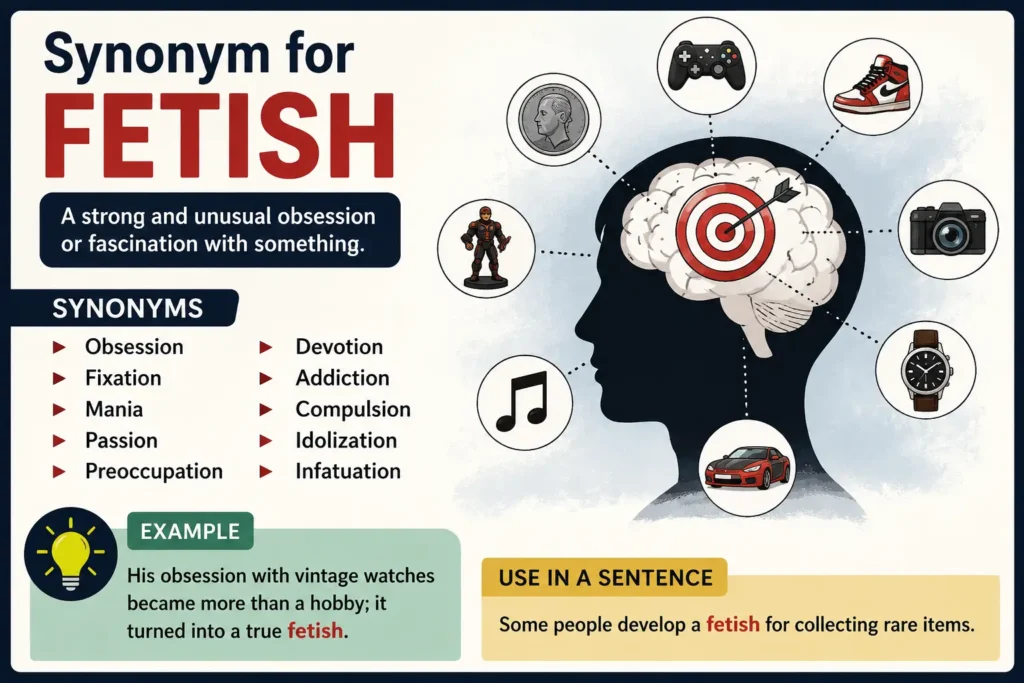
The word refers to an extraordinarily strong obsession, devotion, or fixated attraction toward a specific object, idea, or activity. In modern usage, it often describes an intense, irrational commitment to something that absorbs a person’s attention.
Native speakers use this word in both psychological contexts and informal conversations. It often carries an intense, absorbed, or slightly unusual emotional tone depending on how it is spoken.
In English, the word functions primarily as a noun.
Definition: An excessive, irrational, or deeply fixated devotion or attachment to a specific object, desire, or activity.
Connotative Meaning
(Connotation means the cultural, emotional, or secondary meaning that a word carries beyond its literal dictionary definition.)
- Positive tone: Represents deep passion, artistic dedication, or extreme commitment to craftsmanship.
- Negative tone: Implies an unhealthy obsession, irrational fixation, or compulsive compulsion.
- Neutral tone: Describes a simple psychological preference, habit, or strong personal interest.
Etymology
The word originates from the Portuguese word feitiço, meaning “charm” or “sorcery,” which traces back to the Latin facticius (“artificial” or “made by art”). Portuguese traders in the 15th century used it to describe physical objects worshipped by native West Africans.
- Old English (450–1100): Not present in the language; early Germanic terms focused on physical charms or talismans.
- Middle English (1100–1500): The concept existed through Latin religious texts, but the specific English word had not yet formed.
- Modern English (1500–Present): Entered English in the 1700s to describe physical idols, later evolving into psychological terms in the late 19th and 20th centuries.
Pronunciation
- US: /ˈfɛt.ɪʃ/
- UK: /ˈfet.ɪʃ/
Syllables
- Syllable Break: fet-ish
- Affixation Pattern: Root-based noun with historical suffixation.
- Root: fait- (Latin facere, meaning “to make”)
- Prefix: None
- Suffix: -ish (derived from the Portuguese/French ending -iche)
Synonyms List
Fixation (Noun) — US: /fɪkˈseɪ.ʃən/ | UK: /fɪkˈseɪ.ʃən/
- Meaning: An unhealthy or obsessive preoccupation with a single idea or object.
- Tone/Register: Neutral, Academic, Psychological
- Example: Her fixation on perfection made her rewrite the report five times. He developed a fixation on collecting vintage mechanical watches.
Obsession (Noun) — US: /əbˈsɛʃ.ən/ | UK: /əbˈseʃ.ən/
- Meaning: A persistent idea or desire that continuously fills a person’s mind.
- Tone/Register: Neutral, Informal, General
- Example: His obsession with fitness keeps him in the gym for hours daily. She turned her obsession with baking into a profitable business.
Mania (Noun) — US: /ˈmeɪ.ni.ə/ | UK: /ˈmeɪ.ni.ə/
- Meaning: An excessive enthusiasm, craze, or intense obsession shared by many or held individually.
- Tone/Register: Informal, Dramatic
- Example: The new video game sparked an absolute mania among teenagers. His mania for collecting stamps started when he was seven.
Compulsion (Noun) — US: /kəmˈpʌl.ʃən/ | UK: /kəmˈpʌl.ʃən/
- Meaning: An irresistible urge to behave in a certain way, often despite one’s better judgment.
- Tone/Register: Formal, Psychological
- Example: She felt a strong compulsion to double-check the lock on the front door. His impulse to organize books by color became a daily compulsion.
Passion (Noun) — US: /ˈpæʃ.ən/ | UK: /ˈpæʃ.ən/
- Meaning: A powerful or compelling emotion or enthusiasm for an activity.
- Tone/Register: Positive, General
- Example: Teaching young children has always been her main passion. He paints landscape scenery with incredible passion every weekend.
Preoccupation (Noun) — US: /priːˌɑː.kjəˈpeɪ.ʃən/ | UK: /priːˌɒk.jʊˈpeɪ.ʃən/
- Meaning: A state where someone’s mind is completely dominated by a specific thought.
- Tone/Register: Formal, Written
- Example: His continuous preoccupation with safety made him plan every detail carefully. Her primary preoccupation during college was achieving top marks.
Infatuation (Noun) — US: /ɪnˌfætʃ.uˈeɪ.ʃən/ | UK: /ɪnˌfætʃ.uˈeɪ.ʃən/
- Meaning: An intense but short-lived passion or admiration for someone or something.
- Tone/Register: Neutral, Informal
- Example: His interest in guitar turned out to be just a temporary infatuation. Her infatuation with French cinema inspired her to study abroad.
Fascination (Noun) — US: /ˌfæs.əˈneɪ.ʃən/ | UK: /ˌfæs.ɪˈneɪ.ʃən/
- Meaning: The state of being extremely interested or captivated by something.
- Tone/Register: Positive, General
- Example: The young boy looked at the night sky with total fascination. Her fascination with marine biology started on a family beach trip.
Craze (Noun) — US: /kreɪz/ | UK: /kreɪz/
- Meaning: Something that is extremely popular for a short period of time.
- Tone/Register: Informal, Casual
- Example: The latest dance trend became a huge craze on social media. Organic smoothie bowls were the biggest food craze last summer.
Weakness (Noun) — US: /ˈwiːk.nəs/ | UK: /ˈwiːk.nəs/
- Meaning: A strong inclination or fondness that is difficult to resist.
- Tone/Register: Informal, Conversational
- Example: Fresh chocolate chip cookies are my absolute weakness. He has a major weakness for expensive Italian leather shoes.
Predilection (Noun) — US: /ˌprɛd.əlˈɛk.ʃən/ | UK: /ˌpriː.dɪˈlɛk.ʃən/
- Meaning: A special liking or preference for something specific.
- Tone/Register: Formal, Literary
- Example: She has a strong predilection for classical piano compositions. The author showed a predilection for setting stories in historical towns.
Penchant (Noun) — US: /ˈpɛn.tʃənt/ | UK: /ˈpɒ̃.ʃɒ̃/
- Meaning: A strong or habitual liking for something or tendency to do something.
- Tone/Register: Formal, Written
- Example: He has a penchant for making sudden travel plans on weekends. Her penchant for dramatic storytelling made her popular among friends.
Inclination (Noun) — US: /ˌɪn.kləˈneɪ.ʃən/ | UK: /ˌɪn.klɪˈneɪ.ʃən/
- Meaning: A person’s natural tendency or urge to act or feel in a particular way.
- Tone/Register: Formal, Business
- Example: My initial inclination was to refuse the extra workload. She showed a strong natural inclination toward mathematics.
Partiality (Noun) — US: /ˌpɑːr.ʃiˈæl.ə.t̬i/ | UK: /ˌpɑː.ʃiˈæl.ə.ti/
- Meaning: A particular fondness, preference, or favorable bias toward something.
- Tone/Register: Formal, Academic
- Example: The judge maintained strict fairness, showing no partiality to either side. He admitted his partiality toward spicy food.
Propensity (Noun) — US: /prəˈpɛn.sə.t̬i/ | UK: /prəˈpɛn.sə.ti/
- Meaning: An innate inclination or natural tendency to behave in a particular way.
- Tone/Register: Formal, Academic
- Example: He has a propensity to talk quickly when he feels nervous. The research showed a natural propensity for trees to lean toward sunlight.
Enthusiasm (Noun) — US: /ɪnˈθuː.zi.æz.əm/ | UK: /ɪnˈθjuː.zi.æz.əm/
- Meaning: Intense and eager enjoyment, interest, or approval.
- Tone/Register: Positive, General
- Example: She joined the new community project with incredible enthusiasm. His enthusiasm for learning code helped him finish the course early.
Idée Fixe (Noun) — US: /ˌiː.deɪ ˈfiːks/ | UK: /ˌiː.deɪ ˈfiːks/
- Meaning: An idea that dominates one’s mind completely; an obsession.
- Tone/Register: Literary, Formal
- Example: Winning the marathon became an absolute idée fixe for the athlete. The politician made lower taxes his primary idée fixe during campaigns.
Idolatry (Noun) — US: /aɪˈdɑː.lə.tri/ | UK: /aɪˈdɒl.ə.tri/
- Meaning: Extreme admiration, love, or reverence for something or someone.
- Tone/Register: Formal, Literary
- Example: The young fans treated the singer with near idolatry. His total idolatry of money ruined his personal relationships.
Custom (Noun) — US: /ˈkʌs.təm/ | UK: /ˈkʌs.təm/
- Meaning: A traditional and widely accepted way of behaving or doing something.
- Tone/Register: Neutral, General
- Example: It is a local custom to remove shoes before entering a home. Her family maintained the custom of gathering for Sunday lunch.
Habit (Noun) — US: /ˈhæb.ɪt/ | UK: /ˈhæb.ɪt/
- Meaning: A settled or regular tendency or practice, especially one that is hard to give up.
- Tone/Register: Neutral, Everyday
- Example: Drinking green tea in the morning is a healthy daily habit. He tried hard to break the habit of checking his phone late at night.
Addiction (Noun) — US: /əˈdɪk.ʃən/ | UK: /əˈdɪk.ʃən/
- Meaning: A strong, harmful compulsion to use a substance or engage in an activity.
- Tone/Register: Serious, Clinical, Informal
- Example: Video game addiction can negatively affect sleep schedules. Her addiction to reading kept her up until early morning hours.
Craving (Noun) — US: /ˈkreɪ.vɪŋ/ | UK: /ˈkreɪ.vɪŋ/
- Meaning: A powerful desire or urgent need for something specific.
- Tone/Register: Informal, Everyday
- Example: She suddenly felt an intense craving for dark chocolate cake. His craving for adventure led him to go backpacking alone.
Monomania (Noun) — US: /ˌmɑː.noʊˈmeɪ.ni.ə/ | UK: /ˌmɒn.əʊˈmeɪ.ni.ə/
- Meaning: Exaggerated or obsessive enthusiasm for or preoccupation with one single thing.
- Tone/Register: Formal, Psychological
- Example: His focus on finishing the project turned into pure monomania. The detective pursued the case with a quiet monomania.
Zeal (Noun) — US: /ziːl/ | UK: /ziːl/
- Meaning: Great energy or enthusiasm in pursuit of a cause or an objective.
- Tone/Register: Formal, Positive
- Example: She defended her ideas with great zeal during the public debate. His zeal for environmental protection inspired his whole neighborhood.
Infatuation (Noun) — US: /ɪnˌfætʃ.uˈeɪ.ʃən/ | UK: /ɪnˌfætʃ.uˈeɪ.ʃən/
- Meaning: Foolish or extravagant love or admiration.
- Tone/Register: Neutral, Informal
- Example: The teenager experienced a quick infatuation with the famous actor. She realized her passion for the hobby was just a passing infatuation.
Fancy (Noun) — US: /ˈfæn.si/ | UK: /ˈfæn.si/
- Meaning: A superficial or fleeting liking or attraction to something.
- Tone/Register: Informal, Conversational
- Example: He took a sudden fancy to painting watercolor landscapes. She bought the bright pink coat on a lighthearted fancy.
Attachment (Noun) — US: /əˈtætʃ.mənt/ | UK: /əˈtætʃ.mənt/
- Meaning: An affection or fondness for someone or something specific.
- Tone/Register: Neutral, General
- Example: He has a deep emotional attachment to his old childhood house. Her attachment to her trusty laptop made her hesitate to upgrade.
Bias (Noun) — US: /ˈbaɪ.əs/ | UK: /ˈbaɪ.əs/
- Meaning: An inclination or preference toward one thing over another.
- Tone/Register: Neutral, Professional
- Example: The hiring panel showed a clear bias toward experienced candidates. Her personal bias influenced how she reviewed the new book.
Hunger (Noun) — US: /ˈhʌŋ.ɡɚ/ | UK: /ˈhʌŋ.ɡə/
- Meaning: A strong, eager desire or ambition for something.
- Tone/Register: Expressive, Informal
- Example: The young athlete showed a true hunger for success in every match. Her hunger for knowledge drove her to read three books weekly.
Thirst (Noun) — US: /θɝːst/ | UK: /θɜːst/
- Meaning: A strong desire or craving for a specific experience or goal.
- Tone/Register: Expressive, Literary
- Example: The explorer had an unquenchable thirst for discovery and adventure. His thirst for justice made him pursue a career in human rights law.
Affinity (Noun) — US: /əˈfɪn.ə.t̬i/ | UK: /əˈfɪn.ə.ti/
- Meaning: A natural liking for or understanding of a person, thing, or idea.
- Tone/Register: Formal, Positive
- Example: She felt a natural affinity for foreign languages from an early age. His affinity for animals made him choose a career as a veterinarian.
Hype (Noun) — US: /haɪp/ | UK: /haɪp/
- Meaning: Extravagant or intensive publicity or excitement surrounding something.
- Tone/Register: Informal, Modern
- Example: The new smartphone model did not live up to all the internet hype. Despite the hype around the movie, the story was quite simple.
Fascination (Noun) — US: /ˌfæs.əˈneɪ.ʃən/ | UK: /ˌfæs.ɪˈneɪ.ʃən/
- Meaning: Strong interest that holds someone’s complete attention.
- Tone/Register: Positive, General
- Example: His fascination with space exploration began after visiting the planetarium. Ancient history remains a source of endless fascination for her.
Hobbyism (Noun) — US: /ˈhɑː.bi.ɪz.əm/ | UK: /ˈhɒb.i.ɪz.əm/
- Meaning: Casual or serious devotion to pursuing personal hobbies.
- Tone/Register: Informal, Neutral
- Example: His weekend hobbyism includes building elaborate model train sets. She balanced professional work with active personal hobbyism.
Passionate Pursuit (Noun) — US: /ˈpæʃ.ən.ət pɚˈsuːt/ | UK: /ˈpæʃ.ən.ət pəˈsjuːt/
- Meaning: An activity done with high energy, enthusiasm, and focus.
- Tone/Register: Formal, Expressive
- Example: Photography grew from a simple weekend activity into a passionate pursuit. Her passionate pursuit of medical research saved many lives.
Devotion (Noun) — US: /dɪˈvoʊ.ʃən/ | UK: /dɪˈvəʊ.ʃən/
- Meaning: Great love, loyalty, or enthusiasm for a cause, activity, or person.
- Tone/Register: Formal, Positive
- Example: Her total devotion to her family was clear in everything she did. The team showed incredible devotion during the tough training season.
Worship (Noun) — US: /ˈwɝː.ʃɪp/ | UK: /ˈwɜː.ʃɪp/
- Meaning: Feeling or showing extreme devotion, admiration, or respect.
- Tone/Register: Formal, Strong
- Example: His deep worship of classical literature inspired his career as an English professor. The young fan’s idol worship was evident in his bedroom wall posters.
Liking (Noun) — US: /ˈlaɪ.kɪŋ/ | UK: /ˈlaɪ.kɪŋ/
- Meaning: A feeling of regard, fondness, or preference for something.
- Tone/Register: Informal, Casual
- Example: She expressed a strong liking for quiet coffee shops in the morning. The chef adjusted the recipe to suit the customer’s personal liking.
Bent (Noun) — US: /bɛnt/ | UK: /bɛnt/
- Meaning: A natural talent, inclination, or preference for something specific.
- Tone/Register: Formal, Literary
- Example: The student demonstrated a strong artistic bent in her design projects. His analytical bent helped him solve complex software bugs quickly.
Urge (Noun) — US: /ɝːdʒ/ | UK: /ɜːdʒ/
- Meaning: A strong desire or impulse to do something immediately.
- Tone/Register: Informal, Everyday
- Example: He fought the sudden urge to buy expensive shoes online. She felt a deep urge to travel and explore new places.
Habituation (Noun) — US: /həˌbɪtʃuˈeɪ/ɪ.ʃən/ | UK: /həˌbɪtʃ.uˈeɪ.ʃən/
- Meaning: The process of becoming accustomed to something over time.
- Tone/Register: Formal, Scientific
- Example: Daily habituation to noise helps city dwellers sleep comfortably. His long habituation to routine made sudden change difficult for him.
Tendency (Noun) — US: /ˈtɛn.dən.si/ | UK: /ˈten.dən.si/
- Meaning: An inclination toward a particular characteristic or type of behavior.
- Tone/Register: Neutral, Professional
- Example: She has a strong tendency to overthink small decisions. Prices show a steady tendency to rise during peak holiday seasons.
Crazing (Noun) — US: /ˈkreɪ.zɪŋ/ | UK: /ˈkreɪ.zɪŋ/
- Meaning: A state of intense, temporary excitement or preference.
- Tone/Register: Informal, Rare
- Example: The sudden crazing for vintage clothing swept through the school. His temporary crazing for board games lasted only a few weeks.
Fondness (Noun) — US: /ˈfɑːnd.nəs/ | UK: /ˈfɒnd.nəs/
- Meaning: Affection or liking for someone or something.
- Tone/Register: Warm, Positive
- Example: She remembers her high school teacher with great personal fondness. His fondness for spicy street food grew during his travels.
Intoxication (Noun) — US: /ɪnˌtɑːk.səˈkeɪ.ʃən/ | UK: /ɪnˌtɒk.sɪˈkeɪ.ʃən/
- Meaning: A state of overwhelming excitement, passion, or emotional obsession.
- Tone/Register: Expressive, Literary
- Example: The pure intoxication of victory made the team celebrate all night. She fell under the intoxication of the live musical performance.
Synonyms by Tone
Choosing the right tone prevents misunderstandings in your writing.
Positive Tone
- Passion: Highlights healthy energy and creativity.
- Fascination: Shows curious, intellectual interest.
- Devotion: Focuses on loyalty and commitment.
Neutral Tone
- Fixation: Indicates a focused mind without judgment.
- Inclination: Expresses a natural, simple preference.
- Habit: Refers to daily routines.
Negative Tone
- Obsession: Implies an unhealthy mental burden.
- Monomania: Suggests extreme, narrow focus.
- Compulsion: Means feeling forced by an uncontrollable urge.
Playful or Informal Tone
- Weakness: Softens an excessive desire into a relatable trait.
- Craze: Describes temporary social trends.
- Fancy: Suggests a lighthearted interest.
Mini Comparison
Fetish vs. Obsession
- Meaning Difference: A fetish involves an intense, fixated attachment often tied to specific physical objects or highly specialized desires. An obsession is any overwhelming thought that occupies your mind continuously.
- Tone Difference: Fetish can carry stronger psychological or quirky connotations, whereas obsession is widely accepted in casual contexts.
- When to Use Each: Use obsession for everyday hobbies (“his obsession with sports”). Use fetish when emphasizing an extreme, specialized, or physical fixation.
Fetish vs. Predilection
- Meaning Difference: A predilection is a natural preference or favorable bias. A fetish goes beyond preference into deep fixation.
- Tone Difference: Predilection sounds formal and intellectual; fetish feels dramatic or psychological.
- When to Use Each: Use predilection in formal academic essays (“a predilection for history”). Use fetish when describing an intense attachment.
Context-Based Usage
- Daily Conversation: Use light options like weakness, habit, or fancy. Say, “I have a weakness for ice cream,” instead of using complex terms.
- Writing or Blogging: Choose expressive words like fascination, craze, or passion to keep readers engaged without sounding overly clinical.
- Professional Tone: Opt for predilection, inclination, or propensity in emails or business reports to maintain neutrality.
- Creative Writing: Use terms like monomania, idée fixe, or infatuation to create rich character descriptions in stories.
Common Mistakes & Native Usage
- Misuse Scenarios: Avoid using fetish in formal business settings when you simply mean a preference. Saying a client has a “fetish for clean slides” sounds inappropriate; use “strong preference” instead.
- Confusing Tone: Do not mix up passion (positive) with monomania (unhealthy focus) when praising a colleague’s hard work.
- Overuse Warnings: Repeating obsession frequently makes writing repetitive. Vary your choice using words like penchant or fixation.
Register Notes:
- Formal vs. Informal: Words like predilection belong in writing, while weakness works best in casual conversation.
- Spoken vs. Written: Craze is common in spoken English, whereas idée fixe appears mostly in literature.
For more helpful guides on related vocabulary terms, check out our core English vocabulary resources.
Real-Life Mini Scenarios
- Workplace: A designer has a penchant for minimal layouts, choosing clean lines for every project.
- Social Situations: A friend reveals her weakness for vintage clothes whenever she goes shopping.
- Media & Pop Culture: The latest online video sparked a global craze among viewers.
- Storytelling: The main character developed a monomania for finding the lost treasure map.
Interactive Practice Quiz
- Which synonym best fits a formal academic essay describing a natural preference?
A) Weakness
B) Predilection
C) Craze
D) Hype - Choose the option with a positive emotional tone:
A) Monomania
B) Compulsion
C) Fascination
D) Fixation - “She has a major _______ for warm chocolate cookies.” Which word fits best casually?
A) Idée fixe
B) Predilection
C) Weakness
D) Habituation - What is the main difference between an obsession and a predilection?
A) Predilection is negative; obsession is positive
B) Obsession is intense and consuming; predilection is a gentle preference
C) They mean the same thing
D) Predilection is only used in medical settings - Which word best describes a short-lived trend popular among teenagers?
A) Monomania
B) Craze
C) Affinity
D) Inclination - Select the most appropriate word for a psychological clinical context:
A) Fancy
B) Weakness
C) Compulsion
D) Liking - Choose the term that best suits creative storytelling about a driven detective:
A) Idée fixe
B) Custom
C) Bias
D) Habit - Which word is informal and highlights a harmless desire?
A) Propensity
B) Partiality
C) Fancy
D) Habituation - “His natural _______ to save money helped him buy a home early.”
A) Craze
B) Inclination
C) Hype
D) Mania - Which word carries a strong literary connotation of extreme devotion?
A) Idolatry
B) Liking
C) Habit
D) Bias
Application Task: Write one short sentence describing your main hobby using the word passion or fascination.
Answer Key: 1-B, 2-C, 3-C, 4-B, 5-B, 6-C, 7-A, 8-C, 9-B, 10-A
FAQs
1. What is the most common synonym for fetish in everyday conversation?
The most common casual alternative is obsession or fixation. People also frequently use terms like weakness or passion when speaking informally about a strong preference or personal interest.
2. Is fetish always negative in modern English?
No, it depends entirely on context. While it can imply an irrational or excessive fixation in psychological contexts, it is often used informally to highlight intense enthusiasm, harmless hobbies, or creative artistic focus.
3. Which formal word should I use in business writing instead of fetish?
In professional or corporate environments, use terms such as strong preference, predilection, inclination, or penchant. These alternatives convey focused interest without sounding overly dramatic or personal.
4. How does fixation differ from a fetish?
A fixation refers broadly to an idea, activity, or thought that dominates someone’s attention. A fetish typically implies a more intense, highly specialized, or object-centered attachment.
5. What is a literary alternative for an intense obsession?
Literary alternatives include idée fixe, monomania, or idolatry. Authors use these expressions to convey deep emotional depth or character fixations in creative writing.
Conclusion
Expanding your vocabulary with a precise synonym for fetish helps you express complex ideas clearly across all types of written communication.
Mastering a proper synonym for fetish makes your essays, blog posts, and daily conversations far more vivid, engaging, and polished.
Choosing the right synonym for fetish allows you to communicate exact emotional tones without relying on repetitive or overused phrasing.
Try incorporating words like penchant, fascination, or predilection into your next email or journal entry to build real writing confidence today!

Sophia Carter is the founder and lead writer at SynonymVerse.com, a trusted online resource dedicated to English vocabulary and effective communication. She is passionate about helping students, writers, professionals, and lifelong learners find the most accurate words to express their ideas with clarity and confidence.
At SynonymVerse.com, every article is carefully researched and thoughtfully written to provide reliable guidance on synonyms, word meanings, and vocabulary. With a strong focus on accuracy, real-world usage, and easy-to-understand explanations, the website is committed to helping readers strengthen their language skills, enrich their vocabulary, and become more confident communicators.