
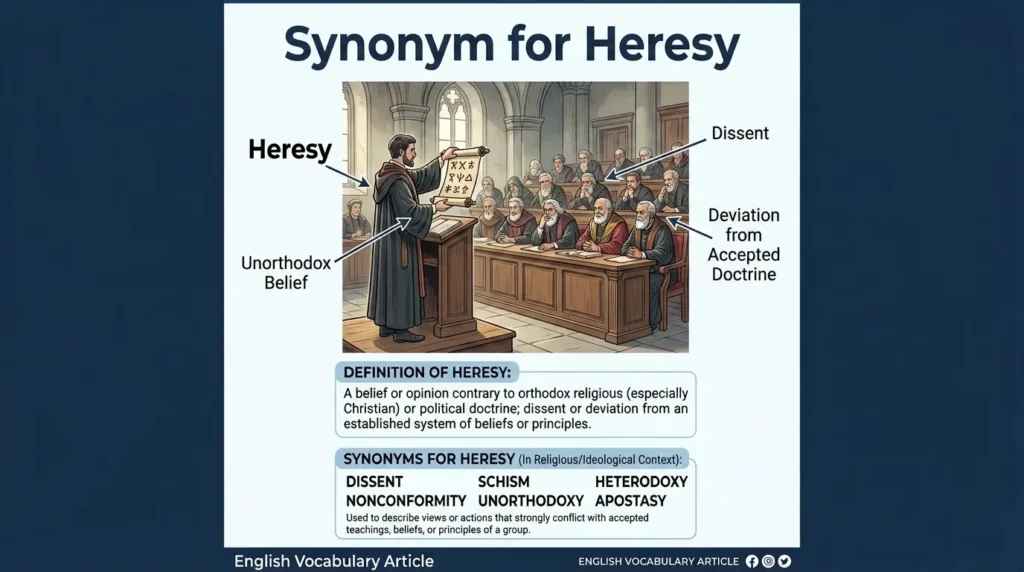
A synonym for “heresy” can transform your writing instantly when you need to describe radical ideas. Imagine proposing a completely remote workforce model thirty years ago; traditional managers would have called your idea complete madness.
A real-life example is Galileo’s claim that the Earth revolved around the Sun, which earned him house arrest for spreading dangerous ideas. Using a synonym for heresy helps writers express precise levels of dissent, nonconformity, or radical thinking without repeating the same word.
This word appears frequently in historical texts, political debates, modern tech discussions, and philosophical essays. Mastering a synonym for heresy empowers students, bloggers, content writers, and daily English speakers to communicate complex ideas with sharpness and authority.
What Does “Heresy” Really Mean?
At its core, “heresy” refers to an opinion, belief, or theory that strongly contradicts established religious doctrines, accepted authority, or traditional societal standards.
The emotional tone associated with heresy is generally critical, dramatic, or confrontational, implying a deliberate break from accepted truth. Native English speakers understand it as an act of intellectual or moral rebellion against an orthodox system.
You will encounter this term in historical narratives, religious studies, political commentary, and modern workplace debates regarding disruptive ideas.
- Part of Speech: Noun
- Definition: A belief or opinion that runs counter to official, established, or accepted doctrines and beliefs.
Connotative Meaning
Connotation is the emotional or cultural association attached to a word beyond its literal definition.
- Positive tone: Bold intellectual innovation, independent thinking, breaking free from outdated dogmas.
- Negative tone: Dangerous rebellion, traitorous ideas, malicious subversion of order.
- Neutral tone: Deviant ideology, non-standard opinion, alternative viewpoint.
Etymology
The word originates from the Ancient Greek word hairesis, meaning “choice” or “thing chosen.” It later shifted through Vulgar Latin haeresis to Old French eresie, acquiring the context of holding unorthodox views.
- Old English (450–1100): The concept existed mainly through Latin religious texts introduced by monks.
- Middle English (1100–1500): Borrowed from Old French as heresie, explicitly describing religious dissent.
- Modern English (1500–Present): Expanded beyond religious contexts to include secular, political, and cultural dissent.
Pronunciation
- US: /ˈhɛr.ə.si/
- UK: /ˈher.ə.si/
Syllables
her-e-sy
Affixation Pattern
- Root: Heres (from Greek hairesis)
- Prefix: None
- Suffix: -y (noun-forming suffix)
Synonyms List
Unorthodoxy (Noun) — US: /ʌnˈɔːr.θə.dɑːk.si/ | UK: /ʌnˈɔː.θə.dɒk.si/
- Meaning: A belief or behavior that strays away from established rules and traditional standards.
- Tone/Register: Formal, Academic
- Example: His unorthodoxy in economic theory challenged every senior professor in the faculty. She embraced unorthodoxy by refusing to follow the standard corporate career path.
Heterodoxy (Noun) — US: /ˈhɛt.ər.ə.dɑːk.si/ | UK: /ˈhet.ər.ə.dɒk.si/
- Meaning: Any opinion or doctrine that differs from an official, established standard.
- Tone/Register: Formal, Scholarly
- Example: The scientist published a paper rooted in biological heterodoxy that shocked her peers. Political heterodoxy often faces quiet pushback from mainstream party members.
Dissent (Noun) — US: /dɪˈsɛnt/ | UK: /dɪˈsent/
- Meaning: The expression or holding of opinions at variance with those previously, commonly, or officially held.
- Tone/Register: Formal, Legal, Serious
- Example: Quiet dissent began to grow among the board members regarding the new budget plan. Public dissent was swiftly contained by the local authorities during the rally.
Nonconformity (Noun) — US: /ˌnɑːn.kənˈfɔːr.mə.ti/ | UK: /ˌnɒn.kənˈfɔː.mə.ti/
- Meaning: Refusal to conform to prevailing rule, custom, practice, or conventional behavior.
- Tone/Register: Neutral, Everyday, Professional
- Example: Her persistent nonconformity made her stand out in a company full of traditional thinkers. Artistic nonconformity is often the driving force behind major creative breakthroughs.
Apostasy (Noun) — US: /əˈpɑː.stə.si/ | UK: /əˈpɒs.tə.si/
- Meaning: The formal abandonment or renunciation of a religious or political principle.
- Tone/Register: Very Formal, Religious, Serious
- Example: Leaving the political party was viewed as pure apostasy by his longtime loyal voters. Ancient empires often punished political apostasy with immediate exile.
Dissidence (Noun) — US: /ˈdɪs.ə.dəns/ | UK: /ˈdɪs.ɪ.dəns/
- Meaning: Protest against official policy, ideology, or established authority.
- Tone/Register: Formal, Political
- Example: Underground dissidence slowly weakened the stability of the oppressive regime. The editorial sparked a wave of political dissidence across university campuses.
Schism (Noun) — US: /ˈsɪz.əm/ | UK: /ˈskɪz.əm/
- Meaning: A formal split or division between strongly opposed sections or parties.
- Tone/Register: Formal, Historical
- Example: A bitter schism erupted inside the tech startup over software ownership rights. The theological schism split the religious community into two separate factions.
Iconoclasm (Noun) — US: /aɪˈkɑː.nə.klæz.əm/ | UK: /aɪˈkɒn.ə.klæz.əm/
- Meaning: The action of attacking or rejecting cherished beliefs and traditional values.
- Tone/Register: Formal, Cultural, Intellectual
- Example: His pure iconoclasm destroyed decades of lazy design standards in the automotive field. She brought a refreshing spirit of iconoclasm to the quiet academic conference.
Revisionism (Noun) — US: /rɪˈvɪʒ.ə.nɪz.əm/ | UK: /rɪˈvɪʒ.ən.ɪz.əm/
- Meaning: The advocacy of revision or alteration of an accepted doctrine or historical view.
- Tone/Register: Academic, Political
- Example: Critics accused the author of historical revisionism regarding the war accounts. Economic revisionism reshaped how the government handled local market regulations.
Infidelity (Noun) — US: /ˌɪn.fɪˈdɛl.ə.ti/ | UK: /ˌɪn.fɪˈdel.ə.ti/
- Meaning: Unfaithfulness to a moral obligation, belief system, or core religious faith.
- Tone/Register: Formal, Moral
- Example: In historical contexts, intellectual infidelity to the state church was severely punished. He viewed changing his lifelong core philosophy as a personal infidelity.
Miscreancy (Noun) — US: /ˈmɪs.kri.ən.si/ | UK: /ˈmɪs.kri.ən.si/
- Meaning: Depraved or villainous behavior that violates accepted moral standards.
- Tone/Register: Archaic, Formal, Literary
- Example: The old village court accused the group of moral miscreancy and lawlessness. Ancient texts often associated philosophical deviation with general miscreancy.
Defiance (Noun) — US: /dɪˈfaɪ.əns/ | UK: /dɪˈfaɪ.əns/
- Meaning: Open resistance or bold disobedience toward authority.
- Tone/Register: General, Dramatic
- Example: The manager viewed the employee’s sudden refusal to sign as direct defiance. Her speech was a fiery act of defiance against unfair company regulations.
Rebelliousness (Noun) — US: /rɪˈbɛl.jəs.nəs/ | UK: /rɪˈbel.jəs.nəs/
- Meaning: A disposition to resist authority, control, or conventional norms.
- Tone/Register: Informal to General
- Example: Teenage rebelliousness often manifests as testing established household rules. His creative rebelliousness resulted in groundbreaking rock music albums.
Mutiny (Noun) — US: /ˈmjuː.tən.i/ | UK: /ˈmjuː.tɪ.ni/
- Meaning: An open rebellion against proper authorities, especially by soldiers or sailors.
- Tone/Register: Dramatic, Historical, Formal
- Example: The crew planned a secret mutiny against the tyrannical ship captain. A workplace mutiny unfolded when the CEO cancelled annual staff bonuses.
Insurgency (Noun) — US: /ɪnˈsɝː.dʒən.si/ | UK: /ɪnˈsɜː.dʒən.si/
- Meaning: An active revolt or rebellion against a constituted government or authority.
- Tone/Register: Formal, Political, News
- Example: The political movement turned into an active insurgency within weeks. Leadership struggled to suppress the growing internal insurgency among board members.
Subversion (Noun) — US: /səbˈvɝː.ʒən/ | UK: /səbˈvɜː.ʃən/
- Meaning: The attempt to weaken or destroy an established system or institution.
- Tone/Register: Formal, Political
- Example: The book was banned for suspected subversion of traditional family ideals. Cybersecurity teams monitor networks to prevent systemic subversion.
Impiety (Noun) — US: /ɪmˈpaɪ.ə.ti/ | UK: /ɪmˈpaɪ.ə.ti/
- Meaning: Lack of piety, reverence, or respect for sacred things or social norms.
- Tone/Register: Formal, Literary
- Example: Shouting during the silent memorial service was seen as the utmost impiety. Historical texts criticized the young philosopher for public impiety.
Sacrilege (Noun) — US: /ˈsæk.rə.lɪdʒ/ | UK: /ˈsæk.rɪ.lɪdʒ/
- Meaning: Violation or misuse of what is regarded as sacred, special, or essential.
- Tone/Register: Dramatic, Serious
- Example: Replacing fresh coffee beans with instant powder felt like complete sacrilege to him. Removing the antique artwork from the cathedral was viewed as sacrilege.
Blasphemy (Noun) — US: /ˈblæs.fə.mi/ | UK: /ˈblæs.fə.mi/
- Meaning: Great disrespect shown to God, sacred things, or deeply held norms.
- Tone/Register: Formal, Religious, High-Dramatic
- Example: Suggesting that pizza is overrated is absolute blasphemy in Italy. The court considered his controversial public remarks to be pure blasphemy.
Deviation (Noun) — US: /ˌdiː.viˈeɪ.ʃən/ | UK: /ˌdiː.viˈeɪ.ʃən/
- Meaning: A noticeable departure from an accepted standard, route, or standard topic.
- Tone/Register: Neutral, Technical, Professional
- Example: Any structural deviation from the official blueprint could cause safety hazards. Her research showed a significant deviation from long-standing market trends.
Nonconformism (Noun) — US: /ˌnɑːn.kənˈfɔːr.mɪz.əm/ | UK: /ˌnɒn.kənˈfɔː.mɪz.əm/
- Meaning: The practice of refusing to comply with prevailing norms, habits, or laws.
- Tone/Register: Formal, Sociological
- Example: The artist’s lifelong nonconformism inspired an entire generation of indie filmmakers. Strict corporate settings rarely tolerate deliberate nonconformism.
Radicalism (Noun) — US: /ˈræd.ɪ.kəl.ɪz.əm/ | UK: /ˈræd.ɪ.kəl.ɪz.əm/
- Meaning: The beliefs or actions of people who advocate thorough political or social reform.
- Tone/Register: Academic, Political
- Example: His political radicalism frightened conservative investors away from funding the project. Early tech founders brought a distinct radicalism to computing solutions.
Disobedience (Noun) — US: /ˌdɪs.əˈbiː.di.əns/ | UK: /ˌdɪs.əˈbiː.di.əns/
- Meaning: Failure or refusal to obey rules, laws, or someone in authority.
- Tone/Register: Neutral, Everyday
- Example: Civil disobedience has played a crucial role in expanding fundamental human rights. The dog received extra training due to persistent disobedience at home.
Insubordination (Noun) — US: /ˌɪn.sə.bɔːr.dəˈneɪ.ʃən/ | UK: /ˌɪn.sə.bɔː.dɪˈneɪ.ʃən/
- Meaning: Refusal to obey orders given by an official superior in rank.
- Tone/Register: Formal, Workplace, Military
- Example: Yelling at the general manager led to an immediate suspension for insubordination. Military law strictly penalizes any form of deliberate insubordination.
Renegadism (Noun) — US: /ˈrɛn.ɪ.ɡeɪd.ɪz.əm/ | UK: /ˈren.ɪ.ɡeɪd.ɪz.əm/
- Meaning: The conduct or state of abandoning an organization, cause, or set of principles.
- Tone/Register: Formal, Literary
- Example: His sudden political renegadism surprised long-time party supporters. The movement collapsed due to internal friction and growing renegadism.
Treason (Noun) — US: /ˈtriː.zən/ | UK: /ˈtriː.zən/
- Meaning: The crime of betraying one’s country or core institution, especially by helping enemies.
- Tone/Register: Legal, High-Dramatic
- Example: Selling military secrets to foreign competitors constitutes clear treason. Sharing confidential company code was viewed as corporate treason.
Perversity (Noun) — US: /pɚˈvɝː.sə.ti/ | UK: /pəˈvɜː.sə.ti/
- Meaning: A deliberate desire to behave unreasonably or unacceptably.
- Tone/Register: Formal, Psychological
- Example: Out of sheer perversity, he argued against the obvious solution during the meeting. Her persistent perversity made group problem-solving sessions very challenging.
Contumacy (Noun) — US: /ˈkɑːn.tə.mə.si/ | UK: /ˈkɒn.tjʊ.mə.si/
- Meaning: Stubborn refusal to obey authority, especially in a legal setting.
- Tone/Register: Archaic, Legal
- Example: The judge cited the defendant for willful contumacy after he refused to answer. Historical trials often punished legal contumacy with immediate imprisonment.
Recalcitrance (Noun) — US: /rɪˈkæl.sə.trəns/ | UK: /rɪˈkæl.sɪ.trəns/
- Meaning: Obstinate uncooperativeness or resistance toward authority and discipline.
- Tone/Register: Formal, Professional
- Example: The employee’s recalcitrance slowed down the entire department’s progress. Overcoming bureaucratic recalcitrance took months of negotiating effort.
Unconventionality (Noun) — US: /ˌʌn.kən.vɛn.ʃəˈnæ.lə.ti/ | UK: /ˌʌn.kən.ven.ʃənˈæl.ə.ti/
- Meaning: The quality of not conforming to accepted rules, standards, or traditions.
- Tone/Register: Neutral, Positive
- Example: The team loved the unconventionality of her marketing campaigns. His unconventionality as a leader brought modern energy to the old firm.
Irreverence (Noun) — US: /ɪˈrɛv.ɚ.əns/ | UK: /ɪˈrev.ər.əns/
- Meaning: A lack of respect for people or things that are generally taken seriously.
- Tone/Register: Lighthearted to Neutral
- Example: The comedian’s refreshing irreverence toward politicians won over the live audience. She approached the strict historical rules with a touch of youthful irreverence.
Sectarianism (Noun) — US: /sɛkˈtɛr.i.ə.nɪz.əm/ | UK: /sekˈteə.ri.ə.nɪz.əm/
- Meaning: Excessive attachment to a particular sect, group, or faction, leading to division.
- Tone/Register: Formal, Political, Religious
- Example: Rigid sectarianism prevented the two community groups from reaching a consensus. The region struggled for decades due to deep-seated political sectarianism.
Dissension (Noun) — US: /dɪˈsɛn.ʃən/ | UK: /dɪˈsen.ʃən/
- Meaning: Disagreement that leads to discord, hostility, or argument within a group.
- Tone/Register: Formal, Organizational
- Example: Internal dissension destroyed the startup before it launched its main product. The leader worked quickly to resolve any political dissension among staff.
Nonconformity (Noun) — US: /ˌnɑːn.kənˈfɔːr.mɪ.ti/ | UK: /ˌnɒn.kənˈfɔː.mɪ.ti/
- Meaning: Failure or refusal to conform to a prevailing rule or practice.
- Tone/Register: Neutral, Sociological
- Example: Modern workplace dress codes now allow for personal nonconformity. Cultural nonconformity often drives new fashion trends forward.
Defiance (Noun) — US: /dɪˈfaɪ.əns/ | UK: /dɪˈfaɪ.əns/
- Meaning: Open and bold resistance to an opposing force or authority.
- Tone/Register: General, Energetic
- Example: Standing up against the corrupt decision was a moment of true defiance. The athlete showed quiet defiance despite facing a tough opponent.
Refractoriness (Noun) — US: /rɪˈfræk.tɚ.i.nəs/ | UK: /rɪˈfræk.tər.i.nəs/
- Meaning: Hard to manage, stubborn, or unmanageable behavior.
- Tone/Register: Formal, Scientific, Psychological
- Example: The child’s behavioral refractoriness required special educational support. Management was frustrated by the ongoing refractoriness of the committee.
Outlawry (Noun) — US: /ˈaʊt.lɔː.ri/ | UK: /ˈaʊt.lɔː.ri/
- Meaning: The condition of being declared an outlaw, or defiance of societal laws.
- Tone/Register: Historical, Legal
- Example: Living in complete outlawry, the rebel group hid deep in the mountain pass. Historical sagas often romanticized acts of courageous outlawry.
Impropriety (Noun) — US: /ˌɪm.prəˈpraɪ.ə.ti/ | UK: /ˌɪm.prəˈpraɪ.ə.ti/
- Meaning: Failure to observe standards or show proper honesty, modesty, or correctness.
- Tone/Register: Formal, Business
- Example: The auditor found no financial impropriety in the company accounts. Dressing casually at the formal dinner was considered a mild impropriety.
Variance (Noun) — US: /ˈvɛr.i.əns/ | UK: /ˈveə.ri.əns/
- Meaning: The state or quality of being different, divergent, or in disagreement.
- Tone/Register: Formal, Technical
- Example: His personal opinion was at total variance with official company policy. There is a noticeable variance between the two research reports.
Non-alignment (Noun) — US: /ˌnɑːn.əˈlaɪn.mənt/ | UK: /ˌnɒn.əˈlaɪn.mənt/
- Meaning: Lack of agreement, alliance, or conformity with established factions.
- Tone/Register: Political, Formal
- Example: The country maintained a policy of strict non-alignment during the regional conflict. Her professional non-alignment allowed her to stay neutral during disputes.
Synonyms for “Heresy” by Tone
- Positive Tone (Innovation & Independent Thought): Unconventionality, Nonconformity, Iconoclasm.
- Neutral Tone (Simple Difference or Disagreement): Deviation, Dissent, Heterodoxy, Variance, Unorthodoxy.
- Negative Tone (Violation, Betrayal, or Rebellion): Blasphemy, Sacrilege, Insubordination, Treason, Apostasy, Impiety.
- Playful/Informal Tone (Mild Disobedience): Rebelliousness, Irreverence.
Understanding tone is vital because choosing a harsh word like “blasphemy” in a casual business conversation might make you sound overly aggressive, whereas “unorthodoxy” praises creative thinking.
“Heresy” vs Close Alternatives
| Word | Core Meaning | Tone & Context | When to Use |
| Heresy | Challenging established core beliefs or authority. | Dramatic, Serious, Historical | Use when an idea radically threatens standard belief systems or official rules. |
| Dissent | Holding a different opinion from the majority. | Formal, Neutral, Legal | Use in political, legal, or corporate meetings to show polite disagreement. |
| Nonconformity | Choosing not to follow common societal habits. | Neutral, Modern, Personal | Use when describing personal style, lifestyle choices, or workplace habits. |
How “Heresy” Changes by Context
In daily conversation, people often use the word playfully to describe an unpopular preference, such as preferring tea over coffee.
The writing or blogging, authors use it to grab readers’ attention when presenting revolutionary advice that disrupts traditional wisdom.
In a professional or academic tone, writers replace dramatic words like heresy with formal terms like “heterodoxy” or “unorthodoxy” to maintain scientific neutrality.
In creative storytelling, using heresy adds high stakes, building tension between rebels and established rulers within a plot.
Common Mistakes Learners Make
Learners frequently confuse “heresy” with “blasphemy.” While blasphemy specifically insults or disrespects sacred things, heresy involves holding active beliefs that contradict an official system.
Another common error is using heresy for minor mistakes, like a grammar error; reserve it for major conceptual challenges. Overusing this word in routine business emails can make simple disagreements sound like aggressive corporate conflict.
Real-Life Mini Scenarios
- Workplace: Recommending that a legacy software firm abandon its core product to focus on open-source tools was seen as pure heresy by senior directors.
- Social Situations: Saying you dislike popular movies at a film club meeting feels like cultural heresy to hardcore fans.
- Media & Pop Culture: Tech bloggers labeled the removal of physical charging ports as electronic heresy before it became industry standard.
- Storytelling: The young scholar faced trial for heresy after discovering evidence that contradicted the kingdom’s history books.
Learning new vocabulary transforms how you articulate thoughts, frame ideas, and persuade others in a professional setting.
Expanding your synonym collection ensures your writing stays engaging, precise, and expressive across any format.
Start practicing these words in your daily emails, essays, and conversations to see your communication skills skyrocket!
Interactive Practice Quiz
- Which synonym fits best when describing a legal disagreement in a courtroom?
a) Sacrilege
b) Dissent
c) Impiety
d) Mutiny - If a colleague proposes a creative, non-traditional marketing idea, which term applies positively?
a) Treason
b) Unorthodoxy
c) Subversion
d) Miscreancy - Calling a traditional recipe “terrible” in front of a famous chef is best described as:
a) Blasphemy
b) Non-alignment
c) Heterodoxy
d) Revisionism - Refusing to obey a military commander’s direct order is called:
a) Insubordination
b) Variance
c) Irreverence
d) Nonconformity - What word describes leaving a political party to join another completely?
a) Deviation
b) Apostasy
c) Contumacy
d) Impropriety - A lighthearted lack of respect toward formal traditions is called:
a) Treason
b) Irreverence
c) Recalcitrance
d) Schism - A major split within an organization into two opposing groups is a:
a) Schism
b) Deviation
c) Nonconformity
d) Variance - Which word has a strictly positive connotation for creative disruption?
a) Subversion
b) Iconoclasm
c) Outlawry
d) Perversity - What is the Ancient Greek root meaning of the word heresy?
a) Betrayal
b) Choice
c) Argument
d) Separation - Which word best suits a technical difference from standard mathematical blueprints?
a) Sacrilege
b) Deviation
c) Defiance
d) Mutiny
Application Task: Write one original sentence using the word “unorthodoxy” to describe a modern technological solution.
Answer Key:
1-b, 2-b, 3-a, 4-a, 5-b, 6-b, 7-a, 8-b, 9-b, 10-b
FAQs
What is the most common synonym for heresy in modern English?
The most versatile and common synonym for heresy in modern English is “unorthodoxy” or “dissent.” While heresy carries historical and dramatic weight, unorthodoxy smoothly fits contemporary business, scientific, and academic discussions without sounding overly religious or dramatic.
How does heresy differ from blasphemy?
Heresy refers to holding beliefs that directly contradict an established doctrine or official authority. Blasphemy, on the other hand, involves active speech or behavior that disrespects, insults, or shows contempt toward sacred entities, religious beliefs, or revered societal traditions.
Can heresy be used in non-religious contexts?
Yes, modern English frequently uses heresy in non-religious contexts. It often describes ideas, workplace methods, or opinions that wildly challenge accepted industry practices, conventional wisdom, scientific consensus, or traditional corporate strategies.
What is a good positive synonym for heresy in business?
In a modern business setting, positive synonyms for heresy include “iconoclasm,” “unconventionality,” or “innovation.” These terms frame unconventional ideas as bold, creative, and transformative rather than dangerous or rebellious.
Which synonym for heresy works best in formal academic writing?
In academic writing, “heterodoxy” and “unorthodoxy” are the preferred choices. They describe divergent theories, alternative economic models, or unconventional research findings neutrally and precisely without introducing emotional bias or dramatic flair.
Conclusion
Learning new vocabulary instantly transforms how clearly you articulate thoughts, frame arguments, and persuade others in everyday writing.
Expanding your personal synonym collection ensures your articles remain engaging, precise, and highly expressive across any creative format.
Mastering alternative words allows writers to express subtle shades of tone while easily avoiding boring, repetitive phrasing in essays.
Start practicing these new words in your daily emails, blog posts, and conversations today to see your overall communication skills soar!

Sophia Carter is the founder and lead writer at SynonymVerse.com, a trusted online resource dedicated to English vocabulary and effective communication. She is passionate about helping students, writers, professionals, and lifelong learners find the most accurate words to express their ideas with clarity and confidence.
At SynonymVerse.com, every article is carefully researched and thoughtfully written to provide reliable guidance on synonyms, word meanings, and vocabulary. With a strong focus on accuracy, real-world usage, and easy-to-understand explanations, the website is committed to helping readers strengthen their language skills, enrich their vocabulary, and become more confident communicators.