synonym for helm is essential when you want to describe leadership or taking control of a situation.
Imagine a crisis hitting a tech company. The founder steps up to steer the ship back on course.
Using diverse words for control strengthens your writing. It makes your essays and blogs far more engaging.
Students, bloggers, and professionals use this term to show authority. Varying your word choice keeps readers interested.
What Does “Helm” Really Mean?
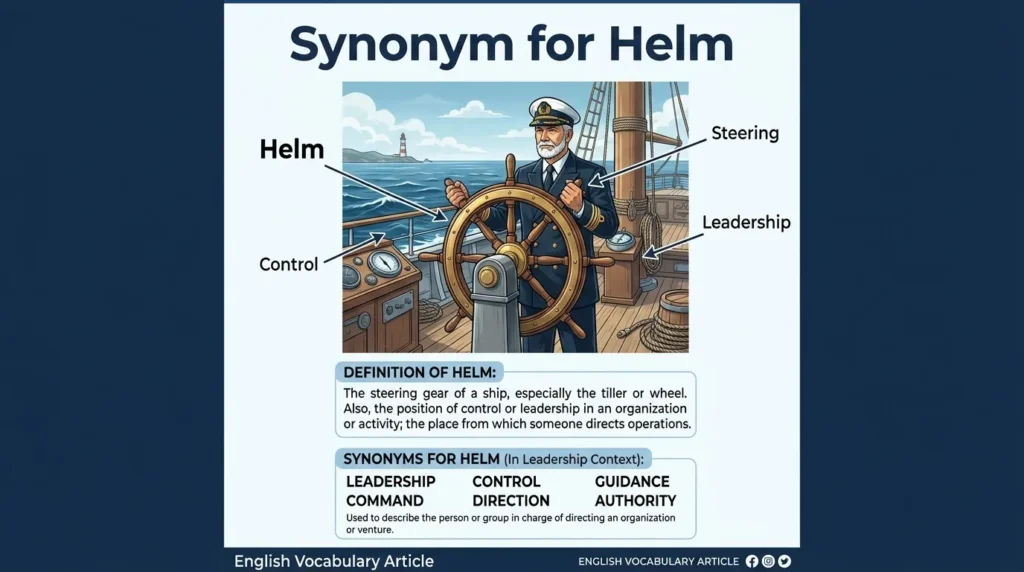
The word “helm” refers to a wheel or tiller used to steer a ship. Figuratively, it means being in control of an organization, plan, or group.
Native speakers view it as a strong noun or verb. It carries an attitude of active direction, authority, and responsibility.
It appears in news articles, business reports, and maritime history. As a noun, it is the steering mechanism. As a verb, it means to guide.
Connotative Meaning
Connotation is the emotional feeling or idea that a word invokes in addition to its literal meaning.
- Positive tone: Suggests strong guidance, decisive command, and successful navigation.
- Negative tone: Can imply heavy burden or sole liability during a severe crisis.
- Neutral tone: Simply indicates the position of official management or operational control.
Etymology
The word comes from Old English helma, meaning a rudder or handle for steering. It connects to Proto-Germanic helmaz.
- Old English (450–1100): Used strictly for the physical wooden handle on boats.
- Middle English (1100–1500): Spelled helme, expanding slightly toward nautical leadership concepts.
- Modern English (1500–Present): Shifted into a widely used metaphor for organizational leadership.
Pronunciation (US & UK)
- US: /helm/
- UK: /helm/
Syllables
- Syllable division: helm
- Affixation Pattern: Root word only.
- Root: Helm
- Prefix: None
- Suffix: None
Synonyms List
Steering Wheel (Noun) — US: /ˈstɪr.ɪŋ ˌwil/ / UK: /ˈstɪər.ɪŋ ˌwiːl/
Meaning: The physical device used to control the direction of a vehicle.
Tone/Register: Neutral, Everyday.
Example: She grabbed the steering wheel tightly as the rain started.
The old ship had a large wooden steering wheel.
Rudder (Noun) — US: /ˈrʌd.ɚ/ / UK: /ˈrʌd.ər/
Meaning: A flat piece hinged vertically near the stern of a boat for steering.
Tone/Register: Technical, Maritime.
Example: The boat shifted course as soon as the captain moved the rudder.
A broken rudder left the vessel drifting at sea.
Tiller (Noun) — US: /ˈtɪl.ɚ/ / UK: /ˈtɪl.ər/
Meaning: A lever used to turn the rudder of a boat.
Tone/Register: Technical, Nautical.
Example: He held the tiller firmly to keep the small boat straight.
The sailor pulled the tiller to avoid the rocks.
Leadership (Noun) — US: /ˈliː.dɚ.ʃɪp/ / UK: /ˈliː.də.ʃɪp/
Meaning: The action or position of guiding a group or organization.
Tone/Register: Professional, Formal.
Example: The company grew rapidly under her strong leadership.
Good leadership requires clear communication and patience.
Command (Noun) — US: /kəˈmænd/ / UK: /kəˈmɑːnd/
Meaning: The authority to give orders and make final decisions.
Tone/Register: Formal, Military.
Example: General Davies took command of the main division yesterday.
She has total command over the project operations.
Control (Noun) — US: /kənˈtroʊl/ / UK: /kənˈtrəʊl/
Meaning: The power to influence or direct people’s behavior or events.
Tone/Register: Neutral, General.
Example: The pilot regained control of the aircraft quickly.
He likes to maintain control over his daily schedule.
Direction (Noun) — US: /daɪˈrek.ʃən/ / UK: /dɪˈrek.ʃən/
Meaning: The management, guidance, or oversight of an activity.
Tone/Register: Professional, Academic.
Example: The film was made under the direction of an expert.
Our team needs clear direction to finish this task.
Charge (Noun) — US: /tʃɑːrdʒ/ / UK: /tʃɑːdʒ/
Meaning: Position of control, responsibility, or care over something.
Tone/Register: Informal, General.
Example: Who is in charge of the event planning today?
She was put in charge of the entire marketing team.
Guidance (Noun) — US: /ˈɡaɪ.dəns/ / UK: /ˈɡaɪ.dəns/
Meaning: Advice or authority provided to direct a person or group.
Tone/Register: Educational, Empathetic.
Example: Students thrive when they receive steady guidance.
Under his guidance, the small non-profit expanded.
Management (Noun) — US: /ˈmæn.ədʒ.mənt/ / UK: /ˈmæn.ɪdʒ.mənt/
Meaning: The process of dealing with or controlling things or people.
Tone/Register: Corporate, Professional.
Example: Upper management approved the new budget plan. Effective management prevents unnecessary project delays.
Directorship (Noun) — US: /daɪˈrek.tɚ.ʃɪp/ / UK: /dɪˈrek.tə.ʃɪp/
Meaning: The position of being in charge of a business or board.
Tone/Register: Formal, Corporate.
Example: She accepted the directorship after years of hard work.
His directorship brought major structural changes.
Steering (Noun) — US: /ˈstɪr.ɪŋ/ / UK: /ˈstɪər.ɪŋ/
Meaning: The act of guiding the course of a vehicle or plan.
Tone/Register: Functional, Technical.
Example: The steering on this old car feels loose.
Careful steering guided the project through tough regulations.
Governance (Noun) — US: /ˈɡʌv.ɚ.nəns/ / UK: /ˈɡʌv.ə.nəns/
Meaning: The action or manner of governing a state or organization.
Tone/Register: Academic, Political.
Example: Good governance builds trust among local citizens.
The board discussed corporate governance rules.
Headship (Noun) — US: /ˈhed.ʃɪp/ / UK: /ˈhed.ʃɪp/
Meaning: The position of chief or leader, especially in a school.
Tone/Register: Formal, Educational.
Example: He was offered the headship at the local academy.
Her headship transformed the culture of the school.
Oversight (Noun) — US: /ˈoʊ.vɚ.saɪt/ / UK: /ˈəʊ.və.saɪt/
Meaning: The action of overseeing or supervising a project or group.
Tone/Register: Professional, Administrative.
Example: The committee provides financial oversight for the project.
Direct oversight helps prevent major operational mistakes.
Supervision (Noun) — US: /ˌsuː.pɚˈvɪʒ.ən/ / UK: /ˌsuː.pəˈvɪʒ.ən/
Meaning: The act of watching over work or tasks to ensure safety or quality.
Tone/Register: Professional, Operational.
Example: Children need constant supervision near the water.
The work was completed under expert supervision.
Authority (Noun) — US: /əˈθɔːr.ə.t̬i/ / UK: /ɔːˈθɒr.ə.ti/
Meaning: The power or right to give orders and make decisions.
Tone/Register: Formal, Legal.
Example: Only the director has the authority to sign this contract.
She spoke with great authority on the subject.
Reins (Noun) — US: /reɪnz/ / UK: /reɪnz/
Meaning: Means of control, derived from straps used to guide a horse.
Tone/Register: Idiomatic, Literary.
Example: The young executive took the reins of the business.
He reluctantly handed over the reins to his successor.
Drivers Seat (Noun) — US: /ˈdraɪ.vɚs siːt/ / UK: /ˈdraɪ.vəz siːt/
Meaning: A position of primary control or command.
Tone/Register: Idiomatic, Informal.
Example: This strategy puts our brand in the driver’s seat.
She prefers to be in the driver’s seat during campaigns.
Command Post (Noun) — US: /kəˈmænd poʊst/ / UK: /kəˈmɑːnd pəʊst/
Meaning: The headquarters of a commander in military or emergency settings.
Tone/Register: Military, Formal.
Example: Officers set up a command post near the fire site.
Orders were issued directly from the central command post.
Pilot House (Noun) — US: /ˈpaɪ.lət haʊs/ / UK: /ˈpaɪ.lət haʊs/
Meaning: An enclosed area on a deck housing the steering wheel.
Tone/Register: Nautical, Technical.
Example: The captain stayed inside the pilot house during the storm.
Modern gear was installed in the boat pilot house.
Wheelhouse (Noun) — US: /ˈwiːl.haʊs/ / UK: /ˈwiːl.haʊs/
Meaning: An enclosed structure on a ship containing the wheel; domain of expertise.
Tone/Register: Nautical, Idiomatic.
Example: The navigator ran up to the wheelhouse immediately.
Data analysis is right in my wheelhouse.
Conning Tower (Noun) — US: /ˈkɑː.nɪŋ ˌtaʊ.ɚ/ / UK: /ˈkɒn.ɪŋ ˌtaʊ.ər/
Meaning: A raised observation tower on a submarine or warship used for steering.
Tone/Register: Military, Nautical.
Example: The commander climbed up to the conning tower.
The submarine surfaced with its conning tower visible.
Helm Station (Noun) — US: /helm ˈsteɪ.ʃən/ / UK: /helm ˈsteɪ.ʃən/
Meaning: The designated spot on a vessel where steering controls are located.
Tone/Register: Technical, Maritime.
Example: The deckhand reported directly to the helm station.
Check the screen displays at the main helm station.
Steering Gear (Noun) — US: /ˈstɪr.ɪŋ ɡɪr/ / UK: /ˈstɪər.ɪŋ ɡɪər/
Meaning: The machinery used to steer a ship or vehicle.
Tone/Register: Technical, Engineering.
Example: Mechanics repaired the steering gear before departure.
A failure in the steering gear caused the delay.
Steering Handle (Noun) — US: /ˈstɪr.ɪŋ ˈhæn.dəl/ / UK: /ˈstɪər.ɪŋ ˈhæn.dəl/
Meaning: A physical handle used to direct small machinery or boats.
Tone/Register: Everyday, Functional.
Example: Grasp the steering handle to change direction.
The steering handle was coated in rough rubber.
Captaincy (Noun) — US: /ˈkæp.tən.si/ / UK: /ˈkæp.tən.si/
Meaning: The position or period of being a captain.
Tone/Register: Sports, Formal.
Example: The team won two titles under his captaincy.
She stepped down from the captaincy last week.
Directing (Verb/Noun) — US: /dəˈrek.tɪŋ/ / UK: /daɪˈrek.tɪŋ/
Meaning: Controlling the management or operations of something.
Tone/Register: Professional, Creative.
Example: Directing a large project requires intense focus.
He is currently directing the sales department.
Steering Position (Noun) — US: /ˈstɪr.ɪŋ pəˈzɪʃ.ən/ / UK: /ˈstɪər.ɪŋ pəˈzɪʃ.ən/
Meaning: The physical spot or role from which something is steered.
Tone/Register: Technical, Formal.
Example: He took up the steering position on the ferry.
Adjust your seat to reach the steering position comfortably.
Captainship (Noun) — US: /ˈkæp.tən.ʃɪp/ / UK: /ˈkæp.tən.ʃɪp/
Meaning: Leadership or command equivalent to a captain.
Tone/Register: Formal, Maritime.
Example: His captainship saved the crew during the surge.
Her captainship was praised by the entire board.
Mastership (Noun) — US: /ˈmæs.tɚ.ʃɪp/ / UK: /ˈmɑː.stə.ʃɪp/
Meaning: Superior skill, domain knowledge, or full control.
Tone/Register: Literary, Academic.
Example: He displayed total mastership over the financial system.
Her mastership of the topic impressed the audience.
Chieftainship (Noun) — US: /ˈtʃiːf.tən.ʃɪp/ / UK: /ˈtʃiːf.tən.ʃɪp/
Meaning: The status or period of rule of a chief.
Tone/Register: Historical, Anthropological.
Example: The crew expanded its territory during his chieftainship.
Chieftainship was passed down through generations.
Premiership (Noun) — US: /prɪˈmɪr.ʃɪp/ / UK: /ˈprem.i.ə.ʃɪp/
Meaning: The position or term of office of a prime minister or leader.
Tone/Register: Political, Formal.
Example: Economic reforms marked her premiership. His premiership lasted for nearly four years.
Lead (Noun) — US: /liːd/ / UK: /liːd/
Meaning: The initiative, principal role, or position at the front.
Tone/Register: Everyday, Business.
Example: Our company took the lead in renewable energy.
She will take the lead on the upcoming account.
Steering Mechanism (Noun) — US: /ˈstɪr.ɪŋ ˈmek.ə.nɪz.əm/ / UK: /ˈstɪər.ɪŋ ˈmek.ə.nɪz.əm/
Meaning: System of parts used to control movement direction.
Tone/Register: Technical, Scientific.
Example: Engineers inspected the automated steering mechanism.
The steering mechanism failed during testing.
Navigation Seat (Noun) — US: /ˌnæv.əˈɡeɪ.ʃən siːt/ / UK: /ˌnæv.ɪˈɡeɪ.ʃən siːt/
Meaning: Place where navigation planning or steering occurs.
Tone/Register: Technical, Aviation.
Example: The pilot returned to the navigation seat.
Instruments surround the navigation seat in the cockpit.
Control Tower (Noun) — US: /kənˈtroʊl ˌtaʊ.ɚ/ / UK: /kənˈtrəʊl ˌtaʊ.ər/
Meaning: A building at an airport used to direct air traffic.
Tone/Register: Technical, Aviation.
Example: The flight received clearance from the control tower.
Operators in the control tower monitor flight paths.
Management Chair (Noun) — US: /ˈmæn.ədʒ.mənt tʃer/ / UK: /ˈmæn.ɪdʒ.mənt tʃeər/
Meaning: A metaphorical or literal position of top executive control.
Tone/Register: Corporate, Informal.
Example: He sat in the management chair for twenty years.
She stepped into the management chair after the election.
Command Seat (Noun) — US: /kəˈmænd siːt/ / UK: /kəˈmɑːnd siːt/
Meaning: The location reserved for a leader in operation.
Tone/Register: Military, Sci-Fi.
Example: The officer returned to his command seat quickly.
Controls are accessible directly from the command seat.
Pilot Seat (Noun) — US: /ˈpaɪ.lət siːt/ / UK: /ˈpaɪ.lət siːt/
Meaning: The primary chair for steering an aircraft or vessel.
Tone/Register: Everyday, Aviation.
Example: She sat in the pilot seat for her first solo flight.
The pilot seat offers an unobstructed view ahead.
Control Desk (Noun) — US: /kənˈtroʊl desk/ / UK: /kənˈtrəʊl desk/
Meaning: A console with instruments used to monitor and direct operations.
Tone/Register: Industrial, Technical.
Example: Engineers monitored power grids from the control desk.
The control desk alerts staff to any sudden errors.
Steering Desk (Noun) — US: /ˈstɪr.ɪŋ desk/ / UK: /ˈstɪər.ɪŋ desk/
Meaning: A station on a ship equipped with navigational controls.
Tone/Register: Maritime, Technical.
Example: The officer checked the map at the steering desk.
All systems respond directly from the main steering desk.
Bridge (Noun) — US: /brɪdʒ/ / UK: /brɪdʒ/
Meaning: An elevated platform on a ship from which it is navigated.
Tone/Register: Nautical, Formal.
Example: The captain walked up to the bridge to inspect the weather.
Officers remained on the bridge throughout the night.
Helmship (Noun) — US: /ˈhelm.ʃɪp/ / UK: /ˈhelm.ʃɪp/
Meaning: The role or skill of steering or managing a group.
Tone/Register: Rare, Literary.
Example: The startup thrived due to her steady helmship.
Strong helmship is necessary during economic market drops.
Control Board (Noun) — US: /kənˈtroʊl bɔːrd/ / UK: /kənˈtrəʊl bɔːd/
Meaning: A panel containing switches and dials for controlling equipment.
Tone/Register: Technical, Engineering.
Example: Red lights flashed across the control board.
He adjusted settings on the main control board carefully.
Synonyms for “Helm” by Tone
Understanding tone helps you select the exact word for your context:
Positive Tone
- Leadership
- Guidance
- Directorship
- Mastership
Neutral Tone
- Control
- Management
- Oversight
- Supervision
Negative Tone (Heavy Burden/Crisis)
- Reins
- Command
Informal / Idiomatic
- Driver seat
- Charge
Tone matters because using a military term like “command” in a relaxed setting sounds unnatural. Similarly, calling formal governance “in charge” might sound too casual for academic papers.
Mini Comparison
Helm vs. Leadership vs. Command
- Meaning Difference: “Helm” emphasizes the active, hands-on process of steering or guiding. “Leadership” is the broad personal quality or general position of guiding others. “Command” focuses heavily on strict authority and giving enforceable orders.
- Tone Difference: “Helm” feels metaphorical and strategic. “Leadership” is positive and corporate. “Command” feels rigid, authoritative, or military.
- When to Use Each: Use helm when describing someone actively guiding an organization through a specific transition or event. Use leadership when praising overall managerial qualities. Use command when absolute authority is involved.
Context-Based Usage
Daily Conversation
In casual talk, people rarely say “helm.” They prefer phrases like “in charge” or “in the driver’s seat.”
- Example: Sarah is in the driver’s seat for the school project.
Writing or Blogging
Bloggers use “at the helm” to create vivid images of executive direction or project management.
- Example: With a new editor at the helm, the magazine redesigned its layout.
Professional or Academic Tone
In business or research papers, precise terms like “governance,” “directorship,” or “oversight” replace metaphorical terms.
- Example: Corporate governance improved following the review.
Creative or Storytelling Use
Nautical or classic terms like “wheelhouse,” “reins,” or “helm” add narrative flavor to novels.
- Example: He took the reins of the kingdom with a hesitant hand.
Common Mistakes & Native Usage
Misuse Scenarios
- Using physical terms metaphorically incorrectly: Saying someone is “at the rudder” of a business sounds awkward to native speakers. Stick to “at the helm.”
- Confusing noun and verb forms: “He helmed the ship” works, but “he was the helm” sounds incorrect unless meant as a metaphor.
Register Notes
“Helm” is predominantly used as a noun in the idiom “at the helm.” As a verb (“to helm a movie”), it belongs to modern business, journalism, or entertainment registers.
Real-Life Mini Scenarios
- Workplace: “After the CEO stepped down, Elena took the helm to keep operations running.”
- Social Situations: “Who is taking the lead on organizing our weekend trip?”
- Media / Pop Culture: “Director James Cameron was at the helm of the new blockbuster.”
- Writing / Storytelling: “The old sea captain stood at the helm, staring directly into the storm.”
Interactive Practice Quiz
- Which synonym best fits a formal military context?
A) Driver’s seat
B) Command
C) Tiller
D) Charge - What is the original physical meaning of “helm”?
A) A military hat
B) A ship steering tool
C) A horse strap
D) A corporate office - Which term is most common in casual everyday speech?
A) Directorship
B) In charge
C) Governance
D) Headship - “At the helm” is best categorized as what type of phrase?
A) Literal mathematical term
B) Metaphorical idiom
C) Scientific formula
D) Legal definition - Which word carries a strong educational or mentorship tone?
A) Guidance
B) Rudder
C) Steering gear
D) Conning tower - Complete the sentence: “The director is in the ______ for the new film production.”
A) Conning tower
B) Driver’s seat
C) Tiller
D) Rudder - Which word implies legal or institutional power?
A) Tiller
B) Steering handle
C) Authority
D) Wheelhouse - What part of speech is “helm” when used in “She will helm the new project”?
A) Adjective
B) Verb
C) Preposition
D) Adverb - Which synonym is specifically nautical?
A) Wheelhouse
B) Administration
C) Directorship
D) Management - What tone does the word “governance” convey?
A) Informal
B) Academic/Formal
C) Playful
D) Military
Reflection Task: Write one original sentence describing a project you led using the phrase “at the helm.”
Answer Key: B B B B A B C B A B
FAQs
What is the most common synonym for helm in business?
In corporate environments, “leadership,” “management,” or “directorship” are the most frequent replacements. While journalists often write “at the helm” to describe a CEO, actual business documents favor formal terms like “executive oversight” or “governance.”
Can helm be used as a verb in formal writing?
Yes, “to helm” is widely accepted as a verb meaning to manage, direct, or supervise. It is common in entertainment media and business reports, such as “She will helm the new marketing campaign.”
Is tiller the same thing as a helm?
Technically, no. A tiller is a simple lever connected directly to the rudder post on smaller boats, whereas a helm often refers to the steering wheel system on larger ships or the entire steering area.
What does the idiom “at the helm” mean?
The idiom “at the helm” means being in control of an organization, project, group, or vehicle. It implies that the person in this position is actively making decisions and directing the future course of the entity.
How does helm differ from control?
“Control” is a broad term that means having power over outcomes or actions. “Helm” specifically carries the connotation of steering or navigating something forward toward a goal, reflecting its nautical origin.
conclusion
Learning new synonyms expands your ability to communicate complex ideas smoothly. Variations of words like “helm” bring precision and clarity to your writing and daily conversation.
Using precise vocabulary builds confidence in academic writing, professional emails, and creative storytelling. Clear word choices allow your true meaning to shine through effortlessly to any reader.
Regular practice ensures these new terms become a natural part of your vocabulary. Try incorporating a few of these synonyms into your next project or discussion.
Which specific area of your writing would you like to focus on optimizing next?

Sophia Carter is the founder and lead writer at SynonymVerse.com, a trusted online resource dedicated to English vocabulary and effective communication. She is passionate about helping students, writers, professionals, and lifelong learners find the most accurate words to express their ideas with clarity and confidence.
At SynonymVerse.com, every article is carefully researched and thoughtfully written to provide reliable guidance on synonyms, word meanings, and vocabulary. With a strong focus on accuracy, real-world usage, and easy-to-understand explanations, the website is committed to helping readers strengthen their language skills, enrich their vocabulary, and become more confident communicators.