
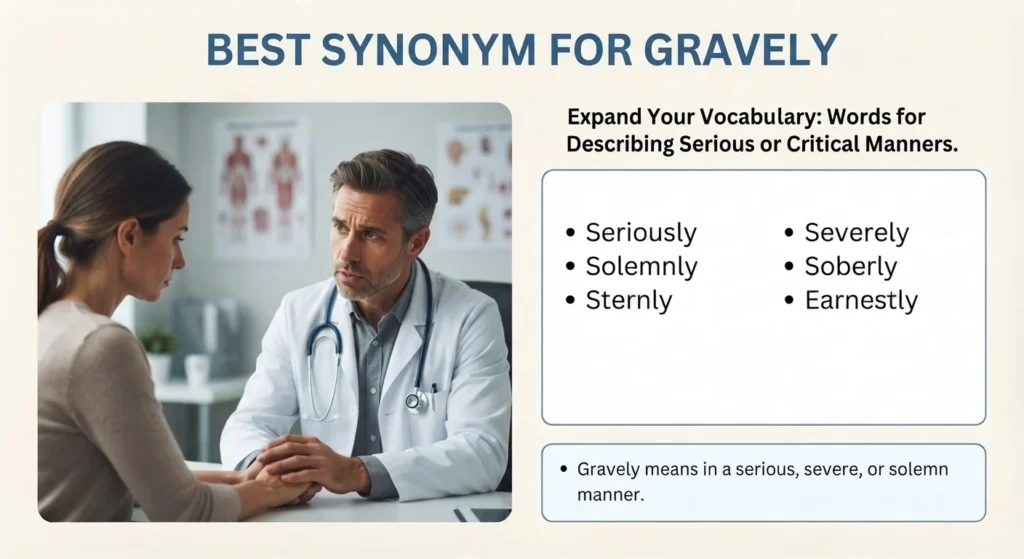
A synonym for gravely helps you describe serious, urgent, or solemn situations with precision. Imagine a doctor delivering critical health updates to an anxious family. Using the right word conveys the exact depth of concern required without sounding repetitive.
You might hear a news anchor speak about a nation facing severe economic challenges. In such moments, substituting your vocabulary choices adds nuance and emotional weight. A strong grasp of language transforms basic descriptions into vivid narrative images.
Learning a synonym for gravely allows writers and students to communicate with authority. Bloggers can capture audience attention by selecting words that match specific emotional tones. Daily speakers benefit by expressing serious thoughts clearly in professional settings.
Expanding your word choice builds confidence across essays, emails, and presentations. Repeating the same terms makes writing feel monotonous and uninspired. Mastering semantic alternatives ensures your voice remains engaging, expressive, and impactful.
What Does “Gravely” Really Mean?
“Gravely” is an adverb used to describe actions done in a serious, solemn, or critical manner. It indicates a sense of weight, importance, or danger. Native speakers use it when lightweight or casual words fail to capture the severity of a moment.
The word carries a heavy, serious emotional tone. It implies that a situation lacks humor and demands immediate, respectful attention.
- Part of Speech: Adverb
- Definition: In a serious, solemn, or critically important manner.
Connotative Meaning
Connotation is the emotional feeling or cultural association attached to a word beyond its literal dictionary definition.
- Positive Tone: Rarely positive; used almost exclusively for serious matters.
- Negative Tone: Strongly negative when describing illness, danger, or harm.
- Neutral Tone: Formal or objective when reporting serious news without panic.
Etymology
The word stems from the Latin adjective gravis, meaning heavy, weighty, or severe. It passed into Old French as grave before entering the English language.
- Old English (450–1100): Not present in early Germanic dialects; concepts were expressed using native terms like swīþe (severely).
- Middle English (1100–1500): Adopted from French to describe heavy physical weight and weighty moral matters.
- Modern English (1500–Present): Shifted primarily into a descriptive adverb for solemn behavior and critical circumstances.
Pronunciation
- US: /ˈɡreɪv.li/
- UK: /ˈɡreɪv.li/
Syllables & Structure
- Syllables: grave-ly
- Root: Grave
- Prefix: None
- Suffix: -ly (adverbial suffix)
Synonyms for Gravely
Seriously (Adverb) — US: /ˈsɪr.i.əs.li/ | UK: /ˈsɪə.ri.əs.li/
- Meaning: In a sober, earnest, or non-playful manner.
- Tone/Register: Neutral / General
- Example 1: The manager spoke seriously about the upcoming budget cuts.
- Example 2: You need to take your studies seriously this semester.
Severely (Adverb) — US: /səˈvɪr.li/ | UK: /sɪˈvɪə.li/
- Meaning: To a harsh, extreme, or critical degree.
- Tone/Register: Formal / Serious
- Example 1: The old oak tree was severely damaged by the storm.
- Example 2: The new policy severely limits unnecessary business travel.
Solemnly (Adverb) — US: /ˈsɑː.ləm.li/ | UK: /ˈsɒl.əm.li/
- Meaning: In a formal, dignified, and deeply serious manner.
- Tone/Register: Formal / Academic
- Example 1: The president solemnly took the oath of office.
- Example 2: He looked at the monument and nodded solemnly.
Critically (Adverb) — US: /ˈkrɪt̬.ɪ.kəl.i/ | UK: /ˈkrɪt.ɪ.kəl.i/
- Meaning: In a way that is vital or relates to a crisis.
- Tone/Register: Formal / Technical
- Example 1: The patient remains critically ill in the intensive care unit.
- Example 2: Supplies are critically low following the delivery delay.
Grimly (Adverb) — US: /ˈɡrɪm.li/ | UK: /ˈɡrɪm.li/
- Meaning: In a stern, harsh, or unforgiving manner.
- Tone/Register: Literary / Dramatic
- Example 1: The captain grimly steered the ship through the rough sea.
- Example 2: She smiled grimly as she accepted the tough challenge.
Somberly (Adverb) — US: /ˈsɑːm.bɚ.li/ | UK: /ˈsɒm.bə.li/
- Meaning: In a dark, gloomy, or quiet manner.
- Tone/Register: Literary / Formal
- Example 1: The crowd dressed somberly for the memorial service.
- Example 2: He walked somberly down the quiet, empty hallway.
Earnestly (Adverb) — US: /ˈɝː.nɪst.li/ | UK: /ˈɜː.nɪst.li/
- Meaning: With sincere, intense, and honest conviction.
- Tone/Register: Warm / Personal
- Example 1: She begged earnestly for a second chance to explain.
- Example 2: The team worked earnestly to finish the project on time.
Inflexibly (Adverb) — US: /ɪnˈfleks.ə.bli/ | UK: /ɪnˈfleks.ə.bli/
- Meaning: In a rigid manner that refuses to alter direction.
- Tone/Register: Formal / Stern
- Example 1: The guard stood inflexibly at his post all morning.
- Example 2: She maintained her strict rule inflexibly despite the requests.
Dangerously (Adverb) — US: /ˈdeɪn.dʒɚ.əs.li/ | UK: /ˈdeɪn.dʒər.əs.li/
- Meaning: In a way that involves risk, harm, or threat.
- Tone/Register: General / Urgent
- Example 1: Water levels rose dangerously close to the bridge base.
- Example 2: The car accelerated dangerously on the icy mountain road.
Sternly (Adverb) — US: /ˈstɝːn.li/ | UK: /ˈstɜːn.li/
- Meaning: In a strict, severe, or unyielding tone.
- Tone/Register: Direct / Authoritative
- Example 1: The teacher sternly warned the students against cheating.
- Example 2: Father looked sternly at the broken window frame.
Weightily (Adverb) — US: /ˈweɪ.t̬əl.i/ | UK: /ˈweɪ.tɪ.li/
- Meaning: With great importance, burden, or deep significance.
- Tone/Register: Academic / Literary
- Example 1: The judge spoke weightily on the consequences of crime.
- Example 2: The matter rested heavily on the committee’s mind.
Acutely (Adverb) — US: /əˈkjuːt.li/ | UK: /əˈkjuːt.li/
- Meaning: In a sharp, severe, or intense degree.
- Tone/Register: Academic / Formal
- Example 1: He was acutely aware of his recent errors.
- Example 2: The country suffered acutely during the sudden drought.
Deeply (Adverb) — US: /ˈdiːp.li/ | UK: /ˈdiːp.li/
- Meaning: To a profound, intense, or significant extent.
- Tone/Register: General / Emotional
- Example 1: We are deeply concerned about the recent events.
- Example 2: She felt deeply moved by the orchestral performance.
Intensely (Adverb) — US: /ɪnˈtens.li/ | UK: /ɪnˈtens.li/
- Meaning: With extreme force, strength, or focused effort.
- Tone/Register: General / Expressive
- Example 1: He stared intensely at the complex puzzle pieces.
- Example 2: The sun shone intensely over the desert sand.
Threateningly (Adverb) — US: /ˈθret.nɪŋ.li/ | UK: /ˈθret.nɪŋ.li/
- Meaning: In a manner suggesting imminent danger or harm.
- Tone/Register: Dramatic / Storytelling
- Example 1: Dark storm clouds gathered threateningly over the valley.
- Example 2: The rival steps forward threateningly during the argument.
Utterly (Adverb) — US: /ˈʌt̬.ɚ.li/ | UK: /ˈʌt.ə.li/
- Meaning: Completely, totally, or to an absolute degree.
- Tone/Register: Formal / Emphatic
- Example 1: They were utterly shocked by the unexpected news.
- Example 2: The project was utterly ruined by the sudden rainfall.
Heavy-heartedly (Adverb) — US: /ˌhev.iˈhɑːr.t̬ɪd.li/ | UK: /ˌhev.iˈhɑː.tɪd.li/
- Meaning: With a feeling of sadness, grief, or heavy sorrow.
- Tone/Register: Literary / Emotional
- Example 1: She walked heavy-heartedly away from her childhood home.
- Example 2: He sighed heavy-heartedly as he closed the final chapter.
Alarmingly (Adverb) — US: /əˈlɑːr.mɪŋ. li/li/ | UK: /əˈlɑː.mɪŋ.li/
- Meaning: In a disturbing manner that causes sudden fear or worry.
- Tone/Register: News / General
- Example 1: Global temperatures rose alarmingly throughout the decade.
- Example 2: The engine started making alarmingly loud noises mid-trip.
Awfully (Adverb) — US: /ˈɑː.fəl.i/ | UK: /ˈɔː.fəl.i/
- Meaning: To a very unpleasant, severe, or serious extent.
- Tone/Register: Informal / General
- Example 1: Things went awfully wrong during the afternoon presentation.
- Example 2: He looked awfully sick after returning from the trip.
Austerely (Adverb) — US: /ɑːˈstɪr.li/ | UK: /ɔːˈstɪə.li/
- Meaning: In a plain, strict, or unadorned manner.
- Tone/Register: Formal / Literary
- Example 1: The room was decorated austerely with only essential furniture.
- Example 2: The monk lived austerely in his quiet mountain shelter.
Bleakly (Adverb) — US: /ˈbliːk.li/ | UK: /ˈbliːk.li/
- Meaning: Without hope, warmth, or encouraging prospects.
- Tone/Register: Literary / Dramatic
- Example 1: He looked bleakly out at the ruined landscape.
- Example 2: She spoke bleakly about her chances of finding work.
Desperately (Adverb) — US: /ˈdes.pɚ.ət.li/ | UK: /ˈdes.pər.ət.li/
- Meaning: In an intense, urgent manner driven by distress.
- Tone/Register: General / Expressive
- Example 1: The crew desperately needed clean drinking water.
- Example 2: He reached desperately for the loose safety rope.
Direly (Adverb) — US: /ˈdaɪər.li/ | UK: /ˈdaɪə.li/
- Meaning: In a desperate, dreadful, or urgent manner.
- Tone/Register: Formal / Urgent
- Example 1: The city was direly in need of fresh supplies.
- Example 2: Consequences will be direly felt if action is delayed.
Dreadfully (Adverb) — US: /ˈdred.fəl.i/ | UK: /ˈdred.fəl.i/
- Meaning: In a terrible, distressing, or severely bad way.
- Tone/Register: Conversational / Emphatic
- Example 1: She missed her family dreadfully during her long stay.
- Example 2: The situation degenerated dreadfully within a few hours.
Fearfully (Adverb) — US: /ˈfɪr.fəl.i/ | UK: /ˈfɪə.fəl.i/
- Meaning: In a manner showing severe apprehension or anxiety.
- Tone/Register: Emotional / Descriptive
- Example 1: The child glanced fearfully toward the dark alleyway.
- Example 2: She waited fearfully for the test results to arrive.
Forbiddingly (Adverb) — US: /fɚˈbɪd.ɪŋ.li/ | UK: /fəˈbɪd.ɪŋ.li/
- Meaning: In an unwelcoming, harsh, or threatening manner.
- Tone/Register: Literary / Formal
- Example 1: The high stone walls rose forbiddingly above the city.
- Example 2: He looked forbiddingly at the unexpected visitors.
Grievously (Adverb) — US: /ˈɡriː.vəs.li/ | UK: /ˈɡriː.vəs.li/
- Meaning: With severe pain, suffering, or tragic harm.
- Tone/Register: Legal / Historical
- Example 1: The soldier was grievously wounded in the battle.
- Example 2: They were grievously mistaken about the true costs.
Harshly (Adverb) — US: /ˈhɑːrʃ.li/ | UK: /ˈhɑːʃ.li/
- Meaning: In a rough, severe, or unkind manner.
- Tone/Register: General / Direct
- Example 1: The supervisor spoke harshly to the entire morning crew.
- Example 2: Winter settled harshly over the small northern town.
Incurably (Adverb) — US: /ɪnˈkjʊr.ə.bli/ | UK: /ɪnˈkjʊə.rə.bli/
- Meaning: To a degree that cannot be corrected, healed, or cured.
- Tone/Register: Medical / Formal
- Example 1: The rare condition was found to be incurably advanced.
- Example 2: He remained an incurably optimistic person throughout life.
Life-threateningly (Adverb) — US: /ˈlaɪfˌθret.nɪŋ.li/ | UK: /ˈlaɪfˌθret.nɪŋ.li/
- Meaning: To a degree that endangers human life directly.
- Tone/Register: Technical / Medical
- Example 1: The patient was life-threateningly injured after the collision.
- Example 2: Extreme cold can become life-threateningly dangerous quickly.
Melancholily (Adverb) — US: /ˌmel.əŋˈkɑː.lɪ.kli/ | UK: /ˌmel.əŋˈkɒl.ɪ.kli/
- Meaning: In a pensive, sorrowful, or gloomy manner.
- Tone/Register: Literary / Classical
- Example 1: The rain fell melancholily outside the window pane.
- Example 2: He reflected melancholily on his lost youth.
Miserably (Adverb) — US: /ˈmɪz.ɚ.ə.bli/ | UK: /ˈmɪz.ər.ə.bli/
- Meaning: In a wretched, deeply unhappy, or poor manner.
- Tone/Register: Conversational / Narrative
- Example 1: The initial business venture failed miserably within months.
- Example 2: She sat miserably in the cold station.
Mournfully (Adverb) — US: /ˈmɔːrn.fəl.i/ | UK: /ˈmɔːn.fəl.i/
- Meaning: Expressing deep grief, sorrow, or lamentation.
- Tone/Register: Formal / Expressive
- Example 1: The church bells rang mournfully across the town.
- Example 2: The dog howled mournfully at the locked doorway.
Ominously (Adverb) — US: /ˈɑː.mə.nəs.li/ | UK: /ˈɒm.ɪ.nəs.li/
- Meaning: In a way that suggests something bad will happen.
- Tone/Register: Dramatic / Storytelling
- Example 1: The sky darkened ominously before the huge storm.
- Example 2: The door creaked ominously as he pushed it open.
Profoundly (Adverb) — US: /prəˈfaʊnd.li/ | UK: /prəˈfaʊnd.li/
- Meaning: To a great, deep, or intense depth of understanding/feeling.
- Tone/Register: Academic / Formal
- Example 1: His speech profoundly influenced the voting committee.
- Example 2: She felt profoundly grateful for all their timely help.
Rigorously (Adverb) — US: /ˈrɪɡ.ɚ.əs.li/ | UK: /ˈrɪɡ.ər.əs.li/
- Meaning: In an extremely thorough, strict, or harsh manner.
- Tone/Register: Technical / Academic
- Example 1: The new vaccine was rigorously tested for many months.
- Example 2: Candidates are rigorously interviewed before final hiring.
Sorrowfully (Adverb) — US: /ˈsɑːr.oʊ.fəl.i/ | UK: /ˈsɒr.əʊ.fəl.i/
- Meaning: With deep feelings of grief, regret, or sadness.
- Tone/Register: Emotional / Descriptive
- Example 1: She shook her head sorrowfully upon hearing the news.
- Example 2: He looked sorrowfully at the destroyed garden bed.
Strictly (Adverb) — US: /ˈstrɪkt.li/ | UK: /ˈstrɪkt.li/
- Meaning: In a rigid, precise, or non-negotiable manner.
- Tone/Register: Legal / Official
- Example 1: Safety guidelines must be strictly followed in the lab.
- Example 2: Access to this private area is strictly forbidden.
Tragically (Adverb) — US: /ˈtrædʒ.ɪ.kəl.i/ | UK: /ˈtrædʒ.ɪ.kəl.i/
- Meaning: In a dreadful, disastrous, or heartbreaking manner.
- Tone/Register: Formal / News
- Example 1: The historic theater was tragically destroyed by fire.
- Example 2: He tragically passed away before achieving his goal.
Urgently (Adverb) — US: /ˈɝː.dʒənt.li/ | UK: /ˈɜː.dʒənt.li/
- Meaning: In a manner requiring immediate action or attention.
- Tone/Register: Direct / Urgent
- Example 1: Medical assistance was urgently needed at the site.
- Example 2: Please call back urgently regarding your account status.
Kya aap chahte hain ke main in saare 40 synonyms ko main article mein integrate karke poora 1,500+ words SEO-optimized article updated format ke saath generate kar doon?
Synonyms by Tone
Understanding tone ensures your vocabulary matches the environment of your writing.
- Neutral Tone: Seriously, Deeply, Acutely.Ideal for factual reporting, professional communication, and everyday context.
- Negative / Threatening Tone: Severely, Critically, Dangerously, Threateningly.Best suited for discussing risk, injuries, crises, or extreme conditions.
- Solemn / Formal Tone: Solemnly, Somberly, Weightily, Sternly.Appropriate for ceremonies, official legal statements, or serious discipline.
- Earnest / Emotional Tone: Earnestly, Grimly, Intensely.Useful in expressive storytelling, sincere pleas, or dramatic character arcs.
Mini Comparison
Gravely vs. Severely
- Meaning Difference: Gravely emphasizes dignity, solemnity, or life-threatening seriousness. Severely focuses on physical force, damage, or strictness.
- Tone Difference: Gravely carries a quiet, heavy tone. Severely carries a harsh, sharp tone.
- When to Use: Use gravely for solemn speeches or medical updates. Use severely for weather damage, rules, or physical injuries.
Gravely vs. Solemnly
- Meaning Difference: Gravely includes a sense of danger, emergency, or critical impact. Solemnly refers primarily to formal, dignified, or ceremonial seriousness without immediate danger.
- Tone Difference: Gravely feels tense and urgent. Solemnly feels calm, respectful, and traditional.
- When to Use: Use gravely when someone is in critical condition. Use solemnly when taking vows or attending formal honors.
Context-Based Usage
- Daily Conversation: Use accessible terms like seriously or deeply. Saying someone is “seriously ill” sounds natural in casual speech, whereas “gravely ill” sounds like news reporting.
- Blogging & Content Writing: Use terms like critically or acutely to capture reader interest without sounding melodramatic.
- Professional & Academic Tone: Opt for solemnly or weightily when drafting policy papers, formal speeches, or legal arguments.
- Creative & Fiction Writing: Utilize evocative choices like grimly, somberly, or threateningly to build atmospheric tension.
Common Mistakes & Native Usage
- Confusing Physical Damage with Tone: Do not use gravely to describe minor mechanical breakdowns. A car is severely damaged, not gravely damaged.
- Overusing “Gravely” for Minor Issues: Avoid applying this term to daily inconveniences, such as being late for a bus. Save it for high-stakes contexts.
- Register Shifts: Avoid using formal terms like somberly in casual text messaging unless aiming for intentional irony.
Real-Life Mini Scenarios
- Workplace: The CEO nodded solemnly before announcing the company restructuring.
- Social Situations: She looked earnestly at her friend while offering words of support.
- Media / Pop Culture: The news anchor reported gravely on the sudden natural disaster.
- Storytelling: The knight stepped grimly into the dark, unknown cavern.
Synonym for Gravely – 10 MCQs ⚠️
1. Which word is a synonym for “gravely”?
A) Seriously
B) Happily
C) Lightly
D) Playfully
2. What does “gravely” mean when describing a serious situation?
A) Seriously
B) Cheerfully
C) Carelessly
D) Quickly
3. Which word can replace “gravely” in this sentence?
“He was gravely injured.”
A) Seriously
B) Slightly
C) Happily
D) Easily
4. Which is closest in meaning to “gravely”?
A) Severely
B) Gently
C) Casually
D) Lightly
5. “She spoke gravely about the problem.” What does “gravely” mean here?
A) Seriously
B) Jokingly
C) Excitedly
D) Carelessly
6. Which word is NOT a synonym for “gravely”?
A) Seriously
B) Severely
C) Solemnly
D) Cheerfully
7. If someone is gravely concerned, they are:
A) Very seriously concerned
B) Completely relaxed
C) Extremely amused
D) Slightly interested
8. Which word best describes a gravely serious matter?
A) Severe
B) Funny
C) Minor
D) Casual
9. “The doctor gravely warned him.” Which word can replace “gravely”?
A) Solemnly
B) Playfully
C) Happily
D) Lightly
10. Which is the best synonym for “gravely”?
A) Seriously
B) Cheerfully
C) Casually
D) Lightheartedly
Answer Key
- A | 2. A | 3. A | 4. A | 5. A
- D | 7. A | 8. A | 9. A | 10. A
Application Task: Write one short sentence using either somberly or critically to describe a real situation from your week.
Frequently Asked Questions
1. What is the most common synonym for gravely in casual speech?
The most common casual alternative is “seriously.” While “gravely” fits formal, medical, or urgent situations, native speakers rely on “seriously” for everyday conversations. It conveys importance without making the sentence sound overly dramatic or distant.
2. Can gravely and severely be used interchangeably?
Not always. “Gravely” implies solemnity, weight, or danger to life, such as being “gravely ill.” “Severely” focuses on intensity, physical damage, or strictness, such as “severely injured” or “severely punished.” Match the word to physical vs. emotional context.
3. How does tone change when using somberly instead of gravely?
“Somberly” emphasizes a dark, quiet, or gloomy mood, often linked to mourning or sadness. “Gravely” focuses on seriousness, urgency, or critical importance. Use somberly for quiet reflection and gravely for high-stakes news or dangerous situations.
4. Is gravely used exclusively in medical contexts?
No, it is widely used in journalism, legal settings, and literature. You might hear about a nation being “gravely concerned” over international affairs or a judge speaking “gravely” during sentencing. It applies anywhere deep seriousness is required.
5. Why should writers learn different semantic choices for gravely?
Using varied alternatives prevents repetition and keeps readers engaged. Selecting precise adverbs allows writers to control the emotional atmosphere, whether crafting an academic paper, news article, or creative story.
Conclusion
Building a strong command of nuanced vocabulary transforms how you write and speak. Moving beyond basic word choices lets you capture exact emotions and professional tones effortlessly.
Expanding your range helps you express critical ideas with confidence across essays, blog posts, and daily conversations. Precise communication ensures your message lands with clarity and impact every time.
Try using two new vocabulary choices from this guide in your next email or writing project. Regular practice turns unfamiliar terms into natural tools for effective everyday expression.

Sophia Carter is the founder and lead writer at SynonymVerse.com, a trusted online resource dedicated to English vocabulary and effective communication. She is passionate about helping students, writers, professionals, and lifelong learners find the most accurate words to express their ideas with clarity and confidence.
At SynonymVerse.com, every article is carefully researched and thoughtfully written to provide reliable guidance on synonyms, word meanings, and vocabulary. With a strong focus on accuracy, real-world usage, and easy-to-understand explanations, the website is committed to helping readers strengthen their language skills, enrich their vocabulary, and become more confident communicators.