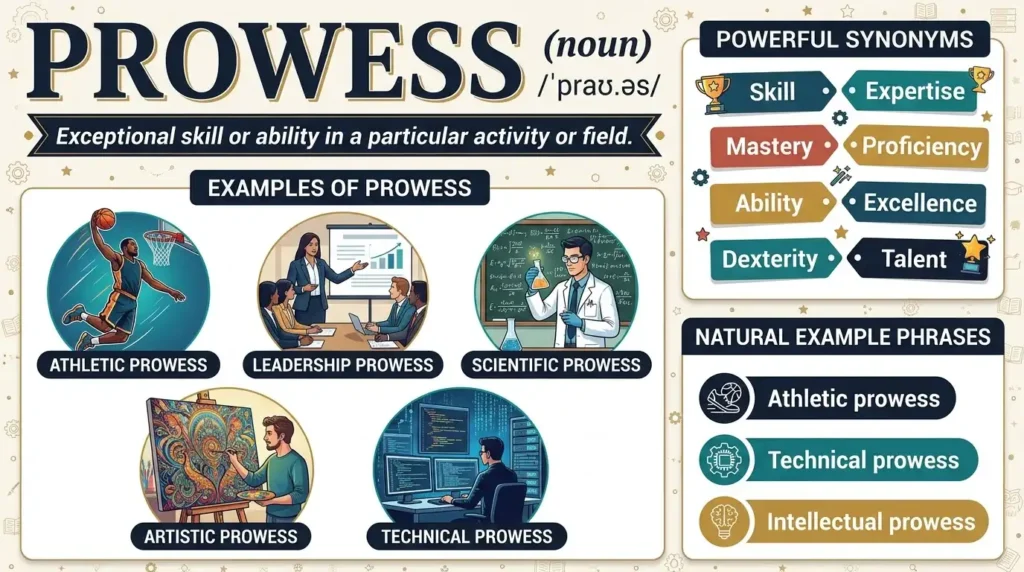
A synonym for the word prowess is a word that describes exceptional skill, talent, ability, or expertise in a particular activity. Common alternatives include mastery, proficiency, competence, dexterity, virtuosity, and expertise. The best choice depends on the situation and the level of skill being described.
Imagine a football player who controls the game with incredible precision. You might describe the player’s prowess as exceptional athletic ability. Similarly, a writer can demonstrate literary skill, while a scientist can show technical expertise.
The word prowess appears frequently in sports, education, business, entertainment, and professional writing. Learning its alternatives helps you express different levels of skill without repeating the same vocabulary.
Whether you are a student, blogger, content writer, or everyday English learner, understanding a synonym for the word prowess can make your communication clearer and more expressive.
What Does “Prowess” Really Mean?
Prowess is an impressive level of skill, ability, or expertise that someone demonstrates in a particular activity. It often suggests outstanding performance developed through natural talent, experience, or practice.
In simple English, prowess means being exceptionally good at something.
Part of Speech: Noun.
Simple Definition: Exceptional skill or ability in doing something successfully.
How Native Speakers Understand Prowess
Native English speakers generally use prowess to describe someone who performs an activity with remarkable skill or effectiveness.
For example:
- A chess champion demonstrates strategic prowess.
- A skilled surgeon displays medical prowess.
- A talented musician shows musical prowess.
The word often carries a positive and admiring attitude. It suggests that someone’s abilities deserve recognition.
Common Contexts
- Sports and athletics.
- Academic achievements.
- Business and leadership.
- Military history and combat.
- Technology and innovation.
- Art, music, and creative activities.
Connotative Meaning of Prowess
(Connotation means the emotional feeling or association connected to a word beyond its basic dictionary meaning.)
Positive tone: Prowess usually suggests excellence, impressive ability, confidence, and achievement.
Negative tone: The word itself is rarely negative. However, it can describe impressive abilities used for harmful purposes, such as a criminal’s technological prowess.
Neutral tone: In factual writing, prowess can simply describe someone’s demonstrated ability in a particular field.
Etymology of Prowess
The word prowess entered English through Old French proesse or prouesse. It was associated with bravery, courage, valor, and exceptional ability.
Its historical development reflects the changing way English speakers describe strength and achievement.
Old English Period (450–1100)
Prowess was not an established Old English word. However, Old English vocabulary included related ideas of courage, strength, bravery, and heroic ability.
Middle English Period (1100–1500)
The word entered English through Anglo-Norman and Old French influence. It commonly described bravery, valor, and exceptional courage, especially in battle.
Modern English Period (1500–Present)
Its meaning gradually expanded beyond military bravery. Today, prowess commonly describes outstanding ability in sports, business, science, technology, education, and creative fields.
Pronunciation of Prowess
US: /ˈpraʊ.əs/
UK: /ˈpraʊ.əs/
Syllables: prow-ess
Affixation Pattern:
- Root: prowess
- Prefix: None.
- Suffix: None in its modern English structure.
The ending -ess is part of the inherited word and does not function as a separate feminine suffix.
Synonyms List
The following alternatives describe exceptional ability, impressive performance, or specialized skill. Some are more suitable for particular contexts than others.
1. Skill (Noun) — US: /skɪl/ | UK: /skɪl/
Meaning: The ability to perform an activity well through knowledge, practice, or experience.
Tone/Register: Neutral, conversational, professional.
Example:
- Her writing skills impressed the entire team.
- He developed excellent cooking skills through practice.
2. Expertise (Noun) — US: /ˌek.spɝːˈtiːz/ | UK: /ˌek.spɜːˈtiːz/
Meaning: A high level of specialized knowledge and practical ability in a particular subject.
Tone/Register: Formal, academic, business.
Example:
- Her expertise in digital marketing helped the company grow.
- We need someone with technical expertise for this project.
3. Mastery (Noun) — US: /ˈmæs.tɚ.i/ | UK: /ˈmɑː.stər.i/
Meaning: Complete or highly developed command of a skill or subject.
Tone/Register: Academic, professional, formal.
Example:
- His mastery of classical music is remarkable.
- She achieved mastery of the language after years of study.
4. Proficiency (Noun) — US: /prəˈfɪʃ.ən.si/ | UK: /prəˈfɪʃ.ən.si/
Meaning: A strong and competent ability to perform a particular task.
Tone/Register: Formal, educational, professional.
Example:
- The position requires proficiency in English.
- Her computer proficiency makes daily tasks easier.
5. Competence (Noun) — US: /ˈkɑːm.pə.t̬əns/ | UK: /ˈkɒm.pɪ.təns/
Meaning: The ability to perform a task successfully and to an acceptable standard.
Tone/Register: Neutral, professional, academic.
Example:
- The manager demonstrated competence during the crisis.
- Technical competence is important in this profession.
6. Ability (Noun) — US: /əˈbɪl.ə.t̬i/ | UK: /əˈbɪl.ə.ti/
Meaning: The power or capacity to perform an activity successfully.
Tone/Register: Neutral, everyday, professional.
Example:
- Her ability to solve problems impressed her colleagues.
- He has an exceptional ability to understand complex ideas.
7. Aptitude (Noun) — US: /ˈæp.tə.tuːd/ | UK: /ˈæp.tɪ.tjuːd/
Meaning: A natural tendency or potential to learn and perform a particular activity well.
Tone/Register: Educational, academic, professional.
Example:
- The student has a natural aptitude for mathematics.
- Her musical aptitude became clear at an early age.
8. Talent (Noun) — US: /ˈtæl.ənt/ | UK: /ˈtæl.ənt/
Meaning: A natural ability to perform something exceptionally well.
Tone/Register: Neutral, conversational, creative.
Example:
- His artistic talent attracted many admirers.
- She has a remarkable talent for storytelling.
9. Dexterity (Noun) — US: /dekˈster.ə.t̬i/ | UK: /dekˈster.ə.ti/
Meaning: Skill and control in performing precise physical movements, especially with the hands.
Tone/Register: Formal, technical, professional.
Example:
- The surgeon operated with impressive dexterity.
- Playing the instrument requires excellent finger dexterity.
10. Virtuosity (Noun) — US: /ˌvɝː.tʃuˈɑː.sə.t̬i/ | UK: /ˌvɜː.tʃuˈɒs.ə.ti/
Meaning: Exceptional technical skill in an artistic or creative performance.
Tone/Register: Formal, artistic, academic.
Example:
- The pianist displayed extraordinary virtuosity.
- Her performance combined technical precision with artistic virtuosity.
11. Finesse (Noun) — US: /fɪˈnes/ | UK: /fɪˈnes/
Meaning: Delicate skill and clever control when handling a difficult situation or task.
Tone/Register: Professional, sophisticated, conversational.
Example:
- She handled the difficult negotiation with finesse.
- The designer completed the project with remarkable finesse.
12. Adeptness (Noun) — US: /əˈdept.nəs/ | UK: /əˈdept.nəs/
Meaning: The quality of being highly skilled at performing a particular activity.
Tone/Register: Formal, neutral, professional.
Example:
- His adeptness at problem-solving impressed the director.
- She demonstrated adeptness in managing complicated assignments.
13. Adroitness (Noun) — US: /əˈdrɔɪt.nəs/ | UK: /əˈdrɔɪt.nəs/
Meaning: Cleverness and skill in handling situations quickly and effectively.
Tone/Register: Formal, literary, professional.
Example:
- The lawyer showed adroitness during the questioning.
- Her adroitness helped resolve the disagreement.
14. Skillfulness (Noun) — US: /ˈskɪl.fəl.nəs/ | UK: /ˈskɪl.fəl.nəs/
Meaning: The quality of performing an activity with considerable skill and control.
Tone/Register: Neutral, descriptive, professional.
Example:
- The artist’s skillfulness was evident in every detail.
- His skillfulness made the complicated task look simple.
15. Facility (Noun) — US: /fəˈsɪl.ə.t̬i/ | UK: /fəˈsɪl.ə.ti/
Meaning: Natural ease and ability in performing a particular activity.
Tone/Register: Formal, academic, literary.
Example:
- She has a remarkable facility for learning languages.
- His facility with numbers helped him excel in mathematics.
16. Capability (Noun) — US: /ˌkeɪ.pəˈbɪl.ə.t̬i/ | UK: /ˌkeɪ.pəˈbɪl.ə.ti/
Meaning: The ability or potential to perform a particular task successfully.
Tone/Register: Business, professional, neutral.
Example:
- The team demonstrated its capability to handle major challenges.
- Her leadership capability grew with experience.
17. Know-how (Noun) — US: /ˈnoʊ.haʊ/ | UK: /ˈnəʊ.haʊ/
Meaning: Practical knowledge and experience needed to perform a task effectively.
Tone/Register: Informal, conversational, business.
Example:
- He has the technical know-how to repair the equipment.
- Running a small business requires financial know-how.
18. Artistry (Noun) — US: /ˈɑːr.t̬ə.stri/ | UK: /ˈɑː.tɪ.stri/
Meaning: Exceptional creative skill and imagination demonstrated through artistic work.
Tone/Register: Artistic, formal, creative.
Example:
- The filmmaker’s artistry made the documentary unforgettable.
- Her artistry transformed an ordinary room into a beautiful space.
19. Craftsmanship (Noun) — US: /ˈkræfts.mən.ʃɪp/ | UK: /ˈkrɑːfts.mən.ʃɪp/
Meaning: High-quality practical skill demonstrated in making or creating something.
Tone/Register: Professional, artistic, technical.
Example:
- The furniture reflects excellent craftsmanship.
- His craftsmanship is visible in every wooden detail.
20. Excellence (Noun) — US: /ˈek.səl.əns/ | UK: /ˈek.səl.əns/
Meaning: The quality of achieving an exceptionally high standard of performance.
Tone/Register: Formal, academic, professional.
Example:
- The school is recognized for academic excellence.
- Her commitment to excellence inspires the entire department.
21. Brilliance (Noun) — US: /ˈbrɪl.jəns/ | UK: /ˈbrɪl.jəns/
Meaning: Outstanding intelligence, talent, or performance that attracts admiration.
Tone/Register: Positive, expressive, formal.
Example:
- The scientist’s brilliance changed the way researchers understood the subject.
- His brilliance on the football field amazed the audience.
22. Genius (Noun) — US: /ˈdʒiː.ni.əs/ | UK: /ˈdʒiː.ni.əs/
Meaning: Exceptional intellectual or creative ability, sometimes demonstrated through extraordinary achievement.
Tone/Register: Positive, informal, academic.
Example:
- Her mathematical genius became obvious during the competition.
- The invention demonstrated remarkable creative genius.
23. Giftedness (Noun) — US: /ˈɡɪf.tɪd.nəs/ | UK: /ˈɡɪf.tɪd.nəs/
Meaning: The possession of exceptional natural abilities in one or more areas.
Tone/Register: Educational, formal, descriptive.
Example:
- The teacher recognized his giftedness in science.
- Her artistic giftedness became clear through her paintings.
24. Accomplishment (Noun) — US: /əˈkɑːm.plɪʃ.mənt/ | UK: /əˈkʌm.plɪʃ.mənt/
Meaning: An achievement that demonstrates considerable ability, effort, or success.
Tone/Register: Neutral, professional, academic.
Example:
- Winning the international competition was a remarkable accomplishment.
- Completing the research project showed her dedication and ability.
25. Athleticism (Noun) — US: /æθˈlet̬.ə.sɪ.zəm/ | UK: /æθˈlet.ɪ.sɪ.zəm/
Meaning: Physical ability, strength, coordination, and fitness demonstrated through sports or movement.
Tone/Register: Sports, professional, descriptive.
Example:
- The young player impressed everyone with his athleticism.
- Her athleticism helped her succeed in several competitions.
26. Valor (Noun) — US: /ˈvæl.ɚ/ | UK: /ˈvæl.ər/
Meaning: Great courage and bravery, especially when facing danger or fighting.
Tone/Register: Formal, literary, historical.
Example:
- The soldiers received recognition for their valor.
- The historical account celebrates the valor of the defenders.
27. Courage (Noun) — US: /ˈkɝː.ɪdʒ/ | UK: /ˈkʌr.ɪdʒ/
Meaning: The mental strength to face danger, fear, or difficult situations.
Tone/Register: Neutral, positive, emotional.
Example:
- She showed courage when speaking against injustice.
- It takes courage to admit a serious mistake.
28. Heroism (Noun) — US: /ˈher.oʊ.ɪ.zəm/ | UK: /ˈher.əʊ.ɪ.zəm/
Meaning: Exceptional bravery and selfless action in dangerous or challenging situations.
Tone/Register: Formal, historical, emotional.
Example:
- The firefighter’s heroism saved several lives.
- The story describes acts of heroism during the disaster.
29. Daring (Noun) — US: /ˈder.ɪŋ/ | UK: /ˈdeə.rɪŋ/
Meaning: A willingness to take bold risks when pursuing a challenging goal.
Tone/Register: Neutral, expressive, informal.
Example:
- The climber’s daring impressed the entire audience.
- Her daring in business helped launch an innovative idea.
30. Strength (Noun) — US: /streŋθ/ | UK: /streŋθ/
Meaning: The physical, mental, or practical power to perform effectively or overcome challenges.
Tone/Register: Neutral, conversational, professional.
Example:
- His greatest strength is his ability to lead under pressure.
- The athlete demonstrated impressive physical strength.
31. Command (Noun) — US: /kəˈmænd/ | UK: /kəˈmɑːnd/
Meaning: A strong and confident level of control or knowledge over a subject or skill.
Tone/Register: Formal, academic, professional.
Example:
- She has an excellent command of English grammar.
- His command of the subject impressed the examiners.
32. Fluency (Noun) — US: /ˈfluː.ən.si/ | UK: /ˈfluː.ən.si/
Meaning: The ability to perform or communicate smoothly and naturally without unnecessary difficulty.
Tone/Register: Educational, conversational, professional.
Example:
- Her fluency in three languages helped her career.
- The speaker demonstrated impressive fluency during the presentation.
33. Expertness (Noun) — US: /ˈek.spɝːt.nəs/ | UK: /ˈek.spɜːt.nəs/
Meaning: The quality of having advanced knowledge and skill in a particular field.
Tone/Register: Formal, descriptive, professional.
Example:
- His expertness in engineering earned him professional recognition.
- The report reflects her expertness in environmental research.
34. Acumen (Noun) — US: /ˈæk.jə.mən/ | UK: /ˈæk.jʊ.mən/
Meaning: The ability to make intelligent judgments and understand situations quickly.
Tone/Register: Business, formal, professional.
Example:
- Her business acumen helped the company navigate difficult decisions.
- The manager showed financial acumen throughout the negotiation.
35. Ingenuity (Noun) — US: /ˌɪn.dʒəˈnuː.ə.t̬i/ | UK: /ˌɪn.dʒəˈnjuː.ə.ti/
Meaning: The ability to develop clever, original, and practical solutions to problems.
Tone/Register: Positive, professional, creative.
Example:
- The engineer’s ingenuity produced an affordable solution.
- Their ingenuity helped overcome the technical limitations.
36. Resourcefulness (Noun) — US: /rɪˈsɔːrs.fəl.nəs/ | UK: /rɪˈzɔːs.fəl.nəs/
Meaning: The ability to find clever ways to solve problems using available resources.
Tone/Register: Professional, positive, conversational.
Example:
- Her resourcefulness helped the team finish the project.
- The rescue workers demonstrated remarkable resourcefulness.
37. Precision (Noun) — US: /prɪˈsɪʒ.ən/ | UK: /prɪˈsɪʒ.ən/
Meaning: The quality of performing an action with exceptional accuracy and attention to detail.
Tone/Register: Technical, professional, academic.
Example:
- The surgeon completed the procedure with remarkable precision.
- His precision in measuring every component prevented errors.
38. Commanding Skill (Noun Phrase) — US: /kəˈmæn.dɪŋ skɪl/ | UK: /kəˈmɑːn.dɪŋ skɪl/
Meaning: A particularly impressive level of control and ability in a specific activity.
Tone/Register: Formal, professional, descriptive.
Example:
- The conductor displayed commanding skill throughout the performance.
- Her commanding skill in negotiations impressed the board.
39. Technical Mastery (Noun Phrase) — US: /ˈtek.nɪ.kəl ˈmæs.tɚ.i/ | UK: /ˈtek.nɪ.kəl ˈmɑː.stər.i/
Meaning: Exceptional command of the technical knowledge and practical skills required for a specialized task.
Tone/Register: Technical, academic, professional.
Example:
- The developer demonstrated technical mastery during the presentation.
- Her technical mastery made the complicated installation look effortless.
40. Prowessfulness (Noun) — US: /ˈpraʊ.əs.fəl.nəs/ | UK: /ˈpraʊ.əs.fəl.nəs/
Meaning: An uncommon and nonstandard formation intended to describe the quality of being skillful or impressive.
Tone/Register: Nonstandard; avoid in normal English.
Example:
- Avoid using prowessfulness in formal writing.
- Choose prowess, expertise, or mastery instead.
Usage note: The final entry is included to distinguish a possible word formation from established vocabulary. It is not a standard synonym and should not be used as a normal alternative. The other entries also have context-specific meanings rather than being interchangeable in every sentence.
Synonyms for Prowess by Tone
Choosing an alternative involves more than finding a word with a similar dictionary meaning. Tone helps communicate the exact impression you want to create.
Positive Synonyms
These words emphasize outstanding ability, impressive performance, or achievement.
- Brilliance
- Mastery
- Excellence
- Virtuosity
- Ingenuity
- Talent
- Genius
- Artistry
- Expertise
Neutral Synonyms
These alternatives describe ability without adding strong emotional judgment.
- Skill
- Ability
- Competence
- Proficiency
- Capability
- Dexterity
- Facility
- Precision
- Fluency
Negative or Contextually Critical Synonyms
Prowess itself is generally positive. However, these alternatives can describe abilities in contexts where the results or intentions are questionable.
- Cunning
- Craftiness
- Manipulative skill
These are not exact synonyms. They emphasize cleverness used in potentially dishonest or harmful ways. Use them only when that meaning is intended.
Playful or Informal Synonyms
These expressions work well in friendly conversations and relaxed writing.
- Know-how
- Natural talent
- Skill
- Gift
- Brilliance
Why Does Tone Matter?
A word can change how readers interpret a sentence. For example, expertise sounds professional, while know-how feels conversational.
Selecting an appropriate alternative makes your writing more natural and helps communicate your intended meaning.
Prowess vs. Close Alternatives
Some words have very similar meanings but emphasize different aspects of exceptional ability.
Prowess vs. Expertise
Prowess: Highlights impressive performance or exceptional ability.
Expertise: Emphasizes specialized knowledge and experience.
When to use: Describe a football player’s outstanding performance with prowess. Use expertise when discussing a doctor’s specialized medical knowledge.
Prowess vs. Mastery
Prowess: Focuses on remarkable ability demonstrated through action.
Mastery: Suggests a very high level of command over a skill or subject.
When to use: Describe a musician’s impressive performance as prowess. Use mastery when discussing years of developed musical ability.
Prowess vs. Proficiency
Prowess: Suggests exceptional or remarkable ability.
Proficiency: Describes a strong and competent level of performance.
When to use: Use prowess to emphasize extraordinary achievement. Choose proficiency when discussing someone’s ability to perform a task reliably.
How Prowess Changes by Context
The most suitable synonym depends on the subject, audience, and purpose of your sentence.
Daily Conversation
In everyday English, skill, talent, ability, and know-how sound natural.
For example:
“She has a real talent for fixing things.”
This sounds more conversational than saying she possesses exceptional technical prowess.
Writing and Blogging
Content writers can use expertise, mastery, brilliance, and proficiency to avoid unnecessary repetition.
For example:
“The athlete demonstrated remarkable prowess throughout the tournament.”
An alternative could be:
“The athlete displayed exceptional skill throughout the tournament.”
Professional and Academic Writing
In business reports and academic discussions, expertise, competence, proficiency, and technical mastery are useful choices.
For example:
“The research team demonstrated considerable expertise in data analysis.”
These alternatives communicate professional ability without sounding overly dramatic.
Creative and Informal Writing
Writers describing characters, artists, or fictional heroes can use virtuosity, artistry, brilliance, valor, and ingenuity.
For example:
“The warrior’s valor became legendary throughout the kingdom.”
Such choices add personality and emotional depth to storytelling.
Common Mistakes Learners Make
Understanding similar words is important, but using them in the wrong context can change your intended meaning.
Using Every Synonym Interchangeably
Not every alternative describes the same type of ability.
For example, dexterity refers mainly to physical coordination, while expertise emphasizes specialized knowledge.
Choose according to the specific activity.
Confusing Talent With Mastery
Talent often describes natural ability. Mastery suggests a highly developed level of skill.
A person may have natural talent without achieving complete mastery.
Using Valor for Everyday Skills
Valor describes exceptional bravery, especially in dangerous situations.
It is not an appropriate replacement when discussing ordinary professional competence.
Overusing Formal Vocabulary
Words such as adroitness, virtuosity, and expertness can sound unnatural in casual conversations.
Choose simpler alternatives when communicating with a general audience.
Register Notes
Formal vs. Informal: Expertise, proficiency, and mastery suit formal writing. Know-how and talent work well in casual communication.
Spoken vs. Written English: Skill, ability, and talent are common in everyday speech. Virtuosity, adroitness, and acumen are more common in descriptive or professional writing.
For additional vocabulary practice, explore related articles about synonyms for expertise and mastery.
Real-Life Mini Scenarios Using Prowess
Seeing vocabulary in realistic situations makes it easier to understand when to use each alternative.
Workplace Scenario
A project manager solves a complicated problem before the deadline.
You can describe this achievement as professional expertise, competence, or resourcefulness.
Social Situation
A friend plays the guitar beautifully at a family gathering.
You might compliment their musical talent, artistry, or virtuosity.
Sports and Media
A basketball player performs an impressive move during a championship.
A sports commentator might describe the player’s athletic prowess, dexterity, or brilliance.
Writing and Storytelling
A fictional detective solves a difficult mystery using clever observations.
A writer might describe the character’s ingenuity, acumen, or investigative skill.
Conclusion
Learning a synonym for the word prowess helps you describe exceptional abilities with greater accuracy. Each alternative offers a slightly different meaning.
Words such as expertise, mastery, and proficiency work well in professional writing. Talent, skill, and ability are useful in everyday communication.
A stronger vocabulary makes essays, blogs, emails, and conversations more interesting. It also helps you express ideas without repeating the same words.
Practice these alternatives in your daily conversations and writing exercises. Choose one new word each day and create your own sentence to build lasting vocabulary skills.
Interactive Practice Quiz
Test your understanding with these practical questions. Choose the word that best matches the situation.
1. A surgeon performs a complicated operation with excellent hand control. Which word best describes this ability?
- A. Dexterity
- B. Courage
- C. Talent
- D. Valor
2. A musician performs a difficult piano composition with exceptional technical skill. What is the best word?
- A. Competence
- B. Virtuosity
- C. Strength
- D. Capability
3. Someone has extensive knowledge of computer security. Which alternative is most appropriate?
- A. Daring
- B. Valor
- C. Expertise
- D. Bravery
4. A student learns mathematics naturally and quickly. Which word best describes this natural potential?
- A. Aptitude
- B. Precision
- C. Heroism
- D. Craftsmanship
5. A person communicates smoothly in three different languages. Which word fits best?
- A. Acumen
- B. Fluency
- C. Dexterity
- D. Ingenuity
6. A business leader makes excellent decisions during financial difficulties. Which word describes this quality?
- A. Athleticism
- B. Artistry
- C. Acumen
- D. Valor
7. An engineer develops an unusual solution to a difficult problem. Which word is most suitable?
- A. Ingenuity
- B. Bravery
- C. Strength
- D. Fluency
8. A soldier demonstrates exceptional bravery during a dangerous mission. Which word is appropriate?
- A. Proficiency
- B. Valor
- C. Finesse
- D. Facility
9. A carpenter creates beautiful furniture with excellent practical skill. Which word best describes the quality of the work?
- A. Heroism
- B. Aptitude
- C. Craftsmanship
- D. Fluency
10. An employee handles a difficult negotiation with tact and clever control. Which word fits best?
- A. Finesse
- B. Athleticism
- C. Strength
- D. Giftedness
11. A company employee performs their assigned duties reliably and successfully. Which word is most suitable?
- A. Competence
- B. Genius
- C. Valor
- D. Daring
12. An artist produces impressive creative work through imagination and skill. Which word describes this quality?
- A. Command
- B. Artistry
- C. Courage
- D. Know-how
Reflection Task
Choose any three synonyms from this article. Write one original sentence for each word. Try using them in different situations, such as school, work, and everyday conversation.
Answer Key: 1-A | 2-B | 3-C | 4-A | 5-B | 6-C | 7-A | 8-B | 9-C | 10-A | 11-A | 12-B
External reference for further vocabulary research:
Merriam-Webster Dictionary — https://www.merriam-webster.com/dictionary/prowess
FAQs
1. What is another word for prowess in sports?
Skill, athleticism, ability, and excellence are useful alternatives when describing sporting performance. Athleticism emphasizes physical ability, while skill highlights the ability to perform specific movements successfully. Prowess is particularly suitable when an athlete demonstrates exceptional performance during an important competition.
2. What is the best synonym for prowess in professional writing?
Expertise is often the best alternative in professional writing because it emphasizes specialized knowledge and experience. Proficiency and competence are also useful when describing someone’s ability to perform workplace responsibilities. The right choice depends on whether you want to emphasize knowledge, performance, or reliability.
3. What is the difference between natural talent and prowess?
Natural talent refers to an ability someone may possess without extensive training. Prowess describes an impressive level of demonstrated ability. A naturally talented person can develop their potential through practice and eventually demonstrate exceptional prowess in a particular activity.
4. Can prowess describe intelligence?
Yes. Prowess can describe exceptional intellectual ability when someone demonstrates impressive performance in a mental activity. For example, a mathematician may demonstrate mathematical prowess by solving difficult problems. However, words such as brilliance, genius, and intellectual ability may communicate this meaning more directly.
5. Is prowess a positive or negative word?
Prowess generally has a positive meaning because it describes impressive ability, achievement, or exceptional skill. However, it can describe someone’s abilities even when those abilities serve harmful purposes. For example, a cybercriminal may demonstrate considerable technological prowess.
6. What is the difference between prowess and capability?
Capability refers to someone’s ability or potential to perform a task. Prowess suggests a more impressive level of demonstrated skill. A person may have the capability to complete a difficult assignment, while someone with exceptional prowess can perform it with outstanding ability.
7. How can I use prowess without repeating it in an essay?
Replace prowess with a contextually suitable alternative rather than choosing a random synonym. Use expertise for specialized knowledge, mastery for advanced command, and proficiency for competent performance. You can also restructure sentences to make your writing more natural and avoid unnecessary repetition.

Sophia Carter is the founder and lead writer at SynonymVerse.com, a trusted online resource dedicated to English vocabulary and effective communication. She is passionate about helping students, writers, professionals, and lifelong learners find the most accurate words to express their ideas with clarity and confidence.
At SynonymVerse.com, every article is carefully researched and thoughtfully written to provide reliable guidance on synonyms, word meanings, and vocabulary. With a strong focus on accuracy, real-world usage, and easy-to-understand explanations, the website is committed to helping readers strengthen their language skills, enrich their vocabulary, and become more confident communicators.