Synonym for congruence are essential tools when you want to describe harmony, agreement, or perfect alignment without using repetitive terms.
Imagine presenting a business strategy where team goals match company values perfectly. You need exact terms to express this seamless fit clearly.
Exploring these synonyms for congruence helps you select precise vocabulary that makes essays, blogs, and corporate reports stand out with authority.
Mastering these vocabulary choices empowers writers, students, and professionals to communicate complex relationships with total clarity and confidence.
What Does “Congruence” Really Mean?
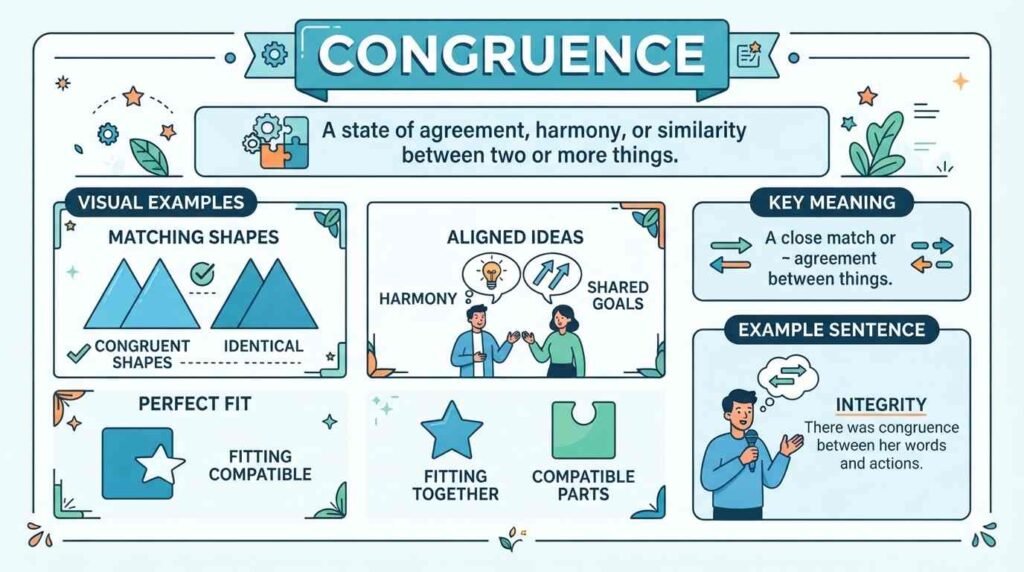
“Congruence” means a state of agreement, harmony, consistency, or exact correspondence between two or more things.
Native speakers use it in formal, academic, mathematical, or psychological contexts to describe things that align without conflict.
It functions as an abstract noun in formal spoken and written English.
Connotative Meaning
(Connotation is the emotional or cultural association attached to a word beyond its strict dictionary definition.)
- Positive tone: Signals perfect balance, honesty, smooth cooperation, and inner integrity.
- Negative tone: Rare, but can sometimes imply rigid, forced, or overly strict conformity.
- Neutral tone: Simply describes geometric equality or factual data alignment without emotional bias.
Etymology
The word comes from Latin congruentia, derived from congruere, meaning “to come together, meet, or agree.”
- Old English (450–1100): Not present in Old English; Germanic roots like gefeog (joining) were used instead.
- Middle English (1100–1500): Adapted from Old French congruence in the 15th century to mean suitability or agreement.
- Modern English (1500–Present): Expanded into mathematics, geometry, psychology, and organizational management to mean exact match or structural harmony.
Pronunciation (US & UK)
- US: /ˈkɑːn.ɡru.əns/
- UK: /ˈkɒŋ.ɡru.əns/
Syllables & Structure
- Syllables: con-gru-ence (3 syllables)
- Root: Congru
- Prefix: Con- (meaning together)
- Suffix: -ence (state or quality)
Synonyms for Congruence
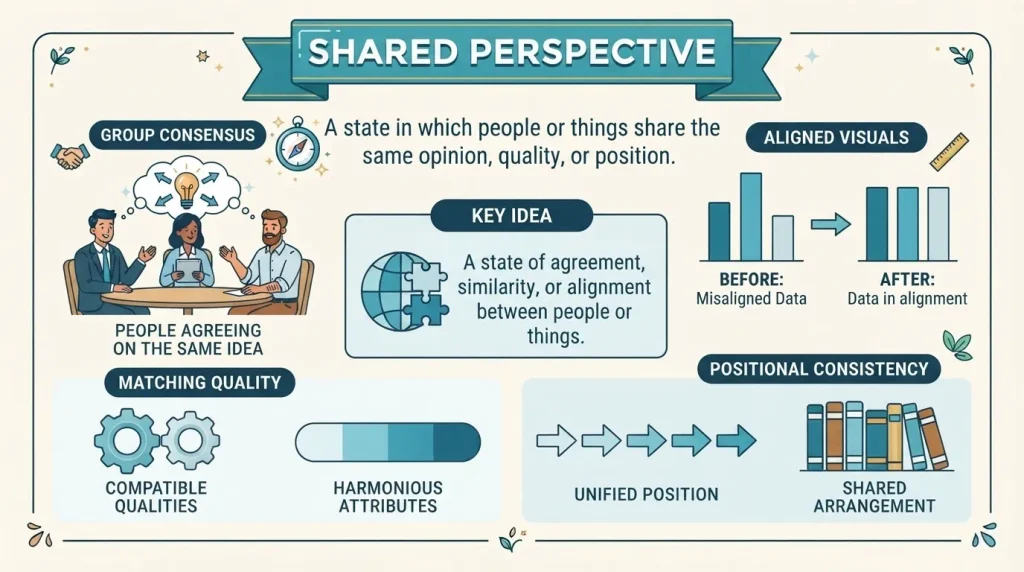
Agreement (Noun) — US: /əˈɡriː.mənt/ | UK: /əˈɡriː.mənt/
- Meaning: A state in which people or things share the same opinion, quality, or position.
- Tone/Register: Neutral, Standard, General.
- Example 1: Both managers reached full agreement on the project budget.
- Example 2: Their statements were in complete agreement with the physical evidence.
Harmony (Noun) — US: /ˈhɑːr.mə.ni/ | UK: /ˈhɑː.mə.ni/
- Meaning: A pleasing arrangement or peaceful combination of different parts or ideas.
- Tone/Register: Positive, Elevating, Expressive.
- Example 1: The team worked in perfect harmony to complete the deadline early.
- Example 2: Color choices in the living room created visual harmony.
Consistency (Noun) — US: /kənˈsɪs.tən.si/ | UK: /kənˈsɪs.tən.si/
- Meaning: The quality of always behaving, performing, or appearing in a similar way over time.
- Tone/Register: Professional, Analytical, Positive.
- Example 1: Her daily habits showed remarkable consistency with her long-term goals.
- Example 2: The auditor checked the report for logical consistency.
Correspondence (Noun) — US: /ˌkɔːr.əˈspɑːn.dəns/ | UK: /ˌkɒr.ɪˈspɒn.dəns/
- Meaning: A close similarity, connection, or matching relation between two things.
- Tone/Register: Formal, Academic, Business.
- Example 1: There is a direct correspondence between study hours and exam scores.
- Example 2: Researchers noted a close correspondence between the two survey results.
Alignment (Noun) — US: /əˈlaɪn.mənt/ | UK: /əˈlaɪn.mənt/
- Meaning: An arrangement in a straight line or correct relative position with other elements.
- Tone/Register: Business, Strategic, Modern.
- Example 1: Clear goals ensure strong alignment across all company departments.
- Example 2: The mechanic checked the wheel alignment before the road trip.
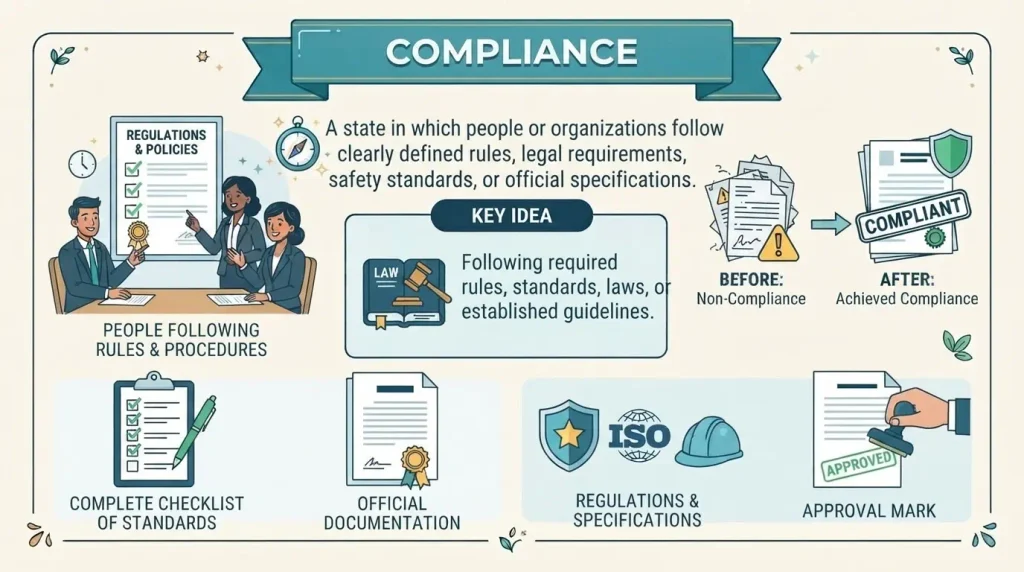
Conformance (Noun) — US: /kənˈfɔːr.məns/ | UK: /kənˈfɔː.məns/
- Meaning: Compliance with standards, rules, laws, or established specifications.
- Tone/Register: Technical, Business, Regulatory.
- Example 1: Factory production maintained strict conformance with safety codes.
- Example 2: Quality inspectors verified the product’s conformance to blueprints.
Conformity (Noun) — US: /kənˈfɔːr.mə.t̬i/ | UK: /kənˈfɔː.mə.ti/
- Meaning: Behavior or structure that matches accepted social standards or physical forms.
- Tone/Register: Social Science, Neutral to Slightly Negative.
- Example 1: Strict conformity to traditions kept the community united.
- Example 2: The design was altered to ensure conformity with local laws.
Accord (Noun) — US: /əˈkɔːrd/ | UK: /əˈkɔːd/
- Meaning: Formal harmony, unity of opinion, or official settlement.
- Tone/Register: Formal, Diplomatic, Literary.
- Example 1: Their actions were in complete accord with company values.
- Example 2: Peace delegates signed an historic accord to end the dispute.
Match (Noun) — US: /mætʃ/ | UK: /mætʃ/
- Meaning: An exact duplicate, equal counterpart, or harmonious pairing.
- Tone/Register: Informal, Everyday, General.
- Example 1: Her shoes proved to be a perfect match for her dress.
- Example 2: The test results were an exact match with computer predictions.
Coherence (Noun) — US: /koʊˈhɪr.əns/ | UK: /kəʊˈhɪə.rəns/
- Meaning: The quality of being logical, consistent, and clear in thought or structure.
- Tone/Register: Academic, Literary, Formal.
- Example 1: The author revised the essay to improve its logical coherence.
- Example 2: His argument lacked overall coherence during the debate.
Symmetry (Noun) — US: /ˈsɪm.ə.tri/ | UK: /ˈsɪm.ə.tri/
- Meaning: Exact balance and proportion between two sides or components.
- Tone/Register: Scientific, Aesthetic, Formal.
- Example 1: Architects admired the pleasing symmetry of the historical building.
- Example 2: Leaf structures display beautiful natural symmetry under inspection.
Uniformity (Noun) — US: /ˌjuː.nəˈfɔːr.mə.t̬i/ | UK: /ˌjuː.nɪˈfɔː.mə.ti/
- Meaning: The quality or state of remaining overall identical, equal, or unchanging.
- Tone/Register: Technical, Organizational, Neutral.
- Example 1: Automated machines ensure strict uniformity in product size.
- Example 2: Standard rules create uniformity across all branch offices.
Similarity (Noun) — US: /ˌsɪm.əˈler.ə.t̬i/ | UK: /ˌsɪm.ɪˈlær.ə.ti/
- Meaning: The state of sharing common features without being completely identical.
- Tone/Register: General, Everyday, Descriptive.
- Example 1: Scientists noticed a striking similarity between the two plant species.
- Example 2: There is a clear structural similarity in their business models.
Equivalence (Noun) — US: /ɪˈkwɪv.ə.ləns/ | UK: /ɪˈkwɪv.ə.ləns/
- Meaning: Equal state in value, force, meaning, importance, or function.
- Tone/Register: Academic, Formal, Scientific.
- Example 1: Foreign degrees require official equivalence testing before employment.
- Example 2: Translators sought dynamic equivalence rather than literal word matches.
Compatibility (Noun) — US: /kəmˌpæt̬.əˈbɪl.ə.t̬i/ | UK: /kəmˌpæt.əˈbɪl.ə.ti/
- Meaning: The capacity of two systems, items, or individuals to exist together smoothly.
- Tone/Register: Technical, Interpersonal, Modern.
- Example 1: Software updates guaranteed smooth compatibility with older devices.
- Example 2: Shared interests built long-term personal compatibility between roommates.
Consensus (Noun) — US: /kənˈsen.səs/ | UK: /kənˈsen.səs/
- Meaning: General collective agreement among members of a group or committee.
- Tone/Register: Business, Political, Formal.
- Example 1: Board members reached a clear consensus regarding the expansion.
- Example 2: Scientific consensus supports immediate environmental protection efforts.
Unanimity (Noun) — US: /ˌjuː.nəˈnɪm.ə.t̬i/ | UK: /ˌjuː.nəˈnɪm.ə.ti/
- Meaning: Complete agreement by all people involved in a vote or decision.
- Tone/Register: Formal, Legal, Official.
- Example 1: Jury members voted with total unanimity to pass the verdict.
- Example 2: Proposals passed with rare political unanimity in parliament.
Parallelism (Noun) — US: /ˈper.ə.lel.ɪ.zəm/ | UK: /ˈpær.ə.lel.ɪ.zəm/
- Meaning: State of corresponding in development, pattern, form, or direction.
- Tone/Register: Literary, Scientific, Technical.
- Example 1: Historians noted an interesting parallelism between the two ancient civilizations.
- Example 2: The sentence structure relies on clear grammatical parallelism.
Affinity (Noun) — US: /əˈfɪn.ə.t̬i/ | UK: /əˈfɪn.ə.ti/
- Meaning: A natural liking, structural resemblance, or inherent connection between elements.
- Tone/Register: Expressive, Semi-formal, Literary.
- Example 1: She felt an instant personal affinity for modern architectural design.
- Example 2: Certain chemical compounds show strong structural affinity toward water.
Concurrence (Noun) — US: /kənˈkɝː.əns/ | UK: /kənˈkʌr.əns/
- Meaning: Agreement in opinion or simultaneous occurrence of events.
- Tone/Register: Legal, Formal, Academic.
- Example 1: The judge wrote a thoughtful concurrence with the main ruling.
- Example 2: A lucky concurrence of good timing led to their business success.
Synchrony (Noun) — US: /ˈsɪŋ.krə.ni/ | UK: /ˈsɪŋ.krə.ni/
- Meaning: Simultaneous occurrence or movement operating in exact rhythm together.
- Tone/Register: Scientific, Technical, Specialized.
- Example 1: Dancers moved in flawless synchrony across the brightly lit stage.
- Example 2: Heartbeat rates showed biological synchrony during shared meditation.
Consonance (Noun) — US: /ˈkɑːn.sə.nəns/ | UK: /ˈkɒn.sə.nəns/
- Meaning: Agreement, compatibility, or harmonious musical/verbal combination.
- Tone/Register: Literary, Musical, Academic.
- Example 1: His actions were in full consonance with his public promises.
- Example 2: The composer built peaceful melodies using sweet musical consonance.
Integration (Noun) — US: /ˌɪn.t̬əˈɡreɪ.ʃən/ | UK: /ˌɪn.tɪˈɡreɪ.ʃən/
- Meaning: Combining smaller elements smoothly into an effective, unified whole.
- Tone/Register: Technical, Organizational, Business.
- Example 1: Successful software integration improved total daily productivity.
- Example 2: The school supported cultural integration across all student activities.
Similarity of Form (Noun Phrase) — US: /ˌsɪm.əˈler.ə.t̬i ʌv fɔːrm/ | UK: /ˌsɪm.ɪˈlær.ə.ti ɒv fɔːm/
- Meaning: Visual or structural likeness in shape and configuration.
- Tone/Register: Descriptive, Geometric, Academic.
- Example 1: Biologists classified the fossils based on similarity of form.
- Example 2: Modern structures share a clear similarity of form with classic arches.
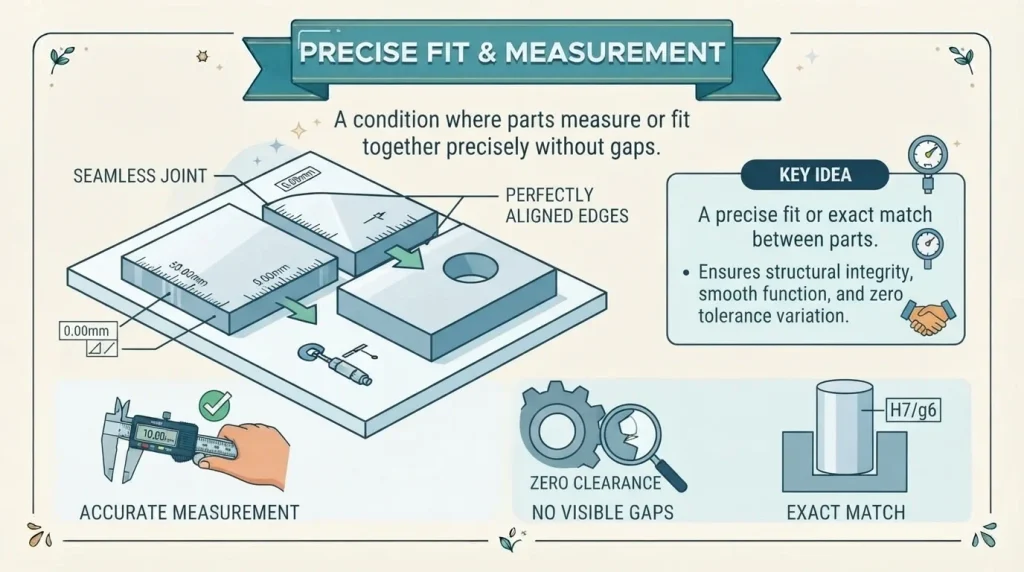
Exact Fit (Noun Phrase) — US: /ɪɡˈzækt fɪt/ | UK: /ɪɡˈzækt fɪt/
- Meaning: A condition where parts measure or fit together precisely without gaps.
- Tone/Register: Everyday, Practical, Mechanical.
- Example 1: The custom replacement tile was an exact fit for the damaged floor space.
- Example 2: She found a job role that was an exact fit for her professional skills.
Identity (Noun) — US: /aɪˈden.t̬ə.t̬i/ | UK: /aɪˈden.tə.ti/
- Meaning: The condition of being completely identical or the same in nature.
- Tone/Register: Mathematical, Philosophical, Formal.
- Example 1: Mathematicians verified the algebraic identity across both sides of the equation.
- Example 2: There was absolute identity between both original documents.
Unison (Noun) — US: /ˈjuː.nə.sən/ | UK: /ˈjuː.nɪ.sən/
- Meaning: Simultaneous performance of action, speech, or sound in complete agreement.
- Tone/Register: Descriptive, Expressive, Musical.
- Example 1: Choir members sang the national anthem in powerful unison.
- Example 2: Workers shouted in unison to voice their approval of the contract.
Symmetry of Purpose (Noun Phrase) — US: /ˈsɪm.ə.tri ʌv ˈpɝː.pəs/ | UK: /ˈsɪm.ə.tri ɒv ˈpɜː.pəs/
- Meaning: Shared alignment in ultimate objectives, values, or target outcomes.
- Tone/Register: Formal, Strategic, Elevated.
- Example 1: Partner companies maintained a rare symmetry of purpose during mergers.
- Example 2: Team success depended on their collective symmetry of purpose.
Cohesion (Noun) — US: /koʊˈhiː.ʒən/ | UK: /kəʊˈhiː.ʒən/
- Meaning: The state of sticking together or forming a unified, solid whole.
- Tone/Register: Academic, Social Science, Organizational.
- Example 1: Strong social cohesion kept the rural village united through difficulties.
- Example 2: Clear transitional words enhance logical paragraph cohesion.
Reciprocality (Noun) — US: /rɪˌsɪp.rəˈkæl.ə.t̬i/ | UK: /rɪˌsɪp.rəˈkæl.ə.ti/
- Meaning: A mutual, equal relationship or matching exchange between two parties.
- Tone/Register: Formal, Legal, Sociology.
- Example 1: Successful business partnerships rely on mutual trade reciprocity.
- Example 2: Trust grows when friends practice practical emotional reciprocity.
Conterminousness (Noun) — US: /kənˈtɝː.mɪ.nəs.nəs/ | UK: /kənˈtɜː.mɪ.nəs.nəs/
- Meaning: The quality of sharing identical boundaries, limits, or temporal extensions.
- Tone/Register: Academic, Geographic, Formal.
- Example 1: Geographic surveys revealed the conterminousness of the two territory borders.
- Example 2: Legal rights showed conterminousness with the active contract period.
Parity (Noun) — US: /ˈper.ə.t̬i/ | UK: /ˈpær.ə.ti/
- Meaning: The state or condition of being equal, especially regarding status, pay, or value.
- Tone/Register: Economic, Formal, Political.
- Example 1: Labor unions campaigned to achieve wage parity across all departments.
- Example 2: Market prices reached currency parity after financial reforms.
Homogeneity (Noun) — US: /ˌhoʊ.moʊ.dʒəˈneɪ.ə.t̬i/ | UK: /ˌhɒm.ə.dʒəˈneɪ.ə.ti/
- Meaning: The state of being entirely of the same kind, structure, or nature throughout.
- Tone/Register: Scientific, Academic, Statistical.
- Example 1: Research samples were selected to guarantee biological homogeneity.
- Example 2: The uniform design created visual homogeneity across product lines.
Uniform Alignment (Noun Phrase) — US: /ˈjuː.nə.fɔːrm əˈlaɪn.mənt/ | UK: /ˈjuː.nɪ.fɔːm əˈlaɪn.mənt/
- Meaning: Consistent positioning or structural agreement across multiple components.
- Tone/Register: Technical, Business, Design.
- Example 1: Software engineering guidelines demand uniform alignment across all code bases.
- Example 2: Graphic designers ensured uniform alignment for all text margins.
Congruity (Noun) — US: /kənˈɡruː.ə.t̬i/ | UK: /kənˈɡruː.ə.ti/
- Meaning: The quality or state of being congruent, suitable, or in clear agreement.
- Tone/Register: Formal, Academic, Elevated.
- Example 1: Auditors praised the total congruity between internal books and bank receipts.
- Example 2: Artistic choices showed complete congruence with the historical theme.
Smooth Fit (Noun Phrase) — US: /smuːð fɪt/ | UK: /smuːð fɪt/
- Meaning: An effortless, easy alignment or adjustment between two elements.
- Tone/Register: Informal, Practical, Everyday.
- Example 1: His previous experience made the transition into management a smooth fit.
- Example 2: New furniture fit remarkably well in the studio apartment.
Mutual Agreement (Noun Phrase) — US: /ˈmjuː.tʃu.əl əˈɡriː.mənt/ | UK: /ˈmjuː.tʃu.əl əˈɡriː.mənt/
- Meaning: An understanding shared equally and agreed upon by all participating sides.
- Tone/Register: Legal, Business, Standard.
- Example 1: The contract was ended early by mutual agreement between both firms.
- Example 2: Successful joint projects require mutual agreement on financial terms.
Structural Match (Noun Phrase) — US: /ˈstrʌk.tʃɚ.əl mætʃ/ | UK: /ˈstrʌk.tʃər.əl mætʃ/
- Meaning: An identical or highly compatible arrangement of underlying components.
- Tone/Register: Technical, Scientific, Engineering.
- Example 1: Engineers verified that the new steel beam was a precise structural match.
- Example 2: Database architects created a structural match between both record systems.
Harmonic Balance (Noun Phrase) — US: /hɑːrˈmɑː.nɪk ˈbæl.əns/ | UK: /hɑːˈmɒn.ɪk ˈbæl.əns/
- Meaning: A state where disparate elements exist in pleasing, peaceful proportion.
- Tone/Register: Aesthetic, Philosophical, Expressive.
- Example 1: Modern interior design aims to achieve harmonic balance across living spaces.
- Example 2: Meditation helps individuals restore internal harmonic balance amidst stress.
Complete Accordance (Noun Phrase) — US: /kəmˈpliːt əˈkɔːr.dəns/ | UK: /kəmˈpliːt əˈkɔː.dəns/
- Meaning: Full, unrestricted compliance or exact conformity with established rules.
- Tone/Register: Official, Legal, Formal.
- Example 1: Construction proceeded in complete accordance with municipal safety codes.
- Example 2: Financial records were organized in complete accordance with tax laws.
Synonyms for “Congruence” by Tone
Positive Tone
- Harmony: Connotes peaceful balance, beauty, and smooth cooperation.
- Harmonic Balance: Implies artistic elegance and internal health.
- Cohesion: Highlights warmth, unity, and strong bonds within groups.
- Affinity: Suggests natural warmth, mutual liking, and intuitive connections.
Neutral Tone
- Alignment: Focuses objectively on structural, strategic, or physical positioning.
- Correspondence: Used in academic or research settings to state matching data points.
- Equivalence: Refers neutrally to equal values, weights, or meanings.
- Structural Match: Strictly describes physical or technical architectural parity.
Negative Tone
- Conformity: Can carry a negative connotation of pressure to bend to crowd expectations.
- Uniformity: May imply dullness, lack of creativity, or strict mechanical repetition.
- Homogeneity: Can suggest a lack of healthy diversity or variety in social contexts.
Playful / Informal Tone
- Exact Fit: Everyday language describing clothes, components, or life choices.
- Match: Friendly, simple descriptor for everyday visual or logical pairings.
- Smooth Fit: Casual phrase used to describe easy transitions or compatible personalities.
Tone dictates how your audience interprets your message. Using “conformity” when praising a creative team can sound critical, whereas “alignment” highlights smart collaboration.
“Congruence” vs. Close Alternatives
| Feature | Congruence | Alignment | Harmony |
| Core Meaning | Exact structural or logical agreement between things | Arrangement of items relative to a line or goal | Pleasing, peaceful combination of different elements |
| Tone & Register | Formal, Academic, Mathematical | Business, Strategic, Modern | Expressive, Aesthetic, Positive |
| Best Usage | Technical papers, geometry, psychology, logic | Corporate strategies, management goals, mechanics | Art, music, interpersonal relationships, team dynamics |
How “Congruence” Changes by Context
Daily Conversation
In casual settings, “congruence” sounds overly formal. Native speakers prefer everyday alternatives like “match,” “smooth fit,” or “agreement” when discussing choices, plans, or clothing.
Writing or Blogging
Bloggers and content creators use terms like “alignment” or “consistency” to maintain an accessible yet professional tone that holds readers’ interest without sounding academic.
Professional or Academic Tone
In academic essays, geometry, and psychology, “congruence” and “correspondence” are standard. They express precise mathematical equality or genuine alignment between inner emotions and external actions.
Creative or Informal Use
Fiction writers lean on stylistic variants like “harmony,” “consonance,” or “unison” to evoke sensory detail and convey deep thematic unity between characters or environments.
Common Mistakes & Native Usage
Common Mistakes Learners Make
- Confusing Congruence with Resemblance: “Resemblance” merely means looking similar, whereas “congruence” requires exact structural or logical agreement.
- Overusing “Conformity” in Business: Calling corporate teamwork “conformity” makes leadership sound controlling rather than collaborative.
- Applying Formal Terms to Casual Settings: Telling a friend their shirt has “congruence” with their shoes sounds unnaturally stiff; use “match” instead.
Register Notes
“Congruence” belongs primarily to formal, scientific, and professional registers. In everyday spoken English, opt for lighter options like “alignment” or “exact fit.”
Real-Life Mini Scenarios
Workplace
A chief executive officer addresses staff to explain how departmental strategy displays clear “alignment” with long-term corporate vision.
Social Situations
Two friends organize a community festival, discovering a delightful “affinity” in their creative tastes and organization styles.
Media & Pop Culture
Tech journalists praise a new smartphone operating system for its seamless “compatibility” with existing smart home hardware.
Writing & Storytelling
A novelist describes two singers whose voices merge in breathtaking “unison,” moving the audience to tears.
Interactive Practice Quiz
1. What is the closest synonym of “congruence”?
A) Agreement
B) Conflict
C) Difference
D) Confusion
2. Which word means a state of harmony or agreement?
A) Congruence
B) Disagreement
C) Separation
D) Opposition
3. “There was ___ between her words and actions.”
A) Congruence
B) Conflict
C) Contrast
D) Confusion
4. Which word is closest in meaning to “congruence”?
A) Compatibility
B) Disconnection
C) Dispute
D) Division
5. What does “congruence” mean?
A) A close match or agreement
B) A strong disagreement
C) A complete separation
D) A sudden change
6. Which is a synonym for “congruence”?
A) Harmony
B) Conflict
C) Inconsistency
D) Opposition
7. “The two ideas showed strong ___.”
A) Congruence
B) Contradiction
C) Conflict
D) Separation
8. Which word can replace “congruence” in this sentence? “The design has congruence with the brand’s identity.”
A) Alignment
B) Confusion
C) Disagreement
D) Difference
9. Which word is NOT a synonym for “congruence”?
A) Agreement
B) Harmony
C) Compatibility
D) Conflict
10. Which sentence uses “congruence” correctly?
A) There is congruence between the two matching designs.
B) The congruence created a loud noise.
C) She used congruence to cook dinner.
D) The weather showed congruence by becoming colder.
Answer Key
- A
- A
- A
- A
- A
- A
- A
- A
- D
- A
How do synonyms for congruence improve professional writing clarity?
Using varied synonyms for congruence allows writers to express precise shades of agreement. Words like “alignment” suit corporate strategy, while “coherence” fits logic, preventing repetitive prose and making complex ideas clear to professional audiences.
What is the main difference between congruence and consistency?
“Congruence” focuses on the state of agreement between two different things at a given moment. “Consistency” emphasizes uniform performance, behavior, or quality maintained repeatedly over a period of time.
Can congruence be used in everyday casual speech?
While grammatically correct, “congruence” sounds overly academic in casual talk. Everyday speakers prefer practical terms such as “match,” “agreement,” or “exact fit” when describing matching objects or opinions in daily conversation.
Which synonym for congruence is best for legal contracts?
Legal contexts favor terms like “complete accordance,” “concurrence,” “accord,” or “mutual agreement.” These phrases clearly define official compliance, binding consent, and formal alignment between contractual parties without ambiguity.
How does alignment function as a modern corporate synonym?
“Alignment” serves as a contemporary business term describing how team efforts, resources, and strategies support overarching goals. It communicates organized cooperation without carrying the negative, rigid connotations associated with words like “conformity.”
Conclusion
Mastering a wide variety of vocabulary choices elevates your written and spoken expression across all professional domains.
Selecting precise terms allows your message to resonate clearly with readers while demonstrating total command of language nuances.
Start applying these powerful synonyms in your essays, professional emails, and everyday conversations today.

Sophia Carter is the founder and lead writer at SynonymVerse.com, a trusted online resource dedicated to English vocabulary and effective communication. She is passionate about helping students, writers, professionals, and lifelong learners find the most accurate words to express their ideas with clarity and confidence.
At SynonymVerse.com, every article is carefully researched and thoughtfully written to provide reliable guidance on synonyms, word meanings, and vocabulary. With a strong focus on accuracy, real-world usage, and easy-to-understand explanations, the website is committed to helping readers strengthen their language skills, enrich their vocabulary, and become more confident communicators.