synonym for homage is a phrase every writer, student, and creator searches for when trying to express deep respect or admiration. Imagine attending a concert where a young guitarist plays a classic solo to honor a legendary rock musician. That performance is a heartfelt gesture of respect that captures the true essence of paying tribute.
Understanding a synonym for homage helps you avoid repeating the same word in your essays, blog posts, and speeches. Finding the right variation allows you to describe admiration accurately, whether you are writing an academic paper or a casual post.
Learning a synonym for homage expands your vocabulary and improves your overall communication skills. Students, bloggers, and professional content writers can use these terms to make their writing more engaging, precise, and expressive.
What Does “Homage” Really Mean?
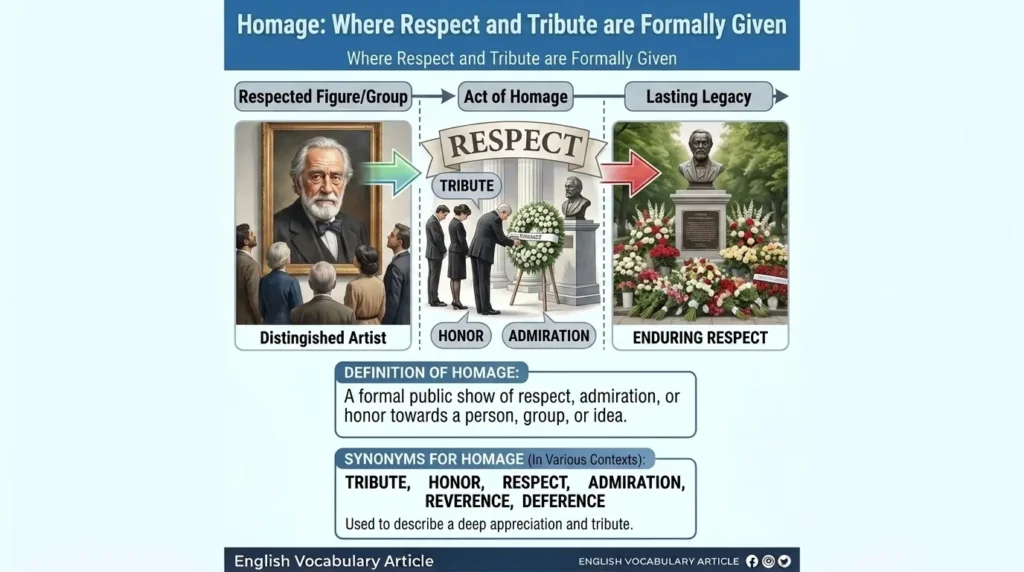
Homage means a public show of respect, honor, or dedication toward someone or something. Native English speakers use it when an action, artwork, speech, or ceremony is specifically created to honor a major influence or authority.
The word carries an attitude of deep respect, reverence, and sincere gratitude. It is a noun that describes an intentional gesture rather than a passive feeling.
Connotative Meaning
Connotation is the emotional feeling or association that a word carries beyond its literal dictionary definition.
- Positive tone: Homage implies sincere admiration, artistic honor, and profound respect.
- Neutral tone: It can simply denote a formal acknowledgment or reference in historical texts.
- Negative tone: It is rarely negative, though forced homage can sometimes feel insincere or overly submissive.
Etymology
- Origin: The word comes from Old French hommage, derived from Medieval Latin hominagium (the service or oath of a vassal to his lord, from Latin homo, meaning “man”).
- Old English (450–1100): The concept existed through Germanic terms like manrēden (fealty).
- Middle English (1100–1500): Entered the language after the Norman Conquest as homage, signifying feudal loyalty to a king or lord.
- Modern English (1500–Present): Shifted from feudal political oaths to general expressions of respect, artistic honor, and reverence.
Pronunciation (US & UK – IPA)
- US: /ˈɑː.mɪdʒ/ or /oʊˈmɑːʒ/
- UK: /ˈhɒm.ɪdʒ/
Syllable Breakdown & Affixation
- Syllables: ho-mage (2 syllables)
- Root: homo (human/man)
- Prefix: None
- Suffix: -age (noun suffix indicating action, state, or relationship)
Synonyms for Homage
Tribute (Noun) — US: /ˈtrɪb.juːt/ | UK: /ˈtrɪb.juːt/
Meaning: An act, statement, or gift intended to show gratitude, respect, or admiration.
Tone/Register: Formal / General
Example 1: The mayor paid a touching tribute to the local firefighters.
Example 2: Her latest novel is a loving tribute to her grandmother.
Honor (Noun) — US: /ˈɑː.nɚ/ | UK: /ˈɒn.ə/
Meaning: High respect, great esteem, or a gesture that shows reverence toward someone.
Tone/Register: Formal / General
Example 1: It was a great honor to receive the lifetime achievement award.
Example 2: The statue was erected in honor of the city’s founder.
Reverence (Noun) — US: /ˈrev.ɚ.əns/ | UK: /ˈrev.ər.əns/
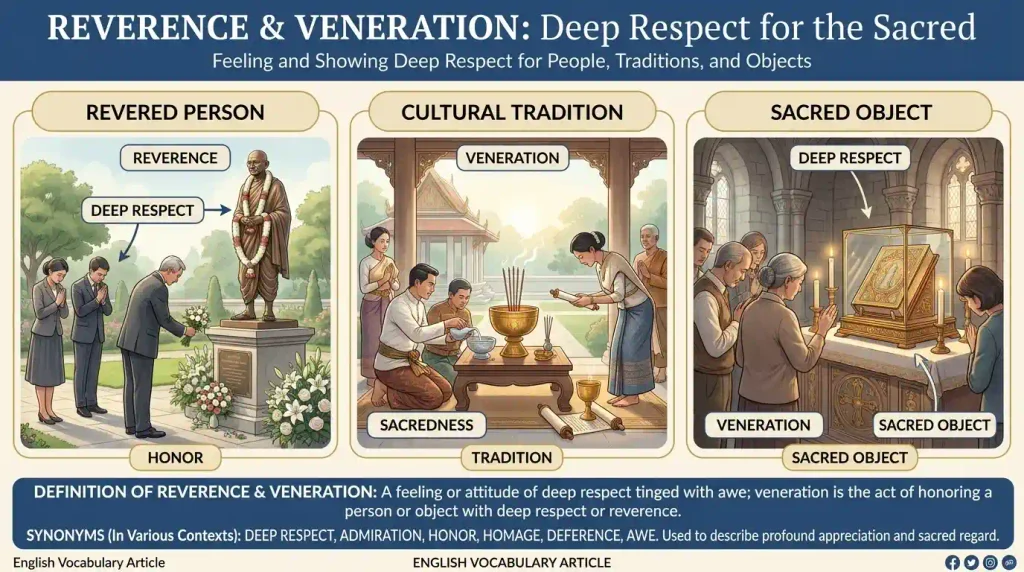
Meaning: Deep respect or veneration felt toward a person, tradition, or sacred object.
Tone/Register: Formal / Academic
Example 1: The quiet crowd showed immense reverence during the ceremony.
Example 2: He spoke about his former mentor with profound reverence.
Obeisance (Noun) — US: /oʊˈbeɪ.səns/ | UK: /oʊˈbeɪ.səns/
Meaning: A gesture of respect or submission, such as a bow or curtsy.
Tone/Register: Very Formal / Literary
Example 1: The court attendants made a low obeisance as the queen entered.
Example 2: He made a quick obeisance before stepping back from the altar.
Accolade (Noun) — US: /ˈæk.ə.leɪd/ | UK: /ˈæk.ə.leɪd/
Meaning: An award, honor, or expression of praise acknowledging high achievement.
Tone/Register: Formal / Professional
Example 1: The film received top accolades at the international festival.
Example 2: She accepted every accolade with genuine humility.
Praise (Noun) — US: /preɪz/ | UK: /preɪz/
Meaning: Expressions of approval, admiration, or commendation.
Tone/Register: Neutral / Conversational
Example 1: The teacher gave the hardworking student well-deserved praise.
Example 2: His new album earned high praise from music critics worldwide.
Adulation (Noun) — US: /ˌædʒ.əˈleɪ.ʃən/ | UK: /ˌæd.jəˈleɪ.ʃən/
Meaning: Excessive admiration, praise, or devotion.
Tone/Register: Formal / Critical
Example 1: The pop star was surrounded by the adulation of millions of fans.
Example 2: He preferred quiet over public adulation.
Acknowledgment (Noun) — US: /ækˈnɑː.lɪdʒ.mənt/ | UK: /əkˈnɒl.ɪdʒ.mənt/
Meaning: Acceptance or recognition of the existence, value, or truth of something.
Tone/Register: Neutral / Professional
Example 1: The book begins with a brief acknowledgment of her research team.
Example 2: His quick nod was a simple acknowledgment of my presence.
Recognition (Noun) — US: /ˌrek.əɡˈnɪʃ.ən/ | UK: /ˌrek.əɡˈnɪʃ.ən/
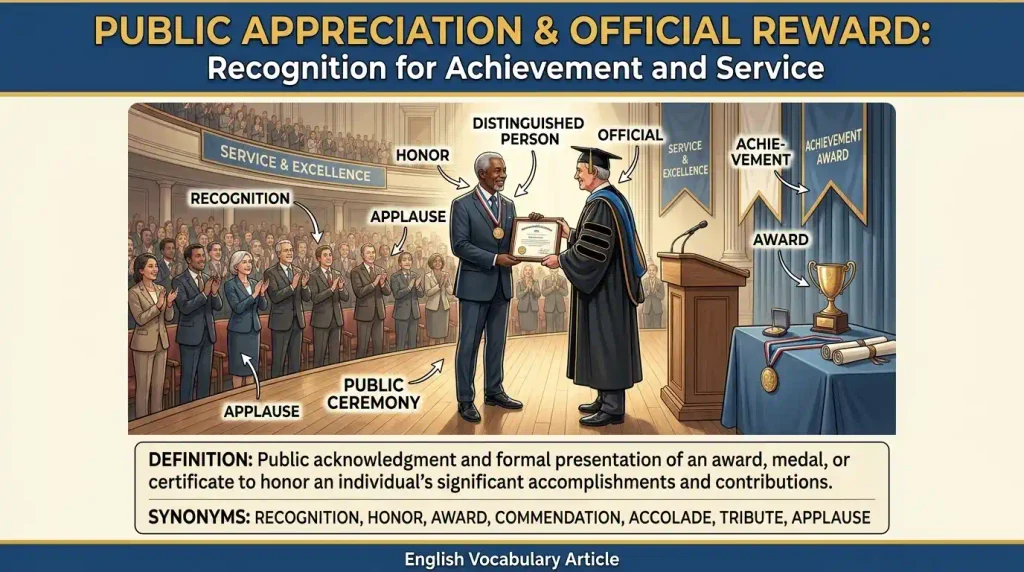
Meaning: Public appreciation or official reward for achievement and service.
Tone/Register: Neutral / Business
Example 1: She finally gained national recognition for her scientific discoveries.
Example 2: The company gave him an award in recognition of his hard work.
Veneration (Noun) — US: /ˌven.əˈreɪ.ʃən/ | UK: /ˌven.ərˈeɪ.ʃən/
Meaning: Deep, solemn respect bordering on worship.
Tone/Register: Formal / Religious
Example 1: The ancient shrine is visited by pilgrims with great veneration.
Example 2: He held the historic document with visible veneration.
Worship (Noun) — US: /ˈwɝː.ʃɪp/ | UK: /ˈwɜː.ʃɪp/
Meaning: Revere or honor a deity, or show extreme devotion to a person.
Tone/Register: Formal / Spiritual
Example 1: The ancient temple was built as a place of daily worship.
Example 2: Her idolization of the author bordered on pure worship.
Fealty (Noun) — US: /ˈfiː.əl.ti/ | UK: /ˈfiː.əl.ti/
Meaning: Formal loyalty or allegiance pledged to a lord, leader, or cause.
Tone/Register: Historical / Literary
Example 1: The knights swore an oath of fealty to their new ruler.
Example 2: Modern political party members rarely show absolute fealty today.
Allegiance (Noun) — US: /əˈliː.dʒəns/ | UK: /əˈliː.dʒəns/
Meaning: Loyalty or commitment to an individual, group, country, or cause.
Tone/Register: Formal / Political
Example 1: Citizens pledge allegiance to the flag every morning.
Example 2: His allegiance shifted after the company changed ownership.
Fidelity (Noun) — US: /fɪˈdel.ə.ti/ | UK: /fɪˈdel.ə.ti/
Meaning: Continued faithfulness, devotion, and loyalty to a duty or relationship.
Tone/Register: Formal / Academic
Example 1: She was rewarded for her long fidelity to the organization.
Example 2: The translated book maintains high fidelity to the original text.
Loyalty (Noun) — US: /ˈlɔɪ.əl.ti/ | UK: /ˈlɔɪ.əl.ti/
Meaning: A strong feeling of support, allegiance, or devotion.
Tone/Register: General / Conversational
Example 1: Dogs are famous for their unwavering loyalty to human owners.
Example 2: Her loyalty to her childhood friends never waned over time.
Devotion (Noun) — US: /dɪˈvoʊ.ʃən/ | UK: /dɪˈvəʊ.ʃən/
Meaning: Love, loyalty, or enthusiasm felt for a person, activity, or cause.
Tone/Register: Warm / Personal
Example 1: His deep devotion to his family showed in everything he did.
Example 2: Teaching requires an immense amount of time and personal devotion.
Salutation (Noun) — US: /ˌsæl.jəˈteɪ.ʃən/ | UK: /ˌsæl.juːˈteɪ.ʃən/
Meaning: A gesture, phrase, or sign of greeting and respect.
Tone/Register: Formal / Written
Example 1: He raised his hat in a polite sign of salutation.
Example 2: Choose an appropriate salutation when writing a business email.
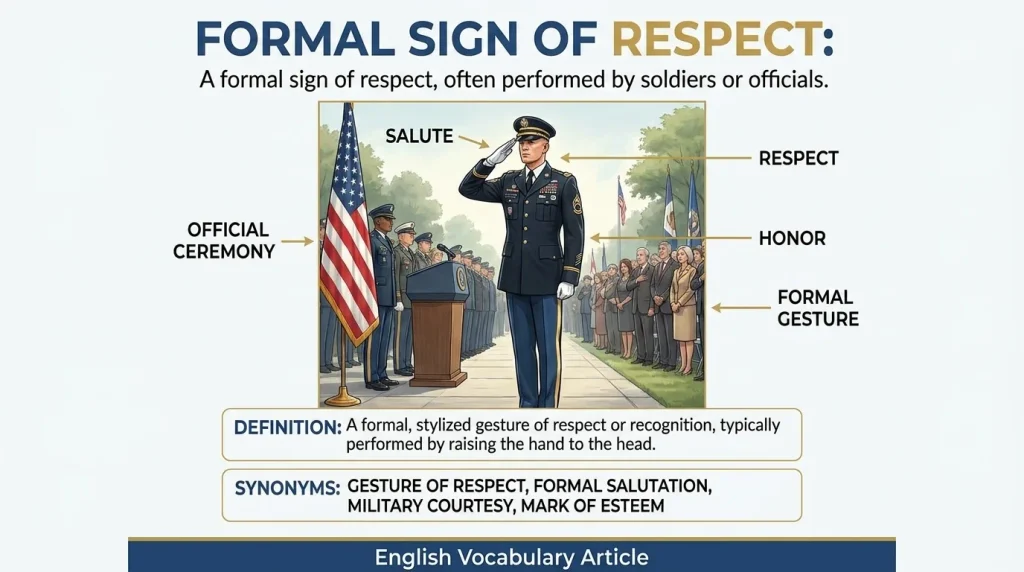
Salute (Noun) — US: /səˈluːt/ | UK: /səˈluːt/
Meaning: A formal sign of respect, often performed by soldiers or officials.
Tone/Register: Formal / Military
Example 1: The officer gave a sharp salute to the commander.
Example 2: The ceremonial fireworks were a grand salute to the nation’s victory.
Panegyric (Noun) — US: /ˌpæn.əˈdʒɪr.ɪk/ | UK: /ˌpæn.əˈdʒɪr.ɪk/
Meaning: A public speech or published text delivered in high praise of someone.
Tone/Register: Literary / Academic
Example 1: The professor delivered a moving panegyric at the memorial service.
Example 2: His article read more like a panegyric than an objective review.
Eulogy (Noun) — US: /ˈjuː.lə.dʒi/ | UK: /ˈjuː.lə.dʒi/
Meaning: A speech or piece of writing that praises someone highly, typically after death.
Tone/Register: Formal / Solemn
Example 1: Her brother gave a heartfelt eulogy at the funeral service.
Example 2: The retired coach received a warm eulogy from his former players.
Encomium (Noun) — US: /enˈkoʊ.mi.əm/ | UK: /enˈkəʊ.mi.əm/
Meaning: A formal text or speech expressing high and enthusiastic praise.
Tone/Register: Academic / Archaic
Example 1: The poet wrote a magnificent encomium to celebrate the king’s victory.
Example 2: The publication printed an encomium highlighting her achievements.
Citation (Noun) — US: /saɪˈteɪ.ʃən/ | UK: /saɪˈteɪ.ʃən/
Meaning: An official commendation or quotation celebrating a specific act of courage or merit.
Tone/Register: Formal / Official
Example 1: The brave young soldier received a special military citation.
Example 2: His scientific research paper received a prestigious academic citation.
Testimonial (Noun) — US: /ˌtes.təˈmoʊ.ni.əl/ | UK: /ˌtes.tɪˈməʊ.ni.əl/
Meaning: A formal statement testifying to someone’s character, qualifications, or value.
Tone/Register: Business / Professional
Example 1: Happy customers wrote glowing testimonials on the product website.
Example 2: She requested a character testimonial from her former manager.
Homage-like Reference (Noun Phrase) — US: /ˈɑː.mɪdʒ laɪk/ | UK: /ˈhɒm.ɪdʒ laɪk/
Meaning: A creative nod or intentional inclusion that mirrors another artist’s work.
Tone/Register: Informative / Creative
Example 1: The scene was a homage-like reference to classic horror cinema.
Example 2: Designers included a homage-like reference to classic retro gaming.
Nod (Noun) — US: /nɑːd/ | UK: /nɒd/
Meaning: An informal or subtle sign of recognition, approval, or artistic respect.
Tone/Register: Informal / Conversational
Example 1: The movie contains a clever nod to the original 1980s comic book.
Example 2: He gave a quick nod to his team before taking the stage.
Hat Tip (Noun) — US: /hæt tɪp/ | UK: /hæt tɪp/
Meaning: An acknowledgment of credit, gratitude, or respect toward someone.
Tone/Register: Informal / Digital
Example 1: A quick hat tip to Sarah for discovering this helpful software glitch.
Example 2: The blog author gave a hat tip to her sources at the end.
Bow (Noun) — US: /baʊ/ | UK: /baʊ/
Meaning: Bending the body forward as a sign of respect, greeting, or submission.
Tone/Register: General / Performative
Example 1: The actor took a graceful bow as the audience applauded.
Example 2: She offered a respectful bow before entering the martial arts arena.
Genuflection (Noun) — US: /ˌdʒen.jəˈflek.ʃən/ | UK: /ˌdʒen.juːˈflek.ʃən/
Meaning: Lowering the body by bending one knee as an act of worship or respect.
Tone/Register: Formal / Religious
Example 1: Visitors performed a quick genuflection near the main altar.
Example 2: His political shift was seen as a genuflection to voter demands.
Commemoration (Noun) — US: /kəˌmem.əˈreɪ.ʃən/ | UK: /kəˌmem.əˈreɪ.ʃən/
Meaning: A ceremony or monument designed to preserve the memory of a person or event.
Tone/Register: Formal / Historical
Example 1: The city hosted a solemn commemoration on the anniversary of the event.
Example 2: The memorial park serves as a lasting commemoration of peace.
Remembrance (Noun) — US: /rɪˈmem.brəns/ | UK: /rɪˈmem.brəns/
Meaning: The act of remembering or honoring the memory of a person or past event.
Tone/Register: Warm / Solemn
Example 1: We gathered together in quiet remembrance of our lost friends.
Example 2: She wore a small red poppy in remembrance of fallen soldiers.
Moniment (Noun) — US: /ˈmɑːn.jə.mənt/ | UK: /ˈmɒn.jə.mənt/
Meaning: A structure created to commemorate a notable person or important historical event.
Tone/Register: General / Architectural
Example 1: Tourists took photos around the historic marble monument.
Example 2: His massive archive stands as a monument to modern journalism.
Dedication (Noun) — US: /ˌded.əˈkeɪ.ʃən/ | UK: /ˌded.ɪˈkeɪ.ʃən/
Meaning: An inscription, ceremony, or commitment honoring a specific person or cause.
Tone/Register: Neutral / Formal
Example 1: The author wrote a short dedication to her parents on page one.
Example 2: The new hospital wing held its public dedication on Tuesday morning.
Deference (Noun) — US: /ˈdef.ɚ.əns/ | UK: /ˈdef.ər.əns/
Meaning: Polite submission and respect shown toward the opinions or wishes of another.
Tone/Register: Formal / Social
Example 1: Out of deference to his age, they listened quietly to his advice.
Example 2: She bowed her head in polite deference to the senior judge.
Regard (Noun) — US: /rɪˈɡɑːrd/ | UK: /rɪˈɡɑːd/
Meaning: High esteem, consideration, or attention paid toward a person.
Tone/Register: Neutral / Professional
Example 1: She holds her former university professor in very high regard.
Example 2: Send my warm regards to your family when you return home.
Estimation (Noun) — US: /ˌes.təˈmeɪ.ʃən/ | UK: /ˌes.tɪˈmeɪ.ʃən/
Meaning: Judgment or opinion regarding the worth, value, or respect of someone.
Tone/Register: Academic / Formal
Example 1: In my estimation, her work is completely unmatched in this field.
Example 2: His brave actions raised him significantly in public estimation.
Esteem (Noun) — US: /ɪˈstiːm/ | UK: /ɪˈstiːm/
Meaning: Respect and admiration, typically held by a group or community.
Tone/Register: Formal / Psychological
Example 1: He was held in high esteem by all his fellow doctors.
Example 2: Winning the competition boosted her professional self-esteem.
Appreciation (Noun) — US: /əˌpriː.ʃiˈeɪ.ʃən/ | UK: /əˌpriː.siˈeɪ.ʃən/
Meaning: Recognition and enjoyment of the good qualities or value of someone or something.
Tone/Register: General / Warm
Example 1: The manager expressed sincere appreciation for our extra efforts.
Example 2: A gift basket was sent as a token of our deep appreciation.
Gratitude (Noun) — US: /ˈɡræt̬.ə.tuːd/ | UK: /ˈɡræt.ɪ.tʃuːd/
Meaning: The quality of being thankful and showing readiness to return kindness.
Tone/Register: Warm / Personal
Example 1: He expressed warm gratitude to everyone who helped him move.
Example 2: She filled her daily journal with notes of personal gratitude.
Favor (Noun) — US: /ˈfeɪ.vɚ/ | UK: /ˈfeɪ.və/
Meaning: Approval, support, or high regard shown toward an individual.
Tone/Register: Conversational / Business
Example 1: The young director quickly gained favor with international critics.
Example 2: Political leaders worked hard to win favor among local voters.
Approbation (Noun) — US: /ˌæp.rəˈbeɪ.ʃən/ | UK: /ˌæp.rəˈbeɪ.ʃən/
Meaning: Official approval, praise, or commendation.
Tone/Register: Very Formal / Academic
Example 1: The plan received full approbation from the city council.
Example 2: He smiled happily upon receiving his mentor’s warm approbation.
Admiration (Noun) — US: /ˌæd.məˈreɪ.ʃən/ | UK: /ˌæd.mɪˈreɪ.ʃən/
Meaning: Respect and warm approval inspired by someone’s talents or actions.
Tone/Register: General / Personal
Example 1: I have endless admiration for people who learn multiple languages.
Example 2: Her stunning art piece drew open admiration from visitors.
Impression (Noun) — US: /ɪmˈpreʃ.ən/ | UK: /ɪmˈpreʃ.ən/
Meaning: An imitation of a person’s voice or behavior, often done to honor or entertain.
Tone/Register: Informal / Creative
Example 1: He did a spot-on impression of his favorite movie character.
Example 2: The comedian’s gentle impression felt more like a tribute.
Copy (Noun) — US: /ˈkɑː.pi/ | UK: /ˈkɒp.i/
Meaning: Something made to look exactly like an original work or performance.
Tone/Register: Neutral / Casual
Example 1: The student made a close copy of the master painting to learn techniques.
Example 2: While it was an exact copy, it lacked the original artist’s emotion.
Echo (Noun) — US: /ˈek.oʊ/ | UK: /ˈek.əʊ/
Meaning: A detail or quality that recalls or reflects something else.
Tone/Register: Literary / Creative
Example 1: Her song contains clear echoes of traditional 1960s folk music.
Example 2: The building’s modern archways offer an echo of ancient Roman architecture.
Reflection (Noun) — US: /rɪˈflek.ʃən/ | UK: /rɪˈflek.ʃən/
Meaning: Something that shows, expresses, or mirrors the influence of a source.
Tone/Register: Neutral / Academic
Example 1: His creative success is a direct reflection of his mentor’s guidance.
Example 2: The new policy is a clear reflection of changing public views.
Synonyms for Homage by Tone
Word choice controls how your audience interprets your message. Using a formal term in a casual conversation can sound rigid, while using slang in an essay weakens your authority. Grouping synonyms by tone helps you select the correct word for your specific writing context.
- Positive Tone: Tribute, Accolade, Praise, Honor, Appreciation, Gratitude, Admiration.
- Neutral Tone: Acknowledgment, Recognition, Citation, Reflection, Echo, Copy, Dedication.
- Formal / Academic / Religious Tone: Reverence, Obeisance, Veneration, Worship, Fealty, Allegiance, Panegyric, Encomium, Approbation.
- Playful / Informal Tone: Nod, Hat Tip, Bow, Impression.
“Homage” vs Close Alternatives
| Word | Core Meaning | Primary Context / Tone | Best Used When… |
| Homage | An intentional action or artistic work made to respect an influence. | Formal / Creative / Respectful | An artist creates something inspired by a master. |
| Tribute | An act, statement, or gift showing gratitude or memory. | General / Formal / Emotional | Honoring someone’s life, career, or sacrifices. |
| Nod | A subtle, quick acknowledgment or creative reference. | Informal / Casual / Modern | A filmmaker includes a brief hidden detail referencing an older movie. |
How “Homage” Changes by Context
- Daily Conversation: In casual settings, native speakers rarely say “homage.” Instead, they use words like nod, hat tip, or shout-out to acknowledge someone’s influence.
- Writing & Blogging: Content creators frequently use tribute, acknowledgment, or dedication when writing reviews, creator breakdowns, or personal stories.
- Professional & Academic: In formal papers or corporate environments, use reverence, citation, deference, or recognition to show professional credibility.
- Creative & Storytelling: Authors, directors, and artists use terms like echo, reflection, or homage when describing works inspired by historic classics.
Common Mistakes & Native Usage
Misuse Scenarios
- Confusing “Homage” with “Copy”: A homage is a respectful reference that adds original value. Copying without credit or originality is plagiarism, not a homage.
- Misinterpreting “Nod”: Using “nod” in a formal legal document sounds too casual. Stick to “acknowledgment” or “citation” in legal contexts.
- Overusing Formal Words: Words like encomium or panegyric can make modern blog posts feel outdated. Reserve these for academic or historical writing.
Register Notes
- Spoken English: Focus on tribute, nod, respect, or hat tip.
- Written English: Utilize homage, accolade, deference, and commemoration.
Real-Life Mini Scenarios
- Workplace: During the quarterly meeting, the CEO presented a special award as a tribute to the founding team’s hard work.
- Social Situations: When speaking at his friend’s wedding, Mark gave a brief hat tip to the bride’s parents for hosting the event.
- Media & Pop Culture: The popular superhero movie included a clever nod to the original comic book creators in the opening scene.
- Creative Writing: The author built a gothic castle in her fantasy novel as a clear homage to classic horror literature.
📝 10 MCQs — Synonym for Homage
1. What is the closest synonym for “homage”?
A) Tribute
B) Criticism
C) Argument
D) Complaint
2. “The ceremony was held as an homage to the artist.” What does “homage” mean?
A) An expression of respect
B) An act of disagreement
C) A formal complaint
D) A public warning
3. Which word can replace “homage” in a sentence?
A) Tribute
B) Insult
C) Refusal
D) Rejection
4. Homage is usually shown to someone to express:
A) Respect and admiration
B) Anger and frustration
C) Fear and confusion
D) Doubt and criticism
5. Which of the following is a synonym for “homage”?
A) Honor
B) Damage
C) Neglect
D) Opposition
6. “The monument pays homage to fallen soldiers.” This means the monument:
A) Honors them
B) Blames them
C) Ignores them
D) Replaces them
7. Which word is closest in meaning to “homage”?
A) Recognition
B) Disagreement
C) Punishment
D) Rejection
8. Which sentence uses “homage” correctly?
A) She wrote a poem as homage to her teacher.
B) He used homage to criticize his teacher.
C) They showed homage by ignoring the artist.
D) The homage caused the machine to stop.
9. Which option is NOT a synonym for “homage”?
A) Tribute
B) Honor
C) Respect
D) Insult
10. An expression of deep respect or admiration is called:
A) Homage
B) Conflict
C) Refusal
D) Complaint
✅ Answer Key
- A
- A
- A
- A
- A
- A
- A
- A
- D
- A
Application Task: Write a short sentence about your favorite book or movie using one of the new synonyms you learned today (e.g., tribute, nod, or accolade).
FAQs
1. What is the most common synonym for homage in casual English?
The most common casual synonyms are “tribute” or “nod.” Native speakers use “tribute” for general acts of respect and “nod” when referring to subtle artistic influences in movies or music.
2. Is paying homage the same as copying someone’s work?
No, paying homage is not copying. A homage is an intentional show of respect that adds creative value, whereas copying simply duplicates content without permission or artistic originality.
3. How do you pronounce homage correctly in US vs. UK English?
In American English, it is commonly pronounced as /oʊˈmɑːʒ/ or /ˈɑː.mɪdʒ/. In British English, the standard pronunciation retains the initial “H” sound, spoken as /ˈhɒm.ɪdʒ/.
4. Can homage be used as a verb in modern writing?
While “homage” is historically a noun, some modern writers use “pay homage to” as a verb phrase. Using the noun form in a phrase remains the most grammatically correct choice.
5. What is the difference between a homage and a parody?
A homage is created to express admiration, respect, and honor toward an original work. A parody uses imitation specifically to poke fun at, criticize, or satirize the source material.
Conclusion
Expanding your vocabulary with synonyms for homage gives you the precise tools needed to express admiration across various settings. Using different words prevents repetition and makes your speech and writing more compelling.
Practicing subtle distinctions between formal terms like veneration and casual terms like nod will instantly improve your writing quality. Choosing the right register builds confidence in academic, professional, and creative communication.
Try using two or three of these new synonyms in your next email, blog post, or daily essay. Consistent practice is the fastest way to master new vocabulary and speak like a native speaker!

Sophia Carter is the founder and lead writer at SynonymVerse.com, a trusted online resource dedicated to English vocabulary and effective communication. She is passionate about helping students, writers, professionals, and lifelong learners find the most accurate words to express their ideas with clarity and confidence.
At SynonymVerse.com, every article is carefully researched and thoughtfully written to provide reliable guidance on synonyms, word meanings, and vocabulary. With a strong focus on accuracy, real-world usage, and easy-to-understand explanations, the website is committed to helping readers strengthen their language skills, enrich their vocabulary, and become more confident communicators.